
Many people finish an SEO course with a certificate but no plan for Monday morning. Choose an SEO course in Singapore whose assessments and live projects match your next job, then pick the funding route.
Key Takeaways
- Choose an SEO course that aligns with your next job, not the one with the biggest subsidy headline.
- Score each shortlisted course on Fit, Fund and Format (1 to 5 each), keeping those scoring 12 or more.
- Judge net cost after subsidy: one SEO course in Singapore costs S$1400.00 in full, falling to S$420.00 after subsidies.
- Most Singaporeans can get up to 90% off course fees with SkillsFuture, while others typically get up to 70% funding. Rates and UTAP caps may change, so please confirm with the provider.
- Verify provider accreditation before paying. Cybercrime losses in Singapore crossed SGD 148 million in 2023, according to the Cyber Security Agency of Singapore.
Why Search Visibility Matters in Singapore
Singapore’s digital economy runs on search. According to DataReportal, 95.8% of the population was actively online at the start of 2025, and many buying decisions begin with a query typed into a search engine. A business absent from those results loses leads to competitors who appear. Good SEO content helps people find that business, and learning SEO helps you build it.
Employers in marketing, e-commerce and digital roles value professionals who understand why some pages rank. A structured SEO training course puts that understanding into practice, especially for career switchers with general marketing experience but no search skills.
Tactics change quickly. The lasting skill is diagnosis: figuring out why a page isn’t indexed, why traffic dropped, or why a competitor outranks you. A worthwhile SEO course in Singapore teaches you to measure your own results and identify the right funding route. Look for hands-on work on real content before committing, and check whether the provider offers free resources you can review first to learn the approach and get a sense of the curriculum.
Who should read this guide?
- Working professionals upskilling into SEO marketing: they need a course that fits around a full-time job and produces a portfolio.
- Business owners deciding whether to train in-house or outsource: they need to know what a trained person can realistically do in early months.
- HR and training managers selecting funded programmes need to check eligibility and claim subsidies without missing a step.
SEO Fundamentals: What the Discipline Covers and How Search Engines Work
Before you compare courses in Singapore or any other SEO training, you need a clear picture of what search engine optimisation covers in digital marketing. Most learners who struggle rarely lack tactics. They cannot identify which part of a website is causing the problem, so they end up guessing. A good SEO course gives you a map first, and that understanding comes before any tactic. Learning the framework helps you diagnose problems before you act, and a solid grounding in content and search principles makes any SEO marketing effort work.
The four main types of SEO
| Type | What it covers |
|---|---|
| On-page SEO | Titles, headings, content quality, internal links |
| Off-page SEO | Links from other sites, brand mentions, digital PR |
| Technical SEO | Crawlability, site speed, indexing, structured data |
| Local SEO | Google Business Profile, citations, reviews |
Technical SEO usually comes first, because a page that search engines cannot crawl cannot rank.
How search engines work: crawling, indexing and ranking
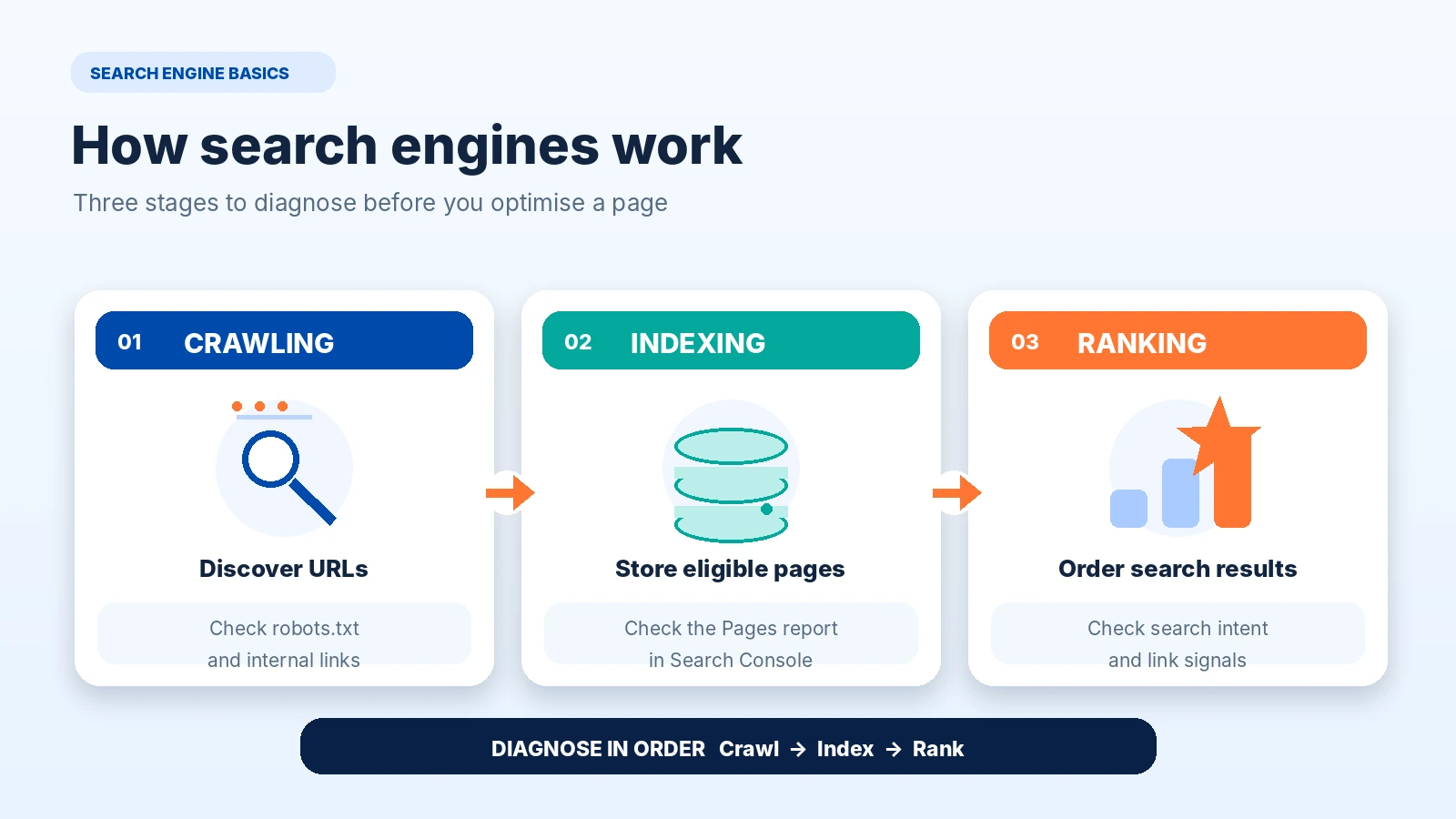
Every search result passes through three stages. Learn to diagnose each one separately.
Crawling is how bots discover pages. A page with no internal links pointing to it, or one blocked in robots.txt, may never be visited.
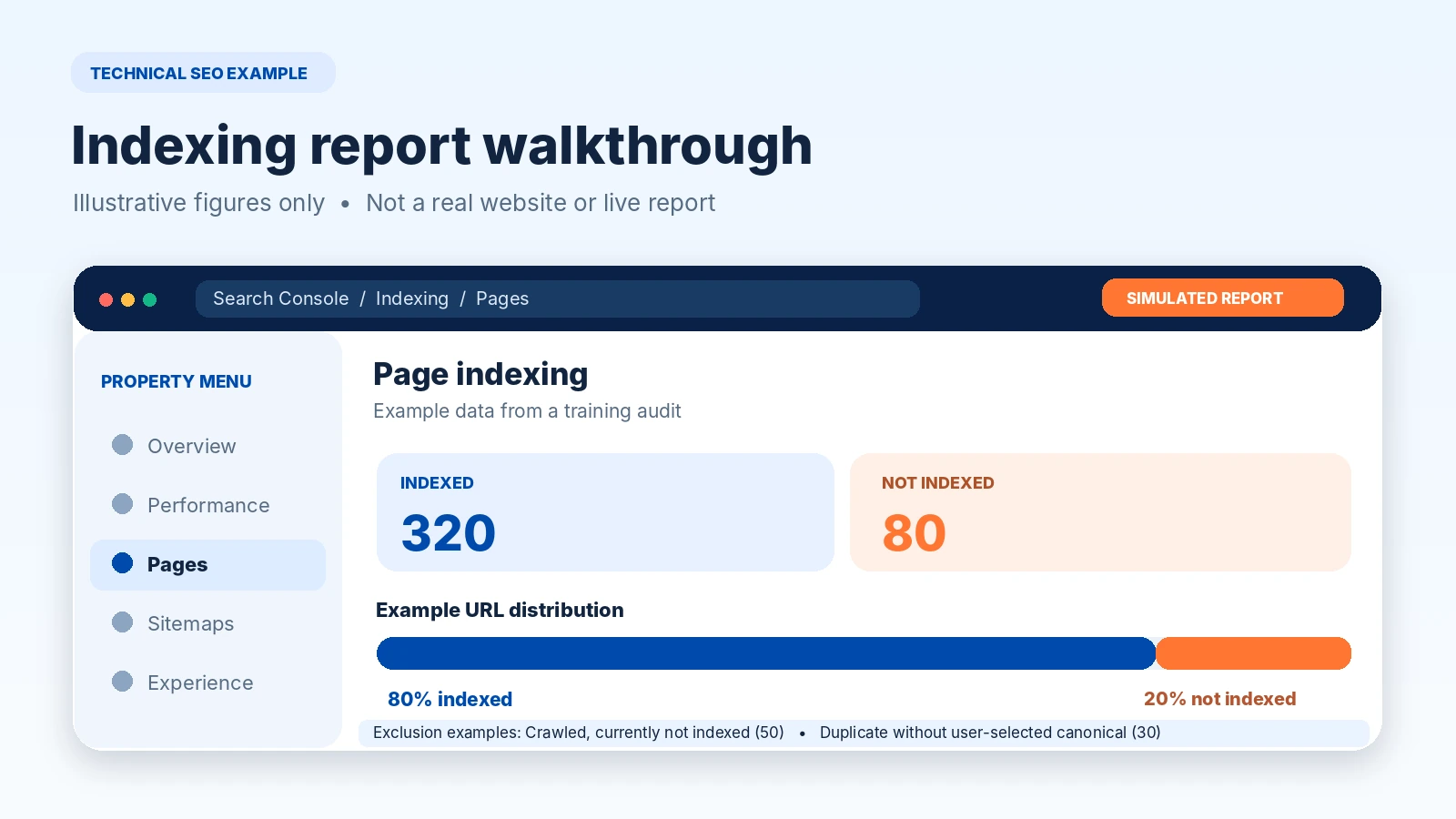
Indexing is what the search engine stores in its database. Thin content, duplicate pages, a noindex tag or a canonical tag can cause a page to be dropped. Google Search Console shows which URLs were excluded and why.
Ranking determines a page’s position among indexed pages based on how well the content matches search intent, the quality of links pointing to it, and site authority. No course can promise a specific position.
When a page underperforms, check crawling, then indexing, then ranking, in that order.
Core SEO techniques a good SEO course in Singapore should teach
- Keyword research and search intent. Find the terms your buyers use, then decide whether they want information, a comparison or a purchase.
- On-page optimisation. Align titles, headings and body copy with the chosen query, without unnatural repetition.
- Link building and digital PR. Earn links from relevant, trustworthy sites. Buying links often ends in penalties.
- Content creation should align with intent. Answer the question the searcher actually has, then measure whether they stay, click and convert.
- Technical and local SEO. Audit crawl errors, speed and indexing, and manage your Google Business Profile for Singapore searches.
If a course covers all five with live tools and a real project, it offers practical skills training. If it covers only one or two, treat it as an introduction. Look for courses that give hands-on access to SEO tools, not just slides. Strong search visibility comes from practice with those tools, not just from slides.
Top 10 SEO Course Providers in Singapore: Compare Fees, Trainers and SkillsFuture Funding
Singapore offers SEO training through specialist digital marketing academies, WSQ training centres and university continuing education programmes. Choosing the right provider means comparing more than course fees. The instructor’s practical experience, curriculum, hands-on assignments, certification, and post-course support can all affect how useful the training will be.
The following ten providers offer dedicated SEO courses or digital marketing programmes with substantial SEO content. The comparison includes direct course information links to help learners check the latest intake, fees and eligibility before enrolling.
| Training provider and course | Trainer(s) | Duration and format | Indicative course fees (SGD) | Eligibility and funding | Contact information |
|---|---|---|---|---|---|
| 1. NTUC LearningHub — SEO Fundamentals with Semrush (SF). SEO foundations, Semrush keyword research and optimisation. TGS-2024046405. | Audrey Ling and Charmaine Lee appear on NTUC’s published SEO trainer roster; assigned trainer to be confirmed. | 24 hours; confirm current class delivery and intake. | Third-party directory lists S$1,150 full / S$345 subsidised. Current prices and GST treatment must be confirmed. | Basic computer skills and English. Funding depends on eligibility and active course support. | +65 6336 5482; marketing@ntuclearninghub.com. Related official NTUC SEO programme. |
| 2. Vertical Institute — SEO Marketing Course. Covers technical audits, local SEO, keyword research, competitor analysis and SEO roadmaps. TGS-2025060161. | Danielle, listed digital marketing instructor. | 16 hours, five lessons and assessment; online/in-person depending on intake. | S$1,300 before GST; S$767 for eligible younger citizens/PRs, S$507 for eligible citizens aged 40+. | Age 21+, basic computer literacy, specified qualifications, two years’ work experience and English proficiency. SSG, SkillsFuture Credit, UTAP and PSEA. | +65 6950 7023; contact@verticalinstitute.com. |
| 3. @ASK Training — 24-Hour Search Engine Optimisation Course. Keyword research, on-page/off-page SEO, link building, GA4 and reporting. TGS-2026064598 (non-SCTP). | Assigned trainer not specified publicly. | Three days / 24 hours; classroom. | S$1,493.30 incl. GST; provider advertises S$447.99 under its 70% tier and from S$173.99 under its 90% tier. | Academic/English entry standards apply, with alternative consideration for mature candidates. SSG funding, SkillsFuture Credit, PSEA and UTAP subject to eligibility. | +65 6484 6723; WhatsApp +65 9430 3852; information@asktraining.com.sg. |
| 4. Equinet Academy — WSQ SEO, AEO & GEO Course. SEO, AI search, structured answers, content, backlinks and measurement. TGS-2019502323. | Jethro Xu and Edwin Lau, listed course trainers. | Two days / 16 hours; in-person training. | S$999 full fee; S$499.50 for its listed 50% tier, S$299.70 for its 70% tier. | Basic internet and English proficiency. Subsidies depend on citizenship, age and employer status. SkillsFuture Credit, PSEA, UTAP and SFEC may apply. | +65 6816 3016; sales WhatsApp +65 8020 9719; enquiry@equinetacademy.com. |
| 5. OOm Institute — WSQ Mastering GEO and SEO for Search Visibility. Technical SEO, local SEO, GEO, content, analytics and AI search. TGS-2023040527. | Christopher Puan and Martin Li. | Two days; onsite classroom training. | S$1,088 excl. GST; S$641.92 at the 50% funding tier, S$424.32 at the 70% tier, including GST. | Basic computer and English skills. Eligible Singapore Citizens/PRs may receive subsidies. SkillsFuture Credit, PSEA and UTAP may apply. | +65 6993 9898; enquiry.institute@oom.com.sg. |
| 6. Tertiary Courses Singapore — WSQ Enhancing Online Presence with AI Powered SEO. SEO audits, content, keywords, AI tools and reporting. TGS-2019503343. | Patrick Foo. | Two days / 16 training hours plus assessment; classroom, Zoom or corporate training. | S$817.50 incl. GST; S$442.50 at the 50% funding tier and S$292.50 at the 70% tier. | Minimum age 18, basic computer literacy, three O-Level passes including English or equivalent, and one year of experience. Funding has additional criteria. | +65 6100 0613; WhatsApp +65 8866 6375; enquiry@tertiaryinfotech.com. |
| 7. SMU Academy — Content Marketing and Search Engine Optimisation. Content strategy, search algorithms, SEO tools and analytics. Part of an SCTP Advanced Certificate. | Kwok Zhong Li and Jimmy Hung, affiliated faculty. | Three days; on campus. Next intake to be advised. | S$2,616 incl. GST; published funded fees include S$784.80, S$304.80 and from S$184.80 for qualifying support. | At least two years of work experience. Higher funding tiers and attendance conditions relate to the relevant SCTP programme. | SMU Academy course enquiry. |
| 8. SUTD Academy — Fundamentals of SEO and Web Analytics. Keyword strategy, on-page SEO, link building, analytics and practical project. Part of the ModularMaster pathway. | Ian Ong, CEO and Co-Founder of Roots Digital. | Five days, including project presentation and assessment. | S$3,815 incl. GST; S$1,907.50 at the eligible 50% tier or S$1,207.50 at the eligible 70% tier. | Funding for eligible Singapore Citizens/PRs and SME-sponsored employees. This module is not eligible for the additional S$4,000 mid-career SkillsFuture Credit. | +65 6499 7171; SUTD Academy course page. |
| 9. Heicoders Academy — DM100 Digital Marketing with AI. Includes traditional SEO, GEO, AI content, paid marketing and analytics. TGS-2025057979 (online); TGS-2025059074 (classroom). | Practitioner roster includes Beh Min Yan, Kong Yu Ning and Chan Yu Siang; confirm assigned instructor. | Published example: six three-hour Saturday classes; online or in-person. | S$1,853 incl. GST; S$1,003 for eligible younger citizens/PRs and S$663 for eligible citizens aged 40+. | Basic English and digital literacy; short pre-enrolment assessment. SkillsFuture subsidies, SkillsFuture Credit, PSEA and UTAP subject to eligibility. | +65 8801 7933; hello@heicodersacademy.com. |
| 10. CBS Training — WSQ Search Engine Optimization. Keyword research, on-page/off-page audits, backlinks, Google Analytics and SEO planning. | Assigned trainer not publicly specified. | Two days / 16 hours; classroom. Confirm current intake. | S$556.40 published full fee; exact subsidised fee and GST treatment to be confirmed. | Minimum one year of employment experience, preferably in sales/marketing, and internet literacy. SkillsFuture Credit and training support mentioned, subject to assessment and attendance conditions. | +65 6278 9785; jaslyn@cbsgroup.com.sg. |
Which SEO Training Provider Should You Choose?
For beginners looking for practical, relatively affordable SEO training, Vertical Institute, @ASK Training, and Tertiary Courses Singapore are worth comparing. NTUC LearningHub is another option for those who prefer training through an established adult education provider, but applicants should confirm availability for the specific SEO course.
Learners who want to understand how AI is changing organic search should consider Equinet Academy and OOm Institute, both of which explicitly incorporate AI search visibility and GEO into their SEO courses.
For structured, university-based training, SMU Academy and SUTD Academy offer programmes that connect SEO with content strategy, analytics and wider digital marketing concepts. Heicoders Academy is an option for learners who want SEO as part of a broader AI-enabled digital marketing skill set.
Before enrolling, ask the provider for the current syllabus, confirmed trainer, course reference number, full fee including GST, personalised subsidy breakdown, assessment requirements and upcoming training dates.
Information reviewed on 27 October 2026. Fees and subsidies are indicative. The NTUC LearningHub-specific course listing above is hosted by an independent course directory rather than on NTUC’s official registration website, and its current fee and intake could not be independently confirmed. Some other providers also require direct confirmation of upcoming intake dates or the assigned instructor. Funding eligibility varies by course and learner profile.
The SEO Course Landscape in Singapore
Most learners find SEO training in three formats, each suited to a different goal. Match the format to your next step; the same course can suit one person well while wasting another’s time. Pick the course whose content and format fit your goal, not simply the one with the most impressive title.
Benefits of taking an SEO course
Self-taught SEO often leaves gaps and no framework for diagnosing underperforming pages. A structured course teaches research, on-page work, technical checks and measurement in sequence, which employers look for. A recognised credential also helps career switchers, as hiring managers cannot quickly assess a self-taught portfolio. Entry-level SEO roles in Singapore pay about S$3,100 to S$3,700 a month, according to Glassdoor. A certificate does not guarantee a job or a salary.
Types of SEO courses available
Short workshops run for two to three days or over several weeks part-time. They suit business owners and marketers who need a refresher on technical audits. Do not expect a portfolio at the end. Fees are confirmed on enquiry.
Certificate and diploma programmes span several months and come closest to a structured career change. They offer graded assessments and, at better providers, a capstone project using real analytics data. The Addison Institute part-time diploma in digital marketing costs SGD $3,480, including GST.
Specialist technical SEO courses cover crawling, indexation, site architecture and structured data, and suit developers and web managers. One example lists a full fee of S$995.00, with fees from S$298.50 after course subsidies.
| Format | Typical duration | Fee guidance | Best-fit learner |
|---|---|---|---|
| Short workshop | 2 to 3 days, or several weeks part-time | Confirmed on enquiry | Business owners, non-specialist marketers |
| Certificate or diploma | Several months | Example: SGD $3,480 including GST (Addison Institute) | Career switchers, early-career professionals |
| Specialist technical SEO | Varies by provider | Example: full fee S$995.00 | Web developers, technical marketers |
Course formats, pre-work and post-course support
Live versus recorded. Live courses meet at fixed times with direct trainer access. Recorded courses suit self-paced learning.
Full-time versus part-time. Compare total contact hours, not just calendar length.
Pre-work. Most certificate programmes assume you can use a spreadsheet, understand basic website structure and read an analytics report. If a provider sets no prerequisites, ask how it will help a complete beginner get started.
Post-course support. This aspect is where providers differ most. Look for mentoring, an alumni community, clear certification exam rules and continued access to tools such as Semrush, Ahrefs, Google Search Console and Screaming Frog. Confirm the access period in writing before you pay. Strong post-course support also helps graduates keep their SEO skills current and improves the visibility of their new work in search results.
What WSQ is and how it differs from a degree
The Workforce Skills Qualifications (WSQ) framework focuses on workforce skills development, not academic degrees. WSQ modules are mapped to job roles, such as keyword research or on-page optimisation. A WSQ-certified SEO marketing course can help you build skills for a digital marketing role, but it doesn’t carry the standing of a university degree or guarantee a job or salary. Many working professionals take these modules as targeted, online training in specific job skills rather than as a full academic qualification. Whether a course is delivered online or in person, the modules still map to the same job skills, so check the course content for what you need, including how it covers search engine ranking. Working professionals can start by reviewing the module outlines before enrolling to learn the fundamentals of SEO.
WSQ eligibility and funding requirements
Most Singaporeans can get up to 90% off course fees with SkillsFuture, while others typically receive up to 70% funding. Treat these as ceilings, not guaranteed rates. Citizens, Permanent Residents (PRs), and LTVP+ holders are typically assessed, and the rate depends on your status and the course. SSG and providers set funding rules that change over time, so please confirm them before you enrol. Understanding these rules helps you avoid surprise costs.
Check this eligibility checklist before you enrol:
- You are a Singaporean, PR, or LTVP+ holder, and your status matches the quoted subsidy tier.
- The course is WSQ-accredited and carries a valid course code.
- You know which fees you still need to pay after the subsidy.
- You have booked and paid within the window the provider sets.
- You have the documents needed to submit your claim.
Then follow the claim process:
- Ask the provider for the course code and the subsidy rate that applies to you.
- Please confirm whether you need to claim before or after enrolment, and note the deadline.
- Book and pay within that window, keeping every receipt.
- Submit your claim with the documents the provider lists.
- Track the reimbursement and confirm the final amount you will pay.
Please ask the provider these questions before you pay:
- Is the course WSQ-accredited, with a valid course code?
- What subsidy rate applies to me, and which fees do I still need to pay?
- Do I need to book or pay before the start date to keep the subsidy?
- Which documents do I submit to claim?
SkillsFuture funding for SEO courses
SkillsFuture Credit is the base layer. Singaporeans aged 25 and above receive an initial credit of S$500, with periodic top-ups, which you can apply to eligible SEO courses. The government sets eligibility and credit amounts, which may change, so check the official SkillsFuture Singapore page before relying on them.
UTAP applies only to what remains after SkillsFuture and the WSQ subsidy. NTUC members can claim UTAP to offset 50% of remaining unfunded fees, capped at S$500 per year for members aged 40 and above and S$250 per year for members below 40. Please verify the UTAP terms on the official NTUC LearningHub page, as they may change. Understanding how each credit stacks can strengthen your digital marketing career plans.
Review the current rules on the official SkillsFuture and SSG pages, then confirm each condition:
- Are you a Singaporean or PR aged 25 or above for SkillsFuture Credit?
- Is the course listed with a valid WSQ course code?
- Are you an NTUC member for UTAP?
- If you are an NTUC member, are you aged 40 or above?
- Could you please confirm if you booked and paid within the required window?
Funding rules are set by SSG and providers. Please confirm this before you enrol.
Worked example: estimating your out-of-pocket cost
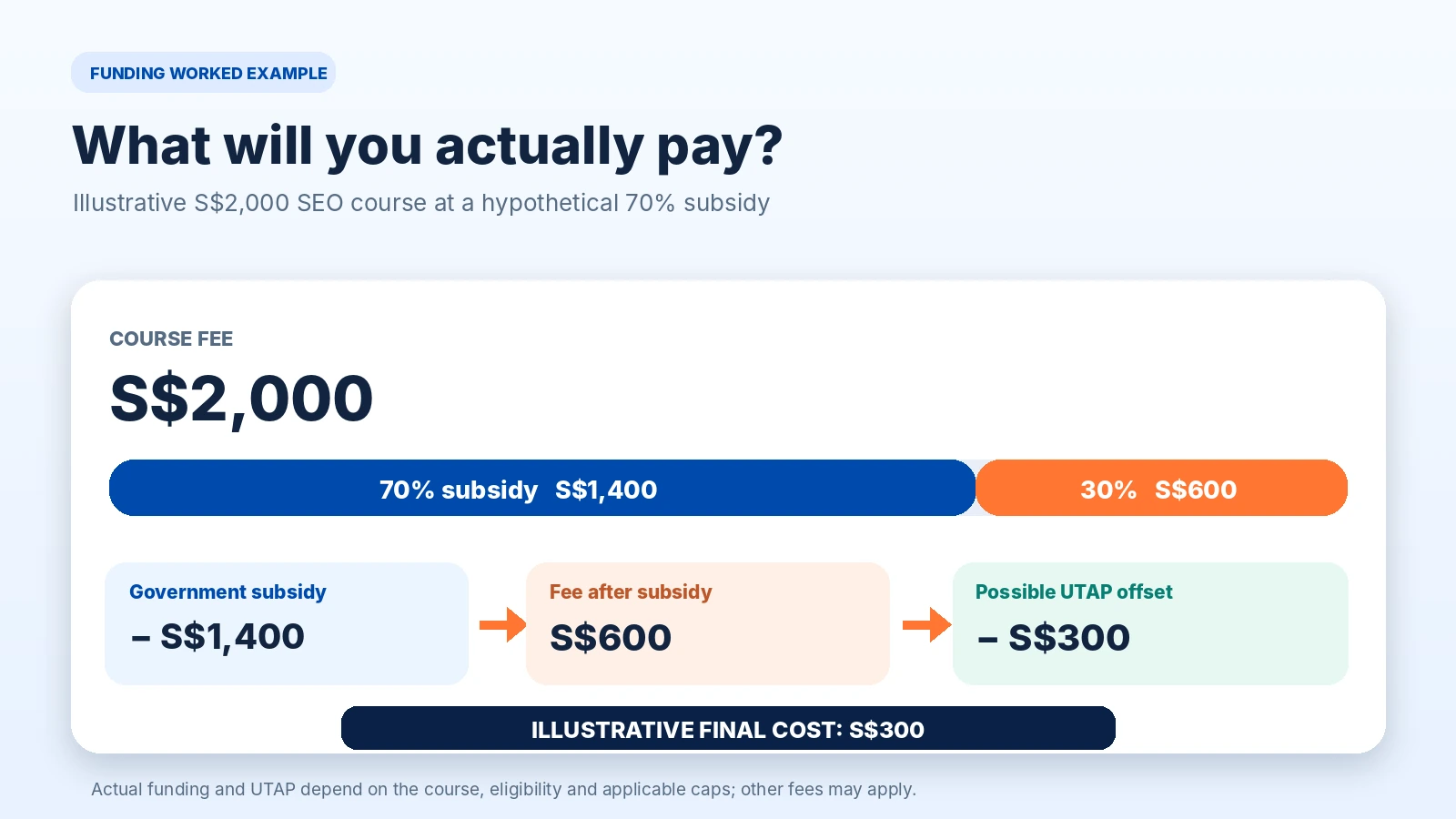
The table below shows how a course listed at S$2,000 before subsidy might work out for an eligible Singaporean. It calculates the subsidy, the remaining fee and the net cost after any UTAP offset. Confirm the subsidy rate with the provider, as it varies by course and eligibility. Use this information as a basic guide, not a quote.
| Step | Item | Example amount |
|---|---|---|
| 1 | Course fee (before subsidy) | S$2,000 |
| 2 | Subsidy rate (eligible maximum) | 70% |
| 3 | Subsidy amount | S$1,400 |
| 4 | Fee after subsidy | S$600 |
| 5 | Offset (UTAP, if you qualify) | Up to S$500 per year (members aged 40 and above) |
| 6 | Net out-of-pocket cost | As low as S$100 after offset |
Two courses with the same S$2,000 headline price can leave you paying very different amounts. Compare net cost, not the sticker price.
How to Choose an SEO Course in Singapore: Criteria and Red Flags
The best course is rarely the one with the longest syllabus. It is the one whose assessments look like the work you will actually do. Test any SEO course in Singapore against the criteria below before you pay, and use your existing understanding of search as the baseline for judging each syllabus.
Criteria for choosing a course
- Curriculum depth: Does it teach diagnosis, or only tactics? Ask for a sample module on a real site audit.
- Tool training: You should run Semrush, Ahrefs, Google Analytics, Google Search Console and Screaming Frog yourself.
- Instructor practice: Ask whether the trainer has run recent digital marketing campaigns.
- Assessment and certification: Check for a recognised WSQ statement of attainment. A live project should count for more than a quiz.
- Class size and support: Smaller cohorts provide more feedback and personal learning support.
Scoring framework for shortlisting providers
Score each course from 1 to 5 on three axes, then add the totals. Only courses scoring 12 or more should reach your shortlist.
| Axis | What to check | Score |
|---|---|---|
| Fit | Covers keyword research, technical SEO, local SEO and analytics, with a live project | 1 to 5 |
| Fund | Your net cost after checking SSG, UTAP or SFEC eligibility | 1 to 5 |
| Format | Schedule and pre-work fit your working hours, with post-course support | 1 to 5 |
Worked scoring example: An anonymised course scores 5 on Fit (covers all four skill areas with a live site project), 3 on Fund (eligible for the WSQ subsidy, but the fee after subsidy is high for your budget) and 4 on Format (evening classes and a mentor). Its total is 12, so it stays on the shortlist. A second course scores 4 on Fit, 5 on Fund and 2 on Format because it has no post-course support. Its total is 11, so it drops off, even though it is cheaper.
A subsidy only helps if the training builds skills you can use at work. The course should show you how your site’s search engine visibility will change as you apply what you learn. Before you enrol, ask the provider to show how a learner would progress from the basics to a full audit, so you can see whether the course helps you learn SEO step by step rather than just cover topics in passing.
Red flags to walk away from:
- Any provider that promises guaranteed rankings is a red flag. No provider controls Google’s results.
- No live tool access is provided during the course.
- No outcome data, such as learner placements or verifiable reviews.
- We encourage you to verify accreditation through official government channels before paying.
Core skills an SEO course should teach
- Analytics and reporting: Read Google Search Console and Google Analytics, then explain a traffic drop in plain language, using the information the tools provide.
- Keyword and competitor analysis: Map search intent, not just volume.
- Technical audits: Run a Screaming Frog crawl and prioritise fixes by their impact.
- Content briefing and measurement: Write a brief from keyword intent, then measure impressions, clicks and conversions.
If a course covers these four areas with practice rather than theory, it has passed the most important test. Check the course outline for each area before you enrol, and look for a module that places search engine optimisation within a wider digital marketing strategy.
Practical Tools Every SEO Learner Should Know
A good SEO course in Singapore puts you in front of real tools, not just slides about them. You need not master every platform before enrolling, but you should understand what each one answers. Many of these platforms offer free resources, so you can start building skills before committing to paid training. Online learning in digital marketing rewards this hands-on approach, because understanding a tool’s output matters more than memorising its menus. SEO marketing depends on reading these outputs accurately, which is why hands-on practice matters more than theory alone.
Overview of key SEO tools
Semrush and Ahrefs are the two most common platforms for keyword and backlink research. They show what people search for, how challenging a term is to rank for, and which sites link to your competitors. An SEO course should let you read these results yourself, not just hear them described.
Google Search Console shows how your website performs in Google Search: which queries bring impressions, which pages earn clicks, and whether Google has indexed them. It is free and is the closest thing to ground truth for organic visibility.
Google Analytics tracks what visitors do after they arrive. Pair it with Google Search Console to connect ranking changes to changes in traffic and enquiries.
Screaming Frog crawls your website like a search engine bot, flagging broken links, missing title tags, duplicate content, and redirect chains.
| Tool | Main use | What a course should expose you to |
|---|---|---|
| Semrush / Ahrefs | Keyword and backlink research | Keyword gap analysis, competitor backlink review |
| Google Search Console | Search performance and indexing | Query and page reports, index coverage errors |
| Google Analytics | On-site behaviour and conversions | Organic channel reports, conversion tracking |
| Screaming Frog | Technical crawl audits | Full site crawl, fixing status codes and metadata |
The test: if a course names these tools in its brochure but never has you use them on a live website, treat that as a warning sign.
A simple first-month practice plan
Work through these steps before your course starts, or during its first four weeks. Each takes a few hours, and the habits transfer directly to content creation work for any business. Learners who complete each step gain a working understanding of the tools, not just a passing familiarity.
- Set up free accounts. Create Google Search Console and Google Analytics properties for a website you own or a friend’s shop.
- Verify and wait for data. Confirm ownership in Google Search Console and submit your sitemap.
- Build one keyword list. Use the free tier of Semrush or Ahrefs, or Google’s autocomplete, to list 20 terms matching one page’s purpose. Label each with its search intent: informational, commercial or transactional.
- Crawl the website. Download the free Screaming Frog and record every broken link, missing title and duplicate page. Check the free version’s current URL limit first.
- Fix three issues. Choose the three most important technical problems, fix them, and note what you changed and why.
- Write or revise one page. Target one keyword from step 3 and match its intent.
- Read the data after 28 days. Compare impressions, clicks and average position for that page in Google Search Console, then note how those search results changed.
- Write a one-page reflection. Bring it to your course, as it shows an instructor where you need help.
If a syllabus cannot teach steps 4 to 7, it is not the practical programme you need. Look for courses in Singapore that build this kind of applied practice into every module.
Conclusion: Choosing an SEO Course That Pays Off
Choose an SEO course in Singapore based on fit, funding, and format. Score each shortlisted course from 1 to 5 on those three axes, and keep only those scoring 12 or more. Prioritise courses that teach you to diagnose and measure how search engines treat your site and how that affects its visibility. A project that audits a real website and reports a measurable change shows employers you can do SEO marketing well, so look for training that includes hands-on content work.
Confirm your subsidy, UTAP eligibility and course code, then compare the net cost. Subsidy rates and UTAP caps change over time, so check the official pages for current figures before you pay. Read the official course information carefully.
Next step: shortlist three providers, score them, and book the strongest project-based option.
Frequently Asked Questions
Is an SEO course in Singapore eligible for SkillsFuture funding?
It depends on the course, not just the provider. Look for WSQ accreditation or a listing on the SkillsFuture course directory, and confirm your own eligibility as a Singaporean or PR. Ask the provider for the course code before you enrol.
How much can I claim under WSQ funding?
Most Singaporeans can get up to 90% off course fees with SkillsFuture, while others typically get up to 70% funding. These are maximums, not automatic rates. Check the current rate on the official SkillsFuture page before you pay.
Do I need prior marketing experience before taking an SEO course?
No, but you should be comfortable with a web browser, spreadsheets, and basic analytics. Introductory courses assume no prior SEO knowledge.
How long does an SEO course in Singapore usually take?
Duration varies by provider and format. Check the course outline for hours and schedule.
What should I check before paying for an SEO course?
Verify the full fee, any applicable subsidy, and any UTAP offset if you are an NTUC member. For members aged 40 and above, UTAP can offset 50% of remaining unfunded fees, capped at S$500 per year. For members below 40, the cap is S$250 per year. Subsidy rates and caps may change, so please confirm the current figures. Could you also confirm the course code, trainer experience, and syllabus?