| AI Summary
An SEO budget covers the people, content, website changes and reporting needed to improve unpaid search performance. Singapore businesses should separate setup costs from monthly work, include staff time and development fees, and compare proposals against the same brief. The planning examples below show how different spending levels affect scope. Each budget should also include a way to track qualified enquiries, sales and profit. |
An SEO budget is the total amount a business sets aside for search engine optimisation. The amount depends on website condition, competition, content needs and business goals. A complete plan includes one-off fixes, ongoing services, internal staff time and measurement, with regular reviews of costs and results.
Key Takeaways
- Audit findings should identify which website problems need funding first.
- Package comparisons need page counts, responsibilities and delivery dates.
- Annual spending includes more than 12 monthly agency payments.
- Break-even calculations need profit figures, realistic sales assumptions and time.
- AI-search services should explain any work beyond the existing SEO scope.
- Budget reviews should connect completed work with enquiries and sales.
An SEO quote can look affordable until the missing costs appear. The audit needs a developer. New articles need staff interviews. Monthly reports show traffic, but nobody knows whether those visitors become customers.
A realistic SEO budget brings these costs together before work begins. The aim is to fund a manageable programme, understand what each payment buys and judge progress against business results.
How Much Should an SEO Budget Be?
There is no single monthly amount that suits every Singapore business. A small service website and an online shop with thousands of products need different amounts of work.
Published prices also describe different services. A fee for occasional page edits cannot be compared directly with a programme that includes writing, development and outreach.
The following figures are illustrative spending scenarios, not market averages or MediaOne quotations. They show how a business could organise its spending.
| Monthly allowance | Annual allowance | Possible focus |
| S$1,000 | S$12,000 | A small set of page improvements, with substantial work handled internally |
| S$3,000 | S$36,000 | A defined programme combining technical support, content and reporting |
| S$6,000 | S$72,000 | More pages, specialist support or several services running together |
Actual deliverables depend on supplier rates and website needs. A smaller allowance may fund a project or advisory support instead of full management.
A business choosing between SEO packages in Singapore should compare the work included before choosing a spending level. The first decision is what needs doing; the second is who will do it.
A spending limit needs a business reason
A business with limited cash should avoid committing its entire marketing allowance to work that may take time to produce returns.
An established company may have more room to fund testing, new content and technical improvements. Its larger budget still needs evidence behind each expense.
The spending limit should reflect:
- Cash available throughout the contract.
- Profit earned from each new customer.
- Capacity to serve additional customers.
- Other channels bringing in enquiries.
- Staff available to support the work.
An SEO programme can attract demand, but the business still needs enough stock, appointment slots or staff to serve it.
What Drives SEO Costs?
SEO costs rise when more research, specialist time or implementation is required. Website size is one factor, but page count alone does not describe the job.
A 30-page website with broken forms and blocked service pages may need more urgent work than a larger, well-maintained site.
Website condition and access
Technical work checks whether search engines can reach and understand important pages. Repairs may involve redirects, website templates, internal links or server settings.
The proposal should distinguish between identifying a problem and repairing it. An audit fee may cover the report without including development.
Website access also affects delivery. A provider cannot publish changes promptly if every edit waits several weeks for another supplier.
Competition and customer searches
A business targeting a broad term such as “accounting services Singapore” may face established companies with extensive websites. A specialist targeting a narrower service may need fewer pages, although a smaller audience also limits potential demand.
Keyword analysis connects customer searches with the services a business sells. Search volume alone does not show whether a keyword will bring suitable customers.
Content, locations and languages
Content costs include research, interviews, writing, editing and publishing. Existing pages may need repairs before the business adds more articles.
Several locations create extra work when each branch needs accurate details and distinct local information. Additional languages require research and editing for those audiences.
The scope should identify:
- Existing pages needing updates.
- New service or product pages.
- Supporting articles and comparisons.
- Location information.
- Language versions and reviewers.
A translation budget also needs someone who can check local meaning, terminology and customer expectations.
How SEO Pricing Models Work
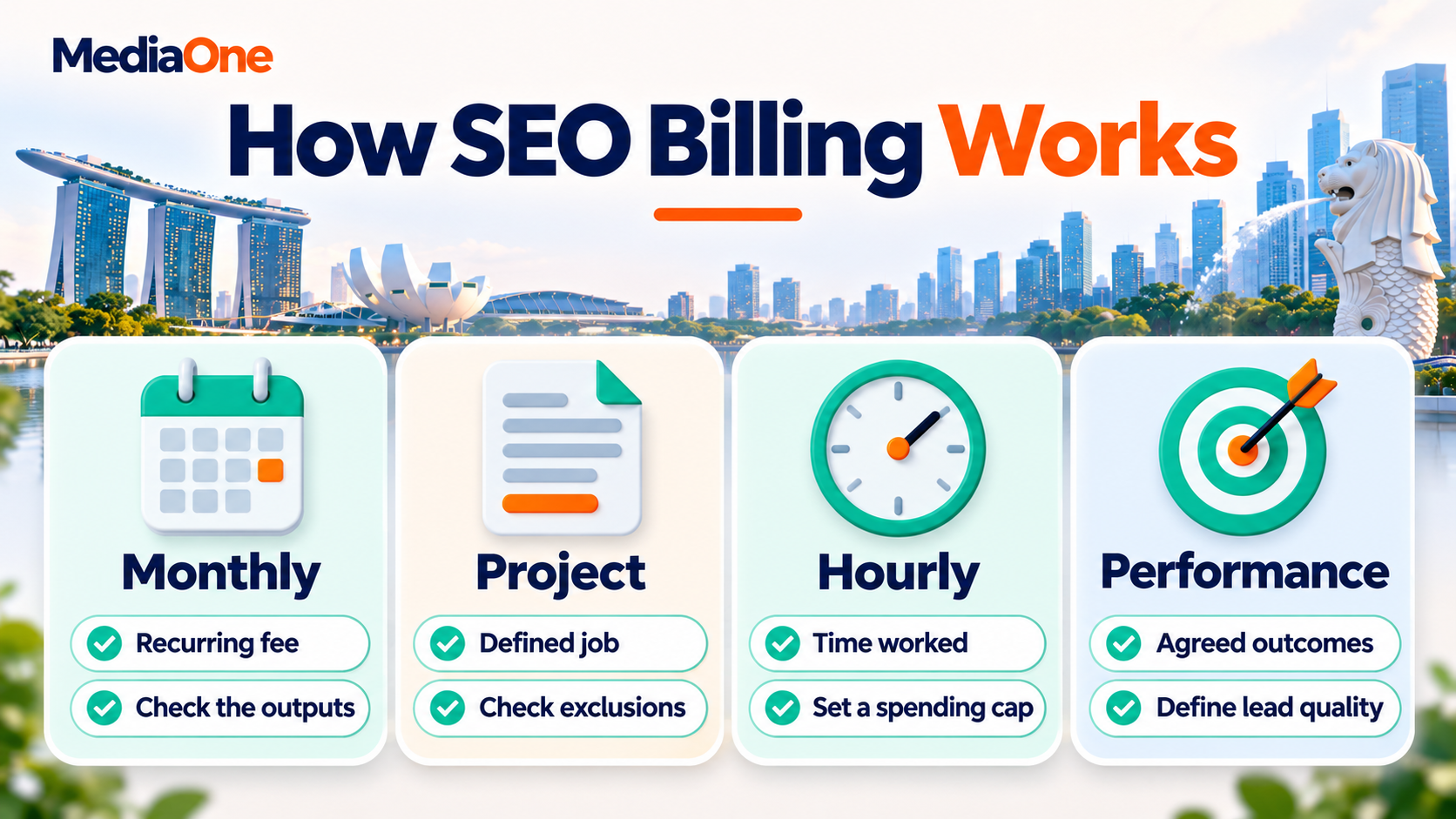
SEO providers can charge by month, project, hour or agreed outcome. Each model changes how the business controls costs.
The billing model should match the task and the amount of ongoing support required.
| Pricing model | How payment works | Suitable situation | Budget concern |
| Monthly retainer | A recurring fee covers agreed work | Regular content, monitoring and improvements | Monthly outputs may be vague |
| Fixed project | One price covers a defined job | An audit, migration or page overhaul | Additional work may need another quote |
| Hourly support | Payment covers recorded time | Advice or a limited technical problem | Costs can rise without an agreed cap |
| Performance-linked | Some payment depends on agreed results | Work with reliable outcome tracking | Disputes over lead quality or attribution |
A fixed project needs acceptance criteria: the conditions that show the work is complete. Hourly support needs a spending cap and approval process.
Performance-linked agreements need especially careful definitions. A form submission is not automatically a qualified lead, and a ranking increase is not a sale.
A low price needs a scope check
A low fee can suit a small task. Problems arise when the proposal suggests full support while leaving essential work unfunded.
A package may include recommendations but no implementation. Another may include articles while excluding interviews, editing or publishing. The comparison should focus on what the business receives, which tasks remain internal and how much those tasks will cost.
What Should an SEO Budget Include?
A complete SEO budget covers delivery as well as advice. Each cost should connect to an output, a responsible person and an expected delivery date.
The following components help prevent expenses from disappearing between suppliers.
| Budget component | What it can cover | Evidence of delivery |
| Initial assessment | Technical checks, content review and baseline data | Prioritised findings |
| Website implementation | Approved repairs and page changes | Live changes and test results |
| Search research | Customer questions and page targeting | Research linked to named pages |
| Content | Briefs, writing, editing and updates | Approved, published pages |
| Local search | Business details and location content | Accurate profiles and pages |
| Outreach | Research and contact with relevant publishers | Outreach records and earned coverage |
| Measurement | Tracking setup and performance reviews | Tested tracking and readable reports |
Content production and upkeep
Different SEO content types serve different customer needs. A buyer comparing services may need a comparison page; someone ready to enquire may need a detailed service page.
The content allowance should cover the complete publishing process. A writing-only quote may leave image sourcing, uploading and quality checks to the client.
Google’s people-first content criteria emphasise original value, reliable information and content created for readers. Article quantity alone does not establish quality.
A smaller number of well-researched pages can be a sensible starting point when staff have limited review time. SEO content writing needs enough budget for accurate explanations and examples.
Local search and outreach
Local work may include business hours, service details, photos and location pages. Google identifies relevance, distance and prominence as the main local ranking factors. Payment cannot remove the distance between a business and a searcher.
Outreach spending should pay for research, relationships and content worth covering. A promised bundle of paid ranking links creates a different risk.
Google’s link spam policies prohibit buying links to manipulate rankings. Advertising and sponsorship links need appropriate link attributes, such as sponsored or nofollow.
How to Build an SEO Budget From Your Website’s Needs
A practical budget starts with a short brief. The document should describe the business goal, current website problems, available staff and spending limit.
The same brief gives competing providers a common starting point. It also reduces the chance that each quote describes a different job.
Step 1: Define the business outcome
A goal such as “more traffic” leaves too much unanswered. A stronger goal identifies the type of customer and the action the business wants.
For example, a commercial cleaning company could aim to increase enquiries from office managers. Its tracking should separate those enquiries from job applications and residential requests.
The baseline should record current qualified enquiries, sales and profit where records allow.
Step 2: Rate the work required
The following scope matrix is a planning aid, not a price calculator. Its purpose is to identify where specialist time will go.
| Area | Lower workload | Higher workload |
| Technical condition | A few isolated faults | Template, indexing or migration problems |
| Content | Existing pages need edits | Many missing or outdated pages |
| Market coverage | One service area and language | Several markets or languages |
| Publishing | Staff can upload and review | Supplier handles the full process |
| Measurement | Reliable tracking exists | Tracking needs setup and testing |
A website can score low in one area and high in another. The budget should reflect that mix.
Step 3: Name the first deliverables
The first phase should identify a limited set of outputs. For example:
- A tested enquiry form and tracking setup.
- Repairs to important pages that search engines cannot access.
- Updates to three priority service pages.
- Research for the next content batch.
- A report explaining completed work and early signals.
A fixed initial scope makes the first review easier. Both parties can see what was promised and what reached the website.
Step 4: Add ownership and dependencies
Every task needs an owner. The brief should state who supplies business information, approves wording, makes technical changes and publishes pages.
Dependencies need dates too. A writer may finish a draft on time while publication waits for missing service details.
A schedule should allow for staff availability. Five articles awaiting approval provide less immediate value than two approved pages that customers can use.

How to Calculate the Full Annual Cost
Monthly fees are only one part of annual spending. Setup, development, tools and internal time can change the total substantially.
A basic calculation is:
Annual SEO cost = setup costs + recurring fees + additional delivery costs + internal staff cost
An illustrative annual plan might look like this:
| Cost item | Calculation | Annual amount |
| Initial assessment | One-off | S$2,000 |
| Monthly programme | S$2,500 × 12 | S$30,000 |
| Separate development | Agreed allowance | S$3,000 |
| Internal coordination | 4 hours × S$50 × 12 | S$2,400 |
| Planned total | Before applicable GST | S$37,400 |
These amounts are invented for planning. Actual quotes may include several items within one fee.
The internal hourly amount represents a business estimate of staff cost. It does not mean an employee receives that amount as wages.
GST and payment timing
Singapore’s current GST rate is 9%. A GST-registered supplier generally charges GST on taxable local services. A S$2,500 fee excluding GST becomes S$2,725 when 9% applies.
The cash plan should show when invoices fall due, including deposits and annual subscriptions. Accounting treatment and any recoverable GST belong in a separate calculation.
Unexpected work needs a rule
An extra-cost policy helps control spending when the audit finds something unexpected.
The agreement can require a written description, price and approval before additional work begins. A reserve can cover approved surprises, but its size should reflect the website’s condition.
A contingency allowance should not become permission for unspecified monthly charges.
Does AI Search Need a Separate Budget?
AI-search work does not automatically require a second programme. Some proposed tasks already belong within technical SEO, content editing or business information management.
Google states that AI Overviews and AI Mode need no special optimisation or additional technical requirements beyond the relevant search fundamentals. Google also identifies no special schema markup required for inclusion.
A separate allowance can still cover additional work, such as testing business questions across AI platforms, recording citations or correcting inaccurate public information.
The proposal should explain:
- Which platforms the work covers.
- Which questions the team will monitor.
- How often checks will happen.
- What changes the supplier will make.
- Which tasks the existing fee already includes.
An AI visibility report describes observations from particular tests. It cannot establish that every user receives the same answer.
The business should also distinguish mentions from visits and sales. An answer that names the company may create awareness without producing a measurable website enquiry.
How to Test Whether the SEO Budget Can Pay Back
A payback test asks whether additional profit can cover the cost. Revenue alone gives an incomplete picture because the business still pays to deliver each sale.
A service business can estimate the contribution from new customers: sales income minus the direct costs of serving them.
Start with profit per customer
The following example is hypothetical:
- Average new sale: S$2,000.
- Direct delivery costs: S$1,200.
- Contribution per sale: S$800.
- Qualified enquiry-to-sale rate: 20%.
- Expected contribution per qualified enquiry: S$160.
The final figure comes from S$800 multiplied by 20%. It represents an average across qualified enquiries, including those that do not become customers.
A S$3,000 monthly programme would need about 19 additional qualified enquiries per month to cover that recurring fee under these assumptions.
Separate monthly break-even from total payback
Monthly break-even means the additional contribution covers that month’s spending. Total payback means cumulative additional contribution has covered all spending to date.
Suppose a business spends S$3,000 each month and earns no additional contribution during the first three months. From month four, it earns S$5,000 in additional monthly contribution while spending continues.
| Period | Cumulative cost | Cumulative additional contribution | Balance |
| End of month 3 | S$9,000 | S$0 | −S$9,000 |
| End of month 6 | S$18,000 | S$15,000 | −S$3,000 |
| End of month 8 | S$24,000 | S$25,000 | S$1,000 |
The example reaches payback during month eight. It is a calculation, not an expected SEO timeline.
Test weaker results too
A forecast should include a cautious version. Fewer enquiries, lower sales conversion or higher delivery costs can all delay payback.
The spending decision should also consider how long customers take to buy. An enquiry received today may produce a sale several months later.
A calculator helps compare assumptions. It cannot predict rankings, demand or customer behaviour.
How to Compare SEO Quotes Without Missing Costs
A common brief makes price comparisons more reliable. Each supplier should state the work included, the exclusions and the cost of extra requests.
A provider can reasonably charge a combined monthly fee. The business still needs enough detail to understand the allocation of work.
The following scorecard supports choosing an SEO agency. Each row can receive one point for sufficient evidence and zero when details are missing.
| Criterion | Evidence to request |
| Relevant scope | Tasks linked to the website’s actual problems |
| Named outputs | Page counts, repairs and delivery dates |
| Implementation | Responsibility for making changes |
| Measurement | Agreed lead definitions and reporting |
| Working relationship | Review process and main contact |
| Handover | Access, files and responsibilities at contract end |
A high score does not prove quality. It shows whether the proposal contains enough information for a decision.
Google’s advice on hiring an SEO supports checking proposed methods and avoiding providers that guarantee first-place rankings. Google also states that advertising does not improve organic placement.
A sample comparison
Provider A quotes S$2,000 monthly but excludes writing and development. Provider B quotes S$2,800 and includes two page updates plus limited implementation. The cheaper fee could still produce a larger total bill once missing work is added.
The business should price the same agreed tasks under both proposals. Any remaining difference can then be assessed against experience, capacity and service quality.

How to Review Spending and Results
SEO budget reviews need two views: whether the team delivered the agreed work and whether business performance improved.
A completed task does not prove a commercial return. Equally, a sales increase does not prove that SEO caused all of it.
A reporting structure built around data-driven SEO connects activity, website behaviour and business records.
| Review area | What to examine | What it helps explain |
| Delivery | Repairs, edits and pages published | Whether agreed work happened |
| Search visibility | Relevant queries and impressions | Whether target pages appear |
| Website visits | Search clicks and landing pages | Whether visibility brings visitors |
| Enquiries | Valid calls, forms and bookings | Whether visitors take action |
| Sales | Qualified leads, customers and contribution | Whether spending supports the business |
Google’s Search Console Performance report provides clicks, impressions, click-through rate and average position. Those figures describe search performance, not completed sales.
Google Analytics supports recommended events, including generate_lead for an information request and purchase for a purchase. Implementation and testing are needed before relying on these records.
Budget decisions should follow the problem
Different results call for different responses:
- Work remains unpublished: approval or implementation delays need attention.
- Visits rise but enquiries do not: page content, forms and visitor intent need review.
- Enquiries rise but sales do not: lead quality and sales follow-up need checking.
- Results improve profitably: additional work can be priced and tested.
- Spending exceeds the limit: lower-priority tasks can move to a later phase.
Monthly delivery checks and scheduled commercial reviews create space for these decisions. Each review should record the next action, owner and cost.
Build an SEO Budget Around Work You Can Measure
An SEO budget becomes easier to manage when each cost has a purpose, an owner and a review date. The strongest spending plan connects website repairs and content with qualified enquiries, sales and the cash available to fund the programme.
MediaOne’s SEO services provide a starting point for discussing the website, target customers and required support. A brief containing those details gives the team a basis for a scoped proposal and an informed budget conversation.
Frequently Asked Questions
Does pausing SEO erase the work already completed?
A pause does not automatically remove published pages or completed repairs. Performance can still change as competitors publish, information becomes outdated or website faults develop. A pause plan should identify who handles essential maintenance and which activities stop.
Is SEO software compulsory for a small business?
Paid software is not compulsory for every business. Google Search Console and Google Analytics can cover several measurement needs. Specialist tools may support larger research or audit tasks. A supplier should explain any separately billed subscriptions and who retains access.
How should a seasonal business schedule SEO spending?
A seasonal business should allow time for research, production, approval and publication before its busy period. Previous sales and search records can help identify that period. A schedule built backwards from customer demand reduces the risk of publishing after buyers have started shopping.
Should an ecommerce budget include product photography?
Product photography belongs in the budget when the planned pages need new images. It may sit under ecommerce or creative spending instead of the SEO supplier’s fee. The project estimate should still identify it so missing images do not delay publication.
Several departments can share a cost when the improvement supports their work. A faster template or better product page may support search, advertising and sales. One budget owner should record the full expense so the business does not count the same cost twice.