Most property buyers in Singapore now start their search on a phone, often well before they contact an agent. Local search visibility is therefore a practical concern for any property business: if your listings, neighbourhood pages and Google Business Profile do not appear when a buyer types “condo near Bukit Timah MRT”, you are competing for a lead that never reaches you.
This guide covers how real estate local SEO works in practice. It explains the ranking factors behind local visibility, how to set up and maintain your Google Business Profile, how to build district and neighbourhood pages, and the technical and reputation basics that decide whether a visitor stays. Each section gives steps you can apply this week.
Local SEO is not a shrunken version of national SEO. A buyer looking for a three-bedroom condo near a particular MRT station is not browsing for “real estate” in the abstract. They are searching a neighbourhood, a price band and a set of trade-offs, often on a phone. Our local seo agency works on exactly this gap, but you can start with the basics yourself.
Key Takeaways
- Local rankings depend on three factors: relevance to the search, distance from the searcher, and prominence across reviews, citations and links. Relevance and prominence are largely within your control.
- Many buyers start online: a weak local presence means enquiries are lost before the first conversation takes place.
- Mobile comes first: pages must load quickly and read well on a phone, since mobile use accounts for a large share of property searches.
- Speed affects enquiries: pages that took longer than 1 second to load experienced a 27% decrease in conversion rate, so slow pages leave potential enquiries unrealised.
- Budget realistically: SEO services in Singapore typically cost S$300 to over S$3,000 per month, and consistent execution over 90 days matters more than any single fix.
Table of Contents
Local SEO Fundamentals for Property Businesses
Traditional SEO aims to rank a page for a topic across a whole country. Local SEO aims to put your business in front of someone searching near a specific place. The goal is usually a spot in the Map Pack (the cluster of three businesses Google shows beneath a map) and in local results for queries such as “condo agent Bukit Timah”.
Three things separate the two. The ranking signals include the searcher’s location and your service-area presence. The main asset is often a Google Business Profile rather than a web page, so profile accuracy matters as much as on-site content. The conversion path is also shorter, since a local searcher is more likely to call, message or visit soon after searching.
A national article on property trends may rank well and still bring you no enquiries. A plain, accurate profile and one well-built neighbourhood page can produce them. Start with the local basics before investing in broad content.
Why Local Search Matters to Singapore Property Buyers
Prospective buyers and tenants typically research properties before making contact. A person viewing a showflat or passing a development is often searching for the nearest agent or the district’s latest launches on a phone.
That behaviour rewards agents who appear for district and estate queries. An agent who only ranks for “property agent Singapore” competes with portals and large agencies. An agent who ranks for the estate a buyer is looking at can win the enquiry at the moment intent is strongest.
The gains are practical. Local visibility brings enquiries from people already close to a decision. It also builds an asset you own: a profile, reviews and location pages that keep working between listings. Prospects who see consistent reviews and accurate contact details before they call are more likely to trust the first conversation.

How Local Ranking Factors Apply to Property
Local search weighs three things: relevance, distance and prominence. Each behaves differently in property. Relevance is the part you control most, distance is the part you control least, and prominence is where many agents underinvest.
Relevance: matching listings, neighbourhood pages and keywords to intent
Relevance is how well your profile and website match what a searcher wants. A buyer typing “condo for sale near Bukit Timah MRT” wants a specific estate, a price band and a transaction type. If your site only says “Singapore property specialist”, it will not match that query.
To improve relevance:
- Map each district or estate you serve to a page that answers the question behind the search, with its name in the title, headings and first paragraph.
- Include the estate, tenure and unit type in listing page titles, not just a project code.
- Use the same vocabulary across your Google Business Profile categories and services, so searchers, crawlers and map results describe you consistently.
Distance: what you can and cannot control
Distance is the gap between the searcher and your business location, measured from the searcher’s position at the moment of search. You cannot move your office closer to every buyer, and many agents work from home or a shared office, where distance is fixed.

What you can control is the service area you declare. If you serve buyers across the East and Central regions, say so, rather than tying the profile to one postcode. Distance matters most for “near me” and map-pack queries, and less for queries that name an estate directly. Chasing distance is therefore a poor use of effort.
Prominence: reviews, citations and local backlinks
Prominence is how well-known your business is across the web. Three signals drive it: the volume and quality of reviews, consistent citations across directories, and links from local sites such as neighbourhood associations, condo management corporations, community news and local business groups.
Reviews carry the most weight for most agents, because buyers read them as well as Google does. Citations confirm that your name, address and phone number match across directories. Backlinks from local, relevant sites take more effort to earn but last longer. One link from a respected estate guide or local news site can carry more weight than many generic directory listings.
Local keyword research and placement for property searches
Start with the questions buyers ask, not the keywords you wish they used. Use Google’s search suggestions, the “People also ask” panel and your own enquiry emails. Property searches are highly specific, so long-tail phrases dominate: “freehold condo near Tanjong Pagar with 2 bedrooms” matches intent and conversion more closely than “property agent Singapore”. Around 70% of Google searches are long-tail queries, according to AgentFire.
Place each target phrase where it does work: the primary phrase for the page, one related phrase in the title, and natural variants in subheadings and the first 100 words. Do not repeat the phrase to force a match. A page that reads clearly to a buyer will usually carry the right terms without forcing.
Setting Up and Optimisation of Your Google Business Profile
Your Google Business Profile is often the first thing a buyer sees when they search “condo agent near me” or “HDB resale agent Toa Payoh”. It appears in the Map Pack, above organic listings, so a thin or neglected profile can quietly cost you enquiries. Treat it as a live listing for your business, not a directory entry you filled in once.
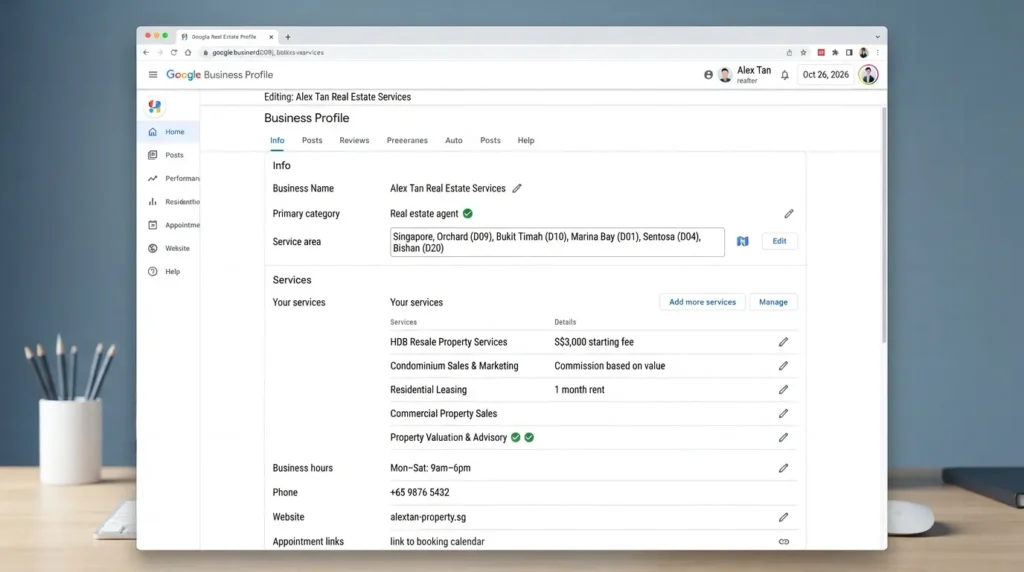
Google Business Profile optimisation checklist
Work through these in order, because the early items carry the most weight:
- Use your real business name. Keyword-stuffed names such as “Best Condo Agent Singapore” breach Google’s Business Profile guidelines and risk suspension.
- Pick the most specific primary category. Choose “Real estate agency” or “Real estate agent” as primary, and add secondary categories only where they describe services you actually provide.
- Complete every attribute and service. List the property types you handle (HDB, condo, landed, commercial) and the transactions you offer (buying, selling, leasing).
- Write a description that explains who you serve. Name the districts and property types you specialise in, in plain sentences.
- Upload current photos. Add your office, team and recent listing photography, and refresh them every quarter.
- Use posts and Q&A. Publish updates about new launches or market notes, and answer common questions before buyers ask them.
Service area configuration for agents who work across regions
An agent who operates from one office but covers the whole island faces a choice. A business with a staffed storefront should show its address. An agent who meets clients at their homes or in showflats may qualify for a service-area business setting, where the address is hidden and the regions served are listed instead.
Be precise. List the districts you genuinely transact in, not all 28 districts under the traditional postal district system. A profile claiming coverage you cannot deliver generates poor reviews and wasted leads. Revisit the list each time your territory changes.
Citations and NAP consistency across directories
A citation is any online mention of your business name, address and phone number. Together these three details are called NAP (name, address, phone). Search engines compare them across the web to confirm that your business is real and located where you say. Inconsistencies, such as “Pte Ltd” on one site and “Private Limited” on another, or an old office address on a forgotten directory, weaken that confidence.
Start with a single master record and copy it exactly everywhere. Audit the major Singapore and property directories, claim duplicate listings and correct them. Review citations at least twice a year, and again whenever you move office or change your phone number.
Neighbourhood and Location Page Strategy
Location pages are where many property businesses lose local search traffic. A single “Singapore condo agent” page competes with every major portal in the market. A page built around one district, one development cluster or one buyer question has a better chance of ranking, particularly where portal coverage is thin.
Building pages that target estate and district queries
Build one page for each district or estate you actively sell in, not one per postal code. Each page should answer the questions prospective buyers typically ask before making contact: price bands, tenure, transport access, and the balance between new launches and resale stock. Pages that only list active units rarely rank, because they repeat portal content.
Keep each page grounded in your own transaction knowledge. State the number of units you have closed in the estate, the typical time on market, and the recent price movements your business has recorded. Date every figure. If you cite a market statistic, name its source and link to the published dataset.
Using long-tail property queries: a content example
The district development guide is a useful format. A page titled “Top 5 Condo Developments in Bukit Timah” targets users searching for properties in that specific area. Before publishing, state the selection criteria used to choose the five developments and disclose any commercial relationship your business has with any featured development. Structure the page as follows:
- A one-paragraph answer stating which developments you cover and the criteria used to select them.
- A comparison table with columns for tenure, total units, nearest MRT and launch or TOP year.
- A short section for each development covering layout mix, resident feedback where it is documented, and the type of buyer it suits.
- A closing section on what the district lacks. Balanced coverage of this kind builds trust.
Update the page when a new launch or a TOP date changes, and add a dated “last reviewed” line so that readers and search engines can see it is current.
This content is general information only. It is not property or investment advice. Readers should seek professional advice before making a purchasing decision.
Site architecture and internal linking between listings and location pages
Organise the site so that location pages sit one click from the homepage and link down to individual listings. Each listing page should link back to its district page using descriptive anchor text, such as “more Bukit Timah condos”, rather than “click here”.
Link each location page to two or three related guides, such as a buyer’s checklist or a financing explainer, so that authority flows through the site. Avoid orphaned listings that no page links to. Avoid near-identical location pages that compete with each other for the same query.
A complete district guide also needs a clear structure. Use one H2 for the district overview, one for the comparison table, one for the development sections and one for the closing section. End with a short checklist that the reader can use to compare options. This helps both human readers and search engines identify what each page is about.
Speed, Mobile and Technical Basics
Most local traffic arrives on a phone, so technical problems cost enquiries directly. Pages that take longer than 3 seconds to load lose a large share of visitors before they finish, according to AgentFire, and pages that took longer than 1 second to load experienced a 27% decrease in conversion rate. Mobile performance is therefore a core requirement, not an optional extra.
Image weight and file formats
Image weight is the most common fix. Serve images in WebP rather than JPEG, which can reduce file size by 25% to 34%, according to guidance from namesilo.com. Compress listing photos before upload and lazy-load images lower on the page so they load only when a visitor scrolls to them.
Core Web Vitals and template testing
Test each key page template against Core Web Vitals, which measure loading speed, responsiveness and visual stability. Check the largest content element, input delay and layout shifts on a mid-range phone using a mobile connection, not only on your office Wi-Fi. Re-test after each change, because a new photo or script can slow a page that was previously fast.
URL structure and internal links
Keep URLs short and descriptive, using the district or development name rather than a string of numbers. Link from each listing to its district page and from each district page to the relevant listings, as described in the location page section above. This helps search engines understand how the site is organised and gives visitors a clear path between general and specific pages.
Reviews, Reputation and Trust
Buyers and tenants usually check an agent’s reputation before making contact. Nearly 90% of consumers read online reviews before purchasing, so reviews act as a conversion asset rather than a vanity metric. Ask every closed client for a review within a week of completion. Make the request simple by including a direct link, and reply to every review, positive or negative. Keep replies factual and free of client details.
Generating reviews consistently
Build review requests into your closing process rather than relying on clients to remember. Send one reminder if the client has not responded, and do not offer incentives that could breach Google’s review policies.
Responding to reviews
Respond to positive reviews by thanking the client and naming the district or property type where appropriate. Respond to negative reviews calmly, acknowledge the concern, and invite the client to continue the conversation offline. A consistent response pattern signals that the business takes feedback seriously.
Reputation also feeds prominence. Reviews that name the district and property type a client transacted in help your profile match local queries, provided the client is comfortable sharing those details.
Measuring Progress and Budgeting
Track three measures each week: Google Business Profile calls, direction requests and website enquiries. Note which pages generate those actions, and compare rankings for your target district queries at day 30, day 60 and day 90. Ranking alone tells you little if it does not produce enquiries.
On budget, SEO services in Singapore typically cost S$300 to over S$3,000 per month, depending on the scope of work, agency expertise and level of competition in your market, according to oom.com.sg. Consistent execution over 90 days matters more than any single fix, so commit to a plan you can sustain rather than a burst of spending you cannot maintain.
Conclusion and Next Steps
Property businesses that struggle with local search usually lack sequence rather than effort. They post a few listings, ask for a review now and then, and wait for enquiries. A 90-day plan sets the order of work: fix the foundations first, then build the signals that Google and AI answer engines use to decide which businesses to recommend.
A 90-day local SEO action plan for property businesses
Days 1 to 30: audit and fix the basics
- Claim and verify your Google Business Profile, then complete every field: primary category, service areas, hours, photos and a description that names the districts you cover.
- Write your business name, address and phone number (NAP, the consistent listing details used across the web) exactly as you want them displayed. Check them against your website footer, social profiles and the main property portals.
- Test your site on a mobile device. Check that pages load in under three seconds.
- Convert images to WebP where your platform supports it, following the file-size guidance above.
Days 31 to 60: build relevance and reputation
- Publish two or three district or estate guides, such as a condo development guide for one area. Answer the questions a buyer actually types.
- Link each guide to relevant listings and to your agent profile pages, using descriptive anchor text.
- Set a review routine: ask every closed client for a review within one week of completion, and send a single reminder if they have not replied.
- Reply to every review within 48 hours, including negative ones.
Days 61 to 90: earn prominence and measure
- Pursue three to five local links from sources you have a real relationship with, such as neighbourhood associations, local news or industry directories.
- Track Google Business Profile calls, direction requests and website enquiries each week in one simple sheet.
- Compare rankings for your target district queries at day 30, day 60 and day 90, and note which pages drive enquiries.
- Decide at day 90 whether to keep the plan in-house or hand ongoing work to [confirm: named local SEO provider] or a specialist such as our local seo agency.
Expect the first results in the second month, and treat day 90 as a checkpoint rather than a finish line. Local rankings compound once reviews, content and citations work together.
Frequently Asked Questions
How long does real estate local SEO take to show results?
Timelines depend on how competitive your districts are, how complete your profile is when you start, and how consistently you publish and collect reviews. Google Business Profile fixes can shift visibility within weeks, while content and link work compounds more slowly. Results are confirmed on enquiry.
Do I need a Google Business Profile if I work from home?
Yes, though the setup differs. Google allows service-area businesses to hide their home address and show only the regions they serve. Listing your service areas lets you appear in searches from those neighbourhoods without a public storefront. Skipping the profile means giving up the map pack for property searches, where buyers often make their first contact.
How many reviews do I need to rank in my area?
There is no fixed number, because ranking depends on how your review count, rating and recency compare with agents competing for the same searches. A steady flow of genuine reviews matters more than a large total. A profile with a few dozen recent reviews often outperforms one with hundreds of old ones.
Are local backlinks worth the effort for property agents?
They can be, when the links come from relevant local sources such as neighbourhood associations, community sites, local news features or partner businesses such as mortgage brokers and renovation firms. Each one can support prominence, one of the three local ranking factors. Avoid paid directory schemes and link exchanges, which carry risk without adding real visibility.
Can I target several districts from one website?
Yes, but each district needs its own dedicated page with specific local content, such as amenities, transport links and recent transactions, rather than a single generic page listing areas. Thin pages that swap only the district name tend to be ignored, so invest in genuine local detail for each area you actively serve.