Search agency work is growing. According to Qoulomb, SEO services will grow from $78.5 billion in 2026 to $112.3 billion by 2033, a 5.2% CAGR. This is an annual growth rate, not a single headline figure to plan around.

Many Singapore SMEs hire an outside SEO team, pay for monthly reports, and still see little change in enquiries. More spending does not guarantee results. The cause is usually not the partner’s skill. It depends on whether the business can act on what the partner delivers and whether its internal tools and company processes are ready to use it. Hiring a partner does not replace internal ownership of keyword research or the marketing decisions that follow.

This guide explains when you should outsource SEO, what it costs in $, and how to pick and manage a partner. It also sets out a readiness scorecard you can run before you sign anything. Our working view is that one internal owner matters more than the partner’s skill. In our view, the readiness threshold is a practitioner heuristic, not a measured rule: two or more gaps in ownership, access, implementation capacity, targets, or budget mean fixing those first. At that point, a full outsourced retainer is unlikely to pay off.
Key Takeaways
- Outsource execution while keeping strategy in-house. Audits, technical fixes, link building and content production transfer well. Keep strategy, brand voice and conversion decisions in-house.
- Check your internal owner first. Without someone with the time, access, and authority to act on recommendations, outsourcing wastes budget, regardless of the partner’s skill.
- Compare the true cost. Salary benchmarks vary by market. ZipRecruiter places the average annual pay for an SEO specialist at $67,388 (2025 data), and freelancer rates depend on location and expertise.
- Match the model to the budget. Fixed-fee project work, such as a one-time technical audit or content overhaul, typically runs $2,000 to $10,000 in Singapore. Ongoing retainers vary with scope.
- Score your readiness. Two or more gaps in ownership, access, implementation capacity, targets or budget mean fixing those first, or starting with a narrower scope.
- Measure against clear KPIs. Track leads, enquiries and revenue, not just rankings, and expect meaningful movement within about 90 days.
What Does It Mean to Outsource SEO?
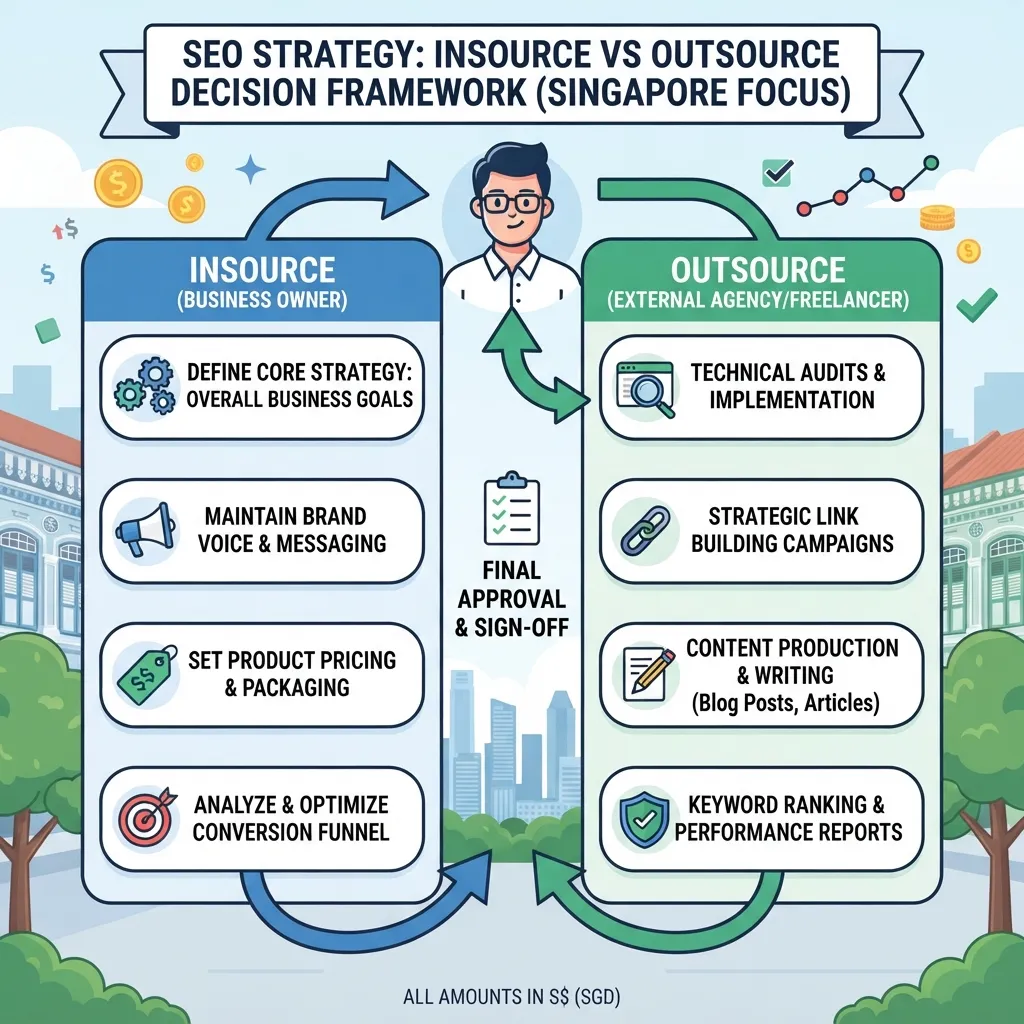
Outsourcing SEO means handing the day-to-day execution of search engine optimisation to an external provider, such as an agency, a freelancer or an offshore team. The business keeps the goals, the budget and the final say. The provider might run the technical audit using specialist tools, write and optimise pages, and build links. Someone inside the company approves changes, supplies product knowledge and measures whether enquiries rise and organic traffic grows.
What stays in-house matters as much as what leaves. SEO strategy ownership, brand voice, pricing and conversion decisions rarely transfer cleanly, because they depend on knowledge only the business holds. A provider can recommend a landing page layout, but only the business knows which objection its sales team hears most often. These decisions also shape how the company’s marketing reaches buyers, which is why they stay close to the business.
The in-house/outsource split: Joe Davies’ model
Joe Davies, co-founder of Fatjoe, has argued that SEO is not a binary choice. His model, set out in his guide to outsourcing SEO, divides the work into tasks that need brand and commercial context and stay internal, and tasks that require volume and specialist tooling and can move outside. The useful lesson is the split itself. A business decides on a task-by-task basis rather than handing over the whole function, with the SEO team having the final say on each decision.
Where SEO outsourcing fits among SEO agencies, freelancers and offshore teams
Outsourcing is a sourcing decision, and there are three main routes. Each suits a different scope and budget. SEO services from local agencies and offshore teams also differ in how they handle reporting and communication. Hiring criteria should weigh the skills each route actually brings, including technical SEO expertise. The right choice depends on the work you need done.

| Option | Typical fit | Main trade-off |
|---|---|---|
| SEO agency | Multi-channel campaigns and larger budgets | Higher retainers and account managers handle several clients |
| Freelancer | Specific projects or a small, senior-led retainer | Capacity limits and single-person dependency |
| Offshore team | Sustained execution work at lower hourly rates | Time-zone gaps and more management effort |
For a Singapore business, the choice often comes down to communication. Local agencies and freelancers with English-speaking account management and reporting in S$ suit companies that want fast, personal contact. Offshore teams can cut costs, but check time-zone overlap before committing, because slow feedback loops erode the gains.
Why Businesses Outsource SEO: Benefits and Measurable Gains
Most businesses that outsource SEO are not chasing a lower invoice. They are chasing speed, a wider set of skills and a team that already knows how to run the work. The gains are real, but they only show up when the business can act on what the partner delivers. A right-sized partner works best when an in-house team stays involved to set priorities. A clearly defined SEO strategy gives both sides a shared plan to measure progress against, and that plan means little unless it is tied to clear results.
Cost, speed and access to specialist skills
You usually compare the cost case with a full-time hire. An in-house SEO specialist’s salary includes staff costs plus overheads such as employer contributions and tools. ZipRecruiter places the average annual pay for an SEO specialist at $67,388, though this varies by market and experience. Freelance rates also vary widely, from offshore freelancers who charge $30 to $50 an hour to US remote freelancers who charge $55 to $90 an hour. A business can buy specific hours instead of a salary. That difference matters for a small Singapore firm that only requires a technical audit each quarter and a monthly content plan. Companies of that size often find the best value in a bounded scope.
Speed is the second gain. According to Arc.dev, sourcing can be compressed from weeks to under 72 hours for teams that prioritise it. The same source says AI-assisted hiring can move a company from identifying a need to onboarding an SEO expert in under two weeks, compared with a month or more using manual methods. These are the source’s claims, not guaranteed outcomes.
Access to specialist skills is the third benefit. A single in-house hire rarely covers technical SEO, link building, content and analytics at the same depth. An outsourced SEO team can supply a technical lead for migrations, a content writer and a reporting analyst without the business recruiting each one. An in-house team keeps ownership of the decisions.
What shifts in the first 90 days after switching to a dedicated team
Switching from a generalist agency to a dedicated team changes the first quarter in predictable ways. According to Hire Overseas, five performance measures typically move within the first 90 days. Those five are organic traffic, ranking positions for priority keywords, click-through rate, enquiries from organic search and organic revenue. In practice, the first month goes on access, audits and a backlog of fixes. The second month shows the first content and technical changes going live. By the third month, the business should be able to see whether those changes are moving rankings and enquiries and whether the results justify continuing.
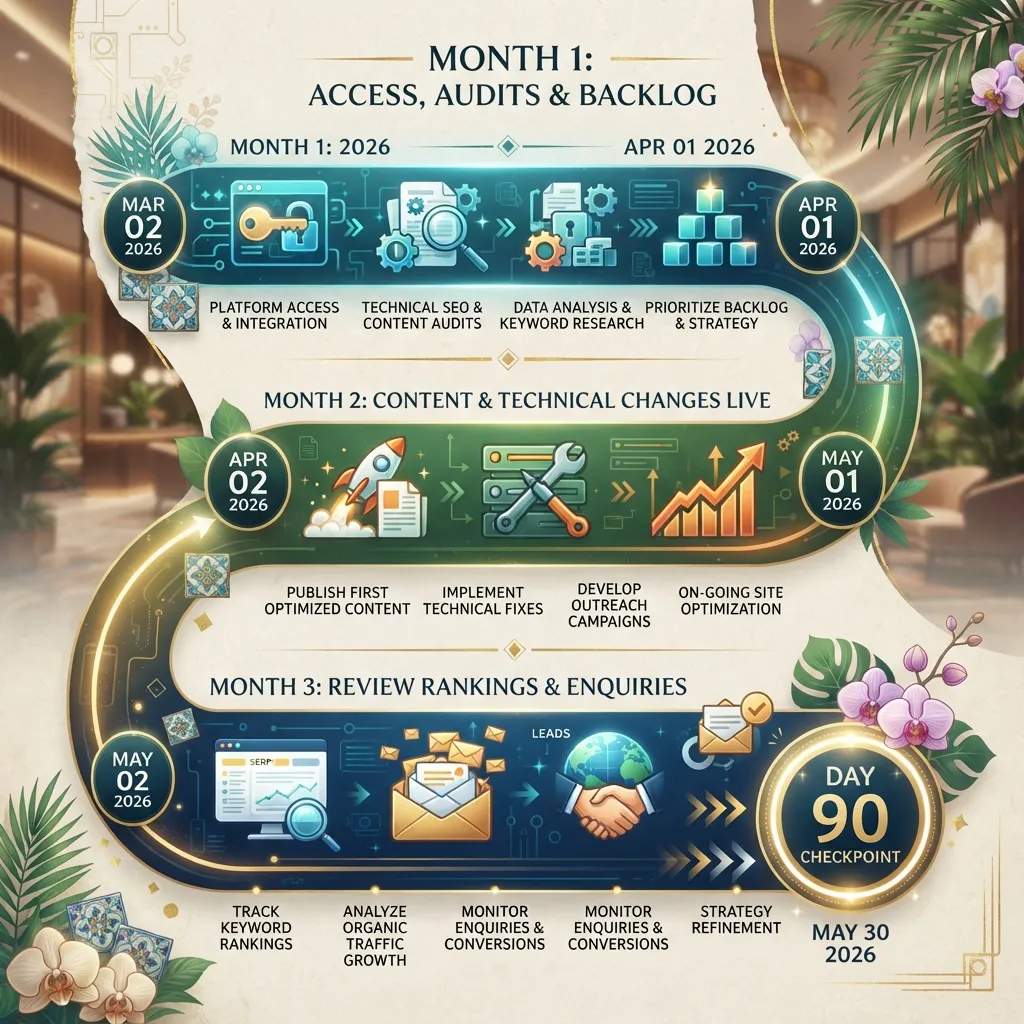
Expect the first month to look slow, since most of the early work is groundwork. Set a checkpoint at day 90 and agree in advance which of the five metrics you will judge against. Treat “months” as the realistic horizon for meaningful movement, and treat 90 days as the first formal review point, not a guaranteed turning point.
Case examples: Arist and SearchSEO cost outcomes
Two vendor-reported cases show the cost range. These are unverified claims, not independent audits. Before relying on them, ask the vendor for the underlying data, check the client’s industry and size against your own, and confirm the spend and enquiry figures in the client’s own accounts.
In the first, Arist cut its monthly spend from $100K to $10K, according to Hire Overseas. In the second, SearchSEO hired one offshore specialist at $3K a month against a projected $60K team cost and offloaded 100% of its support, per the same source. The outcomes also depend on the client already having someone to set priorities. Before you treat either as a benchmark, check whether your business has that internal owner in place. The next section sets out how to test this.
Signs That Outsourcing SEO Makes Sense for Your Business
Outsourcing SEO is not a rescue for a business with no one to manage it. The deciding factor is whether the business can act on what the partner delivers. A good audit is wasted if nobody approves the developer hours needed to fix it. Companies that outsource still need a capable internal team member who can make decisions, set the SEO strategy and keep the work moving. Ask whether your business has that person before you ask which partner to hire. A business ready to outsource will already have this internal owner in place.
Think of the readiness threshold as a practitioner heuristic, not a measured rule. It reflects how agencies and in-house teams in Singapore typically see projects stall, rather than a figure drawn from controlled research. Treat it as a working guide and test it against your situation.
Here is the contrarian point this section rests on: the partner’s skill matters less than having one internal owner. An excellent agency will still underdeliver if no one in your company can approve work, and an average partner can produce results when a clear owner directs it.
A decision checklist you can work through
Answer these five questions honestly. Each “no” is a gap to close before you sign a contract.
- Is there a named internal owner with time allocated? Someone must approve priorities, review monthly reports and answer partner questions within a few days. Where no in-house team exists, this person often coordinates with an outsourced SEO team.
- Can you grant access to your website and analytics accounts? This covers Google Search Console, Google Analytics, your content management system and your domain registrar. A partner who cannot see the site cannot fix it.
- Do you have a resource to implement recommendations? Technical fixes need a developer, and content needs a writer or subject expert who can publish. Without this, every recommendation sits in a backlog. Some companies also weigh hiring an in-house specialist, though that is a larger commitment than a retainer.
- Is the target defined in business terms? “More traffic” is not a target. Enquiries, qualified leads, or revenue from organic search are the targets. Decide which one matters before comparing quotes from SEO agencies.
- Does your budget match the model you want? A monthly retainer, a fixed-fee project and a dedicated hire each suit different budgets. Check the figures in the cost section before you approach anyone.
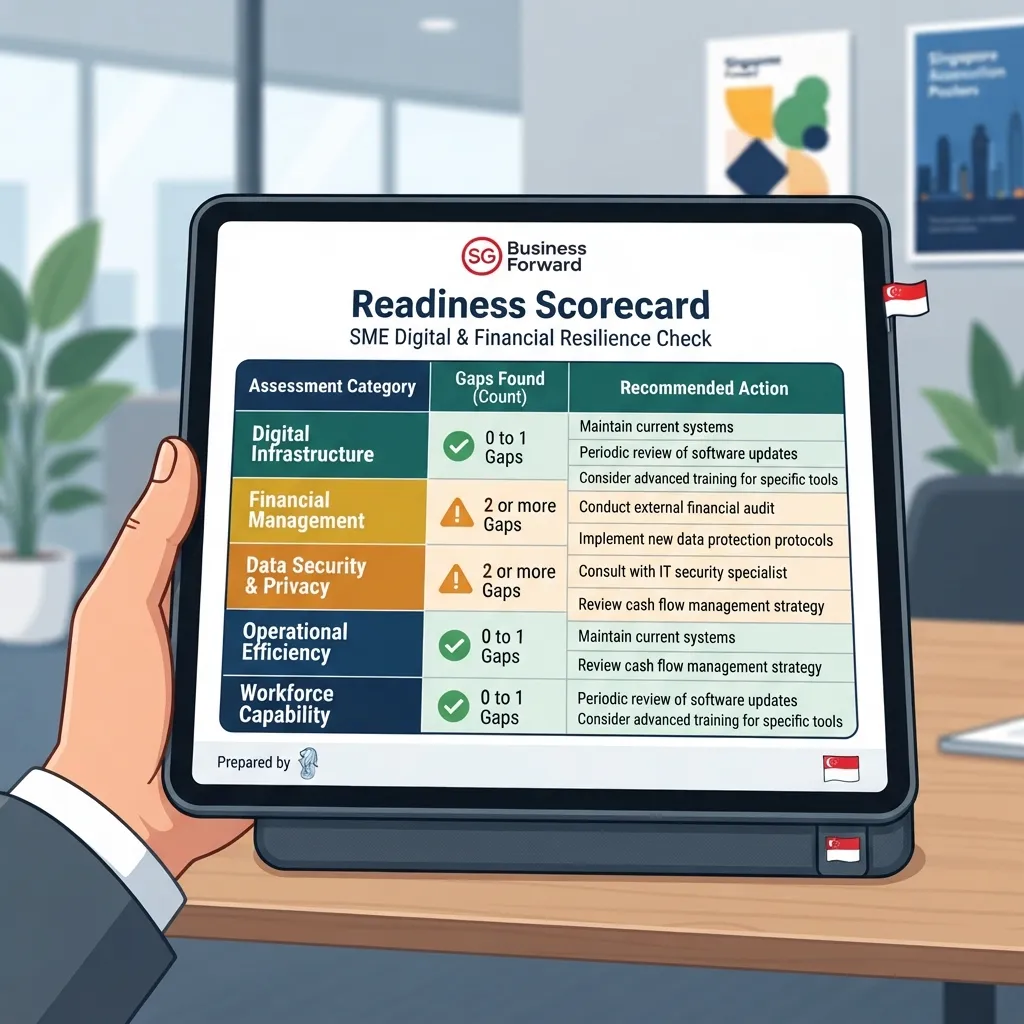
Score yourself as ready, partly ready or not ready:
| Gaps found | Budget and volume signal | What to do |
|---|---|---|
| 0 to 1 | Budget covers a monthly retainer, and you publish or update content regularly | Proceed with full outsourcing, but name the internal owner in writing first |
| 2 or more | Budget covers only a one-off project, or content volume is low | Fix those gaps first, or buy a narrower scope such as a technical audit |
| 2 or more, with no budget for a retainer | Limited spend, but a steady need for search work | Consider a dedicated in-house hire, which is a larger commitment than a retainer |
The two-gap cut-off is a useful guideline. You can usually close one gap within a single planning cycle, while two or more tend to stall a partner’s work. The budget and volume signals are also indicative, so test them against your figures. A narrower scope is a useful test: a one-off audit costs far less than a retainer, and it shows whether your business can implement and benefit from recommendations before you commit to ongoing work. Keyword research is a good first deliverable to test, since it is low-cost and shows how the partner reasons about your market and your search engine visibility. For many companies, this narrower test is a better first step than a full contract. If you want a sense of how a managed service is structured before you compare options, Media One Marketing’s SEO services set out the work a retainer typically covers. Free SEO tools can also help you gauge where your site stands before you engage anyone.
When outsourcing is the wrong move
Outsourcing is the wrong choice in three situations:
- You have no one to approve work or read reports. The partner will keep delivering, but results will stall.
- Your core product depends on proprietary knowledge that only sits in-house. Keep strategy and brand decisions in-house, even if you outsource execution.
- You expect rankings within weeks. SEO results take months, so businesses that need immediate leads should consider paid search while organic work builds.
If your business sits in any of these situations, invest first in an internal owner. That single hire, or a trained existing employee, makes almost any later partnership work better. Choosing the best path depends on where your business stands today.
Conclusion
Outsourcing SEO works when the business keeps the strategy and hands over the execution. The SEO agency runs audits, fixes technical SEO issues, builds links and produces content. The business owns the goals, the brand voice, and the decisions about which leads to chase. Each partner brings specialist knowledge, and the agency’s SEO team should explain what it is doing and why.
Before you sign anything, run the readiness check above. If the business has two or more gaps, close them first, or start with a narrow scope such as a technical audit.
Measure each engagement against a short list of measures agreed at the start: qualified enquiries, organic leads and the revenue those leads produce. Review performance at the 90-day mark, when early shifts usually become visible. That timeline is a common benchmark from one agency’s reporting, not a guaranteed schedule. Then decide whether to scale, change scope or switch partners. Keep reporting access and content assets in your accounts so the relationship can end without losing the work.
Frequently Asked Questions
How much does it cost to outsource SEO?
Costs vary widely. Freelancers charge differently depending on where they are based: offshore freelancers charge $30 to $50 an hour, and US remote freelancers charge $55 to $90 an hour, according to Arc.dev. Monthly packages for competitive markets can run from $2,000 to $10,000 or more, while small firms or startups may find packages of $500 to $2,000 effective, according to Outsource Accelerator. Small and medium-sized businesses in Singapore usually spend between SGD 300 and SGD 1,500 every month on SEO, according to Bthrust. Fixed-fee project work such as a one-time technical audit or content overhaul typically runs $2,000 to $10,000, according to Stridec. These are indicative ranges, so obtain your own quotes.
Is outsourcing SEO cheaper than hiring in-house?
Not always. ZipRecruiter places the average annual pay for an SEO specialist at $67,388, according to Rankability, before recruitment, tools and training. Outsourcing can look cheaper on paper for many companies. The savings disappear if the business lacks an internal owner to direct the partner. Work that nobody scopes or implements is paid for and wasted. Compare total cost, not only the monthly fee.
How long does it take to see SEO results after outsourcing?


Expect the first 90 days to show movement in process and early indicators, not revenue. Hire Overseas reports that five performance measures typically shift within this window after a business moves from an agency to a dedicated team. Ranking gains and enquiry growth usually follow over several months. The pace depends on the site’s starting point and how quickly you implement the recommendations.
What should I keep in-house when outsourcing SEO?
Keep strategy ownership, brand voice, conversion decisions and final approval of content. Your internal owner should also hold website, analytics and Search Console access so the business can move to another provider without losing data. Outsource execution: audits, technical fixes, link building and content production.
How do I choose an SEO outsourcing partner in Singapore?
Start with five checks. Ask for named account managers who work during Singapore hours, and confirm how often they report. Request a sample audit and a sample monthly report. Ask who does the work, whether links are earned or bought, and how AI search visibility is measured. Read the contract for data ownership and exit terms. Compare a local retainer with an offshore option based on time zone overlap and price.