A marketing plan is a written document that sets your objectives, audience, channels, budget and success measures for a set period. It is a decision tool that forces trade-offs before you spend money, so your marketing efforts support the goals that matter. Most Singapore businesses file their marketing plan away and run campaigns on instinct, so the budget disappears into channels no one can justify. This guide shows what a plan should contain, how to set goals and budgets, how to score each activity before launch, and how to review progress over 90 days.
Our working view is that most Singapore SMEs should spend less time on long planning documents and more time on small, measured tests. A plan earns its place by shortening the list of things you test, not by filling pages. The marketing plan sits inside the broader business plan. It is a written document that answers one question: how will we find and win the customers the business needs? A strong executive summary at the top of the plan states that answer in a few sentences, so a reader can grasp the direction without reading the rest.
Key Takeaways
Here are the main points to take from this guide:
- A marketing plan is a decision tool that forces trade-offs before you spend money.
- Tie every channel, budget line and metric to one measurable business goal.
- Score each planned activity out of 25 with a five-criterion checklist, and cut or redesign anything below 15. This is this guide’s own heuristic, not an industry standard.
- With 90.6% of Singapore’s population on social media, start channel choice there.
- Run quick wins to fund longer initiatives, and review progress at 90-day checkpoints.
- Segment audiences rather than running generic campaigns, since 84% of marketers admit to doing so.
Marketing Plan Template: One-Page Example
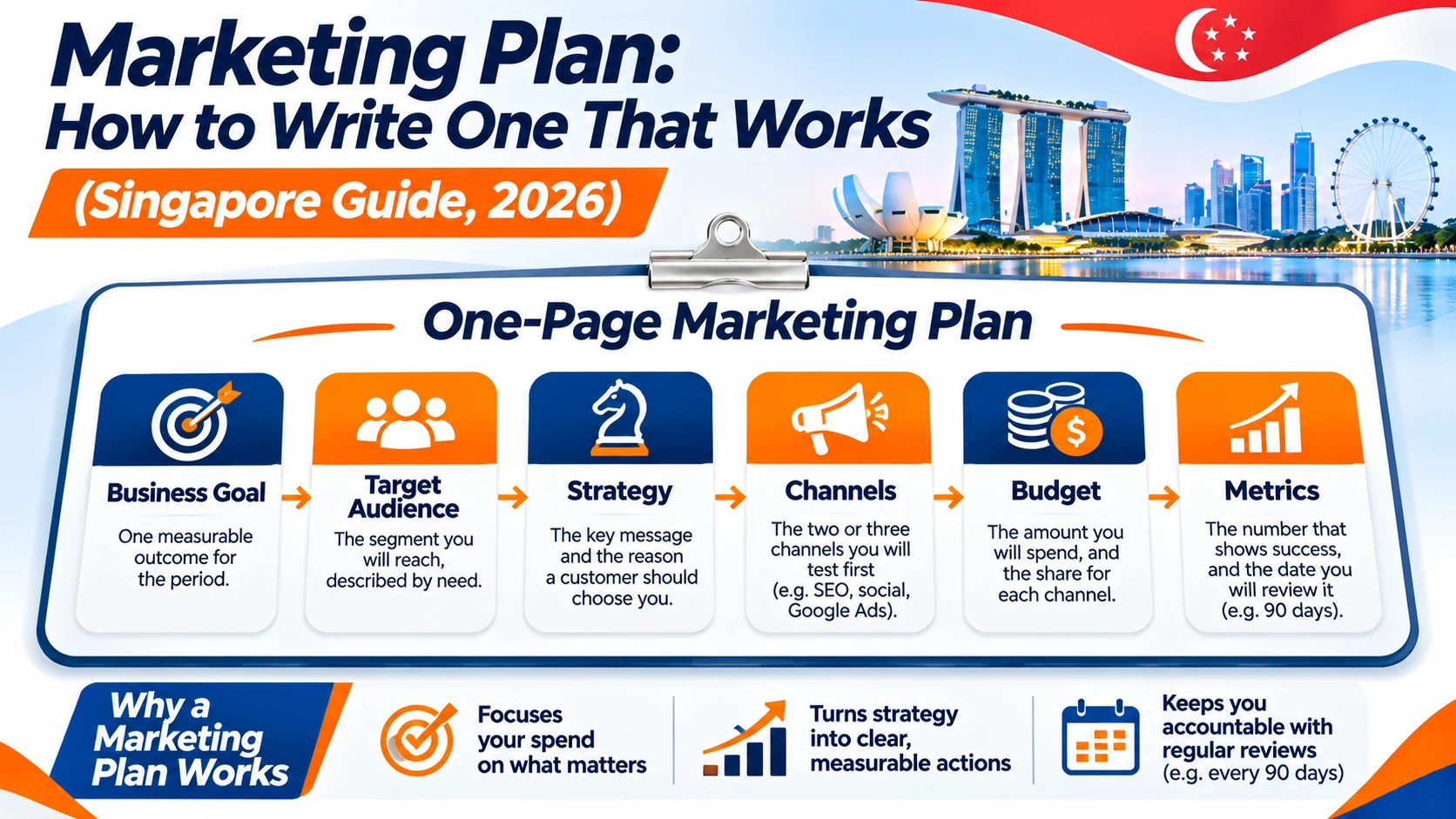
Use this marketing plan template before you read further. Fill in every field, then check the example below it. A plan template should stay short enough that a team can review it in one sitting, and this one is built to help you do that. Each field gives you a clear place to note your marketing strategies and the tactics behind them, so you can see at a glance how each piece fits together.
| Field | What to write |
|---|---|
| Business goal | One measurable outcome for the period |
| Target audience | The segment you will reach, described by need |
| Strategy | The one message and the reason a customer should choose you |
| Channels | The two or three channels you will test first |
| Budget | The amount you will spend and the share for each channel |
| Metric and review date | The number that shows success, and the date you will check it |
Worked example: a Singapore bakery running a three-month push; the goal is 40 pre-orders a week for a new cake range. The audience is office workers ordering for team celebrations, a segment identified through simple market research. The strategy is same-day delivery within the CBD, a clear differentiator from nearby bakeries. The channels are Instagram and Google Business Profile, with a small share of the budget set aside for paid advertising. The budget is a fixed monthly sum split between the two. The metric is weekly pre-orders, reviewed every 90 days.
Understanding the Marketing Plan
Marketing plan definition and purpose
A marketing plan is a written document that sets out the objectives for a defined period, the audience each activity targets, the channels used, the budget allocated and the metrics that show whether it worked. It turns a business goal into decisions someone can carry out and review. A clear plan template makes these elements easy to fill in and compare.
Many plans fail because they list tactics without linking them to a goal. Without a shared objective, an Instagram post, a Google Ads campaign and a trade show compete for the same budget with no way to rank them. Plans that link each channel to a marketing goal avoid this, because every activity must justify its place against a shared target. An effective marketing plan defines its target market first, so it chooses every channel for the people it reaches. You’ll find content and strategies work best when you choose them against that same audience definition.
Marketing plan vs. business plan
A business plan covers the whole company: products, operations, staffing, funding and long-term financial targets. The marketing plan sits inside it and answers a narrower question: how will we find and win the customers the business needs?
Most marketing plans cover one to five years, with 12 months most common for small businesses. Revise yours more often than that, because channel performance changes quickly.
Marketing strategy vs. marketing plan
The marketing strategy is the choice; the plan is how you execute it. A marketing strategy might be to “win repeat purchases from existing customers through loyalty and email.” The plan then specifies the emails, offers, send dates, budget and metrics that show progress.
If you cannot state the strategy in one sentence, the plan will drift.
Why businesses need a marketing plan
A written plan lets a small team decide where money goes before spending it. It gives you three main benefits:
- Prioritisation: Channels scored against the same criteria mean weak ideas are cut before they consume budget, whether the channel is paid search, paid advertising or a broader digital marketing effort.
- Comparable results: A named metric and a review date show whether a campaign worked.
- Team alignment: Sales, design and finance work from the same targets.
Channel choice matters especially in Singapore. According to We Are Social’s Digital 2026 Singapore report, there are 5.33 million social media user identities in Singapore, equal to 90.6% of the population, with an average of 17 hours a week spent on social platforms. A plan that ignores where customers spend that time is guessing. Teams planning reach across social, search and traditional media will find the same discipline applies to each, and a clear brand awareness goal helps them judge whether that reach is working. Branded search volume can hint at awareness, but it is an imperfect signal, since it also rises with price promotions and word of mouth that never touched your ads. The best plans treat each channel’s reach and cost as testable assumptions rather than fixed facts. Teams should also check how each channel performs in its market, since reach and cost vary between segments.
A one-person business may not need a formal document. Even then, a one-page version stating the goal, audience, channel, budget and metric is worth writing. It takes an afternoon and prevents a year of unfocused spending.
Marketing Plan Components and Types
A marketing plan is only as useful as its structure. Plans that fail often list activities without showing how each one connects to a goal, a budget or a way of judging success. The components below give the plan its skeleton, and the scorecard later in this section tests each activity against them.
Marketing plan components and structure
A workable marketing plan usually contains seven components:
- Executive summary: a short overview of the plan’s purpose, goals and budget, written last but read first.
- Situation analysis: where the business stands now, including sales trends, customer feedback and competitor moves.
- Marketing goals: the business outcomes the plan must deliver, expressed as measurable targets.
- Target audience: the segments you will reach, described by need and behaviour rather than age alone. Buyer personas and the marketing mix (the 4Ps: product or service, price, place and promotion) are covered in the segmentation discussion.
- Strategy and positioning: the message you will emphasise and why a customer should choose you.
- Tactics and channels: the specific activities, such as email, paid search, social media or events, that carry the strategy.
- Budget, timeline and metrics: the money, dates, owners and measures that show whether the plan is working.
Each component should answer one question for the reader. If a section cannot specify the decision it informs, please consider removing it. Test every marketing strategy against these components before funding it. An effective marketing plan is one where every component links to the next.
Types of marketing plans (annual, campaign, product launch, digital)
Choosing the right type prevents over-planning a small push or under-planning a major launch. Use the table below to match the type to your situation.
| Plan type | Typical horizon | Best used when | Core focus |
|---|---|---|---|
| Annual marketing plan | 12 months | You need a yearly budget and consistent brand presence | Overall goals, channel mix, seasonal calendar |
| Campaign plan | Weeks to a few months | A specific promotion or seasonal push is planned | One offer, one audience, tight metrics |
| Product launch plan | 3 to 6 months around launch | A new product or service enters the market | Awareness, early adoption, sales targets |
| Digital marketing plan | Usually 6 to 12 months | Online channels drive most leads or sales | Search, social, email, content and paid media |
In practice, a Singapore business often runs an annual marketing plan with campaign and launch plans nested inside it. The annual plan sets the budget envelope, and each campaign draws from it. Use a different plan template for each type, so a campaign brief never gets forced into the annual format.
Digital plans deserve special attention because local audiences are heavily online. Start channel selection with where customers spend their time, not with the channels competitors use. Treat each channel as a hypothesis to test, not a default. Paid advertising strategies should follow the same test-first approach. Media marketing decisions, from paid placements to owned content, should be judged the same way, and the plan should help teams see which marketing efforts actually move the numbers. Before you commit budget, compare the market each channel reaches with your own customer data so you know which bets deserve testing first.
Setting Objectives, Budget and Channels
Setting Marketing Objectives
Many marketing plans stall here because their objectives are vague. “Grow awareness” gives a team nothing to act on. A good objective lets someone check, at the end of a quarter, whether it was met. Before setting any target, connect it to the revenue goal your business plan sets, so every objective has a measurable purpose. A clear objective, documented in a shared plan template, is also the best way to help a team agree on what success looks like.
Apply the SMART test: each objective should be specific, measurable, achievable, relevant to a business goal and time-bound. A café that wants “more footfall” should aim for “1,200 new loyalty sign-ups from Tanjong Pagar within 90 days. ” A measurable target makes brand awareness easier to track than a general aim.
Keep the list to three to five key performance indicators (KPIs) per plan. Useful examples include customer acquisition cost (the cost to win each new customer), conversion rate (the share of visitors who buy) and repeat purchase rate. Assign each KPI an owner so progress is easy to track.
Segmentation matters. Salesforce‘s Tenth State of Marketing report, based on a survey of over 4,000 marketers, found that 84% admit to running generic campaigns. McKinsey’s 2025 analysis found that 65% of customers see targeted promotions as a top reason to purchase. An objective that names a defined target audience is far more likely to be hit, and a clear objective also helps decide how much of the marketing budget to commit to each channel, including social media.
Quick test: if you cannot write the objective as a sentence with a number, a segment and a date, it is not ready for the plan.
Marketing Budgeting
Our working view is that most Singapore SMEs should spend less on planning and more on testing. A long planning cycle delays learning, while a small, measured test shows you what your audience actually responds to. Choose a budget method that leaves room for testing, and make sure your budget helps you learn quickly from every channel you try, including advertising and social media campaigns. Start from clear marketing goals so every test has a measurable purpose.
Fixed, percentage-of-revenue and zero-based budgeting
| Method | How it works | Best suited to |
|---|---|---|
| Fixed | A set amount agreed in advance, reviewed each quarter | Stable, predictable cash flow |
| Percentage-of-revenue | A fixed share of sales | Steady revenue that grows over time |
| Zero-based budgeting | Every activity justified from scratch against the expected return | Testing new channels or cutting costs |
Percentage-of-revenue spends more when sales are high, even when extra spend is not needed. Zero-based budgeting makes every line earn its place. It is slower, but it gives more control.
Worked example: channel economics
The figures below are a hypothetical calculation, not evidence about how any channel performs. They assume the same 1,000 visitors and compare three offers:
- Pay-per-sale: at a 2% sale rate and an S$50 commission, it yields S$1,000.
- Pay-per-click: at S$0.20 a click, it yields S$200 if every visitor clicks through.
- Pay-per-lead (you earn for each lead passed on): at a 5% lead rate and S$15 a lead, it yields S$750.
To rerun this with your own numbers, use this formula: visitors × conversion rate × value per conversion. Replace the assumptions with your own conversion rate, cost and visitor count, then compare the result against what each channel costs you to run. Test your own rates before scaling, and include media marketing costs in that comparison. Use market research to set realistic conversion rates before you rely on them.
Choosing Marketing Channels
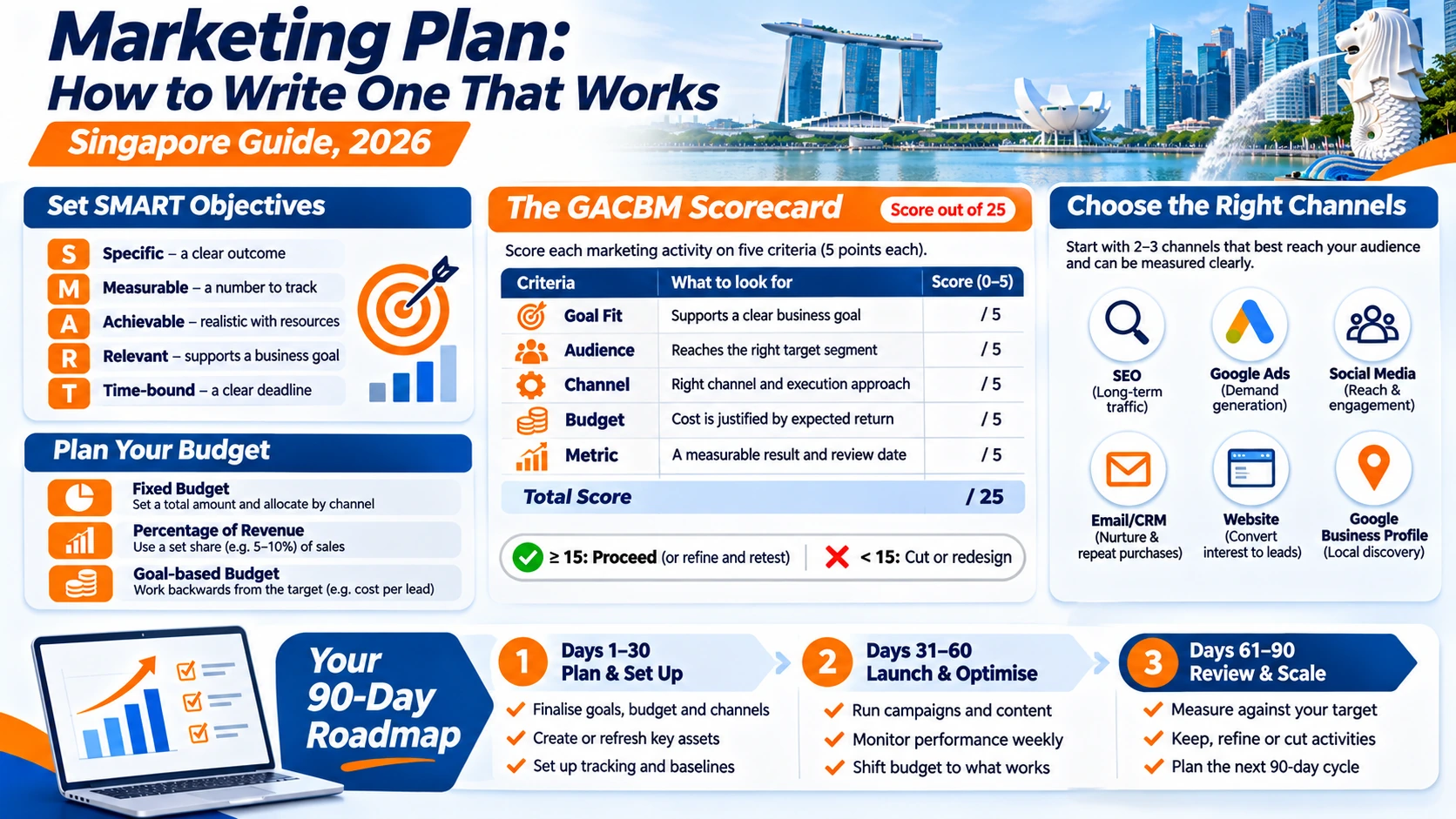
Start from where your audience spends its time. Do not copy competitors’ channels. Choose the marketing strategy that reaches your target market most directly, and build each channel’s content around what that audience needs, since different segments respond to different formats. Map your strategies to each segment before committing to a budget.
Channel selection criteria
In Singapore, social is a strong starting point. The We Are Social Digital 2026 Singapore report counts 5.33 million social media user identities, 90.6% of the population, averaging 17 hours a week on social platforms. You’ll want to check the right mix for your own segments and whether your advertising and marketing goals on each platform will actually help you reach them.
This guide uses its own framework, the GACBM Scorecard, to rank channels. It is this guide’s own heuristic, not an industry standard. Rate each channel from 1 to 5 on five criteria: a clear link to a business goal, a defined audience segment, evidence the channel reaches that segment, a budget tied to expected return, and a named metric with a review date. The maximum is 25. Cut or redesign any channel scoring below 15 before launch.
Channel-by-channel evaluation
Applied to three typical channels, the scorecard works like this. Scores are illustrative of the method, not measured results:
| Channel | Goal link | Segment | Reach evidence | Budget link | Metric and review | Total |
|---|---|---|---|---|---|---|
| Paid social | 4 | 4 | 3 | 3 | 4 | 18 |
| Email to existing customers | 5 | 5 | 4 | 4 | 4 | 22 |
| Generic display ads | 2 | 1 | 2 | 1 | 2 | 8 |
Under this scoring, email and paid social pass the 15-point cut-off, while generic display ads fall below it and would be redesigned or dropped. Start with the two or three highest scorers, and add more only once early results are in.
Steps to Create a Marketing Plan in Ninety Days
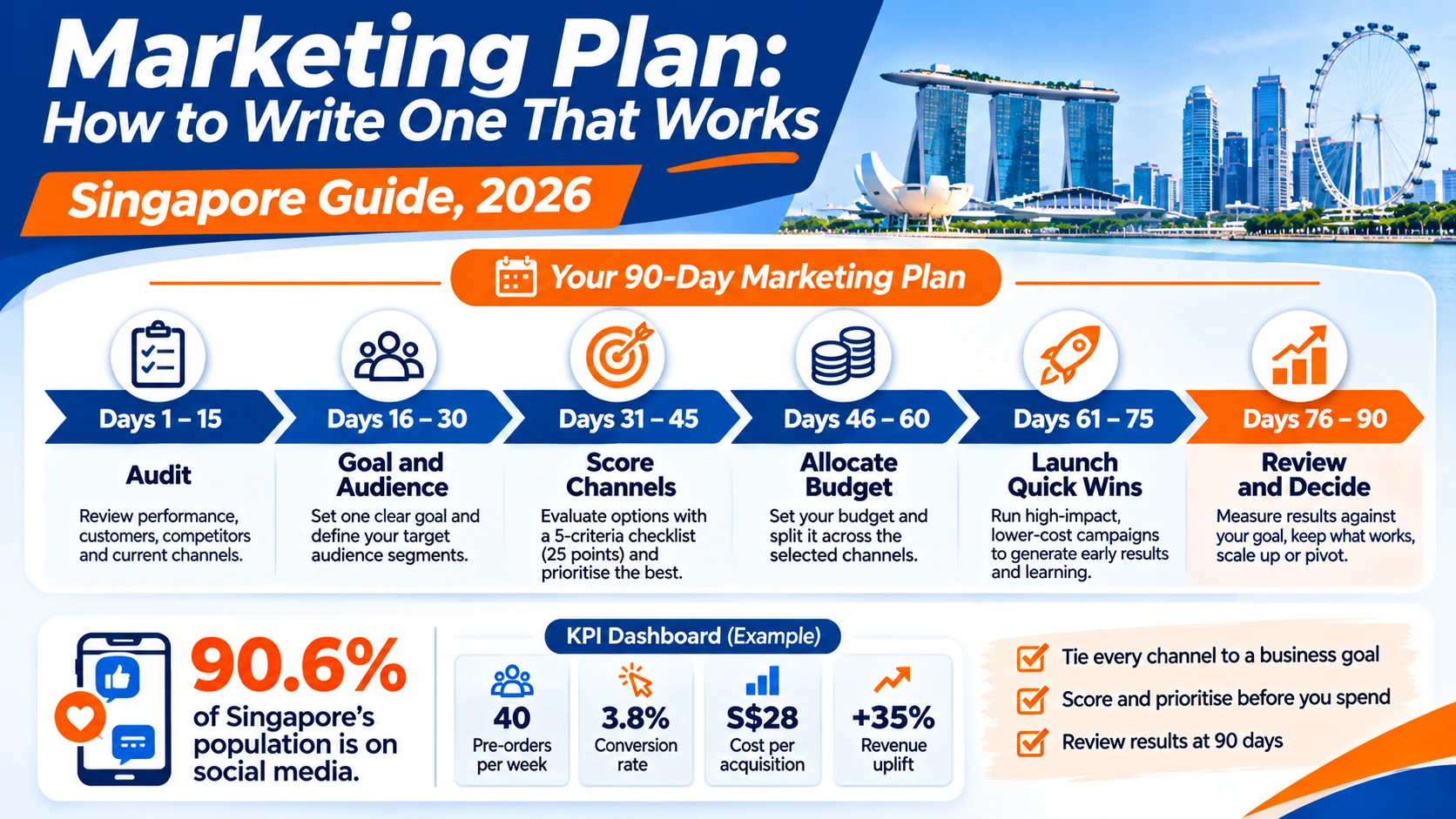
A marketing plan written over a year is usually out of date before it launches. A 90-day cycle keeps the plan honest, because each phase ends with something you can measure. This shorter horizon makes every decision easier to review and adjust. Whether the plan covers digital marketing or traditional channels, the short cycle keeps it grounded, and you’ll see early whether your brand message is landing with the people you’re trying to reach.
Step-by-step framework: from audit to launch
Days 1 to 15: Audit what you have. List every channel in use, its spend and its results over the last six months. Pull numbers from analytics and sales records, not memory. This gives your marketing efforts a factual baseline before you change anything.
Days 16 to 30: Set the goal and the audience. Write one business goal for the quarter, such as a set number of new customers or a revenue target. Define two or three audience segments the goal depends on, and note how each one’s needs differ.
Days 31 to 45: Shortlist and score channels. Build a long list of channels where your segments spend time. Score each candidate on the GACBM Scorecard and cut anything below. 15. Treat the results as a structured judgement to test, not a verified ranking.
Days 46 to 60: Allocate the budget. Compare channel economics before splitting spend. Test your own rates before scaling your advertising.
Days 61 to 75: Launch quick wins first. Start with one or two low-cost tactics that show results within weeks, such as an email to existing customers or a retargeting campaign. Their returns can fund the longer initiatives that follow.
Days 76 to 90: Review and decide. Compare actual results against the metrics you named. Keep the strategies that hit their target, redesign what fell short, and drop what did not justify its cost. Then use these results to build the next 90-day plan template, so your marketing plans improve with each cycle.
A checklist to review your plan before launch
Work through this list before you spend a dollar:
- The plan names one primary business goal with a measurable target.
- Each audience segment describes who they are and where they spend time.
- Every channel scores at least 15 out of 25 on the GACBM Scorecard.
- Each budget line links to an expected return, not just an activity.
- Every activity has a named metric and a review date within the 90 days.
- Quick wins are scheduled early enough to inform later phases.
- Any use of customer data has a documented purpose and consent basis.
- A named owner is responsible for each activity and each review.
If any item is unticked, fix it before launch. A plan that fails this check is a list of hopes, not a decision tool.
Using AI and Data to Strengthen Your Marketing Plan
Why generic campaigns underperform
A generic campaign is written for “everyone” and sent to whoever is on the list. Many Singapore businesses still run this way because it is quick to produce and quick to waste money.
Salesforce’s Tenth State of Marketing report, based on a survey of over 4,000 marketers, found that 84% admit to running generic campaigns and 69% struggle to respond to customers promptly. A marketing plan built on the same assumptions will repeat the same results.
If the audience is undefined, you can’t justify the channel choice, message, or marketing budget. Relevance is a conversion lever, not a nice-to-have. Start with segmentation before creativity. Define two or three audience groups from your existing customer data, then assign each one a message, channel and metric in your marketing plan.
Segmentation also shapes the marketing mix, the four Ps of product, price, place and promotion. Once your buyer personas are defined, check that each segment’s product or service, price point, channels and promotions match what that group actually needs, and link each persona back to the segmentation work above. Your business plan should record this mix so the whole team works from the same assumptions.
Personalisation, measurement and data guardrails
Personalisation only works when you hold the right data and have the right to use it. Before any tool touches customer records, confirm what you collect, why you collect it, and whether customers have agreed to that use. Keep consent records with your marketing plan.
Measurement is the second guardrail. Each segment needs a named metric and a review date. Your 90-day roadmap should set checkpoints at day 30, 60 and 90, each comparing results against your baseline. This shows which marketing strategies are working and which need changing. Open the plan with a one-page executive summary so decision-makers can see the audience, goal and metric at a glance.
Use AI to draft variants, sort audience data and spot patterns in campaign results. Keep strategic decisions, such as which goal a channel serves, with the people accountable for the budget. HubSpot’s 2026 State of Marketing report found that 80% of marketers already use AI for content creation. The tools are common; your advantage comes from the segmentation and measurement behind them.
Conclusion and Summary
A marketing plan earns its keep when it changes what you spend and what you stop doing. Score each activity from 1 to 5 on the GACBM Scorecard, and cut or redesign anything under 15 out of 25 before launch.
Start with one measurable business goal, and check that every channel, budget line and metric traces back to it. Review metrics at each checkpoint of the 90-day roadmap and reallocate budget toward what the numbers support. With 5.33 million social media identities at 90.6% of the population, start with the channels where your audience already spends time.
Frequently Asked Questions
What is the difference between a marketing plan and a marketing strategy?
A marketing strategy sets direction: who you serve, what you stand for and why customers should choose you. A marketing plan turns that direction into action through channels, budget, timing, owners and metrics. The strategy answers “where do we want to win?” and the plan answers “What will we do, when, with how much, and how will we know it worked?”
How long should a marketing plan be for a small business in Singapore?
Keep it short enough that someone reads it every week. For most small businesses, three to five pages are often sufficient: goals and target audience, channels and budget, and a 90-day activity calendar. Length matters less than whether every activity links to a measurable goal.
How often should a marketing plan be reviewed?
Review it formally every 90 days and check core metrics monthly. Rebuild the annual plan only after a major change, such as a new product or service line or a shift in competitor pricing.
How much of revenue should go into marketing?
There is no universal figure. Many small firms set a fixed percentage of revenue, but the right number depends on margins and growth targets. Zero-based budgeting, which justifies each line from expected return, is often more reliable than copying an industry average.
Do I need a marketing plan if I am a sole proprietor?
Yes, though it can fit on a single page. Write down your goal, your target audience, two or three channels, a monthly budget and one metric to review.
What metrics should a marketing plan track?
Track metrics tied directly to your goals. For sales, measure revenue, conversion rate (the share of visitors who buy) and customer acquisition cost (what it costs to win each customer). For awareness, track reach and brand awareness, which branded search volume can indicate, though it is an imperfect proxy. For retention, track repeat purchase rate and customer lifetime value. Limit the list to five or six metrics so you can review and act on each one.