Most Singapore business owners searching for local SEO help aren’t short on options. They lack a clear basis for comparison. One agency quotes S$850 a month, another S$1,800, and a third lists neither price. Before you can judge which quote is good value, you need to know what the best local SEO services package should include and what it should leave in your hands.
Over half of all Google searches now carry local intent, according to MediaOne’s local SEO cost guide. A neighbourhood business therefore competes mainly for the few listings that appear in the local map pack. Many local SEO agencies in Singapore sell monthly retainers, but the lowest retainer is often the costliest choice, because monthly fees buy activity rather than owned assets. The rankings that bring in customers depend on a Google Business Profile, a review pipeline and a citation set that you must own and verify yourself. Keywords still matter, but only once those assets are in place. This guide sets out a five-point local SEO scope audit, a framework proposed by the author, to help you check any proposal before you sign.
Key Takeaways
- Local SEO is decided on the map, not the website alone. Your Google Business Profile, reviews and citations drive the local pack that Singapore searchers see first.
- Over half of Google searches carry local intent, according to MediaOne’s analysis of local search.
- General SEO retainers are not local SEO. Advertised general packages start from about S$850 to S$1,800 a month, with local scope often quoted separately.
- Score every proposal with the local SEO scope audit. The author suggests a threshold of 6 out of 10. Below that, the proposal is likely a general SEO quote relabelled as local.
- Keep ownership of your listing and login. Keep reviews and profile access in your name so you can leave without losing them.
- Track rankings by district and postcode, not just site traffic, to prove the spend is working.
What Local SEO Is and Why Singapore Businesses Need It
Local SEO fundamentals and definition
Local SEO is the work of making a business visible when a nearby customer searches for what it sells. Google decides who appears in the map pack, the block of three to four listings above the organic results, using signals such as relevance, distance and prominence. For a Singapore SME, those listings are the most competitive space. Ranking on page one of a general search matters less than appearing in the local pack for “bakery Tiong Bahru” or “aircon servicing Jurong East”.
Local SEO covers three things. The first is your Google Business Profile, the listing that appears in Google Maps and the local pack. The second is the consistency of your business information across the web. The third is the reviews and local content that tell Google where you serve. Each one is a separate asset you can check today.
Local SEO versus general SEO: the practical differences
The two disciplines share tools but differ in what they optimise and who they compete with. General SEO competes for national or topic-wide rankings in a standard search engine. Local SEO competes for a few listings within a few kilometres of the searcher, and a sound local search visibility strategy depends on winning that narrow space.
| Factor | General SEO | Local SEO |
|---|---|---|
| Target | Organic results across a wide area | Map pack and nearby searches |
| Main asset | Website content and authority | Google Business Profile and citations |
| Typical competitors | Any site on the topic | The three to four nearest listings |
The practical gap shows up in pricing. An agency quoting a general SEO retainer may not include Google Business Profile work or citation management. The rest of this article helps you check for that gap.
Why local intent matters: over half of searches are local.
Over half of all Google searches (52%) now have local intent, according to the MediaOne local SEO cost guide. Those searchers want a result they can act on today: a call, a route, a visit. A business absent from the local pack loses that customer to a competitor who is present, even when its website ranks well elsewhere, which is why a sound SEO strategy starts with visibility in the local pack.
How Local SEO Works: The Framework and Ranking Factors
Local SEO framework and process: a step-by-step sequence
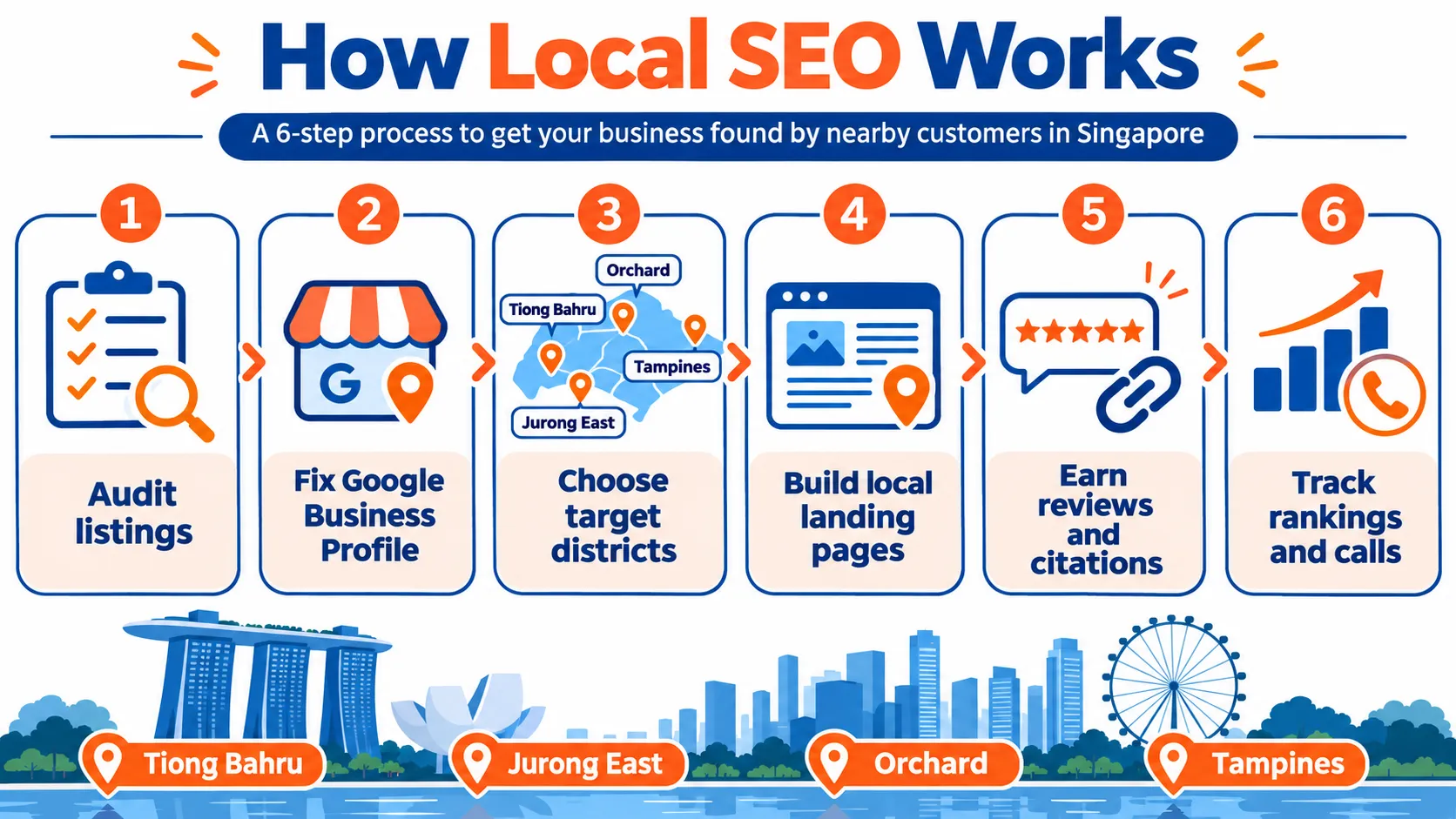
Local SEO follows a repeatable order. Skipping steps is the most common reason a campaign stalls. Each step below includes a target you can check.
- Audit your listings. Check your Google Business Profile, your website and the main directories for name, address and phone consistency. Target: every listing matches your registered details exactly before you start anything else.
- Fix the foundation. Correct the category, services, hours and photos on your profile. Target: a complete profile with at least 10 real photos, reviewed once a month.
- Map your target areas. Decide which Singapore neighbourhoods or postcodes you need to rank in, such as Tiong Bahru or Jurong East. Target: a written list of no more than five priority areas, each with its own landing page plan.
- Build local content. Create pages that address each service and area you serve. Target: one dedicated page per core service and priority area, each with your address and a phone button.
- Earn reviews and citations. Set up a steady review request process and confirm your listings on relevant directories. Target: review requests sent to every completed job and a citation check every quarter.
- Measure by area. Track rankings and calls by district, not only by one citywide keyword. Target: a monthly report showing rank and calls for each priority area.
Most businesses in Singapore need the first three steps done properly before paying for content or links. A good SEO agency starts with this audit so you can measure later work against a clean baseline, and a sound local strategy builds on that baseline.
Google Maps ranking factors
Google ranks local results on three broad signals. The first is relevance: how well your profile matches the search. The second is distance: how close you are to the searcher or the search location. The third is prominence: how well-known and well-reviewed you are. Your profile completeness, review count and rating, and consistent citations all feed prominence, and the best-maintained profiles tend to hold the strongest visibility. Distance is largely outside your control, which is why businesses serving several neighbourhoods need content and profile signals for each area. Google’s own Business Profile Help pages describe how these details are managed, and the same signals shape how your business appears in every search engine results page.
Mobile-friendly website design and local landing pages
Most local searches happen on phones, so a slow or cluttered mobile page loses the call before it starts. Each core service and neighbourhood should have its own landing page with the area named in the title, a clear phone button and your address. Avoid copying one template with only the district name changed, because thin duplicate pages rarely rank and can dilute your signals.
Google Business Profile, Citations and Local Keywords
Most local ranking work happens before you optimise a single page. For a Singapore business, the Google Business Profile (GBP) and the listings around it do the core ranking work in the map pack. These assets come first, and you should keep them in your name. A clear local search strategy starts with getting these foundations right.
Google Business Profile optimisation checklist
Work through these items in order and confirm each one yourself. Google’s Business Profile Help guidance covers each setting.
- Claim and verify the listing under an owner account you control, not an agency’s personal login.
- Choose the correct primary category and add secondary categories that match real services.
- Enter accurate hours, service areas and attributes. Service-area businesses without a shopfront should hide the street address and list the districts they serve.
- Write a description that names the service and the areas served in plain language so that your customers can quickly see what you offer.
- Upload real photos of premises, team and work. Target: refresh photos at least once a month.
- Post updates and offers and reply to every review. Target: one post a week and a reply within a few days of each review.
Local keyword targeting for Singapore neighbourhoods and districts
Target the neighbourhood people actually type, such as “plumber Tiong Bahru” or “dental clinic Jurong East”, rather than “Singapore” alone. Keyword research should show which districts your customers actually search for. Place the district on your service page, in your page titles and in your GBP description, but only where it is true. Stuffing ten districts into one page reads as spam to people and to search engines alike. Strong local visibility comes from a few well-built pages, not a long list of districts.
Citation consistency and Singapore directories
Citations are mentions of your business name, address and phone number on other websites. Keep the details identical everywhere, including punctuation and unit numbers. Inconsistent details split your authority across duplicate records. Start with the major directories and industry listings relevant to your trade, then check each one quarterly. If you hire an agency in Singapore to manage this, keep the listings under your own accounts.
Reviews, Local Links and Partnerships
Review and reputation management
Reviews carry more weight in the Google Maps pack than most SMEs expect. For a neighbourhood business in Tiong Bahru or Jurong East, the three to four listings in the local pack are usually separated by review volume, recency and star rating, and the owner controls all three. The practical job is a steady pipeline. Ask every satisfied customer for a review at the point of payment or handover, reply to every review within a few days, and flag fake or abusive reviews through the profile dashboard. A consistent review pipeline is a core part of any local search visibility strategy, and it should be built into your broader SEO strategy from the start.
Here is the test that matters when you evaluate a vendor. Ask who will request reviews, how often, and whether the request is sent from your business profile or from a third-party tool. Under the Scope Audit, a proposal that names review generation as a deliverable, with a monthly target and a named owner, scores 2 on criterion 3. A proposal that says “reputation management” with no volume or method scores 0.
Local link building and partnerships
Local links matter less than reviews and profile accuracy, but they help a site compete when the map pack is saturated. The useful sources are the ones a Singapore customer would actually meet: trade associations, chambers of commerce, neighbourhood business groups, local event sponsorships, and partner businesses that can credibly link to you. A single link from a respected local body is worth more than twenty directory listings. A reputable agency in Singapore can help you identify these sources, earn links from them, and align that outreach with your content and keywords.
Many vendors sell link packages that buy volume from low-quality domains. These add cost and risk without moving local rankings. Before paying for links, ask for the referring domain list and check whether each one is a real Singapore business or organisation.
Pricing and Cost of Local SEO Services in Singapore
Local SEO prices in Singapore vary widely, and the headline number often hides what you are actually buying. Published general SEO retainers run from around S$800 for freelance consultants and small-scope work to S$2,500 to S$7,000 monthly for mid-market agency programmes. First Page Digital advertises general SEO from S$1,800 per month, with local scope quoted separately. Impossible Marketing starts at S$1,099 per month, and its local scope needs confirmation. A general SEO quote is not a local SEO quote, and a strong search visibility strategy depends on which of the two you are actually buying. Search engines reward pages that match local intent, so the scope of local search work matters as much as the price.
Published price points from Singapore agencies
Treat published prices as starting points. The range is wide because the scope behind each figure differs. SEO With Senthil lists packages from S$1,600 per month, and NinjaPromo lists S$4,200 per month. Check what each one includes before you compare them, especially whether Google Maps listing work is covered. Ask each SEO agency to show the local content it will produce for your listings.
Local SEO scope versus general SEO retainers: what to confirm before signing
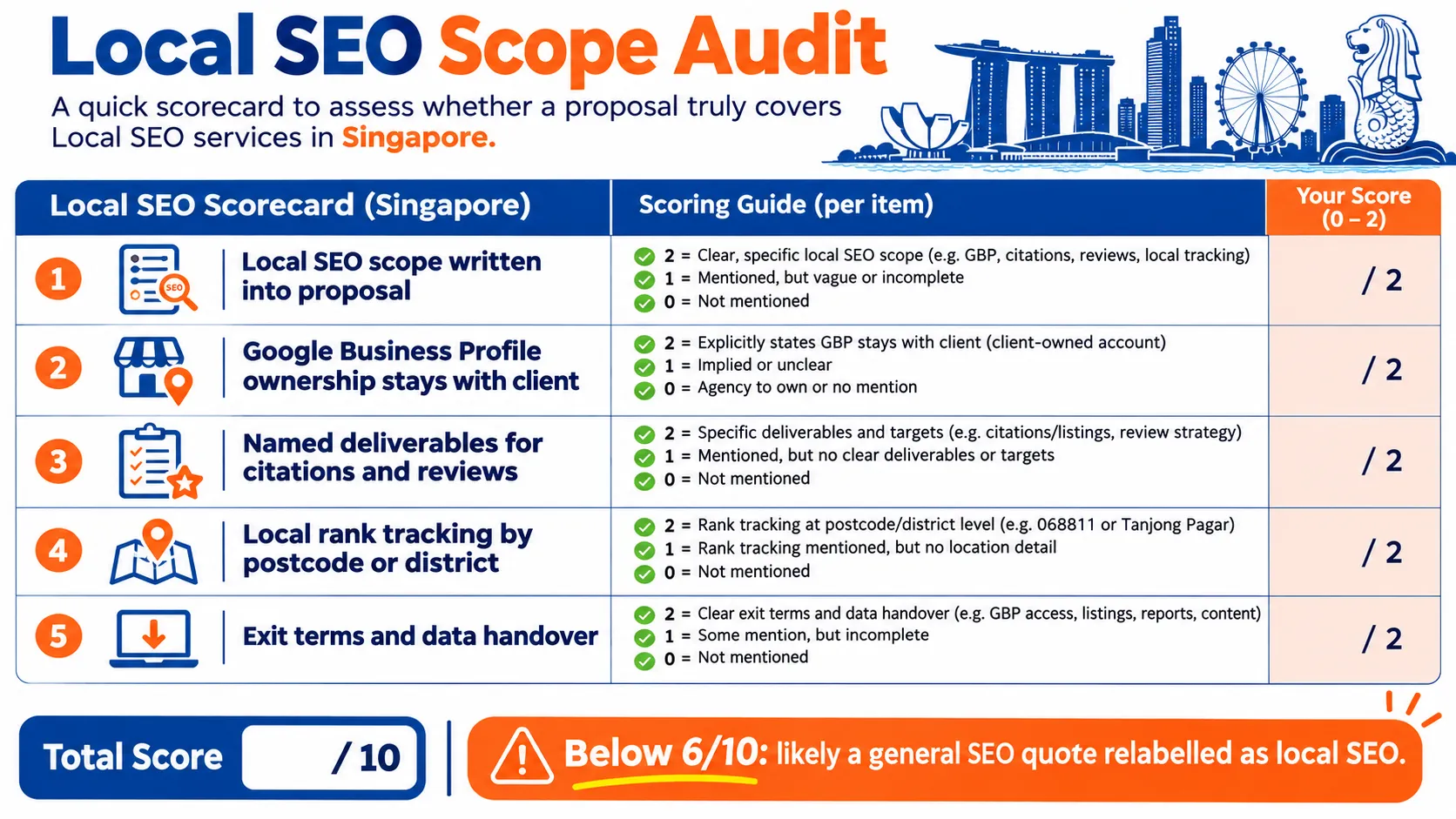
Before you sign, run the local SEO scope audit. This is the author’s suggested framework, not an established industry standard. It scores each proposal from 0 to 2 on five points:
- Explicit local scope written into the quote.
- Google Business Profile ownership stays in your name.
- Named deliverables for citations and reviews.
- Local rank tracking by postcode or district.
- Exit terms and data handover, including reviews and login custody.
A proposal scoring under 6 out of 10 may be a general SEO quote with a local label. Ask for a separate local line item before you commit.
Tracking local SEO performance metrics and proving return
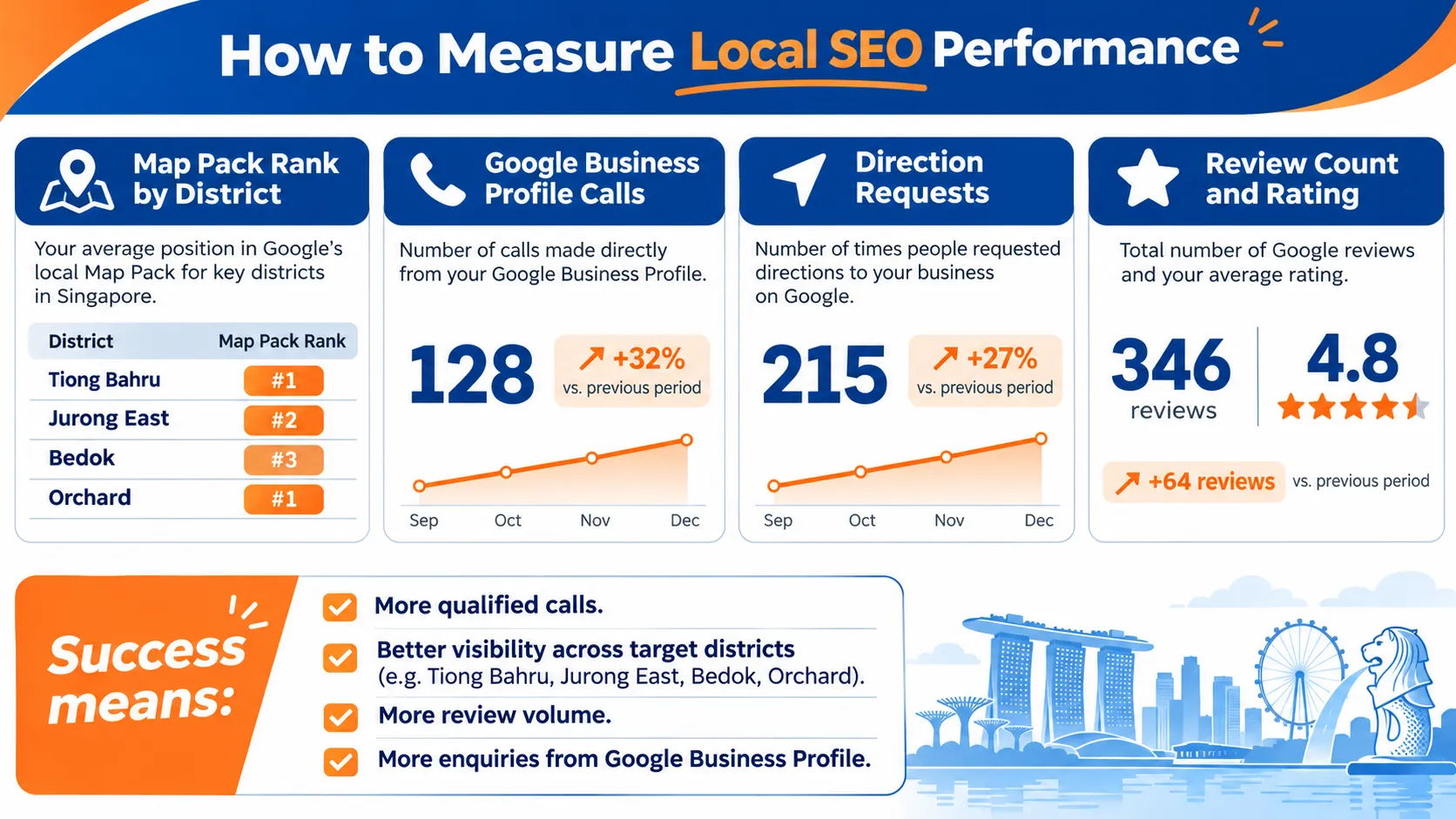
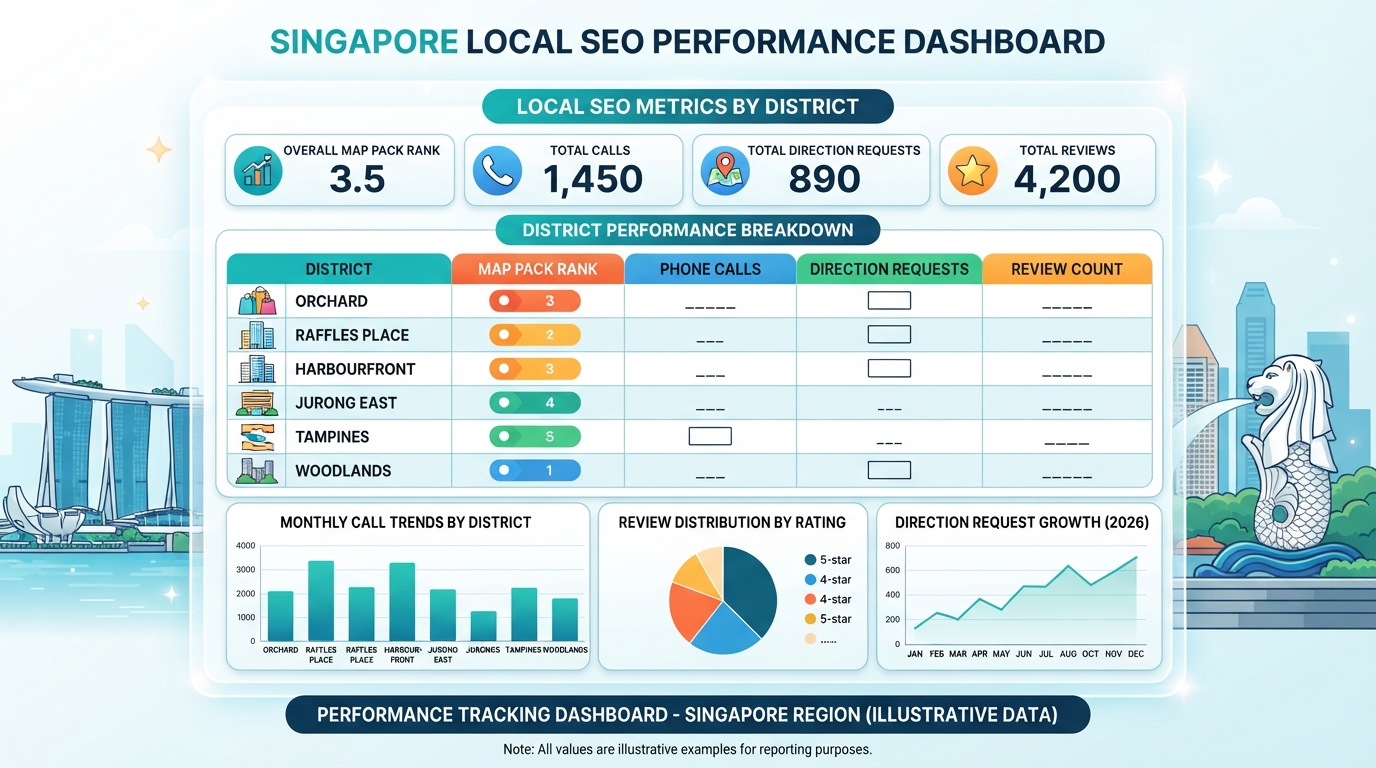
Track results you can verify yourself: your position in the local map results for core keywords in two or three districts, direction requests, calls and website visits from your Google Business Profile, and review count and rating over time. Check rankings manually by searching from several Singapore locations, because a single search from your office will mislead you. If a vendor cannot report these numbers, you are paying for activity rather than visibility in search results. Insist that every report shows the content your agency published and how it affected local search results.
Comparing local SEO services in Singapore providers
From each provider’s own page, as read on 2026-11-08. Prices, dates and formats change: confirm them with the provider before you decide.
| Provider | What they offer | Price | Where |
|---|---|---|---|
| MediaOne | Local SEO services: the guide covers pricing factors and models | Quoted on enquiry | Singapore |
| SEO With Senthil | Boutique SEO for service businesses and e-commerce | From $1600/Month | Singapore |
| Halo Tech Media | Local SEO with hyper-local keyword targeting and Google Business Profile management | Quoted on enquiry | Singapore |
| RHAD | Local SEO is essential for attracting local customers if your business operates in a specific region | Quoted on enquiry | Singapore |
Conclusion
Local SEO in Singapore comes down to one question: who owns the assets that drive your local rankings? A monthly retainer from a digital marketing agency can buy plenty of activity, but the listings, reviews and citations that decide who appears in local results on Google Maps and other search engines are the parts you should hold in your own name. Before you sign up for any of the services on offer, run the local SEO scope audit, explained in the pricing section above. It is a suggested framework, not an industry rule.
Check your own results with the tools you already have. Search your core terms from several Singapore neighbourhoods, record where your listing appears in local results, and repeat monthly. That manual check tells you more than an SEO agency’s activity report.
Frequently Asked Questions
How long does local SEO take to show results in Singapore?
The first ranking movement for Google Business Profile management is usually within 8 weeks. Stable results depend on how competitive your neighbourhood is and how many reviews your competitors already hold. A business in a dense district such as Tiong Bahru may take longer than one in a less contested area. Treat any promise of page-one rankings within weeks as a warning sign.
What does local SEO cost in Singapore per month?
Published general SEO retainers run from around S$800 for freelance consultants and small-scope work to S$2,500 to S$7,000 monthly for mid-market agency programmes. Dedicated local scope is often priced separately, so confirm whether Google Business Profile, citation and review work is included before you compare figures. A low monthly fee that excludes local deliverables is usually a general SEO quote with a local label.
Can I do local SEO myself, or do I need an agency?
Many owners can handle the core tasks themselves: claiming and verifying the Google Business Profile, keeping hours and categories accurate, requesting reviews and fixing inconsistent listings. An agency adds value through local keyword research, content for neighbourhood pages and systematic citation building. Whichever route you choose, keep the profile login in your own name so you retain control of your listing.
What is the difference between local SEO and general SEO?
General SEO aims to rank a website for broad keywords across the whole country. Local SEO focuses on visibility in location-based results, chiefly the Google Maps results, your Business Profile and listings in directories. The two overlap on the website, but local SEO also depends on profile accuracy, reviews and location signals that general SEO does not cover.
Which metrics show whether local SEO is working?
Track Google Business Profile calls, direction requests and website clicks, along with your position in local results measured by postcode or district. Review count, average rating and citation accuracy also indicate progress. Rankings alone can mislead, so link these metrics to enquiries and sales where possible.
Do I need a separate website for each Singapore location?
Usually no. One well-structured website with dedicated local landing pages for each area you serve is generally enough. Each page should contain unique, useful content about that neighbourhood rather than duplicated text with the place name swapped. Separate websites add cost and maintenance without a clear benefit for most small and medium businesses.