Brand Strategy Singapore: Using Humour Without Losing Trust
AI Summary
Humour can be a powerful brand-building tool in Singapore’s tight-knit market, but only when it’s deliberately linked to the brand and calibrated to context. Research shows unlinked or generic humour gets shared without earning brand credit, while brand-tied humour measurably lifts ad effectiveness. The piece outlines three humour modes (in-group warmth, sharp wit, cultural shorthand), four common failure patterns (punching down, humour-washing, borrowed voice, and slow crisis response), and a five-step build process, starting from positioning rather than trends, matching humour intensity to funnel stage, and locking in a pre-launch test and response plan, to help brands use humour as a repeatable strategic tool rather than a risky guess.

Table of Contents

A joke that gets shared without your brand attached isn’t a marketing win. It’s content you paid to make for someone else’s meme folder.
That’s the risk sitting inside almost every conversation about humour in a Singapore brand strategy. Done well, humour builds warmth and word-of-mouth that no media budget buys on its own. Done carelessly, it either fades without building brand memory or backfires in a market small enough that everyone sees the misstep by lunchtime.
This guide is for Singapore brand owners and marketers who suspect humour could work for them. They just want a repeatable process, not a gut call before every campaign.
It covers where humour earns trust and where it backfires locally. Then a five-step build process, plus a pre-launch test you can run in an afternoon.
Used deliberately, humour isn’t decoration sitting on top of a brand strategy Singapore audiences already trust. It’s one of the instruments that builds that trust in the first place.
Key Takeaways
Defining the Humour Zone
Not every joke belongs to a brand strategy. Some are just content, gone by the next scroll. The difference is whether the humour is doing a job: making a product, a position or a customer truth easier to remember.
The Three Humour Modes That Work in Singapore
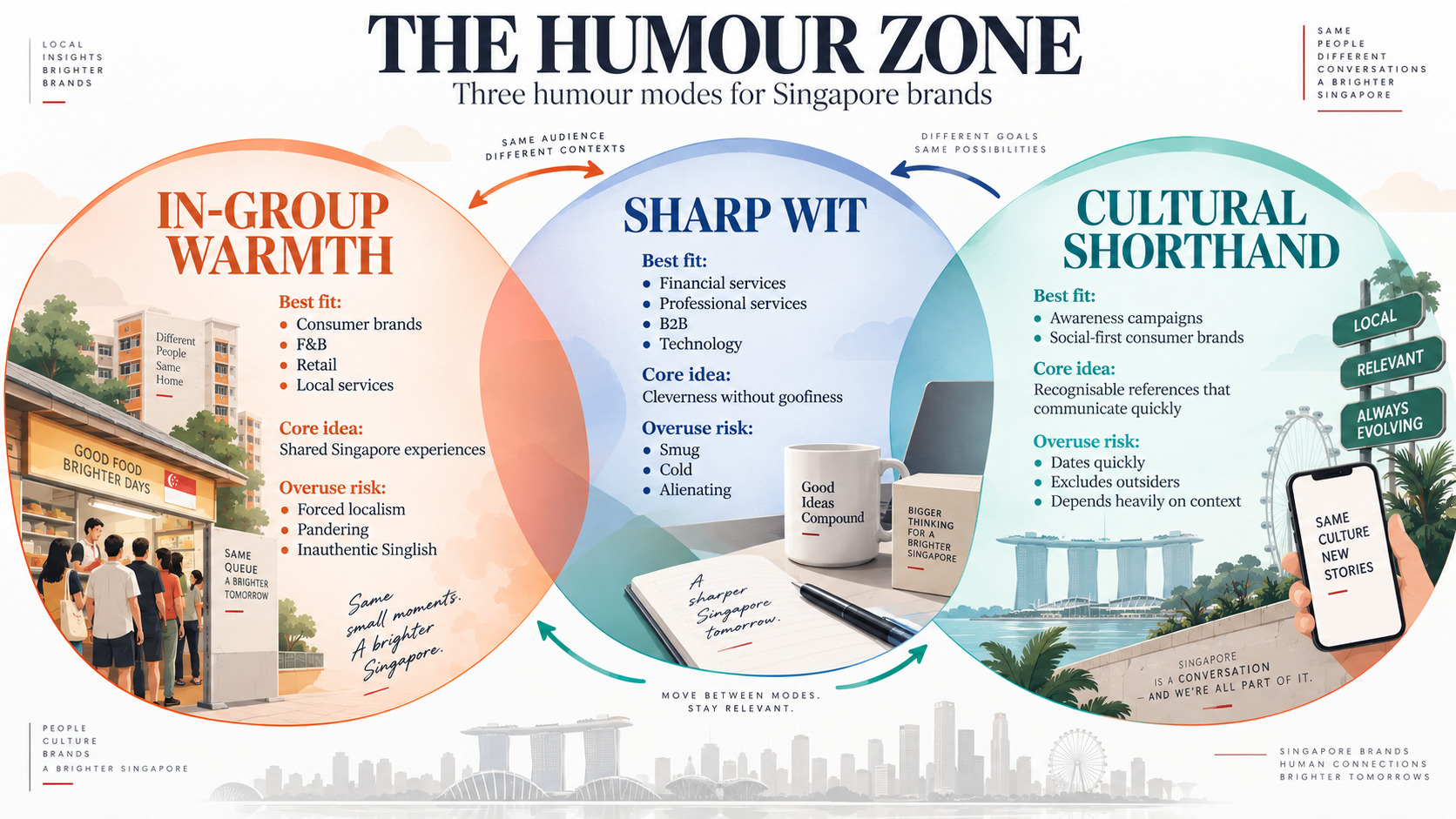
Three modes cover most of the brand humour that actually earns its keep here.
- In-group warmth leans on shared local experience: hawker centre queues, HDB living, National Service, exam season. It works because the audience recognises itself in the joke within a second, no explanation needed.
- Sharp wit relies on cleverness rather than familiarity: a dry one-liner, a well-timed pun, a knowing aside about the category. It suits brands that need to look smart without looking silly, which is often the difference between “relatable” and “unserious” for a bank or a law firm.
- Cultural shorthand borrows a recognisable reference, whether local slang, a meme format or a shared cultural touchstone. The goal is to compress a longer idea into something instantly legible. It travels fast on social, but it also expires fast and can quietly exclude anyone who doesn’t share the reference.
None of the three is inherently safer than the others. Each carries a different failure mode, which is what the comparison table below sets out.
Comparison Table
| Humour Mode | Best Audience Fit | Risk If Overused |
| In-group warmth | Consumer brands, F&B, retail and services with a strong local identity | Slides into forced Singlish or pandering that reads as inauthentic |
| Sharp wit | Financial services, professional services, B2B and tech that need cleverness without goofiness | Reads as smug, cold or alienating to anyone outside the joke |
| Cultural shorthand | Broad awareness campaigns and social-first consumer brands | Ages within weeks and excludes audiences unfamiliar with the reference |
The Trust Multiplier
Humour isn’t a reliable brand-builder by default. Kantar’s own creative-effectiveness data shows that the share of ads built around humour has fallen from 53 per cent to 34 per cent globally since 2000, even as humour dominates the organic content people actually enjoy on social platforms. Many brands have simply played it safer.
Kantar’s testing also shows why the ones who kept using it were right to. When a joke is clearly tied to the brand rather than borrowed from wherever, its ad-effectiveness score jumps from an average rating to a strong one, for both short-term recall and long-term brand-building. Humour without that link doesn’t get the same lift.
That “brand-linked” condition matters even more in a market as compact as Singapore’s. A joke that lands here travels through a small, densely connected audience quickly. Warm, well-linked humour earns the kind of word-of-mouth a media budget alone can’t buy. Poorly linked humour spreads just as fast, minus the brand credit.
The Four Ways Humour Backfires
Most humour failures aren’t random. They follow one of four recognisable patterns, and each has a specific fix.
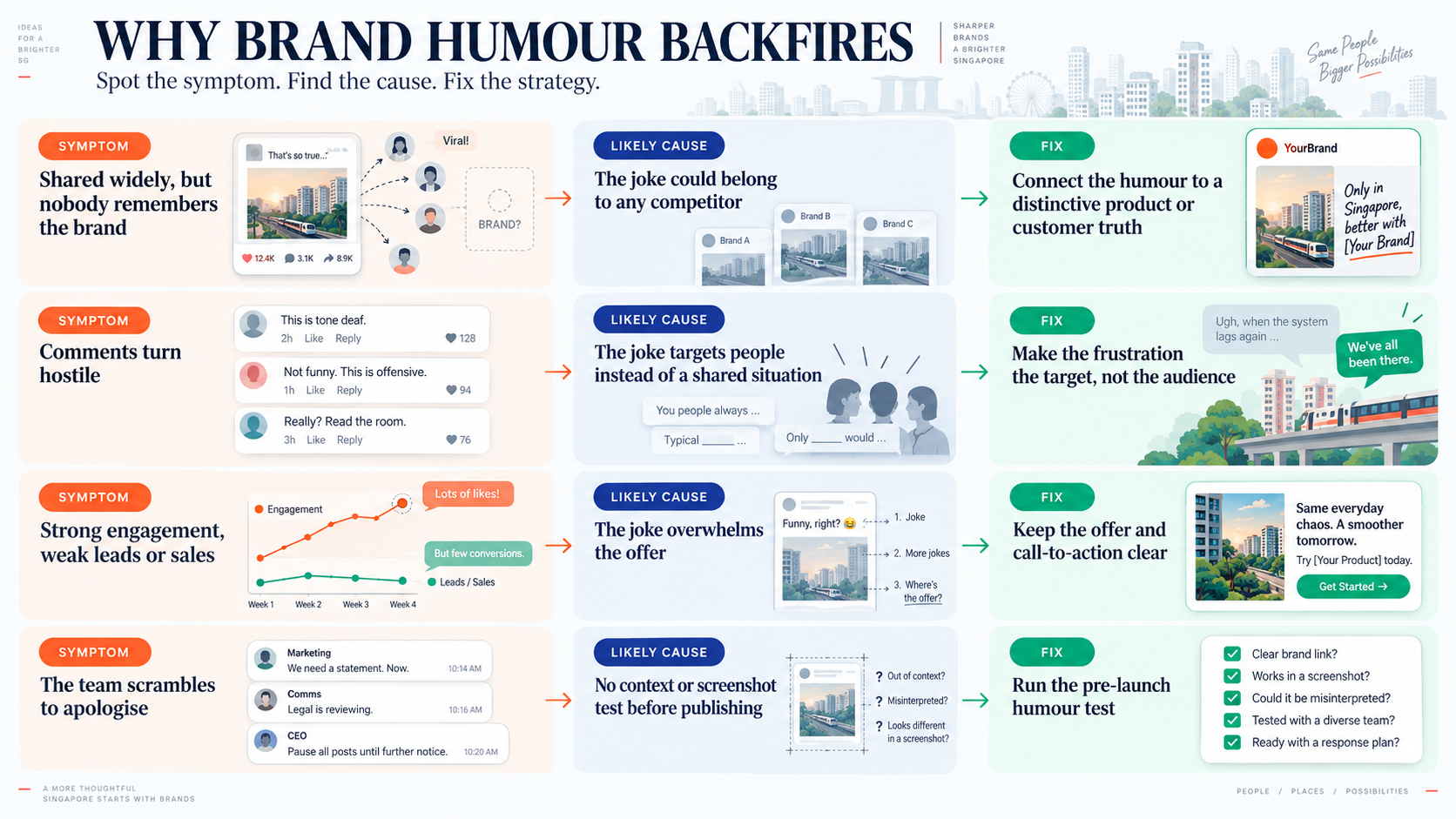

Diagnostic Table
| Symptom | Likely Cause | Fix |
| The post gets shared widely, but nobody remembers who made it | Remove the logo and a competitor could publish the same joke unchanged | Rebuild the joke around a product truth or a customer frustration unique to your brand |
| Comments turn hostile faster than expected | The joke punches at a group of people instead of a shared situation | Redirect the humour at the category frustration everyone recognises, not at a person or group |
| Engagement is strong, but sales or leads don’t move | The humour is distracting from the offer instead of introducing it | Keep the offer and call-to-action in plain language elsewhere in the same asset; let humour open the message, not carry it |
| The team scrambles to write an apology after launch | No pre-publication context-collapse or screenshot test was done | Run the Five-Step Pre-Launch Humour Test below before every campaign goes live |
Risk One — Punching Down on Job, Age or Race
Singapore’s audience isn’t culturally uniform. It’s also ageing.
- Residents aged 65 and over made up 18.8 per cent of the resident population in 2025.
- The resident median age has climbed to 43.2 (Singapore Department of Statistics, 2025).
A joke aimed at “boomers,” a job type or an ethnic stereotype doesn’t just risk offence in the abstract. It risks alienating a meaningful share of the audience the brand actually needs.
The rules back this up:
- The Advertising Standards Authority of Singapore’s Code of Advertising Practice requires every advertisement to be legal, decent and truthful.
- “Decent” leaves no real room for humour that targets a protected characteristic.
The safer target is shared category frustration, not a group of people. Think the printer that never works, or the commute that always runs late.
Risk Two — Humour-Washing
Humour-washing is using a joke to change the subject from a real failing instead of fixing or owning it. A brand that jokes about its own late deliveries instead of addressing them isn’t being self-aware. It’s hoping the laugh distracts from the complaint.
The Consumer Protection (Fair Trading) Act backstops the honesty rule in the SCAP. Reactive, evasive humour tends to draw exactly the scrutiny it’s trying to avoid.
Risk Three — Borrowed Voice
Singlish signals authenticity when it reflects how a brand’s own team and customers actually talk. Bolted onto generic copy purely to look local, it reads as costume rather than voice. The same goes for meme templates or humour formats copied from a viral post. If it wasn’t grown from the brand’s own tone, it won’t fit.
A useful test here borrows from “context collapse.” This is the idea that social platforms flatten many different audiences into one shared feed. Content written for one group can land in front of people who don’t share its assumptions (Marwick & boyd, 2011).
Ask a simple question: would this joke still sound like your brand to someone who has never seen your other content?
Risk Four — Silence After the Miss
The most damaging part of a humour failure is often not the joke itself. It’s the hours of silence afterwards while a team debates internally what to say.
A brand that already knows who decides, how fast, and what an acknowledgement should sound like recovers in hours. One without that plan can spend days making it worse. This is exactly what Step 5 and the checklist below are built to prevent.
How to Build a Humour-Safe Brand Strategy
Step 1: Start From Positioning, Not From Memes
The brief should never start with “what’s trending.” It should start with what the brand stands for and what it wants to be remembered for doing well. Humour then gets tested against that positioning, not the other way round. This is the foundational work our content marketing team does with a client before a single script or caption gets written.
Step 2: Name the Ideal Client Profile Before You Write the Joke
Write down who has to laugh, and who is allowed to be confused. A joke aimed at 20-something shoppers doesn’t need to also land with a 55-year-old B2B procurement lead. Still, it does need to not alienate anyone else who might see it. Naming the profile first stops the team from writing to an imagined, overly broad “everyone.”
Step 3: Lock the Visual Identity to the Tone
If a competitor could swap out your logo and the post would still make sense, the visual identity isn’t doing its job. Colour, type, mascot and caption style should all reinforce that a specific brand, not just “a funny Singapore account,” made this.
Step 4: Match Humour Tolerance to Funnel Stage
The same joke shouldn’t follow a customer through the whole buying journey. Humour that wins attention at the top of the funnel can actively hurt trust once someone is entering payment details.
| Funnel Stage | Humour Tolerance | Main Danger If Ignored |
| Awareness | High | Joke overwhelms the brand message |
| Consideration | Moderate, product-related | Important details get lost in the cleverness |
| Conversion | Light, supporting only | Wit lowers clarity right when clarity matters most |
| Payment or application | Minimal | Customer questions security or price |
| Support and complaints | Only if the customer sets the tone first | Brand looks dismissive of a real problem |
| Crisis communication | Avoid entirely | A serious issue looks trivialised |
Step 5: Set the Response Rule Before Launch
Before anything goes live, settle three things. Who has authority to respond if a joke misfires, how quickly they need to act, and what an acceptable acknowledgement sounds like.
Suppose you need help building that monitoring and response workflow into your content calendar. Then, our social media marketing team sets this up as standard practice for clients running humour-led campaigns.
The Five-Step Pre-Launch Humour Test
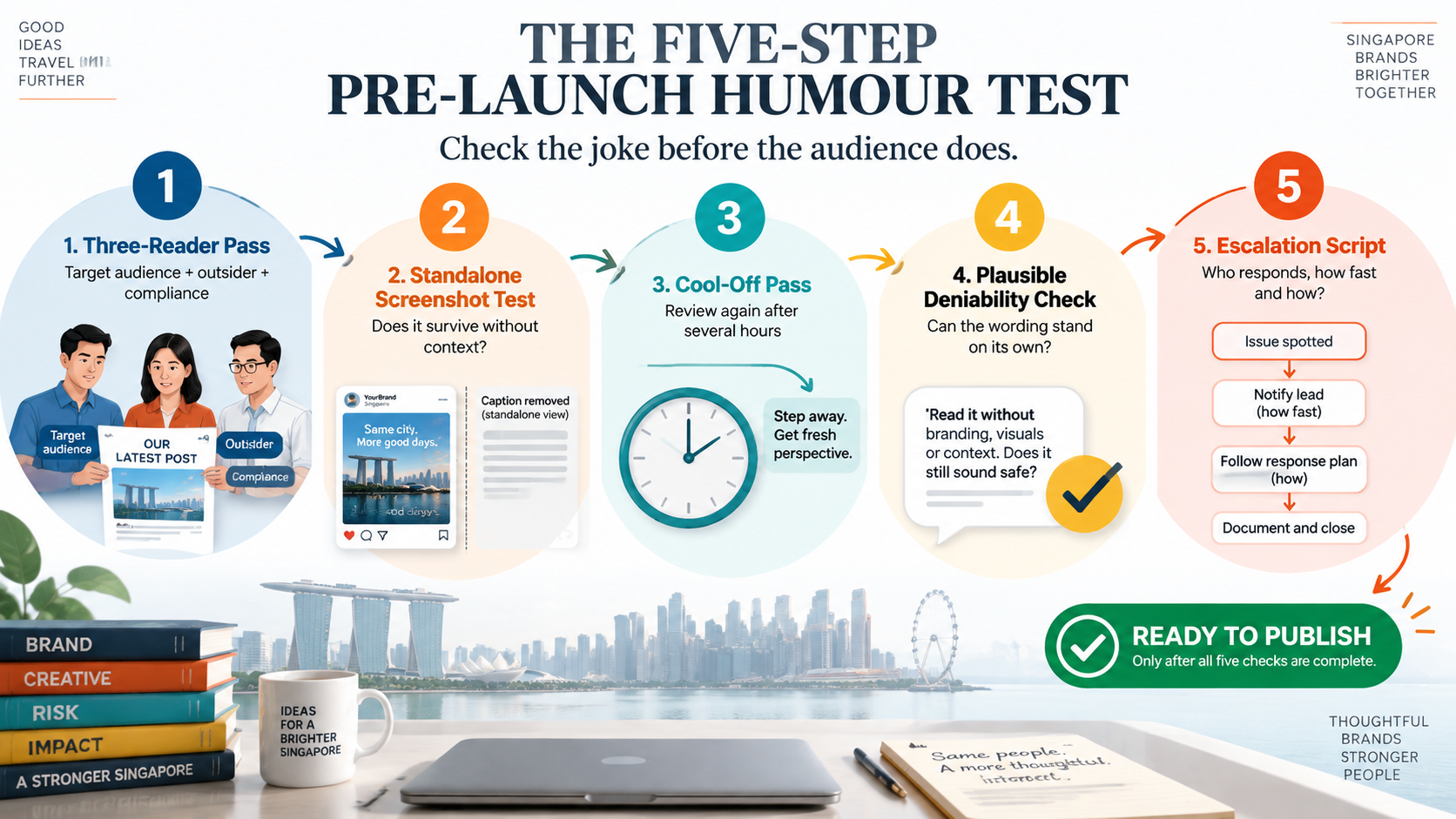
Run every piece of brand humour through this checklist before it publishes.
- Three-Reader Pass. Have someone from the target audience, someone outside it, and someone with a compliance or legal instinct read the draft separately. If any of the three flags it, revise before moving on.
- Standalone Screenshot Test. Assume the post gets screenshotted without its caption and sent to someone with none of the surrounding context. Does the joke still make sense, and does the product claim still hold up?
- Cool-Off Pass. Wait at least a few hours, ideally overnight, before publishing anything reactive or trend-based. What feels obvious at 10am can feel forced by the next afternoon.
- Plausible Deniability Check. Could an employee defend the wording to a customer without first explaining the meme or trend behind it? If the joke needs a footnote to justify itself, it isn’t ready.
- Escalation Script. Confirm who responds if the joke backfires, within what timeframe, and with what kind of message, before the post goes live, not after.
Where This Leaves Your Brand Strategy
A working brand strategy Singapore audiences actually remember doesn’t treat humour as a coin flip. It treats humour as a tool with rules.
- Link it tightly to the brand.
- Match it to the funnel stage.
- Test it before launch.
- Back it with a response plan if it misses.
Consumer brands with a strong local identity can lean into in-group warmth. Regulated and professional-services brands are usually better served by sharp wit, used sparingly and kept well clear of payment and compliance messaging.
Either way, the choice of mode, and how far to push it, is worth a second set of eyes before the campaign. Not after it goes wrong.
If you’d like our team to pressure-test a concept or build the humour-safe process into your content calendar, get in touch with us.
Frequently Asked Questions
Is humour safe for a regulated industry in Singapore?
Yes, in limited doses and away from regulated claims. Keep humour around the customer experience. Save plain, literal language for price, risk, eligibility and compliance wording. To know more about ad compliance, check our article on Advertising in Singapore.
How do I pitch edgy humour to a conservative stakeholder?
Lead with the brand-linkage evidence rather than the joke itself. Research shows humour tied clearly to the brand lifts both short and long-term ad effectiveness. Studies on B2B audiences find product-related humour improves attitudes toward the ad and the brand, even among cautious buyers.
What is the single fastest way to know humour will backfire?
Remove the logo and ask whether a direct competitor could publish the same joke unchanged. If yes, the joke is entertaining but isn’t doing any brand work. It’s also the type most likely to be remembered without being credited.
Should a Singapore brand use Singlish in its humour?
Yes, when it reflects how the brand and its customers genuinely speak. Avoid dropping in “lah,” “leh” or “sia” purely to make generic copy look local. Audiences notice the difference between authentic voice and costume.
How long should a brand stay quiet after a humour backfire?
Long enough to understand what went wrong, but not so long that silence itself becomes the story. A pre-agreed escalation script keeps that window to hours rather than days. Set it before launch, not during the fallout.
Does humour work for older Singapore audiences?
It can, but the reference points need to change. Cultural shorthand built for younger, terminally-online audiences often won’t land the same way with older ones. Shared, universal frustrations tend to travel across age groups more reliably.