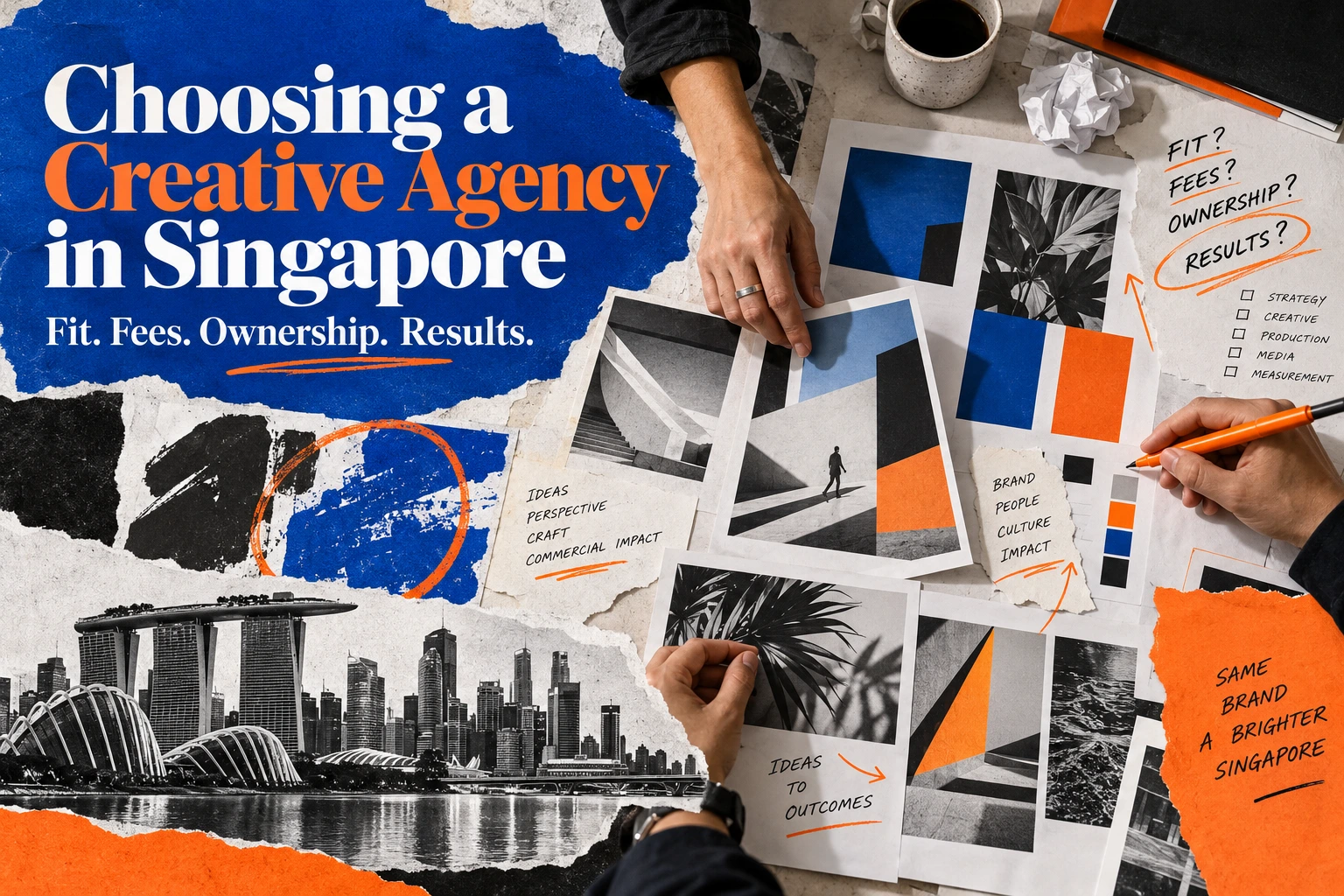
Choosing a creative agency in Singapore comes down to structure, not just portfolio or quote. A creative agency that shares risk through its pricing, agrees success metrics before the brief, and protects your ownership of the work will usually deliver more than a stronger studio on a loose arrangement. Creative agencies in Singapore typically fall into three types: boutique, full-service and niche specialist. Fee ranges vary by engagement type, and the contract clauses to check are set out below.
Most Singapore brands choose creative agencies based on the portfolio and the quote. That is the wrong test. A portfolio shows what an agency could do for someone else, and a low quote can hide costs that surface later. Ask three things instead: does the pricing model share risk, are success metrics agreed before the brief, and do the contract terms protect your assets?
This guide is for marketing leads, founders and procurement teams shortlisting creative agencies. It provides a scorecard to compare agencies on fit, pricing alignment, and contract protection, with local price benchmarks in Singapore dollars. By the end, you will have a shortlisting method, a comparison of pricing models and a checklist of contract clauses to negotiate before signing.
Key Takeaways
- Choose on structure, not just portfolio. Pricing model, KPI definition and contract terms predict results more reliably than polished past work.
- Match agency type to scope. Boutiques suit focused projects, full-service agencies suit integrated campaigns, and niche specialists suit specific channels such as B2B performance.
- Pricing splits are shifting. Project fees make up about 45% of spend, monthly retainers about 40%, hybrids about 10% and pay-for-performance about 5%, according to Hamilton Sherwind’s review of Singapore agencies.
- Tie part of the fee to results. Lead-generation and e-commerce agencies may tie 10 to 20% of fees to CPA or ROAS targets. Keep the trigger metric simple and the amount at risk capped.
- Protect your assets in the contract. Settle IP ownership, working-file access, termination and handover before signing.
- Set KPIs before the brief. Agree upfront on measurable targets and a reporting rhythm so you can judge every agency on the same outcome.
What the Market Size Means for Buyers
Singapore’s advertising market is large and still growing. Ad spend is forecast to reach about SGD 3.6 billion in 2025, with digital marketing above SGD 1.25 billion and growing at 10.7% a year, according to Hamilton Sherwind’s review of Singapore creative agencies. Add experiential, activation, and production fees, and the creative-services revenue pool sits at roughly SGD 4.2 to 4.3 billion, according to the same source.
Foreign brands drive much of this demand. The overall advertising market grows at about 6 to 7% a year, slightly ahead of Singapore’s GDP, as multinationals move APAC budgets to the island. More than 7,000 regional HQs run APAC lead generation from Singapore, making B2B performance marketing one of the fastest-growing niches here. Companies in that segment increasingly expect their Singapore agency to deliver measurable outcomes.
A large, crowded market gives buyers more choice, but weak selection costs more. Treat these figures as context for screening, not proof that any one agency offers good value. Keep media spend and creative spend separate when you build a budget, because agencies quote against different pools. Set a clear strategy before you contact design agencies or marketing services providers so every campaign has a defined purpose, and check that the agency’s website and past work show how it plans to help you reach it.
Most brands choose an agency on portfolio polish and headline price. The better test is whether the agency’s fit, pricing structure and measurable outcomes match your goals. A strong portfolio shows what an agency can make. The commercial terms show whether it will keep working toward your results after the pitch. The same test applies to branding agencies, marketing agencies, and the web design, packaging design, and social media work they deliver.
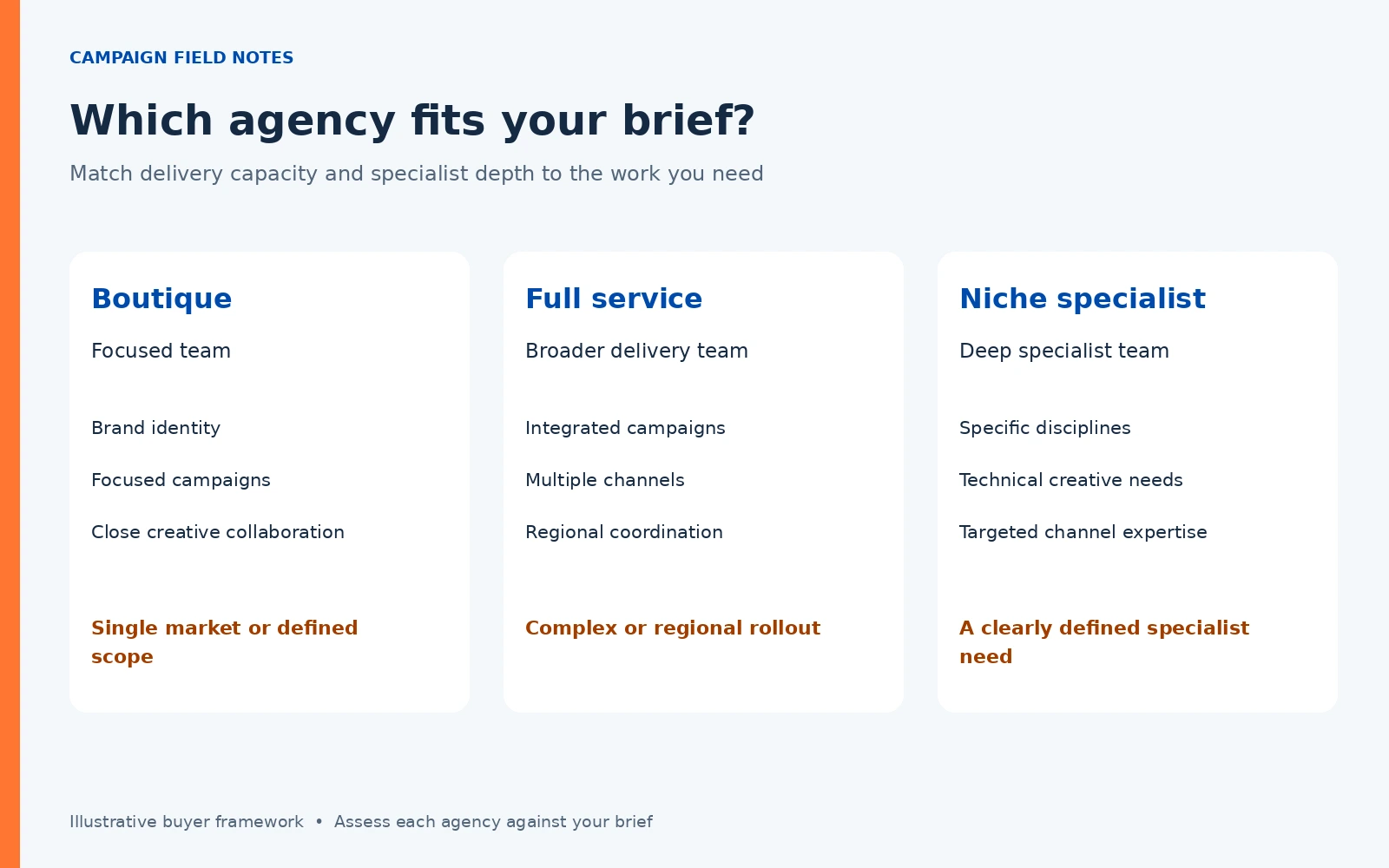
Comparison Table: Agency Types
Three types of agencies serve three kinds of briefs. Matching the type to scope and budget matters more than how polished the last campaign looked.
Boutique agencies run on small teams, so a senior person often stays close to your account. You get direct attention and fast decisions. The trade-off is capacity: a boutique can struggle with a large multi-market roll-out that needs many people working at once.
Full-service agencies handle branding, digital and production under one roof. That suits businesses that want one partner and one set of briefs. The cost is higher overheads, which show up in your fees.
Niche specialists go deep on one discipline, such as B2B performance marketing, e-commerce or experiential activation. They usually deliver faster results in their field, but they will not run the brand identity for you, so the business may still need other partners for design and packaging design.
| Agency type | Team size | Best-fit projects | Typical engagement | Trade-offs |
|---|---|---|---|---|
| Boutique | Small, senior-led | Focused brand or single-market work | Project or retainer | Limited capacity for large roll-outs |
| Full-service | Large, multi-discipline | Integrated campaigns across channels | Retainer with project add-ons | Higher overheads and fees |
| Niche specialist | Focused, specialist team | One discipline done well | Project or performance-linked | Narrow scope, needs other partners |
Match the type to scope first, then to budget. A regional roll-out with a tight deadline usually needs full-service capacity, while a single-market campaign may suit a boutique. Before you shortlist, review each agency’s services and contact options, and check how its marketing and digital services fit your content and social media plans. Companies comparing a design agency or a digital strategy partner should also weigh how each option handles their strategy and advertising needs.
A Quick Diagnostic
Ask three questions before writing the brief:
- What is the gap? Awareness, consideration, conversion or retention.
- Where does the buyer decide? The buyer may decide at a screen, a showroom, an event, or a sales call.
- What would prove success? A lead count, a sign-up rate or a brand-recognition lift.
If the answer to question one is “people don’t know us”, start with branding or experience. If the answer is “people know us but don’t buy,” start with digital.
Most businesses in Singapore choose a creative agency based on portfolio and price. A better test is how the agency is paid, how it defines success before the brief, and what the contract says about ownership. Those three choices decide the outcome long after the pitch. The Singapore market is crowded, so a structured shortlist helps a buyer find the right help. Ask each marketing agency on the shortlist the same questions in the same order, so you can compare the answers directly.
Start with the pricing model, because it allocates risk. Project fees suit a defined campaign, while retainers suit ongoing work. According to Hamilton Sherwind’s review of Singapore agencies, project-based deals account for roughly 45% of spend, and monthly retainers for about 40%, with pay-for-performance still niche at around 5%.
Top 10 Creative Agencies in Singapore to Consider in 2026
Choosing a creative agency becomes easier when you know what you need it to solve. A brand repositioning, a regional advertising campaign and an ongoing social content programme require different strengths.
This shortlist brings together ten Singapore agencies across integrated marketing, advertising, branding and design. The suitability recommendations are editorial assessments based on published services and work. Portfolio examples demonstrate experience, but do not establish that an agency currently holds the account or delivered every aspect of a client’s marketing.
Disclosure: MediaOne publishes this guide and appears first. This list is an affiliated editorial shortlist, rather than an independent industry ranking. Compare relevant work, client references and proposals before making your decision.
Creative Agencies in Singapore: Quick Comparison
| Agency | Particularly suitable for | Main creative focus |
|---|---|---|
| MediaOne | Businesses connecting brand development with digital marketing and measurable acquisition | Brand strategy, storytelling, design and digital execution |
| The Secret Little Agency | Brands seeking distinctive campaign ideas and culturally relevant communications | Creative strategy, advertising and integrated campaigns |
| BLKJ Havas | Established brands seeking attention through culture, entertainment and media | Integrated creative and brand-building campaigns |
| GOVT VCCP | Organisations needing coordinated local and regional communications | Advertising, integrated campaigns and digital creative |
| Kinetic Singapore | Brands prioritising unconventional ideas and strong design craft | Branding, advertising, experiences and digital design |
| Foreign Policy | Businesses building or repositioning a distinctive brand | Strategy, identity systems and brand experiences |
| Anak | Organisations developing identities across multiple customer touchpoints | Branding, design systems and brand transformation |
| Somewhere Else | Challenger brands seeking clearer positioning and differentiation | Brand strategy, verbal identity and visual identity |
| Formul8 | Businesses needing coordinated advertising, content and production | Advertising, branding, digital, social and video |
| DSTNCT | Brands engaging younger audiences through content and experiences | Audience strategy, social content and integrated campaigns |
1. MediaOne: Branding Connected to Digital Growth
Best for: SMEs and enterprises wanting brand strategy and creative execution connected to their wider marketing programme.
MediaOne’s branding services cover strategy, brand storytelling, visual design and social communication. Its broader digital offering makes it relevant when a new identity must carry through to websites, content and customer acquisition. The agency says it has worked with more than 3,000 businesses across its services; this is an agency-wide credential, not a count of branding projects. MediaOne
Why consider MediaOne? A refreshed brand needs practical implementation. MediaOne is worth considering when the brief includes both developing the brand and putting it to work across digital channels.
What to ask before hiring: Request recent creative projects comparable to your brief. Confirm the creative lead, research scope, revision rounds, working-file ownership and how brand objectives will connect with campaign measurement.
Explore: MediaOne’s branding services.
2. The Secret Little Agency: Distinctive Campaign Ideas
Best for: Ambitious brands seeking memorable advertising and ideas that connect with culture.
The Secret Little Agency, commonly known as TSLA, is a Singapore creative company within the Mother family. Its published work includes Star Alliance, while its news page describes collaboration with sister branding practice Anak on the Singpass rebrand. These examples offer starting points for examining its campaign thinking and ability to coordinate specialist disciplines. The Secret Little Agency
Why consider TSLA? Put it on your shortlist when the central challenge is finding a distinctive creative platform that can support a broader brand story.
What to ask before hiring: Ask how the team develops and tests ideas, who remains involved after the pitch, and which production, design or experiential services require separate scopes.
Explore: TSLA’s work.
3. BLKJ Havas: Creative Work Built Around Culture
Best for: Established brands seeking campaigns that earn attention across entertainment, media and contemporary culture.
BLKJ Havas positions its work around cultural relevance and integrated creativity. Its website highlights Singapore Agency of the Year recognition at Spikes Asia 2024, providing a specific award credential buyers can investigate alongside the underlying work. blkjhavas.agency
Why consider BLKJ Havas? It merits consideration when a conventional advertising approach is struggling to attract attention and the brief needs a stronger connection with how audiences spend their time.
What to ask before hiring: Request a comparable campaign showing the business problem, creative idea, distribution plan and measured outcome. Clarify which network resources are included and which carry additional fees.
Explore: BLKJ Havas.

4. GOVT VCCP: Integrated Local and Regional Campaigns
Best for: Organisations that need a coordinated creative partner across advertising, digital, and regional communications.
GOVT and VCCP announced their strategic merger in January 2026. The announcement identifies experience across brands including OCBC, Cathay Pacific, Sentosa, Julie’s Biscuits, Puma and Canon. These credentials span the combined businesses, rather than evidence of identical service scope for every client. GOVT VCCP
Why consider GOVT VCCP? The combination makes it relevant for briefs that require local audience understanding alongside a broader network’s delivery resources.
What to ask before hiring: Confirm the team assigned to your account, how responsibilities are divided across disciplines, and how regional adaptation, approvals and production costs will be managed.
Explore: GOVT VCCP Singapore.
5. Kinetic Singapore: Unconventional Ideas and Design Craft
Best for: Businesses wanting distinctive design across brand identity, campaigns, experiences and digital touchpoints.
Kinetic describes itself as an independent design and advertising agency. Its portfolio includes work for DesignSingapore Council, MINI, SGInnovate, Project Açai and NTU’s School of Art, Design and Media. Its stated capabilities extend from branding and activation to social campaigns and web and app UX/UI design. kinetic.com.sg
Why consider Kinetic? Its published work offers a useful reference for buyers who value visual originality and detailed execution.
What to ask before hiring: Ask how the concept will translate into everyday materials, who will manage production, and what guidelines, templates, and editable assets your internal team will receive.
Explore: Kinetic’s portfolio.
6. Foreign Policy: Strategy and Expressive Brand Systems
Best for: Organisations creating a new brand or repositioning an existing one across physical and digital experiences.
Foreign Policy is an independent Singapore strategy and design office founded in 2007. Its published services span research, positioning, naming, visual and verbal identity, digital design, spatial design and campaign rollout. Its website features projects including Makan and Dumpling Darlings. Foreign Policy
Why consider foreign policy? Its breadth matters when the brand must feel coherent across packaging, spaces, communications, and digital experiences.
What to ask before hiring: Clarify the research deliverables, customer validation, implementation support and division of responsibility between the agency, architects, developers and production vendors.
Explore: Foreign Policy’s capabilities.
7. Anak: Brand Transformation Across Touchpoints
Best for: Organisations building a distinctive identity that must work across products, services, spaces and communications.
Anak’s published portfolio includes Brand SG, Banyan Group, Love, Bonito, Mandai, Grain and Cold Storage. TSLA identifies the practice as its sister branding agency, so buyers considering both should understand the relationship and the proposed division of work. Branding and Design
Why consider Anak? Its portfolio makes it a relevant option when the brief goes beyond a logo and requires a coherent brand system across many applications.
What to ask before hiring: Ask how the identity will be tested across languages, formats and customer journeys. Confirm launch support, brand governance and the templates needed for future implementation.
Explore: Anak’s projects.
8. Somewhere Else: Positioning for Challenger Brands
Best for: Growing businesses that need a clearer reason for customers to choose them.
Somewhere Else positions itself as a strategy-first, people-centred brand consultancy for challenger brands. Its published case studies include Gryphon Tea, Mr. Bucket, Cedele, Seek Sophie, Oatbedient and Brass Lion Distillery, giving buyers several examples of how positioning translates into identity and expression. Strategic Brand Consultancy in Singapore
Why consider Somewhere Else? It is worth exploring when the underlying problem is unclear differentiation, rather than simply dated visual materials.
What to ask before hiring: Ask how customer research informs the strategy, how competing positioning options are evaluated, and what support follows delivery of the brand guidelines.
Explore: Somewhere Else’s case studies.
9. Formul8: Broad Creative and Production Support
Best for: Businesses coordinating advertising, branding, social content, digital assets and video.
Formul8 lists more than 25 years of experience across sectors including real estate, government, lifestyle, automotive and finance. Its services cover advertising strategy, identity development, digital design, social content and video production. Its published client roster includes Audi, BMW, CapitaLand, GovTech, and UOB. Agency
Why consider Formul8? Its broad service range makes it relevant when a campaign requires many connected deliverables and consistent execution.
What to ask before hiring: Clarify which services are delivered internally, how production is priced, and how deadlines and approvals will be coordinated across the different workstreams.
Explore: Formul8’s services and credentials.
10. DSTNCT: Audience Relevance, Content and Experiences
Best for: Brands seeking to engage younger audiences through social content, integrated campaigns and live experiences.
DSTNCT positions itself around the next generation of consumers, platforms, content and brands. Its published portfolio includes AIA Glow Festival, AIA social media work, GrabShare’s launch, and social media marketing for Singapore Art Week. These projects offer useful examples of its content and experiential execution. dstnct.co
Why consider DSTNCT? It belongs on a shortlist where audience participation and platform relevance are central to the brief.
What to ask before hiring: Ask how audience insights shape the concept, how content will be adapted by platform, and how engagement will connect with attendance, enquiries or other agreed outcomes.
Explore: DSTNCT’s work.
Turn This List Into a Practical Shortlist
Choose three agencies whose published work matches your business challenge. Give each the same brief, deliverables, budget parameters and evaluation criteria.
Request one relevant case study and a client reference from a comparable engagement. Compare the proposed team, strategic process, implementation scope, total costs and ownership terms alongside the creative work.
The next section’s scorecard will help you assess those proposals consistently.
Scoring Agencies on Fit and Contract Terms
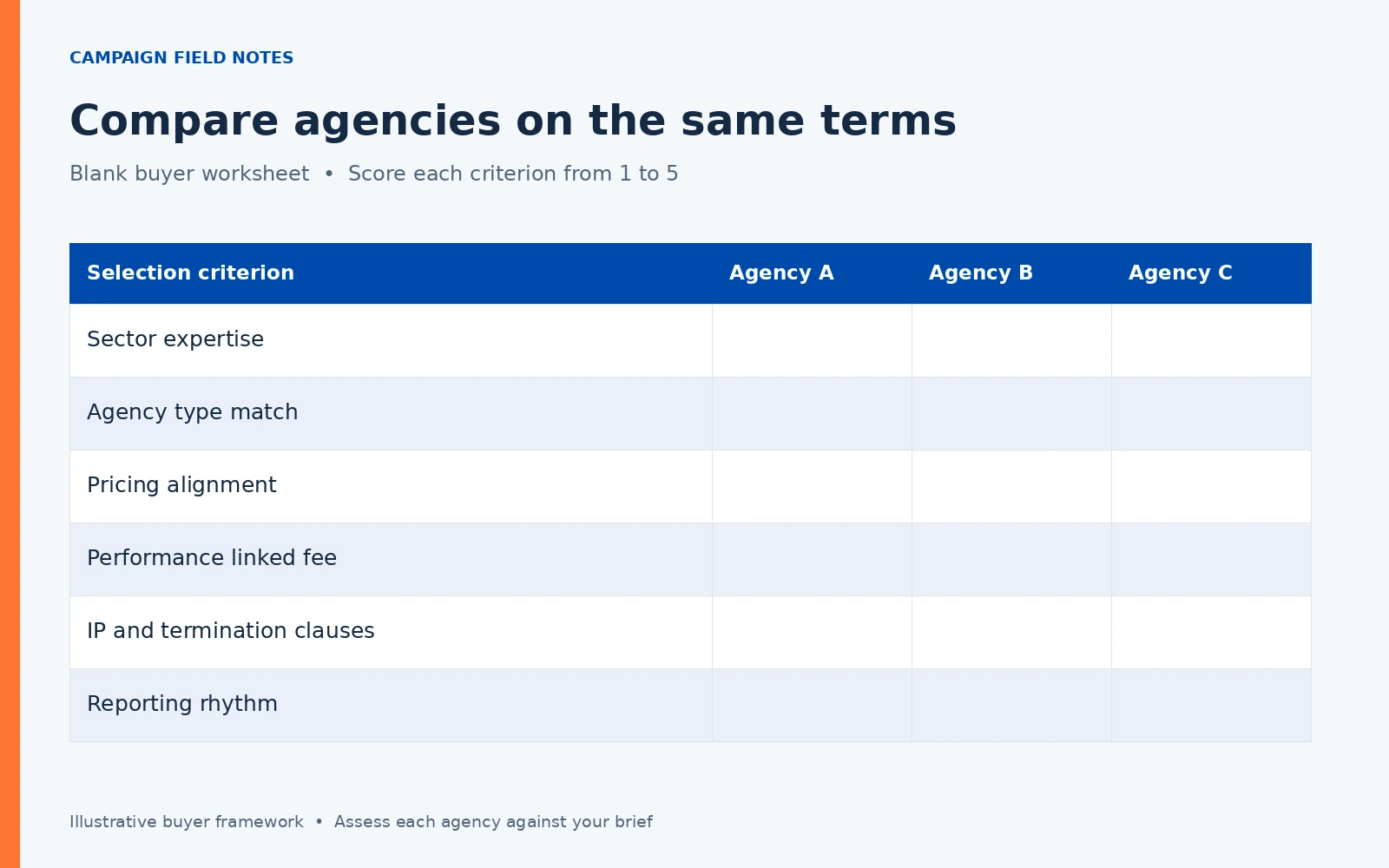
Score each shortlisted agency from 1 to 5 on six criteria: sector expertise, agency type match, pricing alignment, performance-linked fee, IP and termination clauses, and reporting cadence. Double-weight pricing and contract terms, since they shape results after the pitch. Set a minimum pass threshold of 4 on both weighted criteria before an agency is selected. These thresholds are the author’s suggested working rule, not an industry standard.
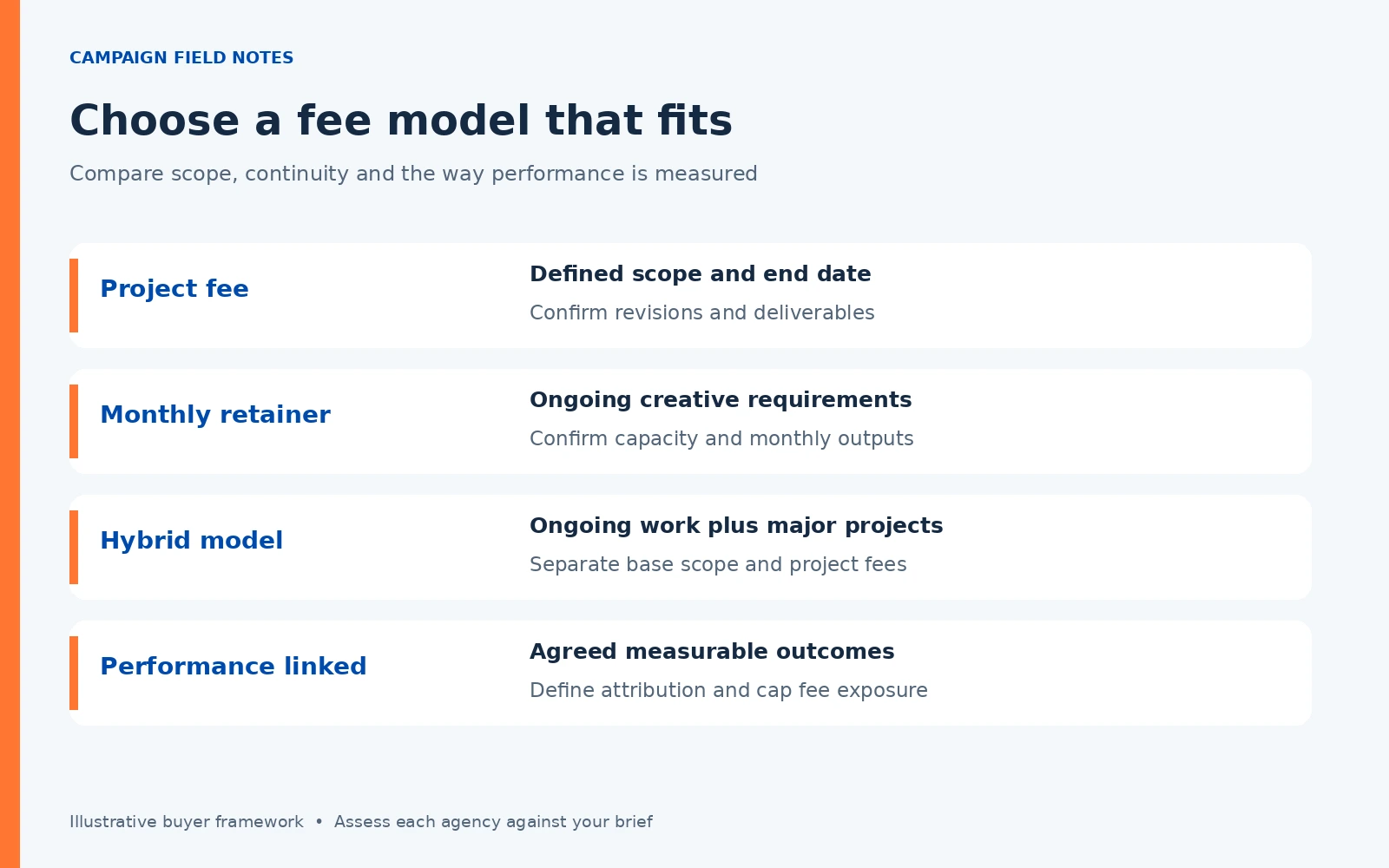
Most buyers compare agencies on price and portfolio. That misses where the money actually goes. The pricing model decides how risk is shared, and risk-sharing decides whether the agency and the client pull in the same direction. Design agencies and full-service firms often bundle fees in ways that hide this split, so ask for each line to be shown separately.
Industry estimates put project-based fees at roughly 45% of agency spend, monthly retainers at about 40%, hybrid arrangements at about 10%, and pay-for-performance at around 5% (source). Project fees suit a defined campaign with a clear end date. Retainers suit ongoing social content or always-on digital work, but they can drift if scope is not written down.
| Pricing model | How fees are set | Risk allocation | Best use case | Watch-outs |
|---|---|---|---|---|
| Project | Fixed fee per deliverable | The client carries budget risk; the agency carries delivery risk | Naming, logo, a single campaign | Scope creep after sign-off |
| Retainer | Fixed monthly fee for a capacity | The client pays for time whether or not results land | Ongoing content and social | Unused capacity, vague deliverables |
| Hybrid | Base retainer plus project fees | Shared, with a predictable base | Brands with steady work plus launches | Two billing streams to track |
| Performance-linked | Part of fee tied to CPA, ROAS or brand lift | Agency shares outcome risk | Lead generation, e-commerce | Hard to agree on a trigger metric |
For lead-generation and e-commerce work, agencies may tie 10 to 20% of fees to CPA or ROAS targets (source). Cost per acquisition (CPA) is the cost of each customer won, and return on ad spend (ROAS) is the revenue earned per dollar spent. Set the trigger before the brief, and cap the amount at risk so a missed target does not sink the relationship.
Conclusion: Choosing the Right Creative Agency Partner
Choosing a creative agency comes down to six linked decisions. First, match the agency type to the project: a boutique for senior attention on a focused brief, a full-service agency for integrated roll-outs, or a niche specialist for one channel. Second, confirm the speciality fits the brief. Third, test sector fit and cultural fit through a paid briefing. Fourth, select the pricing structure that shares risk sensibly, whether project, retainer, hybrid or performance-linked. Fifth, lock in contract clauses that protect your assets, including ownership of the working files. Sixth, agree the KPIs and reporting cadence before the first deliverable.
Run the agency relationship as a measured partnership, not a supplier purchase. Set targets, review them monthly, and tie part of the fee to outcomes where the channel allows it. Portfolio polish shows what an agency can make. The commercial structure shows whether it has a reason to make the work that moves your numbers.
Frequently Asked Questions
How much does a creative agency cost in Singapore?
Costs depend on scope. Naming, a logo and a mini guideline for an SME typically run SGD 18,000 to 35,000. A full corporate identity for a large regional brand runs SGD 60,000 to 200,000. A single-market campaign costs SGD 80,000 to 150,000 before production and media, and a Southeast Asia regional toolkit runs SGD 180,000 to 350,000. These are starting ranges, not fixed quotes. Ask each shortlisted agency to itemise its quote against the same brief.
Should I choose a retainer or a project-based agency?
Choose a project fee for a defined campaign with a clear end point. Choose a monthly retainer for continuous work such as social content or always-on lead generation. Project fees account for roughly 45% of agency spend, and retainers about 40%, so retainers are common. If your needs are mixed, a hybrid model of a base retainer plus project fees is the usual compromise.
What should a creative agency contract include?
Check four areas: who owns the creative assets and working files, and when that ownership transfers; notice periods, payment for completed work and handover duties on termination; any performance-linked fee, with the CPA or brand-lift target defined in advance; and how campaign and customer data is handled and kept confidential.

How do I measure whether an agency is delivering results?
Set KPIs before the brief, matched to the goal: awareness, consideration, conversion or revenue. Agree on a reporting rhythm, typically weekly operational updates, monthly performance reviews and quarterly strategy checks. Insist on direct access to analytics and agreed attribution rules so you can check results without relying only on the agency’s summary.
When is in-house creative work better than outsourcing?
In-house work makes more sense when output is frequent, repetitive, and closely tied to product knowledge, such as routine social posts or internal updates. Outsource when you need specialist skills you don’t employ, such as brand identity, large campaign concepts, or experiential activation, or when the point of the project is a fresh outside view.
What is the difference between a boutique and a full-service agency?
A boutique agency offers small teams and senior attention but has limited capacity for large, multi-market rollouts. A full-service agency provides branding, digital and production under one roof, with higher overheads. Match the type to your scope: a boutique suits a focused project, while a full-service partner suits a multi-channel programme needing one coordinating team.