AI Summary
|
To hire digital marketers in Singapore well, you need more than the longest CV or the fanciest portfolio. It is about matching the right skill set to your business model, channel, and growth stage, then testing that match before committing capital.

Three common hiring mistakes undermine recruitment in Singapore. Businesses hire generalists when they need specialists. They outsource everything to an agency without understanding what they are paying for. They skip compliance checks that create legal and data-protection risk later. This playbook walks through a five-step hiring process, 2027 salary benchmarks, and a diagnostic rubric for measuring whether the hire is working by week twelve. The outcome is a one-page hiring brief template ready for use with recruiters.
TL;DR: The Singapore Digital Marketing Hiring Brief
- Define the role by channel, not job title. An e-commerce paid-search specialist and a B2B account-based marketing (ABM) marketer require different skill sets and are not interchangeable hires.
- Match your hiring model to your channel mix. In-house works best for compounding channels such as search engine optimisation (SEO) and lifecycle email. Agencies win on speed and unfamiliar channels. A hybrid model combining a local lead with offshore execution pods wins on cost efficiency for businesses spending S8,000toS20,000 monthly.
- Budget the true all-in cost, not the advertised salary. A S$6,000 monthly hire costs noticeably more than the advertised salary once employer Central Provident Fund (CPF) contributions, tools, recruitment fees, and equipment are included.
- Filter candidates with a paid trial task and a structured 90-minute walkthrough. Portfolios may misrepresent capability; a structured trial task provides objective evidence of actual skill.
- Use a shared scoring rubric before deciding. A decision record based on agreed criteria is more reliable than gut feel.
The Singapore Hiring Reality Check: Why “Just Post a Job Ad” Fails
Most Singapore employers treat digital marketing recruitment as a standard hire. Post a job ad to LinkedIn and JobStreet. Interview a handful of candidates. Hand the offer to whoever sounds sharpest on a call. This approach reliably produces one of three poor outcomes: hiring someone overqualified who leaves in six months; hiring someone underqualified and spending a year fixing their work; or hiring an agency that costs 40% more than an in-house alternative.
Three structural constraints make Singapore harder to hire into than London, Sydney, or Toronto.
Constraint One: Ministry of Manpower Employment Pass Requirements
Under Ministry of Manpower (MOM) rules, a new Employment Pass applicant must earn a fixed monthly salary of at least S$5,600 (S$6,200 in financial services), with the threshold rising with age. For new applications from 1 January 2027, this rises to S$6,000 (S$6,600 in financial services). Applicants must also pass MOM’s COMPASS points framework, and employers must meet job-advertising requirements.
This threshold immediately eliminates mid-market talent pooling. If you want a regional manager or performance marketing lead from abroad, the salary threshold is realistic. For mid-level or junior roles, most salaries fall below the Employment Pass minimum, so you will usually hire locally or use an S Pass, which has its own lower salary threshold (S$3,300 for most sectors in 2026).
Local talent is concentrated in finance, technology, and fast-moving e-commerce. Digital marketing as a career still carries lower prestige and lower salary ceilings than software engineering or data science. Senior practitioners often transition into product management or strategy roles instead of staying deep in marketing execution.
Constraint Two: Cost Penalty Against Regional Alternatives
Singapore salaries for digital marketing professionals run 25% to 40% higher than equivalent roles in Malaysia, Thailand, or India, even when adjusted for cost of living. A mid-level SEO specialist in Singapore costs S6,000toS8,000 monthly in-house. The same skill set in Kuala Lumpur or Bangkok costs 40% to 50% less.
Employer CPF contributions are up to 17% of monthly wages for Singapore Citizens and Permanent Residents aged 55 and below. This is capped at the S$8,000 monthly Ordinary Wage ceiling, so the maximum is S$1,360 per month. Employment Pass holders are not covered by CPF.

Add paid leave under the Employment Act, plus common contractual benefits such as a 13th-month Annual Wage Supplement and medical cover. Overseas agencies exploit this arbitrage aggressively. They sell a “full-time equivalent” Southeast Asia team at a price that looks cheap against Singapore salaries but delivers lower continuity and local knowledge.
Constraint Three: Shortage of Senior Practitioners
Singapore has no shortage of junior and mid-weight digital marketers. There is a chronic shortage of practitioners with seven or more years in a single market who have built campaigns that delivered measurable results at scale and can lead or mentor.
Many senior people work agency-side and are not available for in-house roles. Others have moved into strategy, business development, or management consulting, where career progression is faster. Hiring a truly senior person (Head of Marketing, Director level) often means accepting someone with strong credentials but weaker local execution experience, or paying agency-equivalent fees for fractional leadership.
Local vs. Regional Hiring: When Singapore Knowledge Matters
Not every role needs a Singapore specialist. But the trade-off is rarely straightforward.
Singapore is a multi-lingual, multi-cultural, heavily regulated market where campaign assumptions shift fast. A campaigns executive running Facebook ads here must understand what resonates with Chinese-speaking audiences (where filial piety and value-for-money messaging differ from Anglophone Southeast Asia). The same applies to Tamil-speaking and Malay-speaking audiences. Language is not just translation. It is category knowledge, cultural sensitivity, and regulatory interpretation.
Personal Data Protection Act (PDPA) compliance for data handling looks simple on paper. Many agencies fail it because they do not understand that Singapore customers expect granular consent and easy opt-out, not the bare legal minimum. Influencer marketing works differently here than regionally. Micro-influencers are often more trusted than mega-influencers because the population is smaller and scepticism of sponsored content runs high.
A regional hire can learn these nuances. Ramp-up time typically runs six to nine months before someone from Bangkok or Manila operates at full effectiveness in Singapore. For campaigns that need to move fast, that ramp-up cost often exceeds the salary savings of regional hiring.
Decision thresholds for local vs. regional hiring:
- If your business generates 60% or more of revenue from Singapore and operates in a category where local trust and regulatory compliance matter (financial services, healthcare, e-commerce), hire locally.
- If you are a pure regional software-as-a-service (SaaS) business that happens to serve Singapore, a regional hire works fine.
- If you are in between, hire locally for customer-facing roles and regionally for execution support.
The Agency Default Trap: Why Many SMEs Overpay
When hiring seems too complex, small and medium enterprises (SMEs) default to an agency. Agencies appear simpler: sign a contract, they own hiring and continuity, and you get defined output. This simplicity is expensive.
A full-service digital agency in Singapore charges S8,000toS25,000 monthly for a retainer, depending on scope and seniority of staff. That retainer buys a team of two to four people at any given time, but team members turn over frequently. Your account is shared with five to ten other clients. Strategic decisions move at the agency’s pace, not yours.
Over a 24-month contract, you spend S192,000toS600,000. An in-house hire costs S72,000toS120,000 yearly all-in (salary plus CPF plus statutory benefits), meaning an in-house marketer over two years costs S144,000toS240,000. You get one person who is 100% yours, stays long enough to understand your business, and compounds in effectiveness over time.
The agency model makes sense if you have no marketing function at all and need to test a channel fast. It makes little sense if you know you will be hiring marketing for three or more years.

Many SMEs discover this too late. They spend 18 months with an agency, realise the account performance is declining, switch to in-house, and spend another six months rebuilding what was lost. By then, they have spent the agency retainer plus in-house salary and resent both.
Before You Hire: Define the Role by Channel and Business Model, Not Job Title
The question to ask before posting a job ad is not “What seniority level should I hire?” Instead, ask “Do I need a full-time specialist, a shared senior part-time hire, an agency, or a hybrid?” The answer determines everything downstream: salary expectations, where you search, what you ask in interviews, and how you measure success.

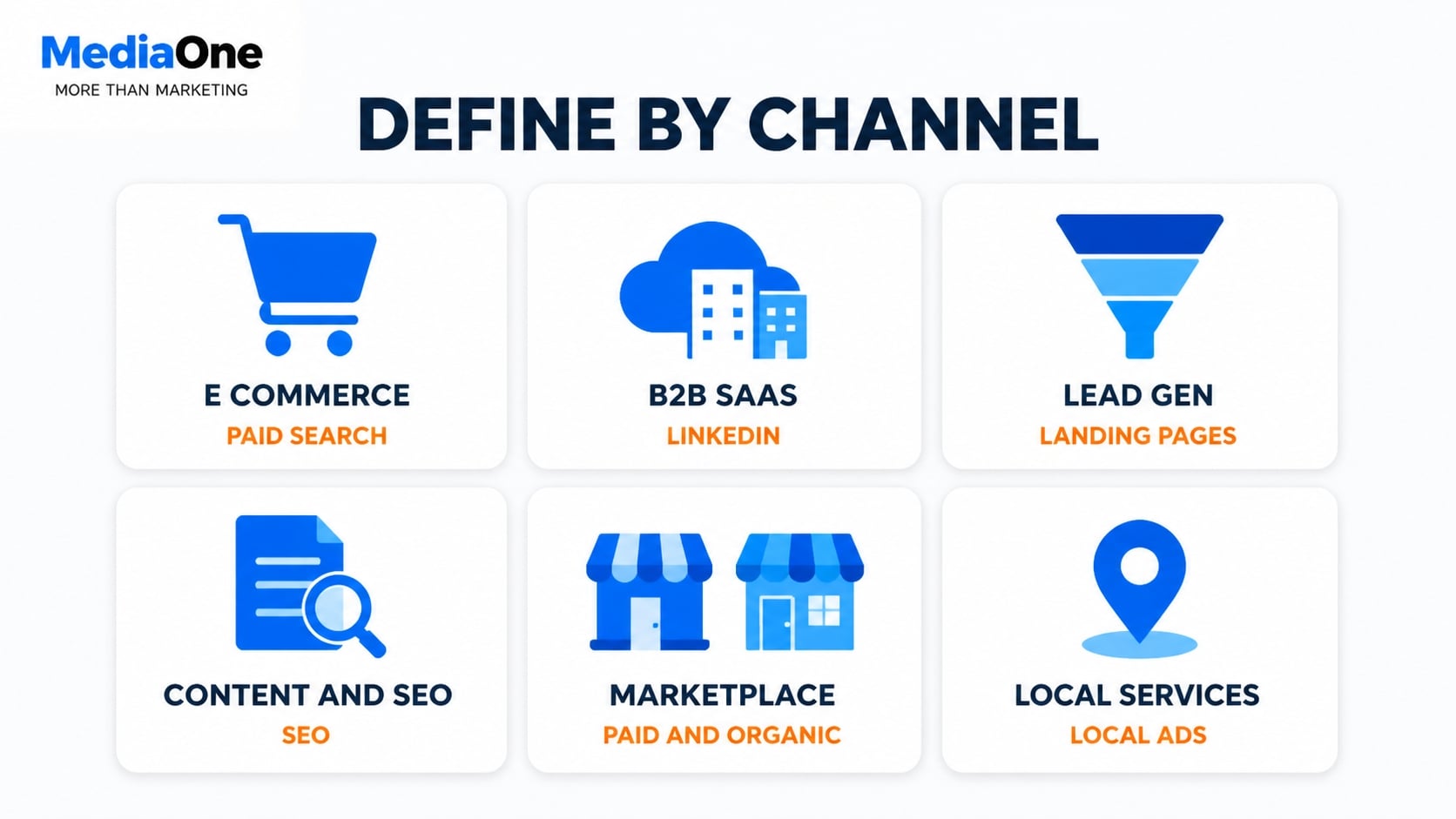
Different business models and channels require different skill weightings. E-commerce roles prioritise conversion rate optimisation (CRO) and paid performance. B2B roles emphasise account research, messaging discipline, and sales alignment. Lead-generation roles depend on funnel mechanics and cost-per-lead optimisation. These are not job title differences. They are fundamentally different skill sets and experience requirements.
The most common mistake Singapore employers make is posting a job ad for “Digital Marketer” or “Marketing Manager” and waiting to see who applies. This approach almost always leads to hiring the wrong person for the wrong reasons.
A job title tells you nothing about what the person will actually do. “Digital Marketer” could mean someone running paid search ads, building email nurture sequences, writing SEO content, managing social media communities, or analysing customer lifetime value. These are not just different tasks. They require different skill weightings, different experience baselines, and different hiring timelines.
The fix is to define the role backwards from your business model and primary marketing channel. Start there, not with the job title.
E-commerce, B2B, and lead-gen roles need different skill weightings
An e-commerce marketer’s success depends critically on conversion rate optimisation, attribution modelling, and product feed management. They need hands-on Shopify, Klaviyo, or Google Merchant Centre experience. Expect them to spend around 40% of their time on paid search and shopping ads, and they must understand unit economics from day one.
A B2B software company needs someone fluent in account-based marketing (ABM: targeting high-value accounts with personalised campaigns) workflows, LinkedIn campaign design, and sales enablement. They must speak the language of sales cycles, pipeline stages, and customer acquisition cost (CAC, the cost to win one customer) against lifetime value (LTV, the total profit from that customer). The role is more strategic and requires comfort with ambiguous attribution (tracking which touchpoint actually caused a sale).
A lead-generation business (financial services, education, real estate) needs a marketer who can reverse-engineer a cost-per-lead target, test landing pages rapidly, and manage a stack of CRM integrations (connecting tools so data flows automatically between them). Speed of iteration matters more than depth of channel expertise.
A content and SEO-first brand needs someone who understands long-tail keyword research (targeting less competitive search phrases with lower volume but high intent), content calendars, and linking strategies. They may touch paid media as a secondary lever, but their primary output is published work that ranks and attracts inbound traffic.
These are not interchangeable hires. A high-performing e-commerce paid-search specialist will struggle and likely burn out in a lead-gen role because the reward loop feels backwards to them (many leads, low conversion). A B2B ABM marketer will find e-commerce attribution exhausting because it demands constant tool-switching and spreadsheet work.
What this means for your hiring brief: Do not list “five years of digital marketing experience” as a requirement. Instead, specify proportions: “Primary responsibility: driving e-commerce conversion through paid search and feed optimisation (60% of time). Secondary: email and retention campaigns (30%). Tertiary: brand awareness (10%).”
A decision table: Map your primary channel to the required seniority and hire type
Use this table to anchor your hiring decision before you write the job description.
| Primary Business Model | Primary Channel | Secondary Skills | Seniority to Hire | Best Hire Type | Realistic Timeframe |
|---|---|---|---|---|---|
| E-commerce | Paid search (Google, Meta) | Feed optimisation, CRO, email | Manager or Lead | In-house specialist, or hybrid (lead plus agency support) | 4-8 weeks |
| B2B SaaS | LinkedIn plus content | ABM, email nurture, sales enablement | Manager or Lead, or fractional Head | In-house lead plus agency or freelancer for execution | 6-10 weeks |
| Lead-gen (services) | Landing pages plus paid acquisition | CRM integration, analytics, A/B testing | Lead or Specialist | In-house lead plus junior or freelancer for ad operations | 3-6 weeks |
| Content and affiliate | SEO plus organic social | Link building, content production, analytics | Lead or Content Strategist | In-house lead plus freelancer content team | 4-8 weeks |
| B2B marketplace | Paid search plus organic listings | Community, partnerships, analytics | Manager or Specialist | In-house (requires market context) | 6-10 weeks |
| Local services (SME) | Google My Business plus local ads | Reputation, paid search, basic SEO | Specialist or Junior | Freelancer or part-time in-house | 2-4 weeks |
How to use the table:
- Identify your primary business model in the left column.
- Confirm the primary channel is correct for your business. If it is not, that is a strategic problem to solve before hiring.
- Use the seniority level and hire type as your anchor. A junior hire for a lead-gen role is viable because the channel is narrow and the playbook is repeatable. A junior hire for B2B SaaS will fail because they lack the diagnostic skills needed to troubleshoot complex sales funnels.
- Treat the timeframe as the window to source, interview, and onboard. If your process is taking twice as long, the issue is usually role clarity, not the talent pool.
The “one-person army” fallacy: When a generalist is a cheaper mistake than a specialist
Small business owners often think: “I will hire one person who can do SEO, social, paid ads, and email. They will be cheaper than hiring a specialist.”
This is usually false.
A true generalist (someone equally strong at SEO, paid media, email, and analytics) is rare in Singapore and commands a senior salary of S60,000toS85,000 annually. You pay more, not less, because you are paying for scarcity.
A “generalist” you can hire quickly and cheaply (S35,000toS50,000) is not a generalist. They are someone mediocre at everything. They will:
- Run paid ads with poor audience segmentation and waste your budget.
- Publish thin SEO content that ranks for nothing.
- Send email campaigns with 15% open rates.
- Spend 60% of their time learning new tools instead of generating results.
The mismatch between their pay and your expectations builds resentment. Eleven months in, they resign.
The truth: A single specialist (a paid-search expert at S55,000toS70,000) will deliver roughly three times the return on investment (ROI) of a junior generalist at S$40,000. The specialist generates revenue. The junior generates friction from their learning curve.
When is a generalist the right hire? Only when:
- Your annual marketing budget is under S$15,000, so you are using free and low-cost channels only.
- You are explicitly hiring for 15 hours per week, not 40, and you own the strategy yourself.
- Your business model is so new you do not yet know which channel matters, and you are genuinely okay with slow, experimental results for the first six months.
In all other cases, hire for the channel that delivers your revenue most, then add a second person (junior or freelancer) once that channel is consistently profitable.
Strategic implication for your brief: Specify the primary channel first. Only add secondary channels to the role if your first-choice candidate already has them. Do not treat breadth as a feature; treat it as a red flag that the role is under-resourced.
The Four Hiring Models in Singapore Compared: In-House, Agency, Freelancer, and Hybrid
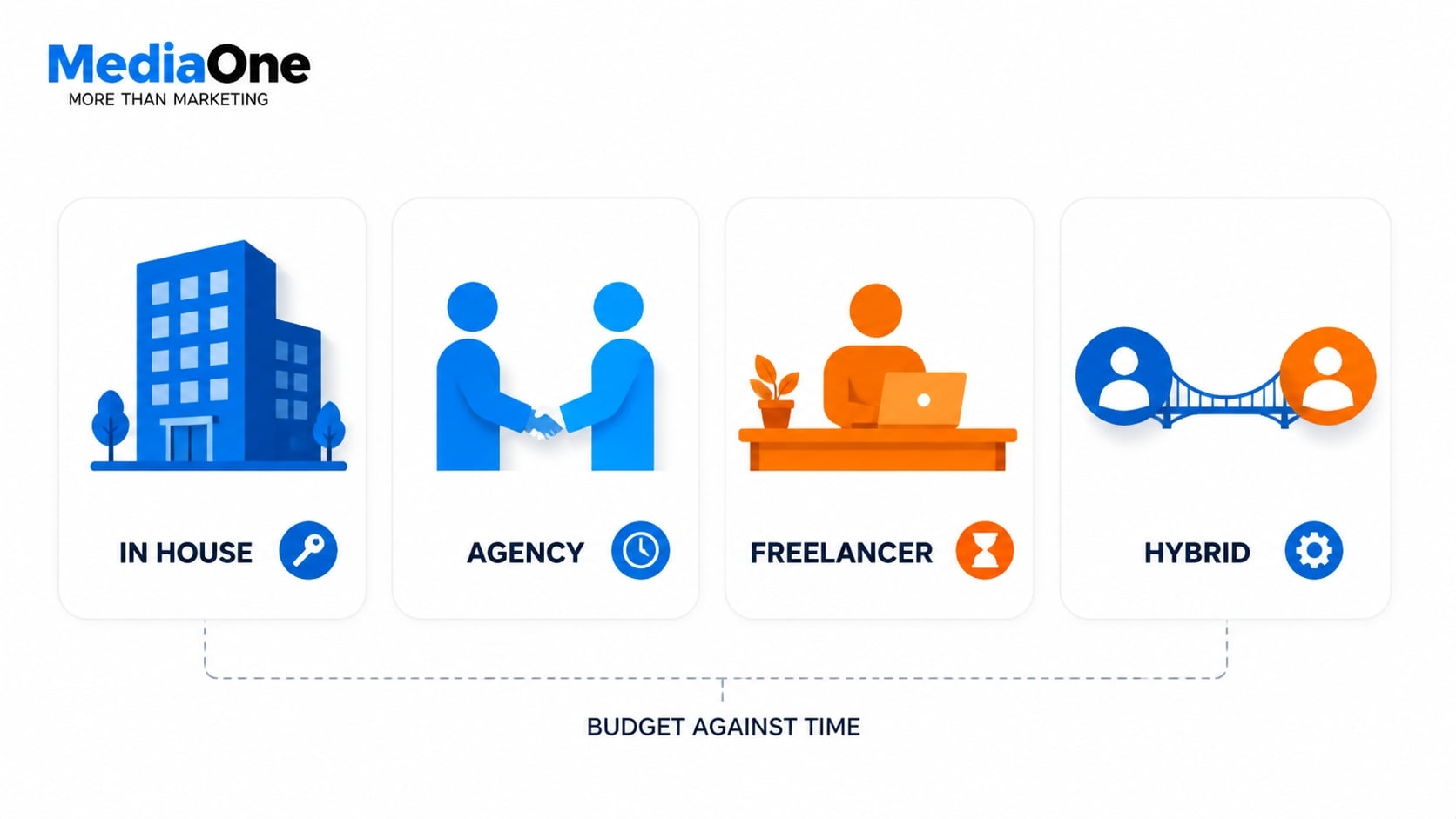
Most Singapore employers frame hiring as a binary choice: in-house or agency. This framing costs money because it ignores two viable models and overlooks the fact that your channel mix, not your headcount preference, should determine your hiring approach.
Before reviewing the comparison table, keep one question in mind: who carries the risk if this hire does not perform? The answer differs by model and is the single best predictor of total cost.
Comparison table: Cost, control, speed, and scalability for each model
| Factor | In-House | Agency | Freelancer | Hybrid |
|---|---|---|---|---|
| Upfront cost | Recruitment fee (15–25% of annual salary), notice-period buyout if applicable | Low: first retainer or project deposit | Lowest: often paid per deliverable | Moderate: local lead salary plus offshore pod rates |
| Ongoing monthly cost (SME range) | S4,500toS12,000 fully loaded | S3,000toS15,000 retainer | S800toS4,000 per project or part-month | S6,000toS14,000 combined |
| Control over priorities | High | Low to medium, shared across client roster | Medium, capped by hours purchased | High at the strategy layer |
| Time to first output | 6 to 12 weeks including hiring and notice | 2 to 4 weeks | 1 to 3 weeks | 3 to 5 weeks |
| Scalability | Low, one person has one capacity ceiling | High, but you pay for it | Very low | High, pods flex up and down |
| Knowledge retention | Stays in the business | Leaves with the account team | Fragmented, rarely documented | Stays with the local lead |
| Key risk | Wrong hire is expensive to unwind | Your account is never the priority | No cover when they go quiet | Coordination overhead if the lead is weak |
Table: Singapore market ranges based on advertised salaries, agency rate cards, and freelance marketplace listings, 2025.
Notice the pattern. Agencies trade cost for speed. In-house trades speed for control. Freelancers trade scalability for cost. Hybrid trades coordination effort for leverage. None of these are free.
The trap lies in the “ongoing cost” row. A S3,000agencyretainerappearscheaperthananS8,000 in-house hire until you examine what the retainer actually delivers. Most SME retainers at that level cover roughly 20 to 30 hours per month across a shared team. That is about one week of a dedicated employee’s time, for 40% of the salary.
When an in-house hire delivers better value than an agency
The rationale for in-house hiring works under specific conditions and fails under others. Here is the decision rule.
In-house delivers better value when all three are true:
- You have a compounding channel. SEO, lifecycle email, and content marketing reward accumulated context. An in-house marketer who understands your customer data over 18 months out-executes a rotating agency team on these channels.
- You produce more than 20 deliverables per month. Below that volume, you are paying a full salary for part-time output.
- Your category needs deep product knowledge. B2B SaaS and regulated industries such as fintech, insurance, and healthcare require this. Agency staff cannot credibly write about a product they relearn every quarter.
Agency delivers better value when any two are true:
- You need a capability you will not use full-time. Programmatic display, advanced analytics implementation, or creative production are examples. Hiring for a 10-hour-per-month need is waste.
- You are entering an unfamiliar channel. A first paid social launch benefits from an agency’s existing playbooks and tracking setup.
- Speed outranks cost. If your window is a product launch in six weeks, hiring cannot compete.
Freelancer delivers value when the task is bounded: a website migration, a one-off landing page set, or a Google Analytics 4 (GA4) setup. Treat freelancers as project capacity, not a marketing function.
One critical point that agency sales decks rarely emphasise: an agency retainer does not replace a marketing owner. If nobody inside your business can judge whether the agency’s work is good, you pay for output you cannot evaluate. This is the most expensive model of all.
The hybrid model that works: A local lead plus offshore execution pods
The hybrid model delivers the best cost-to-output ratio for Singapore SMEs, yet it is often executed poorly. The difference lies in whether the local lead is a strategist or a coordinator.
The structure:
- Local lead (Singapore-based, S6,000toS10,000 per month): Owns strategy, stakeholder management, and quality control. Must understand the Singapore and regional market, including language and cultural nuance across English, Mandarin, and Malay audiences.
- Offshore execution pod (Malaysia, Philippines, Vietnam, or India): Handles production such as ad builds, copy variants, design, reporting, and quality assurance. Rates typically run 40% to 70% below equivalent Singapore rates.
Why it works: The expensive Singapore salary funds strategy and decisions, not production. Strategy does not scale with time zones. Production does.
Why it fails: If the local lead cannot write a clear brief, review output critically, or push back on a pod that misses the mark, you have added a cost layer between you and the work. The pod will produce whatever it is asked to produce, including the wrong thing, efficiently.
Two guardrails make the difference:
- The local lead must own the scorecard. If the pod reports directly to you, accountability splits.
- Start with one pod, one channel, 90 days. Adding a second pod before measuring the first multiplies coordination cost without increasing output.
The hybrid model suits businesses spending S8,000toS20,000 monthly on marketing. Below that, coordination overhead consumes the savings. Above it, you can likely justify a second in-house specialist instead.
Whichever model you choose, the next question is what you pay. The benchmarks below give the 2025 figures, including CPF contributions, tools, and recruitment costs that employers often overlook in budgeting.
Salary and Rate Benchmarks: What You Actually Pay in Singapore (2025 Figures)
The cost of hiring a digital marketer in Singapore varies significantly depending on seniority, employment model, and scope. Too many SMEs underprice the role, then overpay for junior generalists. These are the real 2025 figures and the hidden costs.
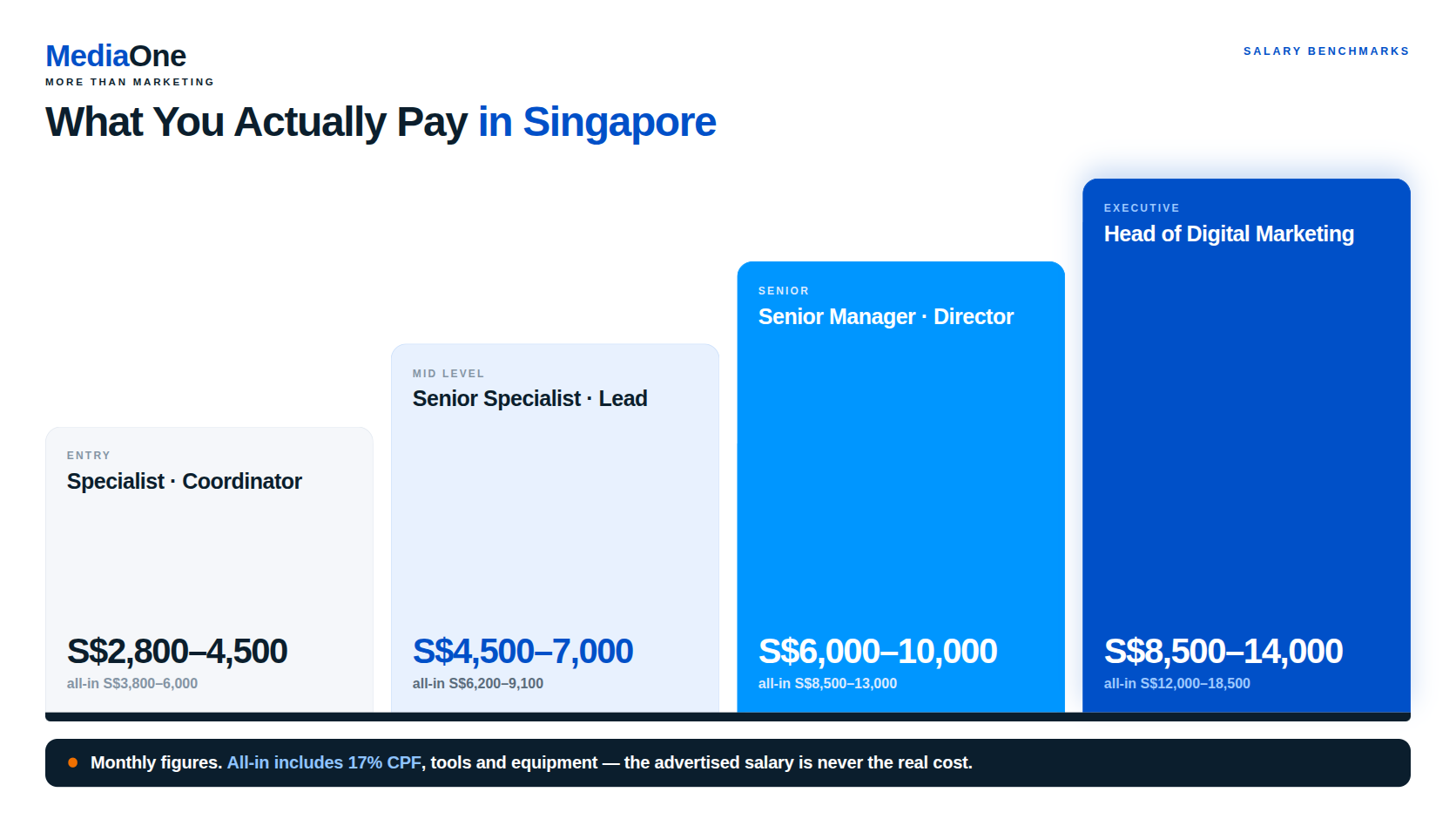
Monthly salary ranges by seniority: Executive, Manager, Lead, Head
Head of Digital Marketing / Executive (five or more years leading teams, profit and loss ownership, strategy to execution)
- In-house salary: S8,500toS14,000 per month
- Scope: Reports to C-suite, owns budget allocation, builds and manages teams of two to four people. Sets strategic direction, negotiates vendors, reports to the board, recruits and develops staff.
- All-in cost (including 17% CPF, tools, equipment): approximately S12,000toS18,500 per month
Senior Manager / Digital Director (three to five years in paid, organic, or full-funnel roles with proven ROI track record)
- In-house salary: S6,000toS10,000 per month
- Scope: Owns one or two channels end-to-end, trains junior staff, manages medium budgets (S50,000toS300,000 monthly spend). Develops campaign strategy, interprets analytics, supervises juniors, manages vendors.
- All-in cost (including 17% CPF, tools, equipment): approximately S8,500toS13,000 per month
Mid-Level Lead / Senior Specialist (two to three years hands-on, manages one channel or campaign vertical with minimal oversight)
- In-house salary: S4,500toS7,000 per month
- Scope: Deep expertise in SEO, paid search, social, or email. Briefs junior staff, executes campaigns, runs A/B tests, communicates with stakeholders, troubleshoots technical issues.
- All-in cost (including 17% CPF, tools, equipment): approximately S6,200toS9,100 per month
Specialist / Coordinator (zero to two years, or a strong generalist with two to three years across channels)
- In-house salary: S2,800toS4,500 per month
- Scope: Execution-focused, learning on the job, works under direction. Manages ads, posts content, monitors basic analytics, creates assets using templates.
- All-in cost (including 17% CPF, tools, equipment): approximately S3,800toS6,000 per month
These ranges apply to Singapore Citizen and Permanent Resident hires, so the all-in costs include employer CPF. Employment Pass holders do not attract employer CPF, so their all-in cost is lower on that line. Hiring a permanent resident or Singaporean citizen keeps the salary the same but eliminates visa sponsorship friction.
Agency retainer vs. project fees: Typical ranges for SMEs and MNCs
Boutique agency retainers (three to eight people, specialism in one or two channels)
- Small SME package: S3,000toS8,000 per month (20 to 40 hours) for ongoing optimisation across one channel
- Mid-market retainer: S8,000toS20,000 per month (60 to 100 hours) for multi-channel management or deeper strategic support
- Includes: Strategy, execution, monthly reporting, platform management, time on your existing ad budget
Full-service agency retainers (20+ staff, end-to-end service)
- Small retainer entry point: S15,000toS30,000 per month (40 to 60 hours)
- Enterprise retainer: S40,000toS150,000+ per month, depending on complexity and ad spend volume
- Overhead includes: Account management, brand strategy, creative teams, and higher fixed costs
Project-based work (one-off campaigns, audits, content production)
- SEO audit or content strategy: S4,000toS15,000 (two to four weeks)
- Paid media campaign launch: S8,000toS25,000 (includes setup, initial optimisation, reporting template)
- Full rebrand or website migration: S20,000toS80,000
Common hiring mistakes and how to avoid them
| Common Hiring Problem | Why It Happens | How to Avoid |
|---|---|---|
| Hire a generalist when you need a specialist | Budget pressure or lack of clarity on channel mix | Map your primary revenue channel first. One channel with depth beats four channels at 25% depth. |
| Choose an agency retainer you cannot measure | No internal marketing knowledge to assess output quality | Require monthly reporting tied to agreed KPIs. Spend two hours a month reviewing the work yourself. |
| Overpay freelancers on retainer instead of per-project | Unclear scope creep or avoiding vendor management friction | Define scope per project in writing. Pay on delivery, not time. Use platforms with dispute resolution. |
| Hire in-house, then starve them of budget | Salary paid but insufficient budget to execute | Calculate total-cost-of-hire upfront, including tools, software, and ad spend. Budget both salaries and working budget. |
| Set up a hybrid model with a weak local lead | Hiring for cost, not strategy capability | Insist the local lead writes briefs and owns the offshore team’s scorecard. This is not a coordinator role. |
| Expect a junior hire to own P&L | Misaligned seniority and scope | Match seniority to scope. A coordinator does not own P&L. A director does. |
Frequently Asked Questions
How much does it cost to hire digital marketers in Singapore?
The cost depends on seniority, channel and hiring model. The advertised salary is only part of it. Add tools, recruitment fees, equipment and, for Singapore Citizen and Permanent Resident hires, employer CPF of up to 17%. See the salary benchmarks above for ranges by seniority.
Should I hire in-house or use an agency?
Hire in-house if your main channel builds over time, such as SEO or email, and you have enough work for a full-time role. Use an agency if you need speed or are entering a new channel. Many businesses combine both.
Do I need an Employment Pass to hire a foreign digital marketer?
Yes, unless the candidate already has the right to work in Singapore. The minimum salary is S$5,600 a month (S$6,200 in financial services), rising to S$6,000 (S$6,600) for new applications from 1 January 2027. Check the latest rules on the Ministry of Manpower website before making an offer.
What is a hybrid digital marketing team?
It pairs a Singapore-based lead, who owns strategy and quality, with an offshore team that handles production work such as ads, copy and reporting. It works best when the local lead can write clear briefs and hold the team to agreed targets.
How should I choose between candidates?
Define the role by channel first, then test each candidate with a paid trial task. Score everyone against the same criteria, so the decision rests on evidence rather than gut feel.