| AI Summary
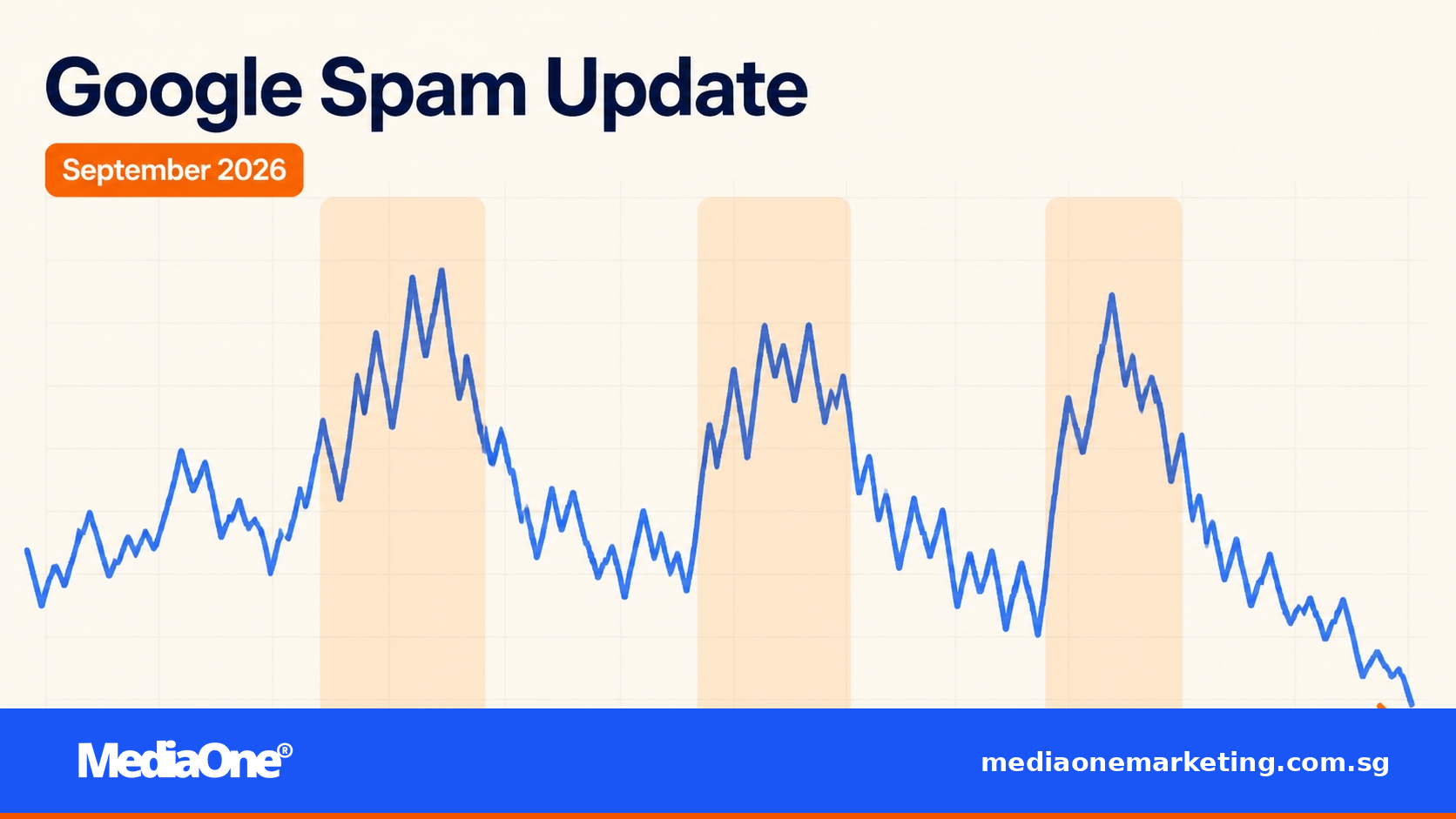
Google spam update for September 2026 rolled out from 24 September to 8 October 2026 — 13 days and 16 hours, the longest spam update of the year and the fourth of 2026. Google has not disclosed what it targeted; the observed impact fell on templated, programmatic and AI-generated content. The rollout is now complete, so site owners can compare Search Console data from before 24 September against after 8 October. |
Google’s September 2026 spam update finished rolling out on 8 October 2026 — after 13 days and 16 hours, the longest spam rollout of the year and the fourth spam update of 2026. If your rankings or traffic moved in early October, this is the most likely reason.


Here is the reassuring part. A spam update is not a punishment aimed at you. It is Google upgrading the filters that catch manipulative content — the system it calls SpamBrain getting better at spotting new tricks. If you play it straight, the usual outcome is that nothing happens, or a competitor gets filtered out and you move up.
This guide focuses on the one update that matters right now: the September–October 2026 rollout. The update’s start and finish dates come from Google’s own Search Status Dashboard. The wave-by-wave detail and the reported impact come from trade reporting, and are attributed as such — Google has confirmed neither. Verified as of 9 October 2026.
The one-line summary: the update is over. Now is the moment to compare your performance before and after it — calmly, and on the right dates.
Key takeaways
- It’s finished. The rollout completed on 8 October. Compare your Search Console data from before 24 September against after 8 October.
- It was unusually long. Nearly two weeks, versus rollouts of under three days for the March, June and August spam updates — so it arrived in waves and daily data is noisy.
- Google won’t say exactly what it targeted. The visible impact points at templated, programmatic and heavily AI-generated pages.
- Don’t panic-edit. React to patterns that persist now the rollout is over, not to a single bad day.
- Start with the boring checks. Technical problems, manual actions and backlinks — before you touch any content.
What happened: the update at a glance
Google announced the September 2026 spam update on 24 September 2026 at 9:15 a.m. Pacific (00:15 Singapore time on 25 September). Its official note was short:
“Released the September 2026 spam update, which applies globally and to all languages. The rollout may take up to two weeks to complete.”
The dashboard later marked it complete on 8 October — 13 days and 16 hours in total, just inside the two-week window Google had predicted. That makes it the longest spam rollout of the year by a wide margin: the next longest, August 2026, took 2 days and 16 hours.
Because it ran so long, it landed in three visible waves rather than one:
|
When (2026) |
What happened |
|
Thu 24 Sep |
Update begins — global, all languages; Google warns of up to two weeks |
|
Fri 25 – Sun 27 Sep |
First wave — the heaviest weekend of movement |
|
Wed 30 Sep – Thu 1 Oct |
Second wave |
|
Sun 4 – Tue 6 Oct |
Third wave |
|
Wed 8 Oct |
Rollout complete — 13 days, 16 hours |
That three-wave pattern is why this one caused so much confusion. Site owners reported a sharp drop, then a partial recovery, then another drop — because Google was still rolling out. Reporting on the phases comes from Search Engine Roundtable and Search Engine Watch, tracking volatility tools across the rollout.
Why this update was different
The most striking thing about September was the length. Compare it with the other three spam updates Google ran this year:
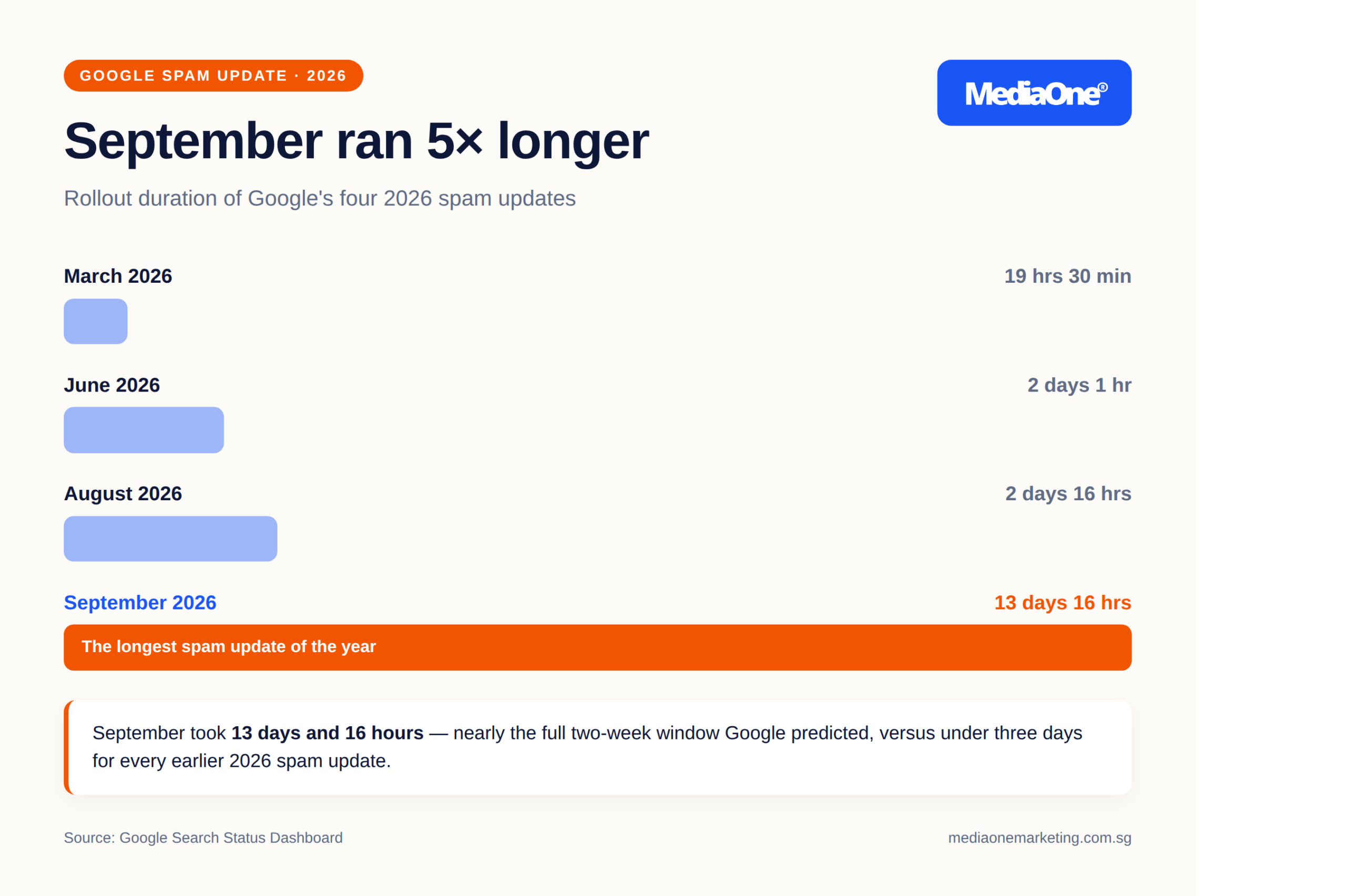
When Search Engine Roundtable asked whether the two-week estimate was a typo, Google’s John Mueller replied that it was “likely to take longer than some of the previous ones.” Search Engine Land notes Google gave each of the previous three updates a window of “a few days” — only September got two weeks.
Two consequences follow, and both matter for how you respond.
First, attribution is harder. A two-week rollout overlaps with everything else that moves in a fortnight — seasonality, your own site changes, competitors. Semrush points out the window makes it easy to blame the update for a drop it didn’t cause. Before you do, check whether your competitors moved too, and whether your visibility changed outside Google.
Second, plenty of SEOs felt it behaved like a broad core update. That is an observation, not a fact — Google has not called it a core update. But it is a useful reminder that “spam update” describes the mechanism, not the size of the shock.
What it targeted — and what Google actually said
Officially: little. Google has not said whether September targeted a specific policy or tactic, and unlike a core update, it published no accompanying blog post. The spam-updates documentation explains the pattern — Google occasionally makes notable improvements to its automated spam detection and flags them as an “update,” without detailing the change.
The unofficial picture is more informative. The clearest early pattern, reported by analysts tracking the rollout, was a hit on templated, programmatic and heavily AI-generated pages — for example, automatically generated pages built for every phone number or area code. The same analysis noted AI-generated spam remaining under pressure, and in some cases even resurging, which is a reminder that enforcement is never perfectly clean.
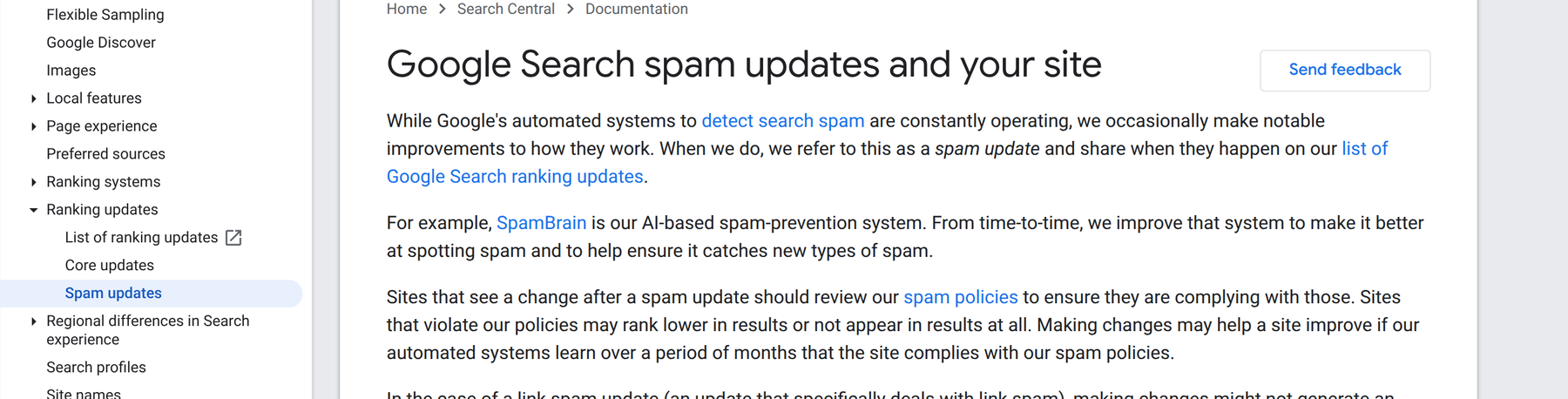
Figure 1: Google’s spam-updates guidance (Search Central)
The likely focus areas, all covered by Google’s existing spam policies:
- Scaled content abuse — large volumes of unoriginal, low-value pages, however they’re produced, including by AI tools.
- Link spam — paid links, link exchanges and mass guest posting meant to manipulate rankings.
- Site reputation abuse — hosting third-party content mainly to borrow a host site’s ranking signals. Notably, September was the first spam update since Google changed how it enforces this policy in the EEA in August.
- AI feature manipulation — Google has confirmed that its spam policies apply to generative AI responses in Search, not just classic results.
One important caveat for anyone chasing links: if a spam update removes the value of spammy links, that lost ranking benefit cannot be regained. Google states this directly in its spam-updates guidance — so “we’ll clean it up and bounce back” is not a safe assumption for a link-spam hit.
Did it hit you? How to tell
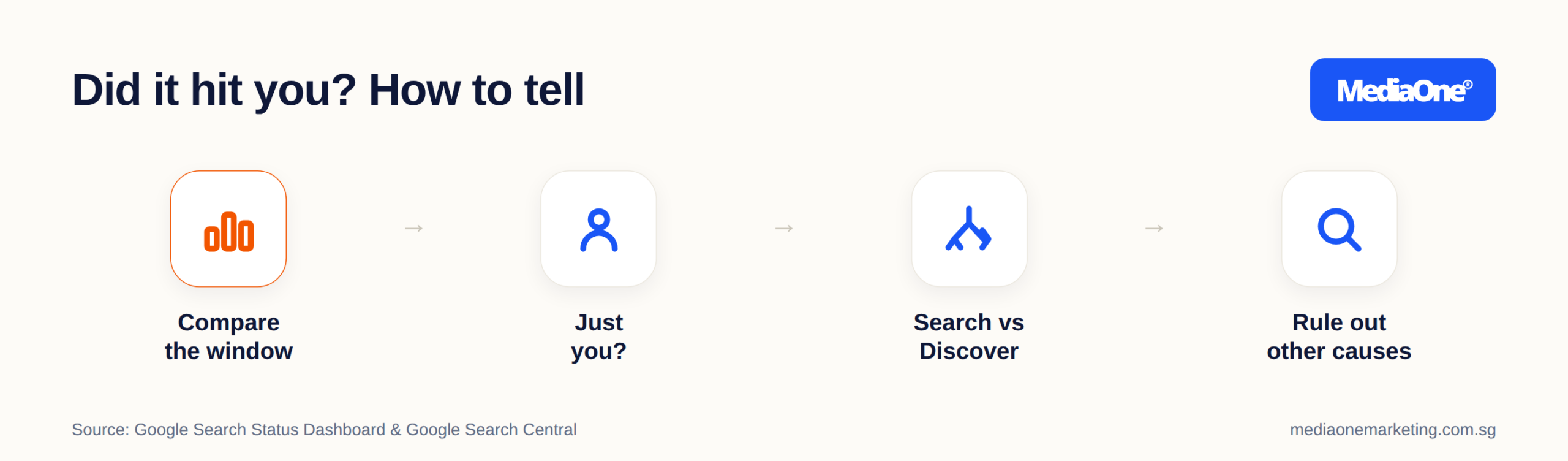
The rollout is complete, so you finally have a clean comparison. Work through this in order:
- Compare the right window. Pull Search Console and compare the weeks after 8 October against the period before 24 September. Ignore isolated bad days inside the rollout — the three-wave pattern guarantees noise.
- Check whether it’s just you. If competitors moved at the same time, the cause may be broader than your site. If only you moved, look closer at your own pages.
- Separate Discover and News from Search. Both were reported as exceptionally volatile during this update, and Discover runs on its own systems. A feed dip is not a search ranking problem — measure it separately.
- Rule out the non-update causes. Seasonality, a site change or a technical problem can look identical to a quality drop. Google’s debugging traffic drops guide walks through the possibilities in order.
What to do right now to protect your rankings
Here is the practical part. Work top to bottom — it’s ordered cheapest and most decisive first.
1. Confirm the update is the cause — then stop, look, and don’t guess. The dashboard entry is closed, so you’re comparing a finished event, not a moving target. If your traffic didn’t move around 24 September to 8 October, the update probably isn’t your problem. Don’t “fix” what isn’t broken.


2. Check for a manual action. Open the Manual Actions report in Search Console. If Google has flagged your site directly — including under the site reputation policy — you’ll see it there, with a route to fix it and file a reconsideration request. If nothing is listed, the drop is algorithmic, which changes your next step.
3. Rule out technical problems. A broken canonical, a slow template, an indexing gap or a crawl error can mimic a quality drop precisely. Check indexing and crawl reports before you rewrite a single word.
4. Review your backlink profile. Because September is a spam update, unnatural links are a prime suspect — paid placements, link exchanges, mass guest posts. Read Google’s link spam rules and remove anything that exists only to move rankings. Remember the caveat above: lost link value does not come back, so the priority is compliance, not recovery.
5. Improve the pages that actually lost — don’t rewrite blindly. Group affected pages by type and ask honestly whether each one deserves to rank above the pages now beating it. Google’s self-assessment questions are the honest test. For a spam update, the fix is almost always alignment, not a full rebuild.
6. Expect recovery to take months, not days. Google is explicit that improvements may only help once automated systems learn over a period of months that a site now complies. Set that expectation internally before you promise a timeline — and avoid the temptation of a “quick fix.”
7. Keep a dated log and watch for the next update. 2026 is the most active year for spam updates since 2021, and the long gap since the last core update makes another broad change plausible. Logging each update against your own data is the habit that turns future surprises into known quantities — the kind of ongoing tracking a good SEO partner builds into your monthly reporting.
Conclusion and summary
The September 2026 spam update is done: 24 September to 8 October, global, all languages, and unusually long. Google hasn’t confirmed what it targeted; the analyst consensus pointed to templated, programmatic and low-quality AI-generated content, and to sites with manipulative links.
The right response to a spam update is simpler than the panic suggests. Confirm you were actually affected, check the obvious causes first, fix anything that genuinely breaks the rules, and improve content that legitimately fell short. Then wait for the systems to catch up.
In one sentence: spam updates reward sites that play it straight. The work of the next few weeks is not recovery tricks — it is making sure you have nothing to recover from.
Frequently asked questions
Is the September 2026 spam update finished?
Yes. According to Google’s Search Status Dashboard, it began 24 September 2026 and was complete by 8 October 2026 — 13 days and 16 hours. It applied globally and to all languages.
Why did this spam update take so long?
Google told site owners the rollout “may take up to two weeks,” and it used almost all of that time. Earlier 2026 spam updates (March, June, August) each finished in under three days. Google hasn’t explained the longer window; John Mueller only said it was likely to take longer than previous ones.
What did the September 2026 spam update target?
Google hasn’t said. Its spam-updates guidance confirms it improves automated spam detection without specifying the tactic. Observed impact pointed at templated, programmatic and AI-generated pages, plus manipulative links.
Was the September 2026 spam update actually a core update?
No. Some SEOs said it felt like one, but Google has not called it a core update, and it did not follow the core update process (there was no announcement blog post or core-updates guidance). Treat it as a spam update in how you respond.
Should I change my site if my rankings dropped during the rollout?
Only after you’ve ruled out non-update causes and confirmed a pattern. Compare before 24 September against after 8 October, check for manual actions and technical issues first, then improve the specific pages that lost. Don’t rewrite pages based on a single volatile day mid-rollout.
My rankings dropped — how do I know it was this update and not something else?
Check the dates. If the drop tracks the 24 September to 8 October window, the update is the leading suspect. If it doesn’t, look at seasonality, your own recent site changes, or a technical issue using Google’s debugging traffic drops guide. Comparing your movement against competitors is the fastest tiebreaker.