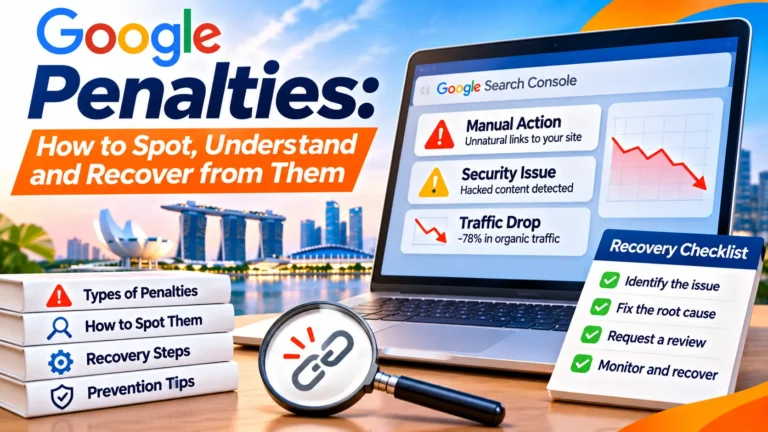
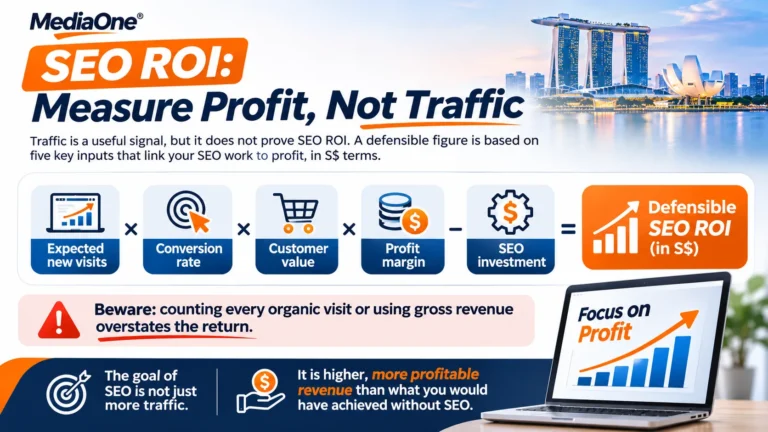
Most Singapore business owners only think about Google penalties once their enquiry form goes quiet. A sudden drop in organic traffic often prompts a rushed rebuild or an agency change. Yet the trigger is frequently a set of signals already outside Google’s webmaster guidelines, and the fix depends on identifying which one. Pages with little original substance, often called thin content, are a common example.
Penalties are more common than most owners expect. In a 2017 snapshot, Semji reported nearly 6 million websites received a penalty notification in Search Console. Diagnose first, then act.
Key Takeaways
- A penalty is rarely one mistake. It usually reflects several issues outside Google’s guidelines at once.
- Check Search Console first. Manual penalties appear there as a direct message. Algorithmic penalties do not.
- Penguin is an algorithm, not a manual action. A reconsideration request will not lift it.
- Not every drop is a penalty. Zero-click and AI-driven results can cut clicks even when your site is fine.
- Diagnose before changing anything. Rebuilding content without a diagnosis is a common reason sites stay down.
- Recovery can be slow. A Penguin-hit site in the documented example took well over a year to regain traffic.
What Google Penalties Are and How They Differ
A Google penalty is a demotion or removal applied because a website’s signals fall outside what Google treats as legitimate. The cause is a policy breach or spam-related issue, and the loss is usually sharper than normal ranking shifts. Penalties are often tied to a Google algorithm update, which can reshuffle rankings across many sites at once.
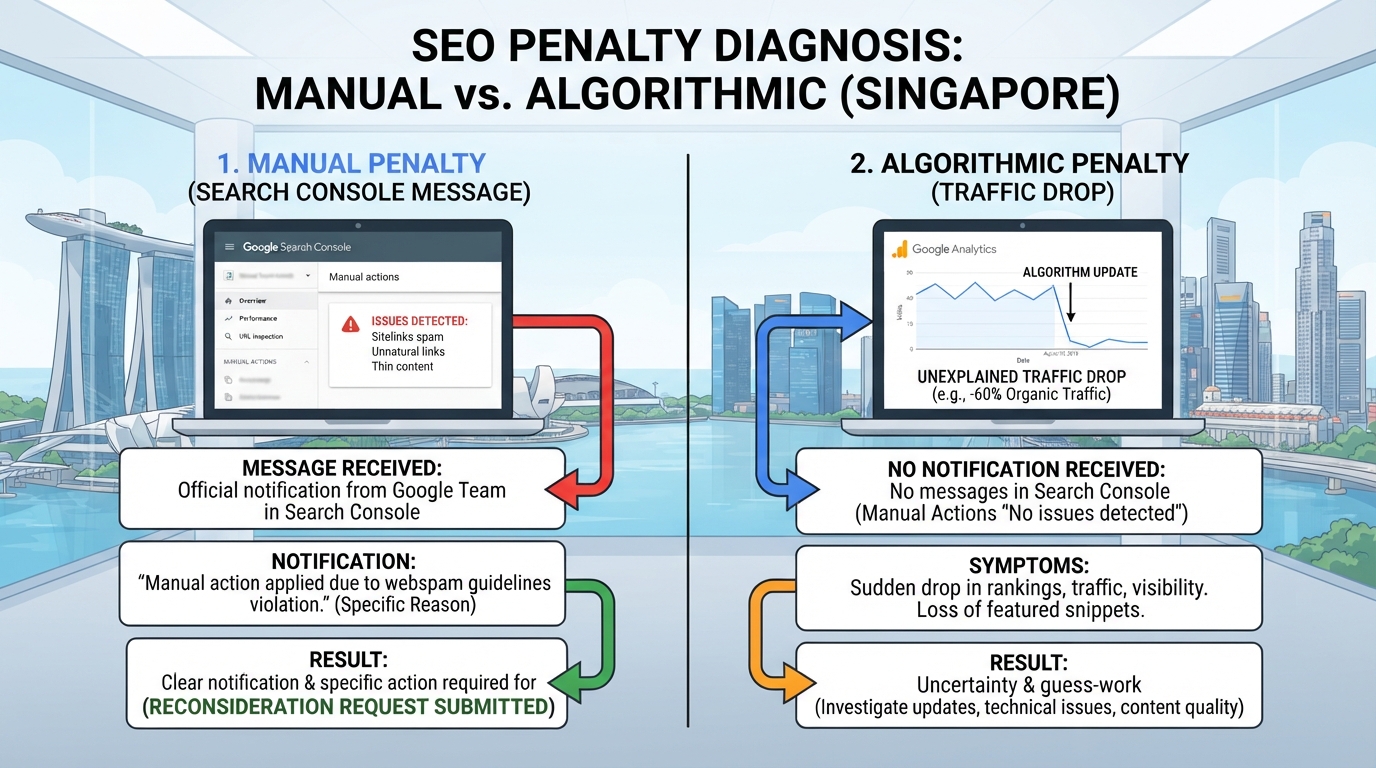
Penalties come in two forms. A manual penalty is a human reviewer’s decision, reported in Google Search Console. An algorithmic penalty happens automatically, with no message, when a system such as Penguin or Fred assesses the website. The recovery path differs for each, so following search engine best practices from the outset helps reduce the risk of either. Site owners can identify which type they face by checking Search Console first, then comparing traffic drops against known update dates.
| Manual penalty | Algorithmic penalty | |
|---|---|---|
| Trigger | Reviewer finds a violation of Google’s spam policies | Automated system detects low-quality or manipulative signals |
| Notification | Message in Search Console under Manual actions | None; inferred from traffic and ranking changes |
| Recovery path | Fix the issue, then file a reconsideration request | Fix the underlying problem; the system re-evaluates over time |
Manual action types and where they appear
Manual actions are listed under Security and Manual Actions in Search Console. Common types include unnatural links, thin content and user-generated spam. Each notice names the affected section, so you can start fixing before requesting a review.
Major Algorithm Penalties: Panda, Penguin and Fred
Many penalties people blame on Google are algorithmic, not manual. Panda, Penguin and Pirate are among the nine major Google algorithm updates, and each targets a different quality signal. Knowing which one fits your drop tells you where to look first.
Panda: content quality and thin pages
Panda targets websites with thin, duplicated or low-value content. Because it assesses quality across the whole site, a large batch of weak pages can drag down stronger ones too. Pages that a search engine finds unhelpful to users can affect how the whole site appears in search results.
Penguin: link spam and manipulative link profiles
Penguin analyses a website’s backlinks. Semji’s account of Google’s history notes that Penguin was implemented in April 2012 to assess the quality, relevance and authenticity of inbound links. Recovery from link-based issues can be slow.
Penguin is now part of Google’s core ranking systems. Please review the current wording in the Google Search Central documentation before relying on older descriptions. Because it’s an algorithm, not a manual action, a reconsideration request won’t lift it. Clean up the unnatural links, and the system will reassess the website. Technical SEO checks, such as crawlability and link structure, can help you spot the source of a problem, and Google’s Webmaster guidelines set out what counts as a manipulative link.
Fred: low-quality content and aggressive monetisation
Keyword stuffing and comment spam as triggers
Keyword stuffing, repeating a phrase unnaturally to win rankings, is a classic quality problem. Read the page aloud: if a keyword appears more often than a person would naturally write it, rewrite that passage. User-generated comment spam, such as links left in forums or blog comments, can build an unnatural link profile unnoticed, so audit the sites linking to you before assuming a larger cause.
Diagnosing a Penalty and Monitoring Performance
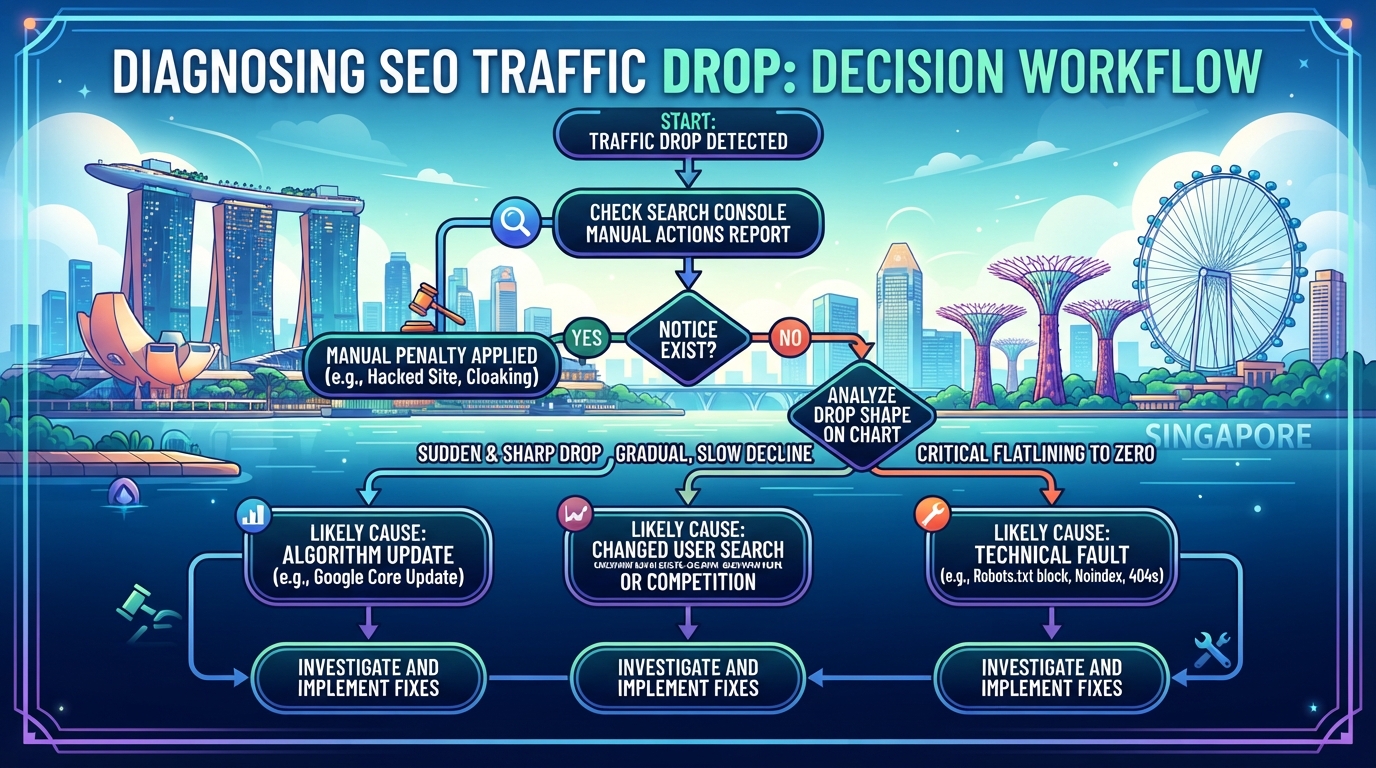
Most traffic drops are not penalties. Use the matrix below to identify the cause family before changing anything. A useful threshold is a drop of 20% or more in organic clicks over the same date range, compared with the period before the change. Search engine ranking losses often look similar at first, so check the pattern before acting. Review your keywords and follow SEO best practices to establish a stable baseline before diagnosing any change.
| Symptom | Likely cause | Threshold to check | First check |
|---|---|---|---|
| Sudden cliff across the whole website | Manual penalty, or a spam-linked algorithmic change | Confirmed on enquiry | Search Console, Manual actions report |
| Gradual decline over weeks | Content quality or a core update | Confirmed on enquiry | Compare the drop date with Google’s published update dates |
| Loss on specific pages or query groups | Thin or duplicate content on those pages | Confirmed on enquiry | Filter the Performance report by page |
| Drop in clicks while impressions hold | Search behaviour, such as AI answers taking the click | Confirmed on enquiry | Compare impressions and clicks over the same period |
Using Search Console to confirm manual penalties and track performance
Start with the manual actions report in Google Search Console. A manual penalty shows a named issue and reason, and is the only definitive confirmation of a penalty. Penalties tied to black-hat link schemes, such as paid or manipulated backlinks, are a common example of what this report can reveal.
Then open the performance report, set the date range to cover the drop, and compare clicks against impressions. Falling impressions point to lost rankings. Steady impressions with falling clicks point to changed search behaviour. Users may also be seeing a different result layout, so check the search appearance filters before drawing conclusions.
Telling a penalty apart from a core update or technical fault
A penalty appears in the manual actions report. A core update changes rankings across many websites and often recovers on its own. A technical fault, such as a noindex tag or a blocked page, causes drops on specific URLs that appear in the Pages report. Technical SEO problems like these are often the easiest to fix once you find them. Check all three before assuming a penalty.
Recovering from a Google Penalty
Recovery starts only after diagnosis. Once you know whether you face a manual or an algorithmic penalty, work through these steps in order:
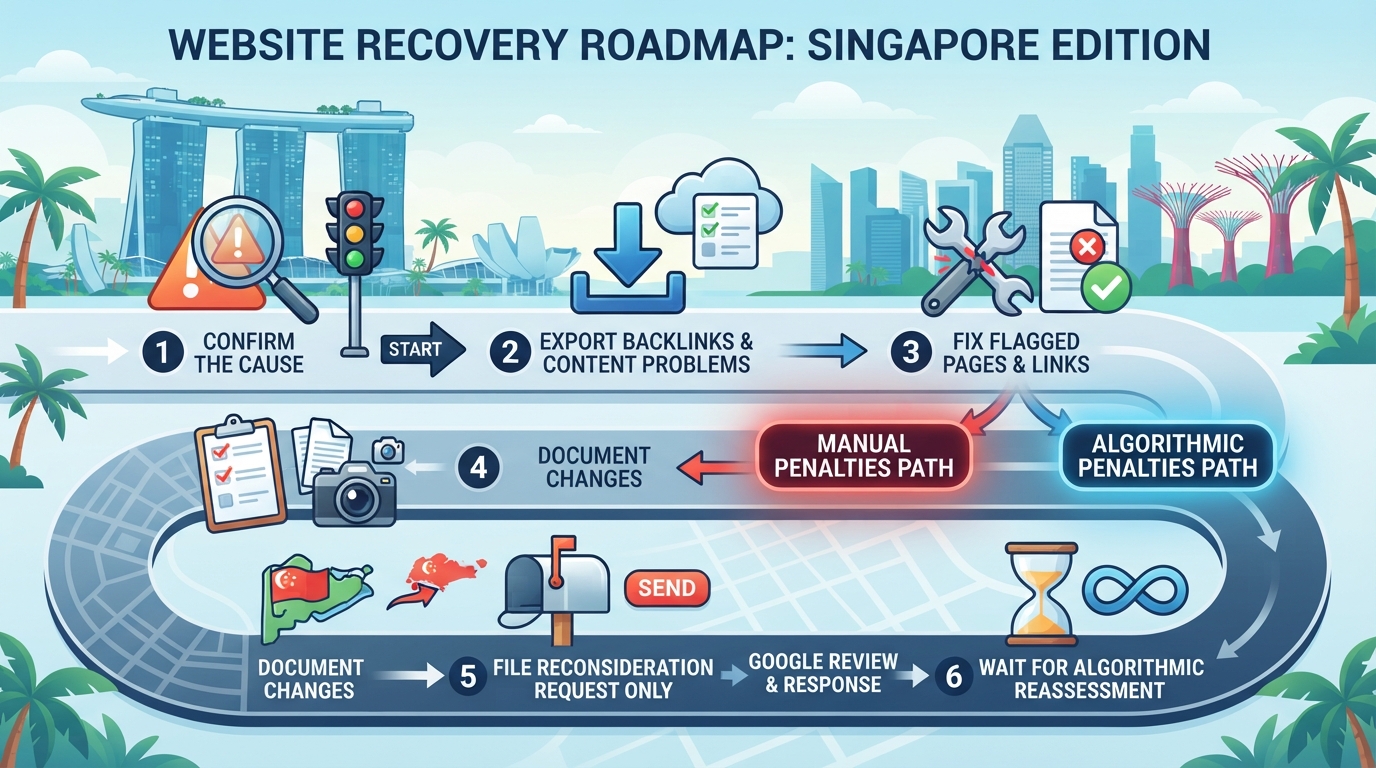
- Confirm the cause in Search Console, or rule out a manual penalty if none appears.
- Export your backlinks and content problems, then record what needs fixing.
- Remove or fix the flagged pages, links and templates.
- Document every change so you can explain it to Google.
- File a reconsideration request only if Google applied a manual penalty.
- Wait. Algorithmic recovery follows the next crawl and reassessment, not a request.
Cleaning up links and content
Start with the issues the penalty points to. For link-driven problems, remove paid or manipulative links where you can, and disavow the rest. For content, consolidate or rewrite thin pages and remove doorway pages. Google’s Search Essentials and spam policies define what counts as a violation.
Filing a reconsideration request
A reconsideration request applies only to manual penalties. Describe the specific issue, the steps you took and the evidence of removal. Google will revoke the manual action if your site no longer violates its spam policies. Algorithmic penalties such as Penguin cannot be lifted this way and may only require monitoring.
Using AI-generated content safely during recovery
Google does not ban AI-generated content. It focuses on whether content is helpful and original, and it penalises mass-produced pages built to manipulate rankings. Use AI to draft or research, then have a person verify facts and add first-hand expertise before publishing. Avoid publishing large volumes of unreviewed AI pages during recovery, since pages that add nothing to the search results can draw the same scrutiny. Reviewing each page lets you identify weak content before it reaches readers.
Conclusion
A Google penalty is rarely one mistake. It is usually a build-up of issues outside Google’s guidelines, so diagnose before repairing. Check Search Console for a manual penalty, match the drop’s shape to a likely algorithmic cause, and only then rebuild. Sites that skip this often rewrite content that was never the problem.
Prevention means keeping content useful, avoiding link schemes and treating fast-ranking promises with caution. Google’s Search Essentials set the baseline.
Frequently Asked Questions
Can a Google penalty be removed without a reconsideration request?
It depends on the type of penalty. Google revokes a manual action once it confirms your site no longer breaks its spam policies after you submit a reconsideration request through Google Search Console. Algorithmic devaluations, such as those caused by Penguin, may only need monitoring, as Google re-evaluates the site once the underlying signals are corrected.
How long does recovery from a Google penalty take?
There is no fixed timeline. Recovery depends on how quickly you remove the cause and how often Google re-crawls the site. In one reported Penguin case, Semji’s analysis describes a site hit in April 2012 whose recovery only began in April 2014. Expect months, not weeks, and track your progress in Search Console.
Does AI-generated content trigger a Google penalty?
Not by its origin alone. Google focuses on whether content is helpful and original, not how it was produced. Thin, duplicated, or mass-produced pages can trigger penalties, regardless of who or what wrote them. Review AI-assisted pages against Google’s webmaster guidelines before publishing.
How do I know if my site has a manual action?
In Google Search Console, go to Security and Manual Actions, then select Manual Actions. If a penalty has been applied, the report names the issue and affected pages. If it shows none but your traffic has dropped, the cause is probably algorithmic.
Will my rankings return automatically after fixing the problem?
Not automatically, and not always to previous levels. Rankings recover only as Google re-evaluates the site, which can take a long time. Some lost positions may not return in full if competitors have improved in the meantime.