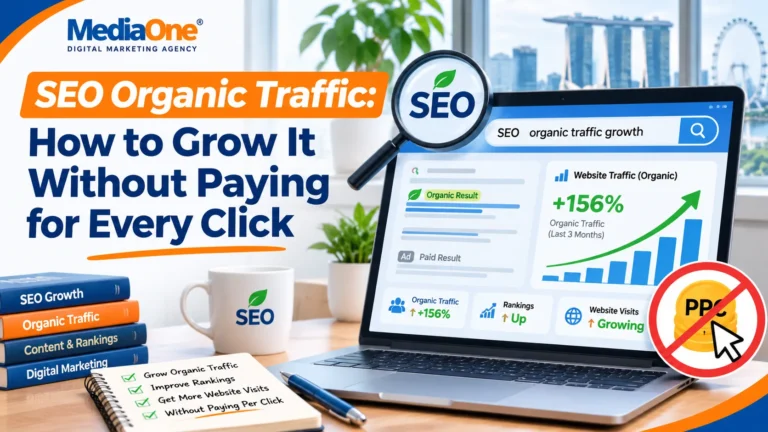
SEO organic traffic is the free visits search engines send to your website when people find your pages through unpaid results. Unlike paid ads, which send visitors only while the budget lasts, a well-ranked page can keep bringing visits at no cost per click. Search engine optimisation helps you judge it by enquiries, not session counts, and to work through three levers in order: keyword targeting, technical health, and authority.
Key Takeaways
- Organic traffic is unpaid, so judge it by the enquiries and sales it produces.
- Organic visitors typically convert at 1-4%, so conversion rate decides the payoff.
- Score keywords by commercial intent and ranking feasibility, starting with quick wins.
- Keep Cumulative Layout Shift at 0.1 or less.
- Track your Google Business Profile alongside website sessions.
What Organic Traffic Is and Why It Matters
Organic traffic is the free visits your website gets from unpaid search engine results. People find you by typing a question or service into Google or Bing and clicking your link. Many businesses rely on driving organic traffic as a core part of their content marketing efforts.
Organic search differs from organic social, which comes from unpaid social media posts. WordStream notes that organic search comes mainly from Google and Bing. Searchers have a stated need, so they usually convert better. A sound SEO strategy, built on seo best practices, helps your pages reach these searchers consistently. The user insights it reveals show you what your audience is looking for, so you can refine your content.
Organic vs paid vs direct
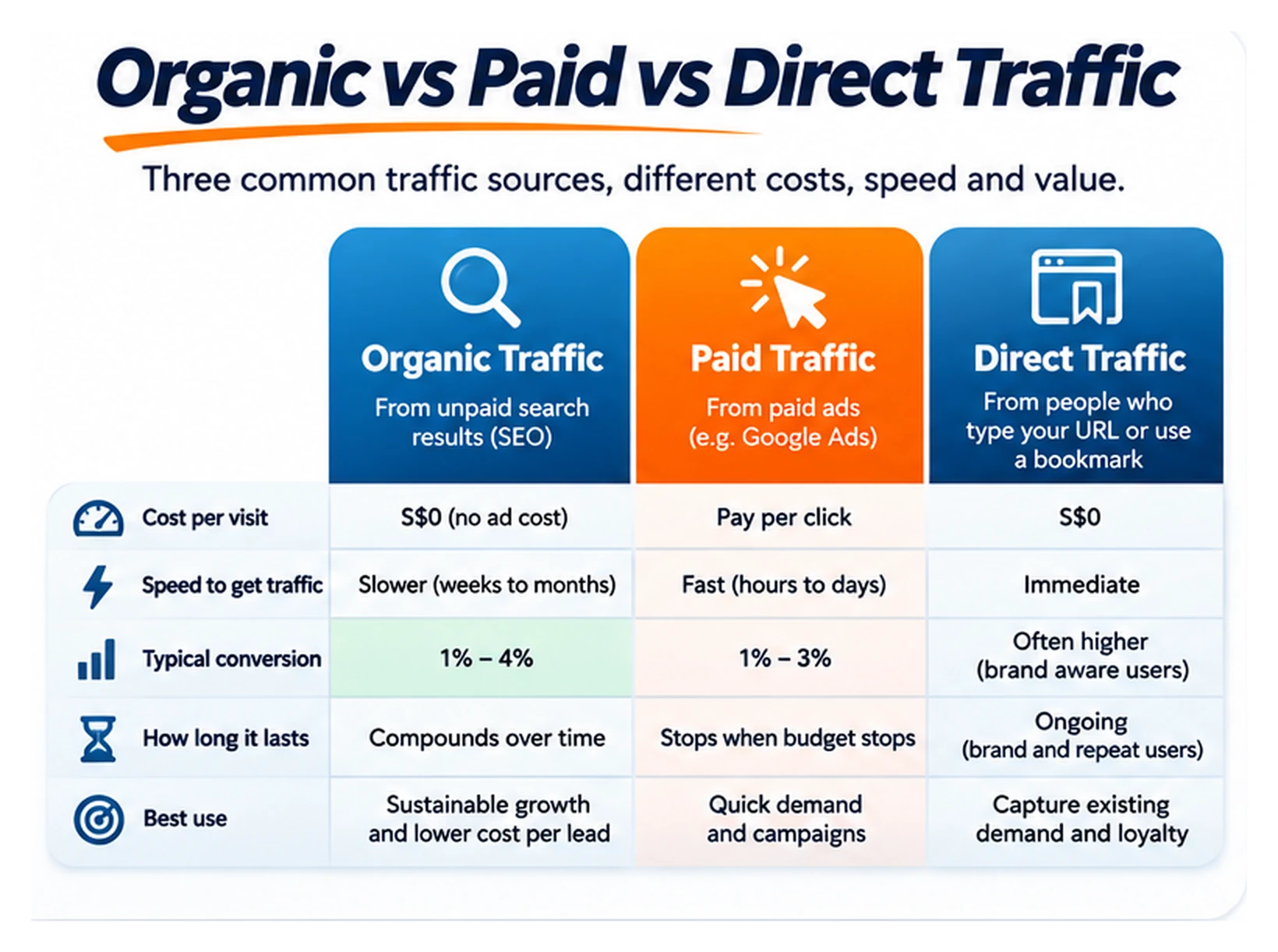
Organic traffic is free per click but slow to build. Good search engine optimisation is what makes that slow build pay off. Paid traffic arrives within hours but stops when the budget stops. Direct traffic comes from people typing your address or using a bookmark.
For a Singapore service business, measure seo organic traffic against sales goals using Google Analytics. Use the results to decide which search engines and pages to prioritise.
Building the Foundations: Keyword Research, Content and On-Page SEO
Start with a competitor gap check, not a list of high-volume keywords. Compare your site against up to 10 competitors and list the keywords they rank for that you do not, as Keywords Everywhere recommends. Score each gap on commercial intent and ranking feasibility, then sort it into one of four quadrants: quick wins, long-term builds, reach content or deprioritise. Assign every page a quadrant before you write or refresh it so that each piece of content supports your seo strategy and helps drive organic traffic from the start.
Refreshing a page that already ranks often gains more from updated facts and internal links than a new article. Keep each page focused on one user need. Internal links from related pages help search engines understand which pages matter most and can pass more link equity to the pages you want to rank. Check Google Analytics to see which refreshed pages gain traffic.
On-page SEO connects the page to the query. Match the title, main heading and opening paragraph to the target keyword, and answer the question on the first screen.
Technical SEO, Core Web Vitals and Local Visibility
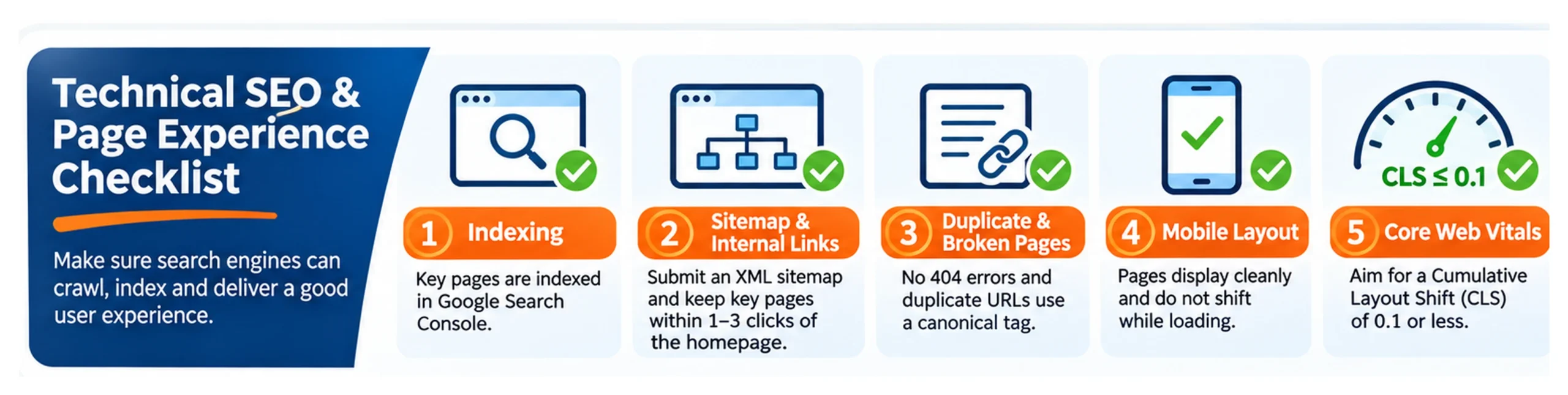
Before chasing more visitors, make sure search engines can crawl, index, and render your pages. Good keyword research should feed this audit. Record a pass or fail for each step:
- Indexing: inspect a key page in Google Search Console. Pass if it is indexed; fail if robots.txt or a stray noindex tag blocks it.
- Sitemap and internal links: submit an XML sitemap. Pass if every commercial page is listed and sits within 1-3 clicks of the homepage, a best practice for better user experience rather than a Google requirement.
- Duplicate and broken pages: crawl the site with a free tool such as Screaming Frog. Pass if no 404 errors remain and duplicate URLs use a canonical tag.
- Mobile layout: load each template on a phone. Pass if key marketing pages display cleanly and do not shift while loading.
Core Web Vitals and the wider page experience
Google made page experience a ranking factor in 2021. Page experience is one signal among many, not a guarantee of rankings. Cumulative Layout Shift (CLS) is the metric visitors feel most, as content jumps while the page loads. Aim for a CLS of 0.1 or less, as web.dev’s Core Web Vitals thresholds set out.
To check CLS on a phone:
- Enter the page URL in PageSpeed Insights (pagespeed.web.dev) and open the mobile tab.
- If the CLS value is above 0.1, record a page load in Chrome DevTools and note which element moved.
- Fix that element, usually an image or ad without set dimensions, then retest.
Reading the Search Console performance report
The performance report in Google Search Console shows how organic pages perform in search. Clicks count visits from results. Impressions count how often your page appeared in search results. Average position shows where it typically ranked. Read them together: many impressions with few clicks suggests a weak title or description, while a page with clicks but a falling position needs a content or link refresh. Filter by page to see which URLs help drive organic traffic within your wider seo strategy.
Local listings optimisation and local SEO tips
For local service businesses, Google Business Profile supports organic discovery alongside wider search engine optimisation work. Google says local results are primarily influenced by relevance, distance and prominence. Keep your name, address, phone number, hours and categories identical across your website, profile and social media pages. Track profile views and calls alongside site sessions, so the audience and users who find you through local search get accurate, consistent information.
Earning Authority: E-E-A-T and Strategic Link Building
Search engines look for signs that a site is run by people who know their subject. Experience, expertise, authoritativeness and trust (E-E-A-T) describe those signs. Every page should show a named author, a real track record and clear contact details. A first-hand case study or pricing note drawn from your own work makes a page harder to replace. A clear digital marketing strategy helps your audience see that expertise across your website, and content marketing reinforces it over time.
Strategic backlink building
Relevance matters more than volume. A few backlinks from Singapore trade associations, industry publications or local partners are worth more than many directory listings. Build them by creating assets others want to cite, such as an original cost guide, then approaching sites that already write about your sector. Track each link against the Value Matrix below, and use Google Analytics to confirm which referred visitors actually convert.
The Organic Traffic Value Matrix
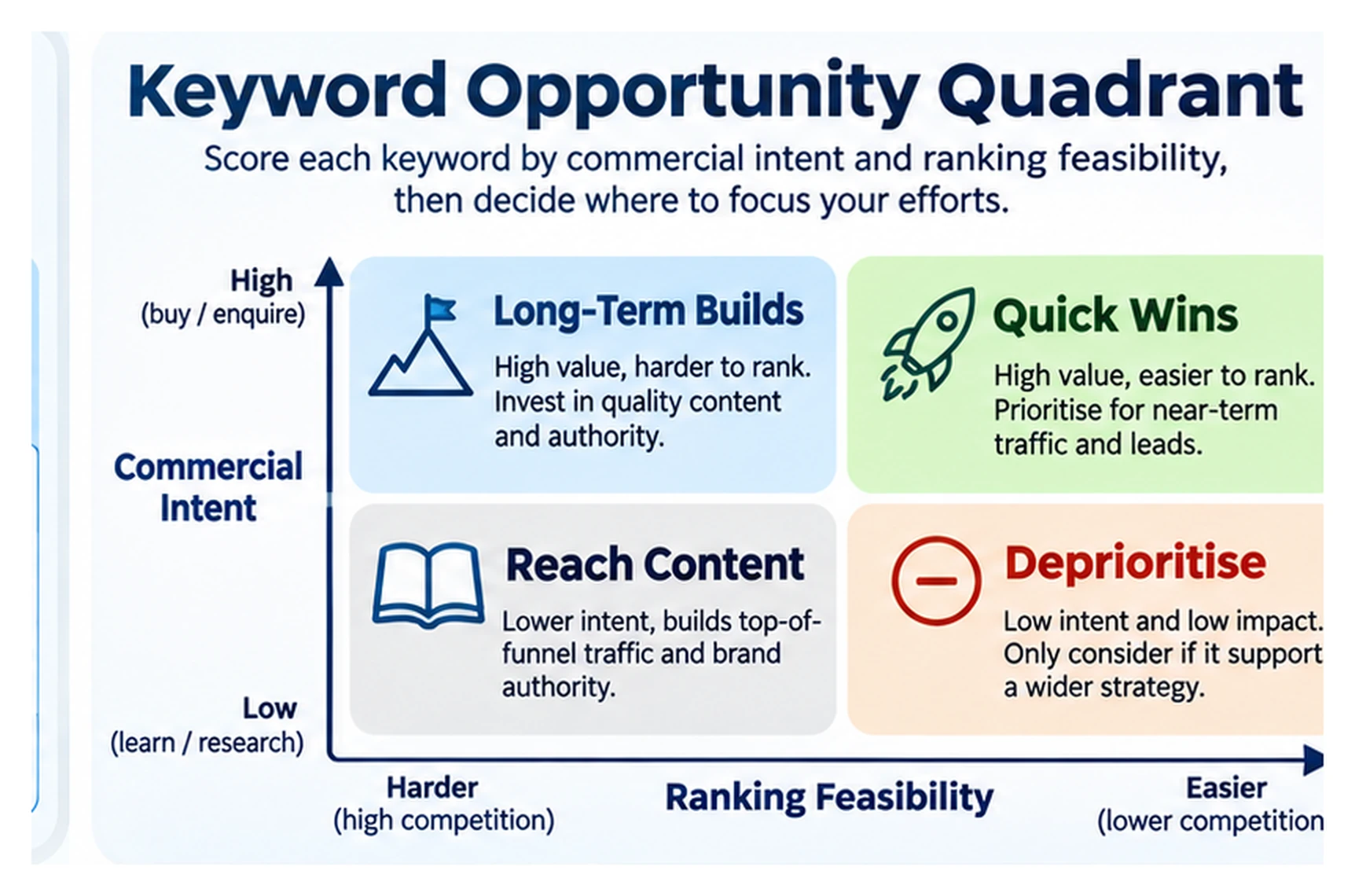
Score each target page from 1 to 5 on two axes: commercial intent (1 informational, 3 comparison, 5 transactional) and ranking feasibility (1 far behind competitors, 5 already close to the top). Multiply the scores. Scores of 15 or more are quick wins, 8 to 14 are long-term builds, and below 8 are deprioritised. Each row below applies the scoring to a page, so you can see the method at work. This approach directs your organic efforts to the pages most likely to earn enquiries.
| Service page | Intent (1-5) | Feasibility (1-5) | Score | Priority |
|---|---|---|---|---|
| Accountant fees for sole proprietors | 5 | 4 | 20 | Quick win |
| Business registration in Singapore | 5 | 3 | 15 | Quick win |
| Company secretary services | 3 | 3 | 9 | Long-term build |
| Bookkeeping tips for freelancers | 1 | 4 | 4 | Deprioritise |
| Service page 5 | Score it | Score it | Multiply | Apply band |
Check each top-priority page for a clear answer on the first screen, a descriptive internal link and a CLS reading of 0.1 or less.
Conclusion and Next Steps
SEO organic traffic compounds without per-click cost, but only when it matches commercial intent and converts. Place each target keyword in the Organic Traffic Value Matrix, starting with quick wins. Track conversion rate alongside sessions, and judge progress by the enquiries it brings.
Frequently Asked Questions
What is the difference between organic traffic and direct traffic?
Organic traffic arrives through unpaid search results. Direct traffic arrives when someone types your URL or uses a bookmark. Organic search can be grown deliberately.
Does organic traffic convert well?
It depends on intent. Transactional pages, such as service pages, convert far better than informational articles. Visitors to organic pages typically convert at 1-4%, and the Organic Traffic Value Matrix ranks keywords by commercial intent, not just volume.
How long does it take to grow organic traffic?
No fixed timeline applies. Low-competition, high-intent keywords can gain ground within months. Measure progress against enquiries, not sessions alone.
Do Core Web Vitals affect organic traffic?
They are one signal among many. Google made page experience a ranking factor in 2021. For mobile users in Singapore, Cumulative Layout Shift matters most. Aim for a CLS of 0.1 or less.
Is a Google Business Profile necessary for local organic traffic?
For local service businesses, it is strongly recommended, since consumers use it to find contact details.