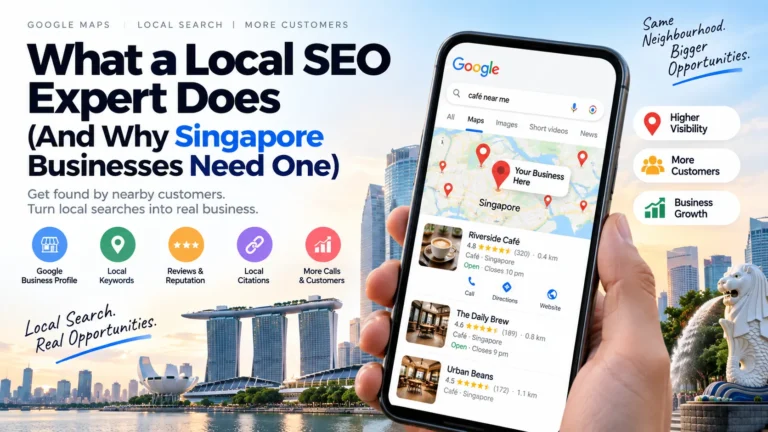
If you manage a franchise in Singapore, you already know that being visible online can make or break your growth. Local SEO for franchises is no longer optional — it is how your customers find each of your locations, whether they are searching for a café in Tanjong Pagar or a gym in Punggol.

Unlike a single-location business, franchises face the challenge of ensuring every outlet is discoverable while maintaining brand consistency.
Singapore’s dense urban environment, competitive market, and strict regulations from the Ministry of Manpower (MOM) mean a one-size-fits-all approach won’t cut it. Each outlet needs tailored visibility strategies, from optimising Google Maps profiles to ensuring local content resonates with nearby customers.
The goal here is practical: a step-by-step blueprint to boost local rankings and foot traffic for every franchise location.
By following this guide, you’ll gain strategies backed by real-world data and actionable insights — the kind you expect from a local SEO agency that knows how multi-location brands succeed.
Key Takeaways
- Local SEO for franchises is essential for ensuring that every outlet is discoverable by customers in their specific neighbourhoods, which directly impacts foot traffic, leads, and revenue.
- A centralised strategy combined with location-specific optimisation, including Google Business Profiles, hyperlocal content, and consistent NAP information, is critical for maintaining brand consistency while maximising local visibility.
- Regular monitoring of performance metrics, proactive review management, and Singapore-specific tactics such as postal code targeting and neighbourhood keywords are necessary to outperform competitors and sustain long-term growth.
Understanding Local SEO for Franchises
Local SEO is the practice of optimising your online presence to attract searches within a specific geographic area. For franchises, this means making sure every location appears in relevant Google searches, maps, and local directories. It is about connecting customers with the nearest outlet when they are ready to engage.
The difference between traditional SEO and local SEO for franchises is significant. While traditional SEO focuses on ranking for broader keywords like “best pizza Singapore,” local SEO ensures that your Orchard Road outlet appears for queries like “pizza near Orchard MRT.”
Per Backlinko, Google Maps now accounts for 52% of all mobile searches with local intent, making this visibility critical.
In Singapore, mobile-first behaviour dominates, with over 95% of consumers using smartphones to search for products or services, according to DataReportal. Franchises must therefore optimise for quick-loading pages, map listings, and mobile-friendly content, ensuring that potential customers don’t click away to competitors.
Core Challenges of Franchise Local SEO
Managing local SEO for multiple locations introduces complexity that single-location businesses do not face. Without clear systems and governance—often supported by a central in-house team or an experienced SEO agency—these challenges can quickly undermine visibility, brand trust, and search performance, especially in Singapore’s dense and competitive local markets.
Duplicate Listings and Inconsistent NAP
One of the most common issues in multi-location SEO is duplicate listings and inconsistent NAP (Name, Address, Phone number) data across directories. Even small variations—such as unit numbers, abbreviations, or outdated phone lines—can confuse Google’s local algorithms.
This fragmentation weakens authority signals, dilutes reviews, and reduces map pack visibility across locations.
Maintaining Brand Consistency
Every location should clearly reflect the brand’s identity while still feeling locally relevant. Over-centralised content often feels generic, while overly customised pages risk drifting off-brand. The challenge lies in balancing consistent messaging, tone, and design with neighbourhood-specific content that resonates with local search intent.
Managing Reviews and Reputation
Multiple outlets mean multiple streams of customer feedback. Without a structured review response framework, tone and response times can vary widely between locations. Inconsistent engagement erodes trust and weakens local ranking signals, making reputation management harder to scale.
Coordinating SEO Efforts Across Teams
Corporate teams and franchisees must collaborate closely to execute SEO strategies effectively. Misalignment often leads to delayed updates, inconsistent implementations, or duplicated work. Clear processes, templates, and accountability are essential to scale local SEO without creating operational bottlenecks.

These challenges are especially common in Singapore’s franchise landscape, where brands may operate dozens of outlets across districts like Jurong East, Bedok, and Tampines. Addressing them systematically is key to sustainable local growth.
Creating a Local SEO Strategy for Franchises
An effective local SEO strategy balances central oversight with local execution. Here’s how to approach it:
- Centralised vs decentralised management: The headquarters should define brand guidelines, content templates, and technical SEO requirements. Local franchisees execute these with location-specific customisation.
- Prioritise high-impact locations: Use search volume and competition data to decide which outlets need the most attention. Tools like Google Keyword Planner and Ahrefs can help identify areas with high local demand.
- Task mapping: Assign responsibilities for content creation, review management, and Google Business Profile updates to specific teams or franchisees.
- KPIs and monitoring: Track local traffic, leads, map rankings, and conversion rates. Consistent reporting ensures you identify which locations outperform and which require optimisation.
Example KPI table for franchises:
| KPI | Target | Tool/Method |
| Google Maps visibility | Top 3 results | Google Business Profile Insights |
| Local website traffic | +20% YoY | Google Analytics |
| Review score | 4.5+ stars | Google Reviews dashboard |
| Click-to-call conversions | +15% | GA call tracking |
Optimising Google Business Profiles for a Franchise Local SEO Strategy

Image Credit: PinMeTo
Google Business Profiles (GBP) are often the first point of contact between your brand and local customers. For multi-location businesses, optimising each profile correctly is critical to visibility, trust, and conversions in local search results.
Create and Verify Each Location
Every physical outlet must have its own dedicated and verified Google Business Profile. This allows each location to appear independently in Google Maps and local pack results. Verification confirms legitimacy and ensures your listings are eligible for reviews, posts, and insights. Skipping this step or combining locations into a single profile limits reach and reduces local relevance.
Maintain Consistent Information
Consistency across profiles is essential. Ensure that your business name, address, phone number (NAP), categories, operating hours, and images are accurate and aligned across all locations. Even small inconsistencies can confuse Google and weaken trust signals, especially for franchises operating across multiple districts in Singapore.
Publish Location-Specific Content
Static profiles underperform. Regularly publish posts featuring outlet-specific promotions, updates, or participation in local events. Highlighting neighbourhood relevance—such as nearby landmarks or community activities—helps Google associate each profile with its immediate area while keeping customers engaged.
Leverage Advanced GBP Features
Fully utilise GBP features such as Q&A, services lists, business attributes, and booking links where applicable. These elements provide additional context to Google and answer customer questions directly within search results, improving engagement and reducing friction.
Monitor and Optimise Using Insights
Google Business Profile Insights provides valuable data on searches, profile views, calls, website clicks, and direction requests. Review this data regularly to identify high-performing locations and underperforming profiles. Use insights to refine categories, content, and posting frequency based on real user behaviour.
Franchises that actively manage and optimise individual Google Business Profiles consistently see higher engagement and stronger local visibility than those relying on static or neglected listings.
Website & Technical Local SEO for Franchises
For multi-location brands, your website must act as the central hub that connects and reinforces every local optimisation effort. Strong technical and on-page execution ensures that Google understands where you operate, what each location offers, and how relevant each outlet is to local searchers.
Location-Specific Landing Pages
Each outlet should have its own dedicated landing page with unique, locally relevant content. These pages should clearly highlight the services offered, full address, contact details, and nearby landmarks or community references. Including local events, promotions, or neighbourhood-specific FAQs helps differentiate pages and align with local search intent.
Structured Data Implementation

Image Credit: Embed Social
Schema.org structured data is essential for multi-location clarity. Implement LocalBusiness schema on each location page to define business name, address, phone number, opening hours, and geo-coordinates. Proper schema helps Google correctly associate each page with its physical location, improving eligibility for rich results and local pack visibility.
Mobile Optimisation
Mobile optimisation is critical in Singapore, where most local searches happen on smartphones. Pages must load quickly, display correctly on all screen sizes, and offer tap-friendly navigation. A fast, mobile-friendly experience improves engagement metrics, which directly influence local rankings.

Image Credit: Backlinko
Duplicate Content Management
Avoid using generic templates that repeat identical content across multiple locations. Duplicate pages dilute relevance and can be ignored by search engines. Instead, customise service descriptions, testimonials, imagery, and internal links for each outlet to ensure every page delivers unique value.
Geo-Targeting for Local Audiences
If your brand serves multilingual or regionally distinct audiences, use geo-targeting signals such as hreflang tags or postal code references to improve relevance. This is particularly useful for brands targeting different demographics across Singapore.
Pro tip: Singaporeans frequently search using district names like “dentist Ang Mo Kio” or “clinic Bukit Batok.” Making these keywords integral to each landing page significantly improves local visibility and conversion potential.
Local SEO for Franchises: Content Marketing & Backlinks

Image Credit: LinkedIn
For franchises, local visibility depends heavily on how well you combine content marketing with authoritative backlinks. While brand consistency matters, location-specific content and partnerships are what signal relevance to search engines and local customers. When executed strategically, these efforts improve rankings while supporting long-term lead generation.
Hyperlocal Content
Creating hyperlocal content allows each franchise location to rank for searches tied to its immediate surroundings. Blog posts, local guides, and event roundups focused on specific neighbourhoods, districts, or communities improve geographic relevance.
Examples include “Best Family Activities in Tampines” or “What to Expect at Community Events in Jurong.” This type of content marketing helps search engines associate your franchise with real-world locations while giving potential customers information that aligns with local intent.
Local Media Collaborations
Collaborating with local media outlets strengthens both authority and visibility. Guest articles or features on platforms such as online community forums, neighbourhood blogs, or lifestyle sections of Singapore news sites can generate high-quality local backlinks.
These placements expose your franchise to new audiences while reinforcing trust signals for Google. Media collaborations also support lead generation by placing your brand in front of users already interested in local services.
Customer Success Stories

Publishing customer testimonials and case studies builds credibility while supporting SEO. Success stories naturally include service descriptions, location references, and keywords that reinforce local relevance. When integrated into your content marketing strategy, these stories influence purchase decisions and help convert organic traffic into qualified leads.
Influencer Partnerships
Working with micro-influencers with strong engagement within specific communities adds authenticity to your local presence. Influencers can generate locally relevant backlinks and social signals via reviews, event coverage, or collaborative content. Their audiences are usually highly targeted, making influencer partnerships effective for visibility and lead generation.
Content that consistently demonstrates local expertise shows Google that your franchise is genuinely embedded in the community. Over time, this combination of content marketing and local backlinks strengthens rankings, brand trust, and customer acquisition across every location.
Managing Reviews and Reputation in a Franchise Local SEO Strategy

Image Credit: Customer Alliance
For multi-location brands, reviews are more than customer feedback — they are a critical ranking and revenue driver. A structured approach to reviews ensures consistency, protects brand trust, and strengthens local SEO performance. This is where disciplined online reputation management becomes essential, especially when dozens or hundreds of locations are involved.
Collect Reviews Ethically
Ethical review collection protects both your rankings and brand credibility. Encourage satisfied customers to leave Google reviews through post-visit emails, SMS follow-ups, or in-store reminders, without offering discounts or incentives.
This aligns with Google’s review guidelines and avoids penalties that could damage visibility. Consistent, authentic review generation across locations ensures each outlet builds its own local authority while maintaining overall brand integrity.
Respond Consistently
Review responses should follow a clear brand framework while still sounding human and location-specific. Thank customers for positive feedback and address negative reviews calmly and professionally within 24–48 hours.
Prompt responses show both users and search engines that your business is active and customer-focused. Consistency in tone and response time is a core element of effective online reputation management, particularly for franchises and chains.
SEO Benefits of Reviews
Reviews directly influence local search rankings, map pack visibility, and click-through rates. Businesses with higher review volume, stronger ratings, and recent engagement tend to outperform competitors in local results. Review keywords also provide valuable contextual signals that help Google understand what your locations are known for.
Track Trends Across Locations
Monitoring review performance at scale requires the right tools. Centralised dashboards allow brands to track review volume, ratings, response rates, and sentiment trends across all locations. Identifying recurring issues or standout performers helps improve operations while strengthening local SEO consistency.
Brands that actively manage and respond to reviews can experience higher revenue growth due to increased customer trust. In competitive local markets, strong online reputation management is not optional — it is a growth lever.
Tracking Performance & Optimising Campaigns in a Local SEO Strategy for Franchises
Local SEO is not a one-off project. It is an iterative process that requires continuous measurement, testing, and refinement across all locations. The goal is to focus on metrics that reflect real business outcomes, not surface-level vanity numbers.
| Area | What to Track | Why It Matters |
| Key Performance Indicators (KPIs) | Google Maps rankings, website visits, clicks-to-call, direction requests, and estimated foot traffic | These metrics show how visible each location is and how often searchers take high-intent actions that lead to revenue. |
| Analytics & SEO Tools | Google Analytics, Google Business Profile Insights, Moz Local, SEMrush | These tools provide insights into traffic sources, user behaviour, keyword visibility, and listing consistency across locations. |
| A/B Testing | Landing page layouts, call-to-action buttons, headlines, and service descriptions | Testing small changes helps improve engagement and conversion rates, especially for underperforming locations. |
| Regular Audits | NAP consistency, duplicate listings, outdated hours or services, broken links | Quarterly audits prevent technical issues from compounding and protect long-term local rankings. |
Consistent monitoring allows brands to spot performance gaps between locations quickly. High-performing outlets can be used as benchmarks, while weaker locations receive targeted optimisation—such as improved content, stronger CTAs, or additional local links.
By treating local SEO as an ongoing optimisation cycle, businesses ensure sustained visibility, better resource allocation, and stronger performance across every outlet in competitive local markets like Singapore.
Singapore-Specific Tips for Franchise Local SEO
Winning local SEO in Singapore requires more than general best practices. The market is dense, competitive, and highly localised, which means franchises must adapt their strategies to how Singaporeans actually search, navigate, and evaluate nearby businesses.
Use Singlish Keywords and Neighbourhood Terms
Search behaviour in Singapore often blends English with local expressions and hyper-specific location cues. Queries like “kopitiam near Toa Payoh,” “gym Bishan MRT,” or “24-hour clinic Serangoon” reflect real-world language use.
Incorporating Singlish phrases, MRT stations, and estate names into your content, Google Business Profiles, and location pages improves relevance and click-through rates. While content should remain professional, subtle localisation signals help Google connect your brand to local intent.

Postal Code Targeting
Singapore’s postal code system provides strong geographic signals. Google recognises district-level relevance based on postal codes, which can help franchises improve visibility in tightly clustered neighbourhoods. Including postal codes in schema markup, contact pages, and Google Business Profiles strengthens location accuracy and supports proximity-based searches, especially in competitive retail and service categories.
Competitor Benchmarking
Established franchise brands in Singapore often dominate local map results through consistent reviews, optimised profiles, and strong local backlinks. Analysing their Google Business Profiles, review strategies, content structure, and backlink sources provides valuable insights. Use these observations to refine your own approach rather than copying tactics blindly, focusing on gaps your competitors have overlooked.
Regulatory Compliance
Singapore has strict regulatory standards that affect digital marketing. Ensure all promotions, claims, reviews, and listings comply with MOM guidelines, advertising standards, and industry-specific regulations. Non-compliant content risks takedowns, account suspensions, or reputational damage, all of which negatively impact local SEO performance.
Understanding and applying these Singapore-specific nuances allows franchise brands to compete more effectively at the neighbourhood level. In a market where proximity and trust drive decisions, local knowledge becomes a decisive SEO advantage rather than a nice-to-have.
Local SEO For Franchises: Take Action Now
Local SEO for franchises is no longer optional — it drives foot traffic, sales, and long-term growth. By centralising strategy while empowering each location to optimise content, reviews, and listings, you ensure consistent visibility and a strong brand reputation. Your next step is to prioritise consistency, leverage localised content, and monitor performance diligently.
Are you ready to dominate Singapore’s local search results? Partner with MediaOne, an experienced SEO agency in Singapore. Contact us today for a multi-location strategy that translates into measurable growth and real-world results.
Frequently Asked Questions
What is the difference between multi-location SEO and franchise SEO?
Multi-location SEO focuses on optimising multiple outlets of a single brand for local search, while franchise SEO is broader, involving standardised brand guidelines, centralised strategy, and coordination between corporate and franchisees to maintain consistency across all locations. Franchise SEO also emphasises compliance and scalability for larger networks.
How can franchises manage local SEO without confusing Google?
Franchises can prevent confusion by ensuring each location has a unique, verified Google Business Profile, consistent NAP (Name, Address, Phone), and distinct landing pages on the website. Centralised guidelines for content, categories, and local attributes help maintain consistency while avoiding duplicate listings.
Yes, social media can influence local SEO indirectly by driving engagement, traffic, and citations for each location. Sharing location-specific promotions, events, and posts helps signal relevance to search engines and can increase local visibility through backlinks and customer interactions.
How often should franchise locations update their local SEO information?
Franchise locations should review and update their local SEO information at least quarterly, or whenever there are changes in business hours, services, or contact details. Frequent updates signal to search engines that your information is accurate, improving trust and rankings.
Is it better for franchises to centralise or decentralise local SEO management?
The best approach combines centralised strategy with decentralised execution. Headquarters can provide standardised guidelines, templates, and oversight, while franchisees manage location-specific content, reviews, and promotions to reflect local nuances and engage their communities effectively.