
If you run a business in Singapore, you have already felt the squeeze. Every category is competitive. Every district has multiple providers. Every customer has more options than ever.

You are not just competing with your direct rivals. You are fighting for visibility in a city where a five minute walk, one MRT stop, or a single Google search can decide whether someone becomes your customer or your competitor’s.
This is why hyperlocal SEO is no longer a nice-to-have tactic. It has become a high ROI strategy for SMEs that want to attract high intent customers in the exact neighbourhoods where demand is strongest.
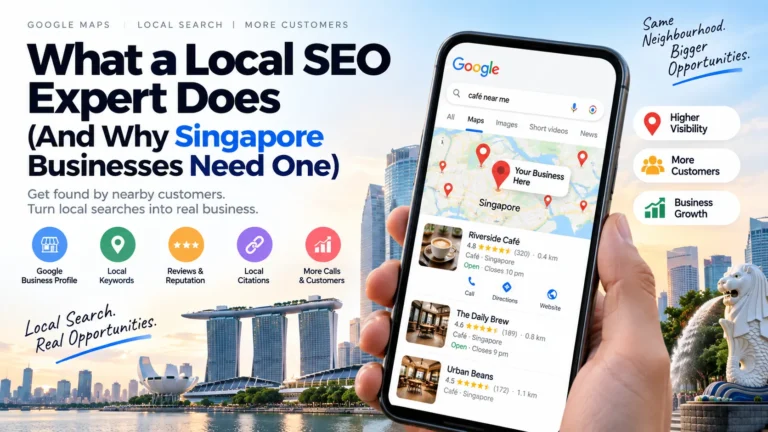
You have probably seen the shift yourself. When Singaporeans search, they rarely type broad phrases like “dentist Singapore” or “AC repair Singapore”. They search based on where they are and how fast they need something. They type “dentist near Tanjong Pagar MRT” or “AC repair near Ubi”.
According to Google, searches with “near me” have grown more than 500% over the past few years, driven by mobile habits and immediate needs.
The rise of voice search reinforces this behaviour. When someone tells Siri or Google Assistant they need a pizza place near Orchard Road or a clinic close to Punggol MRT, the intent is urgent and the search radius is tiny.
These users want solutions that are nearby, available, and trustworthy. If you want to win these high value clicks, you can’t rely on standard SEO tactics that target country level search queries. You need a strategy that helps you show up at the exact moment someone in your micro area is ready to buy.
The gap is that most SMEs still optimise as if they are competing for visibility across the entire country. They create single service pages. They ignore neighbourhood level keywords. They do not optimise their Google Business Profile based on micro areas.
In a dense country like Singapore, this is a costly mistake. The more precise your targeting, the more likely you are to capture people who are minutes away from walking into your shop or booking your service.
If you want to grow your visibility in districts like Tanjong Pagar, Toa Payoh Central, Sengkang, Bukit Timah, or Geylang Serai, you must work with an approach that reflects how consumers move and search in Singapore. This is why many SMEs now invest in a local SEO agency.
Key Takeaways
- Hyperlocal SEO allows Singapore SMEs to target customers with high intent by optimising for ultra-specific locations such as MRT stations, streets, and neighbourhood clusters, rather than competing broadly across the entire country.
- Implementing hyperlocal strategies, including geo-landing pages, Google Business Profile optimisation, local content, and neighbourhood-specific reviews, significantly increases visibility in Map Pack results and drives more foot traffic, calls, and conversions.
- Focusing on micro-locations and precise local signals offers a competitive advantage, reduces marketing spend compared to national SEO, and enables SMEs to dominate their immediate areas before expanding further.
What Hyperlocal SEO Actually Means
Hyperlocal SEO is the practice of ranking your business for ultra precise search intent. This includes searches that reference MRT stations, specific blocks, buildings, malls, or neighbourhood clusters. Instead of targeting the entire island, you target the streets, zones, and micro communities where your buyers live, work, and search.
Traditional local SEO focuses on general queries such as “maid agency Singapore” or “physiotherapy Singapore”. These are broad searches. They attract a mix of high intent and low intent users. They place you in the same competition pool as every other business in your vertical.
Hyperlocal SEO flips this approach. With hyperlocal targeting, you build your content marketing and optimisation strategies around queries like:
- “maid agency near Novena MRT”
- “Bukit Timah maid agency”
- “Serangoon helper agency”
- “orthodontist near Orchard MRT”
- “pet grooming at Ang Mo Kio Central”
These are not just keywords. They are buying signals. Someone who types “mobile repair Tampines 1” is not browsing, they are deciding. Someone who searches “tuition centre Toa Payoh Central” is not casting a wide net, they are looking for a centre near their home or their child’s school.
Singapore’s structure makes this especially relevant. The city is built around MRT lines, mall clusters, HDB estates, and business districts. People make choices based on convenience, travel time, and familiarity. Google’s localised algorithms heavily weigh proximity. If your brand is not optimised for micro areas, you will not show up when someone near you is searching.
Hyperlocal signals also enhance your relevance in Google’s Map Pack. Your keyword clustering, reviews that mention your neighbourhood, proximity cues from mobile users, and a content marketing strategy built around location pages all tell Google you are the best option for people searching within a very precise radius.
When you get this right, you rank in the Map Pack, which drives the highest conversion rates for local intent searches.
Hyperlocal SEO is not about volume. It is about precision. When you attract fewer but more qualified visitors, your cost per lead drops and your close rates climb. This is how SMEs beat larger competitors without outspending them.
Why Hyperlocal SEO Drives Higher-Intent Leads in Singapore

Image Credit: Think With Google
If you want to understand why hyperlocal targeting works so well in Singapore, you only need to look at real search behaviour. Singaporeans rely on local search when they need something fast.
Google reports that 76% of people who make a local search visit a business within one day. Pair this with the fact that 28% of local searches result in a purchase.
You now have the perfect formula for high-conversion traffic and highly qualified lead generation.
Local search equals strong intent. Hyperlocal search equals immediate intent.
Consider how Singaporeans move throughout a typical day. Residents of Bukit Panjang looking for aircon servicing will search “AC repair near Hillion Mall”. Office workers in Raffles Place will search “express lunch Tanjong Pagar”. Someone walking around Tampines will search “phone repair Tampines 1”. These are not casual queries. These are near purchase moments.
Voice search reinforces this even further. Because most voice queries are tied to proximity, users frequently include conversational, location-driven phrases such as “near me,” “closest,” or “open now.” This behaviour is consistent in dense urban environments—including Singapore—where people make voice searches while on the go, driving, or multitasking.
Why this matters for you:
- When someone searches for a hyperlocal query, convenience becomes the primary decision factor.
- Your competition pool shrinks from dozens of competitors to only two or three within the same radius.
- Your visibility increases because Google prioritises businesses that are closest to the user.
- Your conversions jump because users have a clear intention to act.
This creates a competitive advantage that broad SEO can’t provide. Ranking for “dentist Singapore” is hard and expensive. Ranking for “dentist near Tanjong Pagar MRT” is easier, cheaper, and more profitable. You reduce the amount of content you need to create and invest in keywords with less competition but higher buyer readiness.
When you combine hyperlocal strategies with accurate data from Google Business Profile insights, you gain precise control over how people discover and engage with your brand. The more people in your area click, call, request directions, or visit, the more Google reinforces your relevance for similar searches.
This becomes a self strengthening feedback loop that compounds over time. Hyperlocal SEO does not just bring you traffic. It brings you the right traffic.
Key Components of a High-Performance Hyperlocal SEO Strategy
A strong hyperlocal strategy has multiple elements that reinforce one another. If you want to dominate micro areas in Singapore, you need more than just keywords. You need signals that tell Google exactly where you serve customers and why you are the most relevant option.
1. Hyperlocal Keyword Clusters
Hyperlocal targeting starts with smart clustering. You create keywords that combine your service with a precise location. These variations may include:
- Service plus MRT station
- Service plus mall
- Service plus block or street
- Service plus neighbourhood
Examples:
- “orthodontist Orchard MRT”
- “mobile repair Tampines 1”
- “aircon servicing Ubi industrial park”
These clusters help Google understand your proximity relevance. They also capture users who want the closest provider instead of the cheapest.
2. Geo-Landing Pages for Neighbourhoods
If you serve customers across multiple areas, you need individual geo pages. Each page should be built for one neighbourhood and must avoid duplicate content. Google penalises thin or duplicated pages. You can differentiate pages by:
- Highlighting local service examples
- Mentioning nearby landmarks or MRT stations
- Adding photos from the specific branch or area
- Including unique FAQs related to the district
When done properly, neighbourhood pages become your best converting assets.
3. Google Business Profile Optimisation
GBP is the heart of hyperlocal visibility. It influences Map Pack rankings, direction requests, and call clicks. To optimise your profile:
- Select the most accurate categories
- Add hyperlocal keywords to your posts and descriptions
- Add photos that reflect the local area
- Use local attributes such as wheelchair access or halal certification
- Update business hours and phone numbers for each branch
GBP signals often outweigh website signals for micro area intent.
4. On-Page Hyperlocal Signals
Your website must reinforce your local focus. This includes:
- Accurate NAP data (name, address, phone)
- Embedded Google Maps for each branch
- Schema markup for LocalBusiness
- Text that references nearby MRT stations or malls
Avoid forcing location names unnaturally. Readers must feel like the content is conversational and helpful.
5. Locally Relevant Content Assets
To create authority, you need content that addresses hyperlocal needs. Examples include:
- Neighbourhood guides
- Service area pages
- Local FAQs
- Buyer guides tied to specific locations
For example:
- “Best brunch near Bugis MRT”
- “What to do when your aircon breaks down in HDB flats at Jurong East”
This content builds topical relevance and supports your primary geo pages.
6. Local Reviews and User Generated Content
Reviews are one of the strongest hyperlocal signals. Google rewards businesses with reviews that mention the neighbourhood, street, or MRT. You can encourage customers to include location keywords by:
- Asking questions such as “How was your experience at our Toa Payoh branch?”
- Using location specific QR codes
- Creating incentives for neighbourhood specific reviews
Review velocity and relevance directly influence your ranking strength.
Advanced Hyperlocal SEO Tactics for Singapore SMEs
Once you have the foundational elements in place, you can amplify your results with more advanced tactics.
1. Hyperlocal Programmatic SEO
Programmatic SEO allows you to scale hyperlocal pages for various neighbourhoods, as long as the content remains high quality. This works especially well for:
- Clinics with multiple branches
- Tuition centres
- Real estate services
- Home repair and maintenance companies
The key is maintaining unique content for each page. Programmatic does not mean automated spam. It means creating structured content templates with variations that reflect local context.
2. Geo-Fencing and Local Signals from Mobile Users
Singapore has one of the highest smartphone penetration rates globally. According to Data Reportal, it stands at an incredible 179%. When users move within your area and interact with your brand, Google captures signals such as:
- Direction requests
- Click-to-call actions
- Reviews submitted from within the area
- Mobile visits to your website
These signals strengthen your hyperlocal relevance because they prove users near you find your business useful.
3. WhatsApp and Click-to-Call Optimisation
WhatsApp is the preferred communication channel for many Singaporeans. Adding a WhatsApp click button increases micro conversions, especially on mobile. Every time someone engages through WhatsApp or calls you from the search results, Google sees engagement that validates your relevance for local searches.
4. Local Link Building
Local links matter more than generic links for micro area rankings. You can build these by partnering with:
- Community clubs
- Neighbourhood Facebook groups
- Local bloggers
- Property management committees
- School associations
- Small events in malls or community centres
Hyperlocal PR, such as sponsoring school fairs or contributing to district level content, strengthens neighbourhood relevance.
5. Multi-Language Tuning
Because Singapore is multicultural, some searches are made in Malay, Mandarin, or Tamil. Optimising key pages for multilingual variations can increase visibility in specific communities. This is especially useful for services located in areas like Geylang Serai, Chinatown, or Little India.

This combination of advanced tactics makes your hyperlocal signals more robust and gives you an edge over competitors who only focus on basic SEO.
Real Singapore Case Studies
Below are anonymised but realistic examples to show you how hyperlocal optimisation transforms visibility.
Case Study 1: Tanjong Pagar Dental Clinic
This clinic wanted more weekday lunch bookings from office workers. They originally focused on broad terms such as “dentist Singapore”, which brought traffic but not bookings. When they created a geo page for “dentist near Tanjong Pagar MRT” and added neighbourhood specific reviews, their Map Pack ranking improved within weeks.
They added clear walking directions from Tanjong Pagar MRT Exit A. They uploaded lunchtime appointment photos to Google Business Profile. They posted weekly updates referencing Tanjong Pagar offices. As a result, lunchtime bookings increased and their conversion rate doubled for hyperlocal search users.
Case Study 2: Bukit Timah Fitness Studio
This boutique studio wanted more sign ups from nearby condos. They created content that mentioned Maple Woods, Royalville, and Cascadia. They ensured their GBP photos included images of the surrounding estate and added FAQs such as “Do you have parking available for residents of Maple Woods?”

Hyperlocal content paired with strong GBP optimisation led to consistent enquiries from nearby residents. The studio did not rank nationally, but they did not need to. They filled their classes using hyperlocal visibility alone.
Case Study 3: Tampines Mobile Repair Shop
This shop relied heavily on walk ins. They optimised for “phone repair Tampines 1”, “mobile repair Century Square”, and “handphone repair Our Tampines Hub”. They also added a WhatsApp button to their GBP listing, which increased micro conversions.
By focusing on hyperlocal terms and improving their presence around the three main malls, they saw a significant increase in direction requests. This translated directly into higher foot traffic and faster turnaround for same day repairs.
These examples demonstrate that hyperlocal optimisation allows SMEs to grow without competing at the national level. You win by owning your neighbourhood, not the entire market.
Metrics That Show Hyperlocal SEO Is Working
Hyperlocal strategies produce very specific results. You can track progress through the following indicators.
Map Pack Rankings
Showing up in the top three positions of the Map Pack for your neighbourhood is a major win. Map Pack visibility correlates strongly with conversions because these results dominate mobile searches.
Local Keyword Traffic Per Neighbourhood
Tools like Google Search Console allow you to monitor impressions and clicks for area specific queries. These signals confirm your hyperlocal keywords are gaining traction.
Direction Requests and Call Clicks
Google Business Profile Insights shows:
- Direction requests by district
- Calls made directly from your listing
- Website visits from local searches
These interactions tell you which neighbourhoods are driving the most engagement.
Conversions from Geo Pages
Your hyperlocal pages should deliver higher conversion rates than general service pages. People who visit these pages already know they want a local provider.
CTR Uplifts from Hyperlocal Pages
Users click results that reflect their exact location. If your click through rate increases after adding micro area signals, your hyperlocal relevance is improving. When these metrics all trend upward together, you know your strategy is working.
Common Mistakes SMEs Make with Hyperlocal SEO
Many SMEs sabotage their results without realising it. Here are the most common issues.
Thin or Duplicate Geo Pages
Repeating the same content across multiple neighbourhood pages is a red flag. Google sees these as low value and may ignore them entirely.
Overstuffing Location Keywords
Forcing dozens of neighbourhood names into a paragraph makes your content unreadable. It can also harm rankings.
Ignoring Google Business Profile Optimisation
GBP is the most influential factor in hyperlocal visibility. If you ignore your profile, you will not rank locally.
Poor NAP Consistency
Inconsistent phone numbers, branch names, or addresses confuse search engines. Your data must match across all platforms.
Lack of Reviews or UGC
Reviews that mention neighbourhoods strengthen hyperlocal authority. A lack of them puts you at a disadvantage.
Targeting the Entire Singapore Market
Trying to rank for everything makes your strategy unfocused. Hyperlocal SEO works best when you dominate micro areas before expanding outward.
Avoid these mistakes and your results will accelerate faster.
How to Implement This Without Overwhelming Your Team
Hyperlocal optimisation can feel complex, but you can simplify the process by focusing on the highest leverage actions first.
Recommended Workflow
- Identify 10 to 20 high intent hyperlocal keywords based on your service and neighbourhood.
- Build three to five strong hyperlocal pages with unique content.
- Update and optimise your Google Business Profile for each branch.
- Encourage neighbourhood specific reviews.
- Create locally relevant content to support your geo pages.
- Add hyperlocal backlinks from community groups or district level partners.
- Expand only after seeing measurable results.
Outsourcing Options
If your team is small or stretched, you can outsource parts of the workflow. Content writers can handle neighbourhood pages. Programmatic SEO providers can help scale your area coverage. An SEO agency can manage your GBP, reviews, and data consistency. This frees you to focus on running your business while still building a strong hyperlocal footprint.
The goal is to make consistent progress without overwhelming your resources.
Start Leveraging Hyperlocal SEO as Your SME’s Growth Multiplier

Image Credit: Sekel
Singapore is a compact city with highly concentrated purchasing behaviour. When someone searches within your neighbourhood, they are minutes away from becoming your customer. Hyperlocal SEO allows you to reach these people at the exact moment they need you.
This is one of the most efficient ways to grow your business because you are focused on high intent users rather than broad traffic that rarely converts.
When you optimise for micro areas, control your Google Business Profile, and build neighbourhood specific content, you give Google all the signals it needs to rank you above nearby competitors. This creates faster visibility, higher conversion rates, and stronger brand recognition among people who are already within reach of your shop or service area.
If you want expert support for this strategy, you need an innovative partner that understands how Singaporeans search and how Google evaluates hyperlocal relevance. As part of our comprehensive digital marketing services, MediaOne has a proven track record in building profitable local visibility for SMEs.
Contact us today and let’s start maximising the full potential of hyperlocal SEO.
Frequently Asked Questions
What is the difference between hyperlocal SEO and local SEO for small businesses?
Hyperlocal SEO focuses on extremely specific geographic areas such as streets, MRT stations, or neighbourhood clusters, whereas traditional local SEO targets broader locations like a city or region. For small businesses, hyperlocal SEO helps attract customers who are physically close and ready to engage, resulting in higher conversion rates.
How can hyperlocal SEO improve mobile search performance in Singapore?
Hyperlocal SEO enhances mobile search performance by optimising for location-based queries that users perform on the go, such as “coffee near Orchard MRT” or “plumber Tampines 1”. By providing precise directions, clickable call or WhatsApp buttons, and accurate Google Business Profile data, businesses appear more prominently in mobile searches with immediate intent.
Yes, social media can reinforce hyperlocal SEO by sharing content targeted to specific neighbourhoods, tagging locations, and engaging with local groups or community pages. These activities generate local signals and backlinks, which help boost your visibility for hyperlocal searches on Google.
What role do customer reviews play in hyperlocal SEO?
Customer reviews are critical because Google considers mentions of specific locations as a trust signal for hyperlocal searches. Reviews that reference streets, MRT stations, or neighbourhoods improve rankings and influence potential customers who value local reputation and proximity.
Is hyperlocal SEO suitable for all types of Singapore SMEs?
Hyperlocal SEO works best for businesses with a physical presence or service area that can be geographically defined, such as retail stores, clinics, tuition centres, and home service providers. Even SMEs with multiple branches can benefit by creating geo-specific pages and optimising Google Business Profiles for each location.