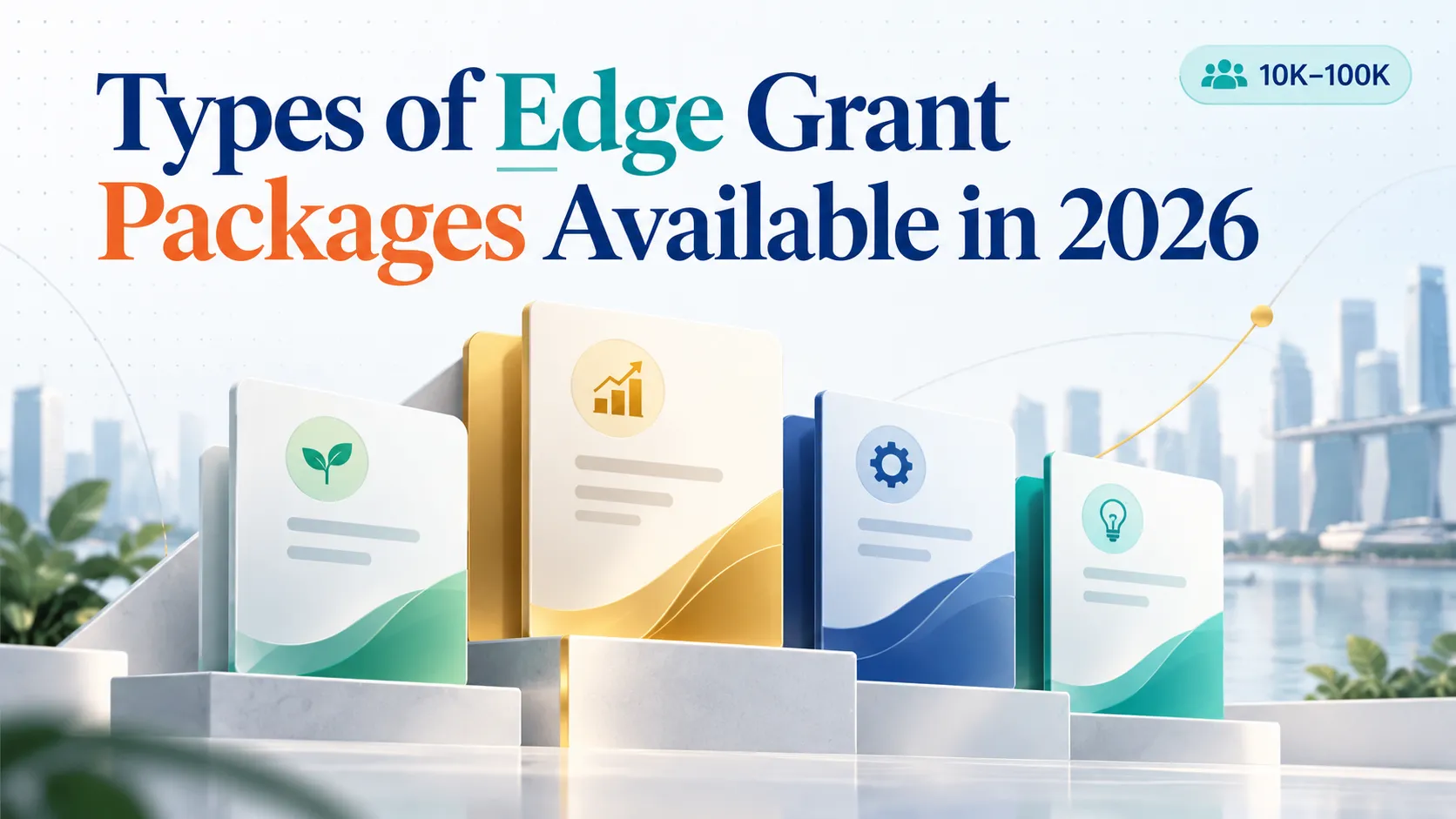
If you have searched for an “edge grant package”, you have probably noticed that the results mix two different things. Some pages describe the government grant, while others sell a bundle of services with the EDGE name attached. Both are real, but they work differently, and confusing them can lead to misjudging what a business will pay. Singapore businesses comparing options should separate the two before comparing prices.
From 30 September 2026, Enterprise Singapore merges EDG, PSG and MRA into one grant called EDGE. Many pages still describe the older schemes separately. This guide maps the main types of support, explains how vendor packages sit on top of the grant, and offers a simple test for whether a package saves money. The answer usually depends on fit rather than headline price. At MediaOne, we see this confusion every week from SMEs comparing digital marketing quotes.
Key Takeaways
- The EDGE grant is a funding framework, not a single product. From 30 September 2026, EDG, PSG and MRA combine into one grant called EDGE.
- Vendor “EDGE packages” are commercial bundles. Their stated 50% support is an illustration only, not a guaranteed outcome.
- SMEs can typically receive up to 50% support, rising to 70% for selected internationalisation and sustainability activities.
- Total support is capped at S$100,000 per business per year, shared across all activities.
- Map the need to a pillar first, then compare each package’s net cost against unsupported spending.
Table of Contents
Understand EDGE Grant Packages for Singapore Businesses
Watch this video to learn more about the EDGE Grant and what to consider when evaluating digital marketing packages. Explore how comparing service scope, deliverables, project costs, and business objectives can help you make a more informed decision when selecting a digital transformation solution.
What the EDGE Grant Is and Who It Is For
The EDGE grant is a government funding framework administered by Enterprise Singapore to help Singapore businesses upgrade their capabilities and manage costs. From 30 September 2026, the Enterprise Development Grant (EDG), Productivity Solutions Grant (PSG) and Market Readiness Assistance (MRA) combine into EDGE, according to Admiral Systems’ summary.
Searches for “edge grant package” often mix two things: the government grant and a commercial package priced by a vendor and partly subsidised under the EDGE name. Treat them as one product and you will misjudge the price, so plan your budget around the net cost after subsidy. Work through each guide’s process before you commit, and check the email terms your vendor provides.
Why the Grant Is a Framework, Not a Single Product
EDGE is a funding framework, not an off-the-shelf product. A business reaches it through a pillar (the category of project funded), usually via a vendor who builds the package. Map your need to a pillar and compare providers before applying; reversing that order means the package fits the vendor’s offer, not your needs. Grants support innovation and market access as well as productivity, so check which core capabilities each pillar covers.
What This Article Covers
This article sets out the main types of support, how vendor packages are priced, and how to test whether a package is worth signing. You will learn to compare packages on scope, gross price, support rate and net cost, and to check how much of the S$100,000 annual cap a package would use over time.
Government EDGE Grant Versus Vendor Packages
The government EDGE grant is the funding itself. A vendor EDGE package is a commercial bundle that the funding may partly cover. Keeping them apart is the first step to judging whether any package saves money, and this comparison matters most for Singapore businesses weighing their options.
What the Government EDGE Grant Covers
From 30 September 2026, EDG, PSG and MRA come together under one grant called EDGE, as the Enterprise Singapore consolidation sets out. Older scheme names still appear on many pages, so check any package against the current EDGE rules. Total support is capped at S$100,000 per business per year, shared across all activities, including growth projects, digital content and strategy work, email marketing and innovation.
Businesses can apply for the new EDGE Grant and use the BizSG portal to find suitable support, according to SMF’s announcement.
How Vendor EDGE Packages Work
A vendor sets a price, and EDGE support then reduces what the business pays. Addlly AI gives an example: up to 30 monthly posts across four platforms, plus planning and trend analysis, which builds brand presence and content for Singapore SMEs.
Its illustration is SGD 7,000 for 12 months, with SGD 3,500 shown at 50% EDGE support, subject to eligibility and approval. This is a hypothetical illustration, not a guaranteed price. Your actual rate depends on your business type and the activity, and the time to approval can vary.
Worked Net-Cost Test for Any Package
Fit matters more than headline price, so test each package the same way, using these labelled assumptions:
- Gross price: the vendor’s quoted price (the illustration uses SGD 7,000)
- Support rate: the rate confirmed on approval (the illustration uses 50%, not guaranteed)
- Net cost: gross price minus support
- Cap used: the supported amount, drawn from the S$100,000 annual cap
On the illustration, net cost is SGD 3,500 and SGD 3,500 of the cap is used. A cheaper package with poor fit can still cost more in practice, so weigh it against your business strategy and core capabilities, and check how it fits your financial management and project plans. A development grant can offset costs, but only where the package genuinely fits.
Comparison Table: Government Grant vs Vendor Package
| Factor | Government EDGE grant | Vendor EDGE package |
|---|---|---|
| Funder | Enterprise Singapore | Commercial provider |
| What is funded | Qualifying costs under EDGE pillars | Vendor services, priced then partly subsidised |
| Support rate | Up to 50% for SMEs, up to 70% for selected activities | Illustrative only, confirmed on approval |
| Cap | S$100,000 per business per year, shared | Draws from the same cap |
| Eligibility check | Through the BizSG portal and Enterprise Singapore | Provider confirms before signing |
| Who applies | The business | Usually the business, with the vendor’s help |
Support Levels, Eligibility and Funding Thresholds
SME Eligibility as the Starting Point
Eligibility sets the starting point for every EDGE grant package decision. Most SMEs qualify under the standard criteria, but an application moves forward only once the business is verified and its account is credible with Enterprise Singapore. Applications stall most often here, not at the pillar or vendor choice. Confirm your company’s standing and details before requesting a quote, and check the EDGE grant guide for the full criteria.
Funding Levels by Business Type
The support rate depends on business type. According to SMF, SMEs can typically receive up to 50% support, rising to 70% for selected internationalisation and sustainability activities. Non-SMEs can receive up to 50%, according to Singapore Secretary Services.
Check the official Enterprise Singapore EDGE page for current rates, as these change. Treat any quoted net price as provisional until approval confirms the rate.
Sharing One Cap Across Several Projects
The consolidated EDGE grant package’s S$100,000 annual cap is shared across all activities. List every planned project, estimate its supported cost, and check that the total stays within the cap before combining support.
Choosing the Right EDGE Pillar and Applying Step by Step
Check which pillar fits your project before you apply. From 30 September 2026, EDG, PSG and MRA come together under one grant called EDGE, according to Admiral Systems’ summary, so older pillar names may still appear in vendor material. Singapore businesses that previously applied under the enterprise development grant should expect the new pillar names to replace the old ones.
Matching Your Business Goal to a Pillar
| Business goal | Pillar to consider |
|---|---|
| Strengthen management, HR or financial management | Core capabilities |
| Develop new products, processes or productivity gains | Innovation and productivity |
| Enter new overseas or domestic markets | Market access |
| Adopt digital tools, systems or platforms | Digitalisation |
Digitalisation is the pillar businesses most often confuse with the others. A one-off marketing campaign bundled by a vendor does not automatically qualify, so check the vendor’s scope first. Our SEO and SEM services show how this plays out: search work is bought as a service, and its eligibility depends on what the grant actually funds. Content, email and brand work follow the same rule, so a campaign that builds growth on its own does not qualify just by being labelled digital.
Application Steps
- Confirm eligibility. Check that your business meets the SME criteria and that your project costs qualify under the grant’s rules.
- Verify account credibility. Make sure your Enterprise Singapore company details are accurate and current.
- Select the pillar. Use the table above to match your project to one pillar, and confirm it supports your broader business strategy.
- Engage a vendor. Compare the package’s scope, gross price and support rate against doing the work unsupported.
- Submit through the BizSG portal. Use the portal to discover and apply for suitable support, as SMF has noted.
- Track approval. Keep claimable spending within the S$100,000 annual cap, shared across all activities.
Some activities require a pre-approved vendor, so check the requirements first. Under core capabilities, listing general improvements without a measurable outcome is a common mistake reviewers often reject.
Checklist Before You Submit
- [ ] Business meets SME criteria for the support rate you expect
- [ ] Project maps clearly to one pillar
- [ ] Vendor package scope matches the work you need
- [ ] Net cost after support is lower than paying for the same work unsupported
- [ ] Remaining annual cap covers this project and your other planned activities
- [ ] Application submitted through the BizSG portal
Conclusion: Matching Your Need to the Right EDGE Package
The EDGE grant is a funding framework, not a single product. From 30 September 2026, Enterprise Singapore’s EDGE announcement brings EDG, PSG and MRA together under one grant, and vendor packages sit on top of it. Map your need to an EDGE pillar first, then compare packages against that need, and check price last. Singapore businesses should treat this as a planning process, with each step reviewed against the strategy and growth goals the grant is meant to support. Working professionals can use this guide to shape a clear, time-efficient plan for enterprise development and financial management.
Treat illustrative figures as non-binding. A vendor example such as SGD 3,500 at 50% support shows what a package could look like. It does not promise your outcome. Your actual support depends on SME status, qualifying costs and approval.
Before you commit, test each package. Does its net cost, after the support rate actually applied, beat doing the same work without grant help? Does it leave enough of the S$100,000 annual cap for your other projects? If either answer is no, the package is the wrong fit, however attractive the headline price.
Your next step is practical. Check eligibility on the BizSG portal, then speak to a provider with your pillar and budget in hand. Ask them to show the support rate applied, in writing, before you sign. For a second opinion on a quote, our SMA and SMM teams can walk through the scope with you.
Is the EDGE grant the same as an EDGE grant package sold by a vendor?
No. The EDGE grant is the government scheme run by Enterprise Singapore. An “EDGE grant package” is usually a vendor’s bundled service that the scheme may partly fund. Vendors set their own pricing, scope and support rates, so check both grant eligibility and package terms before you sign.
How much support can an SME receive under the EDGE grant?
According to SMF, SMEs can typically receive up to 50% support, rising to 70% for selected internationalisation and sustainability activities. Non-SMEs can receive up to 50%. The business always pays the balance. Rates and caps change, so confirm current figures on the official scheme page.
What is the annual cap on EDGE grant support?
Total grant support is capped at S$100,000 per business per year, shared across all activities. A large package can use much of that allowance, leaving less for other projects in the same year.
Which EDGE pillar should a digitalisation project use?
Match the project to the pillar that describes its main purpose, not the vendor’s sales pitch. The digitalisation pillar fits projects that change how the business operates through digital tools. Confirm the choice with Enterprise Singapore before you apply.
Do I need an external consultant to apply?
It depends on the pillar and project. Some activities require a vendor from a pre-approved list, while others let you choose your own. Check the requirements for your chosen pillar on the BizSG portal before engaging anyone.
What are the most common application mistakes?
Applicants often verify their account late, pick the wrong pillar, assume the vendor’s illustrative support rate is guaranteed, and overlook the shared S$100,000 cap. Confirm eligibility and cap headroom before you commit.