The Edge Grant for social media is a reimbursement scheme. It shares the cost of approved, already-priced work. It does not create a strategy. Businesses that qualify, usually SMEs with a separable project, pay their vendors first and then claim back part of the cost.
This guide is for two readers. SME owners and marketing leads will learn how to judge whether a project is worth the application effort. Non-SMEs will learn why the scheme is likely closed to them and where to look instead.
Before you read further, the direct answer is this: social media spend is claimable under the Enterprise Development Grant only where it sits inside an approved, itemised project and falls in an eligible category. Whether a given cost qualifies, and at what rate and cap, is set by Enterprise Singapore. Check the current rate and cap on the official Enterprise Development Grant page before you commit any budget.
We are MediaOne, a Singapore digital marketing agency offering SEO, SEM, SMM and other digital solutions. We use our own package pricing as a reference point for what funded and unfunded engagements cost. The figures below are illustrative.
Key Takeaways
- The grant is a reimbursement, not a free service. The business pays vendors first, then claims a share of approved spend. Budget for that gap before signing anything.
- Only SMEs with a clearly separable project should apply. Non-SMEs fall outside the scheme. SMEs without defined objectives and an itemised vendor scope will struggle to get a claim approved.
- Score the project before applying. Assess eligibility and plan readiness separately, then decide whether to apply, build a scoped plan first, or look at other programmes.
- Structure vendor quotes so each line maps to a claimable activity. Our Boost Up Package A (S$10,000) and Package D (S$9,900) cover different service lines and periods, so each component needs checking against eligible categories.
- Keep a complete documentation trail from day one. Invoices, proof of payment and campaign outputs decide whether a claim survives review.
Table of Contents
What the Edge Grant for Social Media Is, and Who Qualifies
The Edge Grant for social media sits within the Enterprise Development Grant (EDG), administered by Enterprise Singapore. The EDG supports businesses in upgrading capabilities. Social media projects can fall under it when they form part of an approved, separable project.
The grant reimburses a share of approved spend. It does not fund a strategy from scratch. You need a project with a defined purpose, a quoted scope and a payment trail. The grant suits SMEs that already have a plan.
Eligibility for SMEs: the core criteria and how to check them
Eligibility turns on three things: SME status, Singapore registration and whether the project can be separated from ordinary operating costs. Enterprise Singapore sets the headcount and turnover thresholds, so check them on the official page.
To check your position:
- Confirm your SME status against the current definition published by Enterprise Singapore.
- Confirm your business is registered and operating in Singapore.
- Write a one-paragraph description of the project. Check whether it can be separated from routine marketing you would do anyway.
- Compare that description against the eligible expenditure categories on the official page.
If a step leaves you unsure, use Enterprise Singapore’s enquiry channels. They are the authoritative place to resolve it.
Why non-SMEs fall outside the scheme and what alternatives exist
The EDG targets small and medium enterprises, so larger companies are generally outside its scope. A non-SME should ask what budget and support it can access instead.
Alternatives include internal marketing budgets tied to measurable targets, sector or trade association programmes, and partnerships with eligible SME partners where the commercial arrangement allows. Assess each on cost, control and the capability it builds in-house.
Common misconceptions about the grant’s scope
The most persistent misconception is that the grant makes social media largely free. It does not. The business funds a co-payment and must pay vendors before claiming. Another is that all marketing spend is claimable. Only approved, itemised activities in eligible categories qualify, and advertising spend is not automatically covered. A third is that a bundled agency package is fully claimable. Check each component against eligible categories before signing.
Understanding the Funding: What Costs Are Covered
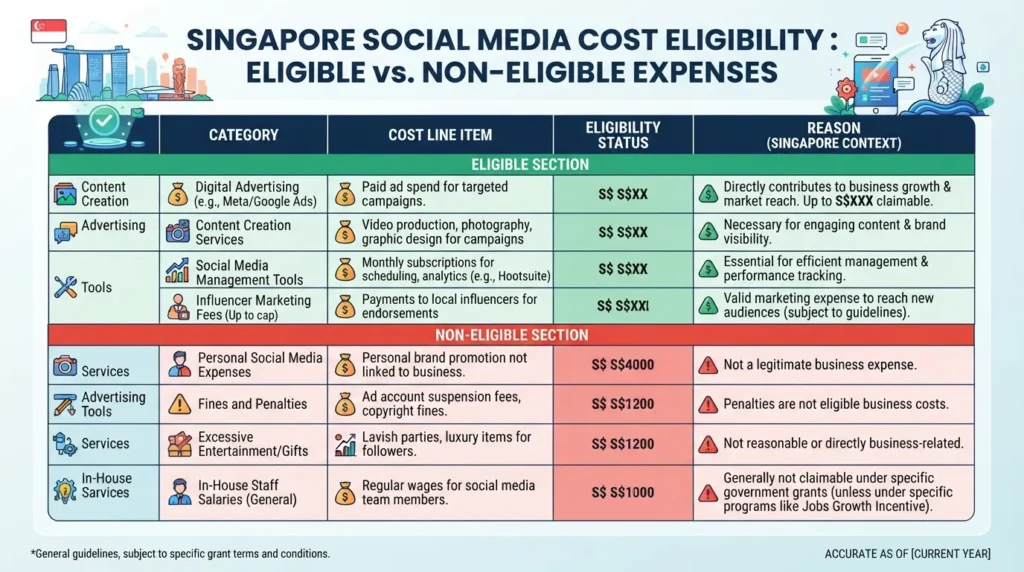
The grant pays a share of approved costs, and you fund the rest. Whether a cost line qualifies depends on how it is described in the quotation and whether it maps to an eligible category.
Understanding the Funding: What Costs Are Covered
Many SMEs assume the Edge Grant for social media funds “social media” as a general activity. It does not. The grant reimburses a share of specific, approved costs inside a defined project. Check which costs fall inside that boundary before you estimate anything.
Eligible costs generally fall into three groups: professional services you contract, capability you build in-house, and tools or outputs the project needs. For social media, most claims come from the services side. These include an approved vendor or consultant planning, setting up and running channel activity, creating content assets the project specifies, and the set-up and measurement work that lets you report results.
When you prepare a quotation, check each line against this logic. A line such as “community management across Facebook and Instagram for two months” maps to a claimable activity. A line such as “general brand consultation with no defined deliverable” does not. The more precisely a line describes an output, the easier it is for an assessor to approve it.
Check the current list of eligible categories on the official scheme page maintained by Enterprise Singapore. Category wording changes, so confirm it against the version in force when you apply.
Platform-specific activities and what they map to
Each platform tends to produce a different kind of claimable activity. Use the list below as a starting point, then match each line to the scheme’s official categories.
Facebook projects usually involve page set-up, content planning, community management and reporting on audience engagement. Recurring management is claimable only if the scope and duration are written into the quotation.
LinkedIn work often covers company page optimisation, thought-leadership content and B2B outreach planning. Ask the vendor to separate content creation from direct messaging or prospecting, because the second may fall outside the approved scope.
Instagram activity typically includes visual content production, account management and hashtag or caption strategy. Content assets are claimable when the project specifies them, so list the number and type of assets in the quotation.
TikTok
TikTok projects tend to cover short-form video planning, filming support and channel management. Describe each video deliverable separately, because a lump-sum “TikTok management” line gives an assessor nothing specific to approve.
Paid ads
Paid advertising is a separate question. Boosted posts and campaign spend are generally treated as media cost and are often excluded. Management fees for running paid campaigns may be claimable, but only the fee, not the ad spend.
Typical funding levels and the co-payment you must budget for
The grant does not pay the whole bill. You fund the gross cost first, then receive reimbursement for the approved share. The co-payment, the share you pay yourself, is the figure to budget for, not the headline grant rate.
Two numbers drive the calculation: the grant percentage for your project and the cap on total support. Open the official Enterprise Singapore scheme page, identify the rate and cap that apply to your project type and business profile, and record both before you request quotations.
Take the publisher’s own packages as a reference point. We price our “Boost Up” Package A (SEO for 30 keywords plus SEM for three months) at S$10,000. Package D (SMM for two months plus SMA for two months) is S$9,900. If both were scoped as eligible within one project, the gross outlay would be S$19,900.
Use this worked example to see how the co-payment is calculated:
- Gross cost: S$19,900.
- Approved grant rate: the percentage that applies to your course, which you should confirm on the official page before relying on it.
- Reimbursed share: S$19,900 multiplied by that approved rate, subject to a funding cap that is also set out on the official page.
- Your co-payment: S$19,900 minus the reimbursed share.
Only the approved rate and cap determine the result, and the grant may not cover every line.
Cash flow matters here. You pay vendors before you claim, so a small business must fund the full gross amount until disbursement. This is the most commonly overlooked cost in grant-backed projects.
Costs that are not claimable and where businesses commonly go wrong
The most common rejection reason is not an ineligible service. It is a cost claimed without a clear link to an approved project. Three patterns recur.
First, advertising spend. Money paid to platforms for boosted posts, sponsored placements or paid campaigns is generally treated as media cost and is frequently excluded. A vendor bundling SEM into a package does not make the ad spend itself claimable.
Second, internal staff time. Your employees’ salaries and time are typically not claimable in the way external vendor fees are. Budget for this as an internal cost you carry.
Third, costs incurred before approval. Spending or contracting before the approval date can invalidate a claim, so the timing rules in the application section apply here too.
Businesses most often go wrong by mixing these categories in one lump-sum invoice. A quotation reading “Social media package, S$9,900” gives an assessor nothing to approve. Ask your vendor to itemise each service, its duration and its deliverables.
Common rejections and how to avoid them
| Common Rejection | Likely Reason | How To Avoid |
|---|---|---|
| Ad spend refused | Paid media treated as media cost | Claim only management fees; confirm exclusions with Enterprise Singapore |
| Lump-sum invoice queried | Line items cannot be mapped to an approved activity | Ask the vendor to itemise services, durations and deliverables |
| Pre-approval costs disallowed | Contracts signed or payments made before approval | Wait for the approval letter before contracting or paying |
| Vendor not accepted | Provider does not meet scheme requirements | Confirm the vendor’s eligibility in writing before signing |
| Internal staff time claimed | Salaries are not treated like external vendor fees | Budget staff time as an internal cost you carry |
| Scope change not reported | Activity differs from the approved project | Notify the agency before incurring extra cost |
Step-by-Step Application Process
The Edge Grant for social media works on reimbursement, not upfront funding. You commit cash to vendors first, prove the spend, and then claim back a share. Businesses that start spending without a plan usually end up with rejected claims or unexpected costs. The steps below follow the order in which the application unfolds.
Preparing before you apply: documents, quotations and timelines
Before you open the application portal, gather the evidence the assessor will want to see. At minimum, prepare:
- Company registration and SME status documents, including your UEN and the figures that confirm you meet the SME definition.
- A written project scope with defined objectives, target platforms and the period the activity covers.
- Itemised vendor quotations, one per vendor, with each line described in plain terms. For example, “monthly paid social management, LinkedIn” rather than “digital services”.
- A rough timeline showing when you expect to contract, start, deliver and pay each vendor.
Plan the timeline backwards from the approval date. Do not sign contracts or make payments for activity that starts before approval. Pre-approval spend is a common reason claims are refused. Build in a buffer, because a delayed approval can shorten the campaign window you planned. The rules and processing times are set by Enterprise Singapore. Check them on the Enterprise Singapore scheme page before you set your dates. Confirm the exact processing time with the agency, since it is not stated here.
Choosing an approved vendor or consultant
There are no pre-approved vendors for the EDG. Confirm in writing that your chosen provider meets the scheme’s requirements for vendors and consultants. Do not rely on a verbal assurance from a sales representative.
When comparing quotations, use this checklist:
- Does the quote state the service scope, deliverables and duration in writing?
- Is each line item priced separately, so you can map it to a claimable activity?
- Does the quote separate one-off set-up work from recurring monthly management?
- Are GST and any optional add-ons shown clearly?
- Will the vendor issue invoices in your company name that match the quotation?
- Does the vendor provide reporting you can later submit as evidence?
Rejected claims often trace back to unclear quotations. Bundled prices are the most common cause. A bundle that mixes claimable and non-claimable services cannot be split cleanly at claim time.
MediaOne, a Singapore digital marketing agency offering SEO, SEM, SMM and other digital solutions, lists its Boost Up packages as one example of how bundled quotes are priced. Its Package A (SEO covering 30 keywords plus SEM for three months) is S$10,000, and its Package D (SMM for two months plus SMA for two months) is S$9,900. These are bundled prices. The grant may cover only some components, so ask any agency to split a bundle into separate service lines before you decide what to claim. A bundle price is not the claimable amount.
Submitting your application and what happens after approval
Submit only once your scope and quotations are final. Substantive changes later can trigger a re-assessment. Keep copies of everything you upload, along with the submission confirmation.
Expect the assessor to request clarifications, and respond quickly and in full. Once approved, you receive an approval letter setting out the approved project, the approved budget and the conditions attached. Read these closely. They usually govern the activity period, the approved vendors and what happens if you change scope. Begin the approved activity only once approval is in place, and only with the vendors named or permitted in the approval.
Claims, disbursement and record-keeping obligations
Under a reimbursement model, you pay the vendor in full and then submit a claim with proof of payment. Disbursement follows assessment of that claim, so your cash flow must cover the gap. Plan for it explicitly, especially as a small business. On a S$10,000 engagement, you front the full amount and wait for the claim cycle before recovering the grant share.
Keep a record trail that a reviewer can follow from quotation to outcome:
| Record | What it proves | Keep for |
|---|---|---|
| Signed quotation and contract | Scope agreed before spend | Duration stated in grant conditions |
| Vendor invoices | Amount billed and to whom | Duration stated in grant conditions |
| Proof of payment (bank records) | Money actually paid | Duration stated in grant conditions |
| Campaign outputs and reports | Activity delivered as approved | Duration stated in grant conditions |
| Approval letter and correspondence | Basis for the approved budget | Duration stated in grant conditions |
The retention period and audit rights are set by the scheme. Confirm the exact duration with Enterprise Singapore and in your approval letter. If activity changes from what was approved, notify the agency before you incur the extra cost. Costs outside the approved scope are typically not reimbursed, and a claim can be reduced or reclaimed.
A Decision Framework: Should Your Business Apply?
Most businesses that ask whether they should apply for the Edge Grant for social media are really asking a different question: do we have a plan good enough to make a grant worthwhile? The grant reimburses a share of approved spend. It does not fund a strategy from scratch. So the framework below scores two things before anything else: eligibility and plan readiness.
Use this two-axis test:
- Eligibility: SME status, Singapore registration, and a social media project that can be separated cleanly from your ordinary marketing.
- Plan readiness: defined objectives, an itemised vendor scope, and a payment and reporting trail.
Businesses that score high on both should proceed to application. Businesses that are eligible but not ready should first build a scoped plan. Businesses that are not eligible should look at other programmes. The administering agency sets the eligibility criteria and grant percentages, and they can change. Check them on the Enterprise Singapore Enterprise Development Grant page.
Scoring your readiness: a checklist for SMEs
Work through this checklist and count the ticks. Each item is a yes or no.
Eligibility
- [ ] Your business is registered in Singapore.
- [ ] Your business meets the SME definition confirmed on the official scheme page.
- [ ] Your social media project has a distinct purpose, not a general marketing budget.
- [ ] The project will run on platforms and activities the scheme recognises, as confirmed on the official page.
Plan readiness
- [ ] You have written, measurable objectives, such as a target number of enquiries or a defined reach for a specific audience.
- [ ] You have chosen a metric for each objective and know how you will measure it.
- [ ] You have at least one itemised quotation from a vendor, with each line tied to a deliverable.
- [ ] Someone in your company owns the project and signs off on invoices and outputs.
- [ ] You have budgeted for the co-payment and for paying vendors before any reimbursement arrives.
- [ ] You can keep invoices, proof of payment and campaign outputs for the full record-keeping period the scheme sets.
How to read your score
- Pass: every eligibility box is ticked and at least five of the six plan-readiness boxes are ticked. Proceed to application.
- Borderline: every eligibility box is ticked but two or more plan-readiness boxes are missing. Build the plan first. Applying with a vague scope is the most common reason claims get questioned later.
- Fail: any eligibility box is missing. The grant is not your route. Move to the alternatives in the section below.
The readiness step is where most SMEs fall short. Many have a sense that they should “do more social media” but no measurable target. A grant does not fix that gap. It only shares the cost of a project that already exists on paper.
Worked co-payment example
Use the blanks below to test your own numbers. Enterprise Singapore sets the approved rate and the cap, so fill them in from the official page before you rely on the result.
- Quoted project cost: S$__________
- Approved grant rate: __________%
- Grant cap for the project: S$__________
- Claimable amount: the lower of (quoted cost × approved rate) and the grant cap. Fill in: S$__________
- Your co-payment: quoted cost minus the claimable amount. Fill in: S$__________
On a S$10,000 quote, the co-payment is the full S$10,000 minus whatever the claimable amount works out to. Budget for the whole co-payment plus the cash you front before the claim is paid.
Scoring your readiness: what non-SMEs should do instead
If your business is not an SME under the scheme’s definition, the Edge Grant for social media is not available to you. For most non-SMEs, the right call is to skip the grant and budget the project from their own funds. The reason is simple: a grant only helps if it changes a decision you would otherwise make differently. If the project would not be funded without it, the grant is not a reason to proceed.
Non-SMEs should do three things:
- Run the readiness steps anyway. Objectives, a quotation scope and a reporting trail are useful whether or not a grant pays for any of it. A non-SME with a clear plan spends its own budget more efficiently.
- Compare the internal cost against an external quote. Ask whether a retained agency, a freelancer or in-house hiring gives the best return for the same scope. A bundled quote, such as the packages offered by DM MediaOne (covered in the worked example above), gives you a concrete figure to compare against your internal cost per deliverable.
- Look at ecosystem programmes. Trade associations and industry bodies sometimes run capability programmes or subsidised training. Check each programme’s own eligibility, because these are separate from the Edge Grant.
For a non-SME, the honest answer is usually to budget, not to apply. Treat any public-funding option as a bonus to confirm on its official page, not a line item in your plan.
Comparison table: the Edge Grant against other support schemes
The table below compares the Edge Grant for social media against the types of support a business is likely to weigh. Amounts, eligibility and administering agencies can change, so confirm the current terms of each scheme on its official page before you decide.
| Factor | Edge Grant for social media | Self-funded agency or freelancer | In-house capability build |
|---|---|---|---|
| Who it suits | Eligible SMEs with a costed, separable project | Any business with a defined budget | Businesses planning long-term ownership of social media |
| Funding model | Reimbursement of a share of approved spend | You pay the full quote | You pay salaries, tools and training |
| Upfront cash needed | Full vendor cost, then claim | Full vendor cost | Ongoing salary and tool costs |
| Paperwork burden | High: approved vendor, invoices, proof of payment, outputs | Low: contract and invoices | Low to medium |
| Main risk | Claim rejected or clawed back if the trail is weak | Paying for activity without results | Slow ramp-up and skills gaps |
| Best first step | Confirm eligibility and rates on the official page | Get itemised quotes from several providers | Map the skills you need against your current team |
The grant changes your cost, not your need. If you would not commission the project without the grant, the reimbursement is a reason to reconsider the project, not to proceed with it.
Building a Social Media Project Scope That Qualifies
A grant assessor does not approve a social media budget. They approve a project. A project needs a defined objective, a bounded set of activities and a way to show the work happened. Most rejected scopes describe a wish (“grow our brand on social media”) rather than a deliverable (“publish 12 short-form videos per month on TikTok and Instagram, reaching 40,000 unique viewers per quarter”). This section explains how to turn a business goal into a scope that can survive review.
Defining measurable objectives and key performance indicators
Start with one business outcome. Then attach two or three indicators that show progress toward it. A useful objective names the outcome, the audience, the time frame and the target. For example: “Generate 200 qualified enquiries from LinkedIn over six months, from B2B buyers in the manufacturing sector.”
Keep indicators tied to what the project controls. Reach and impressions are useful diagnostics. But an assessor looks for a clear link between activity and a business result. Examples include enquiries, follower growth in a defined segment, website visits from social referral, or lead conversion. Record a baseline before the project starts. An indicator without a starting number cannot show improvement.
Limit the list to three KPIs. Each one needs a measurement source (platform analytics, CRM, web analytics) and a reporting frequency. If the source is a tool you have not yet set up, list the set-up as a project activity.
Mapping the project to platforms, content and capability building
Once the objective is fixed, map it to the platforms and content types that serve it. Avoid listing every platform the business could use. A B2B firm with a long sales cycle may need LinkedIn and a search-led content plan. A consumer retail brand may need Instagram and TikTok. Write a reason beside each platform in scope.
Separate the project into three layers so the scope reads as a coherent programme:
- Execution: content creation, community management, paid campaigns and reporting.
- Enablement: training staff to run and maintain the channels after the project ends.
- Infrastructure: analytics set-up, tagging, content calendars and approval workflows.
Capability building often gives a scope its credibility. An assessor can see that the business keeps its skills and processes after the engagement. It is not buying a one-off output. Name the training sessions, the number of staff attending and the artefacts they take away, such as a content playbook or a reporting template.
Writing a scope that a grant assessor can approve
A scope that is easy to approve has four features. It is specific. It is itemised. It links each cost to an activity. And it defines what evidence proves completion.
Use this checklist when drafting:
- State the objective, KPIs and baseline in one paragraph.
- List each platform and the number of deliverables per platform per month.
- Name the vendor for each line item and attach a quotation that matches the scope.
- For each activity, write the expected output (for example, “eight LinkedIn articles, published and archived”).
- Define the evidence: invoices, proof of payment, platform screenshots, analytics exports and signed reports.
- State the start and end dates, and the milestones in between.
- Confirm that every cost line maps to one activity. Remove any line you cannot justify in one sentence.
Be cautious about bundling. A combined package can be efficient to buy, but it makes the claim harder to separate. For example, the publisher’s own Boost Up Package A (SEO for 30 keywords plus three months of SEM, S$10,000) and Package D (SMM for two months plus SMA for two months, S$9,900) cover different service lines over different periods. Ask any vendor to show each component as a separate line with its own deliverables, so each can be assessed on its own terms.
Check which components qualify on the official scheme page before you commit. Whether social media spend is currently claimable under the Enterprise Development Grant (EDG), and at what approved rate and cap, is set out on the Enterprise Singapore EDG page. Read the current rate and cap there before drafting any budget. Also ask the EDG team: “Is each of these service lines claimable as a separate component, and what evidence will you require for each?”
Finally, check the scope against the original objective. If an activity does not move one of the KPIs, justify it in writing or remove it. A tighter scope is easier to approve, easier to deliver and easier to defend in a claim review.
Common Mistakes That Lead to Rejected or Clawed-Back Claims
Most rejected claims are not caused by weak marketing. They are caused by process errors that happen before the first invoice is paid. Three categories account for most problems: timing, documentation and vendor or activity mismatch. Each one is avoidable if you know what to look for.
Timing errors: spending or contracting before approval
The most expensive mistake is starting work before the application is approved. Many SMEs sign a retainer, launch paid campaigns or brief a freelancer. They believe the grant will reimburse the project later. Under the Enterprise Development Grant framework, costs incurred before approval are generally not claimable. The spend then becomes entirely your own.
Treat approval as the start line, not the finish line. Before approval, you may gather quotations and prepare your project scope. Do not sign binding contracts or commit payment. The exact cut-off for pre-approval costs is set out on the official scheme page, so confirm it there. Enterprise Singapore maintains the official EDG information.
A practical rule: if a vendor asks for a deposit before you have written approval, pause and check the scheme terms first.
Documentation gaps and inflated quotations
A claim is only as strong as its paper trail. Reviewers look for a chain that links the approved scope, the vendor quotation, the contract, the invoice, the proof of payment and the campaign output. A break anywhere in that chain invites a query or a clawback.
Common gaps include:
- Quotations that list only a total sum, with no breakdown by activity or month.
- Invoices that describe services vaguely, such as “digital marketing services”, rather than matching the approved line items.
- Payments made from a personal account or a third party’s account.
- No evidence of delivery, such as published posts, keyword ranking reports or campaign dashboards.
Inflated quotations are the second risk. If a vendor’s price for an activity sits well above the going rate, or includes padding unrelated to the project, the claimable amount may be reduced. Obtain at least two or three quotations for comparable scopes so you can show the price is reasonable. A quotation should itemise deliverables, duration and unit cost, so that each line maps to something you can evidence.
Consider two quotations for the same SEO component. The first states “SEO services: S$4,000”. The second lists keyword research for 30 terms, monthly on-page optimisation, and a monthly ranking report across three months. The second is far easier to defend, because each deliverable can be checked.
Mismatched vendors and ineligible activities
The third category is a mismatch between what you applied for, who delivers it, and what actually gets done. A project approved for social media management can drift into work the scheme does not cover. Examples include general brand design, website rebuilds unrelated to social channels, or paid media spend outside the approved budget.
Watch for these mismatches:
- Vendor not on the approved list. Check the current vendor requirements on the official page before you contract anyone. Where a vendor must meet the scheme’s criteria, using an unsuitable provider can make the claim ineligible.
- Scope creep. Adding platforms, campaigns or deliverables mid-project without updating the approved scope.
- Bundled packages with mixed eligibility. A single agency package may combine claimable and non-claimable components. Ask the vendor to separate the quotation so eligible and ineligible items appear distinctly. For example, the publisher’s Boost Up Package A (SEO for 30 keywords plus SEM for three months, S$10,000) should be broken down so each service line can be assessed on its own merits.
- Paid advertising spend presented as a service fee. Media spend, the money paid to platforms for ads, is generally not the same as the fee paid to a consultant for managing campaigns. Keep these separate in your budget and invoices.
The safest approach is to write a one-page reconciliation before you submit. List each approved activity, the vendor responsible, the quotation line, the expected evidence and the payment reference. If any row cannot be filled in, the claim has a gap.
A counterpoint worth stating plainly: some SMEs argue these rules are so strict that the grant is not worth the administrative effort. For a business with a small, simple project, that argument has force. For a project with several vendors and deliverables, a clean reconciliation at the outset usually costs less time than untangling a rejected claim later.
Troubleshooting: common rejection reasons
| Common Rejection | Likely Reason | How To Avoid |
|---|---|---|
| Pre-approval costs disallowed | Work or payment began before written approval | Hold all contracts and payments until approval is confirmed in writing |
| Quotation rejected as unclear | Lump-sum quote with no itemised deliverables | Request a line-by-line quotation with units, duration and outputs |
| Invoice does not match approved scope | Vague invoice wording or scope creep | Align each invoice line with a line item in the approved budget |
| Vendor query raised | Provider’s status not confirmed at engagement | Check the vendor requirements on the official page and keep a record |
| Media spend disallowed | Ad spend bundled with service fees | Keep ad spend and consultancy fees on separate quotes and invoices |
| Proof of delivery missing | No evidence the work was completed | Save published posts, ranking reports and campaign dashboards |
| Payment traced to a third party | Paid from a personal or unrelated account | Pay vendors from the business account with the vendor named on the invoice |
Key decisions to make this quarter
Most of the value from the Edge Grant for social media comes before you apply, not after. The decision that matters this quarter is whether your business already has a defined social media plan and a costed execution partner.
Here is the choice you face. You can ask for approval first and then commit, or you can proceed and claim afterwards. The first route is slower but protects your eligibility. The second moves faster but puts the whole spend at risk. For most SMEs, asking for approval first is the sound choice, because a cash outlay that is later disallowed cannot be recovered.
If you already have a plan and a costed partner, the grant can reduce the net cost of work you were going to do anyway. If you do not, the grant is not a reason to start. Time spent on the application will distract from building the plan that would make a claim possible.
Work through three steps in order:
- Confirm eligibility. Check whether your business meets the SME criteria and whether your social media work can be separated into a discrete project. A project needs its own goals, budget and dates. If you are a non-SME, stop here and move to the alternatives covered earlier in this guide.
- Test plan readiness. Write down your objectives, the platforms you will use (for example Facebook, LinkedIn, Instagram or TikTok), the activities you intend to fund, and how you will judge success. If you cannot fit this on a single page, the project is not ready to claim against.
- Get itemised quotations. Ask at least two providers for quotes that list each service separately, with a price, a delivery period and clear outputs. Ask each vendor to show how their price maps to individual activities. In our own quotations, we itemise each component so clients can see exactly what they are paying for.
Once these steps are done, calculate the gross outlay and the net cost after any reimbursement. You usually pay vendors first and claim afterwards, so your cash flow must cover the full amount until the claim is paid.
Where to get official guidance and verify current terms
Grant terms change, and a guide, a vendor brochure or a forum post may be out of date. Use the official scheme page and the administering agency as the source for eligibility, funding percentages, claim caps and deadlines. Third-party articles, including this one, can help you prepare, but they should not drive a funding decision.
Before you commit any money, do the following:
- Open the official Enterprise Development Grant page and note the version date shown on it.
- Record the eligibility criteria, the funding percentage, the cost categories and any cap in your own file, with the date you checked them.
- Ask Enterprise Singapore to confirm anything unclear. The question to bring is whether a bundled package can be claimed in full or only in part, and which of your planned activities qualify.
- Re-check the terms shortly before you submit, because the scheme may have been updated since you first read it.
Where a term is not stated on the official page, do not assume it. Ask in writing and keep the reply with your application records. This protects you if a claim is reviewed later.
Frequently Asked Questions
No, not under the Edge Grant as it is set up for SMEs. Eligibility is tied to SME status, so a business that does not meet the SME definition should not plan on it. Non-SMEs should check whether other programmes fit their situation, and budget their social media spend from their own marketing allocation.
The reimbursement rate is set by the scheme and can change, so this article does not state a figure. Find the current co-funding percentage and any claim cap on the official Enterprise Development Grant page. Multiply the rate by your approved, eligible spend to estimate the reimbursement. You fund the remaining share yourself.
Not automatically. Paid media is a separate question from the grant’s core project costs. It depends on whether the spend falls within an approved project scope and an eligible cost category. Confirm this before you commit ad budget against an expected claim, and keep the campaign’s invoices and proof of payment in case the claim is reviewed.
How long does an Edge Grant application take to process?
Processing times vary with application volume and the completeness of your submission. Build the indicative timeline published by the scheme into your plan. Do not contract vendors or start work on the expectation of quick approval, because spending before approval can jeopardise eligibility.
Do I need an approved vendor to claim?
Check the current vendor requirements with the scheme, because the rules govern which providers and consultants qualify. Confirm a vendor’s status before you sign a contract or accept a quotation, and keep a record of the vendor’s credentials alongside the quotation.
What happens if my project costs less than quoted?
Reimbursement is based on the eligible costs you actually incur and can evidence, not the original quotation. If final spend is lower, the claimable amount usually falls too, and so may your co-payment. Discuss scope changes with your vendor early, document any variations in writing, and update your records so the claim matches what was delivered and paid for.