The edge grant for ecommerce funds defined capability projects, not general online tools. Match a specific project to a support category before submitting your application. This guide covers how the grant works, cash flow around reimbursement, and what to check before committing spend.
This guide is for e-commerce founders and operations leads at Singapore SMEs. The core question is whether an edge grant for ecommerce can fund an online business. It can, if the project changes a business process. Name the project and its support category before you apply, and confirm eligibility with the Singapore government’s official grant information. Assess your readiness assistance needs first, so the project scope reflects what your team can realistically deliver.
Key Takeaways
- Fund projects that change how you sell or fulfil orders. EDGE rewards capability change, not tools you already use.
- Run the Project-to-Category Fit Test first. Confirm the project changes a core process, names its support category, and can be invoiced, paid and recorded.
- Plan cash flow around reimbursement. You pay first and claim later.
- Verify percentages on the official EDGE page. Current figures govern.
- Start documentation on day one. Quotes, invoices, proof of payment and before-and-after order data decide claims.
Table of Contents
Learn How the EDGE Grant Relates to E-commerce Transformation
Watch this MediaOne video to learn more about the EDGE Grant and explore how digital transformation can support your e-commerce business. Discover why choosing suitable digital solutions, improving the online customer experience, and aligning technology investments with your business objectives are important considerations.
Why the EDGE Grant Matters for Online Sellers
An edge grant for ecommerce funds specific capability projects, not general subsidies. Match a defined project to a support category before you apply. Businesses that chase the funding percentage first often face reimbursement gaps and governance problems. Start from the project, not the percentage. Enterprise development grants of this kind reward a clear, well-scoped project, so define the project before you look at any market readiness assistance or other support category.
Cash usually goes out long before the grant comes back. Plan for that gap from the start.
What the EDGE Grant Covers and Who Qualifies
The EDGE consolidated grant framework
EDGE is Enterprise Singapore’s consolidated grant framework, bringing several earlier grants under one set of rules: one pathway, one set of eligibility tests and one claims process. E-commerce projects sit within this framework, so edge grant for ecommerce applications follow the same route as other enterprise development projects. Projects for overseas markets are assessed under separate rules, so the grant for overseas activity should not be assumed to be covered.
Eligibility
The business must be registered and operating in Singapore, have at least 30% local shareholding, and be financially capable of completing the project. Online-only and marketplace sellers face the same tests, but the registered entity applying must be the one trading. Check current criteria on the EDGE page of Enterprise Singapore first.
Related programmes overlap in name, so confirm which one fits:
| Programme | Typical purpose | How it differs from EDGE |
|---|---|---|
| EDGE | Capability projects across business functions | Consolidated framework, project-based |
| Productivity Solutions Grant | Productivity and capability upgrading | Consolidated into the EDGE Grant from 30 September 2026 |
| GRTP (Global Re-Tooling Programme) | Re-tooling and manufacturing upgrades | Narrower focus on production assets |
| EFS-Green | Green and sustainability projects | Green sector and borrower criteria apply |
| Singapore E-Commerce Grant | Online selling capability | Separate scheme with its own rules |
A wrong route can mean a rejected or redirected application, so check this first. Overseas expansion projects fall under different rules, so confirm the project location before applying. Businesses should confirm the activity’s location and purpose before choosing a route.
Funding Levels and Matching Projects to Support Categories
Indicative support levels for SMEs and non-SMEs
EDGE support is a percentage of eligible project costs, with a higher rate and cap generally open to SMEs. Confirm current rates on the Enterprise Singapore EDGE page before budgeting.
| Applicant type | Indicative funding share | Indicative cap | Note |
|---|---|---|---|
| SME | Higher percentage | Higher cap | Confirm on the EDGE page |
| Non-SME | Lower percentage | Lower cap | Confirm on the EDGE page |
Overseas online sales projects are treated as capability projects. You must show how the activity changes your export process. Companies seeking a grant for overseas expansion should keep this in mind when preparing each application, and should confirm that the business development activity and the related services they plan to buy are eligible before committing spend.
Matching your project to a support category
Check each candidate project in order. Does it change a core e-commerce process? Can you name its support category and evidence? Can you pay and record the costs before claiming?
| Project type | Likely category | Fit signal |
|---|---|---|
| Storefront build | Digital capability | Strong if it changes checkout or catalogue management |
| Marketplace integration | Digital capability | Strong if it automates order sync |
| Analytics | Data-driven operations | Moderate, needs evidence of decisions changed |
| Logistics automation | Operations | Strong if it alters fulfilment flow |
| Market entry | Overseas expansion | Strong only with a defined overseas market plan |
Worked example: A warehouse management system that changes order fulfilment falls under operations. Keep written quotes and pick-error rates from before and after the change. Pay the full cost upfront, then confirm the claimable amount against the scheme terms.
Applying for EDGE: Process, Mistakes and Governance
Application process, step by step
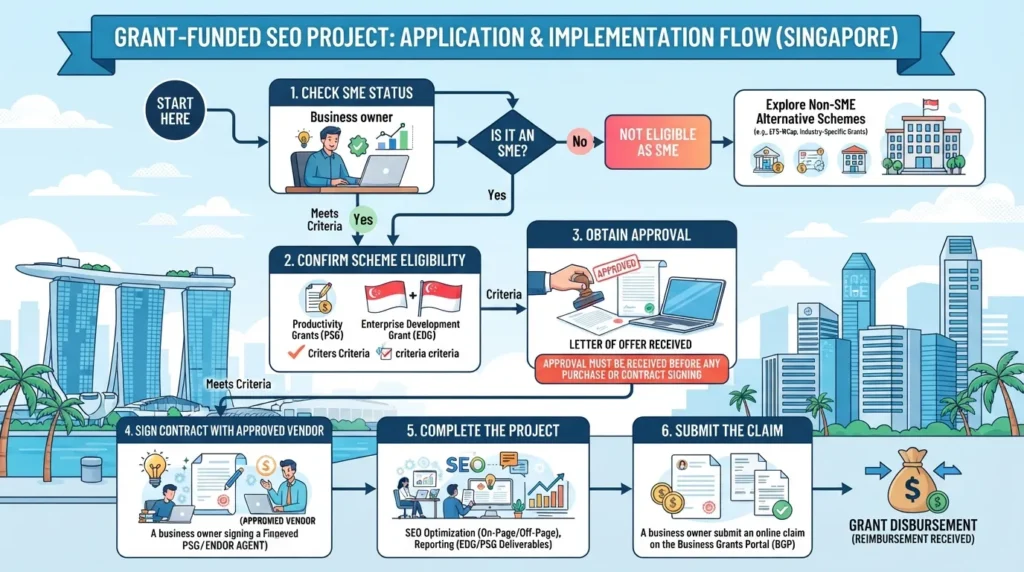
- Eligibility self-check. Confirm your registration, local ownership and SME status on the Enterprise Singapore website, and check fit through the business grants portal before committing to a project. Businesses should confirm eligibility under the grant framework before committing to any spend.
- Pre-application consultation. Test whether your project suits an EDGE support category, or whether a development grant or other grants scheme fits better. Services and overseas-facing projects should be checked against any grant for overseas expansion.
- Project scoping. Define the process the project changes, the expected outcome and how you will measure it. Where relevant, state the link to market readiness.
- Quotations. Obtain itemised quotes covering scope, unit costs and delivery dates. Vague quotes cause delays.
- Submission, approval and implementation. Commit spend only after approval, since costs incurred earlier may be unclaimable.
Plan cash flow for several months between paying vendors and receiving reimbursement.
What an approving officer looks for
Reviewers check whether the project changes a named process, whether each cost links to that change, and whether the evidence shows it happened. Clear before-and-after measures make an edge grant for ecommerce project easier to approve and claim.
Common mistakes
Paying vendors before approval is the costliest error. Generic scopes and weak quotes also weaken a claim, so keep each project focused on measurable outcomes.
Claims, reimbursement and record-keeping
Claims follow delivery and payment, so reimbursement lags the spend. Keep invoices, proof of payment, before-and-after order data and approval letters in one place from day one. Some firms also track any mra grant support in the same file.
Conclusion and Next Steps
The edge grant for ecommerce pays off when the funded project changes how you sell or fulfil orders, not when it merely buys a tool you already use. Pick a defined project, match it to a support category, and document it from the first quote. Start from the business grants portal, where most Singapore government schemes are listed, and compare the productivity solutions that fit your process.
Before you speak to anyone, check your top candidate:
- Does the project change a core process such as storefront, payments, fulfilment, cross-border selling or data use?
- Can you name its support category and the evidence that proves it?
- Can every cost be quoted, invoiced, paid and recorded before you claim?
- Can you front the full cost until reimbursement arrives?
If any answer is no, park the project and test the next one. Check current support levels on Enterprise Singapore’s EDGE page before you commit, and confirm whether an mra grant could also apply.
Frequently Asked Questions
Can an online-only business apply for the EDGE grant?
Yes, if you are a registered, locally owned business. Eligibility depends on the project, which must change how you sell or fulfil orders, not on having a physical shop. Check current rules on the official EDGE portal first.
Is the EDGE grant the same as the Singapore E-Commerce Grant?
No. EDGE funds specific capability projects, while the Singapore E-Commerce Grant is a separate scheme with its own conditions. Compare both against your scope.
What costs are typically claimable for e-commerce projects?
Costs must be tied to an approved project and supported by invoices, quotations and proof of payment. Storefront builds, payment integrations and fulfilment software can qualify. Tools you already use, or costs incurred before approval, usually cannot.
How long does it take to receive reimbursement after a claim?
Claims open only once the project is delivered and paid for, so you must front the cash. Timelines are set by Enterprise Singapore and vary by case. Check the current claims timeline on the EDGE portal.
Does EDGE cover overseas market expansion?
EDGE supports overseas expansion only for projects that meet its category criteria, such as overseas online sales activity. Confirm current support categories on the official EDGE portal.