Many business owners assume the EDGE grant works like the schemes it replaces. It does not. EDGE pays by activity, not by grant category, and that changes who qualifies and how much support can be reached. Enterprise Singapore has consolidated the Enterprise Development Grant (EDG), Productivity Solutions Grant (PSG) and Market Readiness Assistance (MRA) into one scheme. It was announced under Budget 2026 and launches in the second half of 2026. Eligibility depends on two things read together: the activity you plan to fund and your group profile. This guide explains both, shows how the S$100,000 annual cap is shared across applications, and gives a checklist to confirm your position before you apply. Singapore SMEs should check the eligible requirements against their own position first, since grant support is only as useful as the financial management behind it.
Key Takeaways
- EDGE is activity-based. It replaces the EDG, PSG and MRA. Athr reports that support is capped at S$100,000 per company per year across EDGE-supported activities.
- One cap covers every application. The S$100,000 limit is shared across all applications in a year.
- The cap refreshes on 1 April each year. It does not follow your financial year end. To use a year’s cap, submit before 31 March, as Synergix Technologies advises.
- Support rates differ by status. SMEs can receive up to 70% for specific activities. Non-SMEs receive up to 30% in general, and up to 50% for certain activities.
- Local shareholding must stay at 30% or more. If it falls below that after approval, claims will not be supported.
- Integrated enterprise systems carry a S$30,000 sub-cap. Claims open 1 November 2026 for single-function digital solutions, integrated enterprise systems and pre-scoped equipment.
Table of Contents
Watch Our Guide to EDGE Grant Eligibility in Singapore
Wondering whether your business may qualify for the EDGE Grant? Watch this video from MediaOne for an introduction to the grant and learn why it is important to review the latest eligibility criteria, application requirements, and project conditions before starting the application process.
Quick Eligibility Checklist
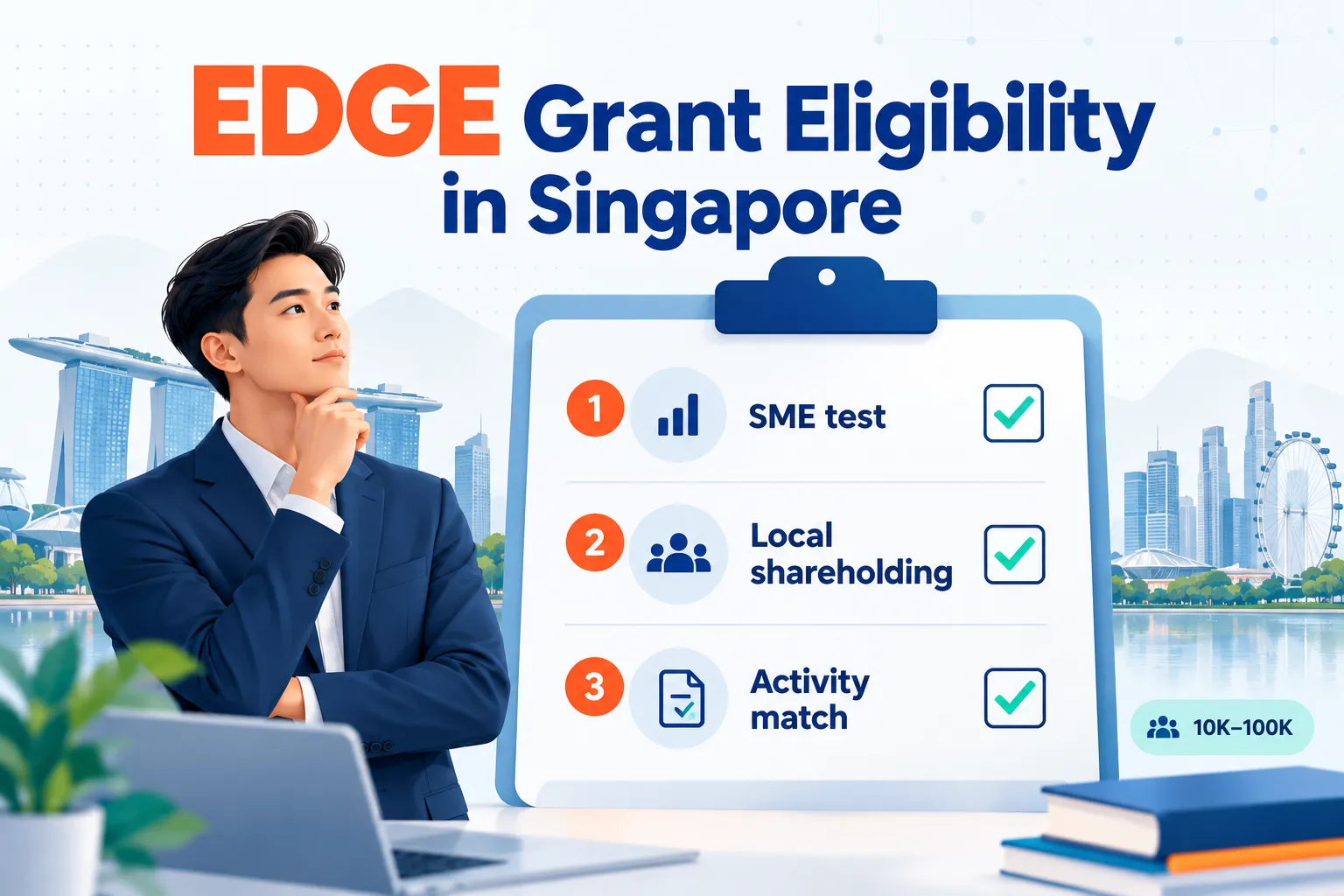
Run these three checks in order before spending time on a project plan. Singapore SMEs should confirm eligibility before drafting any grant support application, and Enterprise Singapore’s grant schemes are a good place to start.
- SME test. Is your group annual sales turnover S$100 million or less? Or is your group employment 200 workers or fewer? If neither applies, you are a non-SME.
- Local shareholding. Do Singapore citizens or entities hold at least 30% of your business? Check this at group level.
- Activity match. Does your project fall into an eligible claimable activity category, such as digitalisation, market expansion or operational upgrades, and do its costs match that category?
If you pass all three, the next question is which claim to submit first. Work through the sections below, using this guide to align each project with your business strategy and the right solutions.
Table of Contents
Why Eligibility Is Read Differently Now
Most businesses reading about the EDGE grant ask one practical question: do we qualify, and what can we actually claim? EDGE succeeds three schemes many companies already know: the Enterprise Development Grant (EDG), the Productivity Solutions Grant (PSG) and Market Readiness Assistance (MRA). Under the old structure, a company picked a scheme and the scheme decided what it could claim. EDGE reverses that order.
Under the old schemes, eligibility largely depended on which grant category a project sat in. Under EDGE, the activity (digitalisation, market expansion or operational upgrades) and the business profile (SME or non-SME, local shareholding, group size) are assessed together. Synergix Technologies reports that EDG, PSG and MRA ceased on 29 September 2026, so the old category labels no longer open the door. Applicants now submit each request through the business grants portal, where the application is checked against the activity and profile together.
When we help businesses prepare marketing and digital projects, the same mistake comes up often: teams pursue the largest project without checking the annual ceiling. Those planning under the old schemes treated each one as a separate pot, and funding was often assumed per project. EDGE does not work that way. Support is capped at S$100,000 per company per year, and that cap is shared across everything a business applies for, across all support levels.
The central point is that eligibility is decided by the activity and the business profile together, not by grant category. The businesses that gain most plan claims against the cap calendar and the sub-caps for each activity.
What the EDGE Grant Is and Why It Was Consolidated
The EDGE grant was announced under Budget 2026 and launches in the second half of 2026. It is a new consolidated grant from Enterprise Singapore that replaces EDG, PSG and MRA, bringing their funding into one scheme with clearer support levels for businesses. Government grants of this kind are designed to reduce the cost of upgrading, and the consolidation is intended to make the business grants portal simpler to navigate.
The main change is how support is organised. Instead of choosing between separate grant categories, EDGE is built around the activity a business wants to undertake. A company identifies the activity first, then checks which costs can be claimed against it. Eligibility now turns on the activity rather than on the name of an old scheme, so a business can see which grants it is eligible for before it applies through the grants portal. Planning the claimed costs alongside sound financial management helps a business keep its records consistent with the claim.
The status of EDG, PSG and MRA
The old schemes are no longer the route for new projects. According to AFON, new applications under EDG, MRA and PSG are no longer accepted after 30 September 2026. Synergix Technologies gives the cessation date as 29 September 2026. The two sources differ by one day, so confirm the exact date with Enterprise Singapore before committing to a plan.
Previous grant recipients: what carries over
Businesses already approved under EDG, PSG or MRA should check their position against the EDGE rules. Existing approvals are not the same as new applications, and any existing funding should be reviewed separately. The main continuity is that SME status and local shareholding still apply to any claim. The main change is that new projects must be framed under EDGE’s activity categories, with the S$100,000 annual cap covering everything the business applies for in the year.
Core EDGE Grant Eligibility Criteria
Eligibility rests on three checks, run in order. A business that fails the first check never reaches the others, so confirm each step before spending time on a project plan.
Step one: confirming SME status
An SME is defined at group level. According to Synergix Technologies, a business qualifies as an SME if its group annual sales turnover is S$100 million or less. It also qualifies if its group employment is 200 workers or fewer.
The word “group” matters. If your company sits under a parent or holds subsidiaries, the figures for the whole group are tested. A small local company owned by a larger regional group can fail this test even when its own revenue is modest. Check the consolidated numbers before assuming SME status. Working professionals and business owners should raise this with their finance team early, since group structures are often overlooked in the initial assessment.
Step two: the Singapore ownership requirement
The applicant must have at least 30% local shareholding. Ownership is not a one-time check. If local shareholding falls below 30% after approval, claims will not be supported. Review any share transfer or fundraising round against this threshold before it completes.
Step three: the activity you are applying for
EDGE pays by activity, not by grant category. The activity categories include digitalisation, market expansion and operational upgrades. Each activity has its own claimable cost types, so the project must be described in the category that matches its costs. A mismatch between activity and cost is a common reason claims are rejected.
Where a business is working with an agency on digital activities such as SEO or SEM, confirm early that the service fits a claimable activity category.
Key dates after approval
- Only the project end date and the claim due date can be amended. Change requests open from 1 November 2026.
- Claims for integrated enterprise systems open from 1 November 2026, alongside single-function digital solutions and pre-scoped equipment.
Plan your project timeline around these fixed points.
Expanded Eligibility for Non-SMEs
Enterprise Singapore has made EDGE open to non-SMEs as well as SMEs. Under the earlier schemes, a larger company often had no clear route to this kind of support. Under EDGE, the activity being funded, not only company size, shapes what can be claimed, and each EDGE grant is assessed against the scheme’s own requirements.
What non-SMEs can now apply for
Non-SMEs can apply for the same activity categories as SMEs: digitalisation, market expansion and operational upgrades. The difference lies in the support rate. According to Synergix Technologies, SMEs can receive up to 70% for specific activities, while non-SMEs receive up to 30% in general and up to 50% for certain activities.
What this means in practice
| Factor | SME | Non-SME |
|---|---|---|
| Eligible activities | Digitalisation, market expansion, operational upgrades | Same categories |
| Maximum support rate | Up to 70% for specific activities | Up to 30% in general, up to 50% for certain activities |
| Annual cap | S$100,000 per company per year | S$100,000 per company per year |
The annual cap is the same for both groups. A non-SME’s principal cost is the lower support rate, not a smaller ceiling.
Companies near the boundary should decide early which category they fall into. Because the test uses group figures, a subsidiary cannot qualify on its own numbers if the wider group exceeds either threshold. Check the EDGE application requirements before committing spend, as this determines which grants the company can claim.
Funding Levels, Caps and How the S$100,000 Limit Works
EDGE support is capped at S$100,000 per company per year across EDGE-supported activities, according to Athr. That ceiling covers the whole year, not each project. Every claim made in the cap year draws on the same pool, so the question is how your planned activities fit inside it. Businesses should map every planned activity against this shared ceiling before committing budget.
How the cap year is measured
The cap refreshes on 1 April each year, not at your financial year end, as Synergix Technologies explains. A company with a 31 December financial year end still follows the 1 April to 31 March cap year. To use a year’s cap, submit before 31 March. A submission made after that date falls into the next cap year.
Sub-caps and a worked example
Integrated enterprise systems carry a S$30,000 sub-cap. Under the former PSG, the ERP cap stood alone at S$30,000. Under EDGE, that figure sits inside the wider S$100,000 ceiling, so an ERP project cannot be funded above S$30,000 whatever else is in the plan.
Consider an SME with an ERP project costing S$60,000. At the 50% rate, support would be S$15,000, which sits within the S$30,000 sub-cap. The company’s claim is also limited by the annual cap. If the same company plans S$90,000 of other activity, the combined support would exceed the S$100,000 ceiling, so the later claim may be reduced or deferred to the next cap year.
For a non-SME, the rate is up to 50% in general, not 70%. Take a non-SME with a S$60,000 ERP project. At 50%, support would be S$30,000, which exactly meets the sub-cap. If the project cost rose to S$80,000, support would still stop at S$30,000, because the sub-cap, not the rate, sets the claimable amount.
Prior approvals draw on the same ceiling
Earlier approvals draw on the same ceiling. Any amount already committed in the cap year reduces the headroom for new applications. Before applying, total existing approvals and planned claims, then check what remains. Businesses that track government grants in one schedule avoid surprises at claim stage.
Ongoing Eligibility Conditions
Eligibility is not settled at approval. Local shareholding must stay at 30% or more for claims to be supported. Check any share transfer, new investor or fundraising round against that threshold before it completes, because a drop below it after approval removes support from later claims.
Only the project end date and claim due date can be amended, and change requests open from 1 November 2026. Keep records of each claim, since claims are reviewed against the approved project scope and the original application.
Transition from Previous Grants
EDG, PSG and MRA were replaced by EDGE and ceased on 29 September 2026. Existing approvals and claims under those schemes are handled separately from new EDGE applications. Businesses with approvals under those schemes should confirm their position directly with Enterprise Singapore.
Cap-and-Calendar Eligibility Map
Use this checklist before you submit anything. For each planned activity, note its sub-cap and support rate (up to 70% for SMEs, up to 50% for non-SMEs). Note also the 1 April to 31 March cap year and the date by which each submission must be made. Check each planned activity against the [solutions](#) requirements of the scheme.
- Total your planned claims and check them against the S$100,000 annual cap.
- Flag any activity that exceeds its sub-cap, such as integrated enterprise systems above S$30,000.
- Flag any claim that would be submitted after 31 March and so fall into the wrong cap year.
- Confirm local shareholding remains at 30% or more.
Resolve any flagged item before the project is submitted. Keep this [guide](#) at hand when you prepare your [business grants](#) applications, especially if you are planning [overseas expansion](#).
Conclusion and Summary
EDGE eligibility rests on two things read together: the activity you apply for and your group profile. Your group must meet the SME or non-SME test, and local ownership must stay at 30% or more. Support is paid by activity, so the same company can receive very different amounts depending on the projects it plans and when it submits them. Singapore SMEs should confirm the eligible requirements before committing to any project, and review which business grants and funding routes fit their plans alongside the grants portal.
Three actions to take this week:
- Confirm your group figures and shareholding. Check that group turnover is S$100 million or less, or group employment is 200 workers or fewer. Check that local shareholding is at least 30%.
- Map each planned activity against its sub-cap and support rate. Up to 70% for SMEs and up to 50% for non-SMEs, with the S$30,000 sub-cap for integrated enterprise systems in view. Compare the solutions available for each activity.
- Diary the 31 March cap deadline. Submit before 31 March to draw on that year’s allocation.
Rules, rates and application windows change. Check the latest guidance from Enterprise Singapore before you commit to a project timeline.
Frequently Asked Questions
Can a non-SME apply for the EDGE grant?
Yes. EDGE has been extended to non-SMEs, so larger businesses can apply based on their activities. The difference is the level of support: SMEs can receive up to 70% for specific activities, while non-SMEs receive up to 50% in general.
Does the S$100,000 cap reset on my financial year end?
No. The cap refreshes on 1 April each year, not at your financial year end. The cap year runs from 1 April to 31 March, so submit before 31 March to draw on that year’s cap.
What happens if my local shareholding falls below 30% after approval?
Your claims will not be supported. The 30% local shareholding threshold applies throughout the project, so a drop below it after approval affects further claims. Monitor your shareholding whenever ownership changes.
Do EDG, PSG and MRA applications still get accepted?
No. New applications under EDG, PSG and MRA closed after 30 September 2026, and the schemes ceased on 29 September 2026. New applications must be made under EDGE. Confirm the exact cut-off date with Enterprise Singapore.
How is SME status decided?
SME status is decided on the group, not the standalone company. A business qualifies as an SME if its group annual sales turnover is S$100 million or less, or its group employment is 200 workers or fewer.