
Your online store looks beautiful. The homepage has professional product photography, the branding feels premium, and customers are clicking through from your advertisements.
Yet sales remain disappointing.
Shoppers visit product pages but don’t add anything to their carts. Others abandon checkout when delivery fees appear. Mobile visitors struggle with product filters, and your team still needs a developer whenever you want to update a promotional banner.
These are not simply design problems. They’re ecommerce problems.
The best ecommerce web design agencies in Singapore understand that an online store needs to do more than look attractive. It needs to help shoppers find products, trust the business, complete purchases and return.
That requires a combination of user experience design, platform expertise, payment integrations, mobile performance, product catalogue planning and conversion optimisation.
We’ve shortlisted ten Singapore ecommerce web design agencies based on their published services, platform specialisations, portfolio evidence, pricing transparency and suitability for different types of online businesses.
The objective isn’t to declare one provider universally better than the others. It’s to help you choose an agency that matches your store’s size, technical requirements, budget and growth plans.
Editorial disclosure: This article is published by MediaOne, which provides ecommerce website design and development services and appears in the comparison. We have a commercial interest. Agency information was reviewed in November 2026 using publicly available materials. We have not independently audited agency-reported sales results or conducted controlled tests of every provider’s websites.
Best Ecommerce Web Design Agencies in Singapore at a Glance
| Agency | Best For | Ecommerce Strengths | Pricing |
|---|---|---|---|
| MediaOne | Ecommerce design with SEO and digital marketing | Shopify, custom ecommerce, conversion-focused design, analytics | Custom ecommerce quotation |
| Verz Design | Shopify Plus and established retailers | Shopify migrations, storefront UX, CRO, integrations | Custom quotation |
| 360&5 | Premium Shopify and direct-to-consumer brands | Shopify Plus, custom themes, B2B/DTC commerce | Custom quotation |
| Jumpstart Commerce | Enterprise Shopify Plus projects | Store migrations, custom storefronts, checkout and retention | Custom quotation |
| eFusion Technology | SMEs and B2B ecommerce | Shopify, SHOPLINE, custom workflows and ecommerce support | Custom quotation |
| JIN Design | UX-focused ecommerce websites | WooCommerce, storefront design, navigation and product discovery | Custom quotation |
| Awebstar | SME ecommerce and custom functionality | Shopify, WooCommerce, BigCommerce, software integrations | Custom quotation |
| Nerb | SMEs seeking transparent WooCommerce pricing | Custom WooCommerce, payments, shipping and GST setup | From S$4,400 |
| OOm | Ecommerce with ongoing digital marketing | Ecommerce websites, SEO, advertising and support | Custom ecommerce quotation |
| Webpuppies | Complex enterprise ecommerce | Custom platforms, integrations and B2B procurement | Custom quotation |
Pricing is based on public information where available. A quoted starting price may apply only to a specific package, while custom projects require a detailed scope.
1. MediaOne — Best for Ecommerce Web Design Connected to SEO and Sales Growth
Best for: Singapore businesses wanting ecommerce website design integrated with search visibility, digital advertising, analytics and conversion optimisation.
Key services: Shopify website design, ecommerce development, custom storefronts, payment integration, SEO, content and conversion optimisation.
Pricing: Custom ecommerce quotation.
Website: MediaOne Ecommerce Web Development
MediaOne is a Singapore digital marketing and website development agency offering ecommerce design alongside SEO, paid advertising, content marketing and analytics.
Its principal strength is the ability to approach the online store as part of a wider digital acquisition strategy.
This matters because a website can look polished without addressing the reasons customers hesitate to buy.
For example, a skincare retailer might invest heavily in Instagram and Google Ads but send visitors to product pages with unclear ingredients, weak product descriptions and confusing shipping information.
Increasing advertising spend may bring more traffic, but it won’t necessarily improve profitability.
A stronger ecommerce strategy considers the entire journey from product discovery to checkout.
Where MediaOne Could Add Value
Conversion-focused storefront design
MediaOne’s published website services emphasise responsive layouts, navigation, user experience and conversion paths.
For ecommerce businesses, these principles can inform product pages, promotional landing pages and checkout experiences.
SEO and organic product discovery
Ecommerce search visibility depends on more than a homepage ranking for broad commercial keywords.
Category architecture, product descriptions, internal linking, structured data and technical crawlability can influence how customers discover products through search.
MediaOne’s wider SEO capabilities make it a relevant partner when organic visibility is part of the growth strategy.
Digital marketing integration
An ecommerce website often supports Google Shopping, Meta advertising, email marketing and other acquisition channels.
MediaOne’s broader services may help coordinate these requirements, provided the relevant work is included in the project scope.
Custom functionality
The agency’s ecommerce development service describes capabilities involving payment gateways, shipping rules, invoicing, inventory reporting and custom integrations.
These functions should be scoped according to what the business actually needs.
Important Considerations
Ask whether the quotation includes product migration, custom Shopify development, payment integration, SEO redirects, analytics, testing and post-launch maintenance.
MediaOne’s general website design packages have published starting prices, but these should not be mistaken for a guaranteed ecommerce project quotation.
Our assessment: MediaOne is worth shortlisting when ecommerce design needs to work alongside SEO, advertising and a broader customer-acquisition strategy.
2. Verz Design — Best for Shopify Plus and Established Retail Brands
Best for: Established retailers, growing ecommerce brands and businesses planning platform migrations.
Key services: Shopify and Shopify Plus development, ecommerce UX/UI, custom themes, migration, CRO and integrations.
Pricing: Custom quotation.
Website: Verz Design
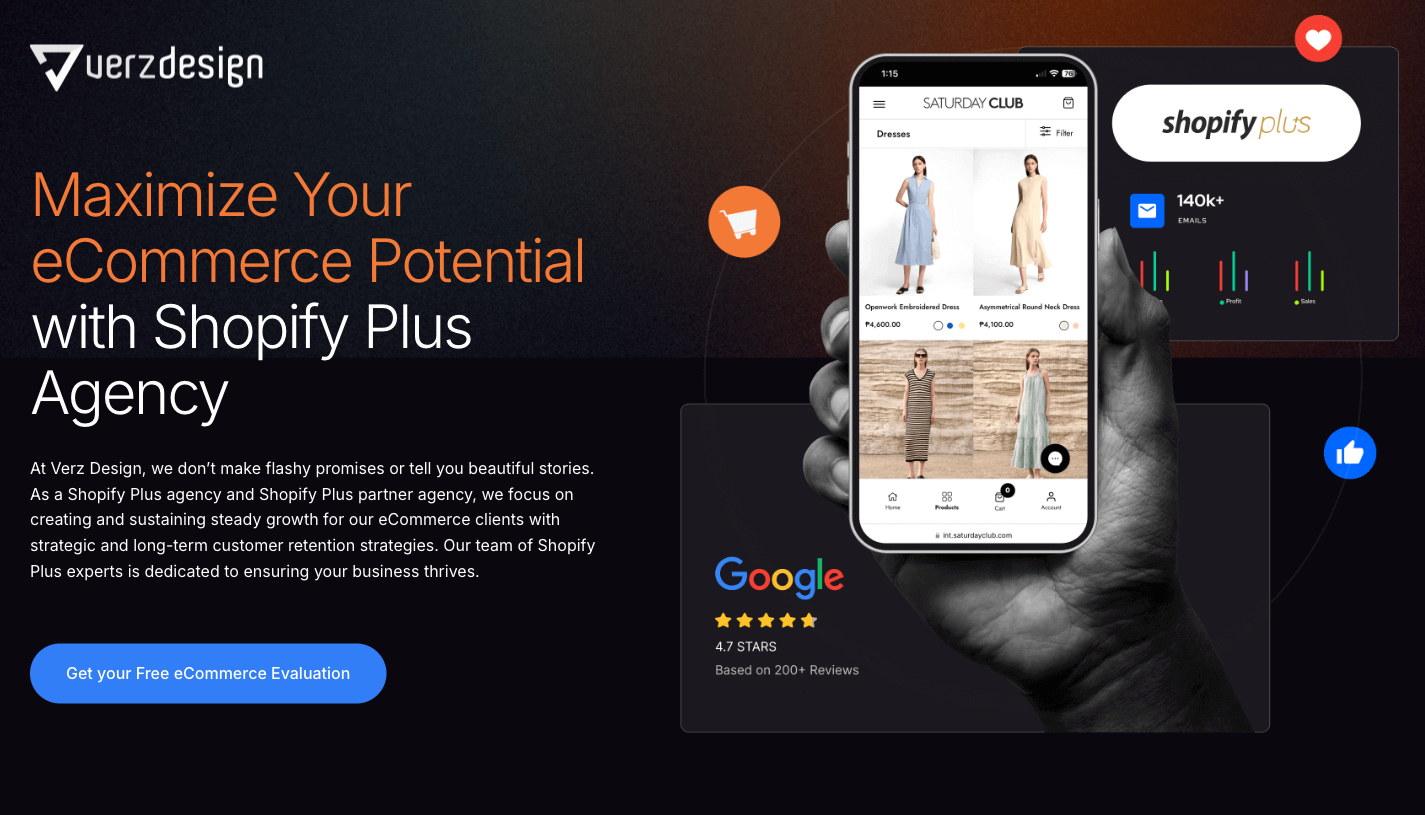
Verz Design is an established Singapore ecommerce and web design agency with a substantial focus on Shopify and Shopify Plus.
Its services extend beyond building new storefronts to include platform migrations, custom development and ongoing ecommerce optimisation.
The agency’s published portfolio includes a Magento-to-Shopify Plus migration for Mayer, demonstrating experience with established retail operations.
Why Migration Experience Matters
Migrating an online store is different from launching one from scratch.
An existing retailer may need to preserve product records, customer accounts, order histories, search rankings, promotions and integrations with its inventory systems.
Errors can affect real sales.
A product URL that disappears without an appropriate redirect may lose search visibility. A poorly transferred customer record can disrupt account access, while checkout problems can prevent purchases entirely.
Verz Design’s documented migration work makes it a relevant candidate for businesses facing these requirements.
What to Evaluate
Ask for examples of stores with a similar catalogue size, platform architecture and customer journey.
Request the agency’s process for product-data migration, SEO preservation, checkout testing and post-launch monitoring.
Our assessment: Particularly relevant for established ecommerce businesses planning Shopify Plus implementations or substantial platform migrations.
3. 360&5 — Best for Premium Shopify and Direct-to-Consumer Stores
Best for: Established DTC brands, retailers and businesses looking for a specialist Shopify development partner.
Key services: Shopify Plus, custom theme design, platform migration, checkout customisation, integrations and ecommerce strategy.
Pricing: Custom quotation.
Website: 360&5

360&5 is a Singapore-headquartered Shopify specialist serving direct-to-consumer and B2B merchants.
The agency is listed as a Platinum Partner in Shopify’s official Partner Directory.
Its published capabilities include custom storefront design, platform migrations, checkout customisation and application integrations.
Where 360&5 Could Be Valuable
A growing lifestyle brand may already have a functioning Shopify store but struggle with product discovery, custom merchandising or an increasingly complicated application stack.
At this stage, the challenge is not necessarily launching a new website.
It may involve improving category navigation, simplifying user journeys or developing custom functionality that standard themes cannot provide.
A specialist Shopify agency can be valuable when much of the work takes place inside the platform’s ecosystem.
Why Platform Specialisation Matters
Shopify development involves its own theme architecture, application ecosystem and checkout capabilities.
An agency regularly working with Shopify may be better positioned to identify when native functionality is sufficient and when custom development is justified.
However, a high partner tier is not a guarantee of better results for every project.
Our assessment: A strong shortlist candidate for established Shopify merchants looking for advanced storefront design and platform-specific customisation.
4. Jumpstart Commerce — Best for Enterprise Shopify Plus Development
Best for: Mid-market and enterprise retailers requiring Shopify Plus design, migrations and regional ecommerce capabilities.
Key services: Shopify Plus, custom themes, store migrations, checkout customisation, integrations and retention marketing.
Pricing: Custom quotation.
Website: Jumpstart Commerce

Jumpstart Commerce is another Singapore-based Shopify Platinum Partner.
Its Shopify directory profile describes experience helping mid-market and enterprise brands build, migrate and expand online stores.
The agency’s published services include storefront customisation, site performance, checkout development and marketing integrations.
Shopify’s directory also lists verified client relationships involving organisations such as Omnidesk and Banyan Tree Essentials.
Where Jumpstart Commerce Could Fit
Imagine a retail brand operating several stores across Singapore and other Southeast Asian markets.
The business may require different catalogues, regional pricing, localised storefronts and inventory coordination.
It might also need a consistent brand experience across markets while supporting different operational requirements.
These projects require more planning than adapting a standard Shopify theme.
Important Considerations
Ask Jumpstart Commerce how it manages regional stores, data migration, ERP connections and checkout requirements.
For enterprise projects, establish which functions depend on Shopify’s native features, additional applications or custom development.
Our assessment: Worth considering for established retailers seeking a specialist Shopify Plus partner with regional ecommerce experience.
5. eFusion Technology — Best for SME and B2B Ecommerce Websites
Best for: SMEs, distributors and businesses requiring ecommerce functionality beyond conventional retail checkout.
Key services: Ecommerce design, Shopify, SHOPLINE, custom development, business integrations and maintenance.
Pricing: Custom quotation.
Website: eFusion Technology
eFusion Technology is a Singapore website development company established in 2004, offering ecommerce design and related digital services.
Its published capabilities include Shopify and SHOPLINE solutions, custom web applications and ongoing website support.
The company also documents projects involving B2B ecommerce requirements.
Why B2B Ecommerce Is Different
A conventional online store may display the same price and checkout flow to every customer.
B2B ecommerce can require substantially different functionality.
For example, a distributor may need customer-specific prices, restricted product catalogues, quotation requests, minimum order quantities or different account permissions.
These requirements influence the platform choice and the amount of custom development needed.
A technically capable ecommerce agency should be able to explain which features can be implemented using existing tools and which require bespoke development.
Important Considerations
Ask eFusion for examples involving similar purchasing rules, catalogue structures and customer permissions.
Clarify whether post-launch support, platform subscriptions and integration maintenance are included.
Our assessment: A relevant choice for SMEs and B2B businesses requiring practical ecommerce functionality and ongoing technical support.
6. JIN Design — Best for User Experience and Product Discovery
Best for: SMEs, brands and businesses prioritising custom UX, WooCommerce and intuitive product navigation.
Key services: Ecommerce UX/UI, WooCommerce, custom storefront design, product filtering, checkout and analytics.
Pricing: Custom quotation.
Website: JIN Design Ecommerce Services
JIN Design is a Singapore web design studio offering ecommerce development with a strong emphasis on user experience.
Its ecommerce service page describes WooCommerce and Webflow-related solutions, including product navigation, checkout, payment integration, tracking and custom functionality.
The agency’s positioning is particularly relevant to stores where shoppers need to compare products before purchasing.
Why Product Discovery Matters
Imagine an online furniture retailer with hundreds of products.
Customers may want to filter by dimensions, materials, colour, availability or price.
If product navigation is confusing, shoppers can abandon the store even when the products themselves are attractive.
Effective ecommerce UX should make it easier to locate the right product and understand what is being purchased.
JIN Design’s published services include advanced filtering, product organisation and conversion-focused layouts.
Important Considerations
Ask which ecommerce platform is most suitable for your requirements.
Also verify how the agency tests navigation, product selection, checkout and mobile usability.
Our assessment: A relevant shortlist candidate when product discovery, custom design and intuitive shopping journeys are central priorities.
7. Awebstar — Best for SME Ecommerce and Custom Website Functionality
Best for: SMEs seeking ecommerce development alongside integrations, business websites and digital marketing.
Key services: Shopify, WooCommerce, BigCommerce, website development, software integration and SEO.
Pricing: Custom quotation.
Website: Awebstar
Awebstar is a Singapore website development company offering ecommerce solutions across multiple platforms.
Its published services cover online store development, website customisation, platform migration and related digital services.
This makes it relevant for businesses that have not yet decided which ecommerce platform they need.
Where Awebstar Could Fit
A retailer moving from manual WhatsApp orders to an online store may need payment collection, inventory management, customer records and basic order processing.
However, it may not require enterprise-level custom development.
Awebstar’s platform breadth makes it worth evaluating for smaller projects where selecting an appropriate technology stack is part of the engagement.
Important Considerations
Ask for examples of live stores built on the platform being proposed.
Clarify the number of products included in setup, which third-party applications are necessary and how recurring costs will be managed.
Our assessment: A practical candidate for SMEs seeking ecommerce development and related website functionality through one provider.
8. Nerb — Best for Transparent WooCommerce Pricing
Best for: Singapore SMEs looking for a defined starting price and a WooCommerce-based online store.
Key services: WooCommerce, custom design, product pages, checkout, payment integration, shipping, GST setup and maintenance.
Published starting price: S$4,400.
Website: Nerb Ecommerce Website Design
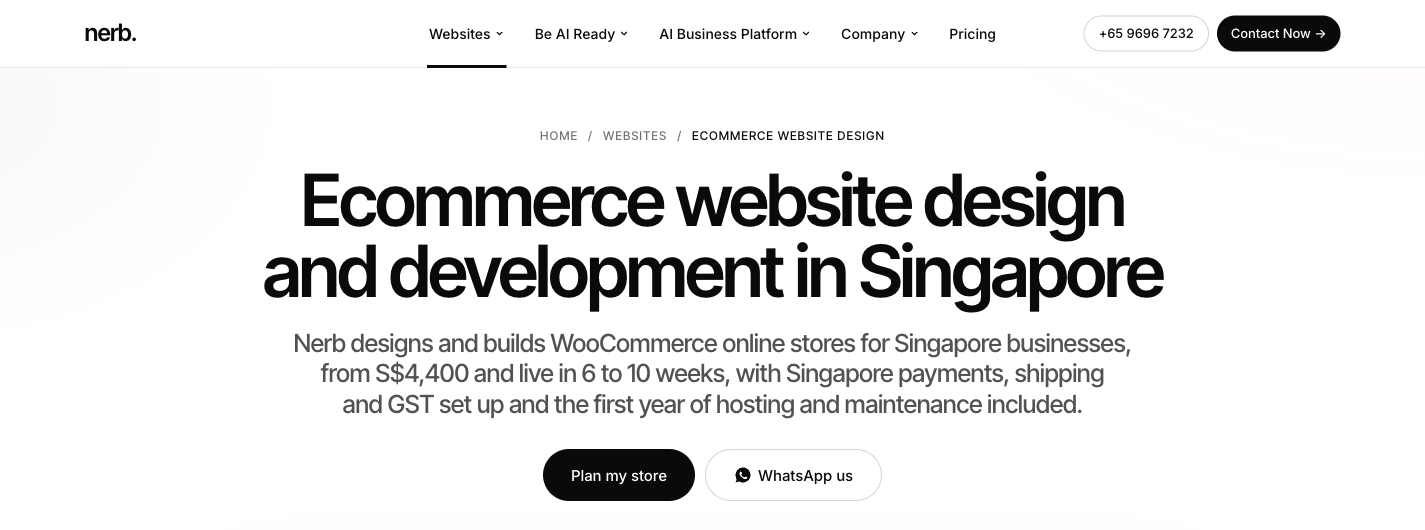
Nerb is one of the more transparent providers in this comparison when it comes to ecommerce starting prices.
Its published WooCommerce package starts at S$4,400, with an indicated development period of six to ten weeks.
The service page describes a package covering the online store, shopping cart, customer accounts, payment integration, shipping rules and GST configuration.
It also advertises first-year hosting and maintenance within the package.
Why Transparent Pricing Is Useful
A published starting price provides SMEs with a more concrete reference point before requesting a proposal.
However, the final cost still depends on the product catalogue, custom features, integrations and project scope.
For example, a store selling 30 simple products will typically require less configuration than one managing thousands of items with multiple variants.
Important Considerations
Confirm the exact number of products and pages included, how products are uploaded and what maintenance costs apply after the first year.
Ask who owns the hosting account, website files and relevant licences.
Our assessment: Particularly relevant for smaller businesses that prefer WooCommerce and want a clearly advertised starting price.
9. OOm — Best for Ecommerce Design With Ongoing Digital Marketing
Best for: SMEs that want an ecommerce website and continued support with SEO or advertising.
Key services: Ecommerce website development, responsive design, SEO, paid advertising and maintenance.
Pricing: Custom ecommerce quotation.
Website: OOm
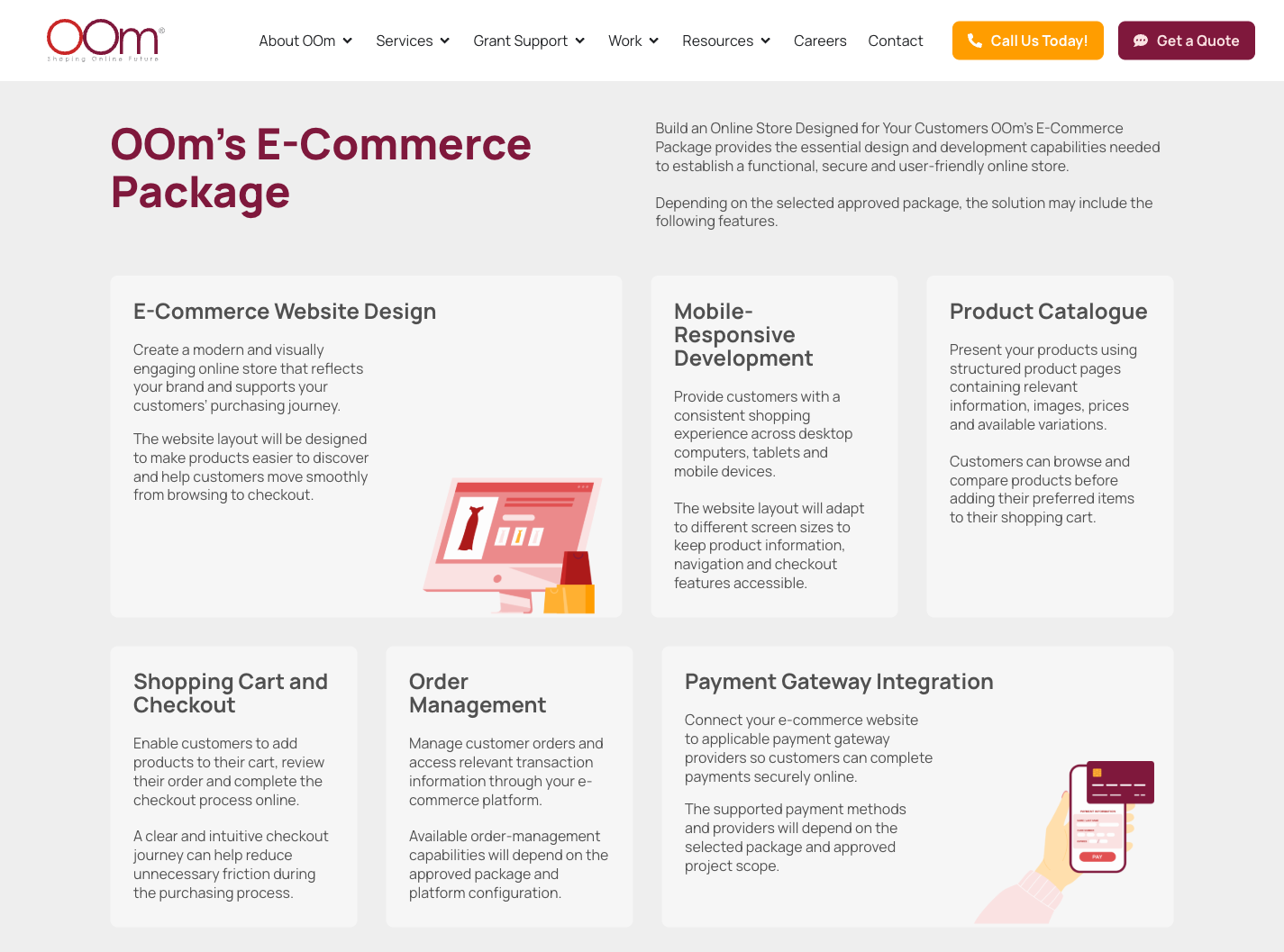
OOm is a Singapore digital marketing agency offering ecommerce development alongside SEO and paid marketing services.
Its published ecommerce process covers discovery, design, development, testing and support.
The agency also describes structured project management and ongoing marketing capabilities.
Why Post-Launch Marketing Matters
Launching an online store does not automatically bring customers.
A retailer may need to improve product visibility through organic search, run product advertising campaigns or develop content supporting customer discovery.
When the website and marketing strategy are planned separately, the store may require additional changes after launch.
OOm’s combined services make it worth evaluating when the business expects to invest in ongoing digital acquisition.
Important Considerations
Clarify whether ecommerce design, SEO, marketing management and maintenance are separate contracts.
Ask which elements of the build support conversion tracking and future campaign landing pages.
Our assessment: A relevant option for SMEs seeking a website development partner with broader digital marketing capabilities.
10. Webpuppies — Best for Enterprise and B2B Ecommerce Integrations
Best for: Enterprise businesses, distributors and organisations requiring complex ecommerce systems.
Key services: Ecommerce development, custom web applications, enterprise integrations and digital platforms.
Pricing: Custom quotation.
Website: Webpuppies
Webpuppies is a Singapore digital development company providing ecommerce and custom web solutions.
Its published project experience includes enterprise work involving more complex system requirements.
MediaOne’s earlier ecommerce development comparison also identifies Webpuppies’ work involving procurement integration for Thermo Fisher Scientific.
When Enterprise Integration Matters
A business selling industrial equipment may need its ecommerce platform connected to ERP, procurement, customer-account and inventory systems.
Purchasing workflows can include approvals, credit limits, negotiated pricing and purchase orders.
These requirements are fundamentally different from a consumer purchasing one item with a credit card.
The design must accommodate the buying process, while the underlying software must reliably manage transactions and data.
Important Considerations
Ask Webpuppies about integration architecture, security, testing, documentation and the ongoing cost of maintaining custom functionality.
Enterprise projects should also have clearly defined acceptance criteria and post-launch support arrangements.
Our assessment: Worth evaluating for technically complex ecommerce projects where integrations and operational requirements are more important than a standard storefront template.
Which Ecommerce Web Design Agency Should You Choose?
The most useful starting point is your business model, platform and operational complexity.
| Your Business Need | Agencies to Compare | Priority |
|---|---|---|
| Ecommerce website integrated with SEO and advertising | MediaOne, OOm | Customer acquisition and conversion tracking |
| Shopify Plus storefront or migration | Verz Design, 360&5, Jumpstart Commerce | Platform expertise, checkout and migration |
| WooCommerce store for an SME | Nerb, JIN Design | Total cost, product management and maintenance |
| Custom product navigation and UX | JIN Design, 360&5 | Filters, product discovery, mobile usability |
| B2B pricing and purchasing workflows | eFusion Technology, Webpuppies | Account permissions, quotations and integrations |
| Multi-platform ecommerce planning | Awebstar, MediaOne | Platform choice, functionality and growth requirements |
| Enterprise ecommerce and regional expansion | Jumpstart Commerce, Webpuppies | Scalability, integrations and support |
The best match depends on how closely an agency’s documented work resembles the store you want to build.
How Much Does Ecommerce Website Design Cost in Singapore?
Ecommerce website pricing depends on considerably more than the number of pages.
The product catalogue, checkout requirements, payment gateways, integrations, design complexity and migration work can all affect the final cost.
Illustrative Ecommerce Website Budgets
The figures below are broad planning ranges, not standardised agency quotations.
| Project Type | Illustrative Budget | Typical Requirements |
|---|---|---|
| Basic ecommerce setup | S$3,000–S$6,000 | Theme-based design, small catalogue, standard checkout |
| Semi-custom online store | S$6,000–S$15,000 | Branded layouts, product filtering, payment and shipping setup |
| Custom ecommerce website | S$15,000–S$30,000 | Custom UX, larger catalogue, integrations |
| Advanced Shopify Plus project | S$25,000–S$60,000+ | Complex migration, custom applications, regional operations |
| Enterprise ecommerce platform | Project quotation | ERP, procurement, custom rules and large-scale integrations |
These categories overlap, and actual projects can fall outside the ranges.
Nerb advertises WooCommerce projects starting at S$4,400, while larger Shopify specialists generally require custom quotations for complete store builds.
Costs That Are Easy to Overlook
An ecommerce budget may also include:
- Platform subscriptions and hosting.
- Paid themes, apps and plugins.
- Payment processing fees.
- Product photography and copywriting.
- Data migration and product uploads.
- ERP, POS and delivery integrations.
- Ongoing maintenance and security.
- SEO and digital marketing services.
A lower initial development quote may not remain the cheapest option when all recurring costs are considered.
Shopify vs WooCommerce vs Custom Ecommerce: Which Is Better?
The platform decision affects the store’s maintenance requirements, flexibility and long-term operating costs.
| Factor | Shopify | WooCommerce | Custom Ecommerce |
|---|---|---|---|
| Best suited for | Retail brands seeking managed commerce | Businesses wanting WordPress flexibility | Specialised workflows |
| Hosting | Managed by Shopify | Business or hosting provider manages it | Depends on architecture |
| Customisation | Themes, apps and supported platform APIs | WordPress extensions and custom code | Depends on technical scope |
| Maintenance | Core platform managed by Shopify | Updates and hosting require management | Developer-dependent |
| Main cost considerations | Subscription, apps, development, transaction fees | Hosting, plugins, maintenance, development | Build cost and ongoing engineering |
| Main limitation | Platform-specific constraints | More maintenance responsibility | Complexity and development dependency |
Shopify
Shopify suits many retail businesses because it provides hosted commerce infrastructure and an extensive application ecosystem.
It can reduce the operational burden of managing servers and basic commerce functionality.
However, custom checkout features, advanced integrations and Shopify Plus requirements can increase project cost.
WooCommerce
WooCommerce is built on WordPress and gives businesses considerable control over website content and functionality.
It can be attractive for retailers with content-heavy websites or requirements suited to WordPress.
The trade-off is greater responsibility for hosting, plugin updates, compatibility and security.
Custom Ecommerce
A bespoke platform may be justified for unusual workflows, enterprise integration requirements or complex business rules.
However, custom development introduces additional long-term support obligations.
Choose the platform that meets your operational needs with the least unnecessary complexity—not the one with the most impressive technical sales pitch.
What Makes a Good Ecommerce Website Design?
An effective online store should help shoppers make decisions without unnecessary friction.
We would prioritise five areas.
1. Product Discovery
Customers need to find relevant products quickly.
That includes clear category navigation, functional search, useful filters and logical product collections.
2. Product Page Clarity
Product pages should explain the offer through accurate descriptions, relevant images, specifications, availability and delivery information.
Customers should not need to contact support to understand basic purchasing details.
3. Mobile Shopping Experience
Product selection, image galleries, navigation, forms and checkout should work properly on smaller screens.
A layout that looks attractive on desktop may create usability problems on mobile.
4. Checkout Transparency
Shipping fees, taxes, payment methods and order totals should be clear before customers commit.
Unexpected costs or confusing checkout steps can discourage purchases.
5. Performance and Accessibility
Images, scripts and third-party applications affect loading behaviour.
Stores should also consider readable text, usable controls, accessible forms and keyboard interaction where applicable.
A visually impressive website should not become difficult to use.
How to Measure Whether an Ecommerce Redesign Worked
Website redesign success should not be judged solely on appearance or the total number of visitors.
The most useful metrics depend on the business.
| Metric | What It Measures | Why It Matters |
|---|---|---|
| Product discovery | Whether users reach relevant products | Helps identify navigation friction |
| Add-to-cart rate | Share of relevant visitors adding products | Indicates product-page engagement |
| Checkout completion | Share of checkouts resulting in purchases | Reveals checkout friction |
| Ecommerce conversion rate | Share of sessions or users generating purchases, depending on definition | Measures purchase performance |
| Average order value | Revenue divided by orders | Helps assess transaction value |
| Revenue per session | Revenue relative to sessions | Useful for evaluating commercial performance |
| Mobile conversion | Purchase performance on mobile devices | Highlights device-specific issues |
| Organic product and category traffic | Search visits to commercial pages | Helps evaluate ecommerce SEO |
Example: Why Conversion Rate Can Matter More Than Traffic Growth
Consider a store receiving 20,000 monthly sessions.
At a 1.5% conversion rate, it generates 300 orders.
If design improvements increase the conversion rate to 2%, the same traffic generates 400 orders.
That is 100 additional orders without increasing traffic.
At an average order value of S$80, the difference equals S$8,000 in additional monthly revenue.
This is a hypothetical example, not an expected redesign result.
It illustrates why reducing friction in product discovery and checkout can be commercially meaningful.
Ecommerce Website Redesign Checklist: Protect Your Existing Sales
Redesigning an established online store introduces risks that a new store does not face.
Before launch, ask the agency to cover the following.
Product and customer data migration: Identify which records must transfer, how data will be validated and what happens if information is incomplete.
SEO preservation: Map existing URLs to suitable destinations, protect valuable category and product pages and verify redirects.
Payment testing: Test successful payments, failed transactions, refunds where applicable and order confirmation.
Shipping and tax configuration: Check delivery rules, discounts, tax treatment and final order totals.
Inventory synchronisation: Confirm stock updates work across the website and connected systems.
Analytics validation: Verify purchase events, revenue values, conversions and advertising integrations.
Rollback and support: Establish what happens if serious problems appear after launch.
A migration should not be considered complete simply because the new storefront is live.
Ecommerce Website Grants in Singapore: What’s Available in 2026?
Singapore businesses should be careful when reading older agency pages advertising Productivity Solutions Grant (PSG) support.
The PSG, Enterprise Development Grant (EDG) and Market Readiness Assistance (MRA) schemes ceased accepting new applications on 29 September 2026.
They were replaced by the EDGE Grant, launched on 30 September 2026.
Under the new framework, eligible businesses can access grant support across qualifying activities, subject to the programme’s criteria and limits.
Enterprise Singapore identifies a maximum of S$100,000 in annual grant support across eligible activities, including a S$30,000 sub-limit for certain digital solutions and equipment.
This does not mean every ecommerce website automatically qualifies.
Before making a decision, verify eligibility, the relevant approved activity and the application requirements directly through Enterprise Singapore’s EDGE Grant page.
Do not assume an agency’s historical PSG approval carries over to the current programme.
8 Questions to Ask Before Hiring an Ecommerce Web Design Agency
1. Can you show live stores built on our preferred platform?
Review the actual shopping experience on desktop and mobile rather than relying exclusively on screenshots.
2. How will you design our product catalogue and navigation?
Ask how the agency handles categories, filtering, search and product variants.
3. What is included in the quotation?
Clarify product uploads, content, payment setup, analytics, integrations, testing and maintenance.
4. How will you protect existing SEO performance?
For migrations, request URL mapping, redirect planning and post-launch monitoring.
5. Who owns the store and its assets?
Confirm administrative access, licences, domain ownership, data access and source-code rights where applicable.
6. What recurring costs should we expect?
Request an estimate covering platform subscriptions, applications, hosting, maintenance and support.
7. How will you test checkout before launch?
The agency should explain its approach to payments, shipping, discounts, taxes and order processing.
8. What happens if a critical problem appears after launch?
Agree on support arrangements, response expectations and procedures for resolving issues affecting purchases.
How We Selected These Ecommerce Web Design Agencies
This shortlist was developed using publicly available agency websites, ecommerce service pages, documented project examples and platform partner information reviewed in November 2026.
We considered five areas.
| Criterion | What We Evaluated |
|---|---|
| Ecommerce specialisation | Relevant store design, development and platform services |
| User experience capabilities | Product navigation, storefront design and checkout considerations |
| Technical capabilities | Shopify, WooCommerce, migrations and integrations |
| Business suitability | Fit for SMEs, retailers, DTC brands, B2B and enterprise projects |
| Evidence and transparency | Published services, portfolios, partner listings and pricing |
Shopify Partner Directory information was used to verify the published partner positioning of relevant Shopify specialists.
We did not independently benchmark every agency’s checkout performance or audit private sales results.
Accordingly, this is a researched shortlist based on documented capabilities and business fit, not a controlled ranking of ecommerce conversion rates.
Frequently Asked Questions
Which is the best ecommerce web design agency in Singapore?
The best agency depends on the business. MediaOne is worth evaluating for ecommerce design integrated with SEO and digital marketing, while Verz Design, 360&5 and Jumpstart Commerce have relevant Shopify expertise. JIN Design and Nerb are options for WooCommerce projects, while Webpuppies may suit more complex integrations.
How much does an ecommerce website cost in Singapore?
A smaller ecommerce website can cost several thousand Singapore dollars, while custom stores and enterprise platforms may require substantially larger budgets. Nerb currently publishes a WooCommerce starting price of S$4,400. Other agencies generally require a quotation.
Is Shopify better than WooCommerce?
Neither is universally better. Shopify provides managed commerce infrastructure, while WooCommerce offers WordPress-based flexibility. The right choice depends on the store’s requirements, maintenance resources and long-term costs.
How long does ecommerce website development take?
A straightforward online store may take several weeks, while more complex implementations and migrations may require several months. Nerb advertises an indicative six-to-ten-week timeline for its WooCommerce offering, but project schedules depend on scope and approvals.
Can a web design agency improve ecommerce conversion rates?
An agency can identify usability problems, simplify product discovery and improve checkout experiences. However, conversion improvements are not guaranteed and depend on customer demand, pricing, traffic quality and other factors.
Should ecommerce website design include SEO?
Yes, at least at a foundational level. Product and category URLs, metadata, navigation, structured data, redirects and crawlability should be considered during development. Ongoing SEO campaigns may be separately priced.
Can a Singapore SME get a grant for ecommerce website development?
Some eligible digitalisation activities may receive support under the EDGE Grant introduced on 30 September 2026. However, eligibility depends on the programme’s requirements and the specific activity. Businesses should verify current conditions with Enterprise Singapore.
What is the difference between ecommerce web design and ecommerce web development?
Ecommerce web design focuses on the shopping experience, visual layout, navigation and usability. Development implements the underlying functionality, including shopping carts, payments, inventory and integrations. Most complete ecommerce projects require both.
Final Verdict: Which Ecommerce Web Design Agency Should You Hire?
The best ecommerce website is not necessarily the one with the most elaborate animations, the newest platform or the largest development budget.
It’s the one that helps customers find the right products, understand what they’re buying and complete purchases without unnecessary difficulty.
For established Shopify retailers, Verz Design, 360&5 and Jumpstart Commerce are worth comparing.
If you’re launching a smaller WooCommerce store, JIN Design and Nerb offer relevant capabilities.
Businesses with complicated B2B purchasing requirements may benefit from speaking with eFusion Technology or Webpuppies.
And if you want ecommerce design connected to SEO, advertising, analytics and wider digital growth, MediaOne deserves consideration.
Before choosing an agency, ask for a detailed proposal covering design, platform selection, checkout, integrations, migration, recurring costs and post-launch support.
A great ecommerce website should remain practical to operate long after launch.
Build an Ecommerce Website Designed for Business Growth
If your current online store attracts visitors but struggles to convert them into customers, the next step may be improving how the website supports product discovery, trust and checkout.
MediaOne combines ecommerce website development, SEO and digital marketing services to help businesses build online stores around their commercial requirements.
Explore MediaOne’s Ecommerce Development Services to discuss your project and request a tailored quotation.