| AI Summary
An ecommerce business needs a product people will buy, a reliable way to deliver it and enough money left after each sale to cover running costs. This article explains how to compare business models, test a niche, calculate costs and launch in Singapore. It also covers registration, store setup, marketing and the checks that help owners decide when to expand. |
An ecommerce business sells goods or services online through a website, app or marketplace. Starting one in Singapore involves choosing a product and business model, testing demand, meeting registration requirements, setting up payments and delivery, and tracking costs. Profit depends on sales covering product, fulfilment, marketing and ongoing business expenses.
Key Takeaways
- Business models can overlap: a brand may sell through its own website, offer subscriptions and outsource delivery.
- A supplier’s minimum order can tie up cash before customers buy anything.
- Contribution per order helps pay monthly expenses; it is not the same as net profit.
- Marketplace sales do not give sellers unrestricted access to customer information.
- A small launch should test delivery, refunds and customer support alongside demand.
- Expansion needs enough cash for replacement stock, refunds and the wait for payment payouts.
An ecommerce business can start with a small product range and a simple store. The harder part is making the numbers work after the first orders arrive.
A S$60 sale can look promising until stock, delivery, fees and advertising take their share. Meanwhile, a product that sells well may still leave the owner short of cash when the next supplier payment falls due.
The starting point is a business that can serve a specific buyer at a price that covers its costs. The website comes after that decision.
What Is an Ecommerce Business?
An ecommerce business takes orders online for physical products, digital goods or services. A homeware shop, downloadable planner store and online tutoring business all fall within that definition.
The buyer may be an individual consumer or another business. Business-to-consumer, or B2C, means selling to individuals. Business-to-business, or B2B, means selling to organisations, such as supplying packaging to cafés.
How an online sale works
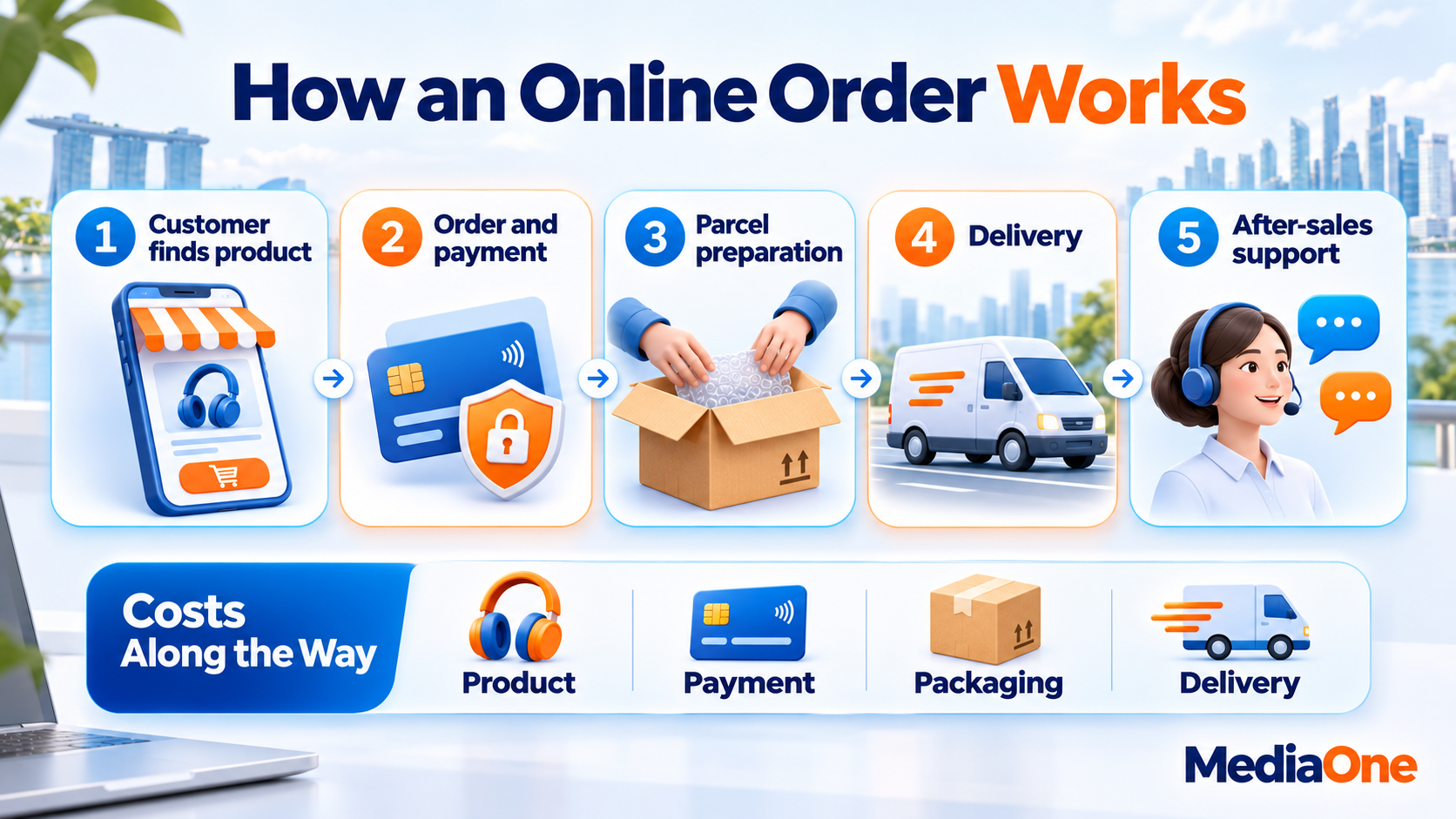
A physical product order usually follows five stages:
- The customer finds a product.
- The store accepts the order and payment.
- The seller or supplier prepares the parcel.
- The delivery provider brings it to the customer.
- The seller handles questions, returns and any refund.
Each stage adds work or cost. Digital products remove parcel delivery, but they still need payment processing, customer support and a way to provide access.
What ecommerce offers, and what it requires
An online store can reach customers without a retail unit. Owners can also test products in small batches and measure which listings attract orders.
The trade-offs include:
- Price competition: customers can compare similar products within seconds.
- Delivery responsibility: late or damaged parcels affect the seller’s reputation.
- Ongoing maintenance: listings, stock records and software need attention.
- Customer acquisition costs: advertising can consume the money left from a sale.
A lower-cost launch still needs time, cash reserves and daily work.
Which Ecommerce Business Model Should You Choose?
An ecommerce model describes how the business sells, earns revenue or fulfils orders. These choices can overlap. For example, a coffee brand can sell directly through its website, offer monthly subscriptions and use an outside warehouse.
| Model or selling approach | How it works | Main cost or operational concern |
| Direct-to-consumer (D2C) | A brand sells directly to its customers | The brand must generate demand and manage the buying experience |
| Marketplace selling | Products appear on a platform such as Shopee or Lazada | Platform fees, policies and competition affect sales |
| Dropshipping | A supplier sends orders directly to customers | Delivery, stock accuracy and quality depend on the supplier |
| Subscription | Customers pay for repeat deliveries or ongoing access | Recurring value, cancellations and reliable billing need attention |
| Print-on-demand | A partner produces an item after an order arrives | Production costs, print quality and dispatch times affect the offer |
Stock ownership changes the starting budget
Stock-based sellers pay for products before selling them. That gives more control over inspection, packaging and dispatch, but unsold items tie up money.
Dropshipping and print-on-demand reduce advance stock purchases. They do not remove spending on samples, store tools, marketing or refunds.
A sample order can reveal problems that a supplier’s photographs miss. Packaging, product quality and actual delivery time should form part of the comparison.
The sales channel changes customer access
A website gives the business more control over presentation and customer communications, within privacy rules. A marketplace provides access to shoppers using that platform, but limits how sellers can use buyer information.
The choice among online shopping platforms in Singapore should account for fees, product demand and daily workload.
A first launch can use one main channel. Extra channels become worthwhile when the team can maintain stock accuracy and respond to customers across them.
How to Choose a Niche Customers Will Pay For
A niche is a specific group of buyers with a shared need. “Home products” covers too much. “Storage accessories for small rental kitchens” gives the seller a more focused customer and product range.
A niche does not need frequent repeat purchases to work. Furniture, gifts and specialist equipment can sell profitably without regular reorders. Their first sale must support the cost of winning that customer.
Five checks for a product idea
A shortlist should compare:
- Buyer need: the problem the product solves.
- Money left per order: the amount available after direct selling costs.
- Delivery difficulty: size, weight, fragility and handling requirements.
- Supplier reliability: quality, lead times and minimum order quantities.
- Reason to choose the store: a difference customers can understand and value.
Customer reviews can reveal missing information or recurring complaints. A storage seller might notice that buyers struggle to judge whether a container will slide beneath a shelf. Exact measurements and photographs showing scale address that problem.
A simple niche comparison
A scoring table can organise research. Scores should reflect evidence from quotes, samples and customer conversations.
| Criterion | Weight | Kitchen storage | Refillable stationery | Printed gifts |
| Money left per order | 3 | 4 | 3 | 3 |
| Evidence of buyer demand | 3 | 4 | 3 | 4 |
| Delivery simplicity | 2 | 3 | 5 | 4 |
| Supplier reliability | 2 | 4 | 3 | 3 |
| Weighted total, out of 50 | 38 | 34 | 35 |
These scores are illustrative. Each rating runs from one to five and is multiplied by its weight. A higher score helps prioritise testing; it does not predict success.
Demand tests need more than likes
A small test should show whether people accept the proposed product, price and delivery terms. A landing page, sample demonstration or limited batch can provide that evidence.
The test record should include:
- The offer and advertised price.
- The audience and traffic source.
- Advertising spend.
- Enquiries, paid orders and cancellations.
- Questions that prevented a purchase.
Product-focused keyword research adds another view of buyer language. A search for “narrow kitchen trolley” expresses a more specific need than “kitchen ideas”.
Pre-orders need realistic dispatch dates and refund terms. Customer payments should not depend on an untested supplier promise.
How Much Does an Ecommerce Business Cost?
Starting costs depend on the product, stock commitment and store requirements. A single budget figure cannot represent both a downloadable template business and a shop importing furniture.
The budget should separate launch spending, monthly expenses and costs attached to each order.
| Cost group | Examples |
| Launch spending | Samples, initial stock, photography, registration and store setup |
| Monthly expenses | Platform subscription, software, storage and staff |
| Order costs | Product, packaging, delivery, payment fees and sales commission |
| Cash reserve | Refunds, replacement stock, delays and unexpected expenses |
A worked example of one order
The following figures are assumptions, not provider quotes. The example assumes a seller that is not GST-registered, with applicable purchase taxes included in costs.
| Item | Amount per order |
| Selling price | S$60.00 |
| Product cost, including inbound freight | S$22.00 |
| Outbound delivery | S$6.00 |
| Packaging | S$1.00 |
| Combined payment or platform charges | S$4.80 |
| Expected returns and damage allowance | S$1.50 |
| Advertising allocated to the order | S$12.00 |
| Contribution after these costs | S$12.70 |
The order leaves S$12.70 towards monthly expenses and profit. The contribution margin is approximately 21.2%, calculated as S$12.70 divided by S$60.
Actual fee calculations vary. A spreadsheet should reflect whether a provider charges on delivery fees, taxes or other amounts, without counting the same expense twice.
Contribution is different from net profit
Contribution measures what remains after the specified variable costs. Net profit also accounts for the business’s other expenses.
At S$1,270 in monthly fixed costs, the example needs 100 orders to cover those costs. That calculation assumes every order produces the same S$12.70 contribution.
Discounts can change the result quickly. A S$5 discount reduces the contribution to S$7.70 if the other costs stay unchanged.
The owner’s time also needs a value. A store that appears profitable before paying for hours of packing and support may not yet support a wage.
Cash flow needs its own calculation
A profitable order does not mean its cash is immediately available. Suppliers may need deposits before production, while payment providers or marketplaces release funds later.
A cash forecast should show when money enters and leaves the bank account. Replacement stock, tax payments and refunds belong in that forecast.
The next stock order should not depend on spending money already needed for customer refunds.
What Does a Singapore Ecommerce Business Need Before Launch?
Singapore registration and tax requirements depend on the business’s activities and structure. Online selling does not create a general exemption from those requirements.
Business registration and structure
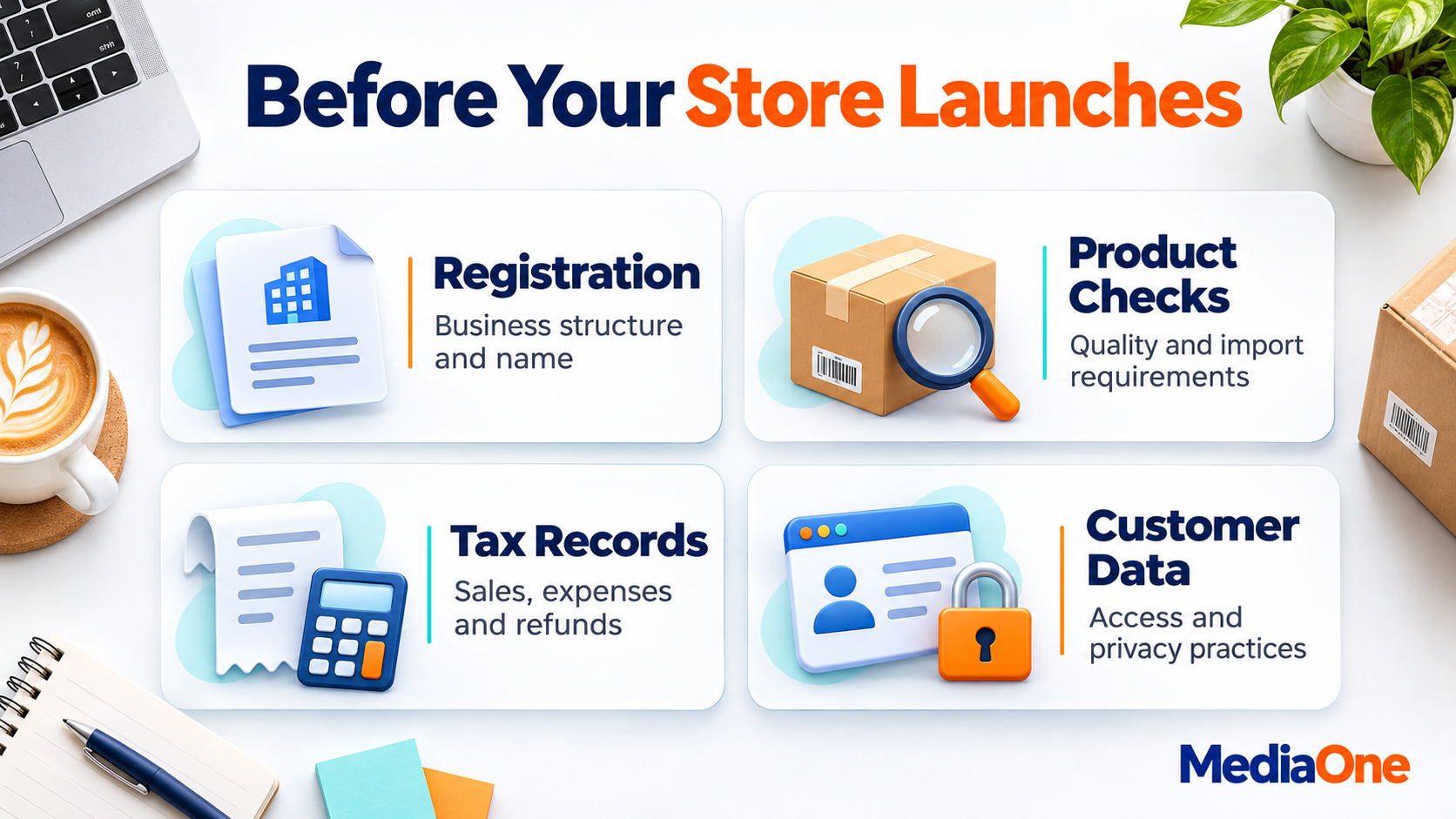
ACRA’s registration requirements cover regular profit-making activities, including online ventures, unless an exemption applies. A sole proprietorship is a registered business structure; it is different from incorporating a company.
The main distinctions in ACRA’s business structure comparison include:
| Structure | Main distinction |
| Sole proprietorship | The owner and business are not legally separate; the owner has unlimited liability |
| General partnership | Partners are personally liable for business debts and losses |
| Limited liability partnership | A separate legal entity with different liability arrangements |
| Company | A separate legal entity with additional filing and governance requirements |
Personal guarantees and individual responsibilities can still create exposure. Incorporation does not remove every personal risk.
A proposed name also needs to satisfy ACRA’s business naming rules. Domain and social account availability deserve separate checks before spending on packaging.
ACRA’s business registration process runs from eligibility and structure through name reservation, registration and post-registration requirements. Product-specific permissions are a separate check.
Tax records and GST
Sales records should connect each order with its payment, fees, refunds and expenses. IRAS’s tax information for online sellers explains that online trading income can be taxable.
GST registration is separate from business registration. The compulsory GST registration tests consider taxable turnover exceeding S$1 million under retrospective or prospective rules. Different tests have different timing requirements.
Imported products and customer information
Overseas sourcing can involve import GST, permits and restrictions. Singapore Customs’ import procedures explain the requirements and relevant exceptions. A supplier’s item price alone does not represent the full import cost.
Customer names, addresses and contact details also need care. The PDPC’s organisational self-assessment helps identify gaps in personal data practices; its results do not certify compliance.
How to Set Up an Ecommerce Store Customers Can Use
A first store needs to explain the offer and complete orders reliably. Extra features can wait until customer behaviour shows a need for them.
Platform costs extend beyond the subscription
Hosted platforms manage much of the technical setup. Self-hosted stores offer flexibility but require someone to maintain hosting, updates and security.
A comparison should include:
- Payment methods available to the business.
- Transaction charges and required apps.
- Delivery and stock integrations.
- Product options, such as sizes or bundles.
- Data export and account access.
- Maintenance and technical support.
A store selling personalised gifts needs a way to collect names or artwork. A downloadable product needs dependable file delivery. These requirements should drive the shortlist.
Product pages should answer buying questions
Customers should understand what arrives, what it costs and when to expect it.
A product page needs:
- A descriptive product name.
- Photographs showing scale and relevant details.
- Dimensions, materials, compatibility or contents.
- Available options and stock status.
- Delivery charges and dispatch estimates.
- Returns information and contact details.
A 750 ml bottle listing, for example, should show capacity, measurements, cleaning instructions and whether the lid prevents leaks. “Premium bottle” tells the buyer very little.
Good ecommerce website design places these answers where customers need them, especially on a phone.
Checkout testing should include refunds
The launch test should follow a customer through payment, confirmation and delivery updates. A refund test checks what the customer receives and what the seller sees.
The checklist should also cover:
- A failed payment.
- An unavailable product option.
- A delivery address outside the service area.
- Discount calculations.
- Mobile forms and buttons.
- Order emails and support replies.
A small group of testers can describe confusing steps. Their observations become more valuable when they attempt a purchase without coaching.
How Should an Ecommerce Business Handle Delivery and Returns?
Fulfilment covers storing, picking, packing and sending orders. The best arrangement depends on volume, space and the work the owner can manage.
| Arrangement | Main benefit | Main responsibility |
| Self-fulfilment | Direct control over packing and inspection | Storage, labour and courier coordination |
| Third-party logistics | Outside storage and dispatch support | Service terms, stock records and charges |
| Supplier dispatch | Less stock handling by the seller | Supplier performance and customer communication |
Delivery promises need operational support
A delivery estimate should distinguish preparation time from courier transit time. Personalisation, weekends and supplier lead times can affect dispatch.
Courier comparisons should include parcel size limits, failed deliveries, tracking, damage claims and collection arrangements. A low advertised rate may exclude services the store needs.
Packaging should protect the actual product. An oversized box can increase delivery charges, while weak protection can create replacement costs.
Returns need a written process
The policy should explain how customers report an issue, what information they need and how the seller responds.
The internal record should identify the reason for each return. Repeated size complaints may point to missing measurements. Damage may point to packaging.
A returns allowance in the budget should reflect expected losses after any resale, recovery or supplier reimbursement. Blanket policy wording should not promise to remove customers’ statutory rights.
How to Market an Ecommerce Business and Earn Repeat Orders
A new store needs a manageable way to reach buyers and learn from their response. Several poorly maintained channels can consume more time than they return.
| Channel | Role in a small launch | Main measure |
| Organic search | Products and answers appear for relevant searches | Orders and contribution from organic visitors |
| Paid search | Ads reach people searching for specific items | Cost per acquired customer |
| Social content and ads | Demonstrations introduce products to an audience | Purchases after campaign costs |
| Marketplace listings | Products appear within an existing shopping platform | Contribution after platform charges |
| Messages support relationships with subscribers | Orders, contribution and unsubscribes |
Product and category pages form the foundation of ecommerce SEO. Descriptive titles, accessible content and organised categories help people and search systems understand the range.
Google Ads campaigns can test demand for specific searches. Their budget needs to account for the cost of acquiring a buyer and the contribution that buyer produces.
A first campaign needs a spending limit
A launch campaign should have one offer, a defined audience and purchase tracking. A maximum test spend prevents an unsuccessful campaign from consuming the stock budget.
The review should examine the whole buying process. Clicks without orders may reflect the wrong audience, missing product information, delivery charges or payment problems.
A campaign’s return on advertising spend measures revenue against ad spend. It does not show whether the store made a profit after products, delivery and other expenses.
Repeat messages should follow the purchase
A planned email marketing lifecycle connects messages with the customer’s stage and product needs.
For example:
- The order confirmation records the purchase and expected dispatch.
- A post-delivery message explains product care.
- A feedback request follows enough time to try the item.
- A replenishment reminder reflects likely usage.
- A related offer follows genuine relevance to the first purchase.
Promotional subscriptions need appropriate permission and an unsubscribe option. An order email should not become an excuse for unrelated advertising.
Thoughtful eDM campaign planning also accounts for frequency. A durable lamp and a monthly consumable need different schedules.
Which Numbers Show Whether the Business Is Ready to Grow?
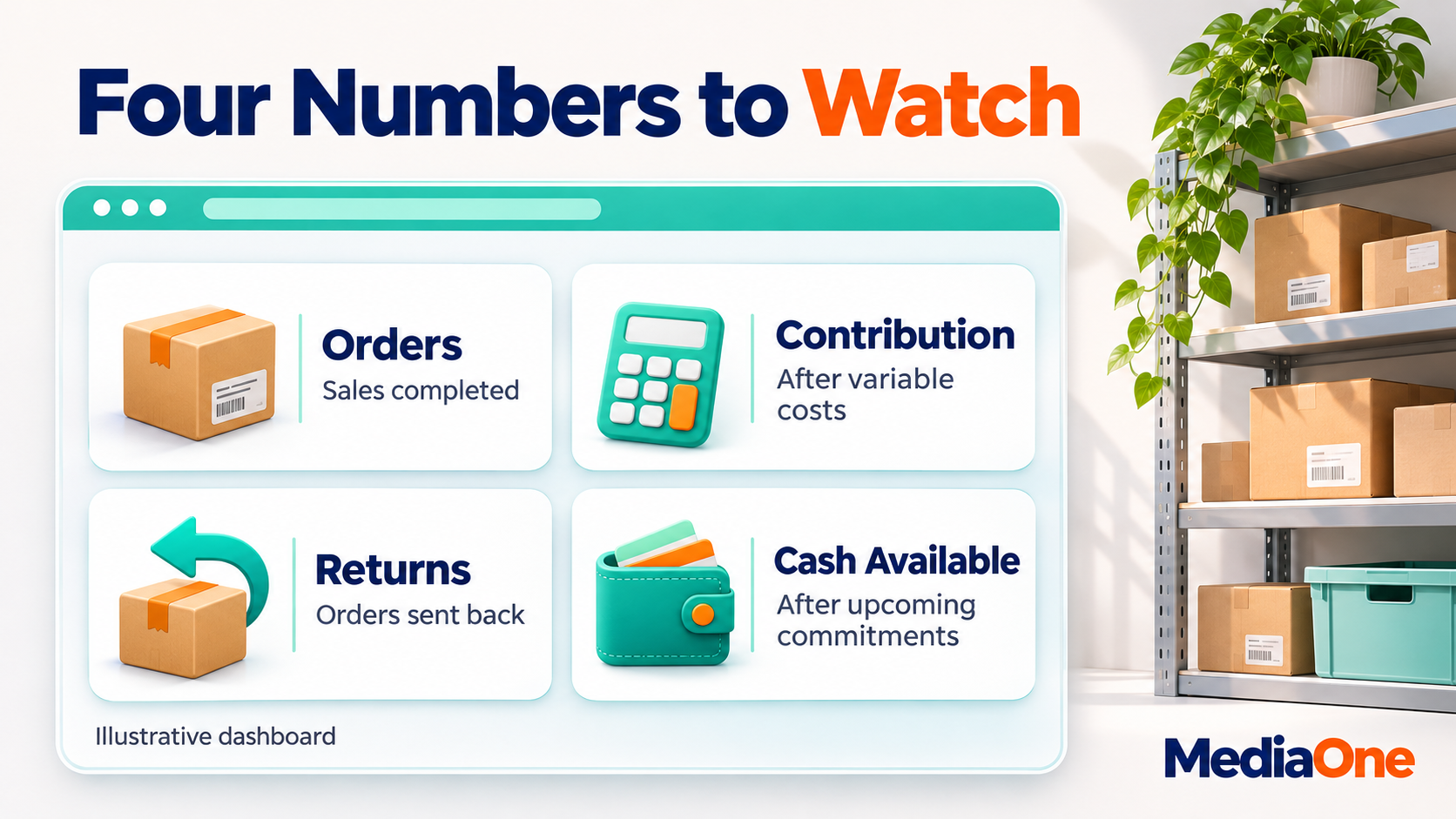
A growing order count can hide weak margins or a cash shortage. A weekly review should connect sales with money, service and stock.
| Measure | What it shows |
| Contribution per order | Money available towards fixed expenses and profit |
| Customer acquisition cost | Acquisition spending divided by new customers |
| Purchase conversion rate | Orders divided by store visits, using a consistent definition |
| Refund and return rate | How often orders lead to refunds or returned goods |
| Repeat purchase rate | How many customers buy again within a stated period |
| Cash available | Funds remaining after upcoming commitments |
The next test should address one problem
A business with product views but few cart additions may need better information or a stronger offer. Frequent checkout exits call for a payment, delivery and mobile review.
A store with healthy orders but poor contribution needs a pricing or cost review. More advertising can deepen that problem.
A monthly review should also compare actual supplier lead times with the assumptions used to order stock.
Security needs regular attention
Store administration should include:
- Individual staff accounts with appropriate access.
- Multi-factor authentication where available.
- Software updates and backups.
- Removal of unused apps and former staff access.
- A named person responsible for security alerts.
Account recovery details should remain under the business’s control. An agency or freelancer should not be the only person able to access the store.
Your Ecommerce Business’s Next Steps
A small launch gives the business evidence before larger commitments. The next decision should follow what customers buy, what each order earns and whether delivery remains dependable.
MediaOne’s ecommerce SEO services and website support can help businesses improve product visibility and the buying experience. A conversation with the team can focus on the store’s current bottleneck, budget and next commercial goal.
FAQs About Ecommerce Business
Can an ecommerce business sell services?
An ecommerce business can sell consultations, lessons, bookings or other services online. The store needs to explain what the customer receives, how appointments work and what happens after payment. Capacity planning replaces some of the stock planning required for physical products.
Should a new store offer free delivery?
Free delivery needs funding through the product price, order value or marketing budget. A minimum-spend offer may work when the extra contribution covers the delivery subsidy. The calculation should include discounts and avoid encouraging orders that lose money.
How can a store manage seasonal products?
Seasonal stock needs a buying deadline, sales window and plan for unsold units. Smaller batches reduce exposure when demand is uncertain. A seller should also consider whether leftover products can sell later without damage, expiry or heavy discounting.
When should an ecommerce business hire help?
Hiring becomes worth considering when a recurring task delays orders, reduces service quality or prevents higher-value work. The calculation should compare employment or outsourcing costs with the time released and the business’s ability to fund that commitment.
Can a store sell to overseas customers immediately?
Cross-border selling requires checks beyond enabling international checkout. Destination taxes, product restrictions, customs documents, delivery charges and returns can change the economics. A limited launch in one destination gives the seller a more manageable test.