A direct marketing campaign sends a specific offer to a specific person and asks for a response. Done well, it is highly measurable. Done badly, it earns complaints. For Singapore SMEs, the difference usually comes down to who was on the list and whether they agreed to receive the message.

Strong campaigns rest on consent and segmentation, not send volume. Email is the most efficient direct channel for most small businesses, but returns depend on personalised content, a clear call to action and offers that match what each customer actually needs.
This guide uses a scoring rubric as its spine. Industry averages describe other businesses, lists and offers — they are a starting reference, not a target. A simple score across channel fit, segmentation, and offer clarity shows whether your next campaign is ready to send.
Key takeaways
- Consent beats volume. A smaller, opted-in, segmented list usually returns more per contact than a large blast.
- Email leads for most SMEs. RingCentral reports email as the main acquisition channel for 81% of SMEs, sourcing the figure to a third party. Treat it as directional.
- Personalisation lifts clicks, not opens. Experian found personalised promotional emails get 41% higher unique clicks — and 29% higher unique opens.
- Score before you send. Rate channel fit, segment fit and offer clarity from 1 to 5 each. Rebuild anything below 9 out of 15.
- Check the Do Not Call Registry before calling or texting a Singapore number — it covers business numbers too, not just residential ones.
What a direct marketing campaign is, and how it differs
Direct response marketing is the measurable branch of direct marketing. Each message carries a specific offer and call to action, and every response can be traced to the message that prompted it. Brand advertising builds awareness across a crowd and is hard to tie to a single send. A direct campaign shows which segment responded, to which offer, and through which channel, so you can refine the next send.
Well-kept customer data makes that segmentation possible. Because each response is recorded, one campaign can be compared directly with the next, and you can see what each segment values. For the tracking layer that makes this possible, see MediaOne on conversion tracking and why data tracking makes or breaks performance.
Where the term came from
Direct marketing long predates email. The Direct Mail Advertising Association, predecessor of today’s Direct Marketing Association, was established in 1917, and in 1967 Lester Wunderman identified, named and defined the term “direct marketing”. The Wikipedia entry on direct marketing records both, and also traces “junk mail” to 1954. Wikipedia carries a maintenance banner warning that the article may contain original research, so treat it as a starting point rather than a primary source.
That history explains the backlash. Consent-based campaigns answer it: a smaller list of customers who expect your messages is worth more than a larger list of people who do not.
Main channels and when to use each
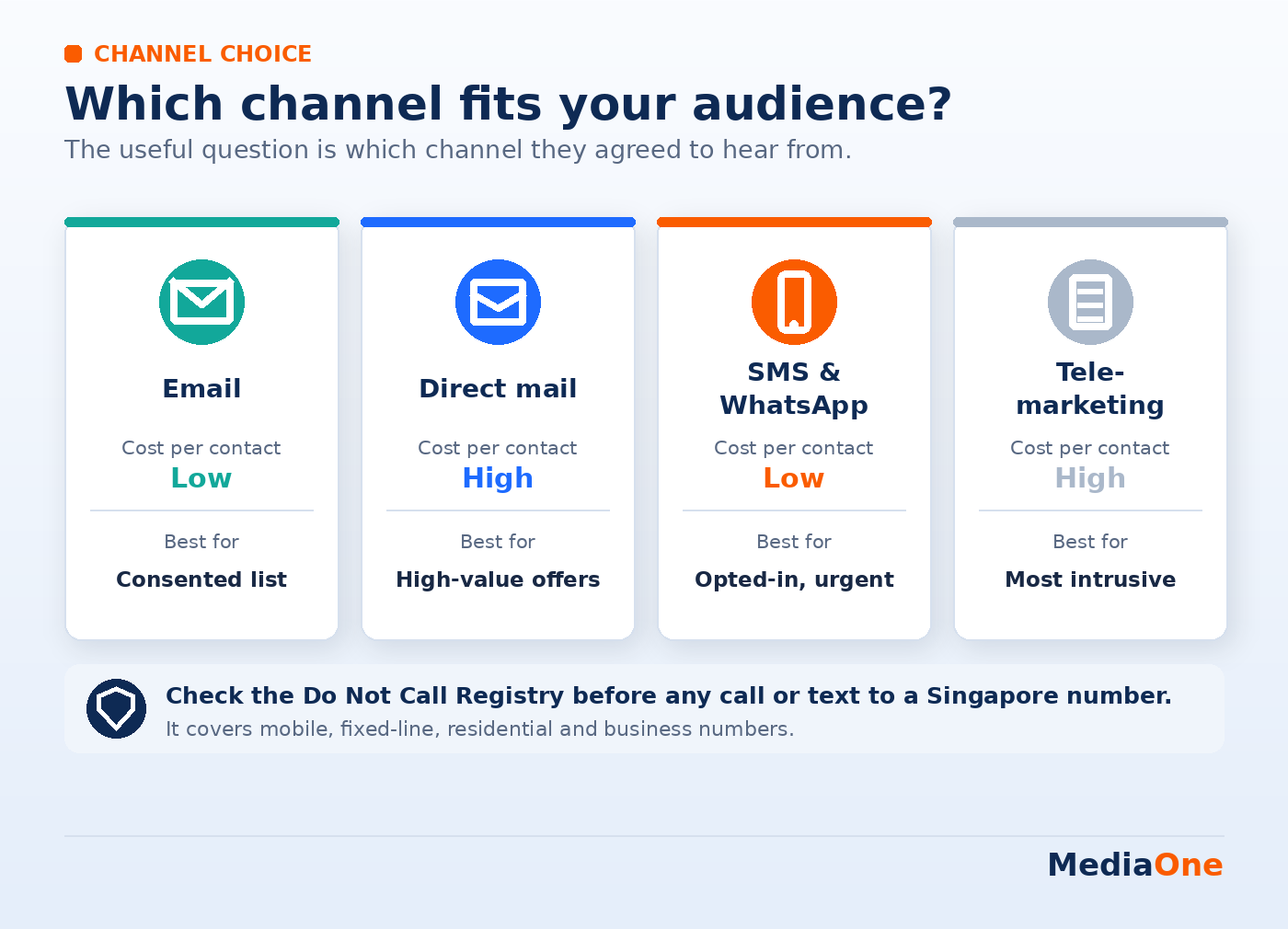
Direct marketing reaches people through a few channels, each suited to a different audience and budget. The useful question is which channel your audience has agreed to hear from.
Direct mail
Printed material sent by post — letters, catalogues or postcards. It suits high-value offers and offline-leaning audiences. Cost per contact is high, so it works best with a small, well-chosen list.

Email marketing
For most Singapore SMEs, email is the most efficient direct channel. RingCentral reports that 81% of SMEs rely on email as their main acquisition channel — a vendor figure which RingCentral itself sources to a third party, so test it against your own list. Email works only with a consented list, and is usually the first direct channel a small team can run without extra tooling.
Telemarketing and text message marketing
Telemarketing and texts convert quickly but intrude easily. Text and WhatsApp messages suit time-sensitive offers to customers who have opted in. Cold lists rarely justify the complaint risk. Before any call or text, check the number against the Do Not Call Registry.
Singapore’s Do Not Call rules in practice
The DNC provisions under the PDPA prohibit sending specified marketing messages — voice calls, texts and faxes — to Singapore telephone numbers registered with the DNC Registry. Two points are commonly missed:
- The registry includes business numbers, not only residential and mobile lines. Switchboards, generic enquiry lines and unknown mobile numbers can all be registered.
- Messages sent through apps such as WhatsApp are covered where a telephone number identifies the recipient.
You may still send to a registered number if you hold clear and unambiguous consent, or if you rely on the Personal Data Protection (Exemption from Section 43) Order 2013 and meet its conditions. Check results are valid for 30 days — resubmit your list if you send later than that. The DNC Registry holds three separate registers, for voice calls, text messages and faxes. See the CEA’s summary of the DNC requirements and the PDPC guide for individuals.
Benefits and disadvantages, including the email trade-off
A direct campaign reaches an identifiable person and shows who responded. The advantages and costs are two sides of the same coin: the practical costs in Singapore are complaints, opt-outs and wasted spend. A cold text to a registered number can lead to a complaint; messages that arrive too often shrink your list permanently; and direct mail carries printing and postage costs on every non-responder.
Email is cheap per message and easy to measure, but it is only as good as the list behind it. RingCentral notes that 42.3% of people delete a marketing email that is not mobile-optimised. Telemarketing is the most intrusive option, so it demands the strictest targeting.
Defining your audience, segmenting it and personalising
Most campaigns fail before the first message goes out, because the list was never defined properly. A target audience is the group most likely to respond to a specific offer — far narrower than “everyone who might buy”. Start with existing customers, and describe them by what they have done rather than by demographic assumptions. Write a short profile for each segment: who they are, what problem your offer solves, and how they prefer to be contacted. Include someone only if they have consented.
Personalisation: what the evidence actually says
Personalisation works best when it reflects what the reader has actually done, such as the last product viewed or the category they bought from. Name insertion adds little.
Earlier drafts stated that “personalised promotional emails have a 41% higher open rate, according to Privy”. Privy’s own benchmark guide attributes the figure to Experian, and describes it as 41% higher unique clicks — not open rate. Both the metric and the source were wrong. Separately, Experian’s finding includes a 29% higher unique open rate; the 41% and 29% figures are frequently conflated online. Test any uplift on your own list.
RingCentral also reports that 49% of consumers want promotional emails from their favourite brands — which means the other half do not.
Step-by-step framework for planning and launching
Most direct campaigns succeed or fail at the planning stage. The framework has three parts: one measurable objective, a check on channel and offer, and a pre-send routine. Write a brief for each campaign so the team works from the same plan.
Step 1: one measurable objective and a response goal
Choose one objective and one number. “Grow sales” is too vague to measure. “Get 40 booked consultations from the March list within 14 days” is measurable. Set the response goal at the same time, with a target for each segment, so you can tell whether the campaign worked and what to change if it did not.
Step 2: score the channel, segment and offer
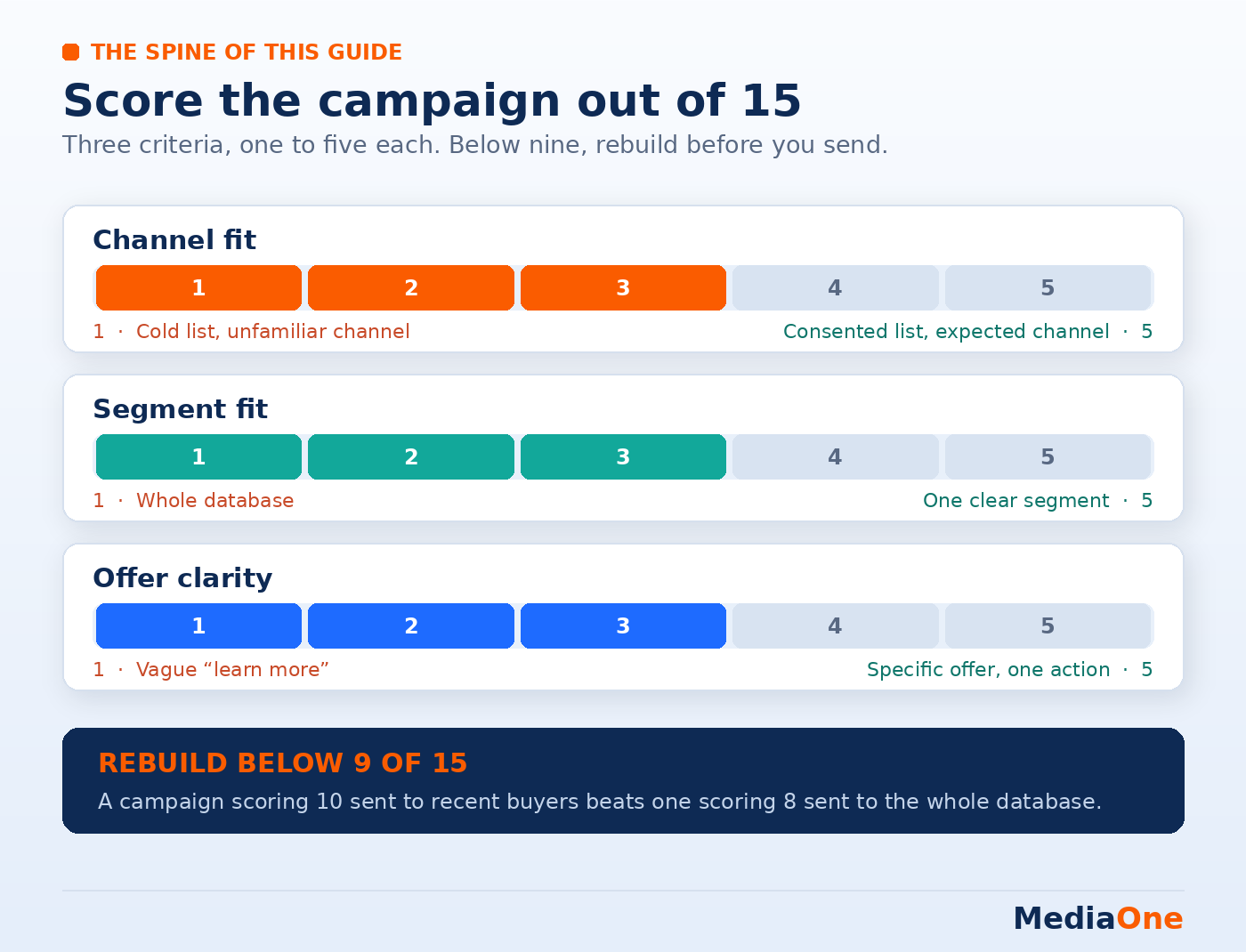
Score each planned campaign from 1 to 5 on three criteria:
|
Criterion |
Question to ask |
Score 1 |
Score 5 |
|
Channel fit |
Does the channel suit this audience? |
Cold list, unfamiliar channel |
Consented list, expected channel |
|
Segment fit |
Is the audience narrow enough for this offer? |
Whole database |
One clear segment |
|
Offer clarity |
Does the call to action state the offer plainly? |
Vague “learn more” |
Specific offer, one action |
Rebuild any campaign scoring below 9 out of 15 before it launches. The threshold is a practical floor, not a proven cut-off, but it reliably separates a tightly aimed send from a database-wide one.
Step 3: launch checklist and pre-send testing
Before sending, confirm that every recipient has opted in and that withdrawal requests are honoured; the call to action appears once, above the fold; the email renders correctly on mobile; and a test send has been checked on two devices.
To judge a test result, you need a sample large enough to separate a real difference from chance. Note your control’s response rate, decide the smallest lift worth acting on, and use an online sample-size calculator set to 95% confidence and 80% power. The result is the recipients needed per version. If your list cannot supply that number, test a larger segment or accept a bigger minimum lift. If the gap is smaller than the lift you planned for, treat it as noise.
Best practices and how to measure results
A consented, segmented list usually outperforms a larger cold list, because every contact has already shown some interest. Three practices matter most: send only to people who opted in and honour unsubscribe requests immediately; time sends to the audience rather than your calendar, testing two or three slots first; and design for the phone, because most marketing email is read on one.
Measure against the single objective you set at planning. Track four numbers for each campaign: response rate (responses divided by contacts reached), cost per response, revenue per contact, and opt-out rate (unsubscribes and complaints divided by contacts reached).
Calculate return on investment as (revenue minus cost) divided by cost. A campaign reaching 500 contacts, costing S$400 and bringing in S$1,200 of attributed sales returns 200%. If opt-outs double, the campaign is losing value, because its list shrinks.
Earlier drafts rendered this example as “costing S400andbringinginS1,200” — words run together with the currency symbol lost. The arithmetic was correct; the text was not. Restored to S$400 and S$1,200.
To track responses, give each channel its own unique link, promo code or phone number. Log every response against that tag in a spreadsheet or your CRM, recording the date, segment and channel, and compare each segment separately so a weak one does not hide in the average.
Turning direct marketing into a repeatable process
Before each campaign, score the plan from 1 to 5 on channel fit, segment fit and offer clarity, and rebuild anything below 9 out of 15. Record every score, response rate and cost per response: that data shows which consumers respond and which channels earn their place, which is more useful than any industry benchmark.
Email remains the most efficient direct channel for most small businesses, but it pays off only when the list is consent-based and small enough to personalise. Fewer, measured messages beat volume-led blasts.
For the paid side of the same audience — search, remarketing and lead-generation funnels — see MediaOne on Google Search ads, remarketing campaigns and building a lead generation funnel.
Frequently asked questions
What is the difference between direct marketing and direct response marketing?
Direct marketing reaches a named person or household by mail, email, phone or text. Direct response marketing is a subset that asks for an immediate, measurable reply, such as a click, call or order. Lester Wunderman named the term “direct marketing” in 1967.
Which direct marketing channel gives the best return for a small business?
For most Singapore SMEs, email gives the best return, provided the list is consented and segmented. RingCentral reports, as a vendor figure, that 81% of SMEs rely on email as their main acquisition channel. Score each channel against your own audience before committing budget.
How do I comply with Singapore’s rules on unsolicited marketing messages?
Confirm that every contact has agreed to receive marketing from you, honour withdrawal requests promptly, and check the Do Not Call Registry before calling or texting a Singapore number — including business numbers. The registry does not stop messages to people who have opted in to you. Check current PDPC guidance before you launch. This is general information, not legal advice.
How many people should be in a test before I scale a campaign?
There is no universal number. Enter your control’s response rate and the smallest lift worth acting on into a sample-size calculator set to 95% confidence and 80% power. Scale only when the winning version beats the control, and repeat the test on a second segment first.
How often should I send direct marketing emails without causing unsubscribes?
Send at a frequency your subscribers have agreed to, and watch unsubscribe rates after each send. A rising rate after a change in frequency is the clearest signal to ease off.