

Few things are more frustrating than seeing your competitors outrank you for keywords that should be yours. You know your product is better, your service is stronger, and your team is top-notch. But their website keeps getting the traffic, leads, and sales you want. Most of the time, this isn’t about luck, it’s about the scope of your content.

According to Semrush’s 2025 State of Content Marketing report, businesses that regularly conduct content gap analyses generate 3.5 times more organic traffic than those that publish content without competitive research.
The difference between market leaders and followers often comes down to one strategic practice: knowing exactly what content to create before investing resources.
A content gap analysis is how you close that gap. It helps you see exactly where your content is falling short and what you need to do to reach your full potential online.
When you find the topics, keywords, and questions your audience is searching for, but your website doesn’t cover, you can start winning back that lost traffic.
This guide goes beyond basic keyword research. You’ll get a practical, step-by-step process for identifying content gaps, attracting your competitors’ traffic, and boosting your rankings. Plus, there’s a downloadable template you can use right away.
Key Takeaways
- Your SEO competitors aren’t always your business competitors. Focus on analysing domains that consistently outrank you in search results for your target keywords, not just companies offering similar products or services.
- Prioritisation is everything. Score opportunities using a matrix of relevance, search volume, and keyword difficulty, focusing on “quick wins” (high relevance, low difficulty) before tackling strategic high-difficulty targets.
- Match search intent, don’t just chase keywords. Ranking for a keyword is meaningless if your content format doesn’t match what users actually want.
- Gap analysis is ongoing, not a one-off. Perform lightweight quarterly reviews and comprehensive annual audits to stay ahead of competitors and adapt to evolving search behaviour.
What Is Content Gap Analysis?
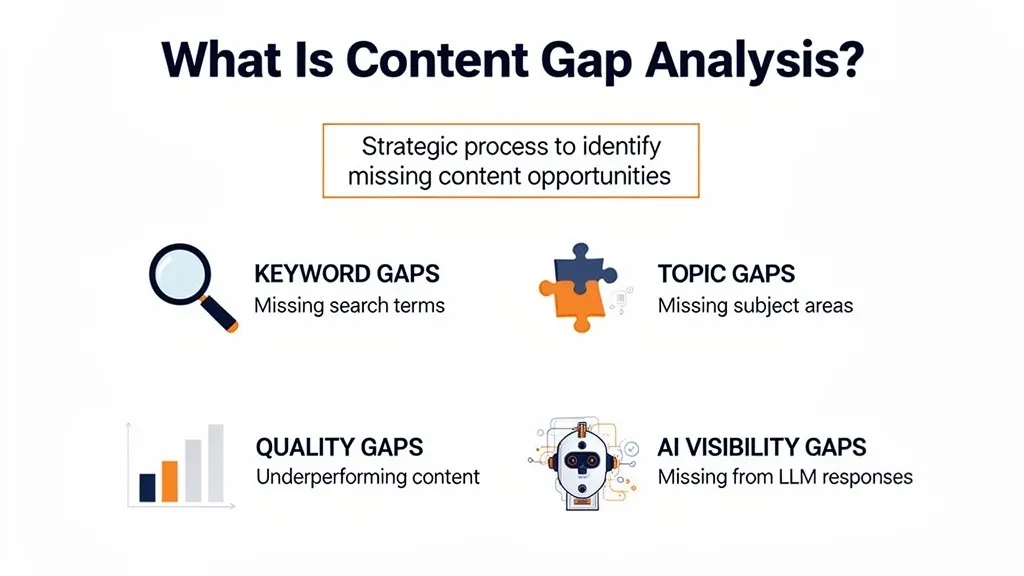
A content gap analysis helps you spot missed opportunities in your content. You compare what you have with what your competitors are doing and what your audience is searching for. This helps you identify gaps where you’re missing visibility.
At its core, it answers one key question: What are your potential customers searching for that you aren’t providing yet?
However, in the SEO landscape of 2026, a gap analysis goes far beyond simple keywords. It now encompasses four distinct dimensions:
- Keyword Gaps: Specific search terms your competitors rank for, but you do not.
- Topic Gaps: Broader themes or subject areas missing from your content architecture.
- Quality Gaps: Content that exists on your site but fails to rank because it lacks depth, freshness, or authority compared to current standards.
- AI Visibility Gaps: Questions answered by Large Language Models (LLMs) like ChatGPT or Gemini where your brand is not cited as a source.
For businesses looking to scale, partnering with experts like MediaOne can accelerate this process, ensuring no opportunity is left uncovered in today’s hyper-competitive digital environment.
Why Every Business Needs Content Gap Analysis in 2026

Running regular gap analyses isn’t just an SEO trick, it’s a smart business move. Here’s why it matters for your growth.
1. Steal Traffic Directly from Competitors
Your competitors have already shown which topics bring in traffic. When you spot their top pages, you can create even better content and attract that traffic to your own site. In other words, you turn their research into your advantage.
2. Identify Low-Hanging Fruit Opportunities
Often, you will find keywords with high search volume but low competition that everyone else has missed. These “content gaps” let you rank quickly and drive immediate traffic without competing for highly competitive terms.
3. Improve Existing Content ROI
You don’t always need to create new pages. Sometimes, just updating an existing post with a few missing subtopics can move it from page two to the top three results. This way, you get more value from content you’ve already created.
4. Align Content with the Customer Journey
A good analysis might show you have plenty of ‘awareness’ content but not enough ‘decision’ content. Filling these gaps helps you guide leads through every stage, so you don’t lose them right before they buy.
5. Future-Proof Against AI Search
As more people use AI tools to search, it’s important to know what questions these models answer. When you create content that AI likes to cite, you boost your visibility in tools like ChatGPT and Gemini. This is the next big step in SEO.
How to Perform a Content Gap Analysis: 7-Step Tactical Guide
Follow this step-by-step process to transform data into a dominant content strategy.
Step 1: Identify Your True SEO Competitors

Your business competitors aren’t always your SEO competitors. You might compete with local firms for clients, but in search results, you could be up against national publishers, educational sites, or industry blogs.
To find your real search rivals, Google your main service keywords (like ‘digital marketing services Singapore’). Write down the domains that keep showing up in the top five. These are the sites you should focus on.
Tools like SEMrush and Ahrefs can automate this by showing you “competing domains” based on shared keyword overlap. If you need assistance identifying these market threats, a specialised SEO agency in Singapore can provide a deep-dive competitive landscape audit.

Step 2: Conduct Keyword Gap Analysis


Next, dive into the data. Look for content gaps at the keyword level. Most SEO tools have a ‘Keyword Gap’ or ‘Content Gap’ feature to make this easier.
Enter your domain and two or three competitor domains. Then, filter the results to show keywords where:
- Competitors rank in the Top 10.
- You rank outside the Top 100 (or do not rank at all).
Prioritise your list using three factors:
- Relevance: Does this keyword actually lead to business revenue?
- Volume: Is there enough search traffic to justify the effort?
- Difficulty: Can you realistically rank for this term with your current domain authority?
Example: If a competitor ranks for “enterprise local SEO” and you don’t, that is a high-value gap to fill, even if the search volume is lower than a generic term like “what is SEO.”
Step 3: Analyse Topic Coverage

Keywords are part of bigger topics. Check your competitors’ site structure. Do they have full topic hubs or categories that you don’t?
Map their content themes against yours. You might find they have a comprehensive series on “Video Marketing,” while you only have one blog post. This indicates a “Topic Gap.” To dominate a niche, you need topical authority, which requires covering a subject in breadth and depth.
Think about the customer journey. Do your competitors have beginner guides, comparison articles, and case studies for decision-makers? Spot the areas where your content is lacking.
Step 4: Evaluate Content Quality Gaps
Sometimes you already have content, but it’s not ranking. That’s a quality gap. Open your competitor’s top pages next to yours and compare them side by side.
Ask these hard questions:
- Freshness: Is their content updated with 2026 data, while yours cites 2023 statistics?
- Depth: Do they cover 10 subheadings while you cover three?
- E-E-A-T: Does their content demonstrate more Experience, Expertise, Authoritativeness, and Trust? Do they quote experts or provide original data?
- Visuals: Are they using custom infographics and videos while you rely on stock photos?
Step 5: Assess AI Visibility Gaps
This is the modern addition to the process. Use tools like ChatGPT, Claude, or Perplexity to ask questions relevant to your industry.
Prompt example: “What are the best strategies for B2B lead generation in Singapore?”
Analyse the response. If your competitors are cited as sources and you are not, you have an AI visibility gap. To fix this, ensure your content delivers concise answers to natural-language questions, is structured for voice-friendly responses, and is technically optimised with schema markup to improve AI and assistant-level understanding.
Step 6: Examine Backlink and Authority Gaps
Why does their content rank #1? Often, it is not just the text; it is the authority. Use your SEO tool to check the backlink profile of their top pages.
If their guide has 50 backlinks from top industry sites and yours has none, that’s an authority gap. Look at why they earned those links. Did they offer original research, a free tool, or a downloadable template? You’ll need to create something just as valuable to compete.
Step 7: Prioritise and Create Your Action Plan
You should now have a massive list of potential keywords and topics. Do not try to do everything at once. Score your opportunities.
The Prioritisation Matrix:
- Quick Wins: High relevance, low difficulty. (Do these first.)
- Strategic Bets: High relevance, great difficulty. (Start these early; they take time.
- Filler Content: Low relevance, low difficulty. (Do these when resources allow).
Assign these tasks to your content calendar with precise deadlines and content briefs.
Content Gap Analysis Template Framework
To make this easy, use our simple framework in Excel or Google Sheets. This way, your data turns into real action steps.
Tab 1: Competitor Analysis
Tab 2: Keyword Gap Tracking
Tab 3: Action Plan
For a deep dive into how we approach this methodologically, explore our guide on content gap analysis. |
Best Tools for Content Gap Analysis
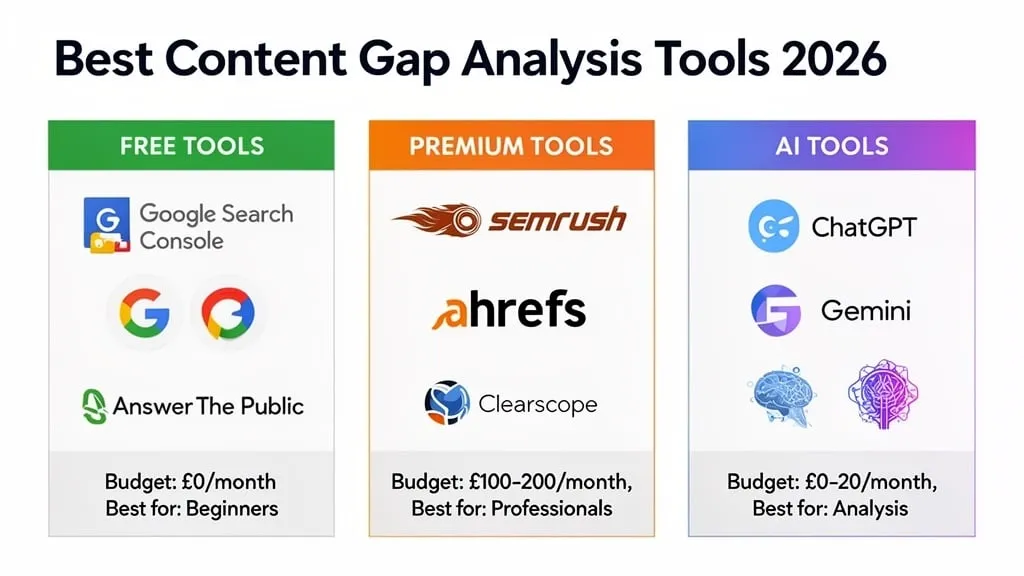
You can perform a gap analysis manually, but the right tools make the process faster and more accurate.
Free Tools
- Google Search Console: Excellent for finding “striking distance” keywords where you rank on page 2.
- Google Search: Use the “People Also Ask” section to find question gaps.
- Answer The Public: Great for visualising questions your audience is asking.
Premium Tools
- SEMrush: Features a dedicated “Keyword Gap” tool that visualises domain overlap perfectly.
- Ahrefs: Their “Content Gap” tool lets you filter granularly, helping you find specific page-level gaps.
- Clearscope: unparalleled for identifying semantic term gaps within a specific article draft.
AI Tools
- ChatGPT / Gemini: Use these to analyse your content against a competitor’s. Paste both articles and ask, “What key points does Article B cover that Article A misses?”
Here’s a quick table for scannability:
| Tool | Pros | Cons |
| Google Search Console | Uses real performance data; great for identifying page-2 “striking distance” keywords | Limited to your own site; no competitor insights |
| Google Search (People Also Ask) | Reveals real user questions straight from Google; excellent for topic gaps | Manual process; no search volume or difficulty data |
| Answer The Public | Visualises audience questions clearly; strong for blog ideation | Limited free usage; results can be broad or repetitive |
| SEMrush | Dedicated Keyword Gap tool; strong competitor overlap analysis | Expensive; steeper learning curve |
| Ahrefs | Granular keyword and page-level gap filtering; highly accurate data | No free tier; can overwhelm beginners |
| Clearscope | Best-in-class semantic and topical gap detection within articles | Not built for competitor discovery; high cost |
| ChatGPT / Gemini | Fast qualitative content comparisons; surfaces missing talking points | No live SERP or keyword data; prompt-dependent output |
Common Content Gap Analysis Mistakes to Avoid
Even with good data, strategies can fail. Avoid these common pitfalls.
- Ignoring Search Intent: Ranking for a keyword is useless if you don’t match the intent. If the user wants a calculator and you write a 3,000-word essay, you have missed the gap. Analyse the top-ranking pages to identify the dominant intent (informational, transactional, or navigational), and match the format and depth before adding enhancements.
- Copying Without Improving: If you simply replicate your competitor’s content, there is no incentive for Google to rank you higher. Apply the “10× improvement” rule by adding clearer explanations, original data, stronger examples, visuals, or insights your competitors lack.
- Neglecting Your USP: Do not chase gaps that are irrelevant to your brand. Just because a competitor ranks for “cheap SEO services” doesn’t mean you should if you are a premium agency. Filter for gaps in your positioning and target audience, and prioritise keywords that reinforce your value proposition.
- Failing to Track Results: A gap analysis is not a one-time event. If you don’t monitor performance, you cannot refine your strategy. Track rankings, impressions, clicks, and engagement in Google Search Console and analytics tools, then revisit underperforming pages every 30–60 days.
Real-World Content Gap Analysis Example
Consider a B2B SaaS company that was struggling to increase organic sign-ups. They assumed their blog was comprehensive.
- The Analysis: We discovered their competitors were ranking for “integration” keywords (e.g., “CRM integration with X tool”). Our client had zero content on this, assuming users would just know their tool was integrated.
- The Action: We created a series of 20 landing pages specifically targeting “software + integration” keywords. We also updated their main features page to explicitly list these integrations.
- The Result: Within four months, organic traffic increased by 45%, but more importantly, these pages had a conversion rate 3x higher than their general blog posts. They found a gap in the “decision” stage of the funnel and filled it profitably.
Start Your Content Gap Analysis Journey Today
Content gap analysis is arguably the highest-ROI SEO activity. It removes the guesswork from content strategy, replacing intuition with cold, hard data about what your audience actually wants.
By systematically identifying where your competitors are winning and you are missing out, you can build a roadmap to market dominance. Remember, the goal is not just to have more content than everyone else; it is to have the most complete ecosystem of answers for your customers.
The digital landscape changes fast. We recommend performing a lightweight gap analysis every quarter and a deep-dive audit once a year.
Start today by identifying your top three competitors and finding five keywords they rank for that you don’t. That small step is the beginning of reclaiming your traffic.
If you want to accelerate results and remove the heavy lifting, MediaOne’s SEO experts can run a comprehensive content gap analysis for you. Contact us today!
Frequently Asked Questions
How long does it take to see results from filling content gaps?
Typically, you’ll begin seeing initial ranking improvements within 4-8 weeks for low-difficulty keywords, whilst more competitive terms may take 3-6 months.
Quick wins like updating existing high-authority pages can show results even faster, sometimes within 2-3 weeks, as Google recrawls and reassesses your improved content.
Can small businesses compete with large enterprises through content gap analysis?
Absolutely. Content gap analysis actually levels the playing field by helping you identify niche topics and long-tail keywords that large competitors overlook. Focus on hyper-specific, local, or emerging topics where you can establish authority before bigger players notice the opportunity.
How much budget should I allocate for content gap analysis?
If using premium tools like SEMrush or Ahrefs, expect £100-£200/month for software subscriptions. For content creation, budget £300-£1,500 per high-quality article, depending on complexity and research requirements.
Many businesses allocate 15-25% of their total marketing budget to strategic content development based on gap analysis findings.
Should I focus on creating new content or updating existing content first?
Start with updating existing content that ranks on page 2 (positions 11-20), as these represent “striking distance” opportunities.
These updates typically deliver faster ROI than creating entirely new content. Once you’ve optimised underperforming assets, shift your focus to creating new content to address unexplored topic gaps.
How do I measure the success of my content gap strategy?
Track five key metrics: organic traffic growth to gap-filled content, keyword ranking improvements for targeted terms, conversion rate from new/updated pages, backlink acquisition to your improved content, and domain authority progression.

Set baseline measurements before implementation, review progress monthly, and conduct comprehensive quarterly assessments to refine your strategy.