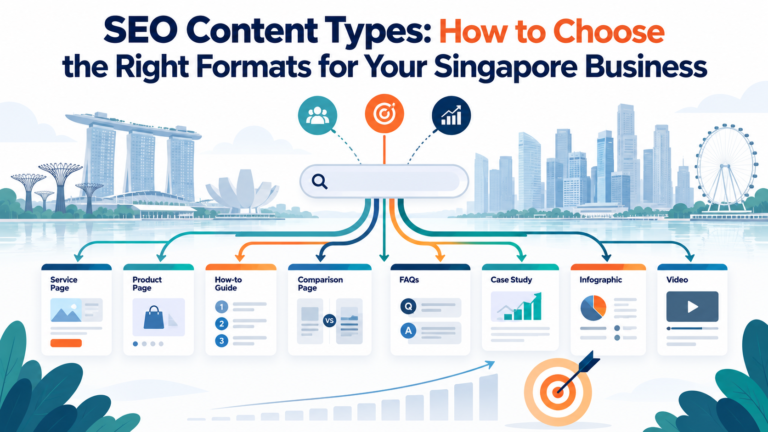

Businesses in Singapore face a pivot point in 2026. Google still handles the large majority of searches in Singapore, yet some analysts project that AI search engines like ChatGPT, Perplexity and others could reduce Google traffic significantly. This shift is gradual but measurable. The dual reality means content strategy cannot ignore either channel.

ChatGPT is not a ranking tool; it is a force multiplier for the work that does rank. It accelerates keyword research, content structure, schema generation and editorial refinement. The businesses winning in 2026 are those using ChatGPT to move faster, then investing the expertise required to publish content that search engines (both Google and AI) actually trust.
This guide outlines how to use ChatGPT in SEO workflow, when to hire a specialist agency, and how to fund that work through Enterprise Singapore grants. Whether an organisation is a solo marketer or a growing SME, a practical path forward exists.
Why SEO in 2026 Demands AI Capability, and Why ChatGPT Matters
The Search Landscape Has Fractured
The 2026 search landscape has fractured fundamentally. For a decade, SEO meant one thing: rank your page higher on Google’s results page. Position one brought clicks. Position ten brought minimal traffic.
AI-powered search engines have changed the game. By 2026, ChatGPT and AI search engines recommend only a handful of businesses per query, not ten. Unlike traditional Google SEO where position determines visibility, AI answers typically feature between two and five vendors. There is no position ten in AI-generated results.
The competitive calculus has shifted. In Google, organisations can rank for hundreds of keywords and accumulate long-tail traffic. In ChatGPT, a business either appears in the AI’s recommended list for a critical query, or it does not. The stakes are binary.
Google remains the dominant channel in Singapore for now. But the clear market trajectory is evident: businesses ignoring AI search engines in 2026 are placing themselves at a competitive disadvantage as traffic shifts.
What Makes Content Rank in 2026
Whether content appears in Google’s top ten or in ChatGPT’s top three, ranking factors have converged. Content ranks in 2026 by demonstrating genuine expertise, original insight, accurate data, and solutions that serve searchers better than existing alternatives.
ChatGPT and other AI engines reward clarity, sourcing and evidence of real knowledge. Concrete examples include a white paper with original research outranking a synthesis of five blog posts; a client case study with verifiable metrics outranking generic best-practice advice; an expert answering from lived experience outranking a generalist paraphrasing competitors.
ChatGPT excels at scaffolding: building outlines, surfacing keyword variations, drafting meta descriptions and generating schema. It does not excel at supplying the original insight, proprietary data or credibility that makes content trustworthy. In 2026, ChatGPT functions as research assistant and editor. Organisations remain responsible for delivering the substance that earns trust.
Key Takeaways
- ChatGPT accelerates SEO workflow (keyword research, outline generation, meta descriptions, schema markup) but does not replace human expertise: content ranks because it demonstrates genuine expertise, original insight and accurate data, not because an AI wrote it.
- In 2026, Singapore businesses face a dual-channel landscape: Google still handles the majority of searches, but AI search engines represent a growing alternative, making visibility in both systems essential for competitive sustainability.
- Generative Engine Optimisation (GEO) is now a structured service category in Singapore: full GEO engagements include audit, entity positioning, content production and schema implementation, typically ranging S$3,500 to S$15,000 per month (market variation applies by agency and scope).
- DIY ChatGPT-assisted SEO suits companies with in-house marketing skill; full GEO engagement suits regulated sectors, B2B technology and professional services targeting critical business queries in AI-generated answers.
- Enterprise Singapore’s Market Readiness Assistance (MRA) Grant may support eligible SMEs in funding international market visibility work; eligibility and coverage amounts require verification with Enterprise Singapore directly.
- ChatGPT’s real value lies in moving faster: use it to scaffold research, structure outlines and generate variations; invest human expertise where it matters: accuracy, originality, sourcing and editorial judgment.
Table of Contents
- Why SEO in 2026 Demands AI Capability, and Why ChatGPT Matters
- Generative Engine Optimisation (GEO) vs. ChatGPT-Only SEO
- Building AI-Optimised On-Page Content and Technical Foundations
- ChatGPT and AI Tool Capabilities for SEO: What It Can Actually Do
- Practical Workflow: How to Use ChatGPT in Your SEO Process
- Summary and Your Next Steps
Generative Engine Optimisation (GEO) vs. ChatGPT-Only SEO
What GEO Is and Why It Differs From Traditional Optimisation
GEO, Generative Engine Optimisation, is structured work to position an entity and its content within AI-generated overviews and LLM-recommended lists. Unlike traditional Google SEO, which focuses on keyword ranking position, GEO targets inclusion in the small handful of businesses or sources that AI search engines recommend to users.
This formalisation signals that AI visibility is no longer a side-effect of good content, but a distinct strategic discipline. Where traditional SEO asks “How do I rank on page one?”, GEO asks “How do I earn inclusion in the AI’s recommended list?”
The core difference: ChatGPT-only SEO treats ChatGPT as a writing tool. Full GEO treats AI visibility as an outcome requiring audit, entity positioning, citation building, schema implementation and ongoing optimisation across multiple channels. It is not simply using ChatGPT to write content; it is systematic work to make an organisation the entity an LLM trusts and recommends.
When to Use ChatGPT Alone vs. Full GEO
ChatGPT alone suits:
- Content scaffolding and outline generation
- Secondary keyword research and semantic clustering
- Meta title and description drafting
- Schema markup templating
- Internal editing and readability review
Use ChatGPT solo if an organisation has in-house SEO skill, can invest time in research and fact-checking, and is optimising for Google first.
Full GEO engagement suits:
- Companies needing to appear in AI answers for critical business queries
- Regulated sectors (professional services, fintech, healthcare) where accuracy and attribution matter
- B2B technology and SaaS vendors competing on research and credibility
- Businesses exploring grant funding for market development work
Singapore SMEs should verify current grant eligibility and funding details directly with Enterprise Singapore, as coverage terms and caps change periodically.
Key GEO Deliverables Beyond ChatGPT Output
Managed GEO engagements, including audit, entity positioning, content production, schema, and reporting, vary in cost by scope and client size. Organisations should confirm current pricing with service providers and verify grant funding eligibility with Enterprise Singapore before committing.
Beyond text generation, full GEO includes entity audits (verifying business data across knowledge graphs), competitive positioning analysis, citation building in authoritative sources that inform LLM training data, and structured data implementation that AI engines recognise. These elements sit outside ChatGPT’s scope and require specialist knowledge of how LLM training data works and which signals AI search engines weigh most heavily.
Building AI-Optimised On-Page Content and Technical Foundations
On-Page Essentials for AI Search Engines
ChatGPT can draft outlines and structure; content depth depends on human expertise. Content ranks by demonstrating genuine expertise, original insight, accurate data, and solutions serving searchers better than existing alternatives. This principle applies equally to Google and to AI search engines that consume training data from the same web.
Write answer-first. Lead with the core claim or data point before elaboration. AI search engines reward clarity because they extract answers for inline display. Include a byline with author name and publication date; both signal to LLMs that content is attributed and current. Cite sources explicitly: if referencing a statistic, law or case study, name where it came from. AI models are more likely to trust cited content than unsourced claims.

Use ChatGPT to structure this work, not to generate it from nothing. Feed ChatGPT research notes, data sets and sources; ask it to draft an outline highlighting where citations belong. Then fill in the actual research, data and examples directly. Where organisations acknowledge uncertainty (“data is limited here” or “expert opinion varies”), LLMs respect the honesty and include content more readily than generalist copy overstating confidence.
Meta Title and Description Optimisation for AI Extraction
Write titles between 50 and 60 characters; write descriptions between 150 and 160 characters. AI search engines extract these fields directly for display in recommendations. Use the primary keyword naturally in the title, and include secondary keywords in the description. ChatGPT can generate ten variations; select the version that prioritises clarity and user intent over keyword density.
Example structure:
- Title: “Expert Review: What Makes ChatGPT Work for Singapore SEO”
- Description: “Understand how ChatGPT accelerates SEO workflow, when to hire specialists, and how Enterprise Singapore grants support GEO investment.”
Technical SEO for AI Indexing
Ensure site HTML is clean, load times are fast and the site responds properly on mobile. These remain non-negotiable for both Google and AI indexing. Implement structured data (schema markup) for key entities: business name, location, categories, ratings, and for article content, author and publication date. ChatGPT can help draft JSON-LD schema; a developer must validate and deploy it.

Schema alone does not rank content, but AI search engines trust structured data when validating entity claims. If a site claims to be a fintech consultant in Singapore and schema confirms this across multiple fields, LLMs align that claim with external sources. Omitting schema costs this alignment signal.
Backlink Strategy in the AI Era
Off-page SEO, earning links from authoritative sources, remains relevant. Both Google and LLM training data treat links as signals of trust and relevance. ChatGPT can help identify link prospects (trade publications, industry associations, sector directories) and draft outreach emails. The human work is relationship-building and earning the actual link. A link from a credible competitor or industry body carries more weight than ChatGPT-generated outreach alone. Concrete example: a link from TechCrunch Asia signals more domain authority than a generic tech blog.
ChatGPT and AI Tool Capabilities for SEO: What It Can Actually Do
ChatGPT’s Role in Keyword Research and Content Strategy
ChatGPT excels at clustering semantically related terms. Provide a seed keyword (“fintech compliance Singapore”) and ChatGPT returns related questions, long-tail variations, and semantic neighbours useful for content structure. This output saves time but requires human validation: some suggestions will be irrelevant, some oversaturated, some outside your service scope.
Use ChatGPT outputs as a starting point for Google Keyword Planner and Search Console analysis. Verify search volume, intent and difficulty before investing content resources.
Content Outline and Meta Optimisation
ChatGPT generates outlines rapidly. Feed it a topic, target audience and primary keyword. Request it to include sections that demonstrate expertise, cite sources, and include data points. Review the outline, remove generic sections, and add domain-specific insights ChatGPT cannot generate.
For meta optimisation, ask ChatGPT for ten title-description pairs. Select the version that reads naturally and includes your primary keyword without forcing it.
Structured Data and Schema Generation
ChatGPT can draft JSON-LD schema for common entities: Article, LocalBusiness, Organisation, FAQPage. Provide your business details (name, address, phone, service categories) and ask ChatGPT to generate schema. A developer must validate the output against Schema.org specifications and test it using Google’s Rich Results Test tool before deployment.
Example: For a service business, generate LocalBusiness schema including name, address, phone, service area, and ratings aggregated from verified review platforms.
Practical Workflow: How to Use ChatGPT in Your SEO Process
Step-by-Step Prompt Strategy for SEO Tasks
Step 1: Research and Keyword Clustering
Prompt: “I target [industry] professionals in [location] searching for [problem]. Generate 20 related questions and keyword variations they might use. Group them by search intent (informational, commercial, transactional).”
Review the output. Discard irrelevant terms. Verify volume and difficulty in keyword tools.
Step 2: Competitive Landscape

Prompt: “Who are the top three competitors ranking for [primary keyword] in [location]? Summarise their content approach, backlink profile and messaging strength. What gaps do they leave?”
Use this to inform your positioning and identify content angles competitors miss.
Step 3: Content Outline Generation
Prompt: “Outline a 2,500-word article titled ‘[Your Title]’ for [target audience]. Include sections demonstrating expertise, case studies, data, and actionable steps. Flag where citations and external links should appear.”
Refine the outline: remove generic sections, add proprietary insights, identify sources you already possess.
Step 4: Meta and Snippet Optimisation
Prompt: “Generate ten H1 titles and ten meta descriptions (max 160 characters) for an article about [topic] targeting [primary keyword]. Prioritise clarity and natural keyword placement.”
Select the pair that best reflects your unique angle and includes the primary keyword without forcing it.
Step 5: Schema Markup Draft
Prompt: “Generate JSON-LD schema for a [LocalBusiness/Article/FAQPage] with these details: [your details]. Include all recommended fields for SEO trustworthiness.”
Have a developer validate and deploy the output.
Quality Checkpoints Before Publishing
- Fact-check every statistic, quote and claim against original sources.
- Verify all external links are live and point to authoritative sources.
- Confirm author byline, publication date and update date are present.
- Run the article through Copyscape or similar to ensure originality.
- Validate all schema markup using Google’s Rich Results Test.
- Test page load speed on mobile and desktop.
- Check that all headings use semantic hierarchy (one H1, multiple H2s and H3s).
Measuring ChatGPT-Assisted Content Performance
Track these metrics for content produced with ChatGPT scaffolding:
- Organic traffic: Month-on-month growth in users arriving from Google and AI search engines.
- AI visibility: Monitor mentions in ChatGPT answers using tools like Semrush or manual checks for branded queries and critical business keywords.
- Citation velocity: Track how quickly your entity appears in Google Knowledge Panels and external directories after publication.
- Conversion attribution: Link content performance to lead generation, signup or sales using UTM parameters and analytics platforms.
- Engagement metrics: Average time on page, bounce rate and internal link clicks indicate whether content depth is meeting user intent.
Summary and Your Next Steps
ChatGPT is a productivity tool for SEO, not a replacement for expertise. Organisations maximise its value by using it for research scaffolding, outline generation and editing, then investing human expertise in original insight, sourcing and accuracy.
Two practical paths forward exist:
Path 1: DIY ChatGPT-Assisted SEO
Best suited to organisations with existing in-house SEO skill. Use ChatGPT to accelerate research and outline work. Invest human time in research validation, original data collection and content depth. This path costs minimal budget but demands significant time commitment and SEO knowledge.
Path 2: Specialist GEO Engagement
Best suited to regulated sectors, competitive B2B markets and organisations targeting AI answer visibility for critical business queries. Partner with a GEO agency to conduct entity audits, build citation authority, optimise schema and monitor AI visibility across multiple platforms. Verify current service pricing and grant eligibility with service providers and Enterprise Singapore directly.
Either path requires the same foundation: clarity about what makes your content trustworthy, original and useful. ChatGPT accelerates the production. Your expertise makes it rank.
ChatGPT and AI Tool Capabilities for SEO: What It Can Actually Do
ChatGPT excels at specific, repeatable SEO tasks: keyword research scaffolding, content structure generation, and schema drafting. Understanding what it genuinely does well (and what it does not) separates time-saving workflow from wasted effort.
ChatGPT’s Role in Keyword Research and Content Strategy
ChatGPT performs semantic clustering and keyword variation at speed. Feed it a primary keyword like “best digital marketing agency Singapore”, and it can generate long-tail variations (“digital marketing agency near me Singapore”, “affordable digital marketing for SMEs Singapore”), question formats (“how much does digital marketing cost in Singapore?”), and intent clusters (informational, commercial, local).
Here is how to use it effectively:
- Open ChatGPT and write: “You are an SEO strategist for [your industry] in Singapore. My primary keyword is [your keyword]. Generate 20 long-tail variations, question formats and semantic variations.”
- Paste the top-3 Google results for your keyword as context.
- Ask ChatGPT to cluster the variations by search intent (informational, commercial, transactional, local).
- Request a word-count roadmap for each cluster.
ChatGPT will produce a structured keyword map in seconds. The output saves days of manual research. However, professionals must verify intent and volume independently using tools like Google Search Console, Google Trends, or Semrush. ChatGPT does not access real search volume data, and it can misclassify intent.
Meta Titles, Descriptions and On-Page Essentials for AI Extraction
ChatGPT structures article outlines and generates meta descriptions faster than writing them from scratch. Ask it to:
- Create an H2/H3 outline with target word counts.
- Generate 5 meta title and description variants (60 characters for titles, 160 characters for descriptions).
- Identify content gaps by comparing your outline to competitor summaries you paste in.
The output is strong scaffolding. However, AI search engines trust titles and descriptions that accurately reflect page content. Write titles and descriptions that summarise your key claim in plain language; avoid keyword stuffing. AI systems penalise misleading metadata more heavily than Google’s traditional ranking algorithm. Include publication date and author byline in schema markup, as these signals boost trust in LLM-driven recommendations.
What makes content rank in 2026 is demonstrating genuine expertise, original insight and accurate data. Concrete examples of this include a white paper containing original research, a case study with verified numbers and results, or an expert answering from lived professional experience. ChatGPT produces the structural framework; professionals provide the substance.
Structured Data and Schema Implementation
ChatGPT can draft JSON-LD schema markup for Organisation, LocalBusiness, FAQPage, and Article types. Ask it: “Generate JSON-LD schema for a Singapore-based digital marketing agency with a physical office in the CBD, phone number, email and service categories.”
It will return clean, valid markup ready to paste into your site’s <head> tag. Schema alone does not rank content. However, AI search engines trust structured data when validating entity claims such as business name, location, category and ratings. Pairing schema with real business citations, phone verification and review signals strengthens positioning in both Google and LLM-driven recommendations.
Use these core schema types:
- Article schema: Includes headline, datePublished, dateModified, author, image. Critical for news, guides and thought leadership.
- LocalBusiness schema: Includes address, phone, business hours, rating, review. Essential for service-based businesses in Singapore.
- FAQPage schema: Markup for FAQ sections. AI systems extract FAQPage results frequently.
- Organisation schema: Your company name, logo, contact, social profiles. Foundation for entity trust.
Validate your JSON-LD markup using the Google Markup Validator before publishing. Errors in schema reduce AI trust signals significantly.
Generative Engine Optimisation (GEO) vs. ChatGPT-Only SEO
What GEO Is and Why It Differs From Traditional Optimisation
Generative Engine Optimisation (GEO) is structured work to position an entity and its content within AI-generated overviews and LLM-recommended lists. Unlike traditional SEO, which aims for a ranking position on Google’s search results page, GEO targets inclusion in the answer an AI engine chooses to surface to users.
GEO represents a clear market trajectory in Singapore, with demand rising alongside AI search adoption. This shift reflects a measurable change: by 2026, ChatGPT and AI search engines recommend only 2-5 businesses per query. Appearing in that shortlist requires a different approach from ranking on page one of Google.
The key distinction: GEO is not “use ChatGPT to write content”. It is full-funnel entity positioning, including building trusted citations, establishing consistent business information across platforms, producing schema-aware content, and ensuring an organisation’s expertise surfaces in LLM training data and prompt responses. ChatGPT may help scaffold that work, but GEO itself involves audit, entity hygiene, strategic content production and ongoing schema implementation.
When to Use ChatGPT Alone vs. Full GEO
Use ChatGPT alone for: content scaffolding, outline generation, secondary keyword research and meta description drafting. ChatGPT excels when the SEO goal is to accelerate in-house content workflows. This suits most small businesses aiming for Google visibility without budget for specialist support.
Use full GEO (via a GEO agency) for: companies needing to rank in AI answers for critical business queries. GEO is essential in regulated sectors (professional services, fintech, healthcare) and B2B technology, where a single AI recommendation can drive qualified leads. It is also the recommended path for Singapore businesses targeting overseas markets.
Concrete advantage: Singapore SMEs can fund GEO work through Enterprise Singapore’s Market Readiness Assistance Grant. [Verify with Enterprise Singapore: current grant structure, eligible costs, and co-funding percentage]. Eligibility typically requires Singapore registration, at least 30% local equity, and group revenue under S$100 million or fewer than 200 employees.
Key GEO Deliverables Beyond ChatGPT Output
Managed GEO engagements include five core deliverables: audit (crawl and citation review), entity positioning (cleaning and enriching business data), content production (original writing optimised for AI inclusion), schema implementation (JSON-LD markup), and monthly reporting.
Text generation alone (what ChatGPT provides) is only one component. The difference is measurable. GEO work includes citation audits, competitive entity analysis and ongoing schema validation, work that ChatGPT cannot perform independently. This is why managed GEO suits businesses where visibility in AI answers directly impacts revenue.
Typical market range for monthly GEO engagements runs S$3,500 to S$15,000 depending on scope, business sector and client size. Costs vary significantly between agencies and by the depth of entity positioning required.
Practical Workflow: How to Use ChatGPT in Your SEO Process
Step-by-Step Prompt Strategy for SEO Tasks
The difference between ChatGPT as a tool and ChatGPT as a force multiplier lies in how it is prompted. The following workflow delivers measurable results:
Step 1: Set the context. Begin with a role-play prompt: “You are an SEO strategist for [your industry] in Singapore.” This anchors ChatGPT to local market dynamics and sector-specific language.
Step 2: Feed it competitive intelligence. Paste the top three SERP results for the target keyword into ChatGPT, along with current page content (if one exists). Ask: “What keyword variations, subtopics and schema types do these competitors cover? What gaps remain?”
Step 3: Request structured output. Tell ChatGPT: “Generate a content outline with H2 and H3 headings, target word counts for each section, and the three cite-worthy claims I need original research to support.” This forces ChatGPT to flag where it cannot help: original data, case studies, local examples.
Step 4: Identify trust signals. Review the outline and ask ChatGPT: “Which of these claims would an LLM trust most if cited?” This trains professionals to spot the difference between plausible writing and defensible claims backed by sources.
Step 5: Draft iteratively, not wholesale. Write each section with ChatGPT’s help, then fact-check immediately. Do not generate ten sections at once and edit later; errors and weak claims will slip through unchecked.
Step 6: Never publish ChatGPT output directly. Edit for accuracy against sources. Add local relevance: S$ amounts, Singapore regulation, case studies from in-house work. This is where expertise lives.
Quality Checkpoints Before Publishing
Every claim must survive a source check. If ChatGPT cites a statistic, verify it against the original source. Dates on regulation, pricing and grants are critical. Confirm that current grant eligibility thresholds, cost-sharing percentages and deadline dates match the active Enterprise Singapore programme.
Add professional insight at the edit stage. This is where experts inject the experience that transforms ChatGPT-generated scaffolding into trustworthy content. Use ChatGPT to peer-review for clarity and flow; use domain specialists to verify accuracy.
Include author byline and publication date in your article schema. These signals strengthen trust in AI systems. An article with identified expertise and recent publication dates receives higher confidence weighting from LLMs compared to undated content with no author attribution.
Measuring ChatGPT-Assisted Content Performance
Track whether published content appears in AI search results and Google rankings. Monitor its inclusion in AI overview answers and measure click-through from those answers. Over time, adjust outline structure and tone based on which writing styles LLMs cite most frequently. If ChatGPT-assisted articles attract citations from AI search engines, the workflow is delivering results. If they do not, the content likely lacks original insight or transparent sourcing.
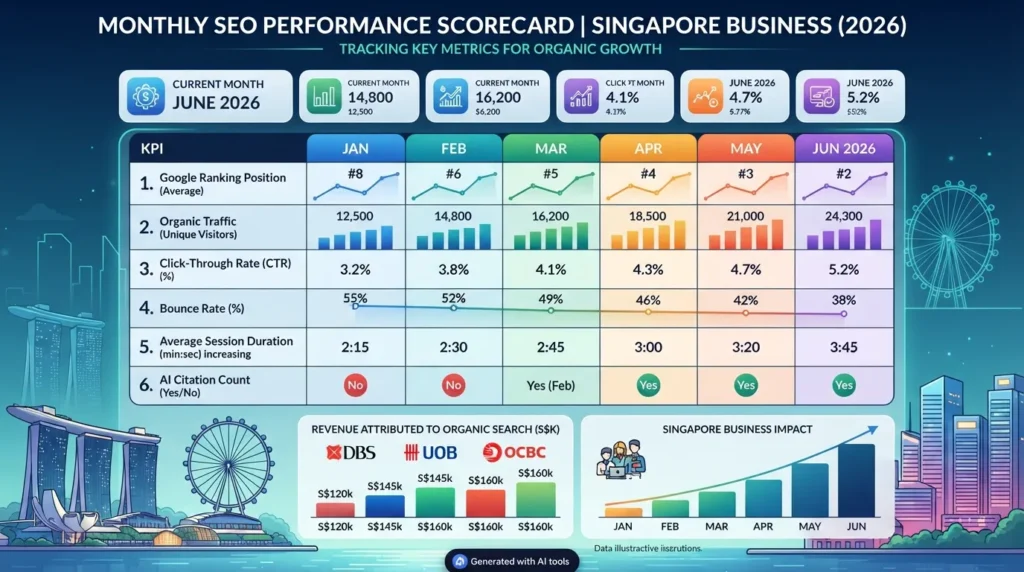
Key metrics to monitor: organic traffic volume, click-through rate from AI overviews, citation frequency in ChatGPT and Perplexity responses, Google ranking position, average session duration, and conversion attribution. Record these monthly for 3-6 months post-publication to establish a baseline.
Summary and Your Next Steps
ChatGPT is a force multiplier for SEO, not a replacement for expertise. In 2026, it excels at scaffolding, research synthesis and workflow acceleration. It does not replace original insight, accurate data or human editorial judgment, the exact factors that define what ranks.
What makes content rank in 2026 is demonstrating genuine expertise, original insight, accurate data and content that serves searchers better than existing results. ChatGPT accelerates the path to publication; professional domain knowledge and editorial rigour determine whether it ranks.
For Singapore SMEs, two distinct paths exist.
Path 1: DIY ChatGPT-Assisted SEO
Use ChatGPT to generate outlines, meta descriptions and keyword strategies. Invest in-house expertise to fill in original research, local case studies and credible sourcing. This path suits companies with established marketing and content skill. Organisations own the output, control the timeline and pay only for tool subscriptions, typically under S$50 per month for ChatGPT Pro. The trade-off: in-house teams must supply the expertise and accuracy that transforms scaffolding into rankable content.
Path 2: Specialist GEO (If Targeting AI Answers)
Engage a GEO agency for full audit, entity positioning and AI-optimised content production. Typical engagements range from S$3,500 to S$15,000 per month depending on scope and business size.
Investigate the Enterprise Singapore Market Readiness Assistance Grant. [Verify with Enterprise Singapore for current grant structure, eligible costs and support limits]. Eligibility typically includes Singapore registration, at least 30% local equity, and group revenue under S$100 million or fewer than 200 employees.
Advantages of GEO support: A correctly structured GEO programme can reduce effective client cost significantly under the grant scheme compared to the full agency rate.
The competitive advantage in 2026 belongs to businesses that use AI to move faster, but remain willing to invest human expertise where it matters: in accuracy, originality and trust.