OpenAI began testing ads in ChatGPT in February 2026 and is launching its Ads Manager Beta. The channel is small and gated, and agencies often overpromise.
Hire a ChatGPT ads agency only if it has a usable product feed, a measurable conversion goal, and enough budget to learn. Its value lies in qualification, measurement and exit criteria, not guaranteed scale.
Key Takeaways
- ChatGPT ads remain a small, gated channel, so judge an agency on qualification and measurement, not promised scale.
- Ads Manager Beta offers budgets, creative uploads and reporting, but access is limited.
- The beta requires a $200K minimum spend, which most mid-market US brands cannot meet.
- Agency fees above 20 to 25 percent of monthly spend can be disproportionate on a small test budget.
- Before hiring, confirm working conversion tracking and set a budget you can learn from.
- Score agencies on published outcomes, transparent process and written exit criteria.
Who Should Hire an Agency: Start Here
Hire an agency only when three conditions already hold. If any answer is no, please address that first, as an agency cannot manufacture a feed or a conversion signal. Early visibility into these basics saves money on paid media.
- Usable product feed, ideally above the roughly 1,000-product threshold: yes or no
- Conversion tracking is live and verified, measuring a real business outcome: yes or no
- Test budget at or above the reported $50,000 minimum: yes or no
The minimum cost to participate in the ads pilot fell from $200,000 to $50,000 when Ads Manager launched, according to eMarketer (via soku.ai). Please confirm the current threshold with OpenAI before budgeting, as the beta’s earlier minimum spend of $200K has changed.
Brands that clear all three can move on to choosing an agency. Brands that do not should run a small, in-house advertising test first to learn which search and content signals matter before committing to the best-fit partner for execution and discovery.
What a ChatGPT Ads Agency Is and Does
A ChatGPT ads agency manages paid placements inside ChatGPT, covering campaign setup, creative, bid optimisation and reporting. Search ads respond to typed keywords, and social ads to audience profiles. ChatGPT ads sit inside a conversation, so the agency must judge relevance against what a user is trying to accomplish. The best agencies treat that as a distinct discipline within paid media and build each campaign around the user’s goal in the conversation. Strong agencies also plan each ad’s content to match that conversational context.
The channel is young and offers limited reporting. An agency promising predictable scale is offering a forecast, not a track record. Brands weighing visibility gains should ask for evidence before committing to a budget.
Understanding ChatGPT Ads: formats, placement, and limited inventory
OpenAI began testing advertising inside ChatGPT in February 2026. Inventory is narrow. A brand’s ad may appear in only a fraction of relevant conversations, so the agency should explain how it will handle under-delivery before launch and set expectations early.
Product feed campaigns suit retailers. Titles, descriptions, prices and images come from the merchant’s catalogue, so feed quality largely determines ad quality. As of mid-June 2026, OpenAI opened product feed campaigns to more sellers, letting merchants upload a catalogue so titles, descriptions, prices, and images pull straight from the feed (according to soku.ai).
How ChatGPT Ads work in practice: the Ads Manager workflow

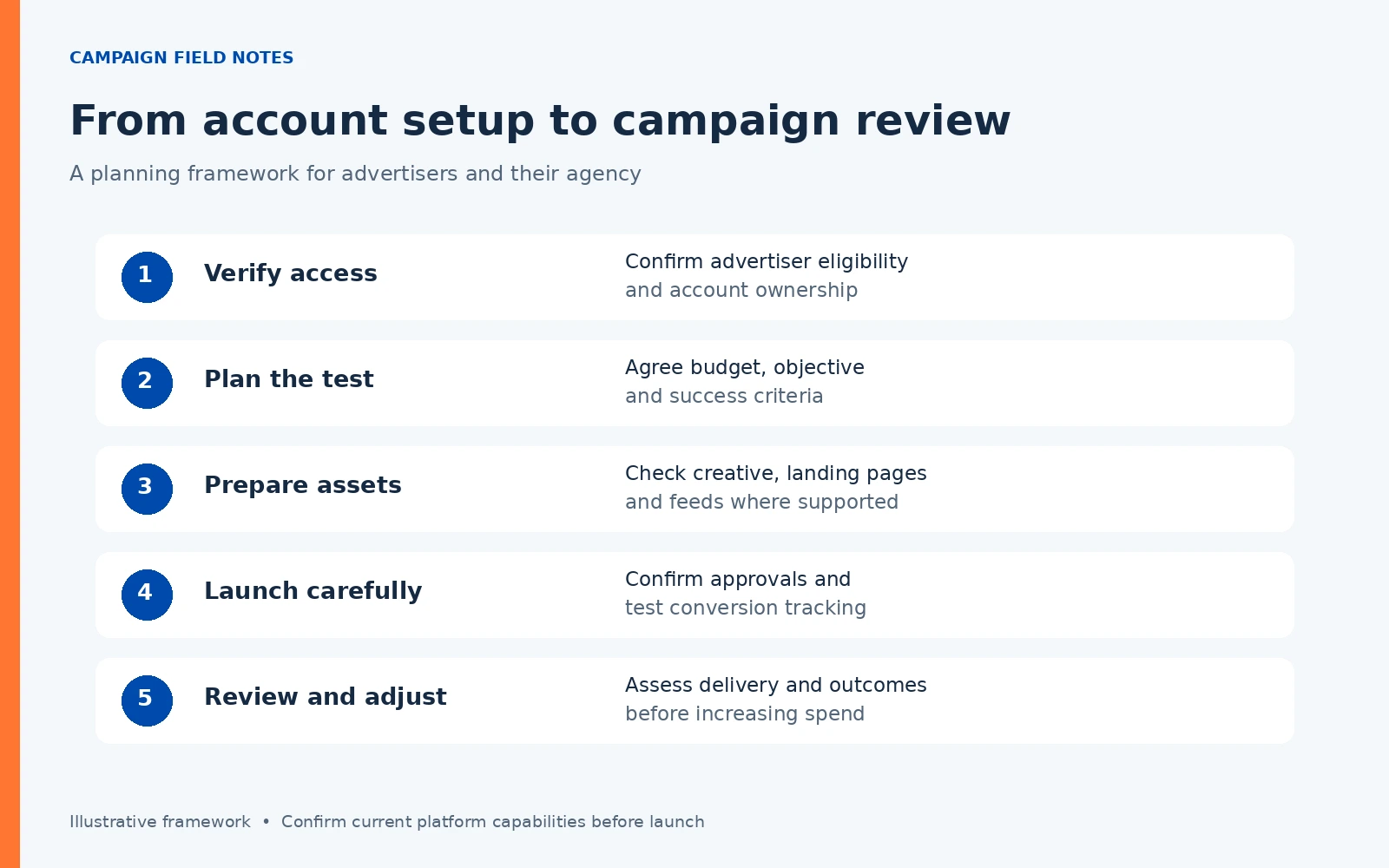
OpenAI launched its Ads Manager Beta. According to soku.ai’s account of the rollout, it lets businesses register as advertisers, set budgets and bids, upload creative, launch campaigns and read performance. The agency verifies the account, configures the budget and bidding, loads the creative and the feed, launches, and then reviews and adjusts. Execution is simplest when the feed and creative are finished before the campaign goes live.
Two limits apply. Agency access depends on the account structure, so please decide upfront who will hold admin rights. Performance data is thinner than on mature platforms, so agree on reported metrics and goals before launch. Brands that already run paid media on other platforms can compare this setup with their existing digimetrics.ai reporting to see where the data differs.
Services a ChatGPT Ads Agency Should Provide
A capable agency focuses on three areas: account and catalogue readiness, conversation-ready ad copy, and creative adapted to ChatGPT’s formats. Setup determines whether a campaign can run, so the groundwork comes first.
Campaign setup, product feed, and catalogue management
Setup is where most of the effort sits. OpenAI’s Ads Manager Beta lets businesses register as advertisers, set budgets and bids, upload creative and read performance. Product feed campaigns pull titles, descriptions, prices and images from a catalogue and can be built in bulk from one spreadsheet upload. Send full snapshots over SFTP at least daily in the approved format.
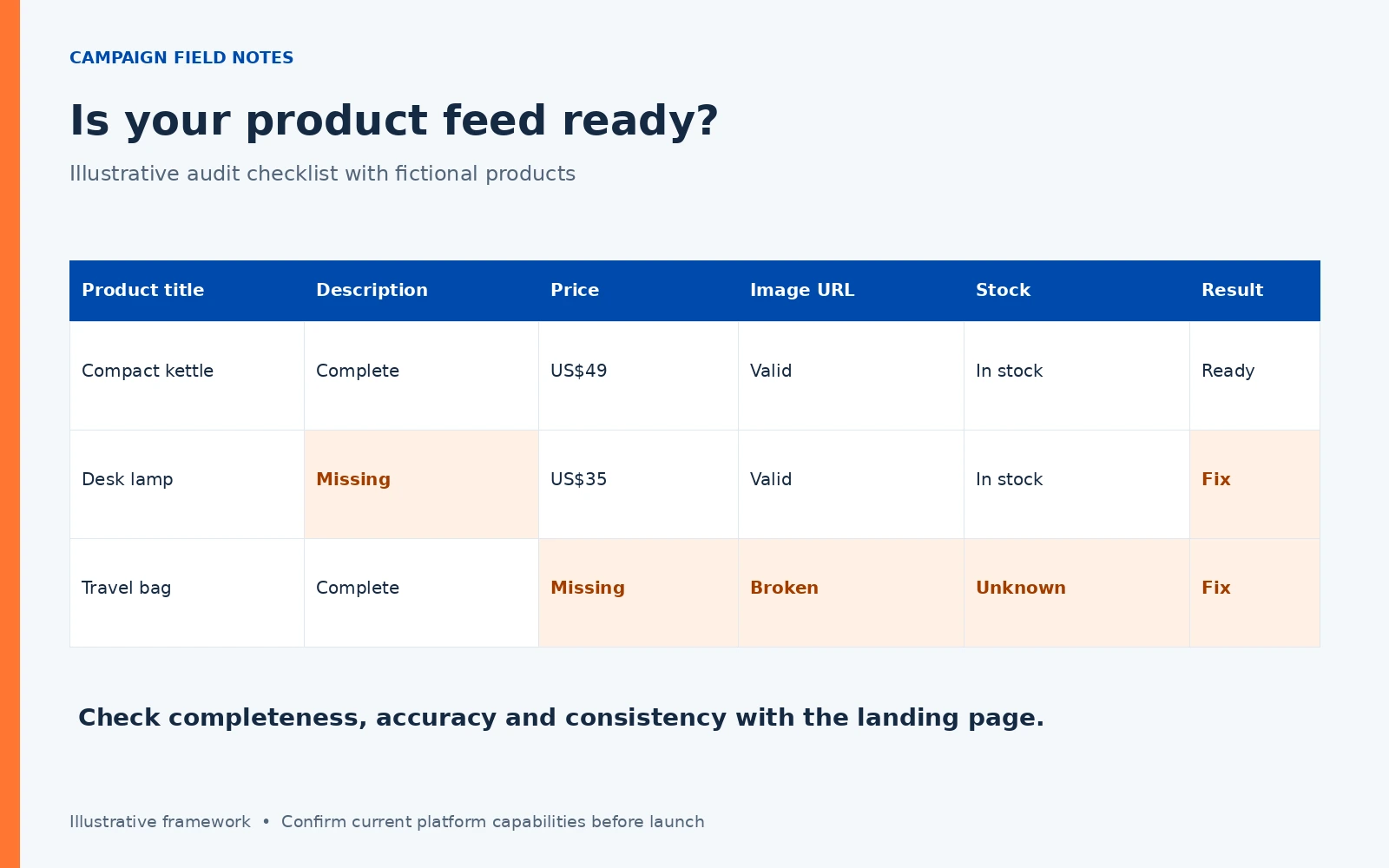
A good agency should handle:
- Auditing the feed for completeness, accurate pricing and clean titles.
- Confirming conversion tracking, so you can see whether a click became a sale.
- Setting bids and budgets against a stated goal.
- Keeping the catalogue current, since stale prices quickly erode trust.
If a brand cannot meet the feed requirements, it cannot use feed-based campaigns. A responsible agency will say so rather than sell a workaround.
Creative development and useful ad messaging
Ads inside a chat answer a question the user has already asked, so the message must be useful first and promotional second. The copy should state what the product does, for whom, and why it fits the query. Relevance drives visibility in this format, and many advertisers fall short. Strong discovery moments happen when the ad meets the user’s question directly. An agency with a sound content strategy will also ensure the copy matches the landing page, so the user doesn’t land somewhere unexpected.
A practical test: write the ad as the answer to the question the user typed. A kitchen appliance retailer answering “Which air fryer suits a small flat?” would name the capacity, footprint and price, then link to the product. A banner reading “Cook smarter today” does not answer the question.
Creative adaptation for conversational formats
Creative built for a feed or social placement does not transfer cleanly to a conversational surface. Adapt assets to a shorter, answer-led format that matches the user’s intent, and keep claims verifiable, since the surrounding text is the assistant’s own answer. Teams that have run paid social campaigns often find their best-performing assets need the most rework here. Careful execution of these adaptations keeps the creative accurate.
Running the Campaign: Workflow, Compliance, and Trust
Campaign workflow: creative, launch, optimisation, and reporting
A ChatGPT ads campaign moves through four stages. The agency’s job is to keep each one honest. Advertisers register, set budgets and bids, upload creative, launch, and monitor performance through the Ads Manager Beta, while keeping visibility into each stage’s goals. Agencies managing ads for multiple clients should keep each client’s stages separate, so one account’s results never blur into another’s.

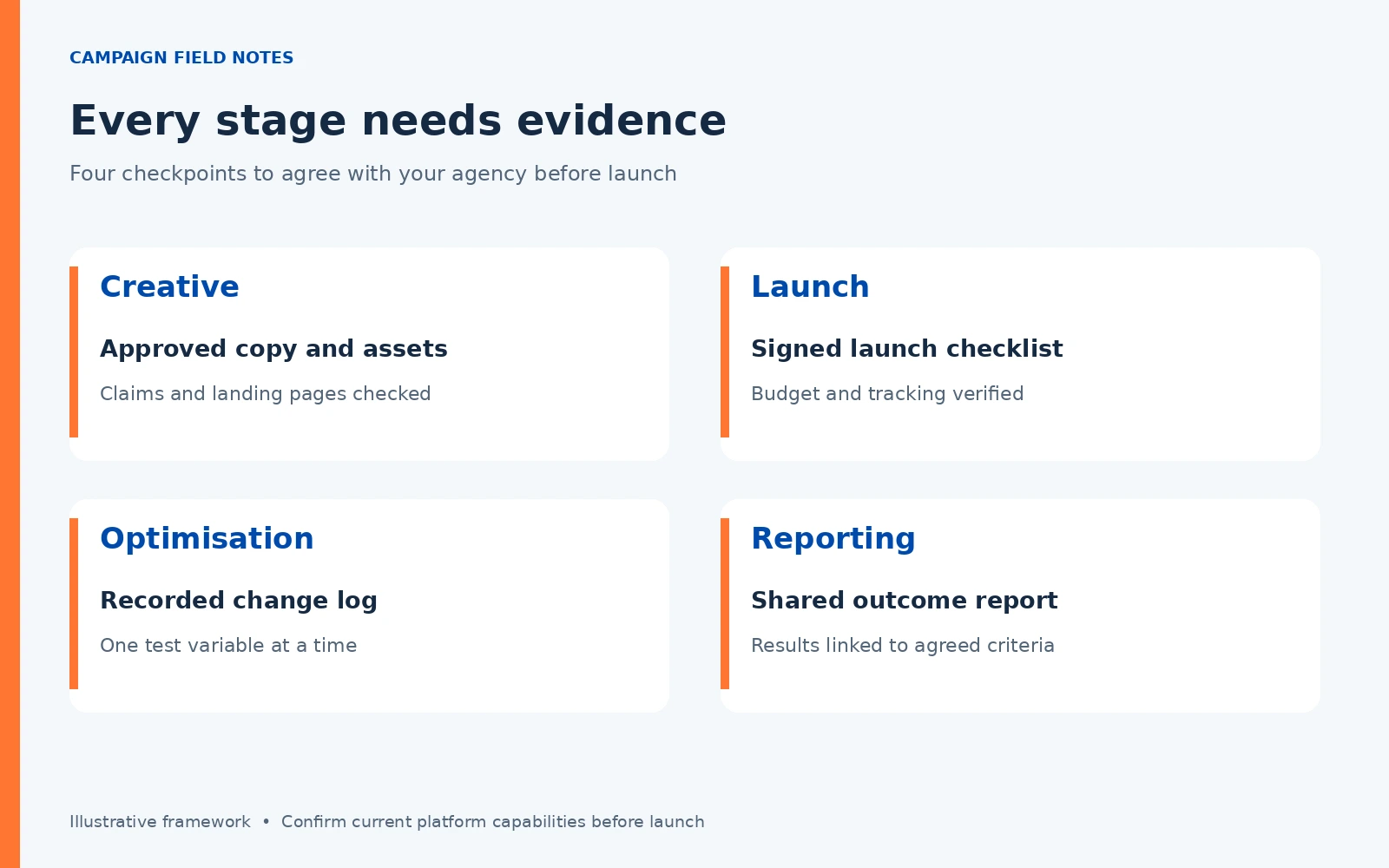
- Creative. Write messages that answer a real question in a conversation, not a rewritten banner. Before launch, check that the feed data (titles, prices, images) matches the landing page.
- Launch. Start with one campaign, one product group and a capped budget, so you can confirm tracking works before scaling.
- Optimisation. Compare delivery and cost against the agreed target. Change one variable at a time.
- Reporting. Agree the format, cadence and metrics in the contract. A report that cannot be traced back to the feed and tracking setup is unreliable.
Ask the agency to share this workflow in a document before spending the first dollar.
Clear labelling, transparency, and privacy considerations in AI advertising
Users need to know that an ad is an ad. The trust risk is larger than the media risk. OneDay Agency’s own research found that 65% of users verify information after using an AI tool. A sponsored answer that looks neutral can damage a brand quickly if users feel misled.
Ask the agency to show, in writing:
- How each ad is labelled as sponsored, and where that label appears.
- Which user data, if any, feeds targeting.
- Which claims the creative makes and who approves them before launch.
Measurement and attribution for ChatGPT ads
Confirm that conversion tracking fires on the purchase or lead event, that revenue values pass through correctly, and that a test conversion appears in reporting. If you cannot see a test conversion, you cannot judge a result.
Set the success metric in advance: one primary outcome (cost per qualified lead, cost per purchase or return on ad spend) and one guardrail metric, such as refund rate. Write the thresholds for “scale”, “hold” and “stop” into the plan.
Measurement and attribution challenges
Attribution in a conversational channel is harder than in search. Last-click reporting undercounts the channel, and multi-touch models assign credit on assumptions you cannot inspect.
Ask the agency which attribution window it uses and how it will show incrementality, meaning sales caused by the ad, such as through a holdout group of users who were not shown the ads. A dashboard screenshot with no method behind it does not prove the reported return. The best marketing agency will explain its method plainly.
Pricing a ChatGPT Ads Agency Offer
Agency fees take two common forms: a flat monthly retainer or a percentage of managed spend. Early in a campaign, a flat retainer keeps costs predictable while the agency tests the advertising strategy. A standard 10–20% of managed spend is common, and this model aligns the agency’s incentives with the client’s scale, rewarding it as budgets grow (according to soku.ai). Reddit discussion suggests totals should not exceed 20 to 25 percent of monthly spend. Treat these as observed ranges, not benchmarks.
At a $4,000 retainer and a 20% fee, costs match at $20,000 monthly spend. Below that, the percentage fee is cheaper; above it, the retainer is cheaper. On a $50,000 budget, a 20% fee is $10,000, 2.5 times the retainer. A retainer suits small tests. A percentage fee suits growing budgets only if the agency is rewarded for performance, not spend alone.
Evaluating ChatGPT Ads Marketing Agencies
Agency pitches for this channel often overlap, so evaluate each one against written evidence. A ChatGPT ads marketing agency’s value in 2026 lies in disciplined qualification, transparent measurement and clear exit criteria, not in promises of scale. Ads inventory is limited, so predictable scale cannot be guaranteed. A good partner should tell you when your brand isn’t ready and explain upfront which search and discovery signals it will track, including the user intent behind each query and how that intent maps to paid social and other advertising formats. Check whether the agency’s content and case studies match your campaign’s intent, rather than relying on a polished deck. The best way to judge that match is to ask for one complete case study showing the execution from the first query to the final result, ideally a single grain of evidence you can trace from baseline to outcome.
A weighted scoring checklist for shortlisting agencies
Start with a simple test: does each agency show evidence you can check? One published framework weights five factors: demonstrated AI visibility (25%), transparency of process (20%), proof of client outcomes (20%), AI-native specialisation (20%) and measurement with clear exit criteria (15%), as set out by Focus Digital. Use these weights, but require evidence for every row. Treat each row as a yes or no question, because a score is only as good as the proof behind it. Our digital marketing strategy services follow the same evidence-first approach, and our digital marketing services page shows how we present that evidence to clients.
| Factor | Weight | Evidence that earns a score of 1 |
|---|---|---|
| AI visibility and citation presence | 25% | Named client results you can verify, with the platform and query where the brand appears |
| Transparency of process | 20% | A written method covering timelines, assumptions and who does each task |
| Proof of client outcomes | 20% | A published case study showing the starting baseline, inputs and measured results |
| AI-native specialisation | 20% | Named staff and past work focused on conversational formats and paid placements |
| Measurement and exit criteria | 15% | Success metrics and stop conditions written before launch |
Score each row 1 if the evidence is present and 0 if it is not. Multiply each score by its weight, then total the results. Here is a worked example for two agencies:
- Agency A: Evidence is present on visibility, process, outcomes and measurement, but not on specialisation. Score: (1 × 25) + (1 × 20) + (1 × 20) + (0 × 20) + (1 × 15) = 80.
- Agency B: Evidence is present only on process and specialisation. Score: (0 × 25) + (1 × 20) + (0 × 20) + (1 × 20) + (0 × 15) = 40.
Suppose a US brand with a 1,200-SKU catalogue, above the roughly 1,000-product threshold noted by Soku, has a $50,000 test budget. Agency A charges 15% and publishes case studies with inputs and results. Agency B charges 20% with no published outcomes. The scoring favours Agency A on evidence, not on price. Some agencies will argue that a low score on specialisation is acceptable because the channel is new, but that argument is only valid if the rest of the evidence is strong.
Red flags and exit criteria to write into your contract
Watch for guaranteed outcomes, refusal to share reporting access, and fees with no link to performance. Be wary too of agencies that blur AI visibility and paid placements into a single product. AI answer visibility is not a result of paid ads.
Write these exit criteria into the contract before the spend starts:
- A review date, such as 30 or 60 days after launch.
- A conversion threshold the campaign must reach to continue.
- A rule for pausing spending if tracking is broken or unreliable.
- Data and account ownership will be returned to you on termination.
Questions to ask in the first call
- Which of these case studies can I verify, and what inputs did you use?
- What is your fee on a $50,000 test budget, and how does it interact with the minimum spend?
- Who on your team has run ChatGPT ad campaigns, and what did they deliver?
- How will you separate AI visibility work from paid placement results in your reporting?
- What would make you recommend we stop?
Conclusion
Choosing a ChatGPT ads agency in 2026 comes down to proof: can the agency show what it delivers, and can your brand supply what the channel needs? The channel is small and gated. OpenAI’s Ads Manager Beta reportedly requires a $200K minimum spend, so most clients will need to plan their paid media budgets around that threshold before engaging an agency, not after.
Score shortlisted agencies on AI visibility (25%), process transparency (20%), proof of client outcomes (20%), AI-native specialisation (20%) and measurement with exit criteria (15%).
Next steps:
- Confirm your product feed meets the roughly 1,000-product threshold.
- Verify conversion tracking is live.
- Confirm your budget meets the reported minimum.
- Shortlist agencies that publish inputs and results.
- Please include exit criteria in the contract before launch.
Frequently Asked Questions
What is a ChatGPT ads agency?
A ChatGPT ads agency plans, sets up, manages and reports on advertising inside ChatGPT. Its work covers Ads Manager workflow, product feed management, conversational creative and performance reporting. Because ChatGPT ads are a small, gated channel in 2026, disciplined qualification and transparent measurement make a good agency valuable.
Do I need an agency to run ChatGPT ads?
Not always. Ads Manager lets businesses set budgets, bids and creative directly. An agency earns its fee when your team lacks feed, tracking or testing discipline.

How much does a ChatGPT ads agency cost?
A common fee is 10–20% of managed spend, according to Soku’s guide to starting a ChatGPT ads agency. That is one vendor’s observed range. On a small test budget, ask about a fixed monthly retainer instead. Check current minimums on ads.openai.com, as reported figures may change.
How do I measure whether ChatGPT ads are working?
Set one primary conversion goal and confirm tracking before launch. Compare cost per qualified action against your baseline over a fixed test window, with exit criteria agreed in advance.
Are ChatGPT ads clearly labelled for users?
Confirm the current labelling rules directly with OpenAI, using its testing ads in ChatGPT documentation, before committing the budget.