Most dealerships in Singapore treat local SEO as a box to tick, something to hand to a web agency once and forget. That is an expensive mistake. For a showroom that depends on people driving in, local search results are where the next buyer decides which dealer to visit. This guide sets out one clear point: your Google Business Profile and the local map pack act as a revenue channel, not a marketing afterthought. It covers how ranking works, what top-performing dealers do differently, and a practical order of work you can start this quarter.
Key Takeaways
- Google Business Profile is a revenue channel. Position-one and position-ten dealers differ most in how completely their profile is built, so treat the profile as a sales asset rather than a directory listing.
- Map pack placement drives traffic. Businesses in the Google local 3-pack receive 126% more traffic and 93% more actions than those ranked positions four through ten.
- Proximity is fixed, so optimise what you control. Proximity carries about 55% of map pack weight, while Google Business Profile signals carry about 32%. Those are the levers a dealer can actually pull.
- Reviews shape both ranking and selection. 97% of consumers read reviews for local businesses, and 47% will not use a business with fewer than 20 reviews.
- Fill the automotive-specific gaps. Position-ten dealers are more likely to lack a Vehicles for Sale feed and a separate Service/Parts profile, so these are practical places to start.
- Work in priority order. Build the profile first, then reviews, then proximity-supporting signals, then on-page optimisation, and track results over 90 days.
Table of Contents
Most dealerships in Singapore still see their website as the shopfront. For many buyers, the first real look at a dealer happens on a phone, in a map pack, before anyone visits the showroom. Local search now decides which dealers get walk-in traffic, so the Google Business Profile deserves more attention than a line on a marketing checklist.
Car dealership SEO is the work of making a dealer’s business, inventory and service offering visible when someone searches for a car, a make, a model or a service nearby. For a dealer with a physical showroom, the strongest version of this is local SEO. Much of the value sits in search results that show a location, a phone number and directions, rather than in a list of blue links.
The scale of this behaviour is hard to ignore. BrightLocal reports that 97% of consumers use the internet to search for local businesses. Angarum Media’s 2026 analysis finds that 46% of all Google searches carry local intent (via webtonic.io). More than 50 percent of search queries globally come from mobile devices (searchengineland.com). A buyer at a traffic light typing “toyota dealer near me” is not comparing ten tabs. They are choosing from the three or four businesses Google puts in front of them.
The core argument of this guide is simple: for a dealer, the Google Business Profile and the local map pack function as a revenue channel. Many dealers still treat them as a box to tick once a year. The rest of this article takes the opposite view.
Car dealership SEO basics and its importance
Dealership SEO has two halves. The first is the local layer: your Google Business Profile, your reviews and your location signals. These decide whether you appear in the map pack at all. The second is the site layer: pages for specific makes, models, used stock and service. These decide whether you capture searches that go straight to your website. Local SEO matters most for a showroom business because the buyer’s next step is a visit. A dealer who ranks well organically but is absent from the map pack loses the buyer who is ready to drive over today.

Why automotive SEO is so competitive
Automotive is a crowded category. Franchise dealers in a given area chase the same high-value terms, while used-car sellers, independent workshops and online marketplaces compete for the same screen space. Because a car is a high-ticket purchase, buyers compare several options, and the map pack rewards the dealers who look most credible at a glance.
The competition shows up in the data. Several factors separate the two groups:
- Inventory feeds. Dealers missing a live Vehicles for Sale feed are over-represented at the bottom of the rankings.
- Service profiles. Dealers without a separate Service/Parts profile are also over-represented among the lower positions.
- Inventory churn. Cars sell quickly, so listings go stale unless someone removes sold vehicles and adds new stock promptly.
- Duplicate listings. Multiple sites, old profiles and franchise pages can create conflicting records that confuse both customers and ranking signals.
- Brand guidelines. Franchise brands often restrict naming, imagery and categories, which limits how far a dealer can tailor its profile. Check these rules before making changes.
A 2025 study of 2,260 automotive Google Business Profiles found that position-one and position-ten dealers differ in fixable ways. This suggests local visibility is not left to chance (webtonic.io). The next section explains how Google decides who gets those slots.
How Local Ranking Works for Car Dealers
When someone searches “car dealer near me” or “Toyota dealer Singapore”, Google does not show a list of blue links first. It shows the local pack: a box of three business listings with a map, ratings and contact buttons. Below it sits the map pack, the wider map view that can show up to 20 results depending on the query. For a dealership, these two placements decide most walk-in traffic.
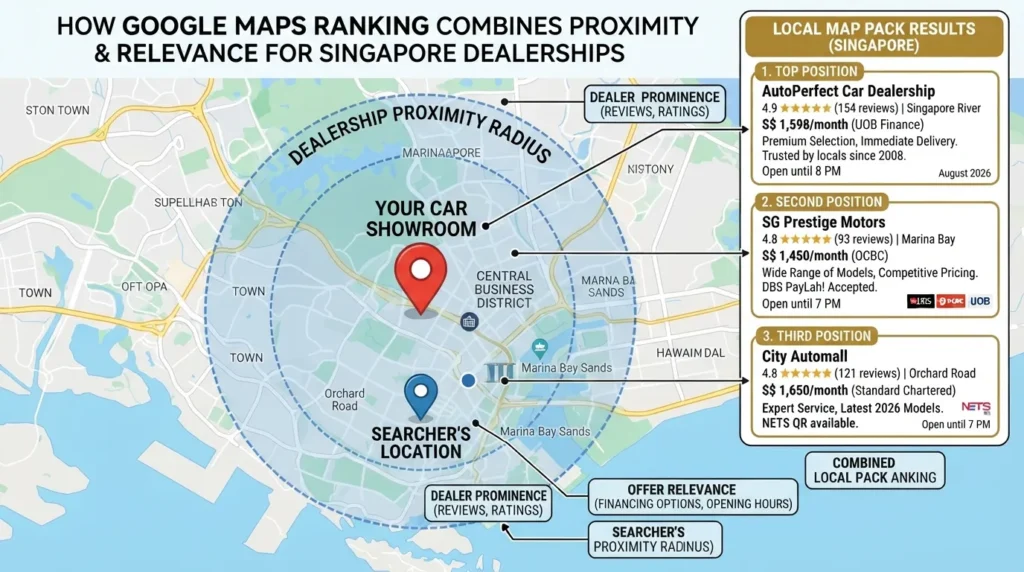
Google ranks dealers within these placements using three broad signals: proximity, prominence and relevance. Proximity is how close your showroom is to the searcher or to the location named in the query. Prominence is how well-known and trusted your business appears across the web, measured through reviews, citations and the strength of your Google Business Profile. Relevance is how closely your categories, services and listing details match what the person typed. Google’s own guidance on how local results are ranked is set out in its Business Profile help documentation.
Proximity carries the most weight. Angarum Media’s 2026 analysis puts it at about 55% of map pack ranking weight, with Google Business Profile signals at about 32% (via webtonic.io). You cannot move your showroom, so proximity is a fixed constraint. The 32% tied to your profile is where a dealer can act.
Clicks follow position. Businesses in the Google local 3-pack receive 126% more traffic and 93% more actions than those ranked positions four through ten. According to webtonic.io, 44% of local searchers click the map pack, against 29% for organic results and 19% for paid. A dealer who appears in the top three gets a disproportionate share of attention, and a dealer outside it competes for what is left.
Visible slots are limited, so the practical goal is to win one of the three pack positions for your core make and location queries. Then reinforce that position with a complete profile and steady reviews.
Optimising Your Google Business Profile for Automotive Search
Your Google Business Profile (GBP) is the most important asset in car dealer local SEO. It controls whether your dealership appears in the map pack, what details a buyer sees before calling, and which inventory and service enquiries reach you. Most dealers fill in the basics and stop there. Dealers ranking at position one go further, and the data shows where the gap sits.
Automotive-specific Google Business Profile fields
Start with your primary category. Choose the category that matches your core revenue, such as “Car dealer” or “Used car dealer”. Then add secondary categories for services you actually offer, such as “Auto repair shop” or “Car wash”. Google uses these categories to decide which searches you are eligible for, so an inaccurate category quietly limits your visibility.
Next, the Vehicles for Sale feed. This is where automotive profiles differ from most local businesses. A live inventory feed gives Google fresh, specific content tied to make, model and price. In a 2025 analysis of 2,260 automotive listings, 31% of position-ten dealers were missing this feed, compared with 13% of position-one dealers. Connect your inventory, keep it current, and remove sold vehicles promptly.
Where you run a workshop, set up a separate Service/Parts profile. A single listing that tries to represent both showroom sales and workshop bookings tends to confuse customers and ranking signals. The same study found 48% of position-ten dealers lacked a separate Service/Parts GBP, against 38% at position one. Each profile needs its own categories, hours, phone number and photos.
Building a dealership-ready profile checklist
Work through this list for each GBP you manage:
- Confirm the business name matches your signage and registration exactly, with no added keywords.
- Set a primary category for your main revenue, then add relevant secondary categories.
- Enter the full address and place the map pin on your actual showroom entrance.
- Enter separate sales and service phone numbers where you have them, and check they are answered.
- Publish accurate opening hours, including public holidays and extended service slots.
- Connect the Vehicles for Sale feed and confirm inventory updates weekly.
- Create a separate Service/Parts profile if you run a workshop, with its own categories and hours.
- Upload current photos of the showroom, forecourt, workshop and staff, refreshed at least quarterly.
- Link each profile to the correct page on your website, not the homepage by default.
- Review the profile monthly for suspended or incorrect information.
Work through the checklist once, then schedule a monthly audit. A profile that drifts out of date costs more ranking ground than most dealers expect. Keep the profile accurate and complete, and do not present any of these steps as a guaranteed ranking outcome, since Google does not guarantee placement.
Reviews, Trust and Dealership Selection
Reviews do two jobs. They help Google decide which dealerships appear in the map pack, and they help a buyer decide which dealership to visit. Most dealers treat reviews as a reputation issue. In practice they are both a ranking input and a conversion input, and both affect walk-in traffic.
Online reviews and how buyers select a dealership
Around 97% of consumers read reviews for local businesses (BrightLocal, 2026, via webtonic.io). Their habits are getting stricter. 32% only look at reviews from the last two weeks, up from 20% the prior year. Volume also matters. 47% of consumers will not use a business with fewer than 20 reviews.
The 2025 SearchLab Digital study found that position-one dealers averaged 3,386 reviews, against 1,885 for position ten. Review volume tracks with visibility, not just with trust.
Recency matters as much as volume. The BrightLocal Local Consumer Review Survey 2026 found that older reviews lose persuasive value faster than many businesses assume. A dealership with 400 reviews, most of them three years old, can look less active than one with 150 reviews collected over the last six months. The practical target is a steady monthly flow of new reviews, not a one-off push.
A review acquisition and response process
Work through this process each month:
- Ask at the right moment. Request a review within 48 hours of handover, when the buyer or service customer is most satisfied.
- Make it one tap. Send a direct Google review link by SMS or WhatsApp, not a general request to “search for us”.
- Assign ownership. One named staff member checks new reviews every week.
- Reply to every review within 48 hours. Thank positive reviewers by name and model if they mention a car or staff member.
- Respond to negatives with a fixed structure. Acknowledge the specific issue, state the corrective step, and move the detail to a direct contact. Keep customer details out of public replies, as personal data is covered by the Personal Data Protection Act (PDPA). Treat every complainant fairly, in line with the Consumers Association of Singapore (CASE) guidance on consumer complaints.
- Log patterns. If the same complaint recurs (pricing, waiting times), escalate it to the sales or service manager.
Review requests must be genuine. Do not offer incentives where they are prohibited, do not post fake or edited testimonials, and do not filter requests to exclude customers who may leave negative feedback. Breaches of Google’s review policies can lead to listings being suspended, which costs far more than a slower review count.
Keyword Research and On-Page Optimisation for Dealer Sites
Most dealers choose keywords by guessing what buyers type. A better method starts with four terms that drive dealer traffic: make, model, location and service intent. Work through them in that order.
Keyword research methodology and steps
- List your makes and models. Pull every brand and model line you sell or service. Add common misspellings and shorthand that buyers use.
- Attach a location modifier. Pair each make with “Singapore”, the estate or a nearby area, such as “used Toyota Corolla Singapore” or “Honda service Bishan”.
- Add service intent. Terms like “servicing”, “COE renewal”, “trade-in” and “test drive” show what the buyer wants to do next.
- Check volume and difficulty. Use a keyword tool to confirm which combinations have search demand and how hard they are to rank for.
- Group the list. Cluster terms that share one intent into a single target page. Do not build a separate page for every near-identical phrase.
Use this sequence to decide what goes on each page before you write any copy.
Choosing keywords and matching search intent
Search intent decides which page should rank. A buyer searching “used Honda Vezel for sale Singapore” wants a stock listing. A buyer searching “Honda service centre near me” wants opening hours, a booking form and a map. Sending both to the homepage serves neither.
| Searcher intent | Example query | Page that should answer it |
|---|---|---|
| Buy a specific car | “used Mazda 3 Singapore” | Model or inventory page |
| Compare options | “best family car Singapore” | Buying guide or comparison page |
| Book a service | “car servicing Jurong” | Service page with booking form |
| Find a location | “dealer near Woodlands” | Location page with map and hours |
Match each cluster to one of these page types. If a page cannot answer the query in its first screen, the intent is wrong for that page.
On-page SEO and optimisation checklist
Work through this list for every dealer page:
- Title tag: Include the make or model, the location and the page purpose, under about 60 characters.
- Single H1: State the page topic in plain words that match the main query.
- Subheadings: Use H2s and H3s for distinct questions a buyer asks, such as price, specifications and test drive booking.
- NAP consistency: Your business name, address and phone number must match your Google Business Profile, directory listings and footer exactly.
- Mobile performance: Over 50% of search queries globally come from mobile devices, so test load speed and tap targets on a phone before you publish.
- Local schema: Add AutoDealer or LocalBusiness structured data with address, opening hours and geo coordinates. Validate it with Google’s Rich Results Test.
- Internal links: Link inventory, service and location pages to each other with descriptive anchors. A local SEO services provider can audit these links if your site has grown without a plan.
The share of respondents who check Google reviews rose from 63% in 2020 to 81% (BrightLocal, via loganix.com). Pages that answer the intent behind a query, and that match what your profile says, are the pages that turn that search into a visit.