Key Takeaways
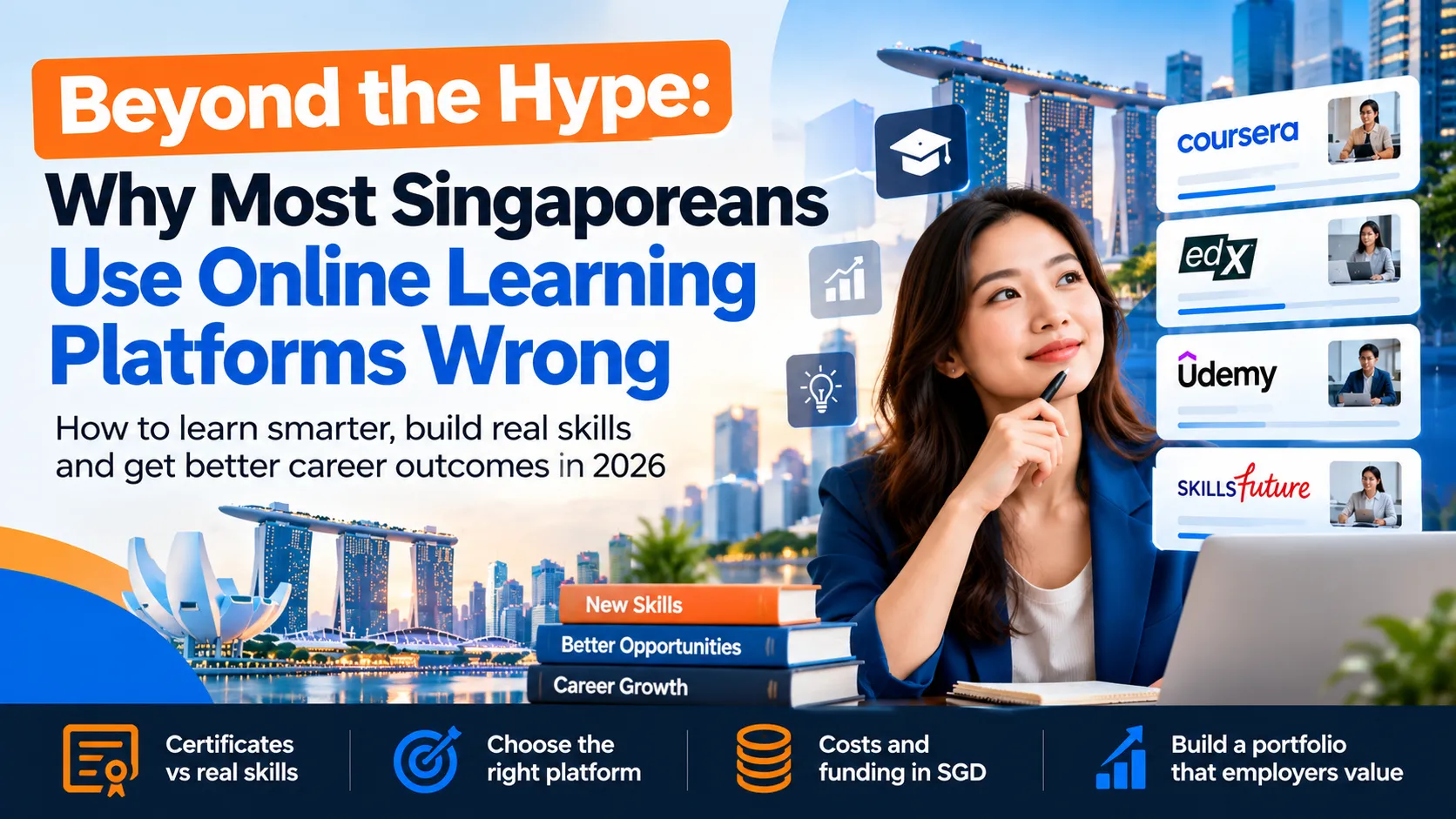
- The certificate is not the product; the portfolio is. Many employers prefer demonstrable evidence: a working project, a code repository, a case study. A PDF from a course platform proves attendance, not capability.
- Instead of focusing on the brand, choose a platform type that aligns with your goal. Government-backed programmes, such as the SkillsFuture Career Transition Programme, suit career switchers. Specific certifications from Coursera or edX (Google Cloud, AWS) suit those chasing globally recognised tech credentials. Subscription platforms suit personal interest and low-cost exploration.
- Price your outlay in SGD before you enrol. The SkillsFuture Credit base of S$500 plus the Mid-Career Enhanced Subsidy can significantly reduce course costs for eligible professionals. Verify current rates and subsidy eligibility on MySkillsFuture.gov.sg.
- Reverse-engineer your syllabus from a real job post. Pull a live role from MyCareersFuture or LinkedIn, identify the listed tools and skills, then choose one keystone certification plus cheaper building-block courses that support it.
- Cohort-based learning beats self-paced when accountability matters. If you have abandoned self-paced courses before, the higher fee for a live virtual classroom is usually cheaper than financing a third failed enrolment.
- Track outcomes, not completions. A CV line that reads “built a multi-channel attribution model in GA4, identifying 15% wasted ad spend” outperforms “completed Marketing Analytics Course”.
The Credential Trap vs. The Skills Portfolio
Many professionals complete a course on Coursera. They receive a certificate and upload it to LinkedIn. Then they wait for recruiter emails. Nothing changes.

This is the credential trap. Many Singaporeans enrol each year, expecting that certification alone will advance their careers.
In many tech and data fields, a generic certificate now carries limited weight. Employers distinguish between evidence of completion and proof of capability. The shift is fundamental: a PDF certificate signals that money was paid and time was spent, not that the person can perform the work.

Employers now value demonstrable skill: a live project in a portfolio, code on GitHub, and a case study showing how a real problem was solved using the tools learned. This reflects maturity in online learning markets. Millions of certificates now exist, making them common signals. Portfolios containing concrete, project-based evidence stand out.
This article rests on one core premise: the value of online learning platforms in Singapore has shifted from obtaining a formal credential to building a verifiable, employer-recognised skills portfolio. Chasing certificates optimises for the wrong outcome.
What This Article Covers
This piece is not a ranked list of “Top 10 Platforms”. Platform choice matters less than the strategy behind it.
Instead, this article provides:
- A framework for selecting platforms based on learning style and career goals, not marketing prominence.
- A cost-benefit analysis in Singapore dollars, including hidden fees and available government funding options.
- An overview of government support through SkillsFuture Singapore and the SkillsFuture Career Transition Programme.
- A practical, step-by-step guide to building a skills portfolio that local employers value.
This article does not rank platforms or offer generic advice like “pick what interests you.” You need strategy instead.
The Singapore Learning Landscape in 2026
Before enrolling, understand the three distinct ecosystems operating in Singapore. They serve different purposes. Confusing them is a costly error.
The Three Pillars of Online Learning
Pillar 1: Government-Backed Upskilling through SkillsFuture
SkillsFuture Singapore (SSG) underpins vocational learning in this country. It is a coordinated funding framework backed by real investment.
Every Singaporean citizen receives a SkillsFuture Credit account with S$500 at age 25, with periodic top-ups. The Mid-Career Enhanced Subsidy (MCES) for Singaporeans aged 40 and above covers eligible course fees at a subsidised rate. Subsidy rates vary by course type and provider, so check MySkillsFuture.gov.sg for your specific course.
The SkillsFuture Level-Up Programme targets mid-career Singaporeans seeking advancement or a career change. Many participants gain employer introductions through structured learning pathways. This represents coordinated upskilling with employment connections, not self-paced exploration.
The primary platform is MySkillsFuture.gov.sg, where you browse approved courses across all provider types. Start here.
Pillar 2: The Global MOOC Giants (Coursera, edX, Udemy)
These platforms provide access to globally recognised certifications and micro-credentials. They operate efficiently: sign up, pay (or use eligible SkillsFuture Credit), and learn on your schedule.
Employers recognise specific certifications from these platforms: Google Cloud certifications, AWS certifications, the Google Data Analytics Professional Certificate. Generic “Introduction to Python” certificates carry less weight. Specificity matters.
These platforms excel at scale, content quality and global recognition. They are less strong on local job placement and Singapore-specific industry pathways. Use them as a building block within a larger strategy, not as your complete solution.
Pillar 3: Niche and Local Specialists (NTUC LearningHub, Equinet Academy, Vertical Institute)
These platforms address specific local industry needs. NTUC LearningHub offers union-backed subsidies and strong content in hospitality and operations. Equinet Academy offers finance courses accredited by the Institute of Banking and Finance Singapore. Vertical Institute typically partners with Singapore employers and runs immersive, cohort-based programmes in tech, product and design.
These platforms are smaller, more expensive upfront and harder to navigate than global alternatives. They often deliver higher job-placement rates because they target the Singapore job market specifically, not a global audience.
Key Trends Reshaping 2026
Three shifts are reshaping online learning in 2026.
Micro-credentials. The shift from full-degree programmes to stackable, short courses is almost complete. A sequence of micro-credentials (AWS Certified Cloud Practitioner, then AWS Certified Solutions Architect Associate) signals expertise in a specific area without requiring a two-year degree. Employers prefer these options because they can quickly evaluate depth.
AI-Powered Personalisation. Platforms now use AI to adapt your learning path in real time. If you struggle with a concept, the system detects your difficulty and adjusts the sequence. This adaptive approach improves outcomes compared to fixed curricula. Look for platforms that mention adaptive learning, not just content recommendations.
The Hybrid Model. Pure self-paced learning is no longer standard for serious courses. Most platforms now blend self-paced modules with live, instructor-led virtual classrooms. You gain flexibility during the week and accountability during synchronous sessions. This hybrid approach reports higher completion rates than either model alone.
Choosing Your Platform: A Decision Framework
The first mistake is choosing a platform because it is famous. The second is choosing based on a friend’s recommendation. The right choice depends on your specific circumstances.
Matching Your Situation to the Right Platform Type
| Your Goal | Recommended Platform Type | Why This Works in Singapore | Example Platforms |
|---|---|---|---|
| Secure a job in tech | Industry-recognised certifications | Employers prioritise specific credentials (AWS, Google, Azure) over generic degrees. Certifications directly signal job-ready capability. | Coursera, NUS SCALE, A Cloud Guru |
| Upskill for your current role | Specialised, short courses | You need immediately applicable skills. Claim SkillsFuture Credit if eligible. Theory can wait. | Udemy, NTUC LearningHub, LinkedIn Learning |
| Change careers | Government-backed programmes | Structured pathways with career guidance matter here. The SkillsFuture Career Transition Programme is designed for this. You need coaching beyond content. | NTUC LearningHub, PSB Academy, Vertical Institute |
| Explore a personal interest | Subscription-based platforms | Low cost and low risk suit self-directed learning. Completion pressure is minimal. | Skillshare, LinkedIn Learning, MasterClass |
Pattern: your goal determines the platform type, not the platform’s brand.
Cohort-Based vs. Self-Paced: The Learning Style Test
Beyond your goal, you need to know how you learn best.
Self-paced platforms like Coursera and Udemy let you start and stop freely. You watch videos at 1.5x speed on Tuesday, skip Wednesday, and finish on Sunday. This suits people with unpredictable schedules or those with strong self-discipline.
The limitation: many self-paced courses report low completion rates. Without accountability, learners drift.
Cohort-based programmes, like Vertical Institute or General Assembly, follow fixed schedules. You attend live classes, complete group projects, and meet peers. You pay more and sacrifice flexibility. Completion rates are substantially higher because you have committed money, a fixed time slot and peer accountability.
Which suits your life? If you have erratic work hours, self-paced is necessary. Cohort-based courses typically deliver better results if you can block fixed evenings or weekends.
The Cost Equation in SGD: Fees, Funding and Your Actual Outlay
Course costs in Singapore range from S$50 (for Udemy monthly subscriptions) to S$3,000+ (for specialist cohort-based programmes). Your actual cost depends on three factors: the course fee, your eligibility for government support, and hidden add-on costs.
Government Funding: SkillsFuture Credit and Course Fee Subsidies
SkillsFuture Credit. Every Singaporean citizen receives S$500 at age 25. This credit funds approved courses across all three pillars. You do not need to repay it. Use it or lose it (credits expire, though renewal happens periodically).
Mid-Career Enhanced Subsidy (MCES). If you are a Singaporean aged 40 and above, you are eligible for subsidised courses. Subsidy rates vary by course type and provider. Check MySkillsFuture.gov.sg for the exact subsidy percentage for your chosen course.
SkillsFuture Career Transition Programme. This programme provides enhanced support, including funding top-ups, for Singaporeans who are making a deliberate career change. Eligibility criteria apply, so please confirm directly with the programme.
Typical Costs After Government Support
| Course Type | List Price (SGD) | SkillsFuture Credit Used | MCES Subsidy (if eligible) | Your Actual Cost (SGD) |
|---|---|---|---|---|
| Udemy short course | 50–150 | 0–50 | 0 | 0–150 |
| Coursera professional certificate | 200–400 | 200–400 | 0 | 0 |
| Specialist cohort-based (8 weeks) | 1,500–2,500 | 500 | 50–70% of the remainder | 300–1,000 |
| NTUC LearningHub accredited | 1,200–2,000 | 500 | 40–60% of the remainder | 200–800 |
Your actual cost may be significantly lower than the advertised price if you are eligible and you claim available support.
Hidden Costs: Subscriptions and Certificate Fees
Beyond the course fee, watch for:
- Software subscriptions. A data analytics course may require Tableau, which costs S$70–100 monthly if you do not already have it.
- Certificate verification. Some platforms charge S$30–50 to issue a verified certificate that you can share.
- Exam fees. AWS, Google and Azure certifications charge separate exam fees (typically S$100–200 per attempt).
- Capstone project costs. Some courses require third-party tools or services for the final project (cloud compute, domain names, design software).
Budget S$200–500 on top of the course fee for a serious career-focused programme.
Note: Government subsidies and eligibility criteria are subject to change. Verify current rates and your eligibility on MySkillsFuture.gov.sg before enrolling.
The Cost Equation in SGD: Fees, Funding and Your Actual Outlay
Most working professionals examine only the course fee and overlook hidden costs. Many also miss government funding that can eliminate most or all of your expenses.
Government Funding: SkillsFuture Credit and Course Fee Subsidies
SkillsFuture Credit provides S$500 for approved courses. This is real money that you can use right away.
Not all courses are eligible. Check the MySkillsFuture portal first. If a course appears there, it is claimable. Coursera courses typically qualify. Many Udemy courses do as well. Local platforms almost always are eligible.

The Mid-Career Enhanced Subsidy (MCES) is less publicised but more powerful than the SkillsFuture Credit. Singaporean professionals aged 40 or above can claim subsidies on eligible courses. Subsidy rates vary by course type and provider; check MySkillsFuture.gov.sg for your specific course. Courses offered by NTUC LearningHub, PSB Academy and many others participate in this scheme. A course listed at S$2,500 might cost you S$250 out of pocket after subsidy.
Check eligibility and the course’s subsidy status on MySkillsFuture.gov.sg before enrolling anywhere else. This single step often saves thousands.

Government subsidies and eligibility criteria are subject to change. Check MySkillsFuture.gov.sg for current rates as of 2026.
Typical Costs After Government Support
Here is what professionals typically pay after applying government funding:
| Platform Type | Listed Fee (SGD) | SkillsFuture Eligible | Your Likely Outlay |
|---|---|---|---|
| Global MOOC (Coursera) | S$80–S$150 per course | Yes, for most | S$0–S$100 (after credit) |
| Self-paced specialist (Udemy) | S$30–S$200 | Some courses | S$0–S$150 (after credit) |
| Local specialist (Vertical Institute) | S$1,200–S$2,500 | Yes, often 70%+ subsidy | S$300–S$750 (after credit and subsidy) |
| Niche B2B (finance STS courses, accounting) | S$800–S$3,000 | Yes, often 80%+ for eligible professions | S$100–S$600 (after subsidy) |
Your actual outlay is often minimal because government funding is substantial and accessible.
Hidden Costs: Subscriptions and Certificate Fees
Many platforms use a two-tier pricing model. Auditing is free, but certificates cost extra. Coursera charges S$50–S$100 per certificate. edX charges similar amounts.
Subscription costs can add up. Coursera Plus costs S$79 per month. Completing three courses over six months adds S$474. LinkedIn Learning costs S$25–S$35 monthly but offers unlimited access, which can be cheaper if you take multiple courses.
Before enrolling, calculate the total cost: course fee plus certificate fee (if separate) plus subscription (if required), minus your SkillsFuture Credit and any subsidies. Only then do you have your true outlay.
Building Your Skills Portfolio: A Five-Step Framework
This section moves from strategy to action. Most professionals skip it. Do not.
Step 1: Define Your Target Role
Avoid vague goals like “learning coding” or “moving into data science.” Vagueness leads to drift and incomplete learning.
Instead, find a real job posting for the role you want. Use MyCareersFuture.sg or LinkedIn. Copy the job description. Extract the required and preferred skills.
That list becomes your syllabus. It reflects what employers actually want, not what a platform assumes you should learn.
Example: You want a data analyst role in Singapore. You find a posting at a fintech company. Required skills are SQL, Python, Tableau, Google Analytics 4, basic statistics. That is your roadmap. You now have a concrete target, not a vague aspiration.
Step 2: Choose Your Keystone Certification
From your skill map, identify the one certification that is most valued by employers in your target industry.
For data analytics, the Google Data Analytics Professional Certificate on Coursera is widely recognised. In cloud engineering, the AWS Certified Solutions Architect Associate is the standard. In UX design, a Google UX Design Certificate and a portfolio project are highly valued.
This keystone is your main project. Everything else supports it. Focus beats breadth. Three incomplete certifications show nothing. One completed keystone certification plus a strong portfolio project demonstrates genuine competence.
Step 3: Augment with Building-Block Courses
Your keystone has prerequisites. Use cheaper, self-paced courses to build those prerequisites efficiently.
Example: You want the AWS Solutions Architect certification but are new to the cloud. First, complete an S$50 AWS fundamentals course on Udemy. This takes two weeks. Then tackle the main certification with stronger foundational knowledge.
This layered approach reduces cognitive load. You are not learning everything at once. You are building a pyramid, one level at a time.
Step 4: Document Your Project Work
Most professionals complete a course, receive their certificate, and consider the work finished. It is not.
You must create a project. It must be tangible, visible and reproducible by others.
If you are learning data analytics, please build a case study. Use public data from Google Trends, Kaggle or government sources. Analyse it. Create a Tableau dashboard or Python notebook. Write your findings. Post it on GitHub or a portfolio site.
If you are learning web development, build a small website for a real local business or non-profit. Not a tutorial project. Something actual. Put it on GitHub. Include the code and your design rationale.
If you are learning product management, write a 2,000-word case study. Analyse a Singaporean product. Explain your strategic recommendations. Post it on Medium or your personal website.
Your certificate proves attendance. Your project proves competence.
Step 5: Optimise for the Singapore Market
With your keystone certification and project complete, make them visible to Singapore employers.
On your resume, do not list your certificate alone. Include the project outcome. Instead of “Google Data Analytics Professional Certificate”, write: “Built an automated dashboard tracking SG e-commerce trends; identified a S$200k revenue opportunity through cohort analysis (GitHub link).”
On LinkedIn, link directly to your project. Tag relevant companies and industry contacts. Consider writing a brief post about what you learned. Engage with content from your target companies and peers in your field.
Use Singapore-specific terminology. If you work in fintech, reference MAS regulations, SWIFT codes, and Singapore remittance corridors. Employers notice professionals who speak their language.
Attend online webinars and industry meetups hosted by target companies. SGTech and industry groups often host free events. Visibility in your chosen community builds recognition.
Pre-Enrolment Checklist
Before committing to any course, review this checklist:
- Does this course map directly to my target job description?
- Is it claimable using my SkillsFuture Credit?
- Have I calculated the total cost, including any certificate fees or subscription costs?
- Will this course help me build a tangible project or portfolio asset?
- Does the time commitment fit realistically into my schedule for the next three months?
If any answer is “no,” reconsider the course or platform.
Measuring Success: Beyond Completion Certificates
Finishing a course and uploading a certificate to LinkedIn is not success. Your professional outcome is.
What to Track on Your CV and LinkedIn
Replace vague statements. Do not write: “Completed AWS Solutions Architect Course (2026).”
Write instead: “Designed multi-tier cloud infrastructure for SG e-commerce startup, reducing latency by 40 percent and saving S$15,000 annually in compute costs. AWS Certified Solutions Architect (Credential ID: X).”
The first is a participation record. The second is evidence of competence.
Your CV should never list a course without its outcome. The outcome is the project, the metric, and what you built or improved.
On LinkedIn, portfolio links matter more than credential lists. A GitHub profile with clear code and documentation, a Tableau Public profile with three dashboards, or a Medium page with case studies carry more weight. Recruiters click these links. They rarely verify course certificates.
Portfolio Over PDF
A PDF certificate is static. It proves you completed a course once. A portfolio is dynamic. It proves you can create, solve problems and iterate.
Portfolio platforms include GitHub for code, Behance for design, Notion for case studies, Tableau Public for dashboards and Medium for written analysis.
Choose one or two matching your field. Build a small project. Publish it. Share the link in every application and on your LinkedIn profile.
One substantial project is worth far more than ten PDF certificates.
Conclusion
The right online learning platform for you is not necessarily the most famous. It is the one aligned with your specific goal, matches your learning style, and delivers a tangible asset for your career.
Three truths about online learning in Singapore in 2026 have emerged throughout this guide:
First, credentials alone no longer advance careers. A certificate on your LinkedIn profile has no impact without evidence of application. A portfolio demonstrating real skill, built through a live project, moves careers forward.
Second, government-backed funding through SkillsFuture removes cost barriers. Whether you are early-career, mid-career switching at 40 or above, or exploring upskilling, your SkillsFuture Credit or MCES subsidy makes quality training affordable. Use it strategically, not on the first available course.
Third, the platform is a tool. Your strategy determines outcomes. The most successful learners reverse-engineer their target role, map required skills, choose one keystone certification, build supporting knowledge, and create a project that proves they can deliver results.
The decision framework here works whether you choose Coursera, NTUC LearningHub, General Assembly or a specialist provider. What differs is your commitment to project work. That is where most professionals struggle, and where your advantage lies.
Your next step is concrete: go to MySkillsFuture.gov.sg, search for a course aligned with a real job posting from MyCareersFuture.sg and enrol this week. A course you start today beats the perfect platform you will never choose.
The learning platform ecosystem is mature, affordable and proven. Your move.
Frequently Asked Questions
Do Singaporean employers recognise online course certificates?
Yes, but credibility depends heavily on the certificate’s source and what skill it proves. Globally recognised tech certifications such as AWS Solutions Architect, Google Cloud Associate and CompTIA Security+ are highly valued by employers here because they signal measurable, job-ready competency. Generic certificates from random platforms carry far less weight. What matters is whether you can demonstrate the skill in a project or interview, not the certificate alone.
Which online learning platform is best for a career switch in Singapore?
For a career switch, choose platforms offering structured pathways with local career support. NTUC LearningHub stands out because its courses often qualify for the SkillsFuture Career Transition Programme (SCTP), which pairs upskilling with job placement assistance. Coursera works for foundational knowledge, but you must add your own project work and local networking. The platform alone will not guarantee a switch; your portfolio and active job search do.
How can I use my SkillsFuture Credit in 2026?
Log into MySkillsFuture.gov.sg and search for approved courses by platform, skill or industry. Your base credit is S$500 at age 25, plus any top-ups you have received. When you enrol in an eligible course, the system deducts the credit at checkout. Not all platforms accept SkillsFuture Credit: Coursera, Udemy and NTUC LearningHub typically do, but always verify on the course page before enrolling. If you are 40 or older, check whether you qualify for the Mid-Career Enhanced Subsidy (MCES). Subsidy rates vary by course type and provider; check MySkillsFuture.gov.sg for your specific course.
What is more valuable: a university degree or an online certification?
They solve different problems. A degree gives you a broad foundation, critical thinking skills and the traditional credential employers recognise. Online certifications are best for acquiring specific, job-ready skills and proving continuous learning without a three-year time commitment. The strongest profile in 2026 combines both: a degree plus a portfolio of recent, relevant online certifications that show you are staying current in your field.
Are free online courses as effective as paid ones?
Free courses excel for exploration: they let you test whether you enjoy a topic before spending money. However, paid courses deliver more structured content, graded assessments, instructor feedback and a verifiable certificate you can add to your LinkedIn profile and resume. The paid course’s value isn’t the information, which is often available online. It is the accountability, the credential and the employer recognition that comes with completion.
What is the best way to stay motivated with online learning?
Enrol in cohort-based courses when possible: learning alongside classmates creates accountability and a deadline. More importantly, make a real project your focus, not the course itself. Build something you care about (a GitHub repository, a Tableau dashboard, a case study) and share progress on LinkedIn while you learn. Applying knowledge to a live problem is the single strongest motivator, and public commitment keeps you on track.
Can I combine multiple online certifications to build expertise?
Yes, but strategically. Stack related certifications around a single domain rather than chasing random credentials. For example, AWS Certified Cloud Practitioner, then AWS Solutions Architect Associate, then AWS Developer Associate signals deepening expertise in a specific area. Employers recognise this progression. A random collection of unrelated certificates such as one on data analytics, one on UX design and one on project management signals scattered interests, not depth. Your portfolio project should anchor all of them.
What happens if I do not complete a course I have enrolled in?
Most platforms do not penalise incomplete courses, but your SkillsFuture Credit may be treated differently by the course provider. On MySkillsFuture.gov.sg, if you abandon a claimable course partway through, you should ask the provider about credit recovery. With subscription platforms like LinkedIn Learning or Skillshare, incompletion simply means you don’t get the certificate, but you haven’t lost money beyond your monthly fee. The real cost is opportunity: each abandoned course delays your portfolio building and your career progress. That is why cohort-based courses work better if accountability is your weakness.
Do I need to disclose my online certifications to my current employer?
No legal obligation exists to disclose personal learning activities. However, transparency is often strategic. If your upskilling directly supports your current role, mention it to your manager: it signals ambition and dedication. If you are learning skills for a career pivot outside your company, discretion is reasonable. Many employees use SkillsFuture Credit to upskill for internal and external moves alike. Use your judgement based on your workplace culture and your long-term relationship with your employer.
Which Singapore government scheme offers the most financial support for learning?
The Mid-Career Enhanced Subsidy (MCES) offers significant financial support if you are eligible and aged 40 and above. The SkillsFuture Career Transition Programme (SCTP) pairs a structured learning pathway with job placement assistance, making it especially valuable for career switchers. All Singaporean citizens aged 25 and above have a base SkillsFuture Credit of S$500. Compare these schemes on MySkillsFuture.gov.sg before enrolling: eligibility and subsidy levels vary by course and your personal profile.
How do I know if a platform or course is legitimate and will actually help my career?
Three checks matter. First, is it listed on MySkillsFuture.gov.sg? If yes, it has met government quality standards. Second, does the certification appear in real job postings on MyCareersFuture or LinkedIn? If employers are asking for it, it is legitimate. Third, check employer reviews on Glassdoor or industry forums. If professionals in your target field have completed the course and landed jobs, it works. Avoid platforms with no employer recognition and no evidence of job outcomes in your field.
What is the difference between a skills portfolio and a certificate collection?
A certificate collection is proof you completed courses. A skills portfolio is evidence you can do real work. Employers prefer the latter. A portfolio includes project examples, code repositories, case studies or client work that demonstrate applied skill. Include your best course projects, professional work samples and any side projects relevant to your target role. Link them on your LinkedIn profile and mention them in your CV. When an employer asks, “Can you do this?” your portfolio answers better than any certificate.
Government subsidies and eligibility criteria are subject to change. Check MySkillsFuture.gov.sg for current rates and requirements.