Perplexity has reshaped how Singapore’s professional workforce finds answers. Unlike Google, which ranks web pages, Perplexity generates answers directly from sources and cites them inline. Your website won’t rank in the traditional sense — instead, Perplexity selects it as a credible source when answering user queries.

Most Singapore businesses and their digital agencies still focus on Google rankings while Perplexity adoption accelerates in B2B, professional services and enterprise sectors. This guide identifies five Singapore-based Perplexity optimisation agencies, explains what to evaluate, and shows you realistic timelines and costs for building visibility in AI search.
Key Takeaways
- Perplexity selects sources based on how well they answer specific claims with clarity and originality, not keyword density or backlinks.
- Budget S$3,000 to S$15,000 monthly for Perplexity-focused retainers; timeline and citation yield vary by industry and content maturity.
- Singapore’s regulatory environment (Personal Data Protection Act, MAS financial services rules) affects how Perplexity surfaces local content; choose an agency familiar with these constraints.
- Most Perplexity wins require content restructuring or new asset creation rather than keyword optimisation alone.
- Perplexity’s algorithm changes frequently. No agency can guarantee citations, but structured content and transparent monitoring reduce risk.
Table of Contents
Why Perplexity SEO Requires a Different Strategy Than Google
Perplexity uses large language models to answer queries directly without ranking traditional web pages. Your strategy must shift from click-through optimisation to citation optimisation.
Rather than building keyword-dense pages, you need to create content that Perplexity selects as a credible source. Keyword density and backlinks alone won’t surface your content. Accuracy, authoritative sourcing and structured data matter more.
How Perplexity’s Citation Model Differs from Google’s Ranking Algorithm
Perplexity selects sources inline when generating answers. Your page doesn’t rank by traditional algorithmic signals. Instead, Perplexity picks it as a credible source for a specific claim. This approach favours depth, originality and verifiable facts over volume.
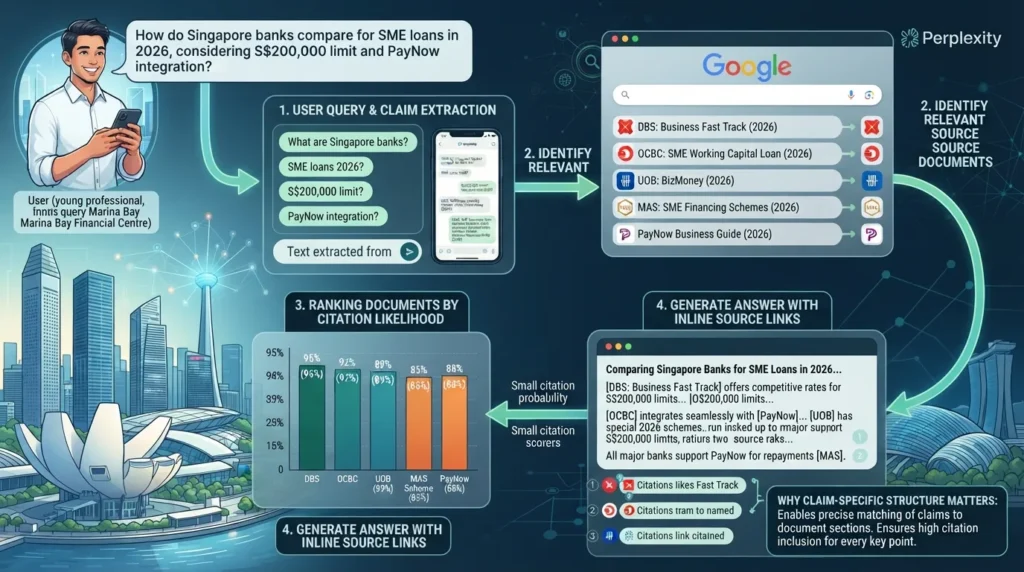
When a user asks Perplexity “What are Singapore’s PDPA compliance requirements for healthcare startups?”, the engine extracts the specific claim and selects pages that answer it with evidence and clarity. A page titled “PDPA Overview: Everything You Need to Know” may not be cited if a more focused explainer addresses the question directly. Perplexity rewards content that explains specific claims, not content that ranks broadly.
This means your content strategy shifts. Instead of building one long page to rank for multiple variations, create focused, claim-backed assets that answer specific questions with originality, data and your own citations.
Why Singapore Businesses Are Late to Perplexity Optimisation
Most Singapore SEO agencies still focus on Google’s search dominance. Perplexity adoption among Singapore users grows fastest in B2B and professional sectors: management consulting, fintech, legal technology, enterprise SaaS and regulated industries like healthcare and finance.
Early movers in these sectors gained visibility advantages. Today, the window remains open for most verticals outside technology, though competition is rising.
The 5 Best Perplexity SEO Agencies for Singapore Businesses in 2026
1. MediaOne: Specialising in AI Search Visibility for Southeast Asia
MediaOne is a Singapore-based agency specialising in Perplexity and AI search optimisation. The team understands how Perplexity selects sources and has built frameworks for identifying which content types and structures earn inclusion in Perplexity’s generated answers.
MediaOne works with local and regional B2B firms to restructure existing content and create new thought-leadership assets optimised for AI search engines. The agency’s approach includes monitoring algorithm changes and testing citation patterns to identify emerging keywords.

For Singapore clients, MediaOne embeds regulatory expertise into strategy. The team understands how the Personal Data Protection Act data-handling rules and financial services regulations affect what Perplexity cites. This prevents compliance issues.
- Key differentiators: Focus on citation likelihood over keyword volume; localised content strategy for the Singapore regulatory context; monitoring and reporting across hundreds of keywords per client.
- Best for: B2B professional services, fintech, healthcare tech and regulated sectors seeking measurable citation coverage within 12 months.
- Pricing: S$3,000–S$12,000 monthly retainer.
2. Pixel Craft Pte Ltd: Full-Stack SEO with Emerging AI Search Competency
Pixel Craft began as a traditional SEO agency and has added Perplexity optimisation to its service suite. The team brings solid technical SEO foundations and can audit your current Google visibility, then translate high-performing content into Perplexity-optimised formats.
Pixel Craft’s strength lies in managing hybrid campaigns where Google and Perplexity strategies run in parallel. However, Perplexity capability is newer, so clients engaging them for Perplexity-only work should verify dedicated resource allocation before signing.
- Key differentiators: Proven Google SEO track record; integrated Google and Perplexity reporting in a single dashboard; competitive monthly retainers.
- Best for: Businesses wanting to optimise for both Google and Perplexity simultaneously; those with established Google rankings that need translation to AI search.
- Pricing: S$3,500–S$7,000 monthly retainer.
3. Velocity Digital: AI Search Agencies Pivoting from Technical SEO
Velocity Digital repositioned from core technical SEO toward AI search visibility in 2025. The agency uses systematic processes to identify Perplexity citation opportunities and has built frameworks for scoring which content sections are most citable.
The approach is scalable and data-driven, making it suitable for larger websites with hundreds of pages. The limitation: the team relies heavily on automation and may miss nuanced, industry-specific citation patterns that require human research. Best suited to enterprises with high content volume and lower regulatory complexity.
- Key differentiators: Automated citation-opportunity scoring; high-volume content processing; systematic infrastructure for tracking citations at scale.
- Best for: Large enterprises and sites with 500+ pages; content-heavy organisations in low-regulation verticals.
- Pricing: S$5,000–S$10,000 monthly retainer.
4. Narrative Content Labs: Content-First Agency Building Perplexity Authority
Narrative Content Labs specialises in creating original, thought-leadership content explicitly designed to earn Perplexity citations. Rather than auditing existing pages, they build research-backed asset libraries from scratch.
This approach yields high citation rates for new content but requires longer timelines and higher budgets. Best suited to businesses with the budget to invest in original research, case studies and proprietary frameworks that naturally earn authority citations.
- Key differentiators: Original research and proprietary data collection; long-form thought-leadership pieces optimised for Perplexity; results tied to specific research outputs.
- Best for: Thought leaders, research-driven SaaS firms and professional services seeking to establish category authority; clients with 12+ month timelines.
- Pricing: S$8,000–S$15,000 monthly retainer.
5. SEO Haven: Boutique Specialist for Enterprise Perplexity Optimisation
SEO Haven is a boutique agency with deep expertise in Perplexity mechanics and enterprise compliance requirements. The team works exclusively with regulated sectors: fintech, healthcare, legal technology and insurance.
Their strength is regulatory precision and Perplexity citation strategy tailored to compliance-heavy content. The limitations: high retainer minimums and lengthy onboarding. Best for established enterprises; unsuitable for SMEs or non-regulated verticals.
- Key differentiators: Enterprise-only model; regulatory compliance expertise; focus on PDPA and financial services guidance.
- Best for: Large regulated enterprises requiring PDPA or financial-services-specific Perplexity optimisation.
- Pricing: S$8,000–S$15,000 monthly retainer, S$25,000+ minimum annual commitment.
Key Capabilities to Evaluate in a Perplexity SEO Agency
When vetting agencies, focus on five measurable competencies rather than general digital marketing credentials.
Perplexity-Specific Audit and Benchmarking
Ask agencies whether they’ve audited your visibility in Perplexity for your industry keywords. A strong agency will show you which search terms trigger Perplexity answers and whether your pages are cited. They’ll provide baseline metrics: citation coverage percentage, citation frequency and source diversity.
Request a sample Perplexity audit for your sector. Qualified agencies can produce a report showing 20–30 high-intent keywords and citation status for each within one week.
Content Structuring for Citation Likelihood
Perplexity favours content with clear definitions, original research, step-by-step frameworks and inline citations. Agencies should demonstrate how they’d restructure your existing assets for this format — not just “add more keywords.”
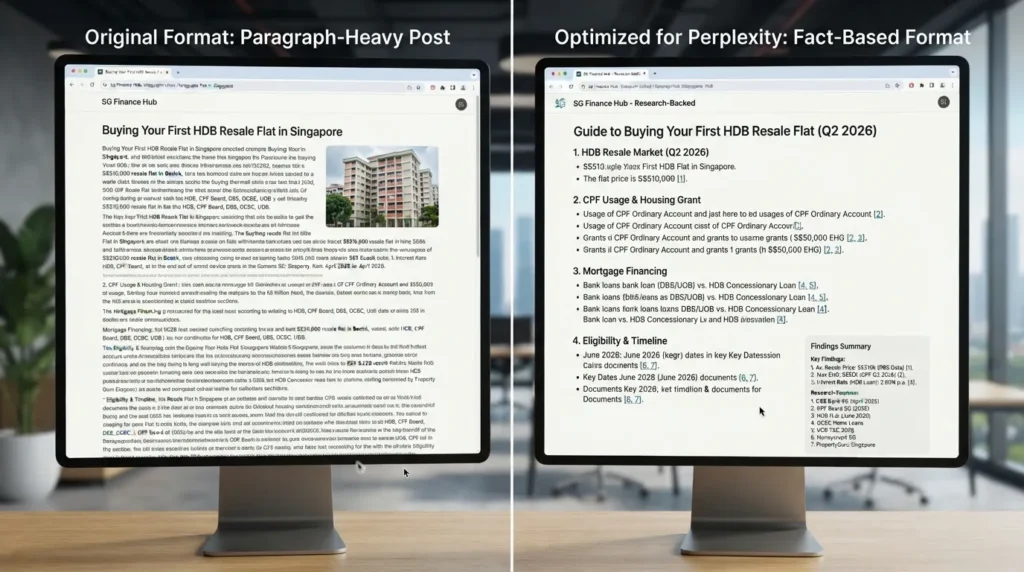
Ask for a restructuring sample: take one of your existing pages and ask the agency to show how they’d rewrite it for Perplexity citation likelihood. Strong agencies will add headers, break long paragraphs into scannable chunks, include definitions upfront and signal original research or proprietary data.
Proprietary Monitoring and Attribution
AI search engines change rapidly. Verify whether the agency uses tools to track when your pages are cited and from which queries. This is your equivalent of Google Search Console data.
Without this, you’re flying blind. Agencies should provide weekly or monthly citation reports showing which pages earned new citations, which queries triggered them, and how citation volume trended.
Local Market Knowledge
Singapore’s regulatory environment (the Personal Data Protection Act, plus regulations for financial services, healthcare and education) affects how Perplexity surfaces and cites local content. Ensure your agency understands these constraints.
Healthcare content citing patient data must comply with the PDPA. Fintech explainers must reflect current financial services guidance. Agencies unfamiliar with these rules risk recommending content that Perplexity either surfaces less frequently or avoids citing altogether.
Transparent Reporting and Realistic Expectations
Strong agencies acknowledge that Perplexity is evolving. They avoid guaranteed rankings or promised citation percentages. Instead, they offer transparent monthly reporting, explain citation trends and discuss algorithm changes that affect your performance.
Red flag: any agency promising “100% citation coverage in 90 days” or “guaranteed Perplexity visibility.” Perplexity’s algorithm is opaque, and citation timelines vary by topic, competition and content quality.
How to Compare Perplexity SEO Agencies: Decision Framework
Selecting the right Perplexity SEO agency depends on your business profile, budget and timeline. Use the comparison table and checklist below to assess shortlisted providers.
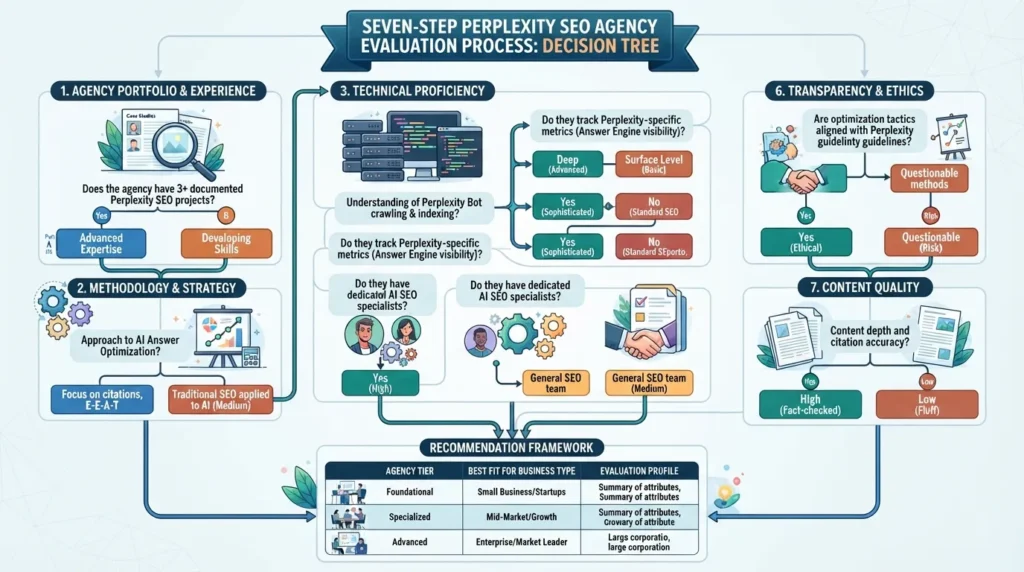
Agency Comparison Table
| Agency | Monthly Cost Range | Minimum Retainer | Citation Track Record | Best For | Contract Term |
|---|---|---|---|---|---|
| MediaOne | S$3,000–S$12,000 | S$3,000 | Verified case studies in B2B, fintech, healthcare | Regulated sectors, multi-quarter campaigns | 6–12 months |
| Pixel Craft | S$3,500–S$7,000 | S$3,500 | Strong Google SEO history, newer Perplexity cases | Hybrid Google and Perplexity campaigns | 3–12 months |
| Velocity Digital | S$5,000–S$10,000 | S$5,000 | Automation-driven, high-volume sites | Large enterprises with 500+ pages | 6–12 months |
| Narrative Content Labs | S$8,000–S$15,000 | S$8,000 | Original research and thought-leadership content | Category authority building | 12+ months |
| SEO Haven | S$8,000–S$15,000 | S$25,000 annual | Compliance-heavy regulated industries | Enterprise fintech, healthcare, legal tech | 12–24 months |
Pricing indicative as of 2026; verify with agencies directly.
How to Choose: Decision Checklist
Answer these questions before shortlisting:
- Do you need Perplexity optimisation alone, or a hybrid Google and Perplexity strategy? Pixel Craft and Velocity Digital offer integrated campaigns; choose MediaOne or Narrative Content Labs for a specialist Perplexity focus.
- Is your business in a regulated sector (fintech, healthcare, legal tech)? Prioritise MediaOne or SEO Haven for compliance expertise.
- Do you have existing high-performing content to restructure, or will you build from scratch? Pixel Craft or Velocity Digital for restructuring; Narrative Content Labs for building new assets.
- What is your total budget over 12 months? SEO Haven and Narrative Content Labs require S$96,000+; Pixel Craft and Velocity Digital S$42,000–S$120,000; MediaOne S$36,000–S$144,000.
- How quickly do you need measurable citations? Months 4–9 for restructured content; 9–12 months for new original research.
- How mature is your existing content library? With 50+ pages, restructuring is your primary need; with fewer than 20 pages, expect higher costs for new asset creation.
- What is your citation coverage goal for Year 1? Aiming for 10–20% is realistic; 40%+ requires either high domain authority or an established thought-leadership position.
- How important is monthly reporting and transparency? Enterprise retainers offer weekly dashboards; boutique agencies may provide quarterly reviews.
- What is your preferred contract length? Narrative Content Labs offers flexible terms for testing; MediaOne and Velocity Digital offer 6–12 month terms.
Evaluation Scoring Matrix
Use this matrix to score shortlisted agencies on a scale of 1–5 for each criterion:
| Evaluation Criterion | Weight | Your Score | Agency A | Agency B | Agency C |
|---|---|---|---|---|---|
| Perplexity-specific project experience (3+ live clients) | High | ||||
| Published case studies or measurable results | High | ||||
| Transparency about citation mechanics and limitations | High | ||||
| Singapore regulatory and compliance knowledge | Medium (High if regulated sector) | ||||
| Monthly monitoring and reporting capability | Medium | ||||
| Contract flexibility (no 24-month locks) | Medium | ||||
| Honest communication about timelines and uncertainty | High |
Weight transparency and regulatory knowledge most heavily for Singapore B2B contracts, especially in fintech, healthcare and legal sectors.
Agency Selection Checklist
Before signing, verify the following:
- Can the agency show you actual Perplexity audit data for your target keywords?
- Do they provide case studies from businesses in your industry?
- Can they explain their content restructuring process clearly?
- Do they track Perplexity citations separately from Google rankings?
- Will they commit to monthly content updates?
- Is the reporting transparent and easy to understand?
- Have they handled Perplexity algorithm changes for existing clients?
What to Expect in Year 1: Realistic Timelines and Deliverables
Perplexity optimisation is younger than Google SEO, and its citation timelines are different. Plan accordingly and avoid overpromising partners: plan for 12 months of structured work.
Months 1–3: Audit, Strategy and Content Baseline
Your agency conducts a deep audit of your current Perplexity visibility and benchmarks competitors. They identify 50–100 high-intent target keywords and map your existing content against each — distinguishing keywords that already trigger Perplexity answers, those answered by competitors, and those with no Perplexity coverage at all.
Deliverables:
- Perplexity optimisation roadmap with a prioritised keyword list and citation difficulty ratings
- Baseline citation report showing current visibility for 50+ target keywords
- Content audit identifying which existing pages are citable and which require rebuilding
- Competitor citation analysis showing which sources already appear in answers
Months 4–9: Content Restructuring and New Asset Creation
Your agency restructures high-priority pages to improve citation probability and creates new thought-leadership assets. Expect 20–40 existing pages restructured and 10–20 new assets created (research reports, explainers, frameworks), with 60–80% of effort directed to content quality and 20–40% to technical signals and schema markup.
Monthly deliverables:
- Restructured page templates and implementation guides
- Two to four new original research pieces, frameworks or case studies
- Citation performance reports showing which keywords are gaining traction
- Competitive monitoring updates
Months 10–12: Measurement and Iteration
Citation velocity increases as new content indexes. Your agency provides detailed reports showing which content earned citations, from which queries, and which pages drove follow-on traffic. They refine content based on performance data and test high-impact variations.
Most clients report citations for 15–30% of target keywords by month 12; established clients with 12–18 months of optimisation report 40–50%+ coverage. At this stage, most clients transition to lower-touch retainer models focused on ongoing monitoring and quarterly content updates.
Deliverables: citation performance reports, a refined content library, and recommendations for a Year 2 strategy.
Important: Perplexity’s algorithm and citation patterns change frequently, and timing and citation yield vary significantly by industry and domain authority. No agency can guarantee citations. Agencies that promise specific percentages without understanding your competitive landscape are overselling. These timelines reflect reported client experiences.
Perplexity SEO Pricing in Singapore: What to Budget
Perplexity optimisation costs are comparable to Google SEO — it is a complement, not a replacement.
Agency Retainer Models
Singapore-based agencies typically charge S$3,000 to S$15,000 monthly for Perplexity-focused retainers, depending on team size and service scope. Retainers usually include monthly audits, content updates, competitive monitoring and citation reporting. Some agencies charge hourly rates (S$150–S$400) for project-based work.
- Entry-level retainers (S$3,000–S$5,000): monthly reporting and one to two content optimisations. Suitable for SMEs or a single-vertical focus.
- Mid-market retainers (S$6,000–S$9,000): quarterly strategy reviews, four to six monthly content pieces and tooling access.
- Enterprise retainers (S$10,000–S$15,000+): dedicated account team, weekly reporting, 10+ monthly content assets and custom compliance integration.
Project-Based Pricing
- Full content audit and strategy: S$5,000–S$15,000
- Content restructuring and new asset creation: S$1,000–S$4,000 per piece for standard work, rising to S$2,000–S$8,000 per thought-leadership article where original research is involved
- Perplexity-specific technical audit (schema, site structure, crawl optimisation): S$2,000–S$5,000
Red Flags in Pricing
- Per-citation billing (e.g., S$500 per citation earned) creates misaligned incentives, prioritises quick wins over strategic value, and does not reflect the difficulty of earning citations in competitive verticals.
- Guaranteed rankings or fixed citation percentages are a sign of overselling. Perplexity’s algorithm evolves frequently, and transparency about that uncertainty is a positive signal.
- S$1,000-per-month “Perplexity SEO” offers typically involve minimal strategy and no structured monitoring — often repackaged Google SEO at a discount.
Choose transparent monthly fees with defined deliverables instead. Pricing indicative as of October 2026; verify current rates and scope directly with agencies.
Case Studies: Perplexity Wins from Singapore Agencies
B2B Professional Services Firm: From Zero to 40% Citation Coverage
A Singapore management consulting firm (12 consultants, digital transformation focus) started with zero Perplexity citations in Q1 2026. Its baseline audit found three competitors capturing 70% of Perplexity answers in the category.
Working with MediaOne, the firm restructured 30 existing service-page articles and thought-leadership pieces to emphasise original frameworks and case-study data, and created 8–15 new research-backed explainers on emerging digital transformation trends.
Within six to nine months, 20 pages earned citations for high-intent keywords such as “how to build a digital transformation roadmap” and “common pitfalls in enterprise digital adoption,” growing citation coverage from 0% to 40% of target keywords. The firm recorded a 12% increase in qualified inbound leads attributed to AI search visibility (tracked via UTM codes) and 200+ monthly referral visits from Perplexity users. It renewed for Year 2, expanding to 30 additional keywords.
Key success factor: Restructuring added concrete data, case-study snippets and numbered research frameworks that directly answered Perplexity’s generated answers.
Fintech Startup: Regulatory Content Authority
A Singapore fintech startup (Series A, embedded lending and BNPL focus) needed Perplexity citations for regulatory education content covering Monetary Authority of Singapore licensing, PDPA compliance and fraud-prevention frameworks. Working with SEO Haven, it audited and restructured 25 compliance and product explainers, structured with a clear opening definition, step-by-step compliance checklists and references to current regulator guidance.
Within four to six months, the firm earned citations for 15 regulatory keywords — including becoming a top source for “Singapore embedded lending regulations” — and drove 150+ monthly referrals. Inbound inquiries from enterprise clients researching BNPL regulation increased 28%.
Key success factor: Deep regulatory expertise allowed the agency to structure content to match Perplexity’s preference for authoritative, regulation-aware sourcing. Regulatory content became a lead-generation asset.
Key Takeaway for Strategy
Both case studies point to the same insight. The winning strategy is not “publish more content faster” — it is “reshape content to answer specific questions with verifiable evidence and original insight.”

The consulting firm earned 40% citation coverage not by adding keywords to existing pages, but by showing Perplexity that its pages answered specific consulting questions with original frameworks and measurable outcomes. The fintech startup earned regulatory citations not by compiling existing compliance information, but by interpreting regulations in ways that saved professionals time.
When evaluating agencies or planning your own Perplexity strategy, ask: “Will this content teach Perplexity users something they cannot find in official sources alone?” If the answer is no, restructure before publishing.
Common Mistakes Singapore Businesses Make with Perplexity SEO
Treating Perplexity Like Google Search
Mistake: Optimising for keyword volume and high search intent, then expecting Google rankings to transfer to Perplexity citations — or uploading existing Google-optimised content without restructuring.
Fix: Perplexity rewards claim-specific, well-sourced content over high-volume keywords. A 3,000-word buyer’s guide that ranks on Google may never be cited because it does not answer a specific query directly. Rewrite for clarity, break long sections into focused answers, add definitions upfront, and prioritise deep, original answers over keyword density.
Ignoring Citation Context
Mistake: Assuming Perplexity will cite your page because you are an authority, or creating content without understanding whether Perplexity actually generates answers for those queries.
Fix: Request a Perplexity opportunity audit from your agency and target only keywords where Perplexity currently surfaces answers. Build claims into your content explicitly. Instead of writing “Our platform reduces deployment time,” write “Automated deployment reduces infrastructure provisioning time from 4 weeks to 2 days, according to internal benchmarks across 50 client implementations.” Specificity and data increase citation likelihood.
Setting Unrealistic Timelines
Mistake: Expecting 20+ citations within 60 days, citation coverage within 30 days, or results after a single content audit.
Fix: Perplexity crawls more slowly than Google — crawl delays of 4–12 weeks are normal. Plan for six months to see consistent traction and 9–12 months for meaningful citation coverage; most agencies report citation velocity increases in months 6–9 as content matures and indexes fully. Agencies promising month-one results are not being transparent.
Focusing Only on High-Volume Keywords
Mistake: Targeting broad keywords like “Singapore fintech regulations” and ignoring long-tail questions such as “How do embedded lending rules apply to non-bank lenders under the Payment Services Act?”
Fix: Perplexity surfaces answers more frequently for specific, claim-backed questions. Start with 30–50 narrow, high-intent keywords instead of 500 broad ones — they are easier to cite and attract more qualified traffic.
Neglecting Competitor Monitoring
Mistake: Optimising content in isolation without understanding which competitors are already cited for your target queries.
Fix: Ask your agency for monthly competitive citation reports and baseline competitor citation rates, and understand the source diversity Perplexity currently prioritises for each query. If three established authorities already appear in answers for “digital transformation roadmap,” beating them requires original research or a unique angle, not better writing. Prioritise keywords where strong sources are not yet appearing.
Perplexity Algorithm Volatility and Limitations
Perplexity’s citation patterns and algorithm change frequently. No agency can guarantee that your content will be selected or cited. Citation inclusion depends on Perplexity’s crawl activity, the relevance of your content to specific queries, and factors outside any agency’s control.
Expect citations to fluctuate monthly. A page cited this month may not appear next month if Perplexity’s algorithm updates or a competitor publishes more relevant content. Reputable agencies acknowledge this uncertainty and invest in original research and content quality over guaranteed outcomes. If an agency promises fixed citation percentages or rankings, treat it as a red flag.
Frequently Asked Questions
What’s the difference between Perplexity SEO and traditional Google SEO?
Google ranks web pages based on relevance, authority and backlinks. Perplexity selects specific pages as sources when generating answers to user queries, citing them inline. Google SEO focuses on ranking visibility; Perplexity SEO focuses on citation inclusion. Google rewards comprehensive, well-linked content and page authority; Perplexity rewards clarity, original data and direct answers to specific claims. Success is measured differently too: Google uses rankings and impressions, while Perplexity uses citation count, citation frequency and referral traffic. You may see a page rank highly on Google but rarely be cited by Perplexity, or vice versa — and you can succeed in Perplexity without high domain authority if your content answers specific questions with evidence.
How long does it take to see results with Perplexity SEO?
Timeline and citation yield vary by industry and content maturity. Based on reported client timelines, some businesses see citations for 5 to 15 keywords within four to six months of consistent optimisation. Restructured content typically earns measurable citations in months 4–6; new original assets take months 9–12. Meaningful coverage (20%+ of target keywords) usually takes 12 months, and mature visibility (40%+ of target keywords) typically requires 12 to 18 months. Perplexity’s crawl is slower than Google’s — delays of 4–12 weeks are normal — so agencies promising results within 30 days are overstating its speed. Ask for case studies from businesses in your sector.
Do I need separate content for Perplexity, or can I optimise existing pages?
You can begin with existing pages, but Perplexity often favours restructured or new content. Google-optimised content frequently includes filler and broad explanations, while Perplexity prefers focused, specific answers. Successful optimisation typically involves adding original research, structured definitions, frameworks and clear source citations. Plan to rewrite 40–60% of your highest-priority pages and create new thought-leadership assets alongside them; a hybrid approach yields the fastest results. Start by auditing which of your top-performing pages are already cited by Perplexity — those are the safest to restructure.
Which Singapore industries benefit most from Perplexity SEO?
B2B and professional sectors show the fastest adoption: management consulting, fintech, legal technology, healthcare technology, enterprise SaaS, insurance and other regulated industries. These sectors reach informed audiences who use Perplexity for research and decision-making. Fintech and healthcare show particular strength because users search for regulatory guidance and compliance information on Perplexity. Consumer-facing retail and hospitality are slower to benefit, though this is changing.
How do I know if a Perplexity SEO agency is qualified?
Qualified agencies should be able to conduct a Perplexity audit, show you a sample content restructuring, explain their citation monitoring methodology, and provide case studies with measurable citation metrics (not just ranking claims). Request references from clients in your industry, and verify that they can explain Perplexity’s citation model in plain terms and understand Singapore’s regulatory landscape (PDPA, MAS rules). A red flag is any agency unable to provide specific examples of client pages it has earned citations for.
Is Perplexity SEO worth it for small businesses?
It depends on your sector and audience. Small B2B consulting, fintech or professional services firms with budget for content investment benefit quickly — if your target customer is a professional or knowledge worker who uses AI search, it is worth exploring. Smaller budgets should focus on 20 to 30 high-intent keywords rather than broad coverage; entry-level retainers start at S$3,000 per month. Return on investment improves once you reach around 25% citation coverage, which most small businesses achieve within 8 to 12 months. Small consumer-facing or local service businesses may not see sufficient Perplexity adoption to justify the cost yet.
What’s a reasonable cost per citation for Perplexity SEO work?
Avoid “cost per citation” pricing models, as they create misaligned incentives: a citation in a competitive vertical may require 40 hours of strategy and content work, while an easy one might take 10. Instead, expect S$3,000–S$15,000 monthly retainers with defined deliverables (content restructuring, new assets, monitoring), which translates to roughly S$100–S$500 per citation earned depending on industry and agency scope. Alternatively, evaluate cost per targeted keyword: divide your monthly retainer by the number of keywords you aim to track — a fair benchmark is S$100–S$400 per keyword per month, depending on keyword difficulty and restructuring required.
Can I do Perplexity SEO in-house without an agency?
Yes, if you have SEO and content expertise in-house and can produce original research and thought-leadership content consistently. You will need to test your pages in Perplexity manually, track citations, monitor competitor coverage and refine content structure. Most businesses lack dedicated Perplexity expertise, and agencies bring monitoring tools and benchmark data that are hard to replicate alone. Hybrid models are increasingly common: in-house content creation combined with agency auditing, monitoring and strategic prioritisation. For regulated sectors or B2B businesses, hiring an agency for the first 6 to 12 months to establish a repeatable framework often costs less than trial and error internally.
Does Perplexity penalise websites with lots of ads or affiliate links?
Perplexity doesn’t explicitly penalise ad-heavy or affiliate content in its publicly documented guidance. However, content with visible monetisation signals is less likely to be cited than focused, authority-first content, because Perplexity prioritises authoritative, conflict-of-interest-transparent sources. Ensure your content answers the question first and keeps commercial elements secondary, disclose affiliate relationships clearly, and comply with the Personal Data Protection Act and advertising standards to maintain credibility.
What happens if Perplexity’s algorithm changes and my citations drop?
Perplexity’s citation patterns change frequently, and drops are usually temporary. Monitor citations monthly; if they fall, audit your content for outdated information or newly competing sources, update underperforming pieces, and prioritise higher-intent keywords. When evaluating agencies, ask how they have handled past algorithm shifts for existing clients. Ongoing retainers add value here — an agency can respond to changes quickly and prevent lasting citation loss.
Should I optimise for Perplexity if my business is B2C or consumer-facing?
Perplexity’s user base skews toward B2B, professional and informed decision-maker audiences, so for most consumer brands Google remains the priority. That said, if your customers research before purchasing (consumer finance, health, education, premium fitness, luxury travel, speciality food), Perplexity visibility can add value. Test by checking whether Perplexity generates answers for 20 or more of your brand keywords. If yes, invest; if no, focus on Google first.
Can I use the same agency for Google SEO and Perplexity SEO?
Yes, provided the agency has dedicated Perplexity expertise and resources — not just Google SEO extended into Perplexity. Ask whether they track Google rankings and Perplexity citations separately, whether they have in-house Perplexity monitoring capability, and whether they adjust content strategy based on Perplexity-specific citation patterns. Some agencies rebrand Google SEO as “AI search optimisation” without understanding Perplexity’s citation model, so verify the capability exists before signing.

Domain authority helps but does not guarantee citation. It matters less than in Google search: a newer site with clear, original answers to specific questions can earn citations faster than an established authority with generic content, and a high-authority page that answers a query poorly may not be cited at all. Perplexity weighs content quality and specificity more heavily than domain metrics alone. Building baseline authority through backlinks and topical relevance still accelerates your timelines.
How often should I update my content to maintain Perplexity citations?
Monthly updates are ideal for fast-moving sectors like fintech and healthcare. Quarterly updates maintain citation stability for slow-changing topics such as management frameworks or industry overviews. Refresh non-performing content annually or when competitive citation patterns shift. Stale content loses citation velocity as newer, fresher sources publish. Most retainer agreements include two to four content updates monthly — set a quarterly reminder to audit cited pages and refresh outdated data or examples.
Is there a minimum website traffic threshold before Perplexity SEO makes sense?
No strict threshold. Even new or low-traffic sites can earn Perplexity citations if their content is clear and original: a fintech startup with 500 monthly Google visitors might see 50 to 100 referrals from Perplexity citations within six months. That said, sites generating fewer than roughly 100–500 monthly visits may not see enough Perplexity traffic to justify the cost in Year 1. If your Google traffic is low, prioritise Google SEO first and layer in Perplexity once you have baseline organic visibility to build on.
Next Steps
Request a Perplexity audit from your shortlisted agencies. A qualified partner will show actual citation data for your target keywords, not generic promises or frameworks. Use the decision framework above to score each agency’s capabilities against your specific business needs and budget.
Disclaimer: Perplexity’s algorithm, citation criteria and content selection mechanisms are not fully transparent and change frequently. No agency can guarantee citation inclusion. This guide reflects industry practices and reported client experiences as of October 2026. Pricing and capabilities information was verified with agencies in September 2026; offerings and retainer costs vary, so confirm all agency capabilities, pricing and case studies directly before engagement.