
| AI Summary
The benefits of digital marketing include wider reach, more relevant targeting, flexible budgets, customer engagement and measurable sales opportunities. Businesses gain the most when each channel supports a defined goal. Search can capture existing demand, social content can introduce a product, and email can support repeat purchases. Performance checks should connect those activities to qualified enquiries, customers and profit. |
Digital marketing helps your business reach people online, explain your offer and measure what happens next. Its value comes from connecting those activities: a customer discovers your business, finds answers and takes a step towards buying.
Your business doesn’t need every channel to benefit. The right combination depends on what customers need before they purchase and what your team can deliver consistently. The sections below explain the main benefits, compare channel options and show how to check whether your investment produces results.
Key Takeaways
- Relevant reach supports growth. Audience and location choices help campaigns reach people your business can serve, while enquiry quality shows whether that reach has commercial value.
- Budget control supports testing. Defined spending limits and complete cost records help you assess an idea before committing more money.
- Different channels serve different needs. Search captures demand, social content introduces ideas, and email supports ongoing customer relationships.
- Customer records strengthen measurement. Qualified leads, completed purchases and repeat orders reveal more than clicks or follower counts alone.
- Consistent reviews support better decisions. Reliable tracking, fair comparisons and time for sales to arrive help your team decide what to improve.
What Are the Main Benefits of Digital Marketing?
Digital marketing connects visibility, communication and sales through channels your customers already use. Those connections give businesses several ways to grow, from reaching a new audience to helping existing customers purchase again.
The scope of digital marketing includes search, websites, social media, email and paid advertising. Each contributes differently, so the benefits below include a practical way to assess its value.
1. Wider reach across relevant markets
A website or campaign can introduce your business beyond the area reached by its physical premises. That creates opportunities for an online retailer, remote service provider or business entering another region.
Reach still needs a commercial boundary. A retailer may attract visitors worldwide but only deliver to selected countries. Its campaigns should reflect those delivery limits, with product pages explaining availability before someone starts an order.
Google Ads supports geographic targeting by country, areas within a country and, where available, a radius. Google also explains that location signals are imperfect, so actual enquiry locations need checking.
A practical assessment pairs audience growth with customer relevance:
- Visitors arrive from areas the business serves.
- Enquiries concern available products or services.
- Delivery, language and support arrangements meet customer needs.
- Sales from the new market justify the work involved.
2. More relevant audience targeting
Digital marketing gives businesses several ways to connect a message with a customer’s current needs. A search query can reveal an immediate problem, while a newsletter preference can show interest in a product category.
For example, someone searching for “commercial freezer repair” has a different need from someone watching kitchen renovation videos. The repair company can address the urgent fault through search advertising and explain maintenance through educational content.
That distinction starts with the words customers use. Thorough keyword research helps connect their questions to pages that answer them.
Targeting quality becomes visible after the click. Relevant visitors should understand the offer and be able to take the next step. A campaign attracting unsuitable enquiries needs a review of its message, audience settings or landing page.
3. More control over spending
Digital campaigns let you assign budgets to individual activities and change future spending as evidence develops. That helps a business test an offer without funding every channel at once.
The full cost includes more than advertising. Content production, software, staff time and outside support all affect whether a campaign is affordable. A low advertising bill can still produce an expensive customer when those costs are omitted.
Platform rules also affect cash flow. Google’s budget documentation explains that an average daily budget can produce higher spending on individual days. For most campaigns, daily charges can reach twice that average, subject to applicable limits.
Budget control works best when your team agrees on:
- The total amount available for the test.
- The costs included in performance reports.
- The result the campaign should produce.
- The evidence needed before spending increases.
4. Stronger brand familiarity and credibility
Repeated exposure can help customers recognise a business when a need arises. Recognition becomes more valuable when the content also answers questions, explains products and demonstrates relevant experience.
A furniture retailer, for instance, might explain fabric care, show accurate product dimensions and publish delivery details. Those answers help customers assess a purchase while giving the business a consistent presence.
A connected content marketing programme builds those explanations around customer needs. Product demonstrations, service details and genuine customer feedback can then support the buying decision.
Credibility also depends on how the business handles concerns. Consistent online reputation management connects public responses with service improvements.
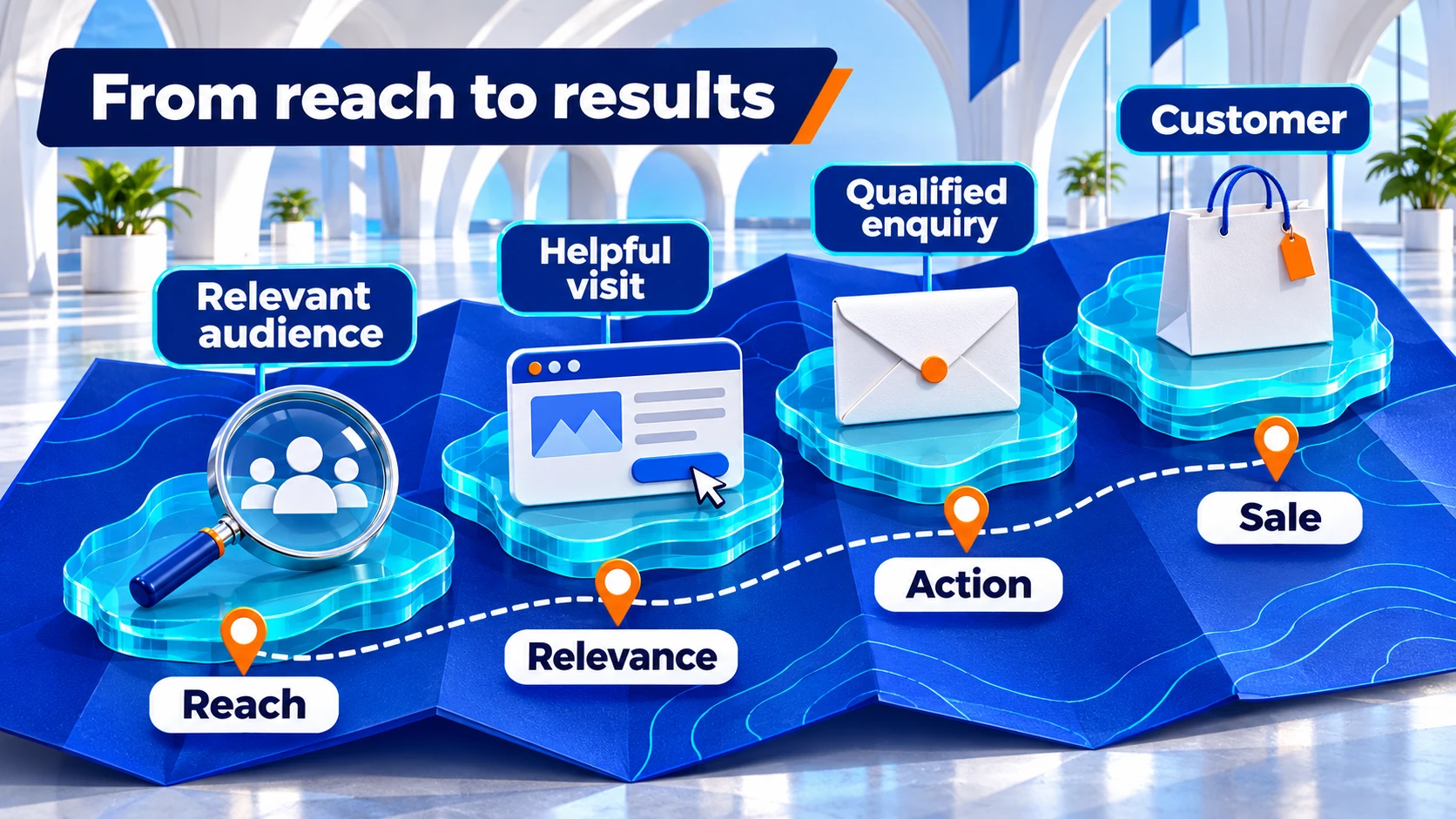
Branded searches, relevant return visits and customer feedback can help assess progress, although none proves trust by itself. The relationship between these benefits becomes easier to assess when each has a business outcome.
5. Faster customer conversations
Social comments, website messages and email replies give customers a way to ask questions while considering an offer. A timely answer can remove a practical barrier, such as uncertainty about size, delivery or service coverage.
The conversation also reveals what your content needs to explain. Repeated questions about setup may justify a demonstration video, while frequent delivery questions may indicate missing information on product pages.
An organised social media marketing programme connects publishing with those responses. Someone needs responsibility for checking messages and passing service issues to the appropriate team.
Useful measures include response time, unresolved enquiries and the proportion of conversations that lead to a relevant next step. Engagement has greater value when customers receive answers they can act on.
6. More relevant follow-up and repeat purchases
Customers often need several interactions before purchasing. Digital follow-up can continue the conversation with information connected to what they requested or bought.
A software prospect who requests a demonstration may need implementation details next. An existing customer may need training or renewal information. Those messages serve different needs, even though they concern the same product.
The email marketing lifecycle helps organise communication around those stages. Preferences and appropriate permissions should guide the sequence, with an easy way to stop unwanted messages.
Delivery also needs technical care. Gmail’s sender guidelines cover authentication and sending practices intended to reduce blocking and spam problems. Clicks, replies, repeat orders and unsubscribes then help assess whether recipients value the communication.
7. Better opportunities to test creative ideas
Digital channels allow businesses to compare different explanations of the same offer. A demonstration might answer customer questions better than a product photograph, while a revised headline might attract more relevant visitors.
A useful comparison begins with one question. A storage brand could test whether showing a cupboard before and after installation produces more product enquiries than showing the storage unit alone.
The test needs consistent conditions:
- One main change, such as the opening image.
- Comparable audiences and offers.
- A defined outcome, such as qualified enquiries.
- Enough activity to assess the difference.
Google’s experiment reporting supports comparisons between campaign versions and shows when data is insufficient. A promising result gives your team an approach to examine further.
8. Content that can continue supporting sales
An accurate buying guide or service page can help customers after its initial publication. That gives a business material it can improve, share through email and use to answer recurring sales questions.
Search engine optimisation, or SEO, helps make that material accessible and understandable to search engines. Its value depends on sustained relevance, website condition and competition.
Google’s SEO hiring guidance says benefits typically begin appearing four months to a year after changes start. That is a planning reference, not a promised deadline.
Long-term content still needs maintenance:
- Product details and examples need checking.
- Older pages may need new answers.
- Broken links need replacing.
- Pages attracting visitors need a sensible next step.
Performance reviews should connect that work with relevant visits, enquiries and sales over time.
How Do You Choose the Right Digital Marketing Channels?
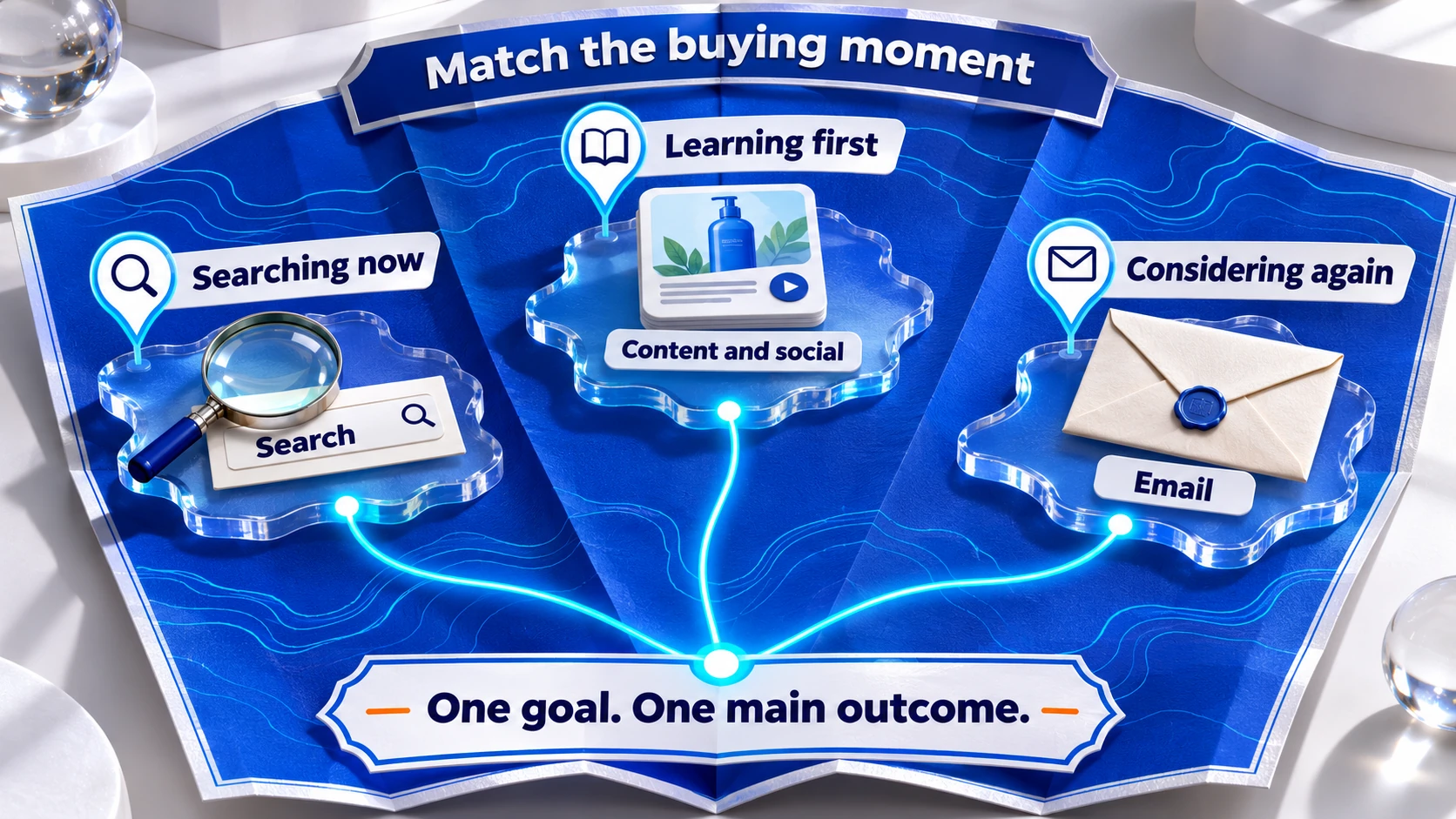
Channel selection begins with the customer’s buying situation. A person seeking an emergency repair needs immediate information, while someone considering new business software may need months of research and discussion.
Your campaign goal should reflect that situation. “More qualified demonstration requests” gives the team a stronger basis for choosing channels than “more online activity”.
Match the channel to the buying need
The comparison below shows common starting points. Each needs checking against your audience, sales process and available resources.
| Customer need | Channel to consider | Main benefit | Outcome to assess |
| An answer to an immediate search | Search advertising | Access to existing demand | Qualified enquiries or purchases |
| Help researching a problem | SEO and educational content | Discovery and explanation | Relevant visits leading to action |
| An introduction to an unfamiliar product | Social content or video | Awareness and demonstration | Engaged visits and later enquiries |
| More information after initial interest | Continued communication | Replies, bookings or purchases | |
| Support after buying | Email and customer content | Product use and retention | Repeat purchases and renewals |
A business using Google Ads can assess which searches produce commercial interest. Those findings may also reveal questions its website should answer.
Some businesses need two channels working together. An equipment supplier might use search to attract buyers, then email to answer questions during a longer purchasing process.
Check whether the business can support the channel
Channel potential means little if the team cannot produce the content or handle the response. A video campaign needs production capacity, while a lead campaign needs someone to contact suitable prospects.
The decision therefore includes a few practical checks:
- Customer access: Evidence shows the audience uses the channel.
- Content capacity: The team can produce appropriate material.
- Sales support: Enquiries can receive timely attention.
- Measurement: Results can connect to customer records.
- Economics: Likely customer value supports the acquisition cost.
A channel meeting those conditions offers a reasonable starting point. The first campaign can then test the remaining uncertainty. The same decision can be shown through three customer situations.
How Do You Measure the Benefits of Digital Marketing?
Measurement begins by defining the action your business wants. A visit, enquiry and sale represent different stages, so reports should show how people move between them.
For a service business, that sequence might run from a website visit to an enquiry, then a qualified appointment and a customer. Connecting those stages helps reveal where performance needs attention.
Choose metrics that connect to the goal
Each metric should answer a business question. Cost per lead shows acquisition expense, but lead quality explains whether those contacts have buying potential.
| Metric | Calculation or meaning | Question it answers |
| Conversion rate | Desired actions divided by relevant visits or clicks, multiplied by 100 | Are visitors taking the intended step? |
| Cost per lead | Campaign cost divided by leads | What does each enquiry cost? |
| Cost per qualified lead | Campaign cost divided by leads meeting agreed criteria | What does a suitable prospect cost? |
| Customer acquisition cost | Defined acquisition costs divided by new customers | What does winning a customer cost? |
| Return on ad spend | Attributed revenue divided by advertising spend | How much revenue is credited to each advertising dollar? |
| Marketing return on investment | Attributable contribution profit minus marketing cost, divided by marketing cost | Does the contribution cover marketing costs? |
Reports need consistent definitions. A conversion rate based on clicks cannot be compared directly with one based on website sessions without explaining the difference.
Connect website actions with sales records
Analytics can record online actions, while customer records show what happened afterwards. A customer relationship management system, or CRM, can connect an enquiry with qualification, sales activity and the final outcome.
A manageable setup includes:
- Defined purchase, booking and enquiry events.
- Test submissions to check that tracking works.
- A record of the source associated with each lead.
- Agreed rules for qualifying enquiries.
- Regular checks against completed sales and revenue.
A planned lead generation process connects campaign activity with that sales follow-up. Without it, marketing may keep attracting contacts that the business cannot convert.
Website experience deserves attention too. Accessible website design helps visitors understand the offer and complete the intended action, making the campaign’s response easier to assess.
Account for attribution and missing information
Customers may encounter several channels before buying. Attribution assigns credit to those interactions according to a model, which affects how results appear in reports.
Google Analytics provides attribution settings that influence how credit is allocated. Those reports support analysis, but they do not prove every credited sale happened because of marketing.
Some activity will also be incomplete. Google’s reporting identity documentation explains how available identifiers and modelling affect measurement across devices.
Your assessment should therefore combine:
- Advertising and website reports.
- CRM records and completed orders.
- Customer explanations of how they found the business.
- Changes in total sales and contribution profit.
Those sources provide different views of performance, so differences between them need investigation.
Use a worked example to separate revenue from profit
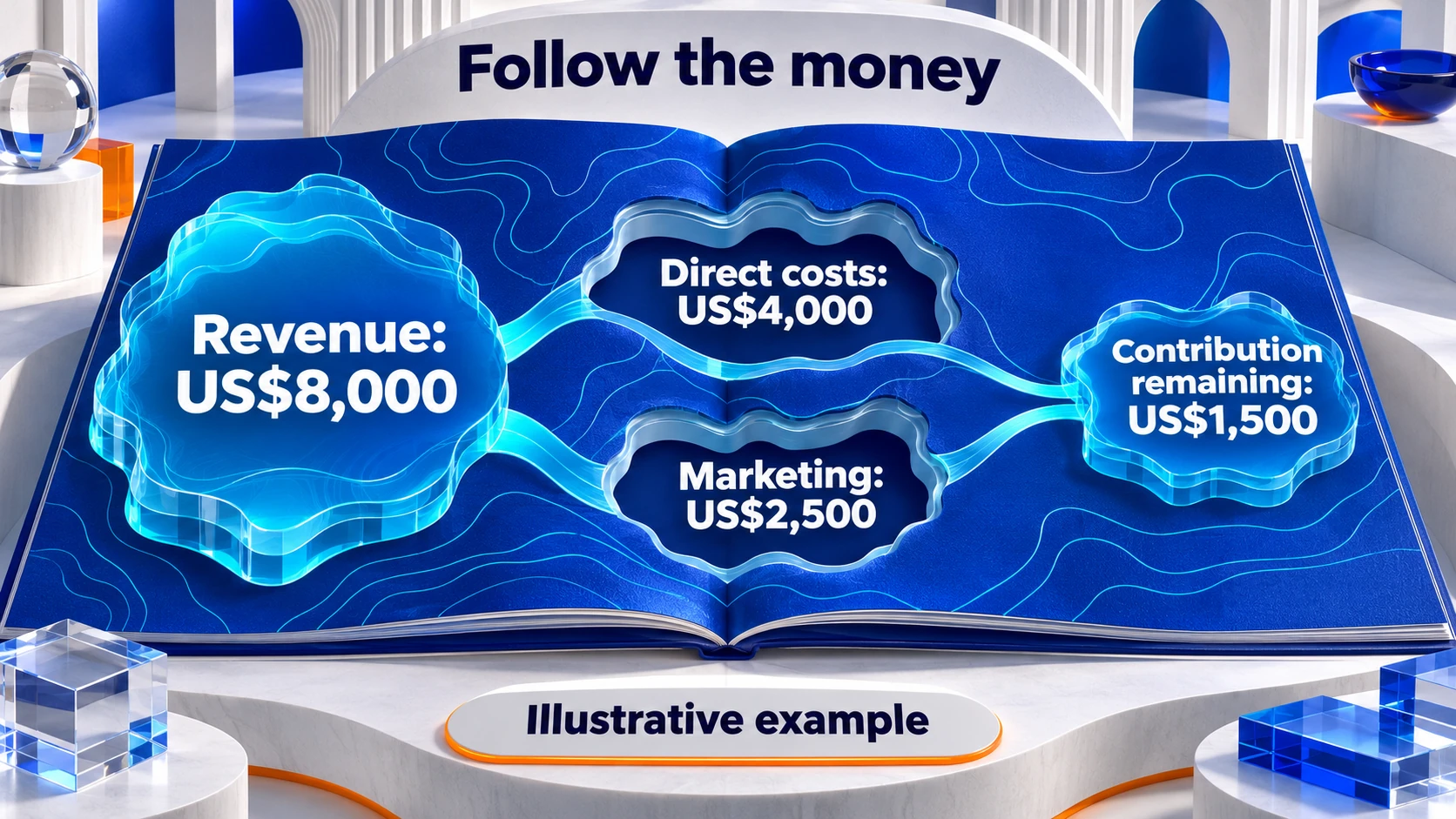
Suppose a retailer spends US$2,000 on advertising and US$500 on campaign production and management. The campaign receives credit for 40 orders worth US$200 each.
The example assumes US$100 in direct costs per order. Its figures illustrate the calculation and are not a performance benchmark.
| Measure | Calculation | Result |
| Attributed revenue | 40 × US$200 | US$8,000 |
| Advertising cost per order | US$2,000 ÷ 40 | US$50 |
| Return on ad spend | US8,000÷US2,000 | 4× |
| Contribution before marketing | US8,000-US4,000 | US$4,000 |
| Contribution after marketing | US4,000-US2,500 | US$1,500 |
| Marketing ROI | US1,500÷US2,500 × 100 | 60% |
The campaign leaves US$1,500 after the stated direct and marketing costs. Other overheads, refunds and tax may still affect business profit. The distinction helps your team assess whether revenue growth produces a financial gain.
How Do You Improve Results Over Time?
A review should end with a decision the team can explain. That decision may concern the audience, offer, page or follow-up, depending on where customers stop progressing.
Frequent changes can make causes harder to identify. A defined review process gives the campaign time to produce evidence while keeping spending under supervision.
Allow time for customers to buy
Some customers purchase immediately; others need approval, comparison or a sales conversation. Recent reports may therefore include advertising costs before the related sales arrive.
Google describes this as conversion delay. Comparing incomplete recent results with older, settled periods can make performance appear weaker than it is.
Your review schedule should follow the buying process:
- Technical checks can happen soon after launch.
- Spending and enquiry quality need regular monitoring.
- Sales performance needs enough time for enquiries to close.
- SEO and retention need longer trend reviews.
No single weekly or monthly schedule serves every campaign.
Locate the problem before changing the budget
The customer sequence helps narrow the investigation. A campaign with clicks and no enquiries presents a different problem from one with suitable leads and few completed sales.
| Pattern | First area to investigate |
| Few relevant visits | Audience, search demand and message |
| Visits but few enquiries | Offer, page content and form experience |
| Many unsuitable enquiries | Targeting and qualification information |
| Suitable leads but few sales | Follow-up, pricing and customer objections |
| Sales with weak contribution | Margins, discounts and acquisition costs |
A focused change gives the next review a purpose. The team can assess whether the suspected cause improved instead of reviewing several simultaneous edits.
Increase spending when the business can support growth
A successful small campaign provides a reason to test more spending. Additional reach can involve different audiences and higher acquisition costs, so the next budget level needs its own assessment.
Sales and service capacity also need checking before demand increases. A business that cannot answer enquiries or fulfil orders may lose the benefit of stronger campaign performance.
A sensible expansion decision considers:
- Stable enquiry quality.
- Acceptable acquisition costs.
- Sufficient contribution per sale.
- Available sales and delivery capacity.
The next increase can then test whether those conditions continue at a larger scale.
Turn the Benefits of Digital Marketing Into Business Results
The benefits of digital marketing become valuable when relevant reach leads to informed customers, qualified enquiries and profitable sales. Channel choices, customer follow-up and consistent measurement help your business understand which activities deserve continued investment.
At MediaOne, we connect SEO, paid advertising, content and customer acquisition around business goals. Our digital marketing consultation gives us a starting point to discuss your audience, current results and the outcomes your next campaign needs to achieve.
Frequently Asked Questions
Can digital marketing support a business that sells mainly offline?
Digital campaigns can promote store visits, telephone enquiries and appointments. Measurement can include booking records, appropriately configured call tracking or campaign-specific offers. Staff should record resulting sales consistently so the business can assess whether online activity contributes to purchases made elsewhere.
A daily schedule is unnecessary unless the audience and content justify it. A sustainable schedule gives the team time to produce relevant posts and answer responses. Publishing frequency should follow the channel’s performance and the business’s capacity, with content quality and customer needs guiding the decision.
Can a business start without a paid advertising budget?
A business can begin with its website, search visibility, organic social content and permission-based email. These activities still require time, skills and maintenance. The starting priority should address an existing customer need, such as missing service information or unanswered product questions, with results reviewed as activity develops.
How can digital marketing support a product launch?
A launch can use customer research to identify questions, then prepare demonstrations, product information and a waiting list. Early responses help test whether people understand the offer. After release, campaign reports and customer feedback help identify concerns that product pages, support materials or later messages should address.
Can customer questions improve products as well as marketing?
Repeated questions can reveal problems with packaging, instructions, delivery options or the product itself. Marketing teams should pass those patterns to the people responsible for the service or product. Customer feedback then supports a practical improvement, whose effect can be checked through later enquiries, complaints and returns.