Many B2B marketing teams in Singapore measure the wrong things. They count leads and engagement, then wonder why revenue barely moves. The gap often comes down to cost.
A programme can look strong on attributed revenue and still leave little after it covers its own expenses. This guide explains how B2B marketing works and why the buying group matters. It covers strategy, channels that earn trust, and judging whether a programme pays back, with a worked example in S$. Every figure in that example is illustrative, so test it against your data.
Key Takeaways
- Judge ABM by net contribution, not pipeline. In the worked example, S$30,000 attributed revenue leaves only S$2,000 after S$28,000 in costs.
- Map the whole buying group. A 6sense B2B Buyer Experience Report found the typical B2B buying team includes 11 people, so one contact covers only part of the decision.
- Give every target account one owner. Usually a sales or account management lead.
- Score accounts on defined criteria. Rate each factor from 1 to 5.
- Run the contribution test before scaling. Keep only accounts and tactics that are profitable after all costs.
What B2B Marketing Is and Why the Buying Group Changes Everything
B2B marketing is the work of attracting, convincing and retaining business customers rather than individual consumers. In Singapore, it means building a case that many people in one company can accept. Success shows up when the right accounts engage and move toward purchase.
How B2B buying differs from consumer buying
A consumer usually buys alone, often within days. A B2B purchase may involve a budget holder, a technical evaluator, a finance approver and a senior sponsor. It can take months to close.
The cost of a wrong decision lands on the whole organisation. So each stakeholder looks for reasons to slow down or say no.
Consumer marketing often aims to trigger a single impulse. B2B marketing builds a case that survives several rounds of internal scrutiny. Each person needs evidence to defend their own choice to their boss.
Measure success by whether the right accounts move toward a commercial decision. Enquiry volume from the wrong companies tells you little. Strong return on investment comes from pursuing accounts that fit your brand positioning, not from chasing every lead.
The role of the buying group
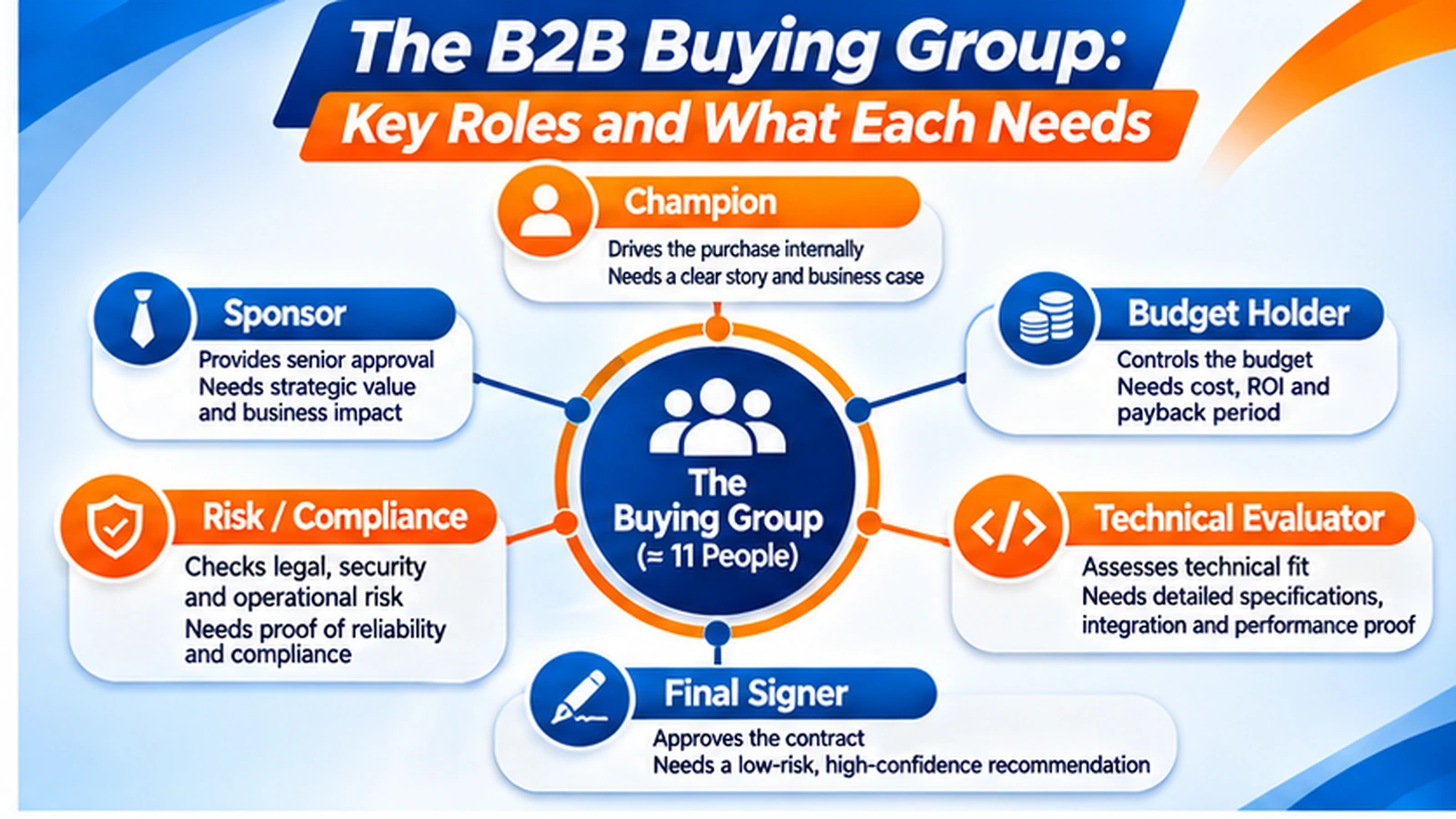
The unit of purchase in B2B is the buying group, not the individual contact. A 6sense B2B Buyer Experience Report found the typical buying team includes 11 people, so a campaign aimed only at the named contact reaches perhaps one of them. Buying groups vary by deal type, and the figure reflects the research sample, not every deal. Treat it as a planning guide, not a fixed number.
Map roles inside each target account before you create content. Ask who will:
- Champion the purchase
- Hold the budget
- Assess technical fit
- Check risk
- Sign the contract
Each role needs different proof. A champion needs a story they can retell internally. A finance approver needs a clear cost and payback case. A technical evaluator needs proof the solution works in their environment.
Content marketing and digital channels, including social media, can keep these teams informed between conversations. They help each role build their case.
Mapping the group also shows where you are weak. Strong contact with the champion but nothing for the finance approver means the deal will stall at budget. Close that gap for each product or service line to grow.
Building a B2B Marketing Strategy, Step by Step
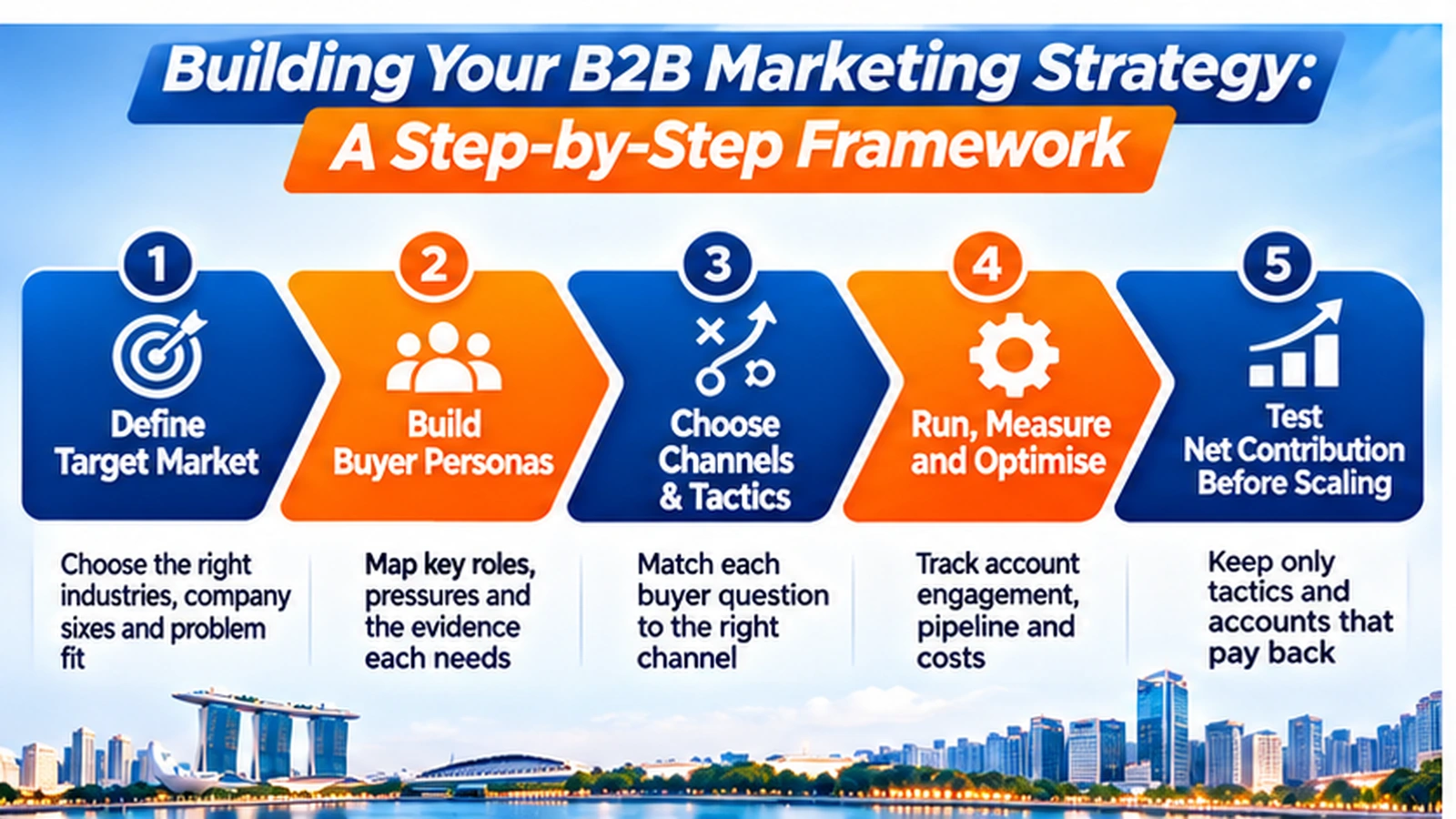
This section sets the target market first. Account-based marketing, covered later, applies the target-market choices made here.
Defining your target market and buyer personas
Strategy starts with deciding who you sell to. For most Singapore B2B firms, a useful target market is narrower than “any company with a budget.” Define it by industry, company size, the problem you solve and the decision process. Then write personas for the roles that influence the purchase.
Good digital marketing and sales work both depend on this clarity. Businesses cannot reach an audience they have not defined. Sound B2B marketing starts with the same clarity.
Work through three questions:
- Which industries have the problem you solve most acutely, and where have you already won business?
- Which company sizes fit your delivery model and deal economics?
- Who must agree before a deal closes, and what does each of them need to see?
A useful persona describes the job each buyer does. It also covers the pressures they face and the evidence they need before acting. For example: “Operations director at a 200-person logistics firm, measured on cost per shipment, sceptical of vendor claims, needs a peer reference before committing.”
Build personas from real data. Use CRM win-loss notes, interviews with two or three recent customers, and the objections sales hears most. Revisit them each year, because buying priorities shift.
Choosing tactics and channels that fit your buyers
Choose channels by asking where each persona already looks for information. B2B marketers can match each channel to a specific buyer question.
| Buyer question | Channel that usually fits |
|---|---|
| “What are the options for this problem?” | Search, comparison content, industry directories |
| “Does this vendor understand my sector?” | Case studies, sector-specific guides, LinkedIn |
| “Is it safe to shortlist them?” | References, peer reviews, executive introductions |
| “What will it cost and what will it return?” | ROI calculators, proposals, sales conversations |
LinkedIn offers two distinct routes for targeting professionals: focusing on specific job titles or selecting a combination of seniority and job function. Choose the route that matches how your personas are defined.
Do not spread budget evenly. Choose two or three channels that reach your priority personas. Add others only when you can measure their contribution.
Creating assets and running campaigns
Assets should answer the questions each persona asks at each stage. Start with a short core set:
- One service page per offer
- Two or three case studies
- A buyer’s guide
- A proposal template
Each asset should explain how your products or services solve a specific problem for your target audience. It should also help your brand earn trust before the first sales call.
A simple campaign process:
- Set one measurable goal for the quarter, such as qualified meetings with a named industry segment.
- Map the assets to the persona and stage they serve.
- Build a minimum viable set before launch, then refine it using sales feedback.
- Brief sales on the campaign message and the objections it addresses.
- Run for a fixed period set in advance, based on your sales cycle.
- Review and decide whether to scale, change the message or stop.
Keep campaigns small enough to learn from. Test one variable at a time. Record what changed so the next review has a clear basis.
Content marketing works best when you test each piece against a single persona. That shows what moves that audience to decide. Measured this way, each campaign shows whether the growth you expect comes from the right buyers. Social media can extend this testing, since its reach and engagement data show which messages hold a persona’s attention. Strong marketing of this kind rests on measured results, not volume.
Account-Based Marketing: Strategies, Costs and Payback
Account-based marketing (ABM) is often confused with a bigger lead list. It is not. ABM treats a small set of named accounts as the market, and it works only when marketing and sales agree on which accounts matter and who owns each one.
Media One Marketing’s guide to account-based marketing in Singapore sets out the core approach. Effective ABM aligns both teams around named accounts, maps the full buying group, and measures commercial contribution after programme costs.
How ABM aligns marketing and sales around named accounts
Broad demand generation fills a funnel and leaves sales to work whatever arrives. ABM reverses that order. Marketing and sales agree a named list of target accounts. Then they build digital content, outreach and events for those companies specifically.
B2B marketing teams in Singapore can use the same discipline. Treat each account as one audience, even when the buying group inside it is large. Many B2B marketers and businesses find this focus makes resource decisions easier to defend.
The practical test is simple. Can sales and marketing both name the ten accounts they are chasing this quarter? Can they explain what each one has done in response? If not, the programme is broad marketing with an ABM label.
Scoring accounts and assigning ownership
A named-account scorecard makes account choices defensible. Here is how to build one:
- List the criteria. Typical ones are buying-group reach, deal size, strength of the existing relationship, and whether a decision is winnable this year.
- Rate each account from 1 to 5 on every criterion. Use the same definitions for all accounts.
- Total the scores and rank the list. Top accounts get the most resources. Bottom accounts are nurtured cheaply or dropped.
- Assign one accountable owner per account. This is usually someone in sales or account management. Shared ownership often means nobody follows up.
Follow-through is where ABM programmes fail. A personalised campaign that no one follows up on with a call or meeting produces engagement data, not revenue.
Why pipeline-based ABM reporting misleads
A pipeline is the value of open opportunities. It can rise even if the programme is unprofitable. A programme that adds S$50,000 of open pipeline but wins nothing that covers its own costs looks successful on the dashboard and fails on the ledger.
Judge ABM by what it returns after it pays for itself. That growth is what matters to both the brand and its customers.
Working out whether an ABM programme pays back
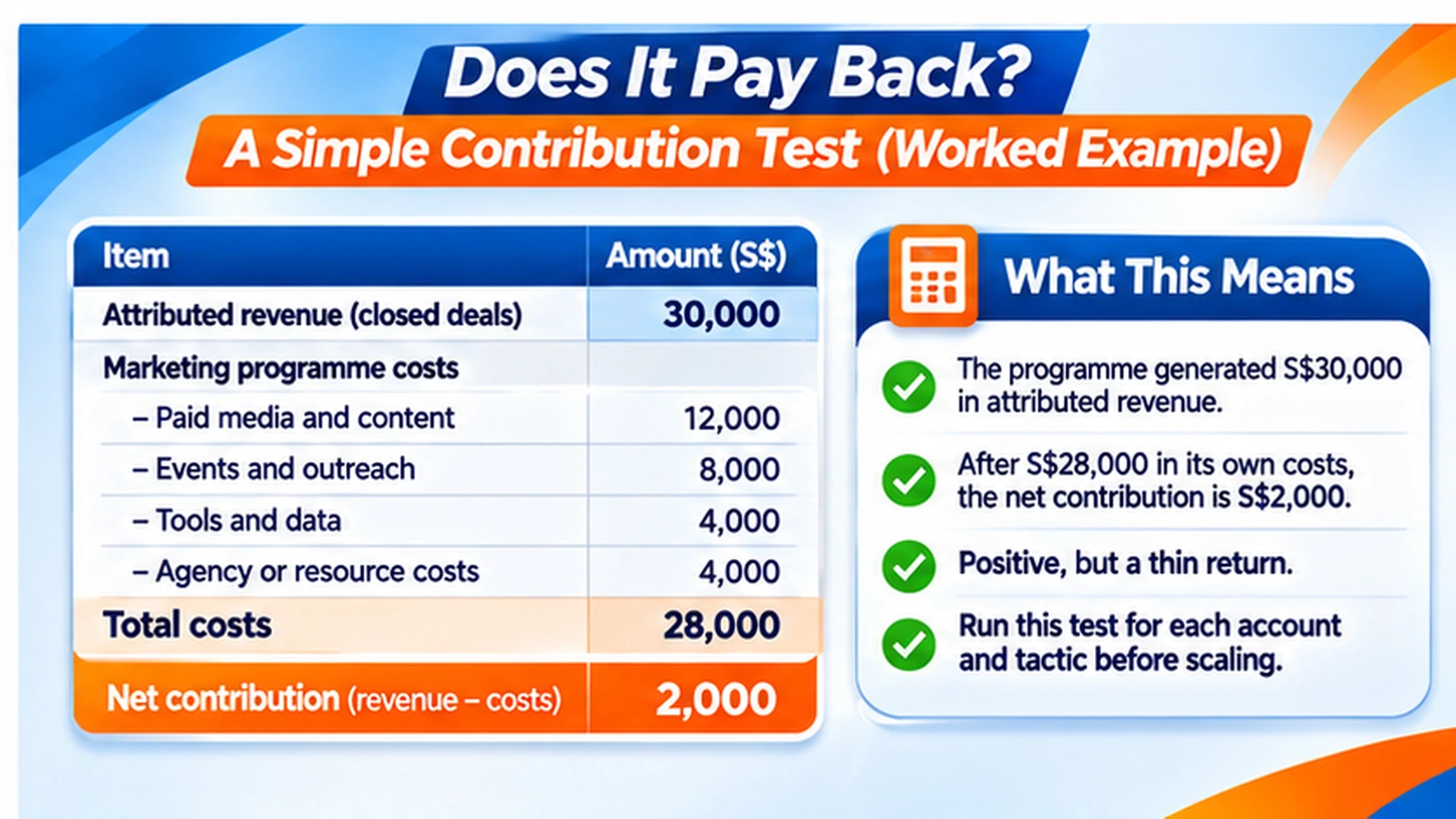
Most ABM reports stop at pipeline or engagement. Apply the Contribution Test: revenue attributed to won business, minus direct delivery costs, minus programme cost. Keep only the accounts and tactics that leave a positive figure.
Three terms recur in this test. Attributed revenue is the sales value of deals you credit to the programme. Direct delivery costs are the expenses of producing and running it. Payback period is how long it takes for returns to cover the spend.
Mapping the Contribution Test to MQLs, SQLs and attribution models is the next step. A marketing-qualified lead (MQL) is a contact marketing judges likely to buy. A sales-qualified lead (SQL) is one sales has accepted for active follow-up. An attribution model is the rule that decides which touchpoint gets credit for a won deal. Only the SQL-to-won path feeds the Contribution Test, so count MQLs as activity, not contribution. Please select one attribution model in advance and apply it consistently across all accounts.
The example below is hypothetical and illustrative, not a benchmark. Media One Marketing’s guide puts the total cost of an ABM programme for a named-account list at S$10,000. It breaks that into research and account preparation (S$1,500), content and landing-page production (S$2,000), workshop or event delivery (S$1,500), allocated sales and marketing staff time (S$3,000), and tools and campaign administration (S$2,000). Ongoing campaigns cost more as the number of accounts and the complexity grow.
Consider the following illustrative figures:
- Revenue attributed to won business: S$30,000
- Direct delivery costs: S$18,000
- Contribution before programme costs: S$12,000
- ABM programme cost: S$10,000
- Contribution after programme costs: S$2,000, a 20% return
A team that reports only the S$30,000 headline will overrate the programme. It may keep funding accounts that barely break even.
Set a default payback horizon of two to three sales cycles. Accept an account if its net contribution is positive by the end of that horizon. Drop it if the figure is still negative after two full cycles and the account scores below 3 on buying-group reach. Copy the scorecard as a simple template, including the columns for account, criteria scores, total, owner, and net contribution. Fill it in each quarter.
Net contribution is not always the right first test. A new programme may lose money in its first cycle, as research and content are reusable. Some wins also close after the reporting window. Set the payback horizon in advance, then judge the programme against it rather than against one quarter’s figures. Strong brand positioning and clear marketing strategies can shorten that horizon over time.
Channel Playbooks: Content, Social, Email, Events and Podcasts
Channels earn their place by the buyers they reach and the decisions they move. The sections below cover the channels most Singapore B2B teams can run. Each one is tested against a single question: does it help a named buyer make progress?
B2B content marketing that earns trust
Content works in B2B marketing when it answers the questions a buying group asks before it talks to a vendor. Those include cost ranges, implementation risks and comparison criteria. Generic thought leadership rarely does this job well. Evidence-based content helps a business show real expertise, and B2B marketers should use that evidence to make their claims credible.
List the five questions your sales team hears most often in first meetings. Then build one substantial asset for each. Cite the source behind every figure, link to it, and state the year of each statistic. Use the same data consistently across every asset so buyers can trust what they read.
LinkedIn offers two distinct ways to target professionals. You can target specific job titles or select a combination of seniority and job function. For a Singapore B2B brand, that makes LinkedIn the most practical place to find the people in a buying group. It is also a core digital channel for most business marketing teams.
Use social media to distribute content, not to push promotions. A workable cadence for a small team is two substantive posts a week from a named expert. Add thoughtful comments on prospects’ posts.
Email works best as a follow-up to a relevant action. Examples include a download, a webinar attendance or a sales conversation. Cold email sent to whole industries tends to fail. Segment by account and role, so each target audience receives messages that match its needs. Keep each message to one clear question. Measure replies rather than opens, because buyers respond to relevance more than volume.
B2B events and podcasting
Events and podcasts give buyers extended time with your people. That matters when decisions take months. A closed-door roundtable of six to ten customers and prospects can produce candid conversations. A busy conference booth rarely allows that. The insights you gather can shape your next product or growth plan and help your business learn what buyers value in your products or services.
Podcasts suit firms with recognisable experts who can speak in depth. Interview customers and practitioners, not only your own staff. Publish transcripts so the material can be searched and cited.
Measure both channels by the next step they create: meetings booked, accounts engaged or opportunities influenced. Attendance and downloads alone do not show payback.
Lead Generation, Retargeting and Outreach That Respects the Buyer
Lead generation and retargeting
Lead generation in B2B marketing is slower and more committee-driven than in consumer marketing. The aim is a steady supply of accounts and contacts already showing signs of a buying decision. Two tactics do most of the work: content-led lead capture and retargeting of people who have already engaged.
Gated content such as a benchmark report still converts. Ask only for the information you need to route the lead. Score leads on fit, meaning whether the company sits in your target segment. Score them on intent too, meaning whether they visited pricing or attended a webinar. Pass only leads above an agreed threshold to sales.
Retarget people who visited a specific service page or downloaded a specific guide. Do not retarget every site visitor. Set frequency caps. Exclude existing customers from prospecting audiences. In Singapore, use consent-based audiences where possible.
Track lead quality as well as volume. Compare the share of leads sales accept and the share that reach a meeting by source.
Why irrelevant outreach backfires
Outreach that ignores the buyer damages your reputation with the people you most need to reach. A Gartner survey of 632 B2B buyers found that 73% actively avoid suppliers that send irrelevant outreach.
Cold calling shows the trade-off. Cognism’s State of Cold Calling reports an average cold call success rate of 2.7% in 2026, up from 2.3% the prior year. Calling without research spends effort on contacts who will never buy.
Relevance is the fix. Before any message goes out, check that the contact is genuinely involved in the decision. Check that the message refers to a problem their business has. Respect opt-outs immediately.
Conclusion
Judge account-based marketing on contribution after costs, not pipeline volume. In a hypothetical example, S$30,000 in won revenue leaves only S$2,000 after S$28,000 in costs. Use the Named-Account Scorecard to allocate budget, and rerun the Contribution Test quarterly.
Frequently Asked Questions
What is the difference between B2B and B2C marketing?
B2B marketing sells to organisations, where several people research, debate, and approve a purchase. B2C marketing sells to individuals who usually decide alone and quickly. B2B deals are larger and slower, so content and relationship building carry more weight than impulse-driven creative.
How much should a Singapore B2B company spend on marketing?
No fixed percentage suits every firm. Start from the value of one account you want to win, then work backwards. Media One Marketing’s guide puts a named-account programme at S$10,000 in total, including research, content, workshops, staff time, and tools. Judge any budget by the contribution it returns, not by the spend itself.
Is account-based marketing only for large enterprises?
No. It suits firms with a small list of high-value accounts and a sales team that can follow up. If your deals are small and your market is broad, demand generation usually performs better.
How long does it take to see results from B2B marketing?
Expect a lag. Early activity shows up first as engagement, then as opportunities, and only later as won revenue. Judge the programme on closed business across a full sales cycle before deciding whether to continue or change it.
Which channel works best for B2B lead generation?
It depends on where your buyers already look. Test two or three channels against the same contribution measure. Keep the one that produces good business at an acceptable cost.