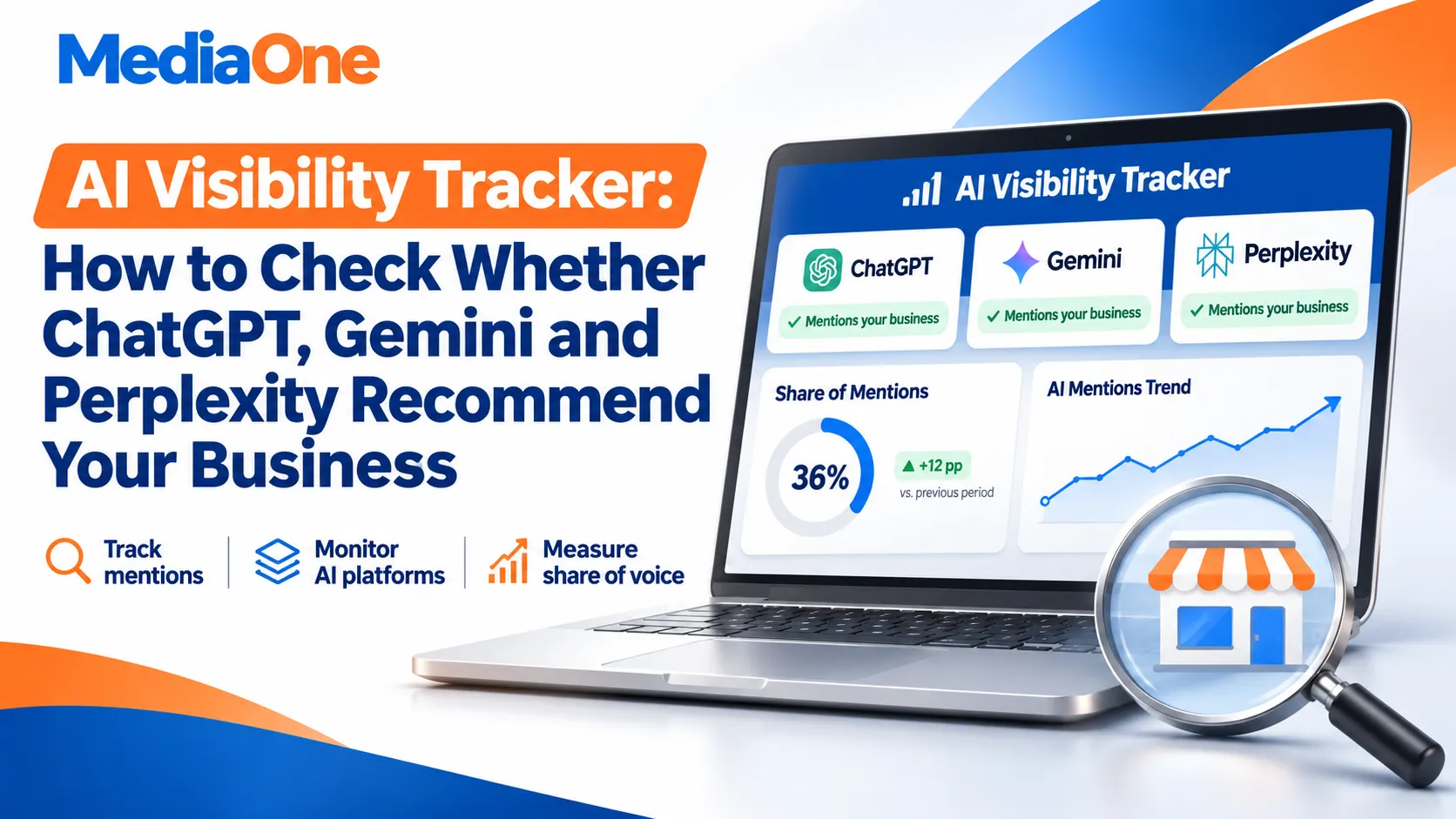
Ask ChatGPT, Gemini or Perplexity for the best accounting software for small firms in Singapore, and you often get a short list of names. Whether your business appears on that list affects how many enquiries reach you. This guide shows you how to check. Build a fixed query bank, log each answer across these AI platforms, calculate your share of mentions and track results over time. You can run the process with a free AI visibility tracker or a manual spreadsheet, and agencies and teams can use either approach alongside traditional brand monitoring.
The core claim of this guide is that the metric most buyers should drop is the single-run ranking. A snapshot of where your brand sits today tells you little, because AI answers shift between runs. Track your share of mentions across repeated checks instead, and use each performance figure as one input to a fuller analysis of your visibility tracking results.
Key Takeaways
- Test the same query set weekly. A fixed bank of 20 to 30 buyer questions keeps results comparable.
- Treat one check as noise. Only 43% of removed URLs returned later in the month, so a single snapshot misleads.
- Track share of mentions. Your mentions divided by the total mentions across named competitors show your real position.
- Separate branded from non-branded queries. A brand named only when asked is usually a weaker sign of recommendation. Treat this split as a working hypothesis, since the source data covers only the study’s own query set.
- Log the engine, position, citations, and competitors for every run so that trends remain comparable.
- Act only on persistent changes that repeat across several runs.
Why AI Visibility Is Now a Measurement Problem
Searches are moving into AI assistants
Buyers no longer always start with a search engine. Industry figures cited by WP Engine suggest 37% of user searches now begin inside AI systems. Authoritas reported in 2025 that the desktop click-through rate for the top result drops by 47.5% when an AI Overview appears.
For a Singapore firm, the consequence is practical. A prospect who asks ChatGPT for “the best IT support company in Singapore for a 20-person firm” may get a shortlist of three names and never see a results page. If your business is missing from that shortlist, there is no ranking to report and no click to lose in your analytics. The loss can go unnoticed unless you test for it on purpose. Brand monitoring and a visibility tool make that test routine. Brand radar views of your mentions, alongside a prompt-by-prompt comparison of your product features and pricing against competitors, show where you drop out of an answer. Your published content and its citation sources shape which names appear, so regular analysis of that data shows where to act. Tracking this performance each month shows whether your share of AI-generated answers is improving.
Why traditional rank tracking misses AI answers
Rank tracking assumes a stable list of ten blue links for each keyword. AI answers break that assumption. There is no fixed position, no single results page to scrape, and the same question can return different wording and sources each time. Teams and agencies working across platforms need visibility tracking that accounts for this variation and covers the pages an assistant actually cites.
The instability is measurable. Behind Rankings reports that no keyword in its study returned 100% URL consistency across runs and that 96% of AI Overviews changed the domains cited. A rank tracker that records one position per keyword per day cannot capture this churn.
Some practitioners argue that a strong search ranking carries over to AI answers. That may hold in part, but the same Behind Rankings data shows cited domains shifting sharply from run to run. The more useful question is how often your brand appears across a fixed set of buyer prompts and whether that share is growing. An AI visibility tracker is built to answer exactly that, and each brand mention or source citation it logs becomes a measurable search visibility signal.
How AI Visibility Tools Work
Prompts, engines and responses
An AI visibility tracker sends the same set of questions, called prompts, to several AI engines such as ChatGPT, Gemini and Perplexity. It stores each response and checks whether your brand is named, where it sits in the answer and which websites the engine cited. Many tools also use brand radar alerts to flag changes as they happen. Most platforms let you group prompts and compare features of each engine’s answers side by side.
Doing this work by hand means typing each buyer question into each assistant. A tool runs the same process across more prompts, on a schedule, and keeps the history. One answer tells you little, because the same prompt can produce a different list on the next run. Judge performance through repetition, and a tool that tracks the same content across runs makes that comparison practical.
Prompts should match how Singapore buyers actually ask. “Best accounting software for SMEs in Singapore” carries local intent that a generic prompt does not. Each engine assembles its answer differently. Chat assistants may draw on training data and live web retrieval, while Perplexity and AI Overviews lean more on retrieved pages and show their sources. That difference affects what a tracker can measure: a brand can be named without being cited or cited without being named, so the tool must log both.
Run prompts from a Singapore location or with location-aware phrasing, and use free trials to test the setup before you commit to a paid plan.
Mentions, citations and share of mentions
Tools usually report three separate signals.
A mention means your brand name appears in the answer text. A citation means the engine links to a source page, which may or may not be your site. A brand can be mentioned without being cited or cited without being named, so record both.
Share of mentions, often called share of voice, compares your mentions with those of competitors across the same prompt set. If your brand appears in 12 of 40 tracked answers and all tracked brands together appear 80 times, your share is 15%.
Expect the numbers to move. Semrush suggests that 40% to 60% of sources cited by large language models change every month, according to the Behind Rankings summary. Treat any single share figure as a reading, not a verdict.
Worked example: share of voice across two cycles
Suppose a Singapore accounting firm tracks 40 prompts across three engines. In cycle one, its brand appears in 6 answers, and the tracked brands appear 40 times in total, so its share of mentions is 15%. In cycle two, its brand appears in 9 answers, and the total rises to 48 mentions, giving a share of 19%. The total moved, so the firm must compare shares, not raw counts. The rise from 15% to 19% is worth watching, but on one cycle alone it could be noise. Only a rise that repeats across further cycles counts as a trend. These figures are illustrative sample numbers, not real results.
Monitoring Google AI Overviews
Chat assistants are not the only place AI-generated answers appear. Authoritas found in 2025 that the desktop click-through rate for the top result fell by 47.5% when an AI Overview appeared. A tracker worth using should cover Overviews alongside ChatGPT, Gemini and Perplexity, because search visibility now depends on all of them.
Overviews are harder to pin down. Behind Rankings reports that 96% of AI Overviews saw a domain change, so a single snapshot can be out of date within weeks. Treat Google AI Overviews as a separate engine with its own results, rather than assuming chat results carry over.
Monitor Overviews on the same fixed query set as the chat engines, using repeated checks so results can be compared side by side across platforms. Teams sharing one dashboard spot shift faster than those checking results individually, and agencies running these queries for clients often rely on that shared view.
Choosing an AI Visibility Tracker
Before you buy, please decide what you need the tool to do. A manual test doesn’t scale beyond a handful of queries across three engines. A tracker automates the logging so you can focus on findings. Many AI visibility tools offer free trials or tiered plans, so test on a free allowance before paying. Use the trial to check how the tool handles brand monitoring and whether its reporting matches your manual logs for the pages you care about. Verify each tool’s coverage claims rather than accepting them at face value.
Criteria for choosing an AI tracking tool
Judge each tool against five questions:
- Which engines does it cover? Check for ChatGPT, Gemini, Perplexity and Google AI Overviews, since buyers use different assistants.
- Does it record mentions and citations separately? A brand named in an answer differs from a link to your site, and you need both.
- Can you control the query set? Fixed, editable prompts are essential for reliable trend comparisons.
- Does it show competitors? Share of mentions only means something if rival brands are logged in the same runs.
- How often does it re-run? Weekly is the minimum. Daily runs suit fast-moving categories.
Please verify the platform’s stated features against its pricing page during the trial.
Visibility trackers versus rank trackers
A rank tracker reports where one URL sits in a results list. An AI visibility tracker reports whether a generated answer names your brand, where it appears, and which sources it cites. The output is a pattern across repeated runs, not a fixed position, so rank-tracking habits transfer poorly.
Quick comparison of AI visibility tools
Prices below are indicative, taken from one published review, and change often. Please confirm the current figures on each vendor’s pricing page before budgeting. Checked against the review source; not verified on each vendor site.
| Tool | Starting price (indicative) | Notable feature |
|---|---|---|
| OtterlyAI | From $29/month | Entry-level monitoring |
| Wellows | From $29/month, up to $497 | Multiple plan tiers |
| AI Peekaboo | From $50/month | Smaller-team option |
| Semrush AI Visibility Toolkit | Tied to Semrush plans | Beside broader SEO data |
Source for the pricing figures: Behind Rankings’ review of AI search visibility tools.
Tool Options
Digimetrics AI Visibility Tracker
The AI Visibility Tracker from Digimetrics is one option that measures brand mentions and citations across several AI engines. The vendor describes this capability on its site, so confirm it during a trial against your manual logs before committing.
Semrush AI Visibility Toolkit
The Semrush AI Visibility Toolkit suits teams already using Semrush, placing AI visibility tracking data alongside keyword and site audit reporting on one platform.
OtterlyAI
OtterlyAI is a lighter option for tracking a defined prompt set.
Trial each option against your query bank to judge coverage, cost and reporting. Give every tool the same test so the comparison stays fair and the results hold up across vendors. Track the same content across each platform so the results are directly comparable.
Building a Query Bank for Singapore Businesses
Every visibility check starts with the questions you ask. Build a fixed query bank of 20 to 30 buyer questions before you open any AI assistant, and keep it unchanged between runs so results stay comparable. Log each run in the same format, so the bank and the record stay consistent across cycles. A structured visibility tool can help you keep the bank and the run log aligned.
Which questions to test
Split the bank into three groups:
- Discovery queries, where the buyer does not yet know your name. Example: “best IT support company in Singapore for a 20-person firm.”
- Comparison queries, where the buyer is weighing options, are also relevant. Example: “Equinet Academy versus the established training providers a Singapore SME would typically shortlist.”
- Branded queries, where the buyer names you directly. Example: “Is Equinet Academy good for AI search training?”
Analyse these groups separately. A brand that appears only in branded queries is a weaker signal of recommendation, since the buyer already knew to look. Discovery queries are where your visibility is really tested, so weight them most heavily.
Write queries the way Singapore buyers type them, including “Singapore”, SGD pricing where relevant, and local context such as company size or industry. Run tests from a Singapore location or use location-aware phrasing, because answers can differ by region. Each query should read as a natural prompt a real buyer would type. Pair each query with the right content and features on your platform, so a visibility gap points to a specific page you can fix. Our Equinet Academy training pages are a useful starting point for checking which of your pages match these queries.
Here is a worked example. A Singapore training provider tests the discovery query “best AI search training course in Singapore for a marketing team” across ChatGPT, Gemini and Perplexity in cycle one. Only one engine names the provider. In cycle two, after publishing a clearer course page, the same query returns the provider on two engines. The shift is small, so it counts as a signal only if it repeats in the next cycle.
Identifying competitors that appear in AI answers
Your visibility competitors are often not the businesses you think about most. Run every discovery query on each engine and record every business mentioned, not only your own. Over a few cycles, a short list of repeat brands emerges. Record these competitors alongside your own brand to provide the total count for share of voice, and review the list each cycle, as new names can enter a category quickly. Monitoring and analysis tools can track these repeat brands across cycles, and comparing them against traditional SEO rankings shows where search visibility diverges.
Measurement Methodology and Metrics
A single screenshot of an AI answer tells you very little, because answers shift from run to run. Measure visibility as a pattern across a fixed query set over time. Specialised visibility tracking tools and agencies can automate much of this monitoring work, though the query design still requires human judgement, and brand radar features can help teams keep that design consistent.
Mention rate, citation share and AI share of voice
- Mention rate is the share of runs in which your brand is named. If your brand appeared in 9 of 25 Perplexity answers, your mention rate is 36%.
- Citation share is the share of cited sources that point to your domain, showing whether an engine uses your content as evidence even when it does not name you.
- AI share of voice is your mentions divided by total brand mentions across you and your tracked competitors. If you and four rivals received 40 mentions, and you received 12, your share is 30%.
Track all three per platform, never blended. A brand can lead on Gemini while being absent from ChatGPT, and a blended average obscures this difference. Compare these metrics alongside your traditional search reporting rather than replacing it, and review how each platform’s answer features shape what gets cited.
Statistical noise and sampling in AI visibility data
AI answers are unstable. Behind Rankings reports that 96% of AI Overviews saw a domain change, and that only 43% of removed URLs returned later in the month. That study’s sample covers its query set, so the figures describe that set rather than every query.
Treat a change as real only if it persists across repeated runs. Run each query at least three times per cycle and compare averages. With 25 queries across three engines, one cycle yields 75 rows: enough to spot a genuine shift, not enough to react to a single week’s movement. Results also depend on consistent query wording and location, so please keep both fixed.
Common AI visibility measurement mistakes
- Testing only branded queries. Asking “Is Equinet Academy good?” does not show whether an engine recommends you unprompted. Keep branded and non-branded queries in separate columns.
- Testing from the wrong location. Run tests from Singapore or use location-specific phrasing such as “in Singapore” and SGD pricing.
- A passing mention should not be counted as a recommendation. A brand listed last among eight options is not being recommended. Log position as well as presence.
- Changing the query set mid-test. Lock the set and change it only deliberately, with a new baseline.
- Ignoring competitors. A rising mention count means little if a rival’s share is rising faster, so track competitors in the same tool, not just your own.
Marketers looking to develop these skills further can explore Equinet Academy’s Advanced SEO, AEO & GEO course, which covers AI visibility measurement, brand mentions, citations, share of voice and performance optimisation.
Running a Visibility Check Over Time
A single check shows what one AI engine said once, not whether you are consistently recommended. Track visibility as a trend across a fixed query set, not as a snapshot, and use brand monitoring to keep those checks consistent over time.
Reporting cadence and dashboard setup
Run the full query bank at least weekly across ChatGPT, Gemini and Perplexity. Use the same queries, wording and location each time, so changes reflect the engines rather than your method. Keep the log in one spreadsheet, with one row per engine, per query, and per run date. Monitoring tools or agencies can automate these runs, but the same fixed logic applies. Many teams start with simple spreadsheet tools, and the tracking tools and pricing you choose should match the size of your query set. A visibility tool can automate these runs, but only if it keeps the same fixed logic. Consider how many AI platforms your audience actually uses before deciding which engines to include.
Set up a dashboard with four views:
- Mention rate by engine: the share of runs in which your brand appears.
- Share of voice: your mentions divided by total mentions across you and your competitors.
- Position trend: whether you are moving up or down within answers.
- Citation count: how many sources each answer cites, and whether your pages are among them.
Review monthly, but judge movement only over rolling four-week windows.
Acting on what the data shows
Act only when a change persists across at least three consecutive runs, and your share of voice moves by at least five percentage points. A smaller shift is noise until it repeats. Then analysis of the pattern should guide your response:
| Pattern in the data | Likely meaning | Action to consider |
|---|---|---|
| Branded queries mention you, discovery queries do not | Engines know your name but do not recommend you for the need | Publish clear, specific content answering the buyer’s question |
| Competitors gain position across several queries | They are being cited more often | Review which sources their answers cite and where your equivalent content is weaker |
| Mentions fall on one engine only | Engine-specific shift in sources | Check that the pages the engine favours are accurate and crawlable |
| Mentions fall across all engines | Broader change in source base | Audit recent content and third-party coverage of your business |
Record each action with a date, so the next cycle shows whether it moved the trend. Without that record, you cannot tell whether a response worked or whether a change would have happened anyway.
Conclusion
AI assistants now shape which businesses buyers hear about, and a single assessment cannot show whether that is working. The defensible measure is a trend: a fixed set of buyer questions run on a regular cadence and logged the same way each time, with the results turned into regular content and analysis.
Start with 20 to 30 discovery, comparison and branded queries, phrased the way US buyers type them. Calculate your share of voice against the competitors who appear alongside you, and treat a change as real only when it persists across repeated runs.
When manual logging becomes too slow, a free AI visibility tracker can automate it across several engines, and a platform-based visibility tool can add brand mentions monitoring over time. The method stays the same.
Frequently Asked Questions
Can I check ChatGPT recommendations myself without a tool?
Yes. Open each engine in a clean session, ask the same buyer questions, and record whether your brand is named, where it sits in the answer, and which competitors appear. A spreadsheet with one row per query, engine and run date is enough to start. The limitation is time and consistency: 25 queries across three engines means 75 checks per cycle. A tool automates that repetition and stores the history, but the manual method shows you what the tool is counting.
How often should I run AI visibility checks?
It’s best to run the full query set at least weekly, as answers shift too often for a monthly check to be useful. Behind Rankings found that only 43% of removed URLs returned later in the same month. Treat a change as real only when it persists across repeated runs.
Why do AI answers change from one run to the next?
AI assistants generate answers probabilistically and pull from live web sources that are constantly changing. Behind Rankings reports that 96% of AI Overviews saw a domain change at some point. A single result is therefore a sample, not a fact about your visibility.
Do AI visibility trackers work for Google AI Overviews?
Many do, though coverage varies by platform. Google AI Overviews appear in search results rather than in a chat window, so a tracker must query search and parse the overview block. Check the tool’s documentation for the engines it covers before you subscribe, and log AI Overviews as a separate engine.
How is AI visibility different from traditional SEO rankings?
A ranking is a position on a results page that stays put long enough to track. An AI answer is a generated paragraph that may name your brand, cite your site, or ignore you entirely, and it can differ for each user and each run. Traditional rank tracking therefore misses whether the assistant recommends you when a buyer asks. An AI Visibility Tracker measures mentions, citations and share of voice across a fixed query set, using repeated checks over time rather than a single position.