AI tools for digital marketing have moved from experiment to everyday infrastructure. In 2026, most Singapore teams no longer ask whether to use them, but which ones to adopt and how many. The market is crowded. A single search turns up long lists of products, each promising to write, design, advertise, analyse or automate faster than the last.
This guide takes a different line. Buying broadly often costs more than it returns, especially for lean local teams. Overlapping subscriptions and duplicated workflows can quietly erode the gains. We argue that most Singapore marketing teams should adopt AI tools narrowly, one workflow at a time, and only after checking the real cost and the data involved. Marketers who work this way keep control of their budgets and their customer data. A clear marketing strategy should decide which workflow comes first, so that each tool earns its place against a defined goal.
You will find a practical scorecard for shortlisting tools, a worked pricing example in S$, and guidance on trialling and ownership. Each section is written to be read on its own.
Key Takeaways
- Adopt AI tools one workflow at a time. Tool sprawl often costs more than the productivity gains.
- Score every candidate tool on five criteria: task frequency, time saved per week, data sensitivity, integration and total monthly cost.
- Trial low-risk, high-value tools first. Review anything that handles customer data before purchase.
- Budget in S$, not the sticker price. Most AI tools bill in USD, so convert and allow for exchange-rate movement.
- Count overlapping subscriptions. Several tools often duplicate the same task, which inflates the real cost.
- Assign one owner for each tool decision across marketing and IT.
Comparison of AI Tool Categories
| Category | Typical plan tiers | Example pricing (USD, check current page) | Best-fit team size |
|---|---|---|---|
| All-in-one campaign platforms | Starter, Professional, Enterprise | Marketing Hub from USD 7 a month for Starter (per seat) | Multi-channel teams running a full content strategy |
| Single-task ad creative tools | Starter, Professional | AdCreative.ai from USD 39 a month (Starter) | Small teams with a clear ad workload |
| Design suites with AI features | Free, Pro, Team | Canva Pro and Team plans (see vendor page) | Any size, especially teams already on Canva that produce visual content |
| Email and newsletter tools | Free, paid by list size | Confirmed on enquiry | Teams with an active mailing list that also publish blog posts |
Costs in Singapore dollars depend on the exchange rate on the day you pay. Confirm current prices on each vendor’s pricing page before you budget.
What AI Tools for Digital Marketing Are and What They Do
AI tools for digital marketing are software products that use machine learning or generative models to perform marketing tasks that once needed a person to do by hand. They write copy, generate images, score leads, predict ad performance or summarise campaign data. Industry guides now treat AI marketing tools as a standard part of the category, covered in a guide to 20 essential tools for 2026, organised by function. That is why selection matters. Marketers who build a shortlist around each stage of their funnel tend to make better choices than those who buy by brand name.
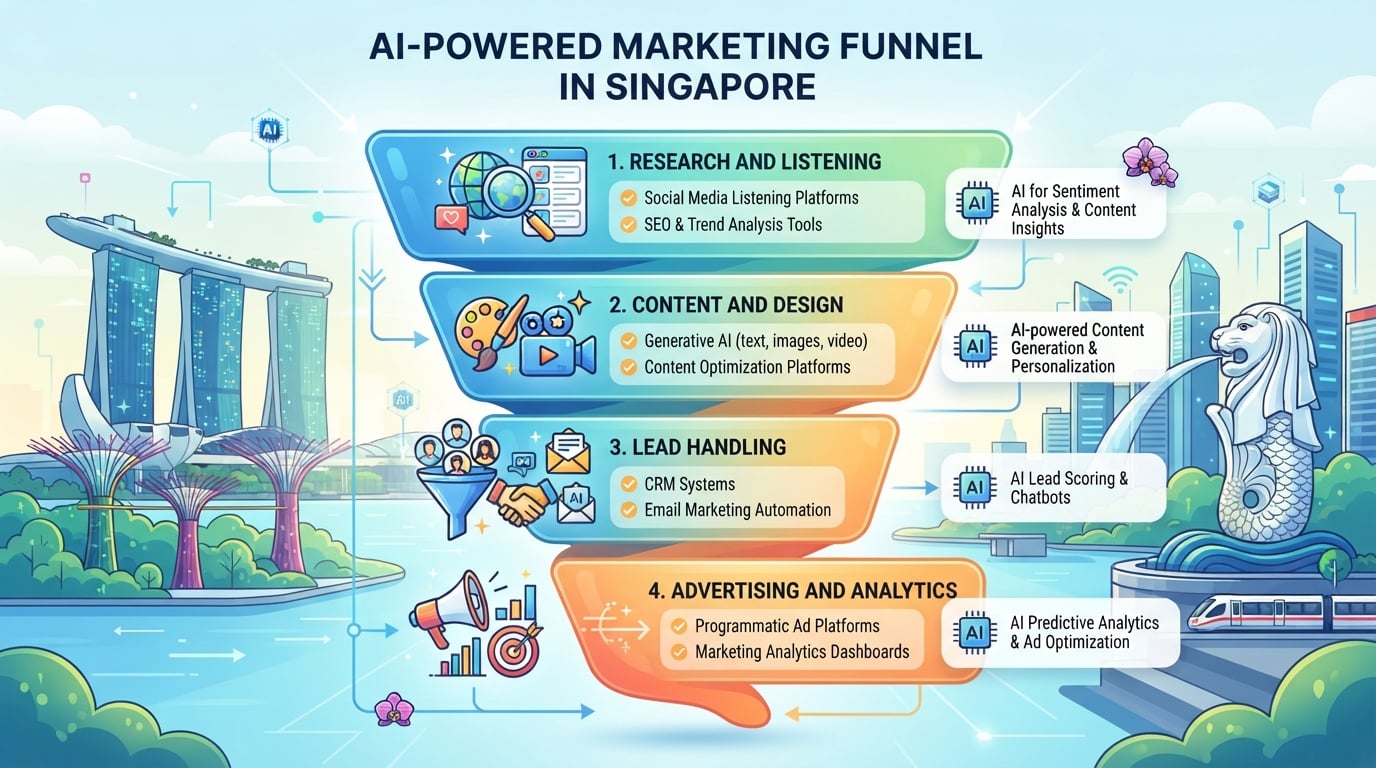
The core applications across the marketing funnel
Most tools cluster around four stages of the funnel. At the top, research and social listening tools surface trends and audience language. In the middle, content creation tools produce assets, while lead tools score and route enquiries. At the bottom, advertising tools generate and test creative, and analytics tools report what happened.
Many products now span several stages. That is where teams often pay twice for the same capability.
Why AI tools are now core infrastructure rather than experiments
Early adopters bought tools to test them. Today, teams depend on them for weekly output, so a tool that fails or changes pricing affects the whole calendar. Treat each tool as a workflow component with an owner, a cost and a record of the customer data it touches, especially where it monitors social media channels.
Choosing the Right AI Marketing Tools for Your Business
Most Singapore teams do not need a long list of AI tools. They need a few tools that fit specific workflows, chosen with a clear method. Buying broadly feels like progress. Overlapping subscriptions and unreviewed customer data flows often cancel out the gains, especially in lean teams.
Matching tools to your goals, team size and channels
Start with the task, not the product. List the three to five workflows that take the most hours each week, such as drafting social posts, building ad variations or producing weekly reports. A tool should earn its place by removing one of those tasks, and its output should meet a clear quality standard.
Then match the tool’s scope to your team. A broad platform such as an all-in-one campaign generator can build a full multi-channel campaign from a single brief. That only pays off if you run campaigns across several channels. If you mainly need ad creative, a tool such as AdCreative.ai, which generates high-converting ad creative using AI trained on performance data from millions of ads, is usually the better fit and costs less to adopt. Pick an AI-powered tool only where it genuinely reduces effort, and check that the resulting visual content meets your brand standards before publishing.
A worked comparison: a broad platform versus a single-task tool
Consider a team of three that needs ad creative every month. A broad platform such as Marketing Hub, for example, runs from USD 7 a month for its Starter plan to USD 800 for Professional. A single-task tool such as AdCreative.ai starts from USD 39 a month on its Starter plan. The broad platform looks cheaper at entry level, but it only saves money if your team uses its email, landing page and reporting features every week. If you only need the ad creative, the single-task tool delivers the same output for less effort and fewer data flows to review.
Check both pricing pages before you decide, and convert the figures into S$ at the rate you expect to pay.
A scoring framework for shortlisting tools
Rate each candidate on five criteria, scoring 1 (low) to 3 (high).
- Task frequency: how often the team performs the task.
- Time saved per week: realistic hours recovered.
- Data sensitivity: whether the tool touches customer personal data. A score of 3 means the lowest risk.
- Integration: how well it connects with your existing stack.
- Total monthly cost: all subscriptions in S$, not just the headline plan.
Add the five scores for a total out of 15. A total of 12 or more triggers a trial. A total of 8 or less triggers rejection. Totals between 9 and 11 mean the tool needs a clearer use case before you decide.
Tools that score high on frequency and time saved go to a trial first. Anything that processes customer personal data needs a privacy review before purchase, and that review should involve whoever owns data protection in your business. Review the tool’s output against your own performance figures and track the insights it returns, so decisions rest on evidence rather than vendor claims.
Tool sprawl: how to spot it and avoid it
Tool sprawl shows up as duplicated functions, unused logins and rising renewals. Audit your subscriptions every quarter and ask who uses each tool each week. Base each renewal decision on that usage data rather than on habit.
Take a typical Singapore SME stack of three tools: a writing assistant at about USD 20 a month, an ad creative tool at about USD 39 a month, and an email platform on a paid plan at about USD 13 a month. That is roughly USD 72 a month before currency conversion and any add-ons. If the writing assistant and the email platform both drafted promotional copy, one of them is redundant. Keep one, trial the other only if it covers a gap, and recalculate the monthly cost in S$.
AI Tools for Lead Generation, Engagement and Advertising
AI lead generation and customer engagement
AI tools for lead generation handle the repetitive work of capturing, qualifying and following up with prospects. Many SME teams find this the easiest place to start, because the workflow is frequent and the time saved is easy to measure. Marketers who run this work often find it the most practical first use of AI. Automation of these routine steps frees staff to focus on higher-value conversations.
Consider the broader tools carefully before buying. Some platforms, such as the one described on MarketingAgency.sg, can generate an entire multi-channel campaign from a single brief. That breadth is useful, but it also means the tool touches email, social media and contact data at once. A narrower tool that only drafts follow-up emails may be easier to control and cheaper to run.
Pricing is often tiered by list size. One email platform offers a free plan for up to 250 contacts, with paid plans from USD 20 a month that scale as the list grows. Check the tier that matches your current contact count, not the one you expect to need next year.
AI advertising tools and creative generation
AI advertising tools produce ad variants, headlines and images, and some test them against performance data. Canva’s Magic Studio suite, for example, offers AI design and copy features that can speed up small creative batches for social and display ads.
The more useful question is how many variants your team can genuinely review. Generating fifty ad concepts adds little if nobody checks brand fit before launch. Start with a small set of variants, measure what performs, and only then expand. Careful analysis of those results usually matters more than volume alone.
Every AI-generated ad claim, price or promise needs a review step before launch. Check that each claim can be substantiated and meets advertising standards, and get human sign-off before anything goes live.
Budget for these tools in S$, not USD. Most AI tools are priced in USD, and currency movement can add a material premium when converted. Factor that into your monthly plan before comparing options.
AI Tools for SEO, Research and Social Listening
AI SEO and content research
AI tools now do much of the groundwork behind search optimisation: keyword clustering, topic gap analysis and drafting outlines for blog posts. The useful question for a Singapore team is which single job it needs to automate, not which tool is most capable. A team that tries to run keyword research, content briefs, rank tracking and link prospecting in four separate tools will usually spend more time managing subscriptions than improving pages. Marketers who start with one workflow and check its results before expanding will get more from these tools.
Start with one research workflow, measure whether it saves hours each week, then decide whether to add another. Check the vendor’s current pricing page before buying, since most AI SEO products bill in USD.
Social listening tools scan posts, reviews and forum threads for mentions of your brand, competitors and category terms, then group those mentions by sentiment and theme. For a Singapore business, this matters most where customers talk in mixed-language and platform-specific ways. Test any tool on your own product names and common misspellings before trusting its sentiment scores, and compare its output against a sample you check by hand.
Keep the scope tight. Track two or three priority topics, review the output weekly and assign one person to act on it. A listening feed nobody reads is another subscription with no return.
Measuring Results: AI Marketing Analytics, Automation and Costs
Adopting AI tools only pays off if you can see what they deliver, so measurement belongs in the plan from day one. Tie each tool to one metric you already track, such as cost per lead or hours spent on a task, and review it monthly.
AI marketing analytics and reporting
Analytics tools now summarise campaign data and flag anomalies without a dedicated analyst. Treat their output as a starting point, not a verdict. Check any AI-generated insight against your raw platform data before you change budget. Good insights come from comparing the tool’s findings with what your own data shows, and a clear reporting routine helps marketers spot the best-performing channels based on verified numbers.
AI marketing automation tools
Automation platforms are where tool sprawl grows fastest, because each one quietly duplicates a feature in another. Pricing reflects this. HubSpot’s Marketing Hub, for example, runs from USD 7 a month for its Starter plan to USD 800 for Professional, according to HubSpot’s own pricing page. The plan you need depends on list size and features. Map each automation to a single workflow before buying, so that every digital marketing tool subscription has a clear purpose.
Tool costs, currency exposure and testing before you commit
Quote the real cost, not the headline plan price. Most AI tools are billed in USD, and the conversion to Singapore dollars adds to the bill. Budget in S$ and recheck the exchange rate each quarter. Prices shown here were not re-verified on each vendor’s page for this version, so confirm them on the vendor’s current pricing page before you budget.
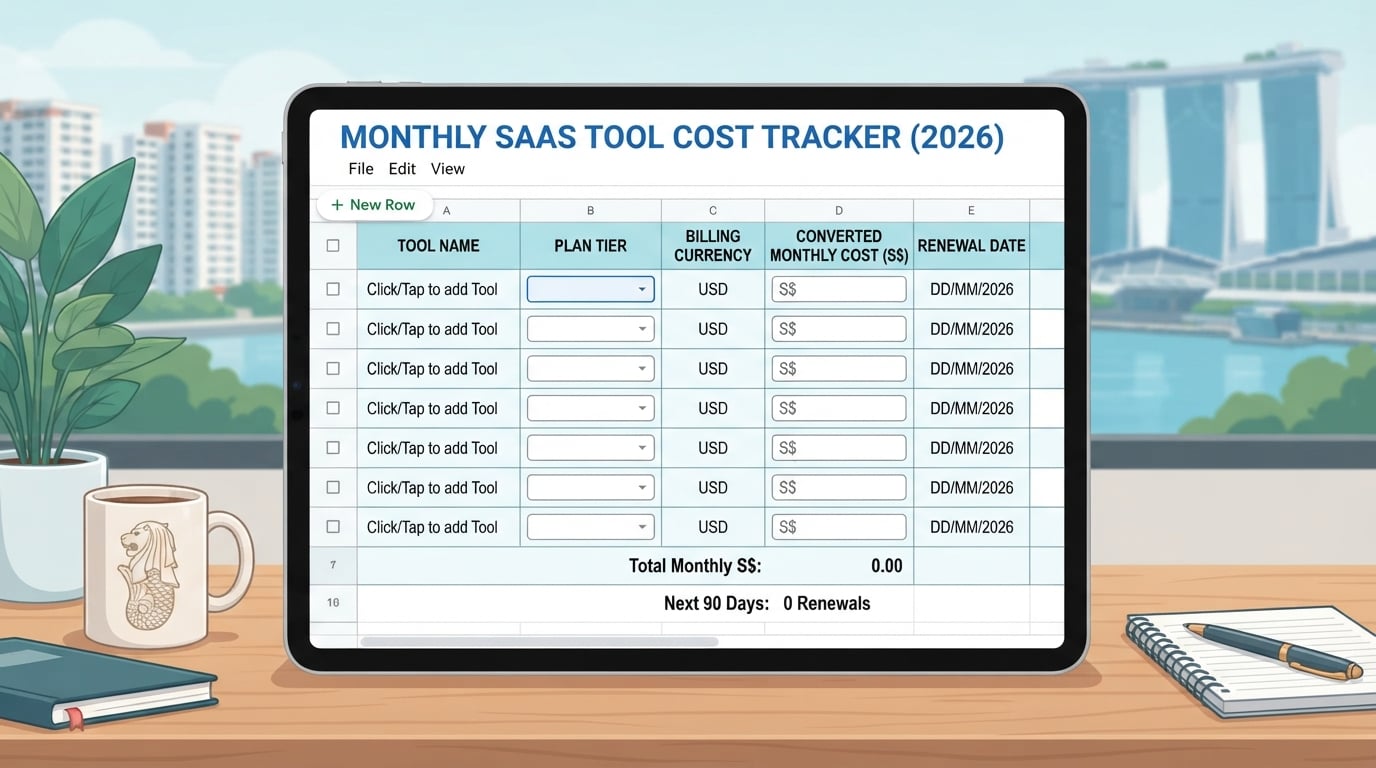
Add up overlapping subscriptions across the whole stack before approving anything new. Then trial one workflow at a time, with a fixed end date and a clear success metric. Plans change often, so check each vendor’s pricing page before you commit.
Conclusion: Building an AI Marketing Stack You Can Sustain
The strongest AI marketing stack is usually the smallest one that works. Most Singapore teams do not need every tool on the market. They need two or three tools that fit the workflows they run every week, cost less than the time they save, and pass a basic data check. Run that way, adoption compounds. Run as a buying spree, it erodes budgets and attention. Judge each option on its pricing against the hours it returns, and treat quality of output as a requirement, not a bonus.
Start with one workflow, score the candidate tool using the Workflow-Fit Scorecard, trial it, and only then add the next. Tools that touch customer personal data get a review before purchase, not after. Convert every subscription to S$ in your planning sheet, and total overlapping plans, since a single monthly plan rarely travels alone.
Revisit the stack every quarter. Retire anything nobody opened in the last month, and let analytics show which features actually drive results. The goal is not to own AI marketing tools but to run a digital marketing function, guided by a clear strategy, that you can explain, afford and maintain.
Frequently Asked Questions
Which AI marketing tool should a small Singapore business start with?
Start with the one task your team repeats most often and that takes the most hours each week, such as drafting social posts or writing ad copy. Score that workflow first, then trial a single tool against it for a month before adding anything else. Broad platforms can wait until you have proven value on one workflow.
Are AI marketing tools expensive for an SME in Singapore?
Entry plans are often modest. One listed tool starts at USD 15 a month, and another offers a free plan with paid plans from USD 13 a month for its cheapest tier. Most tools are priced in USD and convert to a larger sum in S$, and the real cost is usually higher than the plan price. Add up every subscription, including overlapping ones, before you judge the budget.
Do I need to tell customers when I use AI in my marketing?
There is no single rule that applies to every business, so decide on a standard you can defend. Be transparent where a customer could reasonably assume a human wrote or chose something personal, such as a one-to-one reply. For generic creative like banner designs, disclosure is rarely expected. Keep the standard consistent across channels so your brand stays trustworthy.
How do I know whether an AI marketing tool is working?
Set a baseline before you switch the tool on. Track the hours the workflow took before, the time it takes now and one outcome that matters, such as cost per enquiry or click-through rate. Compare over at least four weeks. If the time saved is real but the outcome hasn’t moved, the tool saves effort without improving results, so question whether it earns its fee.
Can AI tools replace a marketing agency?
AI tools can take over production tasks such as drafting, resizing, scheduling and first-pass reporting. They do not replace strategy, brand judgement or accountability for results. Many Singapore teams use tools to handle volume in-house and keep an agency or freelancer for positioning and campaigns that need local insight. Treat the tools as capacity, not a substitute for expertise.
What should I check before an AI tool analyses customer data?
Any tool that stores, profiles or analyses your contacts or enquiries needs a review before you buy it. Check what personal data it receives, where it stores that data, and whether the vendor uses it to train its own models. Involve whoever in your business handles data protection, and do not send contact lists to a new tool until that review is complete.