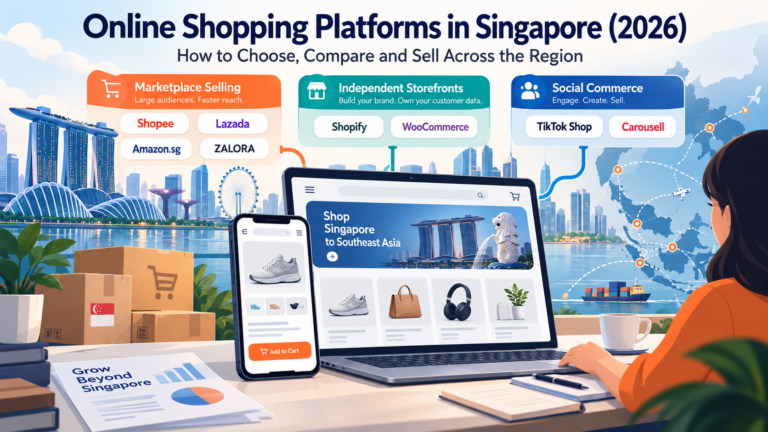
Your ecommerce store competes in a market growing at 12.36% annually toward USD 332.0 billion by 2034. Yet without AI-driven visibility optimisation, you are likely losing 16 to 32 orders monthly, revenue that goes to competitors already using AI for keyword discovery, content optimisation and technical SEO.



This guide shows you exactly how AI accelerates ecommerce SEO at scale: automating the keyword research that takes weeks into hours, generating optimised product descriptions for thousands of SKUs, building internal linking strategies that distribute authority across your entire store, and identifying technical issues before they damage rankings. By the end, you will have a concrete roadmap to compete with marketplace giants like Shopee (13.21 million monthly visits) without the team size they command.
Key Takeaways
- AI tools automate keyword research, product page optimisation and internal linking, three levers driving higher adoption among ecommerce marketers.
- Structured data (product schema) delivers measurable wins: 343% impression growth and 127% click growth in one case study.
- Singapore’s ecommerce market grows at 12.36% annually and reaches USD 332.0 billion by 2034. Competing without AI visibility optimisation costs you 16 to 32 monthly orders.
- 41% of American consumers prefer generative search for shopping.
- ROI breakeven on professional AI-driven SEO (SGD$3,000 to SGD$8,000 monthly) requires just 16 to 32 new orders at Singapore’s SGD$185 average order value.
Table of Contents
Why AI SEO Matters for Ecommerce Stores Right Now
Fifty-six per cent of ecommerce marketers now use generative AI tools at work, more than any other type of AI technology. This shift is reshaping how online stores compete for organic visibility.
The market reality in Singapore is clear. Your market will reach USD 332.0 billion by 2034, expanding at 12.36% annually. Yet independent stores face fierce competition: Shopee alone attracts 13.21 million monthly visits. Without AI-driven optimisation, you are leaving revenue on the table.
Here is the financial reality: if your average order value sits at Singapore’s benchmark of SGD$185, each lost organic visitor represents genuine lost profit. Professional ecommerce SEO costs SGD$3,000 to SGD$8,000 monthly in Singapore. To break even, you need just 16 to 32 additional monthly orders. Most stores generate far more than that, making AI-powered SEO a profit centre, not a cost.
AI visibility optimisation addresses three critical ecommerce SEO challenges that manual workflows cannot scale: product page matching, internal linking logic and competitive keyword discovery.
Keyword Research and Competitive Analysis at Scale
Manual keyword research limits you to dozens of high-level targets. AI assistants expand this to hundreds of long-tail product keywords, the exact queries your customers use when ready to buy.
AI tools analyse competitor product pages, category structures and content gaps in hours, not weeks. They identify which competitors rank for which product queries and why, feeding you competitive intelligence you can action immediately.
For ecommerce, this means discovering high-intent product keywords like “bamboo cutting boards under SGD$50” or “wireless headphones with noise cancellation Singapore” that drive qualified traffic. You also spot competitor blind spots: pages ranking in positions 4 to 10 that small content investments could dislodge to the first page.
One case study achieved 86% of target keywords to page 1 within three months using structured competitive analysis. Without AI acceleration, this takes 6 to 9 months on teams of two or three SEO specialists.
The output is a prioritised keyword map: which products to optimise first, which competitors are weakest, and which long-tail queries offer quick wins.
Product Page Optimisation and AI-Powered Content Generation
Every product listing is a micro-website. AI-driven optimisation transforms each one from a bare catalogue entry into a search-ranking asset.
Product Description Generation

Generative AI tools write product descriptions tailored to search intent. Instead of generic specs, AI crafts descriptions that weave in high-intent keywords naturally whilst answering the questions your customers ask: “What is this made from?” “Who is this for?” “What problem does it solve?”
One case study: Ocarat, a jewellery retailer with 30,000 references and 120,000 product variations, now serves 7,000 monthly clients using AI content automation. Manual writing at that scale was impossible.
On-Page Optimisation
AI tools audit every product page against ranking factors: title tags aligned to search intent and keyword difficulty, meta descriptions that earn clicks from search results, H1 clarity and keyword placement, image alt text for both accessibility and image search, and page load speed (a Google ranking factor since January 2018).
Entity-First Methodology
Rather than keyword-first writing, AI applies entity-first methodology: it structures content around what the product is (entity: leather laptop bag, origin: Italian, material: full-grain leather, audience: professionals), then maps search queries to those attributes. This approach works better in generative AI overviews and helps your store compete in AI-powered shopping.
Structured Data Automation and Product Schema
Structured data is no longer optional for ecommerce visibility in AI-driven search.
Why Product Schema Matters
Ecommerce-focused agencies that implement product schema see measurable gains. One case showed 343% increase in impressions, 127% increase in clicks, and branded search share rose to 74%. Schema markup tells Google and AI search engines exactly what you are selling: product name, price, availability, rating, review count and SKU. Without it, AI overview generators cannot easily cite your products, and your pages rank lower for product-comparison queries.

Structured Data Automation Tools
AI plugins for ecommerce SEO automatically generate and maintain product schema as your inventory updates. Instead of hand-coding JSON-LD for each SKU, the tool maps your product database to schema standards. When a price changes or stock level updates, the schema updates with it.
Internal Linking Powered by Structure
Structured data reveals relationships. AI tools use product attributes to recommend internal links: shoes linked to socks of the same material, laptops linked to compatible keyboards. This automation ensures every product page is woven into a logical internal network.
Internal Linking Strategies That Scale
Internal links distribute authority and guide both visitors and search engines through your store. Manual internal linking strategies break down with large inventories. AI automates this at scale.
How AI Improves Internal Linking
AI visibility audits scan your entire store, identify orphaned pages (products with no inbound links), and suggest links based on keyword relevance, purchase intent and authority distribution. Link a cotton t-shirt to “cotton clothing” or “sustainable fashion” category pages. Link complementary products together. Link high-authority pages to newer or lower-ranking product pages to boost them.
Internal Linking Best Practices
Use descriptive anchor text instead of generic phrases. Limit links per page to 3 to 5 outbound links to avoid dilution. Prioritise links to pages that need ranking help. Create breadcrumb schema so Google understands your category hierarchy.
One benchmark: First Page Digital achieved 800% organic traffic growth and 148% organic growth on a single ecommerce client by restructuring internal linking. AI accelerates this by automating the discovery of linking opportunities across thousands of products.
AI Visibility Audits and Technical SEO Foundations
AI audits reveal what is holding your store back from organic growth. Rather than manual crawls, AI systems scan your entire site and flag issues by impact.
What AI Audits Detect
Page speed issues (load time is a ranking factor), duplicate content (identical product descriptions across variations), crawl errors (pages that return errors or are blocked from indexing), mobile usability (whether checkout and product pages render correctly on phones) and broken internal links.
Technical SEO Priorities for Ecommerce
AI insights prioritise fixes by estimated traffic impact. Fixing a page that receives 500 monthly clicks is higher priority than fixing one that receives 10. This ensures your team focuses on wins first.
Shopify SEO challenges often centre on duplicate content and crawl efficiency. AI tools configured for Shopify auto-detect and flag these before they damage rankings. A professional seo agency can guide implementation, or tools like Semrush and Ahrefs offer automated audits starting at accessible price points for small stores.
ROI Calculation and Getting Started
Your breakeven point (16 to 32 new orders at SGD$185 average order value) is achievable within the first two months of focused AI-driven optimisation. Many stores exceed this in their first quarter, making the investment profitable quickly.
At Singapore’s SGD$185 average order value, each additional monthly order represents SGD$185 to SGD$400 in gross profit, depending on your margin. An agency charging SGD$5,000 monthly needs just 16 to 32 new orders to break even. Most stores generate 100+ new orders from improved organic visibility within three months, making ROI 400 to 800%. One benchmark: First Page Digital achieved 800% organic traffic growth on a gifts store, moving from 35,000 to 87,000 monthly visits.
The evidence is clear: 56% of ecommerce marketers are already using AI SEO. The question is not whether to adopt it, but when, and which tools and partners fit your budget and timeline.
Frequently Asked Questions
Which AI SEO tools work best for Shopify stores in Singapore?
Shopify-native AI tools that understand product collections and variant management are essential. Look for tools that automate meta descriptions, title tags and image alt text per SKU. Schema generation should be automatic. Professional seo agency services in Singapore often bundle Shopify expertise, ranging from SGD$3,000 to SGD$8,000 monthly depending on store size and complexity. The key is ensuring your chosen tool integrates with your product database so updates sync without manual intervention.
How long does it take to see traffic gains from AI SEO optimisation?
First Page Digital’s case studies show 86% of target keywords reaching page 1 within three months. However, this assumes consistent optimisation weekly. Initial gains (20 to 30% traffic increases) typically appear within 4 to 6 weeks; sustained growth (50%+ increases) takes 2 to 3 months. The timeline depends on your current authority, product count and competition level. Stores with 500 to 1,000 SKUs often see results faster than those with 10,000+ variants, since AI tools prioritise high-impact pages first.
Can AI-generated product descriptions hurt my SEO?
No, if written correctly. AI descriptions that are keyword-aligned, original and user-focused perform well. The risk is low-quality, spinning-style AI text that adds no value. Use tools that prioritise clarity and buying intent over keyword density. Test AI output against your brand voice before publishing. A hybrid approach (AI draft, human review, publish) reduces risk and ensures consistency.
What is the ROI of professional AI-driven ecommerce SEO in Singapore?
At Singapore’s SGD$185 average order value, each additional monthly order represents about SGD$185 to SGD$400 in gross profit, depending on your margin. An agency charging SGD$5,000 monthly needs just 16 to 32 new orders to break even. Most stores generate 100+ new orders from improved organic visibility within three months, making ROI 400 to 800%. One benchmark: First Page Digital achieved 800% organic traffic growth on a gifts store, moving from 35,000 to 87,000 monthly visits.
Does product schema (structured data) actually improve rankings?
Yes. One case study showed 343% growth in impressions and 127% growth in clicks after implementing product schema. Schema helps Google understand what you are selling and makes your product eligible for rich snippets, product comparison carousels and AI shopping features. Branded search share improved to 74% for that client. Without schema, AI overview generators cannot easily cite your products, and your pages rank lower for product-comparison queries.
How do I prioritise which products to optimise first?
Start with products that already rank in positions 4 to 10 for high-intent queries. These are one or two optimisations away from page 1. Then target your highest-margin or best-selling products. AI visibility audits flag which pages have the most untapped traffic potential. Products with existing traffic but poor conversion rates also deserve priority, since improving on-page SEO (title clarity, schema, internal links) can push them to page 1 without waiting for domain authority to build.
Should I hire an agency or build AI SEO in-house?
Agencies scale faster initially (3 to 6 months to see meaningful results) because they bring pre-built workflows and competitive intelligence. In-house teams take longer to mature but own the data and strategy long-term. A hybrid approach (agency for audit and strategy, in-house for ongoing optimisation) is common in Singapore. Many stores benefit from a geo agency that understands local search behaviour and competition, especially if you operate across multiple regions.