AI digital marketing uses machine learning and automation to plan, run and measure marketing across channels. It helps Singapore teams decide where to automate, which tools to fund and what the team must still own. AI can generate captions, emails and ad variants in minutes, but output often rises faster than revenue. In short, AI marketing helps Singapore brands work faster across their marketing channels, and the first action is to audit your data and automation before buying another tool.
Key Takeaways
- AI changes what the team owns, not whether it is needed. Work shifts from producing assets to designing data, automated flows and review gates.
- Automated flows deliver strong returns. According to Klaviyo’s benchmark data, flows generate up to 30x more revenue per recipient than campaigns.
- Score your stack before you buy. The four-layer AI audit framework rates data, automation, content and measurement from 0 to 3 each.
- A total below 6 means fix first. Repair data and automation before adding tools, because weak foundations make every new tool less useful.
- Watch the budget mix. Media One Marketing’s guide suggests a 50–60% paid media, 15–20% tools and 20–30% people split. A split like this shows when tools crowd out people.
- Name an owner for AI output. Most quality failures happen at review, so assign approval before scaling content.
What Is AI Digital Marketing and How Does It Work?
AI digital marketing uses machine learning and automation to plan, run and measure marketing activity across channels. For a Singapore brand, the practical question is not whether to use it, but what the team must own once it does.
How AI Marketing Works in Practice
Artificial intelligence marketing uses software that learns from data to make or recommend decisions, such as first drafts, bid settings, send times and which customer sees which message. The team still sets goals, defines rules and approves output. Three layers do the work:
- Data. The customer, sales and behaviour record the system learns from, including social media interactions and website behaviour.
- Models. Patterns found in that record, which surface useful analytics and insights about the audience the brand is trying to reach.
- Automation. Triggered flows that act on those patterns, such as a welcome sequence or a cart-abandonment reminder, set up through marketing automation tools.
Weak data produces weak predictions, so the data layer comes first. A model learns from past records, so its suggestions are only as good as the history it was trained on.
According to Klaviyo’s benchmark data, automated flows generate up to 30x more revenue per recipient than campaigns. These figures come from Klaviyo’s own sample of accounts, so treat them as a directional benchmark, not a guaranteed result. Used well, AI can help a team decide where to start, and identifying the best starting point is often the most valuable first step.
Where AI Changes Digital Marketing Most
AI touches almost every channel, but its value is uneven. Across SEO, paid search, social media and email, the biggest gains come where work is repetitive and inputs are rich. Automation design usually matters more than any single content tool, so marketers should start where automation earns its keep. Across these platforms, the same principle holds, and the insights from one channel often transfer to the next.
Automated Flows Beat Campaigns on Revenue per Send
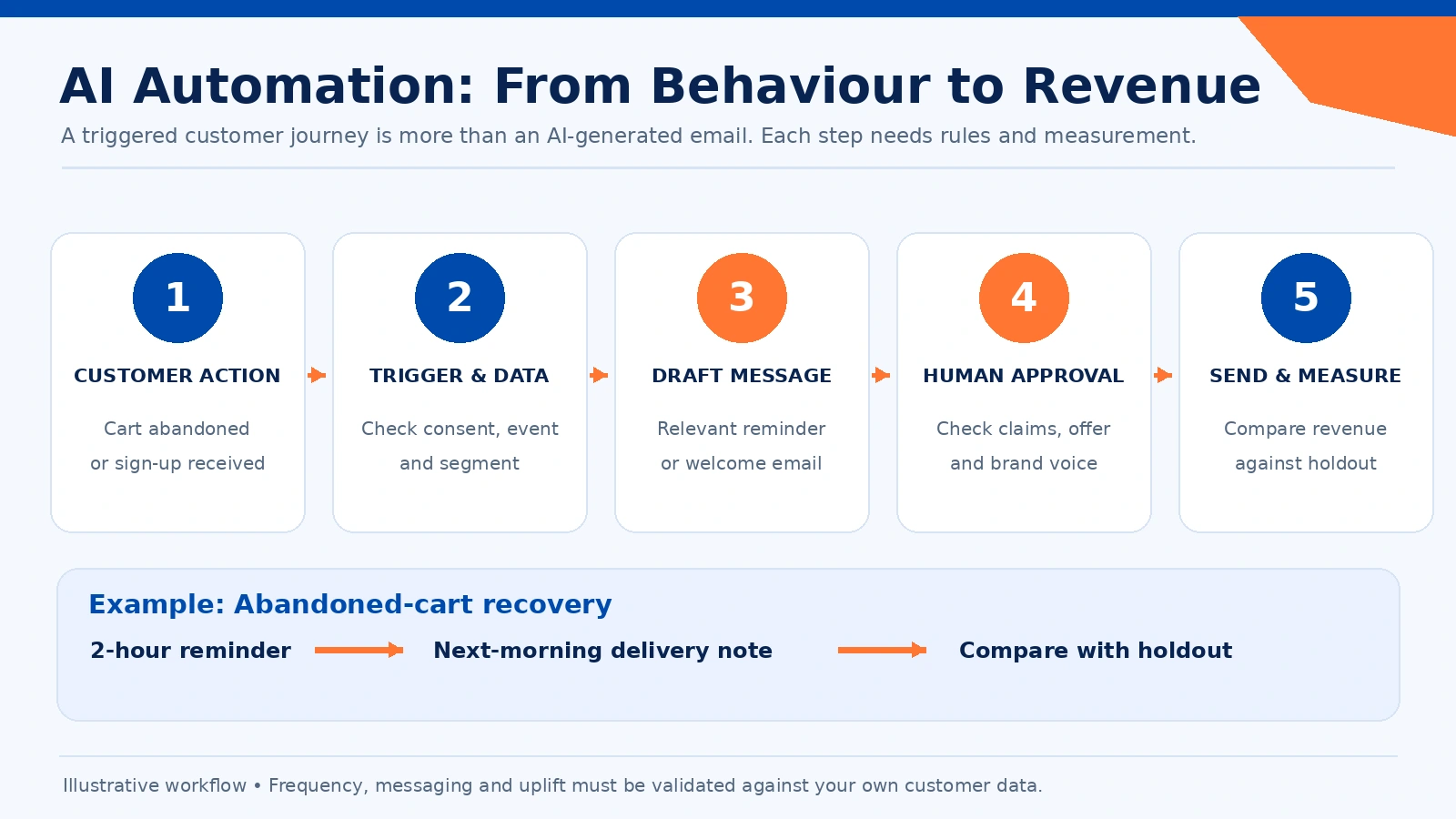
Campaigns drive most email volume, but revenue lives elsewhere. Check whether your onboarding, abandonment and post-purchase flows are triggered and tested before buying another content generator. Flows are where engagement tends to convert into sales. The best place to start is usually the flow with the most traffic.
Consider a Singapore fashion retailer. Its abandonment flow sends one reminder two hours after a cart is left, then a second with a delivery note the next morning. Each step is tested against a holdout group to see which strategies earn the sale.
Email Personalisation and Send Timing for Singapore
Personalisation has a clear commercial case: 86% of consumers would like to receive promotional emails from companies they do business with at least monthly. Mailjet research, as reported by EmailToolTester, found 55.2% of email users check email first thing in the morning, so test an early-morning send window against your own audience.
A send-time model is trained on your past opens and clicks, then checked against a holdout group that receives sends at random times. It needs at least several months of engagement data per contact to work, and its accuracy is measured by whether the predicted window beats random timing on opens.
Singapore’s high smartphone penetration rate of 88% makes mobile-first design the default expectation, and a short video in the email can help lift engagement for mobile readers. Applied to media marketing, this mobile-first habit matters most.
Choosing AI Marketing Tools: Types, Costs and Overlap
Most teams buy AI tools one category at a time, and spend grows faster than results. Zapier‘s research on AI spending found that 86% of professionals expected their AI spending to rise over the next year, while 26% already cited overlapping tools as a barrier to value. Before adding another subscription, decide which layer of the stack needs funding first, and use analytics and customer insights to justify each purchase. Teams that plan their content creation workflow around one clear owner tend to waste less on duplicate tools, and setting clear marketing strategies for each tool’s role helps keep spending focused. Pair each tool with a short demonstration video so every user sees how it fits the workflow.
The Main Categories of AI Marketing Tools
Most tools fall into four groups:
- Content generation (copy and caption writers for social media)
- SEO and search analysis (keyword and content-gap tools)
- Paid media optimisation (bid and ad-variant tools)
- Email and customer automation (flow builders and send-time tools)
Match a tool to a specific gap rather than to a feature list, so marketers can pick the right tool for each strategy.
Budget Planning: Tools, People and Paid Media
A common budget split is 50 to 60% on paid media, 15 to 20% on tools and 20 to 30% on people, according to Media One Marketing’s guide to digital marketing teams. Test this against your own numbers. If tool spend is growing while people capacity shrinks, the tools may be replacing work that a skilled person should do.
Salary benchmarks are illustrative: mid-level PPC managers in Singapore earn SGD 4,500 to 8,000 a month (2024 figure), so compare that cost with what a tool actually removes from the workload.
Avoiding Overlapping Subscriptions
Audit subscriptions against the four-layer stack. If two tools both generate copy or both send triggered emails, keep the one that connects to your customer data. One tool per job, with a named owner, prevents duplicate spend, and a shared view of your media marketing results makes overlaps easier to spot.
Benefits and Challenges of Using AI in Digital Marketing
This section weighs where AI pays off and where it creates risk. The gains come mainly from automation, while the risks sit at the review gate.
Measurable Gains in Speed, Reach and Revenue
Most of the value sits in automated flows rather than faster content. A team that spends its budget on more campaign copy may add volume without adding revenue. Marketing automation platforms help teams find these flows and measure their returns, so effort can focus where returns are highest. Teams that read these insights carefully can see which flows deserve more investment.
A Singapore homeware brand, for example, found that its welcome flow earned more per recipient than its monthly newsletter, so it moved budget from newsletter production into flow design. Teams that analyse engagement data can also direct their search and content budgets toward the channels that return the most.
Risks: Quality Control, Data Privacy and Brand Voice
Scaling AI output scales errors too. A single unchecked product claim can be repeated across dozens of social media posts before anyone notices. The practical control is a named reviewer who signs off on every AI draft against a brand voice guide and a fact-check list.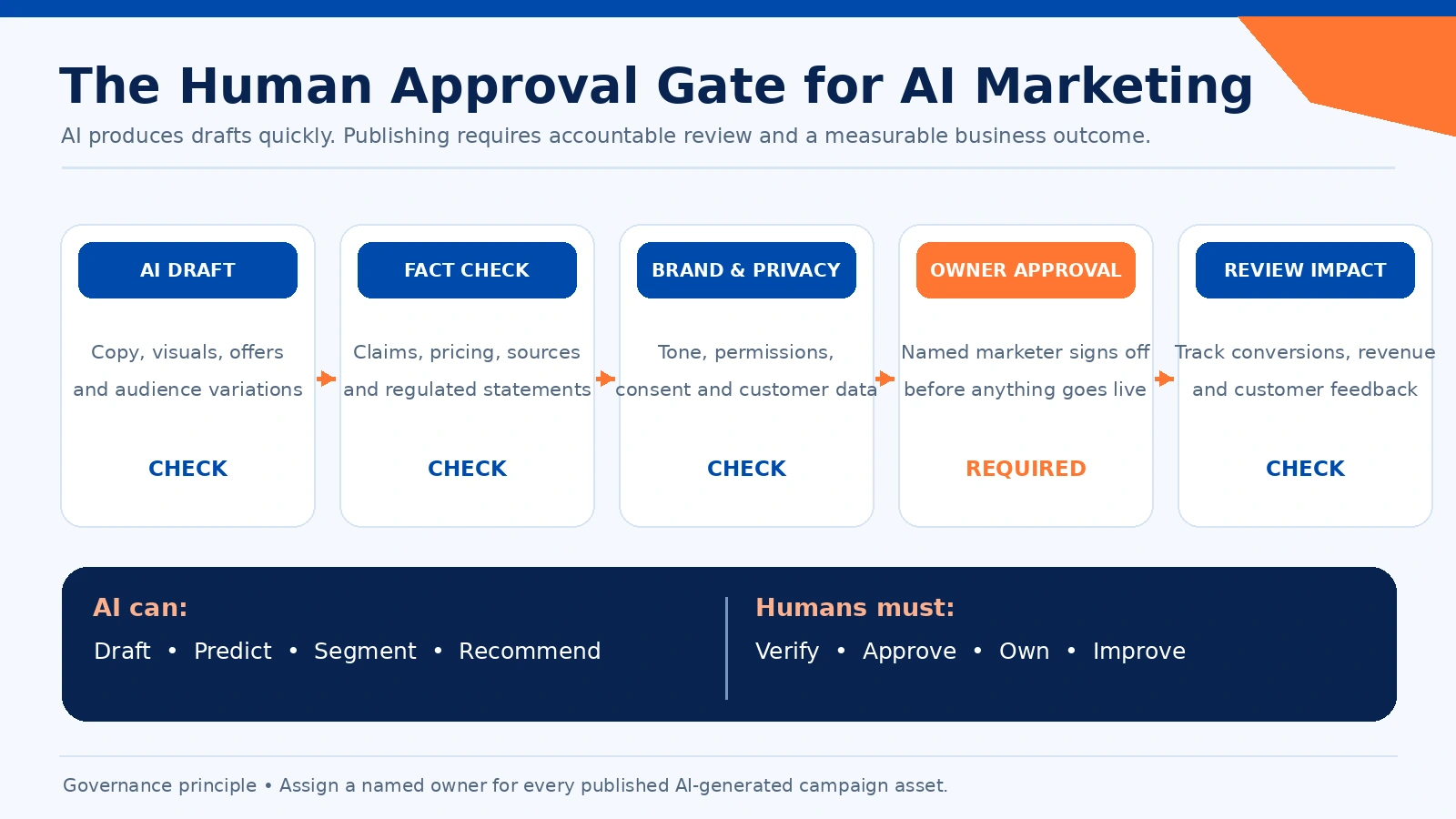
Where Human Judgement Still Decides the Outcome
Artificial intelligence can draft, sort and predict, but people still decide what the brand says and which customers it targets. Judgement matters most at the review gate, where a marketer asks whether a message is accurate, on-brand and right for the audience. Treat that gate as a permanent role, not a temporary check, and build it into the wider marketing strategy, including how the team plans its content creation.
Step-by-Step Framework for Starting AI Marketing in Singapore
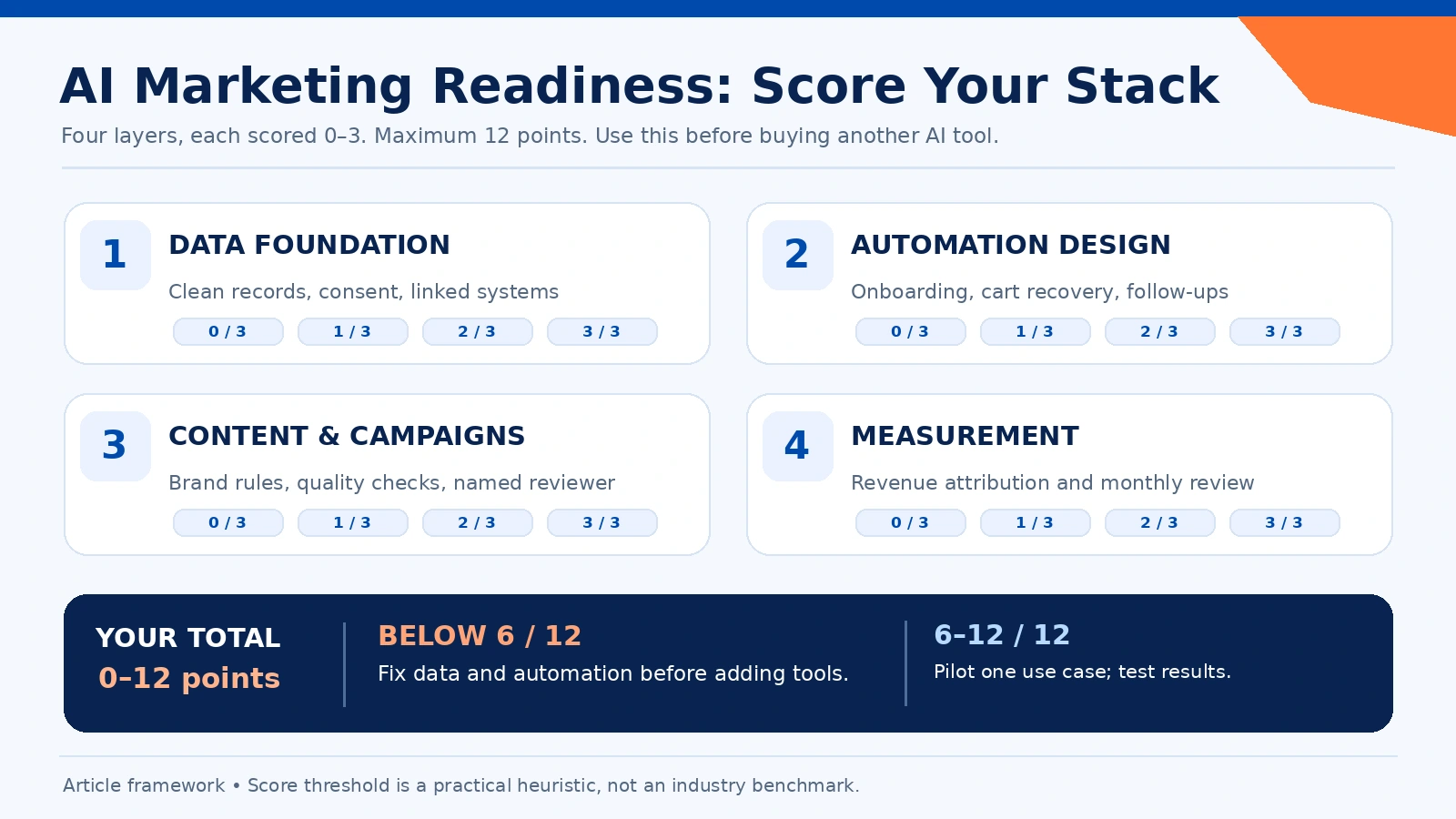
Most teams start by buying a tool. A stronger strategy is to score your current setup first. The AI audit framework is a four-layer framework that shows where your next dollar should go, and it helps marketers see which layer is holding back results across content creation and channel platforms. Score each layer from 0 to 3: data foundation, automation design, content and campaign generation, and measurement. If your total is below 6, fix the first two layers before buying anything else.
The threshold of 6 is a judgement, not a statistical cut-off. A total below 6 usually means data or automation is missing, and buying a content tool then tends to add cost without adding revenue. The strongest counter-argument is to buy tools first to learn quickly, and that can work for a small pilot. The risk is that the team learns on the wrong foundation and pays twice. We recommend fixing the foundation first, then testing tools in one use case.
| Score | Data foundation | Automation design | Content and campaign generation | Measurement |
|---|---|---|---|---|
| 0 | No consistent customer records | No triggered flows | No AI use or no review step | No revenue tracking |
| 1 | Records exist but are not linked to consent | One basic flow, untested | AI drafts published without checks | Revenue tracked by campaign only |
| 2 | Clean records with consent, partly linked | Several flows, reviewed occasionally | AI drafts reviewed against a checklist | Revenue tracked by flow and channel |
| 3 | Clean, consent-linked records across systems | Flows for onboarding, abandonment and follow-up, reviewed monthly | Named reviewer, written brand and fact-check rules | Baseline set, reviewed monthly against revenue |
Audit Your Current Funnel and Data Readiness
Start with layers 1 and 2. Check whether your customer records are clean and linked to consent, then whether you have triggered flows for onboarding, cart abandonment and post-purchase follow-up. Klaviyo’s benchmark data shows automated flows generating up to 30x more revenue per recipient than campaigns. Treat this as one vendor’s sample, not a guarantee for your list.
Pilot One Use Case with a Clear Success Threshold
Choose one use case, such as a single abandonment flow, and set a threshold before launch, such as a clear lift in revenue per recipient over the previous quarter. Keep a named reviewer who approves every AI draft against brand and fact-check rules. Most quality failures happen at this review step, not in the model, so review analytics alongside the drafts to catch problems early. Where a team must create a short video for the flow, the same reviewer checks it before release.
Scale, Review and Set Governance Rules
Scale only what clears the threshold. Then write down who owns AI output, what gets fact-checked, and how spend splits across paid media, tools and people. Budget allocation typically follows a 50–60% paid media, 15–20% tools and 20–30% people split, according to our digital marketing team guide. If tool spend is squeezing people capacity, buy less software and keep the specialist who designs the flows.
Conclusion and Summary
AI changes what the digital marketing team owns. The valuable work moves from producing assets to designing the data, flows and review gates that AI works within. Teams that use AI only to create content faster will see output rise, but revenue may not follow. Teams that invest in data and automation design are more likely to see revenue improve, and a careful analysis of current workflows shows where that investment should go first.
Start with the four-layer AI audit framework: data foundation, automation design, content and campaign generation, and measurement. Score each layer from 0 to 3. If the total is below 6, fix the data and automation layers before buying more tools. Automated flows can produce a disproportionate share of revenue, so they are a sound place to begin.
Frequently Asked Questions
What is the difference between AI marketing and traditional digital marketing?
Traditional digital marketing relies on people to plan, produce and run each activity. AI marketing uses models to automate or speed up parts of that work, such as drafting copy, predicting buyers and adjusting bids. The bigger change is in the job itself. The team shifts from making every asset by hand to designing the data, flows and review gates that AI works within.
Do small businesses in Singapore need AI marketing tools?
Not on day one. Most small teams gain more from fixing customer data and building one or two automated flows than from buying a broad tool suite. Run the four-layer audit first. If your total score is below 6, fix the data foundation and automation design before adding tools.
Which AI marketing use case should we start with?
Start with automated flows for onboarding, abandoned carts and post-purchase follow-up. Flows often generate far more revenue per recipient than campaigns, because the messages are timely and triggered by what the customer just did. Build one flow, such as an abandoned cart reminder, and track its revenue over a month.
How do we measure whether AI marketing is working?
Tie each AI activity to a revenue outcome, not to output volume. Track the share of revenue from automated flows, the conversion rate of AI-drafted content against human-written content, and cost per acquisition after AI-driven bid changes. Set a baseline before launch and review monthly.
What are the main risks of using AI for content?
The main risks are factual errors, off-brand tone and publishing volume nobody can check. Require human approval for every AI draft, fact-check claims against primary sources, and name one person to own approval. Most quality failures happen when nobody is clearly responsible.
Will AI replace digital marketing teams?
No, but it changes what the team does. AI takes on more drafting, testing and reporting, so the valuable work shifts to data quality, flow design and judgement about what to publish. Check your budget mix too. If tool spend grows while people capacity shrinks, you are likely buying speed without the capacity to direct it.