You do not need to be a local SEO specialist to get results. You just need to follow the right steps in the right order.

Patients in Singapore are not browsing the way they used to. They search on Google Maps, scan a few listings, compare ratings, glance at the clinic name, and make a quick decision. If your clinic does not appear in those top local results, you are often out of the running before a patient ever visits your website.
That is the real problem. Most dental clinics are not invisible because they offer poor care. They are invisible because their local presence is weak: incomplete Google Business Profiles, poor category selection, thin location signals, and websites that do not clearly tell Google where they are or what they specialise in.
And because the Google Local Pack only shows a small number of options, the downside is brutal. A handful of clinics get the calls. Everyone else gets what is left.
This guide is built to fix that. Not with vague theory, but with practical steps, a clinic owner, manager, or in-house marketer can actually implement. If you follow the framework below, you give your practice a far better chance of appearing when patients search for a dentist nearby.
If you want expert help with the execution, our team is a local SEO agency in Singapore that works with healthcare practices to build this kind of visibility properly.
Key Takeaways
- Your Google Business Profile is the single most important asset in your local SEO strategy. An incomplete or outdated profile is the fastest way to lose ground to a competitor.
- NAP consistency (Name, Address, Phone) across every directory and platform is a non-negotiable foundation. Even minor formatting differences create conflicting signals for Google.
- Patient reviews are both a trust signal for new patients and a ranking factor for Google. A structured, ethical review acquisition process is worth building into your clinic’s operations.
- The Google Local Pack (the three map listings at the top of search results) captures the majority of clicks for high-intent local searches. Ranking in it should be your primary goal.
- Local SEO results typically take three to six months to build meaningful momentum, but foundational fixes can produce visible improvements within weeks.
- Singapore dental clinics that are not actively managing their local search presence are losing new patient enquiries to competitors who are, often without realising it.
- The Productivity Solutions Grant (PSG) offers up to 50% funding support to eligible SMEs adopting pre-approved digital marketing solutions, helping reduce the cost of getting started.
Why Local SEO Matters for Dentists in Singapore
In a market as dense and competitive as Singapore, local SEO is no longer optional. Patients usually want the nearest credible option, not a long research project. They search for terms like “dentist Yishun”, “Invisalign Bugis”, or “dental clinic near Novena MRT”, and Google responds with map-based results that feel immediate and trustworthy.
That creates two realities at once. First, local intent is incredibly strong. Second, even good clinics lose visibility if their optimisation is weak.
The goal, then, is not to “do SEO” in the abstract. The goal is to send Google the clearest possible signals about three things: what your clinic does, where it is, and why it deserves to appear in local search results.
What is Local SEO for Dentists?
Local SEO, in the context of a dental practice, refers to the process of optimising your clinic’s online presence so that it appears prominently when nearby patients search for dental services on Google and Google Maps.
It differs from general SEO in one critical way: intent. When someone types “dentist near me” or “dental clinic Clementi” into their phone, they are not browsing. They are ready to act. Local SEO positions your practice in front of those high-intent searches at exactly the right moment.
The mechanics involve a combination of factors: your Google Business Profile, the consistency of your business information across the web, the strength and quantity of your patient reviews, the relevance of your website content to local search terms, and the technical health of your site overall.
Done well, it puts your clinic in the Google Local Pack, which is the block of three map-based results that appears at the top of the search results page. Research shows that 76% of people who search on their smartphones for something nearby visit a business within a day.
For a dental clinic, that is an extraordinarily direct line between search visibility and a booked appointment.
Who is Local SEO For?
Local SEO is for any dental clinic, whether you run a single-practice surgery in Jurong, a specialist orthodontic clinic in Orchard, or a multi-location group practice. The strategic principles are consistent. The execution scales with your size and ambition.
It is particularly urgent for clinics that have not reviewed their online presence in the last 12 to 18 months. The competitive environment in Singapore’s dental sector has intensified, and standing still in local search is effectively moving backwards.
What Local SEO Does Not Cover
It is worth being clear about the scope, because I see this conflated regularly.
Local SEO does not cover national or international search campaigns. It does not replace paid advertising, though it complements it effectively. It does not manage your social media, design your website, or run your email campaigns.
A good local SEO strategy is focused: it builds your clinic’s organic visibility in geographically relevant searches.
How It Works and What to Expect
Google’s local search algorithm weighs three broad factors when deciding which dental clinics to show in the Local Pack.
The first is relevance: how closely your profile and website match the search query. A dental clinic that clearly describes its services, including specific treatments such as Invisalign, wisdom tooth extraction, or dental implants, will rank better for those service-specific searches.
The second is distance: how close your clinic is to the searcher’s location. This is partially fixed by where your clinic is located, but proximity signals can be strengthened through hyperlocal content targeting nearby estates and MRT stations.
The third is prominence: how well-known and well-regarded your clinic appears across the web. This is where your review volume, citation consistency, backlink profile, and the overall authority of your website all come into play.
Understanding this framework helps you prioritise. You cannot change your physical location, but you can greatly influence your relevance and prominence signals.

The Role of Google Business Profile
Your Google Business Profile (GBP) is not just a listing. For local SEO purposes, it functions as your primary digital storefront. It is often the first thing a patient sees before they ever visit your website.
I have audited many clinic profiles over the years, and the issues I find most often are not complicated ones:
- Missing service descriptions
- No photos beyond a single exterior shot taken years ago
- Categories selected incorrectly
- Opening hours not updated after a change
- No responses to patient reviews
These are not technical failings. They are operational oversights that have a direct, measurable impact on visibility.
Clinics in Singapore that optimise their GBP well, including posting regular updates, maintaining complete service information, and responding to every review, consistently perform better in local rankings than competitors with stronger websites but neglected profiles.
Realistic Timelines for Results
This is an area where I always try to be honest with clinic owners before they invest. Local SEO is not a paid ad. You cannot switch it on and see immediate results on day one.
The realistic pattern is this: foundational fixes (profile completion, NAP corrections, citation cleanup) can yield noticeable improvements within 4 to 8 weeks. Sustained local content, review growth, and link acquisition build competitive rankings over three to six months.
For clinics in more saturated areas, such as the CBD, Orchard corridor, or Tampines, the competitive set is larger, and the timeline to meaningful Page One presence can extend to nine to twelve months.
What I would caution against is the expectation that local SEO is a one-time project. The clinics I have seen sustain top Local Pack positions are the ones treating it as an ongoing operational priority, not a task to be completed and filed away.
Types and Tiers of Local SEO Strategy
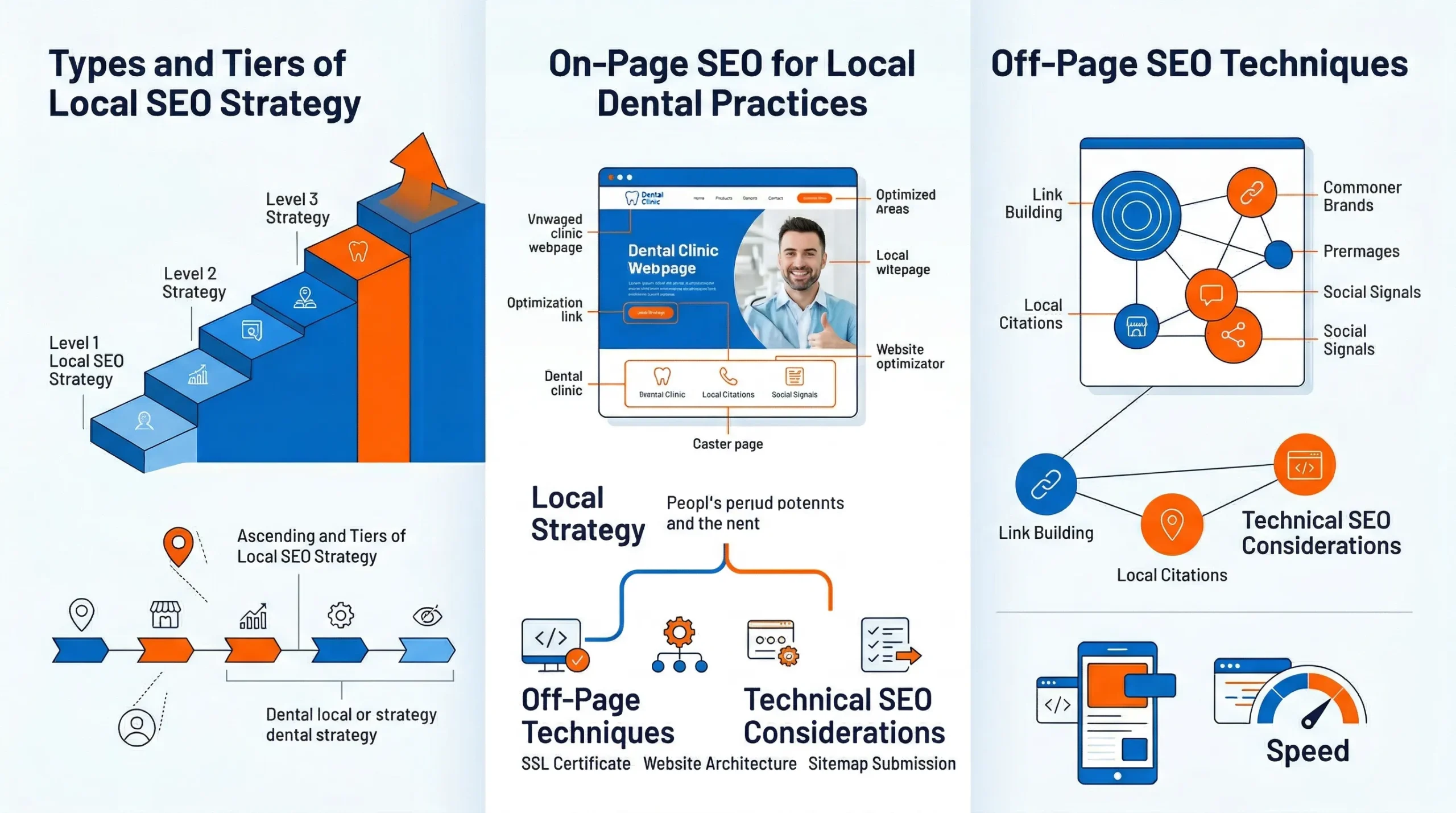
Not all local SEO work is the same, and understanding the difference matters before you spend anything.
There are three broad layers to a well-built local SEO strategy: what you do on your own website, what you build across the wider web, and the technical foundations holding it all together. Each layer reinforces the others. Neglect one, and the gaps show up in your rankings.

On-Page SEO for Local Dental Practices
On-page SEO refers to the optimisation work done directly on your website. For a dental clinic, this means ensuring that every page accurately describes your services using language your patients actually search for.
What to focus on:
- Title tags and meta descriptions that include your location and service type (for example, “Invisalign Specialist in Clementi, Singapore”)
- Dedicated service pages for each treatment you offer, rather than a single generic “services” page
- A contact page with your full address, including block number, unit, and postal code, formatted consistently with how it appears everywhere else
- An embedded Google Map on your contact page
- Location mentions in your body copy, headings, and image alt text, without stuffing them unnaturally
The goal is to give Google clear, consistent signals about what you do and where you are. Many clinic websites I review have good clinical content but weak location signals, which is precisely the gap that local SEO closes.
Off-Page SEO Techniques
Off-page SEO encompasses everything that builds your clinic’s authority and relevance outside your website.
Local citations are mentions of your clinic’s name, address, and phone number across online directories. In Singapore, the key directories to maintain include Google Business Profile, Singapore Yellow Pages, HardwareZone’s business listings, Yelp Singapore, Healthhub, and any dental association directories.
Consistency across all of these is essential. Even a difference in how your address is formatted (say, “Blk 123” versus “Block 123”) can create conflicting signals.
Local backlinks from Singapore-based websites, community pages, or healthcare directories add authority to your profile and strengthen your ranking signals over time.
Community engagement through local events, school health programmes, or partnerships with nearby businesses can generate both organic mentions and genuine goodwill, reinforcing your clinic’s local relevance.
Technical SEO Considerations
Technical SEO is not where most clinic owners should focus their energy first, but it matters as a foundation.
Site speed is a ranking factor, particularly on mobile. A significant proportion of “dentist near me” searches happen on smartphones, and a slow-loading site will lose patients before they even read a word of your content.
Mobile optimisation is non-negotiable. Your site must render correctly and load quickly on a mobile browser. If it requires pinching and zooming to navigate, you are losing patients at the first hurdle.
Local schema markup is structured data you add to your website’s code to help Google understand your business details at a technical level. For a dental clinic, this includes your business type, address, phone number, opening hours, and services provided.
It improves the quality of your listing’s appearance in search results and supports your ranking in local searches.
Comparison Table: Key Local SEO Tools for Dentists
| Tool | Key Features | Indicative Pricing | Best For |
| Google Business Profile | Local listing, reviews, insights, posts | Free | All dental clinics, starting point |
| BrightLocal | Local ranking tracking, citation audit, review monitoring | From approx. SGD 39/month | Clinics tracking multiple local keywords |
| Moz Local | Citation distribution, NAP consistency management | From approx. SGD 130/month | Practices needing citation cleanup |
| SEMrush | Keyword research, site audit, competitor analysis, and local SEO tools | From approx. SGD 135/month | Larger clinics or agencies running full SEO campaigns |
| Whitespark | Local citation building, Google Business Profile audit | Pay-per-use and subscriptions | Practices building citation profiles from scratch |
A note on tools: They support the strategy, but they do not replace it. I see clinic owners and small agencies over-invest in software subscriptions without having a clear plan for what they are measuring or why. The tool is only as useful as the decision-making behind it.
How to Choose the Right Approach for Your Clinic
Most clinics I speak with already know they need to address local search. The question is rarely whether to invest — it is where to start, how much to spend, and whether to handle it internally or bring in outside help.
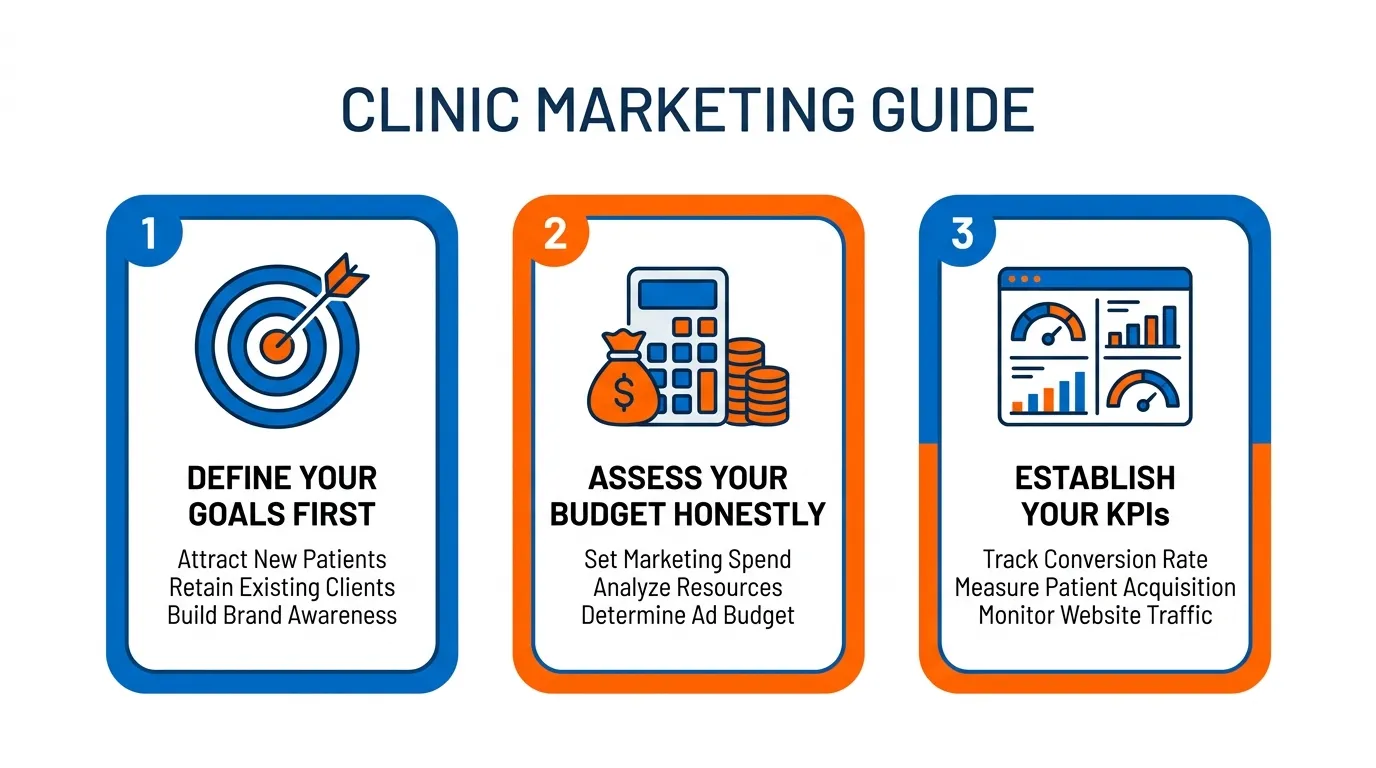
The answer depends on three things: your goals, your budget, and the competitive intensity of your local area. Get those three factors clear before making any decisions, and the rest of the choices become considerably more straightforward.
Define Your Goals First
Before spending a cent on local SEO, be clear about what you are actually trying to achieve. More new patient enquiries per month? Visibility for a specific service, like dental implants or Invisalign? Better performance in a new location you have recently opened?
The goal shapes the strategy. A clinic wanting to rank for general “dentist in Bukit Timah” searches needs a different approach than one aiming to dominate nationally for “sleep dentistry Singapore”.
Assess Your Budget Honestly
Local SEO for a dental practice in Singapore can be handled at different investment levels. Based on current market rates, the following bands are a reasonable guide:
- Self-managed with tools: SGD 100 to 400/month in software costs, plus significant time investment
- Entry-level local agency retainer: SGD 800 to 1,500/month
- Mid-range strategic retainer: SGD 1,500 to 3,000/month
- Full-service campaign with content and link building: SGD 3,000 to 5,000+/month
If you are an eligible SME, it is worth exploring the Productivity Solutions Grant (PSG) from Enterprise Singapore, which can offset up to 50% of the cost of pre-approved digital marketing solutions. This significantly changes the net cost calculation for smaller practices.
Establish Your KPIs
Vanity metrics are easy to generate. Rankings for irrelevant keywords, impressions without clicks, traffic without enquiries. None of that moves the business forward.
The metrics that actually matter for a dental clinic are: new patient enquiry calls (tracked through call tracking), contact form submissions attributed to organic search, Google Business Profile clicks (calls, direction requests, website visits), and Local Pack ranking position for your target service keywords.
4 Easiest Ways To Do Local SEO For Dentists in Singapore (2026)
Step 1: Optimise Your Google Business Profile Categories
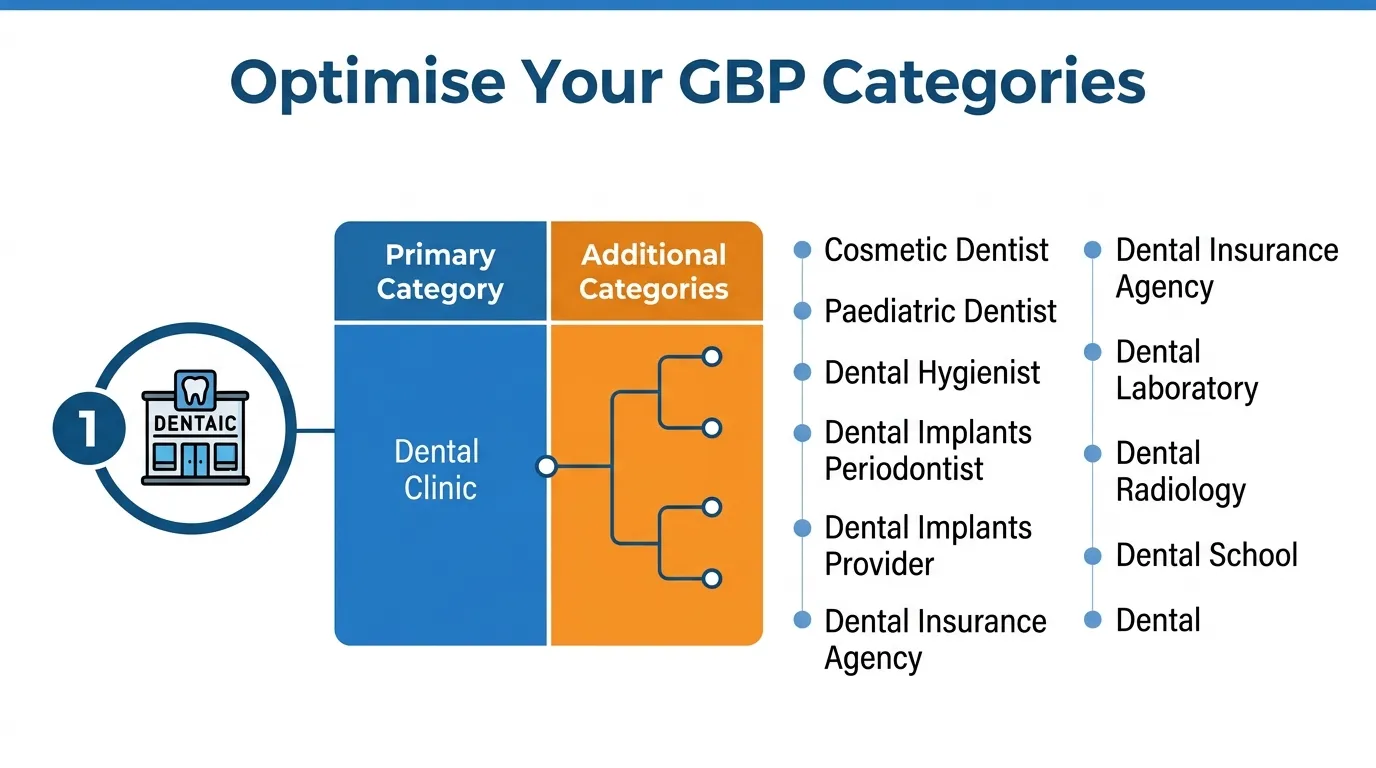
Your Google Business Profile categories tell Google what kind of clinic you are.
This sounds basic, but it is one of the most common local SEO mistakes I see. Many clinics choose only one category, usually “Dental Clinic”, and leave it there. That is better than nothing, but it is rarely enough if you want to show up for a broader set of treatment-specific searches.
Google distinguishes between a primary category and additional categories. The primary category is your main identity.
The secondary categories help Google understand the range of services you offer. Google’s category guidance makes it clear that you should choose the categories that best describe your business, not every category loosely related to dentistry.
Examples of dental-related categories that may be relevant include:
- cosmetic dentist
- pediatric dentist
- dental hygienist
- dental implants periodontist
- dental implants provider
- dental insurance agency
- dental laboratory
- dental radiology
- dental school
- dental supply store
The keyword is relevant. A general clinic should not add categories that do not genuinely reflect its services. More categories do not automatically mean better rankings. Better-fit categories do.
How to Execute Step 1
- Log in to your Google Business Profile.
- Click the nine dots in the top-right corner.
- Select Business Profile Manager.
- Click Edit Profile.
- Click the pencil icon under Business Category.
- Add your primary category if it is not already correct.
- Click Add Another Category.
- Input the additional categories that genuinely match your services.
- Repeat as needed.
- Click Save and wait for the changes to process.
Why Step 1 Is Important
Google uses categories to match search intent.
That means different searches can trigger different Local Pack results. A clinic tagged only as “Dental Clinic” may miss visibility for searches related to cosmetic dentistry, implants, orthodontics, or paediatric services.
In practice, that means missed patient opportunities you could have captured with a better setup. This is one of the easiest forms of low-hanging fruit in local SEO. It is simple, fast, and directly tied to how Google interprets your business.
Step 2: Add Location and Top Service in Your Business Name
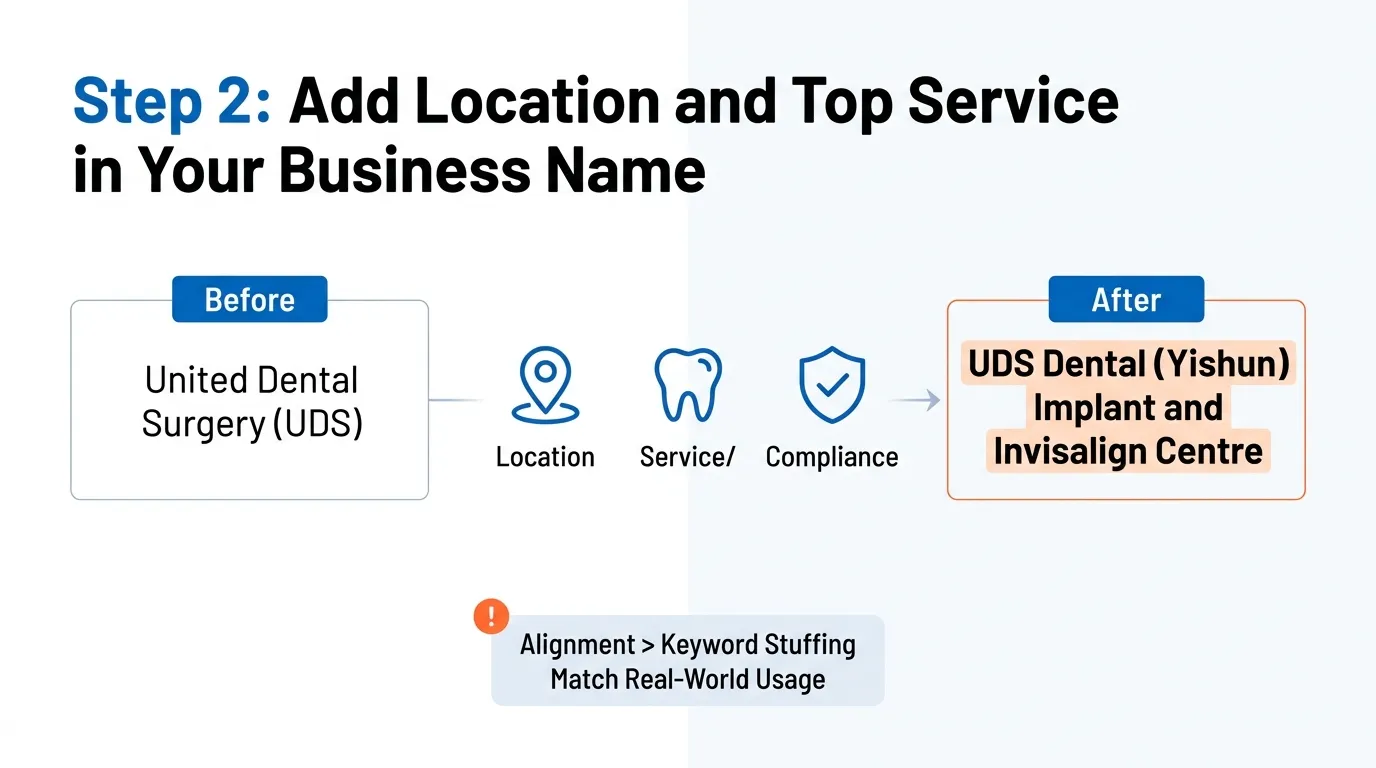
This step is about making your business name more context-rich. In a competitive market like Singapore, Google pays close attention to contextual signals. Your business name is one of the strongest ones.
If a patient is searching for a dentist in Yishun or for Invisalign in Bugis, Google is trying to match location and service relevance as quickly as possible.
A stronger naming format can help. For example:
- From: United Dental Surgery (UDS)
- To: UDS Dental (Yishun) Implant and Invisalign Centre
That said, this point needs an important compliance note. Google’s policy is that your Business Profile name should reflect your real-world business name as used consistently on your storefront, website, and customer-facing materials. Adding extra keywords purely to rank can put the profile at risk.
So the best version of this tactic is not keyword stuffing. It is alignment. If your clinic genuinely trades, signs, and markets itself with a location or service descriptor, use that consistently.
How to Execute Step 2
- Log in to your Google Business Profile.
- Click the nine dots.
- Select Business Profile Manager.
- Click Edit Profile.
- Click the pencil icon under Business Name.
- Update the name using a format like:
Business Name + (Location) + Core Service - Click Save.
Why Step 2 Is Important
Google relies on contextual relevance. A business name that clearly reflects location and speciality can help your clinic match:
- location-based searches
- service-specific searches
- blended location-and-service searches
This is often one of the fastest ways to improve local visibility, but only when done credibly and in line with Google’s rules. Used properly, it sharpens relevance. Used carelessly, it can create compliance problems.

Step 3: Add Your Business Name in Other Languages
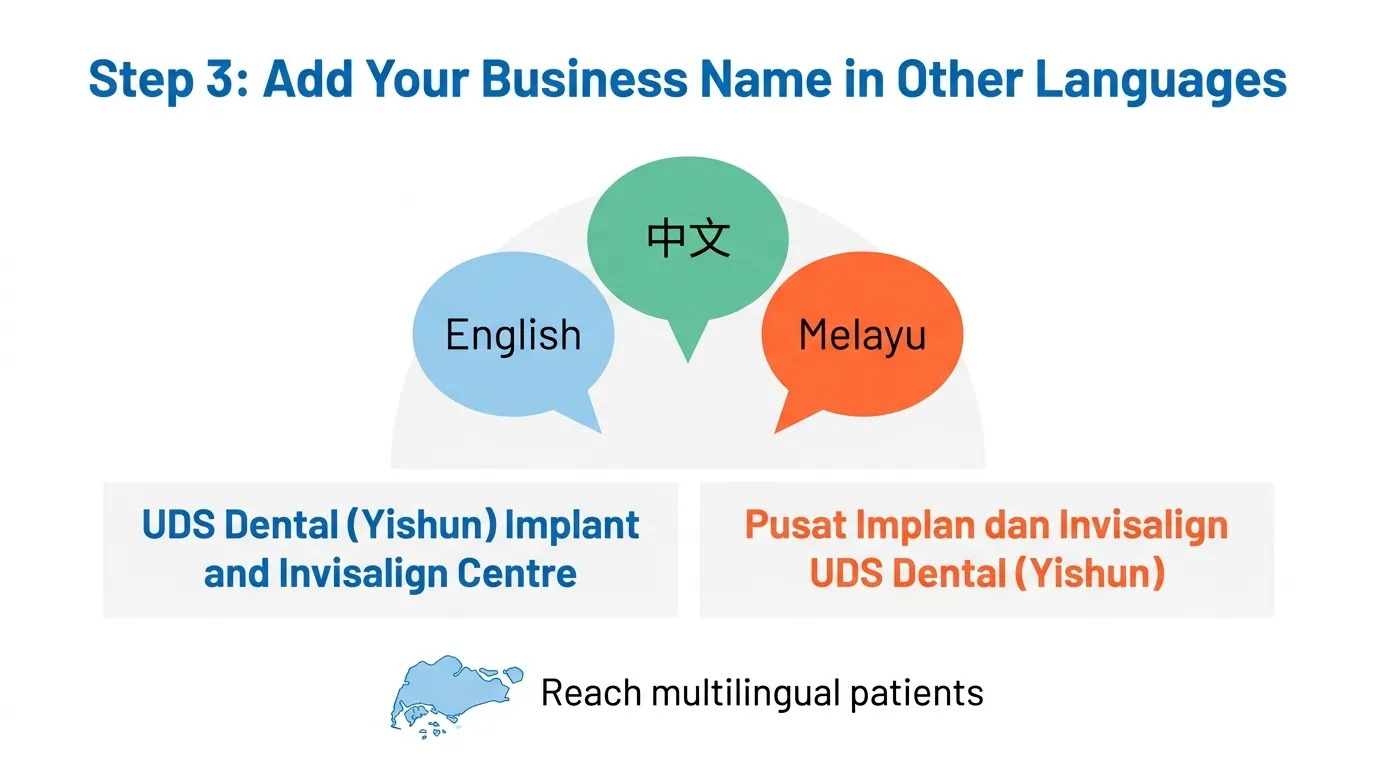
Singapore is multilingual, and search behaviour reflects that.

Not every patient searches in English. Some users search in Mandarin. Others search in Malay. In some cases, the Local Pack results differ depending on the language interface or the wording of the query. That creates an overlooked opportunity for clinics that serve multilingual communities.
If your clinic is genuinely known by a translated or alternative-language name, adding that variation can help you reach additional searchers.
For example:
- English: UDS Dental (Yishun) Implant and Invisalign Centre
- Malay: Pusat Implan dan Invisalign UDS Dental (Yishun)
How to Execute Step 3
- Go to Google Maps.
- Click the menu icon with the three lines.
- Select Language.
- Choose another language.
- Search for your business.
- Scroll down and click Suggest an Edit.
- Choose the first option to edit the business details.
- Enter the translated business name.
- Click Save.
Why Step 3 Is Important
Different languages can produce different search results.
That means multilingual optimisation can expand your visibility beyond the English-speaking audience. For clinics operating in areas with diverse language usage, this can improve reach, increase Local Pack visibility, and capture a segment of patients your competitors may be ignoring.
As with the business name itself, the translated name should be genuine, usable, and consistent with how your clinic is actually known.
Step 4: Optimise Local SEO on Your Website
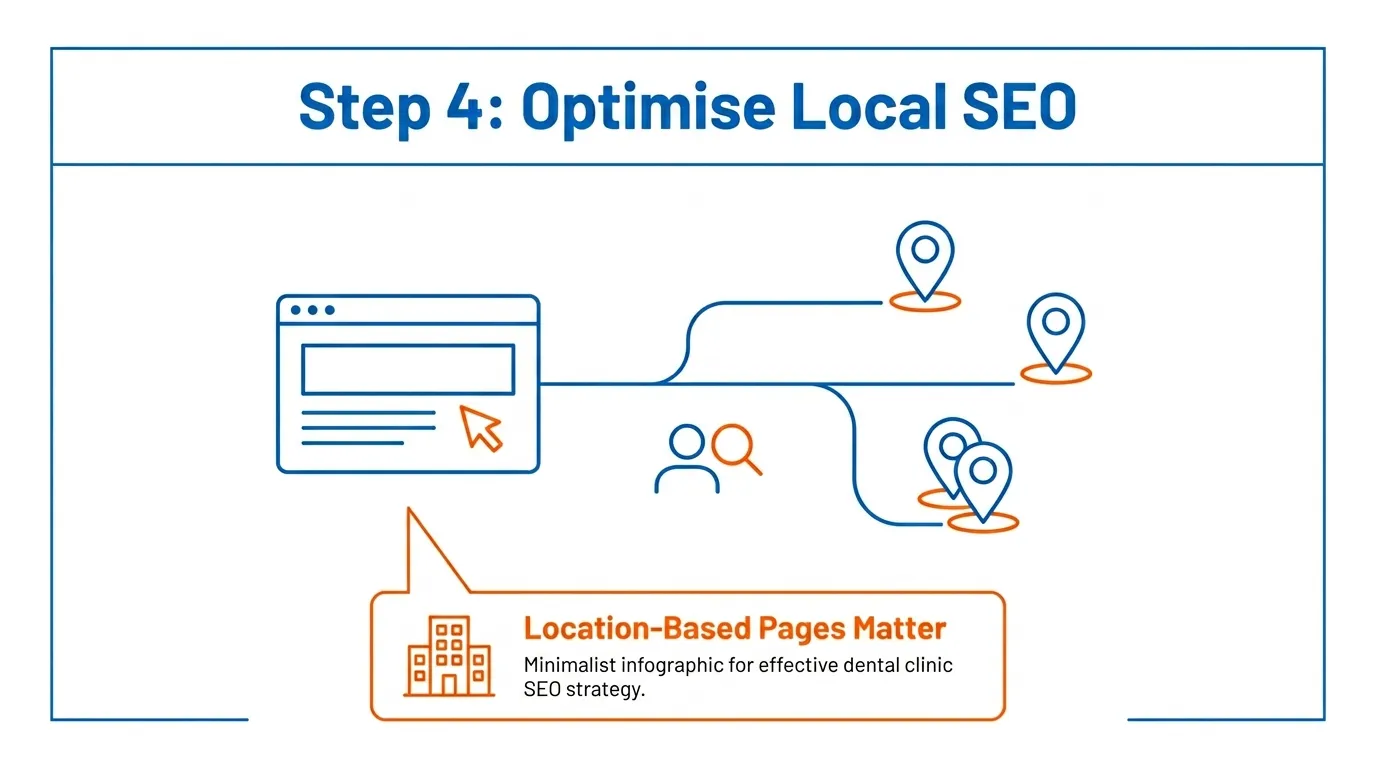
Your Google Business Profile helps you get discovered. Your website helps Google trust what your clinic is about.
For dental clinics, especially those with multiple branches, this is where many local SEO strategies fall apart. The clinic may have a single general website, a single contact page, and a vague list of services, but nothing that clearly tells Google which branch serves which area.
Patients do not search for “a dentist somewhere in Singapore”. They search for a dentist near them.
That is why location-based pages matter.
How to Execute Step 4
- Create a dedicated page for each branch.
- Use a clean URL structure, such as: https://yourclinic.sg/yishun
- Make the content specific to that location.
- Mention the area consistently in headings, copy, metadata, and contact details.
- Include relevant services offered at that branch.
- Add the branch address, phone number, opening hours, and embedded map.
- Make sure each page includes a clear call to action for booking or enquiries.
Why Step 4 Is Important
Google prefers localised content when the search intent is local.
A proper location page helps your clinic rank for branch-specific searches, aligns with what nearby patients actually want, and supports stronger relevance signals overall. It also improves content quality in a YMYL category like healthcare, where accuracy, clarity, and local specificity matter.
If you have multiple branches and only one generic contact page, you are leaving rankings on the table.
What This Looks Like in Practice
A dental clinic can have good branding, competent dentists, and a decent website, and still struggle to appear in the Local Pack.
That usually happens because the fundamentals are incomplete.
In one practical rollout, a clinic that had weak visibility implemented all four steps:
- Expanded and corrected its Google Business Profile categories
- Improved its naming structure in a compliant, consistent way
- Added multilingual business naming where relevant
- Created proper location pages for each branch
- Supported the setup with backlinks and stronger localised content
Within six months, around 40 percent of its target keywords were ranking on page one. Local Pack visibility improved, organic traffic increased, and bookings grew as a result.
That is the point worth emphasising. The gains did not come from some exotic tactic. They came from getting the fundamentals right and keeping them consistent.
Why These Steps Work
These steps are simple, but they are not small.
They work because they align with how local search actually works. Categories improve relevance. Business naming sharpens context. Multilingual naming broadens discoverability. Location pages strengthen website-level local intent.
Each step makes the next one stronger.
And importantly, these are not tasks reserved for SEO specialists. A clinic owner, practice manager, or marketing team can implement them with focus and patience. The work is methodical. The results are measurable.
If This Feels Like a Lot, That Is Normal
There are several moving parts here, and yes, it takes time.
That is the part many clinic owners underestimate. Local SEO is not difficult because the steps are not mysterious. It is difficult because the execution needs consistency. Profiles need updating. Pages need writing. Listings need checking. Reviews need managing. And all of that has to be done properly in a regulated healthcare environment.
That is where outside support can make sense.
Our team at MediaOne can help diagnose what is holding your clinic back, prioritise the highest-impact fixes, execute the strategy clearly, and maintain the work over time. If you are not sure whether your clinic has a naming issue, a category issue, a location-page issue, or all three, a proper audit is usually the fastest place to start.
Eligible SMEs may also want to check current support under the Productivity Solutions Grant before committing to a digital marketing spend with Enterprise Singapore.
Troubleshooting Common Local SEO Issues
Most local SEO problems are not mysterious. In my experience, they come down to a small set of recurring issues that compound quietly over time, leading to stalled or declining rankings.
The table below covers the most common issues I see in dental clinics in Singapore, what usually causes them, and what to do about them.
| Issue | Likely Cause | Recommended Action |
| Low visibility in Local Pack | Incomplete GBP profile, weak relevance signals | Revise GBP description, add services, update photos |
| Inconsistent rankings across locations | NAP inconsistencies across directories | Conduct a full citation audit and correct discrepancies |
| Low click-through from GBP impressions | Poor review count or low rating | Implement a structured review acquisition process |
| High website traffic, low enquiries | Weak on-page conversion elements | Add visible CTAs, appointment forms, and click-to-call buttons |
| Negative reviews are damaging the reputation | Patient dissatisfaction or competitor reviews | Respond professionally, investigate the issue, and build positive review volume |
| Ranking plateau despite effort | Competitive local market, weak backlink profile | Build local links, produce localised content, and audit technical issues |
Standards, Accreditations, and Credentials
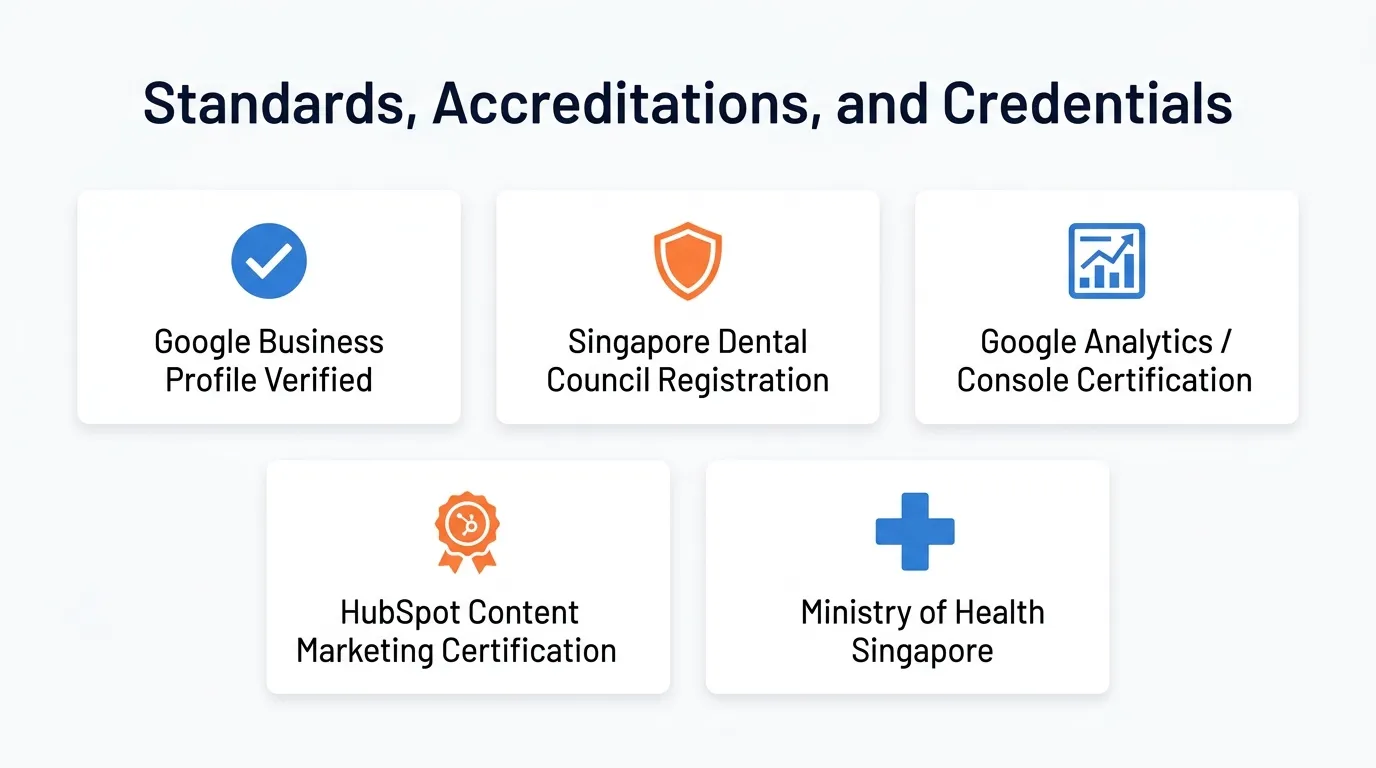
For dental clinics in Singapore operating in the digital space, the following credentials are worth being aware of, both as validation of competence and as signals of content that build trust with patients and search engines.
| Credential | Issuing Body | Relevance |
| Google Business Profile Verified | Confirms legitimacy to Google and to patients viewing your listing | |
| Singapore Dental Council Registration | Singapore Dental Council | Regulatory requirement: mentioning this on your site signals credibility |
| Google Analytics / Search Console Certification | Relevant for in-house marketing staff tracking SEO performance | |
| HubSpot Content Marketing Certification | HubSpot Academy | Useful for staff managing clinic content and patient communications |
| MOH-compliant marketing practices | Ministry of Health Singapore | Healthcare advertising in Singapore is regulated; your SEO content should reflect this |
A point worth making explicitly: the Ministry of Health Singapore has specific guidelines on healthcare advertising. Your website copy and GBP content should be factually accurate, avoid making unsubstantiated claims about treatment outcomes, and not use patient testimonials in ways that could be misleading.
A good local SEO strategy for a dental clinic in Singapore must operate within this framework, not around it.
Start Implementing Local SEO for Dentists in Singapore
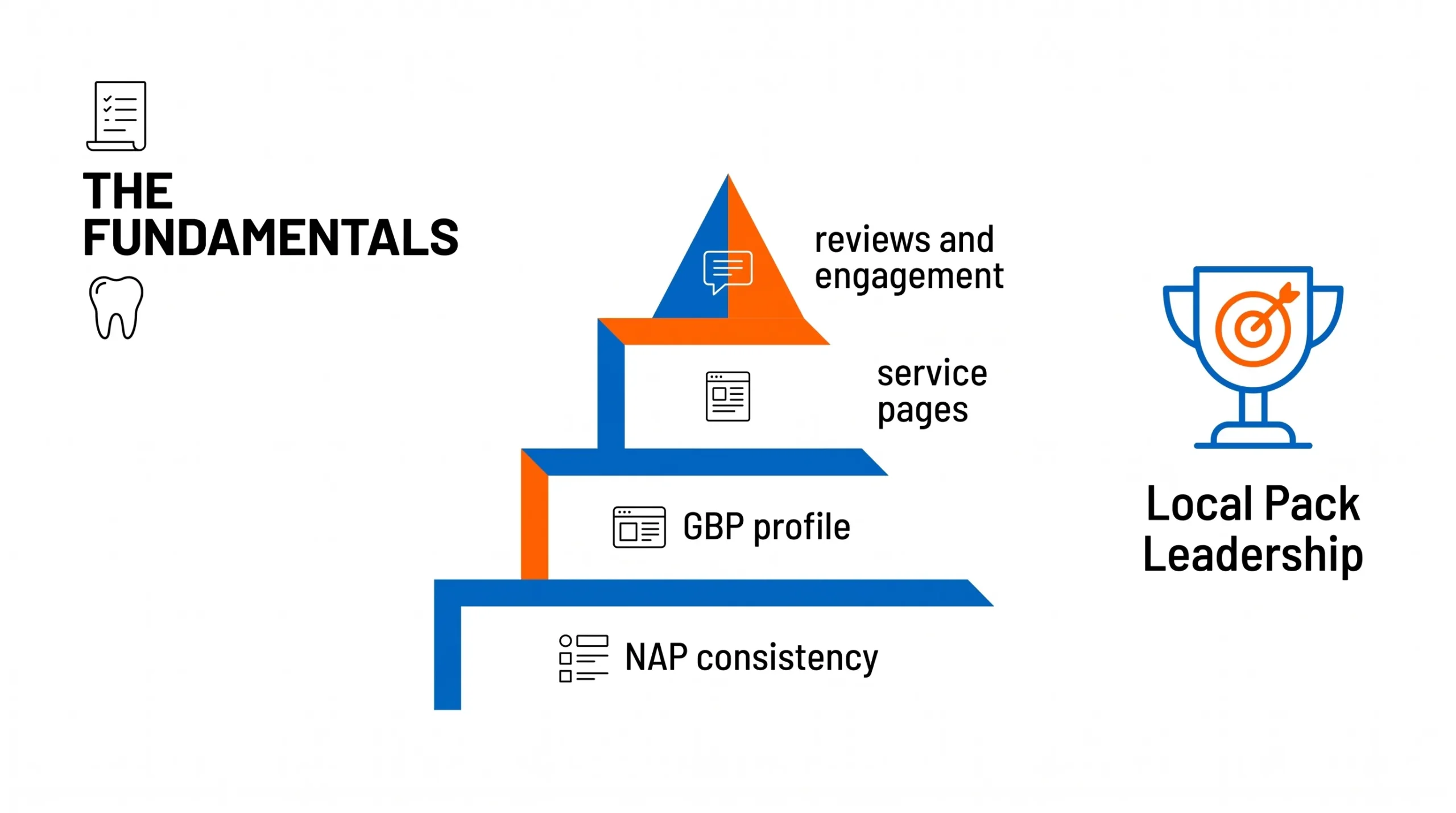
Local SEO for dentists in Singapore does not need to be overcomplicated.
If you optimise your categories, carefully strengthen your business name, add legitimate multilingual variations, and build proper location pages, you put your clinic in a much stronger position to compete in Google’s Local Pack.
These are practical steps. They are actionable. And they are powerful precisely because most clinics still have not implemented them properly.
If you want to understand where your clinic stands now, the next sensible step is to conduct a local SEO audit and develop a roadmap. That gives you clarity on what is broken, what is missing, and what will move the needle first.
If you are unsure where to begin, booking a consultation is a sensible way to get direction before investing heavily. Sometimes a short audit saves months of trial and error.
Want to know why your clinic is not showing up in Google’s Local Pack?
Book a consultation and get a practical local SEO audit, a clear diagnosis of the issues, and a roadmap for what to fix first.
Whether you want full execution or simply expert advice before making a decision, the right next step is to get clarity.
Frequently Asked Questions
What is the cost of local SEO services for dentists in Singapore?
Costs vary depending on the scope and provider. Most SME dental clinics starting out invest between SGD 800 and SGD 1,500 per month for a local SEO retainer with a Singapore-based agency. More competitive campaigns, or those involving regular content production and link building, typically fall in the SGD 1,500 to SGD 3,000 per month range. Eligible SMEs can apply for the Productivity Solutions Grant (PSG) to offset up to 50% of costs for pre-approved digital marketing solutions.
How long does it take to see results from local SEO?
The honest answer is three to six months for meaningful competitive rankings. Foundational fixes, such as completing your Google Business Profile, correcting citation inconsistencies, and improving on-page elements, can produce visible improvements within four to eight weeks. Clinics in highly competitive areas, such as the Orchard or CBD corridor, should plan for a longer runway.
What are common misconceptions about local SEO for dental practices?
The most common one I frequently encounter is the belief that having a nice website is enough. It is not. Your GBP, your citation profile, your review volume, and your on-page localisation signals all contribute independently. Another misconception is that local SEO is a one-off project. It requires ongoing maintenance to sustain and build upon initial gains.
How can I evaluate the quality of my local SEO strategy?
Track the metrics that connect directly to business outcomes: new patient enquiry calls from organic search, GBP-attributed direction requests and website clicks, and Local Pack ranking positions for your priority service keywords. If your agency is reporting impressions and keyword counts without connecting those to patient volume or revenue, that is a conversation worth having.
What should I do if my practice receives negative online reviews?
Respond promptly, professionally, and without becoming defensive. Acknowledge the patient’s experience, offer to resolve the matter offline, and invite them to contact the clinic directly. Never argue publicly in the review thread. A well-managed response to a negative review can itself be a trust signal to prospective patients reading your profile. Long-term, the most effective remedy is building a substantially larger volume of genuine positive reviews.
Are there specific local SEO tactics that work better in the Singapore market?
Yes, several. Singapore patients are highly mobile in their search behaviour, so mobile site performance and GBP usability matter more than they might in other markets. The city’s density means that hyperlocal targeting, with content referencing specific estates, MRT stations, and nearby landmarks, is particularly effective.
Multilingual metadata and content can also yield significant advantages in areas with high non-English-speaking populations. And given the regulated nature of healthcare advertising under MOH guidelines, a compliant but strategically strong approach to patient reviews and testimonials gives clinics that get it right a meaningful edge over those who have never considered it.