Think back to a decade ago. If you asked an SEO expert about keyword density, you’d probably get a calculator and a strict 5% target. But things have changed. In 2026, stuffing your content with the exact phrase over and over is a thing of the past, and that’s a good thing.

So, are keywords dead? Not at all. Keyword placement matters more than ever, it’s just become smarter and more subtle.
In 2026, search engines do more than match words, they understand intent, context, and nuance. They read almost like people. If you want your content to appear, you need to know not just which keywords to use, but where to place them so your page is relevant and easy to read.
In this guide, I’ll walk you through how to master keyword placement and density in 2026. We’ll bust some common myths, cover the latest SEO agency practices, and share easy-to-use templates so you can optimise your content for Google’s newest updates.
Key Takeaways
- Strategic placement in high-impact locations (title tags, H1s, first 100 words) matters more than density percentages.
- Modern SEO demands semantic variations and related terms, not exact-match repetition.
- Google’s NLP understands context, synonyms, and related concepts.
- Unnatural keyword repetition triggers Google penalties that reduce visibility.
- Perfectly placed keywords won’t rank if the content doesn’t match user intent.
What is Keyword Placement & Why It Matters in 2026
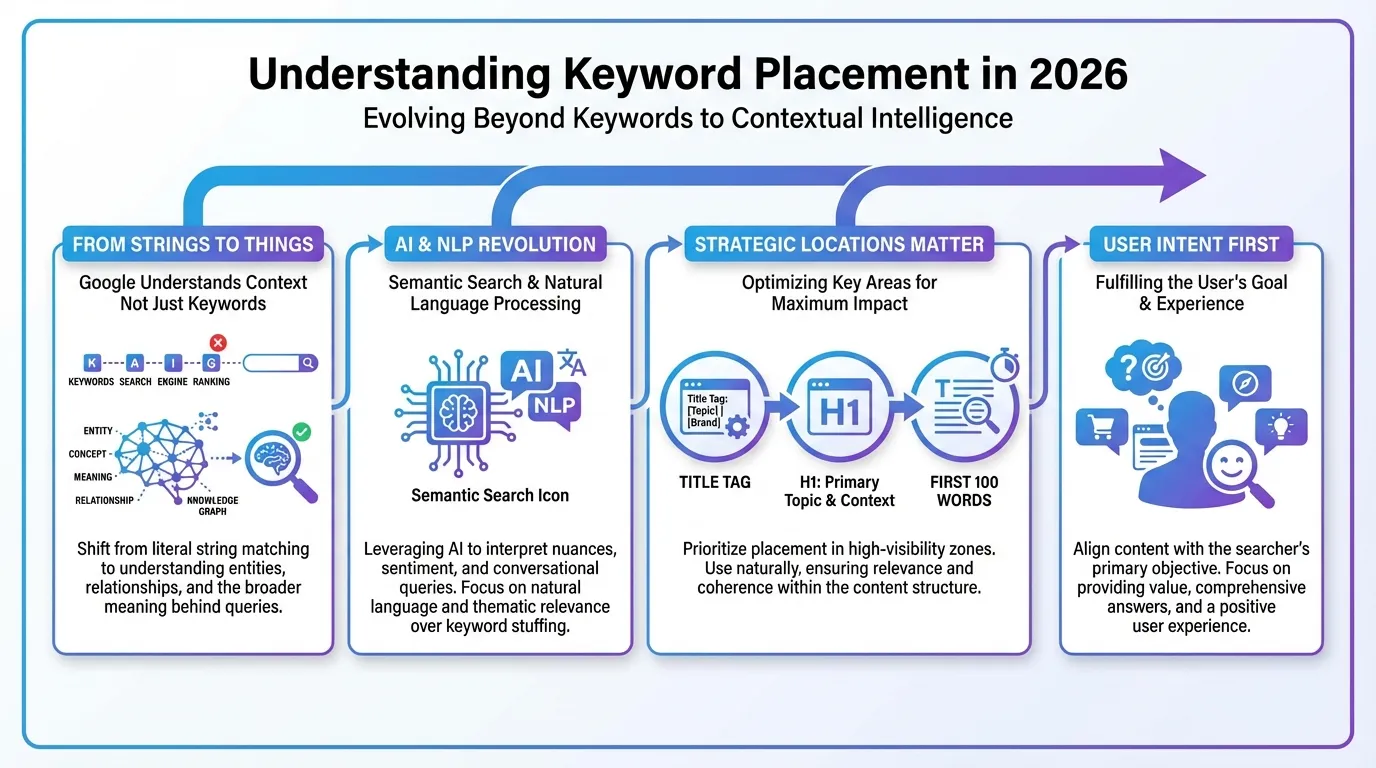
Before we get into where to put your keywords, let’s talk about why it matters. Search engines like Google have evolved from simple directories into smart, AI-powered answer engines. They use advanced language models to understand your content.
Keyword placement means putting your main keywords in the right spots on your page so both search engines and people instantly know what your content is about. In 2026, specific locations carry more weight than others because they signal relevance to both search algorithms and human readers.
Why these positions matter:
- Rankings: Google’s AI prioritises keywords in high-visibility zones (title tags, H1s, first 100 words) as primary relevance signals
- AI Summaries: ChatGPT, Gemini, and Google’s AI Overviews extract content from keyword-rich headings and opening paragraphs
- Click-Through Rates: Keywords in titles and meta descriptions directly influence whether users click your result
From Keyword Counting to Position Priority
Google’s AI now understands concepts, not just exact word matches. This shift changed everything about placement strategy.
What this means for placement:
- Then: Keyword anywhere on the page counted equally
- Now: Keywords in titles, headings, and introductions carry 10x more weight than body mentions
Example: A keyword appearing in your H1 signals “this is the main topic.” The same keyword, buried in paragraph 12, signals a “minor related point.”
Effective keyword placement in 2026 is about mapping your content to the topic cluster it belongs to. Partner with a trusted SEO agency like MediaOne for better results.
Semantic Keywords: Expanding Your Placement Strategy
You’ll hear the term “semantic keywords” a lot. These are words and phrases that are closely related to your main topic.
Semantic keywords are related terms that reinforce your main topic. They matter for placement because they help Google verify you’re covering the topic comprehensively, not just repeating one phrase.
How this affects placement:
- Main keyword: Place in title, H1, first 100 words, conclusion (4-6 times total)
- Semantic variations: Distribute throughout H2s, H3s, body content (8-12 times total)
Example placement strategy for “keyword placement”:
- Title tag: “Keyword Placement Guide 2026″ ← exact match
- H2: “Strategic Keyword Positioning Techniques” ← semantic variation
- H3: “Where to Place Keywords for Maximum Impact” ← natural variation
- Body: Mix of “keyword placement,” “strategic positioning,” “where to put keywords”
This approach shows Google you’re covering the full topic while avoiding robotic repetition in any single location. It’s not just about your main keyword anymore. You also want to sprinkle these related terms throughout your content to help search engines understand the full context.
The Truth About Keyword Density SEO
Let’s talk about keyword density. Is there a magic number you should aim for in 2026?
The short answer: no. Keyword density measures how often keywords appear, but this year, where they appear matters more than how many times.
Density helps you avoid two placement mistakes:
- Under-optimisation: Keyword appears only once (in paragraph 8) → Google unsure of main topic
- Over-optimisation: Keyword appears 50 times → Obvious manipulation, triggers penalties
For a 1,000-word article:
- Target keyword: 5-8 appearances strategically placed
- Semantic variations: 8-12 appearances
- Total keyword family: ~15-20 mentions
Strategic placement beats random repetition:
- Wrong: Keyword appears 20 times, but the first mention is at word 247
- Right: Keyword appears 8 times, with first mention at word 3 (in H1)
Some old SEO tools still warn you if you don’t use enough keywords. Ignore them if your writing sounds natural. In 2026, using too many keywords is a red flag for low quality. It looks like you’re writing for bots, not people.
There’s no strict rule, but aiming for 1% to 2% keyword density is a good target. If you stay focused, you’ll usually hit this range without trying.
Pro tip: Read your content out loud. If it sounds awkward or you keep repeating the same phrase, you’ve probably overdone it. Cut back on keywords until it sounds natural, like something you’d say to a friend.
9 High-Impact Keyword Placement Spots
Now, let’s get practical. You’ve got your main keyword (like “keyword placement”) and some secondary keywords (like “keyword density SEO”). Where should you put them? Here are the 9 key spots to focus on in 2026.
1. Title Tags (The SEO Heavyweight)

The title tag remains one of the strongest on-page relevance signals and directly influences click-through rate.
- Best Practice: Place your main keyword as close to the beginning of the title as possible.
- Example: “Keyword Placement Guide: How to Rank in 2026″ works better than “A Complete Guide to 2026 SEO and Keyword Placement.”
Search engines increasingly evaluate titles for both relevance and intent. AI-powered SERPs often use the title to generate summaries or answer boxes, so a clear, keyword-aligned title can increase visibility beyond the traditional snippet.
Early keyword placement also signals priority and focus to algorithms scanning hundreds of pages.
2. Meta Descriptions

Meta descriptions don’t directly affect your rankings, but they’re key for getting clicks. A higher click-through rate tells Google your content is relevant.
- Best practice: Work your main keyword naturally. If it matches what someone searches for, Google will often bold it in the results, making your listing pop.
- Drafting tip: Write your meta description like an ad. Tell people why they should click, and make sure your keyword matches what you’re offering.
Higher competition and SERP features mean clicks matter more than ever. AI-generated search previews may pull meta content directly, so having concise, keyword-relevant descriptions ensures your page is accurately represented.
Well-written meta descriptions can boost CTR, which, in turn, strengthens the page’s perceived authority.
3. H1 Tag (Your Headline)

Stick to one H1 tag per page. This is your main headline and tells both users and search engines they’re in the right place.
- Best practice: Put your main keyword in the H1. It doesn’t have to match your title tag exactly, but it should be close.
- 2026 update: Make sure your H1 matches what people are looking for. If they want a guide, use the word “Guide.” If they want to buy, use action words that fit.
Search engines cross-check H1s with content and query intent to validate relevance. A strong, keyword-aligned H1 improves chances of appearing in rich results or AI summarised content.
It also enhances user experience by clearly signalling what the page covers, reducing bounce rates.
4. First 100 Words (The Introduction)

Google pays more attention to the top of your page than the bottom. Show right away that your content is relevant.
- Best practice: Use your main keyword in the first paragraph, ideally in the first sentence or two.
- Why it matters: People have short attention spans. If they don’t see right away that your article answers their question, they’ll leave.
Early relevance confirmation supports AI summarisation and snippet selection. If users and algorithms immediately see that the content matches their query, engagement improves, which is a stronger ranking signal than ever.
5. H2 and H3 Subheadings

Subheadings make your content easier to scan and help search engines understand your structure.
- Best practice: Put your main keyword in at least one H2. Use related terms or secondary keywords in other subheadings.
- Example: Notice how the headings in this very article include “Understanding Keyword Placement” and “The Truth About Keyword Density SEO.”
Clear subheadings make content scannable for both users and AI systems. Structured headings can increase eligibility for featured snippets, People Also Ask boxes, and AI-generated summaries. They also reinforce semantic relevance across sections, helping search engines understand content hierarchy and context.
6. The URL Slug

A short, clear URL builds trust. It lets people know what your page is about before they even click.
- Best practice: Keep your URL short, use lowercase letters and hyphens, and include your main keyword.
- Example: yourwebsite.com/keyword-placement-density/ is far better than yourwebsite.com/blog/post-ID-12345/.
Clean, keyword-aligned URLs improve both human trust and machine readability. AI and search systems can parse URLs to confirm topic alignment, which is especially useful when your page is linked or shared outside the main site. Short, descriptive URLs also support enhanced SERP features such as sitelinks and rich cards.
7. Image Alt Text

Google can’t see images the way people do. It uses alt text to determine what’s in the image, which also helps with accessibility.
- Best practice: Write accurate alt text for your images. If your keyword fits naturally, include it.
- Caution: Don’t force keywords into alt text if they don’t fit. For example, if your image is a chart about placement strategies, “Chart showing strategic keyword placement zones” works well.
Visual search and AI-driven content understanding rely heavily on alt text. Correct alt descriptions improve accessibility while giving search engines strong contextual signals about page content.
Optimised images can also appear in image search or AI-powered multi-modal results, driving incremental traffic.
8. Body Content (The Meat)

This is where you use your secondary keywords and related terms.
- Best practice: Mix in variations and synonyms naturally. For example, if your main keyword is “digital marketing agency,” also use terms like “online marketing firm” or “internet advertising company.”
- This keeps your writing fresh and can help you rank for long-tail keywords you might not have considered.
Semantic understanding now drives ranking more than exact keyword density. AI and intent-based search evaluate the depth and coherence of content to determine relevance.
Rich, naturally optimised content can rank for multiple long-tail variations, increasing coverage across queries.
9. Anchor Text (Internal Links)

- Anchor text is often overlooked. When you link to other pages on your site, the words you use for the link matter.
- Best practice: Use descriptive anchor text with your target keyword. Avoid generic phrases like “click here.”
Internal linking signals topical authority and improves crawl efficiency. Keyword-rich anchors help algorithms contextualise the destination page. In AI-powered search and content summarisation, structured linking supports both ranking and discoverability of related pages.
3 Ready-to-Use Templates for Proper Keyword Placement
To make your life easier, we have created three templates you can copy and paste to streamline your optimisation process.
Template 1: Blog Post Keyword Optimisation Checklist
Pre-Publishing Check:
- [ ] Primary Keyword: ___________________
- [ ] Is it in the Title Tag? (Front-loaded?)
- [ ] Is it in the URL Slug? (Short & clean?)
- [ ] Is it in the H1 Tag?
- [ ] Is it in the First 100 Words?
- [ ] Is it in at least one H2 Subheading?
- [ ] Is it in the Meta Description?
- [ ] Is it in the Image Alt Text of at least one relevant image?
- [ ] Does the Keyword Density feel natural (approx. 1-2%)?
- [ ] Have I used 3-5 Semantic/Secondary Keywords?
Template 2: Product/Service Page Keyword Map
Use this to organise keywords for core landing pages.
Page Name: ___________________
- Primary Keyword (High Volume): ___________________
- (Place in H1, Title, URL, Intro)
- Secondary Keyword 1 (Context): ___________________
- (Place in H2, Body Paragraph 1)
- Secondary Keyword 2 (Problem/Solution): ___________________
- (Place in H2, Body Paragraph 3)
- Long-Tail Question (FAQ): ___________________
- (Place in H3 or FAQ Schema section)
- Conversion Keyword (CTA): ___________________
- (Place near the button/form, e.g., “Get your [Keyword] audit”)
Template 3: Content Brief Template
Hand this to your writers to ensure perfect placement every time.
Topic: [Insert Topic]
Target Word Count: [e.g., 2,000 words]
Primary Keyword: [Insert Keyword]
SEO Instructions:
- Please ensure the primary keyword appears in the first sentence.
- Include the following LSI/Semantic terms naturally throughout the text:
- [LSI Keyword 1]
- [LSI Keyword 2]
- [LSI Keyword 3]
- Use the primary keyword in the H2 heading for the section about [Specific Sub-topic].
- Avoid using the primary keyword more than once every [X] sentence to prevent stuffing.
- Write a meta description (max 155 chars) including the primary keyword.
Monitoring & Optimising Keyword Strategy (2026)
In 2026, SEO is increasingly dynamic. Search engines rely on AIand real-world engagement metrics, so your keyword strategy must be continuously monitored and optimised to stay competitive. Effective monitoring ensures you capture trends early, identify underperforming content, and refine targeting based on actual user behaviour.
1. Track Keyword Rankings
Monitor how your target keywords perform in SERPs over time.
- Best practice: Use rank-tracking tools to check positions daily or weekly, and segment by device, location, and search intent.
- Optional example or tip: Focus on high-value “money keywords” and long-tail variants that show rising traffic potential.
AI-driven search personalises results, so rankings can fluctuate more frequently. Consistent tracking helps you respond to volatility, detect content gaps, and adjust optimisation strategies before competitors do.
2. Analyse Click-Through Rates (CTR)
CTR shows how compelling your title, meta description, and SERP snippet are.
- Best practice: Compare CTR against impressions and search position; optimise titles and descriptions if CTR is below benchmark.
- Optional example or tip: Test different calls-to-action or value propositions in meta descriptions to improve engagement.
Even if your content ranks well, low CTR signals to search engines that your page may not satisfy intent. Improving CTR strengthens perceived relevance and can directly boost AI-powered ranking signals.
3. Monitor Engagement Metrics
Metrics like dwell time, bounce rate, and scroll depth indicate user satisfaction.
- Best practice: Use analytics tools to track engagement for each keyword-driven page. Optimise content for clarity, readability, and alignment with intent if engagement is low.
- Optional example or tip: Break long content into sections with clear H2/H3 headings and multimedia to maintain attention.
AI now interprets engagement signals to assess content quality and relevance. Pages with higher dwell time and interaction are more likely to be featured in snippets and AI-generated summaries.
4. Identify Keyword Opportunities
Look for keywords where your pages rank on pages 2–3 or queries gaining traction.
- Best practice: Expand content, add related terms, or create dedicated pages for these keywords.
- Optional example or tip: Use internal linking to boost underperforming pages that are close to ranking.
Search engines increasingly reward relevance and topical authority over exact-match keywords. Spotting emerging queries allows you to capture traffic early and maintain topical dominance.
5. Update & Refresh Content
Regular content updates keep pages relevant to current search intent.
- Best practice: Refresh statistics, examples, and keywords, and prune outdated sections.
- Optional example or tip: Republish or reindex updated content to signal freshness to search engines.
Content decay can reduce rankings even for high-authority pages. Fresh, updated content improves AI recognition of topical relevance and increases chances of appearing in rich results.
7 Keyword Placement Mistakes That Hurt Your Rankings

Even experienced SEOs slip up sometimes. In 2026, these mistakes can quickly hurt your rankings.
1. Keyword Stuffing (Still!)
It’s worth repeating: forcing keywords where they don’t fit makes your content hard to read. If a sentence feels awkward, rewrite it. User experience is a ranking factor. If people leave because your writing is bad, your rankings will drop. Google’s AI models (BERT, MUM) detect unnatural repetition instantly. High keyword density triggers quality filters, pushing your content below competitors’ natural-language content.
The fix:
- Aim for 1-2% total density (5-8 main keyword uses per 1,000 words)
- Use semantic variations: “strategic positioning,” “where to place keywords,” “optimisation techniques”
Tip: Read aloud. If you stumble, readers will too
2. Ignoring Search Intent
You can have perfect keyword placement, but if you write a guide when people want to buy, you’ll miss the mark. Check the search results before you start writing. Are the top results blog posts, product pages, or videos? Match your format to what’s already ranking.
Ranking a 2,000-word guide for “buy running shoes online” (transactional intent) when searchers want product pages with prices and checkout buttons.
Google’s algorithm prioritises content format matching user intent. Even with flawless keyword placement in titles and headings, wrong content type = high bounce rate = ranking drop.
The fix:
- Search your target keyword in incognito mode
- Analyse top 5 results: Are they guides, product pages, videos, or listicles?
- Match that format, then optimise placement within it
- 2026 update: Check if AI Overviews appear. If yes, structure content as Q&A with concise answers
3. Cannibalisation
Google must choose which page to rank. Your authority splits across multiple URLs, and often a weaker page ranks instead of your best content.
This happens when you optimise two pages for the same keyword. You end up competing with yourself and splitting your authority. Make sure each page has its own main keyword.
What it looks like:
Three pages targeting “keyword placement guide”:
- /keyword-placement-tips/
- /seo-keyword-guide/
- /where-to-place-keywords/
Google must choose which page to rank. Your authority splits across multiple URLs, and often a weaker page ranks instead of your best content.
The fix:
- Audit your site: Search site:yourdomain.com “target keyword” in Google
- Consolidate: Merge similar pages via 301 redirects
- Differentiate: Assign unique keywords to each page (e.g., “keyword placement” vs “keyword density” vs “SEO keyword strategy”)
Tool tip: Use Google Search Console → Performance → Queries to find overlap
4. Neglecting the “People Also Ask” Section
Many writers skip over questions. In 2026, answering specific questions (like those in Google’s “People Also Ask” box) is a great way to win featured snippets. Use the exact question as a subheading and answer it right below.
The “People Also Ask” (PAA) box contains high-intent questions that users actively search. Not addressing them = missed opportunities for featured snippets.
AI Overviews and ChatGPT responses pull directly from content that answers specific questions. PAA optimisation puts you in position zero and AI-generated summaries.
The fix:
- Search your target keyword → copy PAA questions
- Use exact questions as H2/H3 subheadings
- Answer in 40-60 words directly below the heading
- Format: Use <h2>How do I optimise keyword placement?</h2> followed by concise paragraph
- Bonus Tip: Add FAQ schema markup for rich results
5. Forgetting Mobile Users
Putting your keyword in the first 100 words is even more important on mobile. If users have to scroll to find what they need, they’ll leave. Get to the point quickly.
70%+ of searches happen on mobile. If users can’t immediately see your keyword/topic match, bounce rates spike. Google’s mobile-first indexing prioritises above-the-fold content.
What it looks like:
- Desktop: Keyword appears in first paragraph (visible above fold)
- Mobile: First paragraph starts at 2-3 scrolls down (below header, ads, images)
The fix:
- Place target keyword in first 50 words (not just first 100)
- Test on an actual mobile device, not just responsive design mode
- Minimise header height, banner images, and pop-ups
- 2026 priority: Core Web Vitals penalise slow mobile load times. Compress images, lazy load below-fold content
6. Over-Optimising Anchor Text
If every internal link uses the same phrase, like “best SEO services,” it looks unnatural. Mix it up with phrases like “our services,” “SEO solutions,” or even just the URL.
Another example could look like this:
- “Learn about keyword placement”
- “Our keyword placement guide”
- “Best keyword placement strategies”
Repetitive exact-match anchors trigger over-optimisation filters. Google’s algorithm expects natural variation in how you link to pages.
The fix:
- Distribution rule: 40% branded/natural, 30% exact match, 20% partial match, 10% generic
- Examples:
- Exact: “keyword placement strategies”
- Partial: “strategic keyword positioning”
- Branded: “MediaOne keyword guide”
- Natural: “learn where to place keywords effectively”
- Generic: “Read our complete guide”
Audit with Screaming Frog → View internal anchor text distribution
7. Ignoring Schema Markup
Schema (structured data) tells search engines exactly what your content contains—articles, FAQs, how-tos, products, reviews, etc. Not using Schema means missing out on extra visibility.
AI search engines (ChatGPT, Perplexity, Google’s AI Overviews) rely heavily on structured data to understand and cite content. No schema = lower chance of appearing in AI-generated answers and rich results.
The fix:
- Minimum viable schema: Add Article schema with headline, author, datePublished
- For guides/tutorials: Add HowTo schema with step-by-step instructions
- For Q&A content: Add FAQPage schema for each question/answer pair
- Validation: Use Google’s Rich Results Test
- WordPress: Install Rank Math or Yoast SEO, both of which auto-generate basic schema
2026-specific advantage: Structured data increases visibility in AI chatbots, citing sources. When ChatGPT references your content, schema helps it extract accurate information.
Advanced Keyword Placement Techniques for 2026

To really stand out, you need to go beyond the basics. Here’s how top SEO teams approach keyword placement in 2026.
Topic Clusters and Pillar Pages
A content architecture where one comprehensive pillar page targets a broad keyword, linking to 8-12 cluster pages that each target specific long-tail variations.
Don’t just focus on single keywords. Build topic clusters. Start with a big pillar page on a broad topic (like “Digital Marketing”) and link out to smaller pages on related topics (like “Email Marketing,” “SEO,” or “PPC”).
Placement strategy:
Pillar Page (broad, high-volume keyword):
- Target: “keyword placement” (1,200 searches/month)
- URL: /keyword-placement-density/
- H1: “Complete Keyword Placement Guide 2026”
- Keyword placement: Title, H1, first 100 words, 3-4 H2s, conclusion
- Word count: 2,500+ words covering all aspects
Cluster Pages (specific long-tail keywords):
- /keyword-placement-title-tags/ → “keyword placement in title tags” (320 searches/month)
- /keyword-placement-meta-descriptions/ → “meta description keyword optimisation” (210 searches/month)
- /keyword-placement-mistakes/ → “common keyword placement errors” (180 searches/month)
Use your pillar page for the main, high-volume keyword. Use your cluster pages for specific, long-tail keywords. Link them together to build authority and show Google how your content is connected.
Entity SEO and Knowledge Graphs
Google wants to see that you’re an authority. Be specific about what you offer. For example, instead of just saying “we do SEO,” list out your services like “technical SEO audits,” “link building campaigns,” and “on-page optimisation.”
Entity-based understanding helps Google match your content to nuanced queries. When you explicitly list related entities, you appear for more variations of your target keyword.
For example:
- Before (vague entity): We offer SEO services to help businesses rank higher.
This is wrong because Google sees generic “SEO services” entities.
After (specific entities):
MediaOne provides specialised SEO services, including:
- Technical SEO audits for site speed and crawlability
- Strategic keyword placement optimisation
- Link building campaigns with high-authority domains
- On-page content optimisation for conversions
- Local SEO for Singapore-based businesses
This is correct because Google sees distinct service entities + location entity
Listing these specific services helps Google’s Knowledge Graph understand who you are and shows you’re an expert in your field.
Tip: Place your most important entities in the first 300 words. Google’s NLP models prioritise entities that appear early in a document when building Knowledge Graph connections.
Optimising for AI Overviews (SGE)
With Google’s AI Overviews now common, your content needs to be ready for snippets. AI often pulls short, clear definitions from your page. Structuring content so Google’s AI Overviews (formerly SGE) and ChatGPT can extract it as authoritative answers.
Position zero (featured snippets) receives ~35% of clicks. AI Overviews appear in 60%+ of informational queries. Being cited = visibility and traffic, even without a top-3 ranking.
Strategy: Add a section that clearly defines your topic. For example, start with “What is keyword placement? Keyword placement means…” This makes it easy for AI to pull your answer for users.
Check if your target keyword already has an AI Overview by searching in incognito mode. If yes, study the format Google extracts (definition? list? table?) and mirror that structure with your keyword placement.
Master Keyword Placement and Let Your Content Work Harder
Mastering keyword placement and density in 2026 isn’t about tricking the system. It’s about clear communication. You want both search engines and people to know, “Yes, this is exactly what you’re looking for.”
By using keywords in the right places, from your H1s to your URLs, and avoiding keyword stuffing, you’ll create content that ranks and connects with readers. Keep your density natural (1-2%), use related terms, and always put the user’s intent first.
SEO takes time, but these basics set you up for long-term success. Algorithms will change, but clear, relevant, and well-structured content will always matter.
If you are ready to take your digital presence to the next level but need a team of experts to guide the way, look no further than MediaOne. We specialise in crafting bespoke strategies that drive real results.
Don’t leave your rankings to chance. Contact us today!
Frequently Asked Questions
How often should I update my keyword strategy?
Review and update your keyword strategy every 3-6 months to stay competitive. Fast-moving industries like technology and finance require quarterly reviews, whilst evergreen topics only need annual updates. Monitor your rankings monthly and refresh content whenever you notice drops or when competitors publish superior content.
Can I use the same keyword for multiple pages on my website?
No, using the same keyword across multiple pages creates keyword cannibalisation, where your own pages compete against each other. Instead, use the primary keyword for one pillar page and target related long-tail variations across supporting pages. This creates a topic cluster that strengthens your overall authority without internal competition.
What’s the difference between keyword placement and keyword stuffing?
Keyword placement is the strategic positioning of keywords in high-impact locations to help search engines understand your content’s relevance. Keyword stuffing is the practice of unnaturally repeating keywords to manipulate rankings, a tactic Google now penalises. Focus on natural language that prioritises user experience whilst strategically incorporating keywords.
Do I need different keyword placement strategies for voice search vs. text search?
Yes, voice search requires longer, conversational, question-based keywords (who, what, where, when, why, how) that match how people speak. Optimise for featured snippets and create FAQ sections, as voice assistants often read these aloud. Text search can use shorter, more direct keywords like “best Italian restaurant London,” whilst voice search would be “What’s the best Italian restaurant near me?”
Which free tools can I use to check my keyword placement and density?

Use Yoast SEO (WordPress plugin), SEOReviewTools, or SmallSEOTools to check keyword density. Google Search Console shows which keywords you’re ranking for, whilst AnswerThePublic and Google’s “People Also Ask” reveal semantic keyword variations. Combine these tools with manual review; if your content sounds unnatural when read aloud, you’ve likely over-optimised.