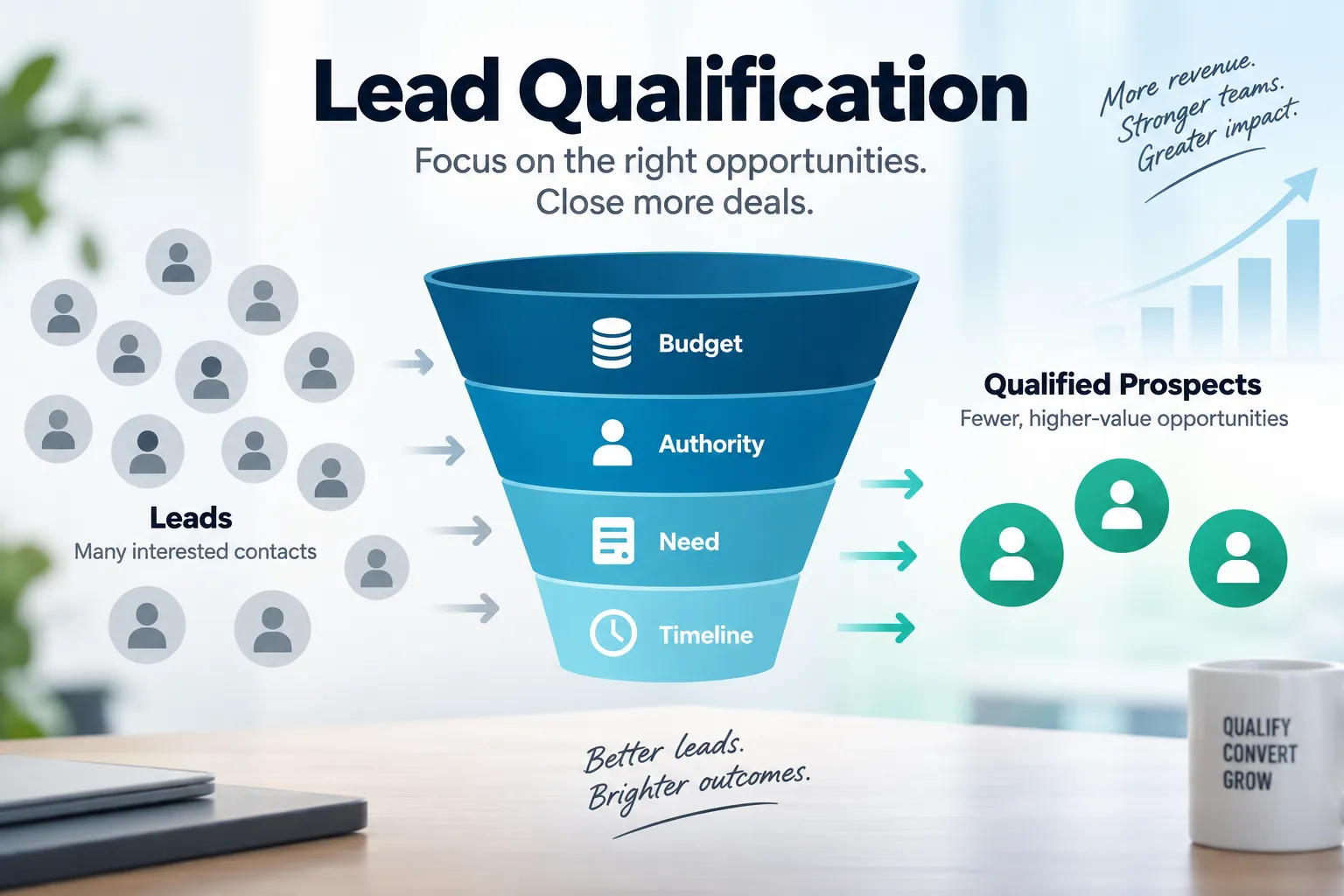
Lead qualification is the process of evaluating whether a prospect has the budget, authority, need, and timeline to become a paying customer. It sits between two critical activities: lead generation, which attracts interested contacts, and sales engagement, which closes deals.


This distinction matters in practice. Lead generation casts a wide net: “Does this person work in tech?” Lead qualification narrows focus: “Does this person’s company have the budget to spend on our solution within the next quarter?” One prioritises volume. The other prioritises viability.
For clarity, this guide uses “lead” to mean an initial contact and “prospect” to mean a qualified lead. The distinction helps you track whether qualification is actually working.
The Cost of Pursuing Unqualified Leads
Without qualification, sales efforts target prospects unlikely to convert. Unqualified leads consume sales capacity without revenue return.
Every hour a sales representative spends on a prospect who cannot buy is an hour wasted when they could have focused on one who can.
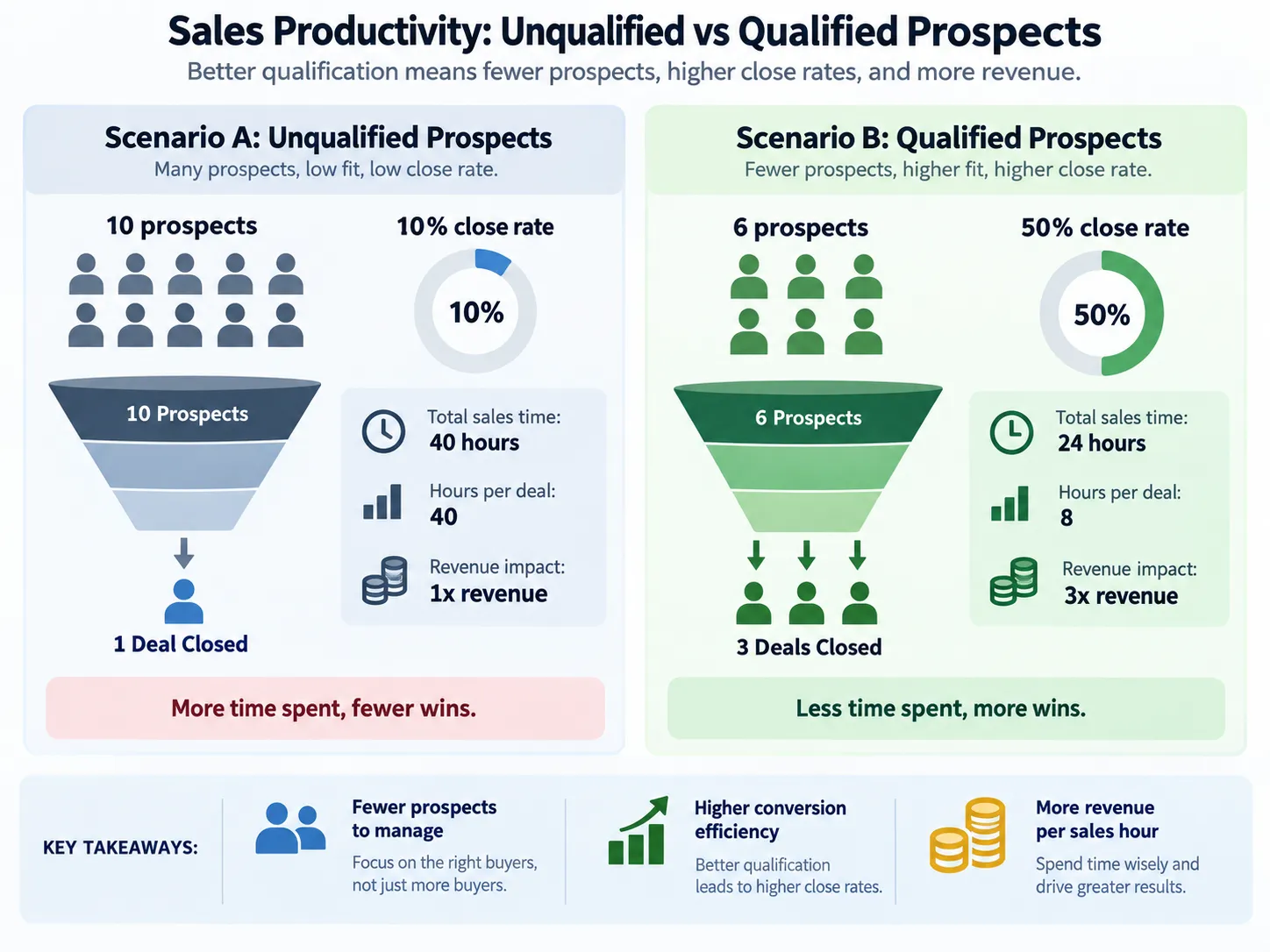
Sales teams operate on a finite number of conversations per period. When many of those conversations are with unqualified leads, close rates fall. Sales cycles lengthen. Revenue becomes unpredictable.
Enterprise sales cycles often range from several months to over a year, depending on deal size and industry. During that time, a single deal can consume dozens of hours: discovery calls, demos, proposal work, negotiation, and legal review. If that deal was never qualified, those hours are wasted. Worse, while your rep pursued that unqualified deal, they missed out on three qualified deals they could have closed instead.
The mathematics illustrate the impact. A rep with 10 prospects and a 10% close rate closes 1 deal. A rep carrying 6 prospects with a 50% close rate closes 3 deals. Better qualification means the rep carries fewer prospects but closes more revenue.
Unqualified leads also damage team dynamics. When marketing sends poor-quality leads, sales questions marketing’s competence. When sales fails to close those leads, marketing questions whether sales is actually trying. The two teams stop working together. Forecasting becomes unreliable. Hiring and resource planning follow the wrong signals.
Resource drain spreads across teams. Unqualified leads trigger unnecessary demos, contracts, and negotiation cycles. Product and customer success teams spend time onboarding buyers who never had budget authority. Legal and finance get drawn into deals that will collapse in final stages because a decision-maker was never in the room. The result is an organisation that feels busy but generates less revenue per headcount than competitors who qualify harder upfront.
The Difference Between Qualification Frameworks
Not all leads are equal, and your business model fundamentally shapes how you qualify them. B2B and B2C organisations operate under different constraints: sales cycle length, deal complexity, buyer committee size, and decision authority all shift how you evaluate whether a prospect is worth pursuing.
Knowing which framework fits your motion prevents you from wasting effort on criteria that don’t match your market.
B2B Frameworks: BANT, MEDDIC, and CHAMP
B2B qualification frameworks emerged from enterprise sales teams chasing large, complex deals. Each prioritises different signals.
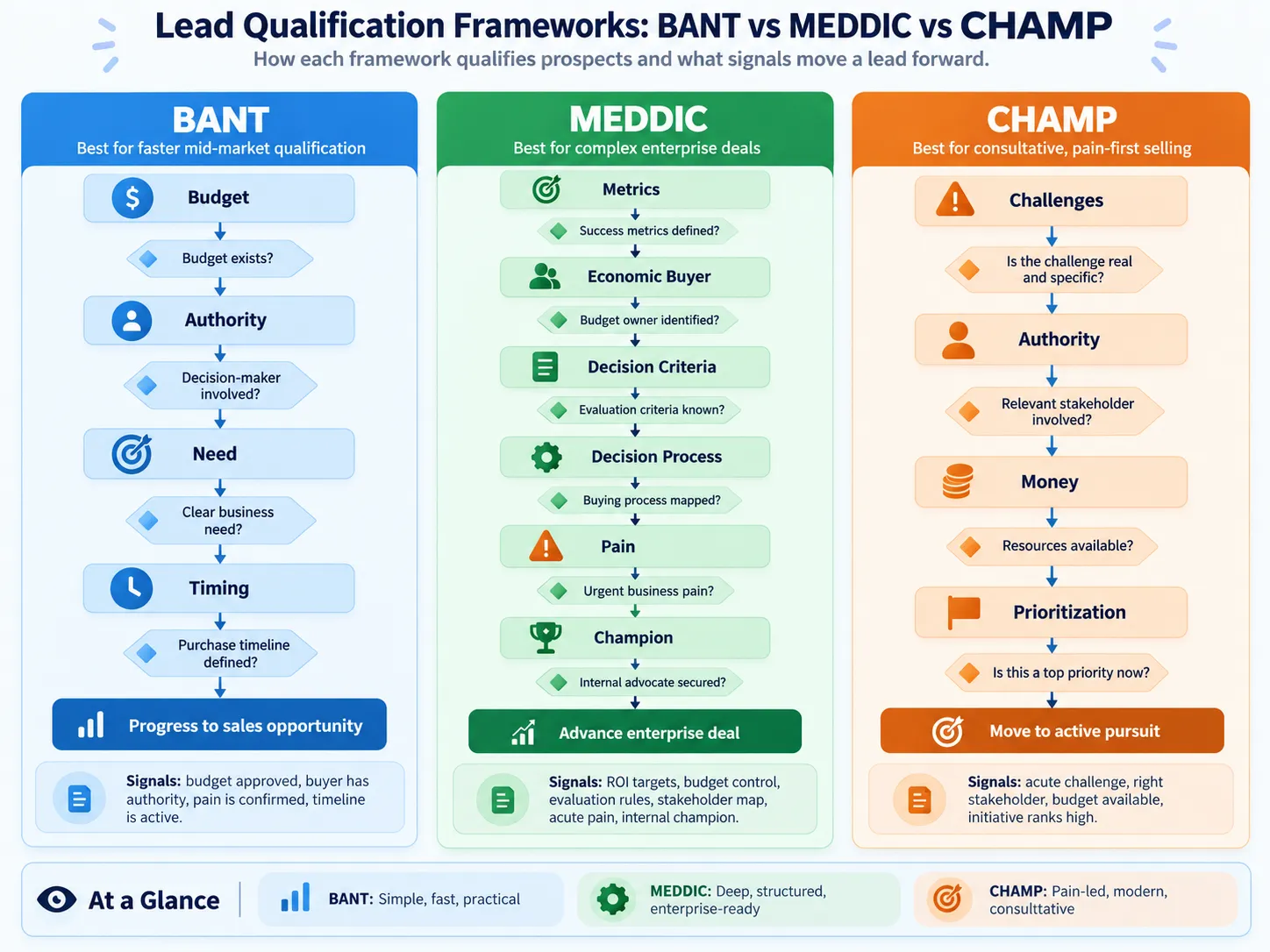
BANT (Budget, Authority, Need, Timing) is the oldest standard. You verify whether a prospect has allocated budget, holds decision-making power, faces a real problem your product solves, and has a timeline to buy. It works well for mid-market deals where you need speed and clarity quickly. The weakness: it assumes a single decision-maker and does not surface competition or the buyer’s existing solution.
MEDDIC (Metrics, Economic Buyer, Decision Criteria, Decision Process, Identify Pain, Champion) adds these layers. It is used by SaaS teams selling large deals. You map the full buying committee, uncover who controls the budget (the Economic Buyer, not always the first person you talk to), document how they will measure success, and find a champion inside their organisation to advocate for you. MEDDIC suits deals where multiple stakeholders influence the decision and can help reduce deal slippage. It takes longer to qualify but extends pipeline visibility.
CHAMP (Challenges, Authority, Money, Prioritisation) flips the order. Instead of starting with budget, you lead with the prospect’s pain. Do they face a challenge your product addresses? Then verify authority and budget. Does your solution rank high on their priority list compared to other projects competing for resources? CHAMP suits modern buyer behaviour: prospects research solutions before sales calls, so pain alignment often surfaces first.
Here is how they compare:
| Framework | Best For | Sales Cycle | Key Strength | Key Limitation |
|---|---|---|---|---|
| BANT | Mid-market, faster deals | 3-6 months typical | Fast qualification, simple gates | Misses buying committee dynamics |
| MEDDIC | Enterprise, complex deals | 6-18+ months typical | Detailed mapping, surface champion | Requires senior reps, slower qualification |
| CHAMP | Modern buyers, product-aware prospects | Consultative selling | Leads with pain, builds urgency | Assumes pain is known upfront |
Choose BANT if your deal size is smaller and you need to move fast. Use MEDDIC if you are selling to large enterprises where the budget sits with a steering committee. Deploy CHAMP if your buyers are already researching solutions when they reach you.

B2C Qualification: Behaviour, Fit, and Intent Signals
B2C qualification looks nothing like B2B. You are not mapping a buying committee or verifying budget authority. Instead, you read behavioural patterns and engagement depth to predict who will convert.
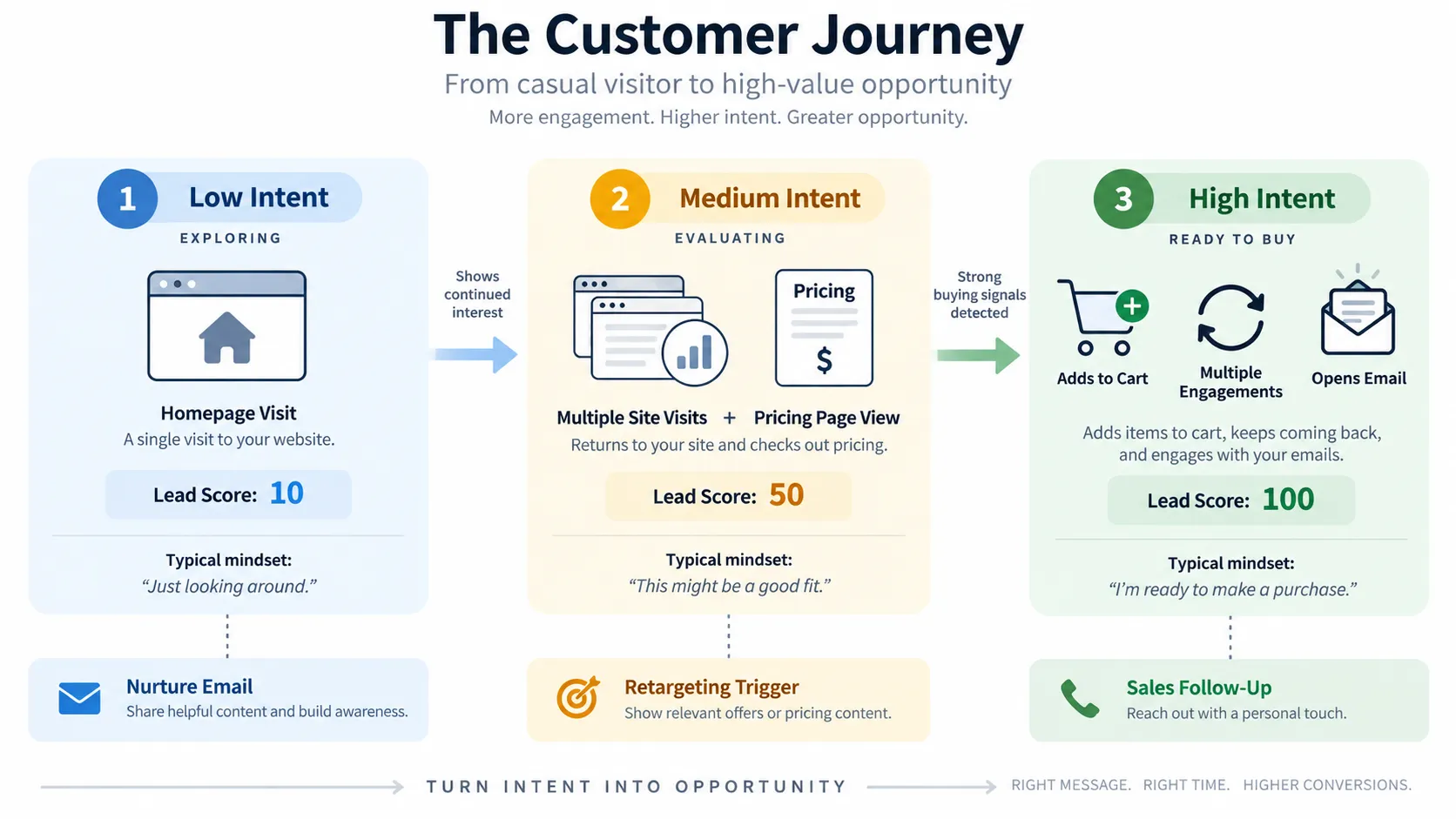
Behavioural signals are your primary lens. Did they visit pricing? How many product pages did they view? Did they download a comparison guide or watch a demo video? Did they return to the site multiple times over days or weeks? Repeat visits and specific page sequences generally correlate with purchase intent. Email open rates, click-through behaviour, and content consumption depth provide a clearer picture of their engagement.
Fit metrics in B2C focus on demographic and psychographic alignment. Are they in your target age group, income bracket, or lifestyle segment? Have they shown interest in related products or categories? Do they live in a geography where you ship or operate? For subscription products, fit metrics also include device type and traffic source.
Purchase intent combines both signals. A first-time visitor who arrived via organic search and spent 90 seconds on your homepage is lower intent than someone who returned three times in a week, viewed pricing, added items to a cart, and opened every email. The latter is ready to move quickly.
B2C teams use behavioural scoring to automate this: they assign points for actions (example weightings: a page view equals 5 points, an email open equals 2 points, and a cart addition equals 20 points), sum the score, and trigger follow-up when a lead crosses a threshold. The advantage is speed and scale: you can qualify hundreds or thousands of leads daily. The trade-off is noise: intent signals are noisier than organisational criteria, and casual browsers can sometimes appear high-intent if they engage with educational content without serious buying intent.
Choosing Your Framework: Market Size, Deal Complexity, and Sales Cycle
Your choice depends on three dimensions: the size of your addressable market, the complexity of the buying decision, and the typical length of the sales cycle.
Market size matters first. If you are selling to thousands of potential customers, qualify them via behaviour and intent scoring. You don’t have the sales team’s bandwidth to do one-on-one qualification for every prospect. If your market is 500-2,000 accounts, BANT or CHAMP work well: you have more reps per lead, and decisions move faster. If you are targeting 50-200 enterprise accounts, use MEDDIC: deal sizes justify the qualification depth, and missing a competitor or misidentifying the Economic Buyer will cost you deals.
Deal complexity drives framework richness. A smaller annual software subscription needs less investigation than a large implementation project. Simple products do not usually need MEDDIC’s full buying committee mapping. Complex, multi-stakeholder deals fail if you skip the full MEDDIC process.
Sales cycle length compounds both factors. A 2-3 month B2C purchase cycle does not justify a 6-week qualification period. You qualify quickly and move quickly. A 12-18 month enterprise deal tolerates and demands deep qualification, as you will spend months nurturing it anyway.
Most practical teams blend frameworks rather than adopt one rigidly. A B2B SaaS company might use CHAMP to qualify inbound leads quickly (does the prospect have pain you solve? Do they have budget authority? Then graduate qualified leads to MEDDIC-style investigation during the discovery call (map the buying committee, find the champion, document their decision process). A B2C ecommerce brand combines behavioural scoring with demographic fit checks, triggering cart automation based on purchase intent.
Start with the framework that matches your market size and deal complexity. Refine it after you have qualified 50-100 real leads and see which questions actually correlate with close rates.
Step-by-Step Lead Qualification Process
Qualification only works when you follow a repeatable workflow. One-off decisions fail because they lack consistency and data. The five steps below turn qualification from a guessing game into a measurable, scalable process you can defend to sales leadership.
Step 1: Audit Your Lead Sources and Data Quality
Before you qualify anything, know where your leads come from and how clean they are.
Run a data audit across your lead sources. Include website forms, paid ads, content downloads, partner referrals, inbound email and sales outreach. For each source, calculate three metrics:
- Completion rate: What percentage of leads have all required fields (name, company, email, phone)?
- Duplicate rate: How many leads appear twice or more in your database?
- Domain validity: What percentage use corporate email addresses versus free (Gmail, Yahoo) domains?
Document your baseline. Inaccurate data here will impact your scoring later. If 40% of leads from paid ads lack a company name, you cannot score fit against your ICP until you fix that source.
Ask the teams that feed leads into your system: marketing, sales, and partnerships. Most data quality problems trace back to how you capture leads, not qualification itself. A form asking 15 questions will have higher abandonment and worse data than one asking three.
Step 2: Define Your Ideal Customer Profile (ICP)
Your ICP is the blueprint for who qualifies. Without it, qualification is arbitrary.
Build your ICP using these attributes:
Company demographics: annual revenue range (e.g., SGD 7M to SGD 70M), employee count, industry, geography, growth stage (bootstrap, Series A, or profitable).
Technical requirements: technology stack they currently use, integration needs, security compliance (SOC 2, GDPR, ISO 27001), data volume or user count.
Business context: business model (B2B SaaS, manufacturing, ecommerce), team size in the relevant department (sales, marketing, engineering), budget owner and approval process.
Problem severity: Which of your top three pain points do they experience? How acute is it (nice-to-have versus revenue-blocking)?
Purchase timeline: When do they need a solution? This quarter, next fiscal year, or exploratory.
Get specific. “Mid-market SaaS” is useless. ” SGD 14M to SGD 140M annual revenue, a SaaS company in Southeast Asia with a sales team of 20+ and currently using Salesforce” is actionable.
Interview your last five customers who became high-value accounts. What did they have in common? Interview five customers who churned or never closed. What was different? This ground-truth work takes two weeks but sets qualification accuracy for the next 12 months.
Document your ICP in a one-page matrix. Sales and marketing both sign off. Changes to ICP need approval so you can trace why qualification criteria shifted.
Step 3: Score Leads Against Fit and Intent
Scoring combines two dimensions: fit (how close to your ICP) and intent (how ready to buy).
Fit scoring: Compare each lead to your ICP profile. Award points for each match:
- Company revenue in your range: 20 points
- Industry match: 15 points
- Headcount in your target department: 15 points
- Company currently using a competing solution: 10 points
- Located in your served geography: 10 points
Total fit: 70 points possible.
Intent scoring: Look for behavioural signals that the lead is actively interested:
- Downloaded a product comparison or pricing page: 15 points
- Visited your product demo page twice in the last 30 days: 15 points
- Opened three or more emails in the last two weeks: 10 points
- Filled a form requesting a demo or trial: 20 points
- Mentioned a problem in their form submission that matches your solution: 10 points
Total intent: 70 points possible.
Note: These are example weightings. Your own scoring should reflect the behaviours that have historically predicted your wins.
Set your qualification threshold: leads scoring 100+ points across both dimensions are SQL (Sales Qualified Leads). Leads scoring 70-99 are MQL (Marketing Qualified Leads) and are sent to nurture. Leads below 70 are excluded or recycled each month.
This scoring method is transparent and repeatable. A lead that scores 85 on fit but only 20 on intent needs nurture, not a sales call yet. A lead with 30 fit but 65 intent is interested but misaligned with your product, so nurture education around use cases instead.
Update scoring weights quarterly based on your win-rate analysis. If leads score high on intent but low on fit still convert, increase the intent weight. If your best customers all have 50+ employees, increase headcount points.
Step 4: Route Qualified Leads to Sales Within 24 Hours
Qualified leads must reach sales within 24 hours. Response time drives conversion.
Use your CRM to automate routing. Leads scoring 100+ go to the assigned sales rep, trigger an immediate email, and appear in a daily qualified-lead report. Most CRM platforms (Salesforce, HubSpot, Pipedrive) support this workflow natively.
MQL leads (70-99 points) enter a nurture campaign, not the reject pile. They are interested but not ready. Your nurture sequence should:
- Provide education on your solution and use cases (not a sales pitch).
- Re-score every 30 days as engagement increases.
- Recycle into the qualified queue if they hit 100+ points.
Unqualified leads (below 70) are not a failure: they are feedback. Track why they scored low. If a high-intent lead failed to qualify due to poor fit data (missing company size), the problem is your ICP or capture process, not the lead.
Set monthly cadence: every 30 days, re-score the entire MQL database. Leads that grew in engagement (opened emails, visited your site again) may now qualify.
Document hand-off criteria between marketing and sales. Sales wants speed; marketing wants accuracy. This tension is healthy if you both agree on the threshold: “When a lead hits 100 points, marketing has delivered a ready-to-talk prospect. Sales owns the conversation from there.”
Step 5: Track and Refine Monthly
Qualification criteria are not set-and-forget. They drift as your market, product and customer base evolve.
Run a monthly qualification report with these metrics:
Win rate by qualification score band: Compare leads scoring 100-120, 120-150 and 150+ points. Which band converts fastest?
Average deal size by band: Do higher-scoring leads close at higher values?
Sales cycle length: Do qualified leads move faster through your pipeline than unqualified ones?
Rejection rate: What percentage of leads do sales mark as unqualified after receiving them from marketing? If it is above 10%, your threshold is too low.
If your 100-120 band converts at 5% but your 140+ band converts at 18%, your threshold is too low. Please consider raising it to 130 and re-routing the 100-129 band back to nurture.
If your sales team rejects 25% of incoming leads as unqualified, interview them to understand why. Common reasons include: the company is too small, they are currently on a locked-in contract, or the budget owner isn’t involved. Those reasons are fit data you can capture at intake and score against.
Adjust your ICP and scoring at least annually. If you acquired 10 customers in Q2 but your ICP predicted only 4 of them would be a fit, something is off. Your ICP was too narrow, or you’re missing fit data at capture.
Document every change to your qualification framework with a date and rationale. This audit trail prevents qualification from becoming a black box that no one trusts.
Key Qualification Criteria and Thresholds
Moving from frameworks to practice requires measurable criteria. Your qualification decision gates live here: the specific attributes and signals that separate prospects worth pursuing from those consuming sales resources without revenue return.
Budget and Authority
Budget is the hardest qualification criterion to verify because prospects rarely volunteer budget constraints unprompted. Detecting it early saves weeks of sales cycles that would otherwise stall at the final stage.
Start by asking about budget allocation timing, not budget size. “When did you approve the budget for this initiative?” tells you more than “What is your budget?” A prospect who answers with a specific quarter has usually cleared internal approval. Those who hedge (“We will figure it out if the solution works”) are shopping without commitment.
For B2B SaaS, verify budget through three tests:
Test one: purchase history. Does the prospect’s company spend on adjacent tools? A mid-market firm using Salesforce and Marketo will have procurement infrastructure for software. A firm on free-tier tools may lack the budget mentality, regardless of company size.
Test two: please review the deal history with your team. Have you sold to this prospect’s company before? Existing customers in a new department usually move faster. New accounts require board approval. Repeat customers navigate internal processes more efficiently.
Test three: authority signals. Is the contact a budget holder or a recommender? A VP of Sales can approve a mid-sized software contract. A coordinator cannot. Verify title, peer mentions, and email domain (corporate versus @gmail suggests decision-making power).
Red flags that kill deals late include:
- “We would love to pilot this for free first.”
- “Budget is frozen until Q3”
- “I will need to get approval from three other teams.”
These are common constraints. They are real. They are disqualification criteria if your sales cycle cannot absorb six-month delays.
Timeline and Urgency
Urgency separates active buying signals from aspirational browsing. A prospect with an 18-month evaluation timeline behaves entirely differently from one who must implement in 60 days.
Ask directly: “When do you need this live?” Listen for specificity. “Next quarter” is vague. “We go live with our new fiscal system on March 15, and we need integrations built by February” is concrete. The second prospect is worth pursuing. The first may be research-only.
Commitment indicators include:
- Named project deadline tied to business outcome (system migration, regulation, new product launch)
- Budget already allocated to the category (not “we will ask for budget if we find the right vendor”)
- Stakeholders already assigned to the evaluation (a named project lead, not “we are still scoping”)
- Internal meetings scheduled before talking to you (discovery calls booked, multiple rounds signed off)
Window-shopping signals include:
- “We are exploring options” with no timeline attached
- Exploratory calls across multiple vendors with no narrowing
- Long delays between calls (more than two weeks suggests low priority)
- Contact changes or lack of follow-up from the prospect’s side
One practical threshold: if a prospect cannot name a business outcome tied to solving their problem, remove them from active pursuit. Reassign to a nurture campaign and reconnect in six months. They may become urgent later. For now, they are not.
Problem-Solution Fit
Problem-solution fit is the emotional currency of qualification. A prospect with acute, specific pain that your solution directly addresses will move quickly. A prospect with a vague problem looking for any tool will shop forever.
Diagnose fit through problem depth, not problem breadth. A prospect who can articulate exactly why their current system fails (specific workflows, measurable costs, named user impacts) has felt the problem. One who says “our processes are inefficient” has spotted a general problem but is unaffected by it.
Ask these questions:
- What is happening right now that should be stopped?
- How much time or money does this cost per month?
- Who else in the company is affected?
Specific answers show problem clarity. For example: “We lose SGD 3,500 a week in manual reconciliation. Our account managers spend 15 hours weekly on data entry. We miss SLAs on follow-up.” Generic answers reveal surface-level awareness: “We need better collaboration. We are looking for a more modern tool.”

Misalignment occurs when your solution addresses the problem. But their acute problem is B. A CRM prospect might need inventory management. A project-management platform might be sold to teams needing time tracking. These are real problems. They are not your problem.
Your disqualification threshold: the prospect cannot articulate one specific business outcome tied to solving their stated problem. “We would like better visibility” does not qualify. We miss 12% of contract renewals because our sales team doesn’t see renewal dates until 30 days before they are due.
Company Size, Industry, and Growth Stage
Not all companies are equally reachable or valuable. Your qualification criteria should encode your go-to-market realities.
Company size matters because the cost of sale scales with complexity. Enterprise implementations require more customisation, longer approval cycles and deeper support. Small businesses need cheaper, faster implementations; otherwise, they cannot afford your product. Mid-market sits between these constraints.
Map this to your pricing. If your product costs SGD 75,000 annually, small businesses (under 50 employees) cannot justify it. If it costs SGD 7,500 annually, enterprises (over 5,000 employees) won’t get enough impact per dollar spent. Your sweet spot is usually one tier above or below your price point.
Industry matters because some verticals have regulatory, operational or cultural requirements you cannot meet. A HIPAA-regulated healthcare prospect has compliance needs. A heavily unionised industry has approval processes that others lack. A start-up-heavy vertical (like venture capital or AI software) has different budget and decision cycles than traditional manufacturing.
The growth stage determines decision speed and budget authority. A Series A company with SGD 7.5M runway moves faster than a profitable bootstrapped business. A public company moves slower than a private one.
Document your constraints clearly:
| Criteria | Target | Exclude |
|---|---|---|
| Company size | 50-500 employees | Under 50, over 2,000 |
| Revenue (if known) | SGD 7.5M-SGD 150M | Seed-stage, or public-only, markets |
| Industry | Professional services, SaaS | Highly regulated (healthcare, financial services) unless equipped |
| Growth stage | Series B+ or profitable | Seed-stage, bootstrapped |
These are examples. Your thresholds are your own. The point is to codify them. Without these parameters, sales will chase opportunities that look promising individually but never close because they sit outside your operational model.
Technical Integration Requirements
For SaaS and software vendors especially, technical fit is a hidden disqualifier. A prospect may have the budget, urgency and problem-solution fit, but if their tech stack cannot integrate with yours, they cannot buy.
Diagnose technical fit early through three questions:
- What systems do you currently use for [the process your software solves]?
- Does your IT team approve new software integrations?
- What integrations are non-negotiable for this tool to work in your environment?
Listen for warning signs:
- Legacy systems with poor API support (mainframe-era banking software, for example)
- Siloed data governance that prevents integrations (separated by department or regulation)
- IT veto power without clear criteria (sometimes a technical objection masks a budget objection)
A prospect on a legacy ERP with no integration experience, requiring integration with five downstream systems, with IT gatekeeping and a 90-day implementation timeline, is technically misaligned. You can sell to them. The friction will extend the sales cycle and increase support costs.
Your threshold: if technical integration adds more than 25-30% to the implementation cost and timeline, escalate to sales leadership before pursuing further. It may still be worth it. Make the decision with full awareness.
Practical Scoring System
Assign each criterion a pass-fail gate or a 1-3 score:
- 1: disqualifies the prospect
- 2: negotiate or accept with conditions
- 3: ready to advance to active sales pursuit
Budget and timeline must clear the gate (both scored 2 or higher) for a prospect to enter active sales pursuit. Problem-solution fit and technical fit can be scored lower if other criteria are strong. This keeps your pipeline moving without opening it to obvious misfits.

Tools and Technology for Lead Qualification
Choosing the right tech stack for lead qualification is less about buying the most feature-rich platform and more about aligning tools to your sales motion, team size, and data maturity. Most qualification failures do not stem from missing features. They come from tools that sit unused because they don’t fit how your team actually works.
CRM Platforms with Built-in Lead Scoring
A CRM is the foundation. Salesforce, HubSpot, and Pipedrive all offer native lead-scoring engines. Each makes different trade-offs.
- Salesforce (Enterprise tier: approximately USD 165 per user per month) offers the most customisation. You can build complex scoring rules by combining behaviours such as email opens and demo attendance, firmographic data like company size and revenue, and custom fields. Salesforce’s Einstein Lead Scoring uses machine learning to identify patterns your team might miss. The catch: setup requires either a Salesforce admin or external help, and configuration can take weeks for larger organisations.
- HubSpot (USD 50+ per month across tiers) balances simplicity with power. Its default lead-scoring model trains on your own closed-won deals. You assign points to properties and interactions (website visit worth 10 points, demo signup worth 50 points), and HubSpot learns which combinations correlate with sales-accepted leads in your business. Non-technical users can build scoring workflows in the UI. The trade-off is less granular control than Salesforce.
- Pipedrive (USD 12+ per user per month) is designed for smaller, faster-moving teams. Lead scoring is more manual but transparent. You define custom fields tied to your Ideal Customer Profile (ICP), and routing rules push qualified leads to sales based on those criteria. Setup takes days, not weeks.
For early-stage teams with fewer than 5 sales representatives, HubSpot usually wins on time to value. For enterprise sales with complex deal structures, Salesforce justifies the investment.
Intent Data and Account-Based Intelligence
Intent data tells you when a prospect is actively researching solutions. This bridges the gap between “they fit our ICP” and “they are ready to buy”.
- 6sense (pricing starts at approximately USD 50k per year) tracks digital behaviour across the web: website visits, content consumption, search queries, and technology stack changes. It feeds signals directly into your CRM, so you can prioritise accounts that show buying intent. This is best for enterprise account-based selling, especially when deal cycles are long and champions may evaluate solutions quietly.
- Demandbase (similar enterprise pricing) combines intent data with account intelligence. You see which target accounts are engaging with your brand and which competitors are in the conversation. This is useful for sales teams that are working on named accounts.
- ZoomInfo (USD 500+ per month) provides company and contact database hygiene alongside intent signals. It is more accurate on data than pure intent, integrates with most CRMs, and enriches lead records automatically.
- LinkedIn Sales Navigator (USD 99 per month per user) is the more accessible option. It does not give raw intent data, but searching for prospects showing buying signals such as recent job changes and engagement with industry content, plus reviewing their activity feeds, offers a manual intent check. Works well for teams running direct outreach.
Intent tools pay for themselves when a single deal is worth enough that faster prioritisation improves close rates. Calculate: (average deal value) multiplied by (probability of accelerated close) multiplied by (number of deals per year). If that number exceeds the tool cost, the ROI is there.
Email and Engagement Tracking
Email opens, link clicks, and content consumption reveal engagement readiness. These aren’t substitutes for structured qualification, but they are strong supporting signals.
Mailchimp, ConvertKit, and Klaviyo (basic tiers USD 20+ per month) track opens and clicks for marketing emails. If a prospect opens multiple emails or clicks deeper into product pages, they signal interest.
Outreach and Salesloft (USD 30+ per user per month) are purpose-built sales engagement tools. They track reply rates, open cadences, and which sequences convert to meetings. Both integrate natively with CRMs, so they automatically feed qualification signals into lead scoring.
Slack integrations let teams see engagement in real time. A Slack notification that a lead has opened an email provides friction-free context for your next outreach.
The risk: mistaking engagement for qualification. A prospect who opens emails might be curious but unqualified. Use engagement as a signal, not a filter. Pair it with explicit questions about budget, timeline, and authority.
AI-Powered Lead Scoring
Machine learning lead scoring sounds like a silver bullet. Feed the system your historical data, and it learns what qualified deals looked like.
Salesforce Einstein, HubSpot’s predictive lead scoring, and specialist tools like Lattice Engines all work on the same principle: they examine your closed-won deals and identify patterns in company size, engagement behaviour, and deal characteristics that preceded sales.
What they are genuinely adept at:
- Finding non-obvious patterns. A human might miss that deals closing in Q1 always had a specific industry mix.
- Surfacing your best signals. The model reveals which lead attributes actually correlate with revenue, not which your sales leader thinks they should.
Where they fall short:
- Data quality. AI cannot learn from incomplete or inaccurate data. If your CRM records are incomplete, the model is biased. Scoring often works well at first, but then drifts as buyer behaviour changes.
- Explainability. The model might say this lead scores 85, but that’s less actionable than saying this lead is qualified because they confirmed budget, timeline, and fit. Sales teams need to understand why they are qualifying a lead to handle objections.
- Setup effort. Pre-built models require at least 50 closed deals. Custom models need clean data pipelines and ongoing tuning. Expect 4 to 8 weeks to see reliable results.
True ROI calculation: Setup costs (internal time or consulting) plus monthly fees versus the percentage improvement in conversion rates. If AI improves your sales team’s hit rate by 5 to 10 percent, it pays for itself quickly. If you see no change, the data likely isn’t clean enough.
For most B2B teams, a rules-based scoring system tuned to your specific ICP outperforms AI in year one. Move to machine learning once you have 200+ qualified deals in your CRM and stable lead data.
Simple Spreadsheet-Based Systems
Not every team needs Salesforce. If you are closing deals under USD 50k, have fewer than 3 sales representatives, or are still defining your ICP, a spreadsheet often works better than a platform.
Here is a simple scoring model:
| Attribute | Points | Notes |
|---|---|---|
| Employee count: 50-500 | 30 | Your sweet spot |
| Employee count: Outside range | 0 | Requalify later |
| The company raised Series A+ | 20 | Indicates budget |
| Product or role mention in LinkedIn | 25 | Problem awareness |
| Responded to first touch | 15 | Engagement signal |
| Confirmed timeline in email | 40 | Intent signal |
| Confirmed budget authority | 50 | Gate-keeper signal |
Threshold: Scores above 80 go to sales. Scores 40-80 get nurtured. Below 40, pause outreach.
Advantages: No setup cost. Everyone sees the same criteria. You can adjust in a day if the pipeline changes.
Disadvantages: It doesn’t scale beyond about 10 leads per week per person. Manual data entry is error-prone. No automatable workflows.
Use spreadsheets until either your lead volume makes manual scoring unsustainable or your sales process becomes complex enough that routing logic cannot fit in formulas. The moment you say “if (ICP fit AND intent score greater than 50 AND not competitor customer) then route to enterprise team,” that is when a CRM pays for itself.
Assembling Your Tech Stack
Most teams use layered tools, not a single platform.
A typical stack:
- CRM (HubSpot or Salesforce): Centralised record of every lead and customer.
- Intent tool or email tracking (LinkedIn, 6sense, or Outreach): Signals of active interest.
- Data enrichment (ZoomInfo or CRM native): Automatic firmographic data on inbound leads.
- Reporting layer (CRM dashboards, Tableau, or simple spreadsheets): Weekly visibility into qualification velocity and conversion rates.
Start with your CRM only. Add intent once your lead volume justifies it. Avoid tools that duplicate functionality. A platform that does both CRM and intent well beats best-of-breed point solutions if your team is small.
The most common waste: paying for features nobody uses. Audit quarterly. If an account is sitting dormant, please consider deactivating it and reallocating the budget.
Common Lead Qualification Challenges and Solutions
Qualification frameworks are clean on paper. In practice, they collide with messy reality: sales teams reject marketing’s qualified leads, prospects fit your ICP but behave unpredictably, and qualification criteria that worked last quarter no longer do.
Here are the most common friction points and how to navigate them:
| Challenge | Why It Happens | How to Address It |
|---|---|---|
| Sales rejects 20%+ of marketing-qualified leads as unqualified | Threshold misalignment. Marketing’s 100-point threshold is lower than sales actually needs, or the criteria miss a gatekeeper signal such as “contact is not the economic buyer” (the person who controls the budget). | Run a rejection audit: ask sales why they rejected the last 10 leads. Code the reasons (title mismatch, no budget, competitor locked in). Add those data points to your scoring. Adjust the threshold upward if the rejection rate stays above 15%. |
| High-fit leads go silent during discovery | Intent signals were strong (visited pricing, opened emails), but commitment was low. A lead can signal high interest without being ready to buy. | Distinguish between engagement (they looked at your site) and commitment (they scheduled discovery and named a stakeholder). We ask for one commitment signal before routing to sales. Nurture high-engagement, low-commitment leads for 30 days. |
| Leads qualify but have very long sales cycles (12+ months) | Your qualification criteria passed them (they fit ICP, have pain, and have a budget), but the timeline gate was weak. They said “this year”, which could mean Q4 or Q1-Q4 of next year. | Add a cycle-length score. Leads planning to buy within 90 days are SQLs (Sales Qualified Leads). Leads planning to buy within this fiscal year move to MQL (Marketing Qualified Leads) and receive light nurture. Leads on 18-month timelines go to low-touch nurture campaigns. |
| Qualification criteria worked in Q1 but not in Q2/Q3 | Buyer behaviour shifted (market downturn, new competitor, internal reorganisation), and your ICP drifted without you realising it. | Run a monthly win-rate analysis by qualification score band. If your best historical leads (140+ points) suddenly convert at 10% instead of 25%, please investigate. Interview recent wins and losses. Update ICP and scoring by quarter, not annually. |
| Budget gate is too strict: many deals proceed without budget confirmation | Budget confirmation is difficult to obtain on the first call. Some prospects move forward confidently without it, especially if they are high-urgency (new regulatory requirement, system outage). | Separate “budget allocated” (gate-keeper signal, required for SQL) from “budget conversation happened” (supporting indicator, valued at 15 points). Allow prospects to progress if other gates are strong (urgency, authority, problem fit) and the budget is flagged for a discovery conversation. |
| Qualification process is documented, but sales does not follow it | The process feels like busywork. Sales representatives chase deals they think will close, bypassing qualification gates. | Show sales the ROI of qualification. Run a cohort analysis: compare conversion rates, deal size, and cycle length for leads that followed qualification versus those that skipped it. Share the results monthly in sales meetings. Tie incentives (bonus qualification) to following the process. |
The Future of Lead Qualification
Lead qualification is evolving as buying behaviour shifts. A few trends are reshaping how teams approach it.
Buying groups, not buyers: Business-to-business deals increasingly involve evaluation groups rather than single decision-makers. Frameworks that emphasise mapping buying committees are becoming common even for mid-market deals. Qualification now requires identifying not just the economic buyer (the person controlling the budget) but all stakeholders influencing the decision.
Behaviour over firmographics: Company size matters less than it used to. A small company with acute pain and rapid decision cycles can close faster than a large company evaluating casually. Qualification is shifting from “Are they a Fortune 500?” to “Are they researching actively?” Engagement signals and intent data are gaining weight.
Earlier qualification gates: As prospects do more research before reaching out, qualification gates are moving earlier. Pre-sales qualification now happens during content consumption and web browsing. Qualification criteria now include “Did they visit pricing more than once?” and “Are they engaging with competitor comparison guides?” rather than only gates from first calls.
Continuous scoring: Static qualification (a lead is qualified or not) is giving way to continuous scoring. A lead’s qualification score updates as new signals arrive, such as email opens, webpage visits, and form submissions. Sales teams see a real-time qualification dashboard instead of a single monthly qualified-lead report.
Regardless of how tools evolve, the fundamentals remain: know your ICP, measure fit and intent clearly, and refine based on what converts. The teams winning at qualification are not the ones with the fanciest artificial intelligence. They rigorously track which leads close, why they closed, and update their criteria monthly.
Frequently Asked Questions
1. What is lead qualification?
Lead qualification is the process of determining whether a potential customer is worth pursuing. It evaluates factors such as budget, authority, need, timeline, customer fit and purchase intent. The goal is to help sales teams focus their time on prospects that have a realistic chance of becoming customers.
2. Why is lead qualification important?
Lead qualification prevents sales teams from spending too much time on prospects who are unlikely or unable to buy. A strong qualification process can improve conversion rates, shorten sales cycles, make revenue forecasting more reliable and help sales representatives focus on higher-value opportunities.
3. What are the main criteria used to qualify a lead?
Common lead qualification criteria include budget, decision-making authority, business need, purchase timeline, company fit, technical requirements and demonstrated buying intent. B2B companies may use frameworks such as BANT, MEDDIC or CHAMP, while B2C businesses often rely more heavily on behavioural and engagement signals.
4. What is the difference between lead scoring and lead qualification?
Lead scoring assigns numerical values to characteristics and behaviours such as company size, pricing-page visits, email engagement or demo requests. Lead qualification uses these scores, along with information such as budget, authority, urgency, and problem-solution fit, to determine the appropriate next step for the prospect.
5. When should a qualified lead be passed to sales?
Generally, pass a lead to sales once it meets the company’s minimum qualification threshold and shows sufficient fit and buying intent. High-intent actions such as requesting a demo, confirming a purchase timeline or discussing budget can indicate that a prospect is ready for direct sales engagement.
6. How can businesses improve their lead qualification process?
Businesses can improve lead qualification by defining a clear Ideal Customer Profile, tracking both fit and intent, standardising qualification criteria, automating lead scoring where appropriate and regularly comparing qualified leads against actual sales outcomes. Review qualification criteria regularly and adjust them as customer behaviour and market conditions change.