If you’ve ever looked at Google’s first page and wondered how those websites got there, you’re not alone. The truth is, there’s no secret trick. The sites that rank at the top know which types of content Google is most likely to show to searchers.

If you’ve been pumping out blog posts hoping something sticks, or worse, watching your competitors climb while you stay put, you’re not alone. The difference between websites that rank and those that don’t often comes down to content diversity. It’s not just about what you say, but how you package it.
In this guide, you’ll find 15 proven SEO content types that can help your website stand out in search results. Whether you’re working with an SEO agency or handling things yourself, knowing these formats will give you the tools you need to compete online.
Key Takeaways
- Don’t rely solely on blog posts. Mix long-form articles, videos, infographics, interactive tools, and case studies to capture different search intents and audience preferences, maximising your visibility across various query types.
- Understanding what users actually want is crucial. Informational queries need comprehensive guides, commercial searches want product comparisons and case studies, whilst transactional queries require optimised landing pages that drive conversions.
- Create comprehensive pillar pages on broad subjects, then surround them with related cluster content that links back to the pillar pages. This interconnected structure signals expertise to Google and helps multiple pieces rank together, lifting your entire content ecosystem.
What Are Content Types?
Content types are the different formats or categories of content you can create to communicate with your audience. They can range from blog posts and videos to infographics, podcasts, and social media posts. Each type serves a specific purpose, such as educating, entertaining, or converting readers, and some formats naturally perform better in search engines than others.
Why Content Type Matters for SEO Success
Before we jump into the specific content types, let’s establish why this matters. Google’s algorithm has evolved dramatically over the past few years.
It’s no longer enough to add keywords to your content and hope for results. Today’s search engines look at how well your content matches what people are searching for, how users interact with your site, and the overall experience you provide.
Different queries demand different content formats. Someone searching “how to tie a tie” expects a video or step-by-step guide with images, whilst someone looking for “SEO statistics 2026” wants data-driven articles or infographics.
When you match your content format to user intent, you’re genuinely helping people find what they need.
The top-ranking websites in 2026 use a mix of content types. They create different formats to reach people at every stage of the buyer’s journey and to match different search intents. Here’s a look at these formats to help you start building a stronger content strategy.
15 Content Types That Will Rank
To boost your visibility, it helps to know which types of content are most likely to perform well in search results. Understanding these formats can guide your strategy and help you create content that attracts both readers and search engines.
1. Long-Form Pillar Articles

Long-form content remains the heavyweight champion of SEO content types. We’re talking comprehensive, 2,000+ word articles that thoroughly explore a topic from every angle.
Why do these work so well? Google rewards content that shows depth and expertise. When your article answers the main question and the follow-up questions users might have, you show authority. These pillar articles become resources that attract backlinks because other sites want to reference helpful content.
Best practices for long-form content:
- Research thoroughly and structure logically with clear hierarchies.
- Use data, statistics, and expert insights to build credibility.
- Break up text with subheadings, bullet points, and visuals.
- Target long-tail keywords that signal specific search intent
- Keep paragraphs short and scannable (nobody wants a wall of text)
- Update regularly to maintain accuracy and relevance.
The beauty of pillar articles is their staying power. A well-crafted piece can continue driving traffic for years, especially if you refresh it periodically with new information and optimise for emerging keywords.
2. Blog Posts and Articles
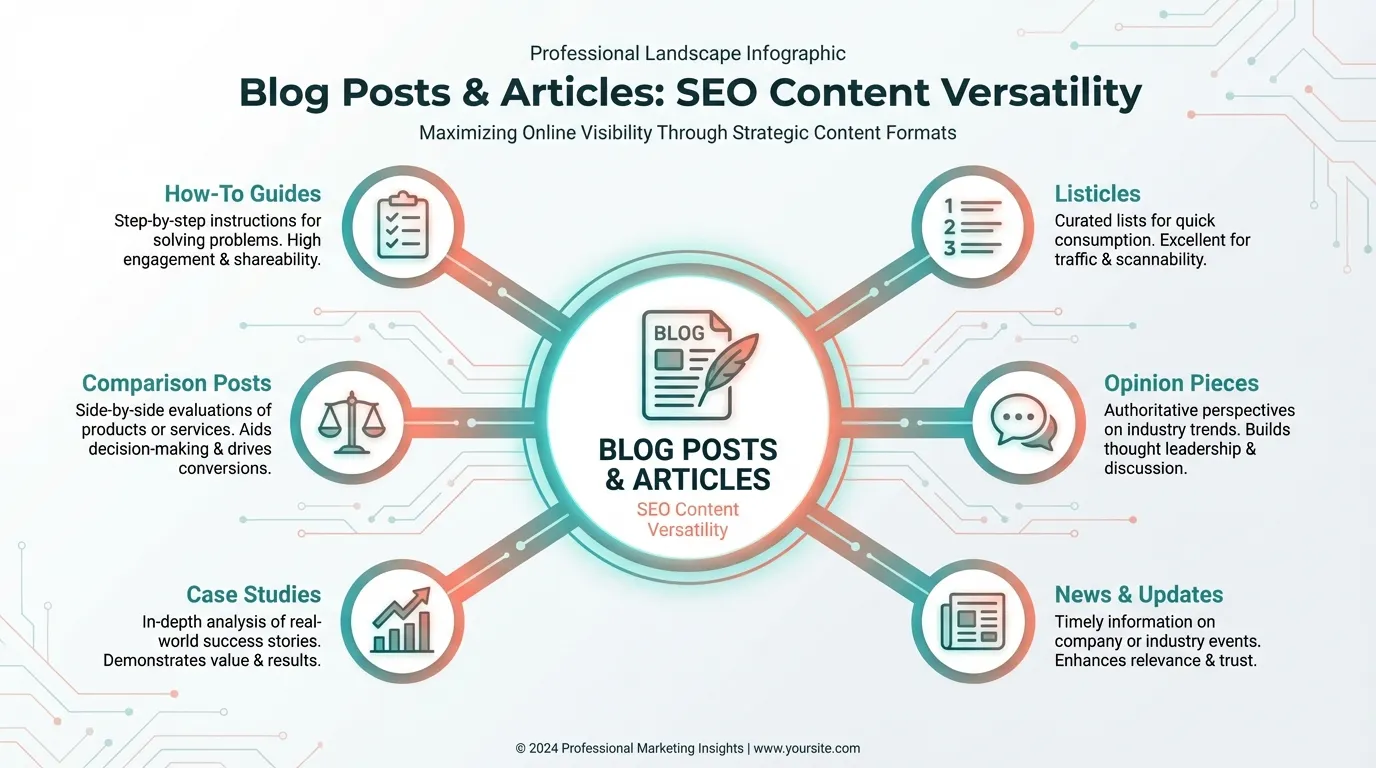
Blog posts are a core part of content marketing because they’re flexible. You can write a short update on industry news or a longer article that explores a topic in depth. Blogs let you respond quickly to trends and help you build authority in your field.
Blog posts are effective because you can cover almost any topic related to your business. You might write beginner guides, expert analysis, company updates, or thought leadership articles. Each post gives you a chance to rank for new keywords and reach different parts of your audience.
Types of blog posts that perform well:
- How-to guides: Practical, actionable content that solves specific problems
- Listicles: Easy-to-scan posts that promise specific value (like this one!)
- Opinion pieces: Thought leadership that positions you as an industry voice
- News and updates: Timely content that capitalises on current trends
- Case studies: Real-world examples that demonstrate your expertise
- Comparison posts: Head-to-head analyses that help readers make decisions
The most important thing for blogging in 2026 is to focus on consistency and quality. It’s better to publish one strong post each week than to post daily content that doesn’t help your rankings or build your authority.
3. Topic Clusters and Pillar Pages

Think of long-form articles as individual pieces, and topic clusters as the bigger picture. With this strategy, you create a main pillar page on a broad topic, then add related articles that link back to it.
For example, if you run a digital marketing agency, your pillar page could be a “Complete Guide to Digital Marketing.” The cluster content would be separate articles on SEO, PPC, social media marketing, content marketing, and email marketing, all linking back to the main guide.
Why topic clusters boost SEO:
- They establish topical authority on specific subjects.
- Internal linking structure helps Google understand content relationships.
- Users can easily navigate related content, improving engagement metrics.
- You can rank for both broad and specific keywords within the same topic.
- Creates a content ecosystem that lifts all boats when one piece performs well
This architecture mirrors how people actually think about and search for information. When MediaOne implements topic clusters for clients, we typically see improvements not just in rankings, but in time on site and pages per session, signals that tell Google your content is valuable.

4. Landing Pages

Landing pages are designed to drive conversions. Unlike blog posts, which are mainly for sharing information, landing pages focus on getting visitors to take a specific action, such as filling out a form, signing up, or making a purchase.
For SEO, landing pages target commercial and transactional keywords. For example, someone searching “hire SEO consultant Singapore” or “best email marketing software” is likely ready to take the next step.
Elements of high-converting SEO landing pages:
- Clear, benefit-driven headlines that match search intent
- Compelling value propositions that differentiate you from competitors
- Trust signals like testimonials, case studies, and credentials.
- Strong, action-oriented calls-to-action
- Mobile-responsive design (most searches now happen on mobile)
- Fast loading times (page speed is a ranking factor)
The key to landing pages is balancing SEO and conversion. You need enough content for Google to understand the page, but not so much that visitors get overwhelmed and leave before taking action.
Use keywords in your headings, meta descriptions, and main text, but always keep your writing natural and persuasive.
5. How-To Guides and Tutorials

“How to” searches represent some of the most common queries on Google. People actively seeking solutions are precisely the audience you want to attract. They’re engaged, motivated, and grateful when you provide clear guidance.
How-to content works exceptionally well for SEO because it directly matches informational search intent. Whether it’s “how to optimise images for SEO” or “how to create a content calendar,” these queries signal that users want step-by-step instructions.
Creating effective how-to content:
- Start with keyword research to identify common “how to” queries in your niche.
- Break processes into clear, numbered steps
- Use visuals, screenshots, or videos to illustrate complex steps.
- Anticipate where users might struggle and provide extra detail there.
- Include examples or templates to make implementation easier.
- Structure content for featured snippets (the position zero boxes at the top of search results)
The best how-to guides are clear and thorough. Don’t assume your readers already know the basics. Walk them through each step as if they’re new to the topic, but also include tips for those with more experience.
6. Product and Service Pages

Often overlooked in content strategies, product and service pages are crucial for ranking in commercial searches. These pages need to work double duty: convince visitors to buy or enquire whilst also satisfying Google’s quality standards.
Short, generic product descriptions are not enough in 2026. You need detailed content that answers questions, addresses concerns, and helps users make informed choices.
Optimising product/service pages:
- Write unique descriptions (never copy from manufacturers or competitors)
- Include detailed specifications, features, and benefits.
- Add customer reviews and ratings (user-generated content is gold)
- Use high-quality images and videos showing products in use.
- Create FAQ sections addressing common questions.
- Implement schema markup so Google can display rich snippets.
Treat these pages like focused landing pages. Each one should target specific transactional keywords and compete with other businesses offering similar products or services. The more helpful and complete your pages are, the better they will perform in search and conversions.
7. Video Content

Video has become increasingly important for SEO, and it’s not slowing down. YouTube is the world’s second-largest search engine, and Google increasingly displays video results for a wide range of queries.
What makes video particularly powerful is its ability to engage. People stay on pages with video longer, they’re more likely to share video content, and video can explain complex concepts more effectively than text alone.
Types of videos that rank well:
- Explainer videos: Breaking down complicated topics into digestible explanations
- Product demonstrations: Showing products or services in action
- Tutorials: Step-by-step video guides that complement written how-tos
- Interviews: Expert conversations that build authority
- Behind-the-scenes: Humanising your brand and building connections
- Webinar recordings: Educational content that showcases expertise
Video SEO best practices:
- Host videos on your website as well as YouTube to keep visitors on your site
- Create detailed video titles and descriptions with target keywords.
- Add transcripts (accessibility and SEO benefits)
- Use engaging thumbnails that encourage clicks.
- Implement video schema markup.
- Optimise video file names before uploading
You don’t need expensive equipment to create effective videos. Authentic, helpful videos often work better than highly produced ones, especially for B2B and educational topics. A smartphone and good lighting are enough to get started and see results.
8. Infographics

The human brain processes visual information 60,000 times faster than text. Infographics capitalise on this by presenting data, processes, or concepts in visually engaging formats that are easy to understand and share.
From an SEO perspective, infographics are link magnets. When you create valuable visual content, other websites want to embed it, usually with a backlink to your site as the source. These backlinks are pure gold for SEO.
Creating shareable infographics:
- Focus on interesting data or insights your audience cares about
- Tell a clear story with a logical flow.
- Use on-brand colours and design elements.
- Keep text minimal. Let the visuals do the talking.
- Make them easily embeddable with simple embed codes.
- Promote across social media and outreach to relevant websites.
- Create blog posts around infographics to provide context and rank for related keywords.
The most effective infographics combine strong visuals with useful information. A good design alone is not enough, and great data needs to be easy to understand. When you get both right, infographics can bring in more traffic and backlinks.
9. Case Studies and Success Stories

Nothing builds credibility quite like demonstrating real results. Case studies showcase your expertise whilst providing social proof that reassures potential customers you can deliver what you promise.
From an SEO perspective, case studies often rank for valuable commercial keywords. Someone searching “SEO results for e-commerce” or “content marketing case study” is researching solutions and evaluating providers, exactly when you want to appear.
Structuring compelling case studies:
- Background: Describe the client’s situation and challenges
- Strategy: Explain your approach and why you chose it
- Implementation: Detail what you actually did
- Results: Show measurable outcomes with specific data
- Testimonial: Include direct quotes from satisfied clients
- Visuals: Use charts, graphs, and before/after comparisons
The more specific your results, the stronger your case study. For example, instead of saying “improved rankings,” say “increased organic traffic by 157% and first-page rankings from 12 to 47 in six months.” Real numbers make your story more convincing.
10. Interactive Content

Interactive content transforms passive readers into active participants. Instead of just consuming information, users click, calculate, explore, or answer questions—creating engagement that Google rewards.
Types of interactive content that perform:
- Calculators: ROI calculators, mortgage calculators, pricing estimators
- Quizzes: Personality tests, knowledge assessments, recommendation quizzes
- Assessments: Website audits, SEO scoring tools, readiness evaluations
- Interactive maps: Location finders, service area maps
- Configurators: Product customisation tools
- Polls and surveys: Gather opinions whilst engaging users
Interactive content usually takes more time and resources to create than regular articles, but the results can be worth it. These tools often become your most-shared and most-linked resources because they offer unique value.
Interactive tools are also great for lead generation. People are often willing to share their email address to get personalised results from a calculator or assessment, which helps you grow your list and show your expertise.
11. Podcasts and Audio Content
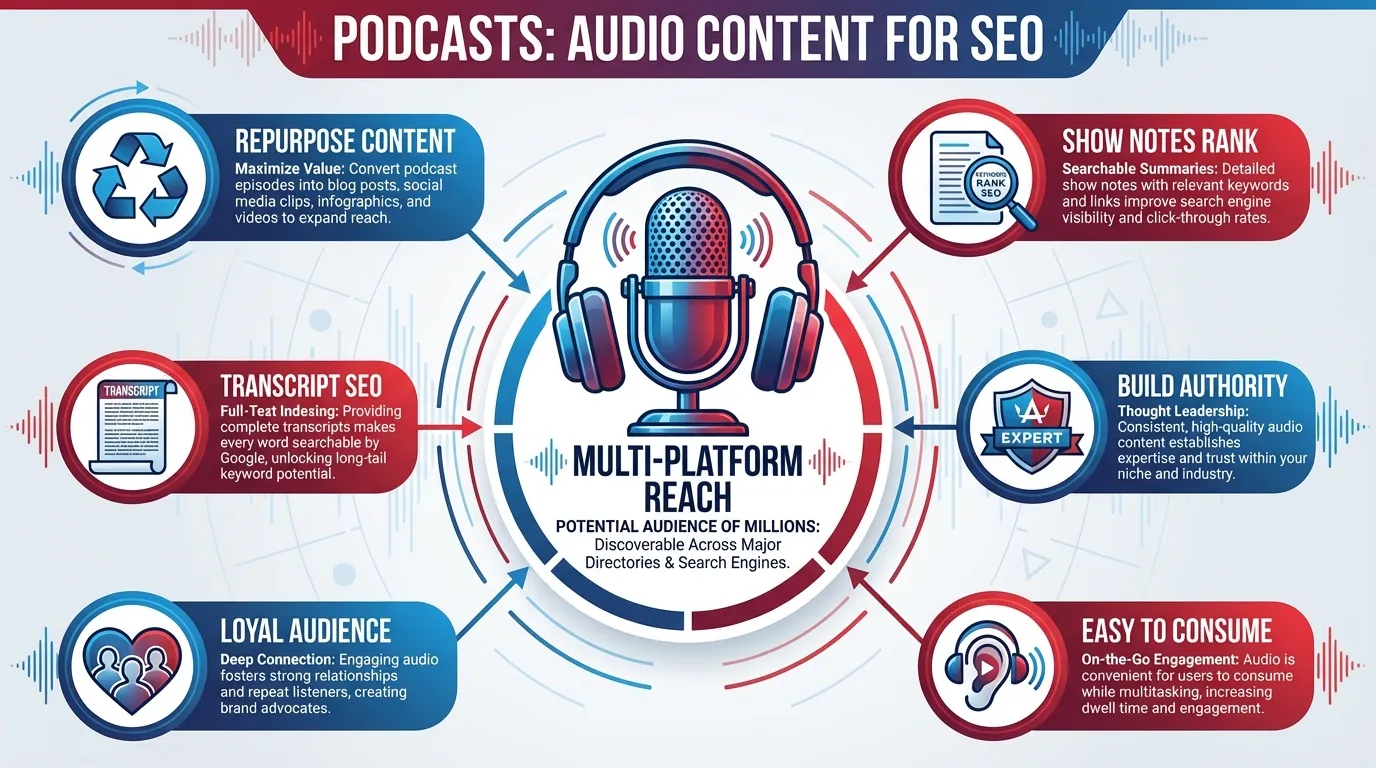
Podcasts have become much more popular, and many businesses are taking advantage of this trend. While Google does not index the audio itself, the content you create around your podcast can rank in search results.
Optimising podcasts for SEO:
- Create detailed show notes for each episode with target keywords.
- Publish full transcripts to capture long-tail keyword variations.
- Write companion blog posts that expand on topics discussed.
- Submit to major podcast directories for discoverability.
- Encourage listener reviews and ratings.
- Embed episodes on your website to increase time on site
- Create audiograms and video clips for social media promotion.
Podcasts are efficient because you can repurpose one interview into several blog posts, social media updates, infographics, and quote images. This helps you get more SEO value from your efforts.
12. Webinars and Virtual Events

Webinars sit at the intersection of education and lead generation. They provide substantial value to attendees whilst positioning you as an authority and capturing contact information for future marketing.
Webinar SEO strategies:
- Create optimised registration pages targeting relevant keywords.
- Publish follow-up blog posts summarising key takeaways.
- Record and repurpose as on-demand video content.
- Create slide decks and upload to SlideShare with backlinks.
- Write detailed Q&A posts addressing attendee questions.
- Generate email sequences that drive traffic back to related content.
The best webinar programs create a whole content ecosystem. The live event is just the start. The recording, transcript, slides, and related content can continue to deliver SEO value long after the event is over.
13. Checklists and Templates


Sometimes the most valuable content is the most practical. Checklists and templates provide immediate utility. Users can download and use them right away to accomplish specific tasks.
These resources work brilliantly for SEO because they target bottom-of-funnel searches from people ready to take action. Someone searching “SEO audit checklist” or “content calendar template” knows precisely what they need and will be grateful when you provide it.
Creating valuable downloadable resources:
- Address specific pain points your audience experiences.
- Make them genuinely helpful, not just thinly-veiled marketing
- Design professionally so the quality reflects your brand.
- Gate with simple forms to capture leads
- Create optimised landing pages for each resource.
- Promote across relevant channels to build backlinks.
Landing pages for these resources can rank very well, especially for keywords like “template” and “checklist” that show strong intent. Once you create the resource, it can keep working for you with little ongoing effort.
14. Lists and Roundup Posts

Humans love lists. They’re easy to scan, they promise specific value (you know exactly what you’re getting), and they’re endlessly shareable. Listicles consistently rank well across virtually every industry.
Types of lists that perform:
- Best-of lists: “Best SEO tools,” “Top content marketing agencies”
- Roundup posts: “15 experts share their top SEO tips”
- Resource lists: “Ultimate list of free marketing tools”
- Statistical lists: “20 SEO statistics you need to know”
- Tip lists: “10 ways to improve your website speed”
Lists also work well for link building. When you feature experts or brands in roundup posts, they often share and link to the content, expanding your reach and boosting your authority.
Be honest with your lists. If you promise “50 tips,” make sure each one is valuable. Quality is more important than quantity. Readers prefer 15 useful tips over 50 that don’t add value.
15. News and Trending Content

Creating content around breaking news or trending topics can bring in a lot of traffic if you do it well. The key is to act quickly while the topic is still popular and to ensure your take fits your area of expertise.
Capitalising on trending topics:
- Set up Google Alerts for industry keywords and competitor names.
- Monitor social media for emerging trends.
- Use tools like Google Trends to identify rising searches.
- Create content quickly without sacrificing quality.
- Add your unique perspective or analysis.
- Promote aggressively while the topic is trending.
Trending content usually only brings in traffic for a short time, but it can help new people discover your brand and earn you links from news sites. The traffic boost may be temporary, but the SEO benefits can last much longer.
Balance trending content with evergreen articles. Only chasing trends can be tiring and unpredictable. A mix gives you steady traffic from evergreen content and occasional spikes from timely topics.
Bringing Your Content Strategy Together
Now that you understand the 15 SEO content types that drive rankings, the question becomes: where do you start?
The answer depends on your goals, resources, and audience. Here’s a framework to guide your strategy:
- Start with foundation content: Pillar pages and long-form articles that establish topical authority in your core areas. These become the bedrock upon which everything else builds.
- Add new content types one at a time: Don’t try to do everything at once. For example, focus on video this quarter, infographics next, and interactive content after that. This step-by-step approach helps you grow your content without getting overwhelmed.
- Match format to intent: Use keyword research to understand what format users expect. Informational queries often want articles or guides. Commercial queries wish to product pages or comparisons. Navigational queries want your homepage or specific service pages.
- Repurpose your content whenever possible: One article can become a video script, an infographic, several social media posts, an email series, and even a podcast episode. This helps you get the most value from your content.
- Track and optimise: Monitor which content types drive the best results for your specific situation. Case studies convert better for you than blog posts. Video drives more engagement than text. Use data to guide where you invest time and resources.
SEO success is not about trying to trick the system. It’s about helping your audience and making it easy for Google to see the value you provide. When you create a range of high-quality content that meets real needs, better rankings will follow.
Implementing Your Content Types Strategy for Maximum Impact
The landscape of SEO content continues evolving, but one thing remains constant: quality and relevance win. Google’s algorithms grow more sophisticated every year, better at identifying content that genuinely helps users versus content created purely for rankings.
These 15 content types give you a strong toolkit for building your content strategy. You don’t need to use all of them right away. Start with the formats that fit your strengths and your audience, then add more over time.
Whether you have a team or are building your content from scratch, knowing these proven SEO content formats gives you a real advantage. The top websites in search results use a mix of content types to reach people at every stage of their journey.
What should you do next? Choose one content type you haven’t tried before and test it over the next month.
Track your results, see what works for your audience, and keep building from there. The way to reach page one is to create valuable, diverse content that puts your audience first. Contact us today.
Frequently Asked Questions
How long does it take for different content types to start ranking on Google?
The timeline varies significantly by content type and competition level.
Blog posts and articles typically take 3-6 months to achieve meaningful rankings, whilst video content often ranks faster, sometimes within weeks. Evergreen pillar content may take 6-12 months to reach peak performance but continues delivering results for years.
Should I create content in-house or outsource to agencies and freelancers?
This depends on your resources, expertise, and content volume needs. In-house creation offers better brand voice consistency and deeper product knowledge, whilst outsourcing brings professional SEO expertise and scalability.
Many successful businesses use a hybrid approach: keeping strategic content, such as case studies, in-house whilst outsourcing high-volume blog posts to specialists.
How many pieces of content should I publish per week to see SEO results?
Quality always trumps quantity in modern SEO. Publishing one exceptional, well-researched 2,000+ word article weekly will outperform five mediocre 500-word posts.
A realistic starting point is 2-4 high-quality pieces per month, ensuring each is thoroughly researched and genuinely useful. Focus on building a content library that demonstrates expertise rather than chasing arbitrary publishing quotas.
Can I rank with AI-generated content, or does Google penalise it?
Google doesn’t specifically penalise AI-generated content. They penalise low-quality content regardless of how it’s created.
AI tools can assist with research and first drafts, but content that ranks well requires human expertise, original insights, and genuine value that AI alone cannot provide.
The most successful approach combines AI efficiency with substantial human editing, fact-checking, and original analysis.
How do I measure which content types are actually working for my SEO strategy?
Track multiple metrics, including organic traffic growth, keyword rankings, engagement metrics (time on page, bounce rate), conversion rates, and backlinks earned across different content types.
Compare monthly performance in Google Analytics and Search Console to identify which formats deliver the best results for your specific audience. Use this data to double down on high-performing content types and optimise or pivot away from underperformers.