

Negative Reviews in 2026: When to Reply, Resolve, Report or Escalate
A negative review is not only a complaint from one customer. Once it is public, your response becomes evidence for every future customer deciding whether your business can be trusted when something goes wrong.


Most negative-review advice sounds the same: apologise, stay polite and take the conversation offline. That advice is useful up to a point, but it treats very different problems as if they require the same response.
A genuine service failure, a factual dispute, an unidentified reviewer, abusive content and a fast-moving social-media complaint should not all be handled with the same template. The more useful question is:
What kind of negative feedback is this, and what is the lowest-risk response?
For this study, we tested different business responses to the same negative review and measured how those responses affected the people who matter once a complaint becomes public: future customers reading the exchange.
Our framework focuses on four decisions:
- Reply when the complaint can be acknowledged publicly
- Resolve when the customer needs a genuine service recovery
- Report when the content appears to violate platform policy
- Escalate when the complaint becomes a legal, safety or broader brand-risk issue
We also measured whether different responses recovered some of the trust lost to the negative review or made the public impression worse.
Quick Answer
The strongest treatment was acknowledge + resolve. It produced a 6.8/10 Bystander Trust score, compared with 4.7/10 when the business stayed silent and only 3.9/10 when it responded defensively. It also generated the highest enquiry intent at 59%.
The strongest practical pattern was not “apologise for everything.” It was:
Acknowledge → Clarify → Resolve → Exit
A useful public response acknowledges the concern, adds only the factual context future customers need, explains the next step and then moves customer-specific resolution away from the public thread.
The central rule is:
Respond for the next customer reading, not just the customer who wrote the review.
Our other tests pointed in the same direction. A calm factual correction produced 2.2 more trust points than a defensive version communicating substantially the same facts. Empathy without an unsupported admission performed better overall than either a full admission or no apology in a disputed case, while a same-day response produced the strongest balance of responsiveness, trust and professionalism.
Public acknowledgement followed by private resolution also outperformed either channel on its own.
That broader finding fits current consumer behaviour. BrightLocal’s 2026 review research reports that 89% of consumers expect businesses to respond to reviews, while generic or templated replies make 50% less likely to choose a business.
Why One Negative Review Is Not the Real Problem
A negative review creates one impression. The business response creates another.
Future customers often read both, which means a company can recover some of the trust damaged by a poor experience or create an even bigger reputational problem by responding badly.
Compare these two approaches.
Defensive Response
“This is not accurate. Our technician arrived within the agreed timeframe and all charges were clearly stated in our terms.”
Calm, Resolution-Focused Response
“We’re sorry the timing and additional charge were not communicated clearly. We’ve reviewed the booking and would like to understand where the process broke down. Please contact our team directly so we can follow this up properly.”
Both responses could come from a business that believes the customer omitted important facts. The difference is that the defensive version tries to win the public dispute, while the second protects the company’s position without turning the reviewer into an opponent.
That distinction matters because negative-review management is part of a much broader reputation problem. MediaOne’s Online Reputation Management services cover monitoring negative feedback, managing harmful online content and strengthening how businesses are perceived across search and digital channels.
How We Tested Negative Review Responses
We created a controlled customer-service scenario around the same fictional local air-conditioning service business.
Every participant saw the same one-star review:
“Booked them for an aircon repair. Technician arrived late, didn’t explain the additional charge and I had to call twice for an update. Wouldn’t use them again.”
The business identity, review wording, star rating and page design remained unchanged. Only the business response changed.
Response A: No Response
The review appeared without any response from the business.
Response B: Generic Apology
“We’re sorry to hear about your experience. Please contact us so we can resolve this.”
Response C: Defensive Correction
The business disputed the customer’s account and concentrated on defending its own actions.
Response D: Acknowledge + Resolve
The business acknowledged the experience, identified what needed to be investigated and gave the customer a clear path toward resolution.
Response E: Long Corporate Response
The business posted a lengthy explanation covering policies, booking conditions and operational context.
Test Structure
The primary test included 300 adult service buyers, randomly assigned across five treatments with 60 participants per response.
We then ran four separate follow-up tests with new participant groups:
| Test | Participants | Split |
| Main response-style test | 300 | 60 per treatment |
| Defensiveness test | 200 | 100 per treatment |
| Apology test | 300 | 100 per treatment |
| Response-speed test | 300 | 60 per treatment |
| Public vs private test | 300 | 100 per treatment |
Trust, professionalism, empathy, fairness, responsiveness and confidence in resolution were measured on 1 to 10 scales. Enquiry intent and perceived admission of fault represent the percentage selecting “likely” or “very likely.”
The dataset does not include confidence intervals or formal statistical-significance tests, so we focus most heavily on the large and repeated directional gaps rather than overinterpreting small differences between treatments.
Bystander Trust: The Metric That Matters Most
The reviewer is not the only person who sees a business response. Anyone researching the company later can read the complaint and decide what the exchange says about how that business treats customers.
We call that effect Bystander Trust:
Bystander Trust = how much a future customer trusts the business after reading the negative review and the business response
Negative Review Response Results
| Response style | Bystander Trust | Professionalism | Confidence in resolution | Likelihood to enquire |
| No response | 4.7/10 | 4.4/10 | 3.3/10 | 34% |
| Generic apology | 5.5/10 | 5.7/10 | 4.8/10 | 45% |
| Defensive correction | 3.9/10 | 3.7/10 | 3.8/10 | 26% |
| Acknowledge + resolve | 6.8/10 | 7.3/10 | 7.0/10 | 59% |
| Long corporate response | 5.1/10 | 5.4/10 | 5.0/10 | 41% |
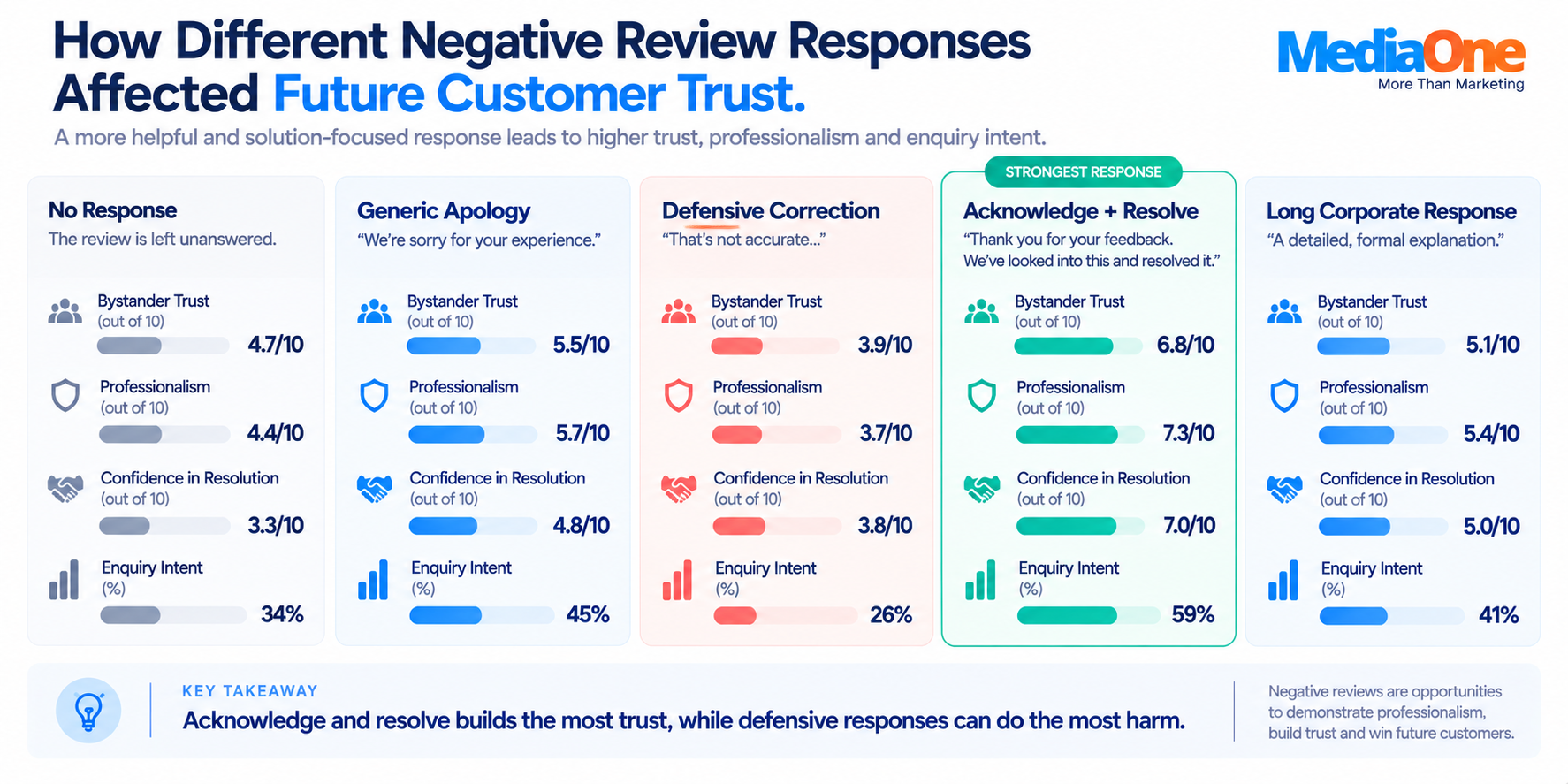
A generic apology performed better than silence but gave participants relatively little evidence that the underlying issue would actually be resolved. The longer corporate response added context but lost some of its effectiveness through length and policy-heavy language.
The defensive correction was the only treatment that performed worse than silence on Bystander Trust. Enquiry intent also fell to 26%, eight percentage points below the no-response group.
The question should therefore not be only:
Did we answer the angry customer?
It should also be:
What does our response tell everyone else about how this business handles problems?
Reputation Recovery Lift
A response can recover some of the reputation damaged by a complaint, leave trust roughly unchanged or make the public impression worse.
We define Reputation Recovery Lift as:
Trust after response − trust after negative review alone
The negative-review-only benchmark was 4.7/10.
Reputation Recovery Results
| Response | Trust after review | Trust after response | Reputation Recovery Lift |
| Generic apology | 4.7/10 | 5.5/10 | +0.8 |
| Defensive response | 4.7/10 | 3.9/10 | -0.8 |
| Acknowledge + resolve | 4.7/10 | 6.8/10 | +2.1 |
| Long corporate reply | 4.7/10 | 5.1/10 | +0.4 |
The acknowledge-and-resolve response recovered 2.1 trust points, while the defensive response lost another 0.8 points after the negative review had already done its damage.
That gives businesses a more useful way to evaluate responses than asking whether a reply sounds polite. A response can actively recover reputation, or it can become the second reputational problem.
The 4R Negative Review Decision
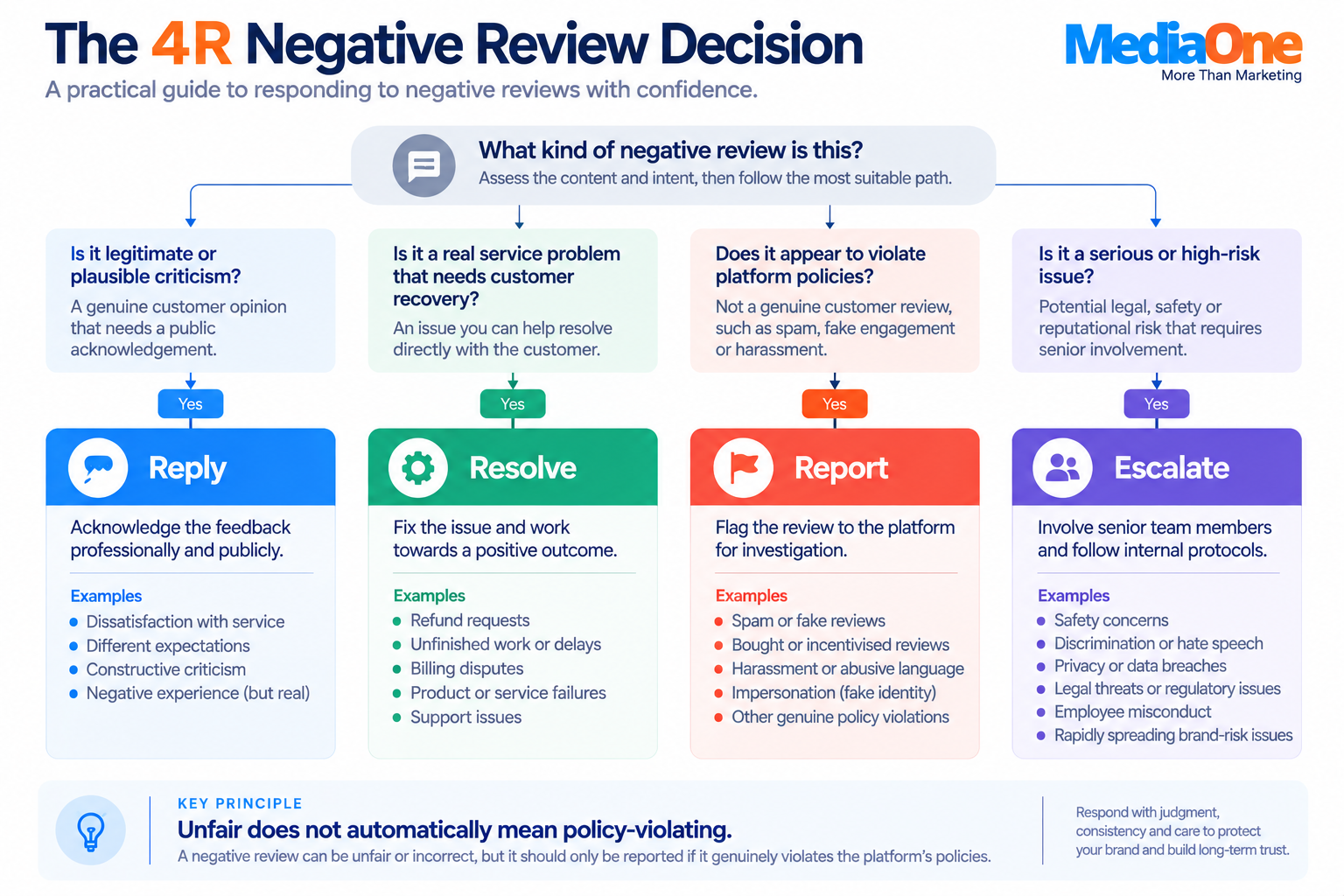
Before writing a response, classify the complaint. The safest action usually falls into one of four paths.
1. Reply
Reply when the complaint is legitimate or reasonably plausible and can be acknowledged publicly.
Typical situations include slow service, poor communication, excessive waiting times, incorrect orders and experiences that did not match customer expectations. The purpose is to demonstrate that feedback is noticed and handled professionally.
2. Resolve
Some reviews expose an actual customer-service problem rather than merely a communication issue. Billing disputes, unfinished work, damaged items, refund issues and support failures usually require more than a public apology.
The public response can acknowledge the problem while the detailed resolution moves to phone, email or direct message, particularly where bookings, payments or private customer information are involved.
Google’s own guidance on customer reviews says businesses can publicly reply to customer reviews, and reviewers are notified when those replies are posted.
3. Report
Report a negative review when there is a genuine platform-policy issue, not merely because the feedback is uncomfortable.
Possible examples include fake engagement, spam, prohibited harassment, impersonation and other policy violations. According to Google’s guidance on reporting reviews, only reviews that violate its policies qualify for removal, and businesses should not report feedback simply because they disagree with it.
4. Escalate
Some complaints should immediately move beyond normal review management. Safety allegations, discrimination claims, serious privacy concerns, potential employee misconduct, credible legal allegations or a rapidly spreading social-media controversy can require management, compliance, legal or crisis-communications involvement.
At this point, the person answering normal customer reviews should stop improvising.
Identify What Kind of Negative Review You Have
One response template cannot safely handle every situation.
Genuine Service Failure
The business clearly got something wrong, such as missing an appointment, damaging an item or failing to communicate an important change.
The response should acknowledge what happened, apologise appropriately and provide a clear path toward resolution.
Expectation Mismatch
The customer expected something the service did not actually promise.
You can acknowledge the disappointment while calmly clarifying what was included. Avoid phrasing such as “you should have read the terms,” even where the customer misunderstood the offer. Future readers are still deciding whether your business communicates clearly.
Factual Dispute
The business and customer disagree about what happened.
Correct the record only as much as necessary. For example:
“Our booking records show a 2–4pm arrival window and an arrival at 3:35pm. We understand the wait was still frustrating and should have communicated the timing more clearly.”
That gives future readers useful context without publicly attacking the customer.
Unverified Reviewer
If you cannot identify the reviewer, do not immediately reply with “fake review.”
A safer response is:
“We’ve checked our recent bookings but haven’t been able to identify this experience. We’d like to investigate it properly, so please contact us with the booking details.”
If there is also evidence that the content violates platform rules, document the case and report it separately.
Policy-Violating Review
Preserve screenshots and other evidence before reporting content that clearly appears to violate platform policy.
Google’s Business Profile policies apply prohibited and restricted content rules to reviews, photos and videos.
Social-Media Escalation

A complaint can stop being a routine customer-service issue once it begins collecting shares, comments, reposts or additional accusations. At that point, response speed, message consistency and internal coordination become increasingly important.
Defensive Responses Can Make a Bad Review Worse
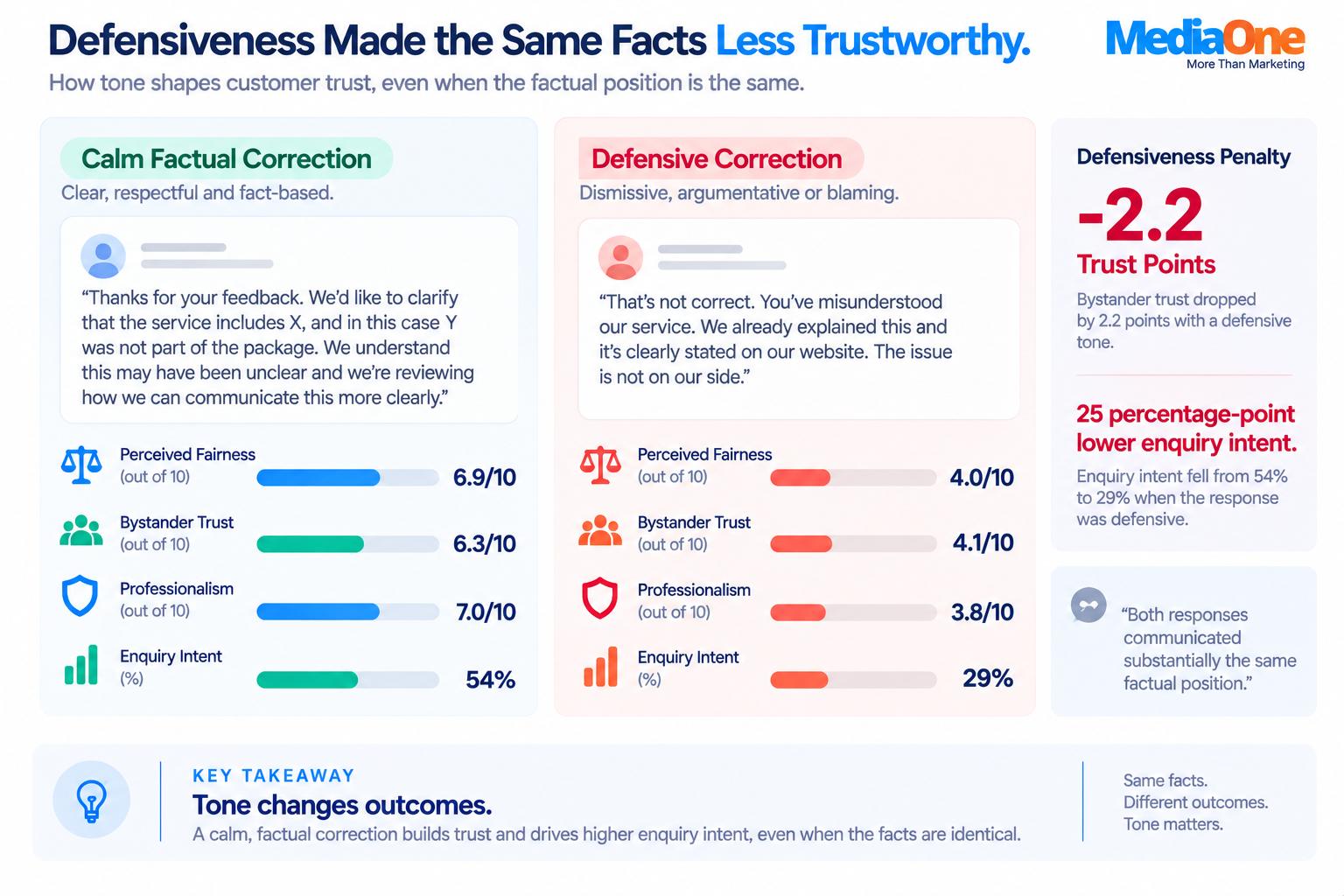
One of the clearest findings came from our direct tone comparison.
Both treatments communicated essentially the same factual position.
Calm Correction
“Our records show the booking window was 2–4 pm and the technician arrived at 3:35 pm. We understand the delay still caused frustration and should have communicated more clearly.”
Defensive Correction
“This review is misleading. Our technician was not late, and the customer agreed to our terms.”
Defensiveness Test
| Response | Perceived fairness | Bystander Trust | Professionalism | Likelihood to enquire |
| Calm factual correction | 6.9/10 | 6.3/10 | 7.0/10 | 54% |
| Defensive correction | 4.0/10 | 4.1/10 | 3.8/10 | 29% |
The Defensiveness Penalty was 2.2 trust points.
Enquiry intent also dropped by 25 percentage points in the defensive condition, even though the underlying factual defence was substantially the same.
Businesses therefore do not have to choose between admitting fault and fighting back. There is a third option: correct the necessary facts without turning the customer into the enemy.
Should You Apologise If You Do Not Agree?
An apology does not have to mean that every factual claim in a review is correct.
We tested three approaches.
Full Admission
“We made a mistake and failed to deliver the service properly.”
Empathy Without Unsupported Admission
“We’re sorry this experience was frustrating and that our communication did not meet your expectations.”
No Apology
“Thank you for your feedback. We have reviewed the matter.”
Apology Test
| Response type | Empathy | Trust | Perceived admission of fault | Enquiry intent |
| Full admission | 7.2/10 | 6.2/10 | 83% | 52% |
| Empathy without admission | 6.8/10 | 6.5/10 | 42% | 56% |
| No apology | 3.8/10 | 4.8/10 | 14% | 36% |
The full admission produced the highest empathy score, but it also created a much stronger perception that the business had accepted the reviewer’s factual version of events.
Empathy without unsupported admission produced the strongest overall balance, with the highest trust and enquiry intent while cutting perceived admission of fault almost in half.
This does not mean businesses should avoid responsibility when they genuinely made a mistake. It means a disputed situation doesn’t require an unsupported public admission to sound human.
For serious legal, financial, medical, privacy or safety matters, normal review-response guidance should give way to the organisation’s internal escalation process.
How Fast Should You Respond?
Speed matters, but it is not the only objective.
The useful standard is:
Fast enough to show attention, slow enough to verify the facts.
We showed participants the same acknowledge-and-resolve response at five different response times.
Response Speed Results
| Response timing | Perceived responsiveness | Trust | Professionalism |
| 30 minutes | 8.3/10 | 6.7/10 | 7.1/10 |
| Same day | 7.8/10 | 6.9/10 | 7.4/10 |
| Next day | 6.9/10 | 6.6/10 | 7.0/10 |
| Three days | 4.4/10 | 5.5/10 | 5.8/10 |
| No response | 2.4/10 | 4.6/10 | 4.3/10 |
Thirty minutes looked most responsive, while the same-day response produced the highest trust and professionalism. The small differences among 30 minutes, same day and the following day should not be overinterpreted, but the decline became much clearer after several days.
That pattern also aligns with current consumer expectations. BrightLocal’s 2026 survey found that 19% expect a same-day reply, 32% expect one by the following day, and 81% expect a response within a week.
For ordinary reviews, a practical target is therefore to acknowledge the issue within one business day where possible. Fast-moving social complaints may need an earlier public acknowledgement, while serious disputes should still be verified before posting detailed facts.
Public Reply or Private Resolution?

Taking everything private protects customer information, but it can create a visibility problem.
Future customers may still see the complaint without any evidence that the business responded.
We tested three approaches.
Public vs Private Results
| Treatment | Bystander Trust | Confidence in resolution | Professionalism |
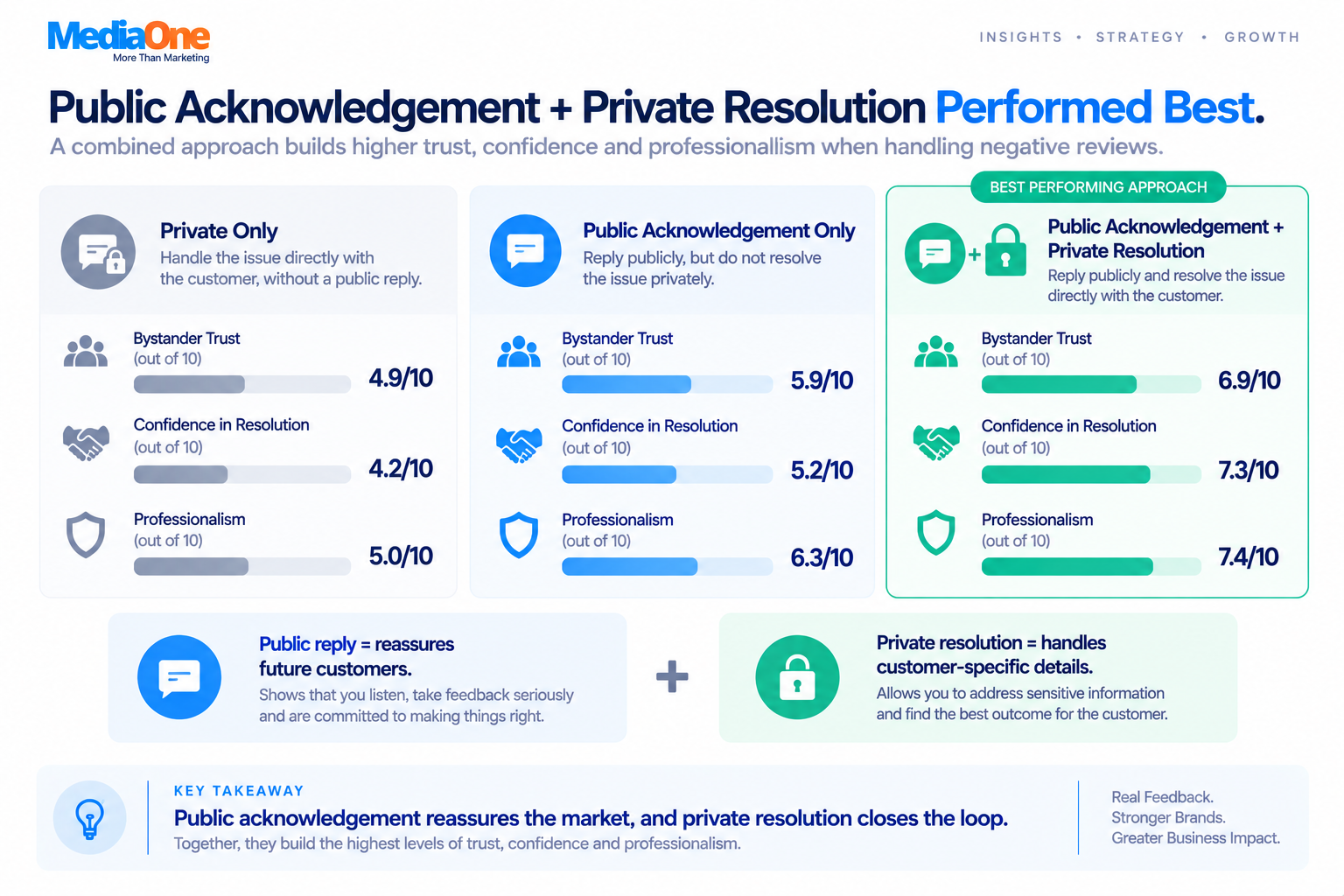
| Private only | 4.9/10 | 4.2/10 | 5.0/10 |
| Public acknowledgement only | 5.9/10 | 5.2/10 | 6.3/10 |
| Public + private resolution | 6.9/10 | 7.3/10 | 7.4/10 |
The combined approach was clearly strongest because it served two audiences.
The public reply gave future customers visible evidence that the complaint had been taken seriously. The private channel then provided room to discuss booking details, payments, refunds or other customer-specific information without exposing it publicly.
The public response does not need to contain the entire resolution. It only needs to make the business’s intention to resolve the issue visible.
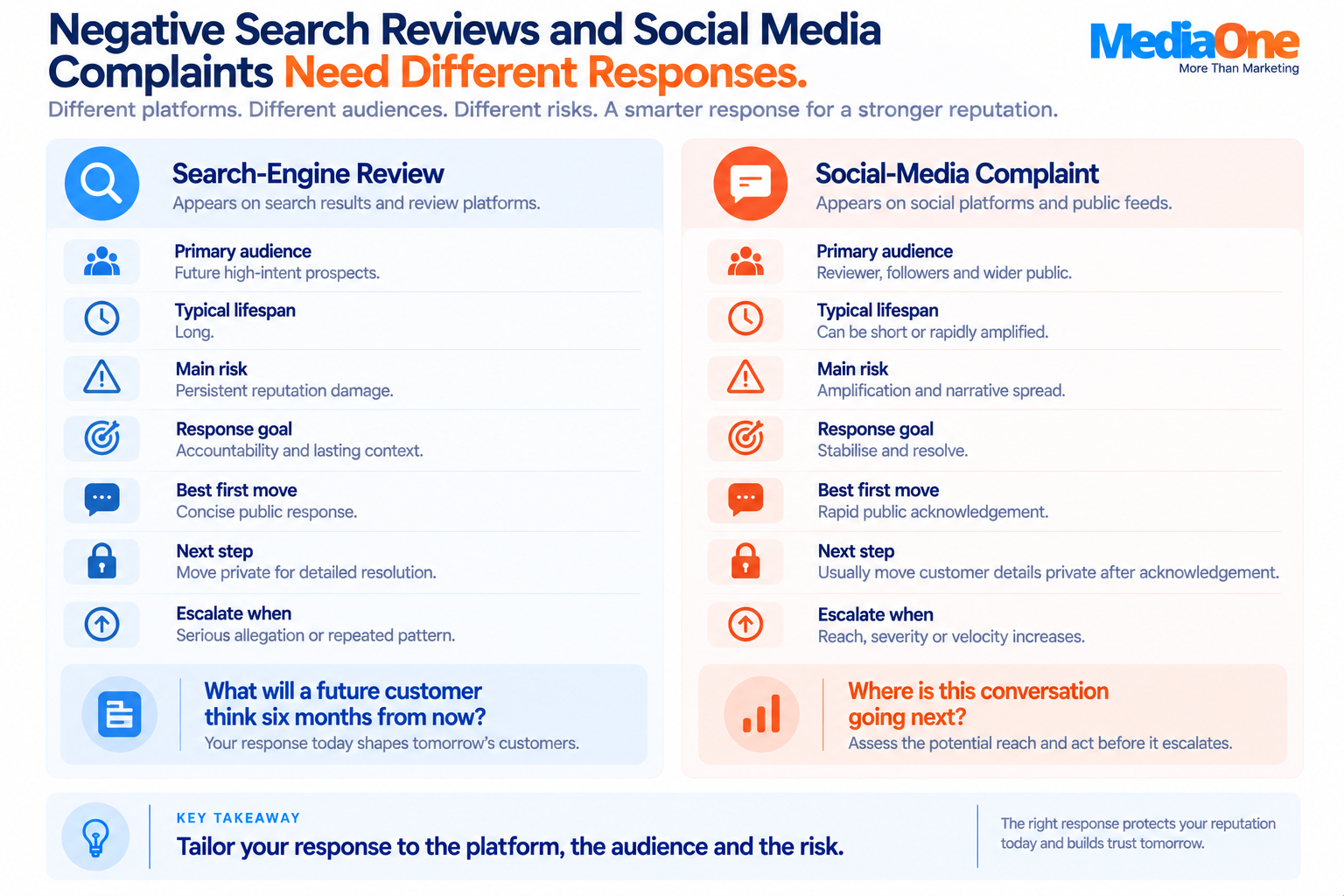
Search Reviews and Social Media Need Different Responses
A one-star Google review and a viral social-media complaint are both negative feedback, but they behave differently.
Search-Engine Reviews
Search reviews are typically persistent, attached to the business profile and visible to people already considering the company. A response may still be read months later, so the objective is to create lasting reputational context.
Ask:
What will someone researching us six months from now conclude from this exchange?
Social-Media Complaints
Social complaints can spread much faster. A Facebook post, Instagram comment, TikTok video or X thread can attract unrelated users, be screenshotted, trigger additional complaints and become a broader discussion about the brand.
That means the response must account for both the original customer and the direction the conversation is taking.
Sprout Social’s 2026 crisis research found that 64% of consumers consider it important for brands to respond publicly on social during a crisis, while 84% said response speed affects how they perceive the situation.
Search Review vs Social Complaint
| Search-engine review | Social-media complaint | |
| Primary audience | Future high-intent prospects | Reviewer, followers and wider public |
| Typical lifespan | Long | Can be short or rapidly amplified |
| Main risk | Persistent reputation damage | Amplification and narrative spread |
| Response goal | Accountability + lasting context | Stabilise + resolve |
| Best first move | Concise public response | Rapid public acknowledgement |
| Move private? | For detailed resolution | Usually after initial acknowledgement |
| Escalate when | Serious allegation or pattern | Reach, severity or velocity increases |
The channel therefore changes the response objective even when the underlying customer complaint is similar.
Negative Review Escalation Matrix
Two questions help determine how serious the response process needs to become:
- How serious is the allegation?
- How widely is it spreading?
| Low public spread | High public spread | |
| Low severity | Reply and resolve | Respond publicly and monitor amplification |
| High severity | Verify and escalate internally | Immediate coordinated escalation |
Low Severity + Low Spread
A single complaint about slow service can usually stay within the normal reply-and-resolve process.
High Severity + Low Spread
A serious accusation with little public engagement should still be verified and escalated internally before unnecessary public detail is added.
Low Severity + High Spread
A relatively minor service problem can become a larger reputational issue if it attracts significant social attention. Respond publicly, clarify the situation and resolve the actual complaint before speculation fills the information gap.
High Severity + High Spread
Safety, misconduct, privacy, or discrimination allegations that spread rapidly require coordinated escalation. Customer service, management, communications and potentially legal or compliance teams may all need to work from the same verified information.
How to Respond to a Negative Google Review
A useful public response usually contains four parts.
Acknowledge
Recognise the customer’s experience without dismissing the concern.
Clarify
Add only the factual context that future readers genuinely need.
Resolve
Give the customer a clear path toward investigation or resolution.
Exit
Move the detailed dispute away from the public thread before the response turns into an argument.
That produces our Public Response Formula:
Acknowledge → Clarify → Resolve → Exit
The purpose of the public response is to demonstrate how the business handles problems. It is not to publish the customer’s complete history.
How to Handle a Negative Social Media Comment
Social responses usually need a faster first acknowledgement because other users can join the conversation immediately.
A strong first response should acknowledge the concern, explain that the issue is being reviewed and move customer-specific details to a private channel. The business should then monitor whether the conversation is attracting more engagement or introducing additional claims.
Do not automatically delete criticism because it is uncomfortable, and avoid copy-pasting the same corporate response beneath dozens of comments. If the issue has become broader than one customer’s complaint, a single coordinated update can be more useful than fragmented replies.
When Should You Report a Negative Review?
Report content when there is a genuine policy reason.
Do not report a review merely because the customer is angry, you disagree with the facts, the customer misunderstood the service or the review lowers your rating.
Google’s review-removal guidance is explicit that disagreement alone does not qualify content for removal.
Before reporting a potentially policy-violating review, preserve the relevant evidence, including screenshots, the review URL, profile details where appropriate, booking or transaction records, the event timeline and any related messages.
Documentation becomes especially important when one review appears to be part of a coordinated pattern.
Should You Delete Negative Social Media Comments?
Automatically removing every critical comment can create another reputation problem.
Legitimate criticism is usually better handled than hidden. Moderation becomes more appropriate for spam, threats, doxxing, harassment, prohibited abuse, malicious flooding or other content that violates the platform’s rules.
The distinction is simple:
Criticism is not automatically abuse.
Deleting ordinary criticism to create the appearance of universal customer satisfaction can make the business look less trustworthy if customers discover the wider conversation elsewhere.
Can You Ask the Customer to Change the Review?
The safest sequence is:
- Resolve the underlying problem.
- Confirm that the resolution has been completed.
- Allow the customer to decide whether the new outcome changes what they want to say publicly.
Do not make a refund, replacement, repair or other legitimate remedy conditional on deleting or changing a negative review.
A reasonable follow-up could be:
“We’re glad we could resolve this. If you feel the outcome changes your experience, you’re welcome to update your review, but there’s no obligation.”

The key rule is:
Resolve first. Never make review removal the price of resolution.
Google’s review policies prohibit manipulative review practices and other forms of fake engagement.
What Not to Say in a Negative Review Response
Some replies add risk without improving the customer’s understanding.
“You’re lying.”
Even when facts are disputed, attacking the customer’s character does little to reassure a future buyer.
“You should have read the terms.”
The statement may be technically accurate, but it makes the business appear more interested in assigning blame than understanding where communication failed.
“We’ve never had this complaint before.”
The lack of previous complaints does not resolve the current one.
“Contact us.”
Without any context, this can look like a generic template. Explain what you want to investigate and give the customer a specific path to continue the conversation.
A 500-Word Defence
Long public explanations can make a company look combative even when much of what it says is factually correct. Include enough information to establish context and professionalism, then stop.
Negative Review Response Examples
Genuine Service Failure
“Hi [Name], we’re sorry the appointment did not go as planned. The delay and lack of updates were not the experience we want customers to have. We’d like to review what happened and make this right. Please contact [channel] and our team will follow this up directly.”
Factual Disagreement
“Hi [Name], thank you for raising this. Our records show a slightly different timeline, but we understand the communication around the appointment caused frustration. We’d like to review the booking with you directly and clarify what happened. Please contact [channel].”
Reviewer Cannot Be Identified
“Hi, we’ve checked our recent customer records but have not been able to identify this experience. We still want to investigate it properly. Please contact [channel] with the booking or service details so our team can look into it.”
Social-Media Complaint
“Thanks for flagging this. We’re reviewing what happened and have sent you a message so we can get the relevant details and resolve it directly. We’ll follow up once the team has completed the review.”
Serious Complaint Requiring Escalation
Do not rely on a canned response. A concise acknowledgement may be appropriate, but allegations involving safety, discrimination, privacy, regulatory issues or potential legal exposure should follow the organisation’s escalation process before detailed public statements are made.
What Should You Learn From Repeated Negative Reviews?
One negative review is feedback. Ten reviews describing the same problem are operational data.
Track recurring complaints around slow responses, unclear pricing, missed appointments, cancellations, rude staff, inconsistent quality, poor follow-up and product failures. If the same issue keeps appearing, a better response template will not solve the underlying reputation problem.
The business process itself has to change.
MediaOne’s small business local SEO guide also lists ignoring customer reviews and failing to engage with feedback, whether positive or negative, as a common mistake that damages a business’s online reputation.
For the broader review-management process, MediaOne also has a guide covering how businesses can get and manage online reviews, including monitoring feedback and responding constructively.
Platform policies should still take priority where older review-acquisition advice conflicts with current rules.
How Negative Reviews Fit Into Online Reputation
A negative review does not automatically destroy an otherwise healthy online reputation. The response itself can become another piece of evidence about the business.
Positive testimonials show how a company behaves when everything goes well. A professionally handled complaint shows how it behaves when something goes wrong.
That is an important distinction because prospective customers are not necessarily looking for proof that a company is perfect. They may simply want evidence that problems will be handled fairly if they occur.
The strongest response therefore does not try to erase the existence of criticism. It gives future customers enough context to judge whether the company deserves another chance.
Limitations of This Test
These were controlled response tests rather than live interventions on real public review profiles. That gave us control over the review wording, company identity, visual context and factual scenario, but real customer disputes introduce additional variables.
Industry, complaint severity, existing brand familiarity, previous ratings, review platform, customer history and the actual remedy offered can all affect how a response is perceived.
The dataset also does not include confidence intervals or formal significance testing, so small score differences should not be treated as universal rules. The most useful findings are the larger repeated patterns, particularly the consistent advantage for calm acknowledgement, clear resolution and public visibility of action over defensiveness or silence.
Final Verdict: Respond for the Next Customer Reading
The test results point to a clear hierarchy.
Acknowledge + resolve produced the highest Bystander Trust at 6.8/10, the highest professionalism at 7.3/10 and the strongest enquiry intent at 59%. A defensive correction performed worse than silence on trust, scoring only 3.9/10 versus 4.7/10, while enquiry intent fell to 26%.
The direct tone comparison made the risk even clearer. Defensiveness cost 2.2 trust points despite both responses communicating substantially the same factual position.
When the facts were disputed, empathy without unsupported admission produced the best overall balance. When timing changed, same-day acknowledgement delivered the strongest mix of trust and professionalism. When public and private handling were compared, public acknowledgement followed by private resolution performed substantially better than either channel alone.
The biggest mistake businesses make is treating a negative-review response as a private argument happening in public. Once the complaint is visible online, the business response becomes part of the company’s reputation evidence too.
Future customers may never know every detail of the original dispute, but they can see whether the company remained calm, acknowledged the problem, explained the necessary context and offered a credible next step.
That is why the most useful response is rarely the one that proves the reviewer wrong in the greatest detail.
The better formula is:
Acknowledge → Clarify → Resolve → Exit
Reply when the issue deserves public acknowledgement. Resolve when there is a genuine customer-service problem. Report content when it violates platform policy. Escalate when severity or public spread makes the issue larger than normal review management.
Most importantly:
Respond for the next customer reading, not just the customer who wrote it.
That is the standard every negative-review response should be judged against.
Frequently Asked Questions
Should You Respond to Every Negative Review?
Most genuine negative reviews deserve some acknowledgement, but the correct action depends on the complaint.
Normal service criticism can usually be replied to and resolved. Spam or policy-violating content may need reporting, while serious safety, privacy, discrimination or legal allegations may require internal escalation before a detailed public response.
How Fast Should You Respond to a Negative Review?
Respond quickly enough to show that the complaint is being taken seriously, but not so quickly that you publish details before verifying the facts.
In our test, a same-day response produced the highest trust and professionalism scores, while the differences among 30 minutes, same day and the next day were relatively small. The clearest deterioration happened after several days.
Should You Apologise for a Negative Review?
When the business clearly made a mistake, accepting responsibility can be appropriate.
In a disputed case, however, our test found that empathy without unsupported admission generated the strongest balance of trust and enquiry intent. A business can acknowledge frustration without automatically agreeing with every factual claim.
Can You Remove a Negative Google Review?
Only some reviews qualify for removal.
Google says businesses can report reviews that violate platform policy, but not simply because they disagree with the feedback.
What If a Negative Review Is Fake?
Preserve the evidence, check the relevant platform rules and report the review if it appears to violate those policies.
Avoid immediately posting accusations of fraud in public unless the situation has been properly investigated.
Should You Reply Publicly or Privately?
Usually both channels serve different purposes.
Our test found that public acknowledgement plus private resolution produced the strongest Bystander Trust, professionalism and confidence in resolution. The public response reassures future customers, while the private channel handles personal details.
Should You Ask Customers to Delete Negative Reviews?
Do not make deletion a condition of fixing a legitimate customer problem.
Resolve the complaint first. Afterwards, the customer can decide whether the outcome changes how they want to describe their experience.
Can Negative Reviews Actually Help a Business?
A negative review itself is not necessarily beneficial, but a good response can reveal something positive that a five-star review cannot: how the business behaves when a problem occurs.
That does not mean businesses should seek or manufacture negative feedback. It means an unavoidable complaint can still be handled in a way that protects future customer trust.