AI Summary
Google still drives roughly 90% of enterprise search traffic and remains the only channel with measurable, trackable conversions. ChatGPT, by contrast, offers only indirect brand visibility pulled from static training data, with no referral traffic or ranking mechanism of its own. The article recommends a Google-first strategy: build topical authority, backlinks, and original research as the foundation, then layer on clear structure, schema markup, and named citations so the same content naturally becomes AI-citeable too, rather than rewriting articles specifically to please ChatGPT.

Table of Contents
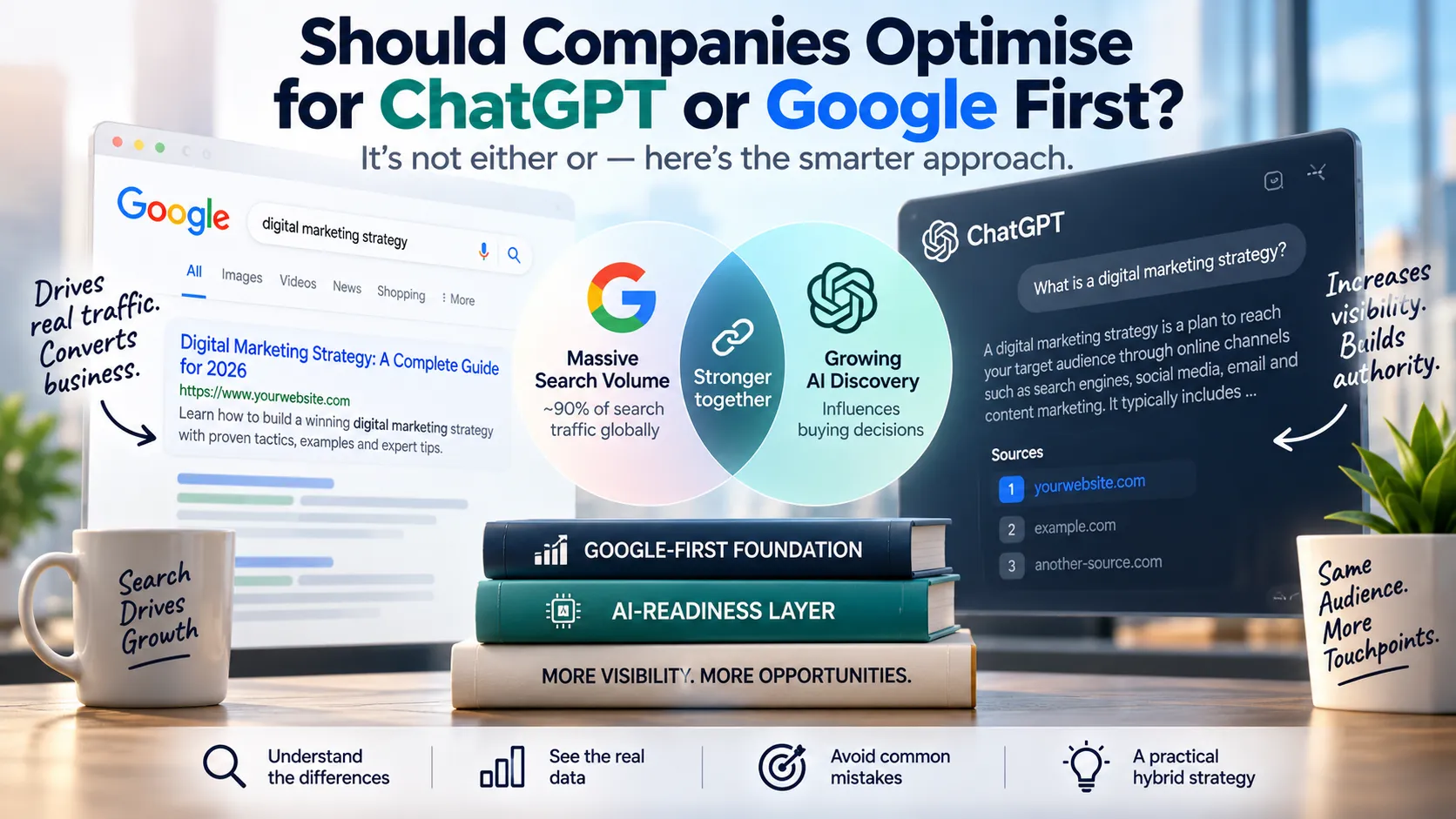
The question lands in every strategy meeting now: should we rebuild our content for ChatGPT, or stick with Google? The answer most businesses get wrong is treating it as a binary choice.
In 2024-2025, search isn’t splitting between two platforms. It’s layering. Google still handles 90% of enterprise search volume globally. ChatGPT, Claude, Perplexity and Google’s own AI Overviews are becoming part of how people find answers, but they’re not replacing Google’s role as the traffic engine that converts. The real challenge isn’t picking a winner. It’s understanding why optimising for the wrong system first costs you months of momentum and budget.
Key Takeaways
- The ChatGPT vs Google choice is a false dichotomy. Most companies need both, weighted toward Google.
- 90% of enterprise search traffic still routes through Google; ChatGPT generates indirect visibility with no measurable referral path.
- Google ranking creates the authority foundation that AI systems later cite and amplify, not the reverse.
- A hybrid visibility model prioritises Google-first strategy with AI-accommodation layers (structured data, clear formatting, citation readiness).
- Companies optimising for ChatGPT first often sacrifice Google topical authority without gaining conversions in return.
The False Choice Between ChatGPT and Google
The question “Should we optimise for ChatGPT or Google first?” assumes a zero-sum tradeoff that doesn’t exist. This framing locks companies into false choices and often leads to strategic drift: either abandoning proven Google visibility for speculative AI gains, or ignoring AI entirely and missing emerging user behaviour shifts.

The real problem is simpler: most companies conflate platform presence with business value. Appearing in ChatGPT doesn’t generate traffic. Ranking in Google does. Both systems influence how your audience discovers you, but ignoring either one leaves money on the table.
Search behaviour hasn’t abandoned Google for ChatGPT. It has fractured into multiple parallel discovery channels, each serving different user needs and different stages of the customer journey. According to a Statista survey, Google still captures an estimated 90% of enterprise and consumer search volume globally. In Southeast Asia, Google’s dominance is even more pronounced at 92%+, with ChatGPT adoption concentrated among tech-forward and white-collar users.
But user behaviour has changed: people now ask different questions in different places. Someone discovering your company for the first time might search your topic on Google, landing on your blog post. That same person might then ask ChatGPT for synthesis, comparison or a quick summary, and ChatGPT may cite your article if it appeared in the model’s training data or if your brand carries authority in the space.
A user’s discovery path might look like this:
- Search Google for “how to choose X software” (Google search)
- Read your detailed buyer’s guide (your Google-ranked content)
- Ask ChatGPT for a comparison (ChatGPT synthesises from multiple sources, including yours)
- Return to Google for specific pricing or recent reviews (Google search again)
- Share your comparison table with their team via email (direct, non-search discovery)

Each channel amplifies the others. The mistake companies make is treating them as competitors rather than as parts of the same discovery ecosystem.
The Hybrid Visibility Model
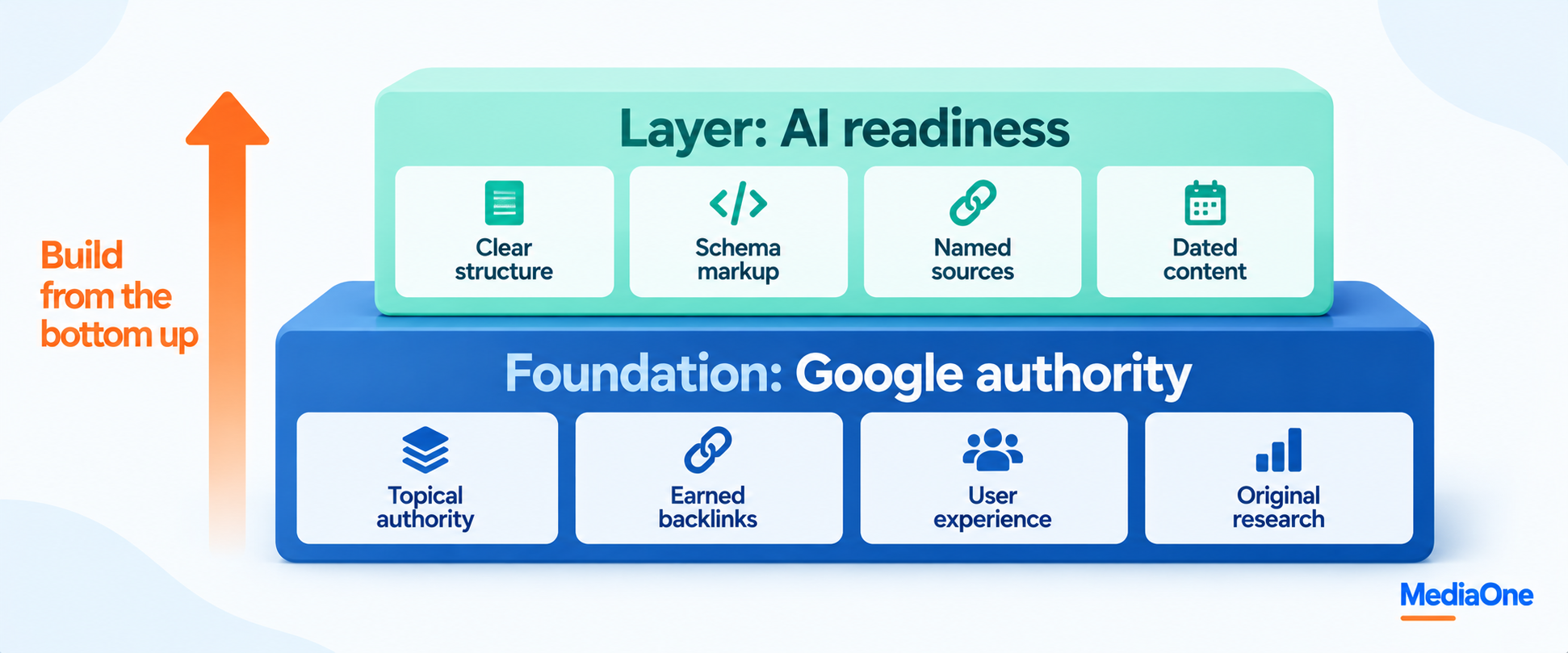
The winning approach for 2025 is not “Google first or ChatGPT first”, it’s the foundation-and-layer model: build your primary visibility and authority through Google, then layer AI-system readiness on top without sacrificing either.
This means:
Foundation (Google-first work): Secure topical authority, earn backlinks, improve user experience signals, and publish original research. These activities build trust with Google’s algorithm and establish your domain as credible. This remains the bedrock of business-relevant search visibility.
Layer (AI-readiness work): Structure your content clearly, use schema markup that AI systems can parse, cite your sources transparently, and publish with dates so systems understand recency. This ensures your Google-ranked content is also discoverable and citeable by AI systems without additional effort or rewriting.
You don’t optimise for ChatGPT any more than you optimise for a specific Google algorithm version. Instead, you build depth-first content that satisfies both systems’ requirements because those requirements overlap far more than they conflict.
Google rewards topical authority, clear structure, and trustworthy sources. ChatGPT values the same things. The differences lie in emphasis: Google weights backlinks and user behaviour; ChatGPT weights training data quality and citation depth. Write for Google’s requirements, and you’re already 80% of the way to ChatGPT discoverability.
How ChatGPT and Google Rank Content Differently
The ranking mechanisms behind ChatGPT and Google are fundamentally different. Understanding these differences is essential if you’re going to optimise for both without sabotaging one in favour of the other.
ChatGPT: Training Data, Synthesis, and Citation Depth
ChatGPT does not rank content in real time. It selects and synthesises passages from its training data (knowledge cutoff April 2024 as of early 2025) to answer your question directly.
ChatGPT is optimised for three things:
- Training data quality and recency. Content published after the cutoff does not exist in its knowledge base. More importantly, the model favours sources that were widely published, cited and referenced during its training period. If your content appeared in academic databases, news aggregators, or industry reports that ChatGPT absorbed, it has a higher probability of being selected.
- Synthesis and multi-source integration. ChatGPT does not reward single, isolated articles. It rewards content that sits within a broader conversation. If your article references other authoritative sources, gets cited by other writers, and fits into a web of correlated ideas, ChatGPT sees it as more valuable. The model is trained to cross-reference, so it inherently favours content that contributes to a coherent narrative across multiple sources.
- Citation depth and traceable claims. When ChatGPT generates a response with citations enabled, it looks for content where claims are attributed, sources are named, and reasoning is transparent. If your article says “According to research from the Pew Research Centre” rather than vague claims like “Studies show”, ChatGPT’s training process registers it as higher-quality source material.
ChatGPT cannot perform new searches to validate or update information. Your content’s visibility in ChatGPT depends almost entirely on how well it is integrated into the pre-training corpus, not on ongoing optimisation work you do after publication.
To know more about how this works, read our article on GEO vs SEO: What Matters More for Local Search Visibility in Singapore?
Google: Topical Authority, User Experience, and Trust Signals
Google ranks content live, in real time, based on current user behaviour and persistent signals of authority.
- Topical authority and content depth. Google measures whether your entire domain (and specific sections within it) demonstrate sustained expertise in a subject area. This is not one-off content. It is a cluster of related articles, built over time, that progressively deepen a reader’s understanding of a topic. A single authoritative article ranks better if it sits within a topical cluster on your site.
- User experience signals measured in real time. Google uses on-page metrics: click-through rate from search results, dwell time on the page, bounce rate, and whether users return to the search results to try another result. These signals tell Google whether your content actually satisfied the searcher’s intent.
- Backlink trust and domain authority. Google still relies on links as a primary trust signal. A backlink from an authoritative domain signals that another trusted entity vouched for your content. The quality, relevance and diversity of your backlink profile directly influence your ability to rank for competitive terms.
Google also prioritises pages that load fast, work seamlessly on mobile devices, and use structured data correctly.
Where Requirements Conflict
ChatGPT rewards breadth and synthesis. It wants your article to reference multiple sources, integrate different viewpoints, and sit within a broader knowledge web. Google’s topical authority model sometimes works against this. If you write an article that spends 40 per cent of its word count on external citations and synthesis, you dilute your on-page keyword presence and reduce the space you have for deep, original analysis. Google may read this as less focused on your core topic.
ChatGPT cannot be influenced by ongoing SEO work. Once your article is published, ChatGPT’s ability to find and surface it depends on the training data cutoff and its presence in the pre-training corpus. Updating an article, acquiring new backlinks, or improving page speed has zero impact on ChatGPT visibility. For Google, these are primary ranking factors.
ChatGPT is indifferent to backlinks. Google treats them as a cornerstone trust signal. A brilliant, original article with zero backlinks will rank poorly in Google but could be prominently cited in ChatGPT if it was available during the training window.
Where Requirements Overlap
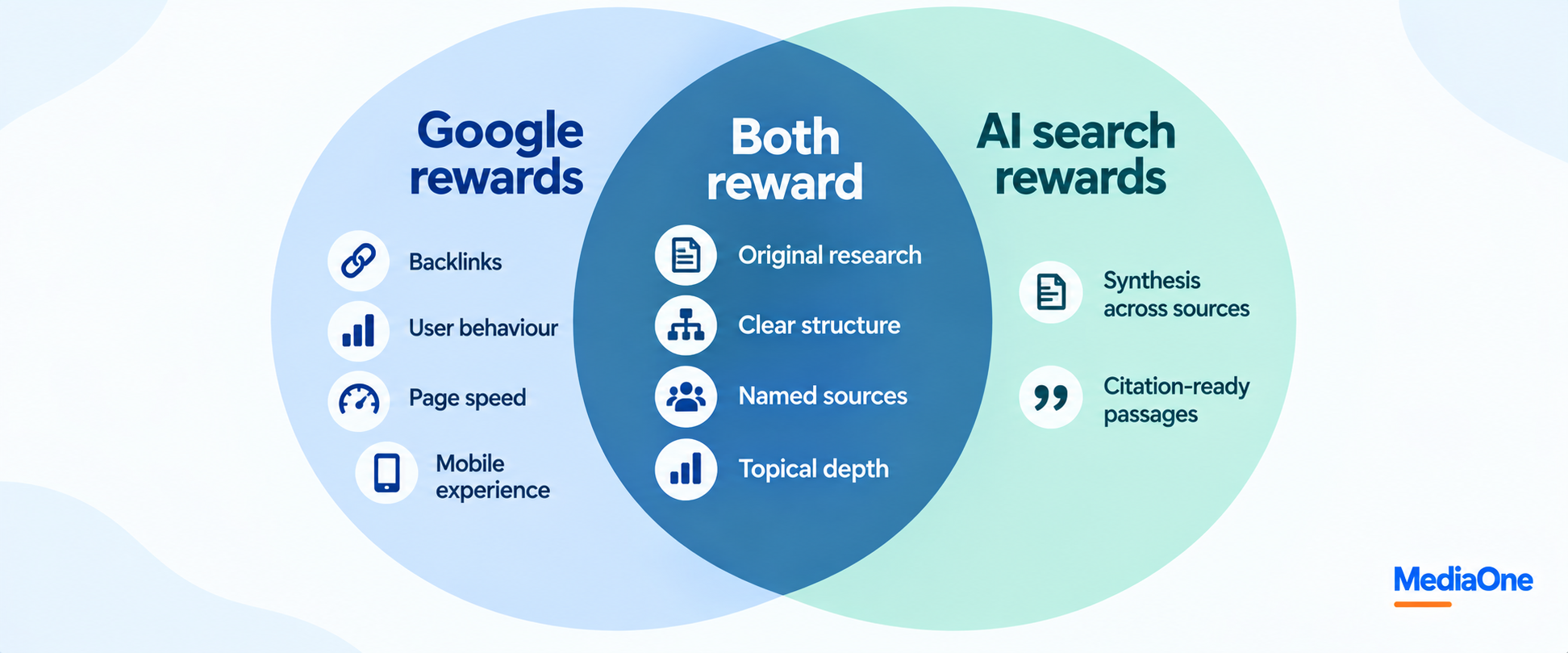
Both systems reward original research and primary data. If your article includes original research, survey data, or primary sources that others cite, both ChatGPT and Google will favour it. When others cite your original study, Google sees backlinks and ChatGPT sees corroborating citations.
Both reward clarity and structural simplicity. ChatGPT extracts information more accurately from well-structured, clearly written text. Google’s algorithm understands structure through headings and semantic HTML.
Both value cited, traceable claims. If you attribute an insight to a specific researcher, organisation or study, both systems read this as more reliable.
The practical translation: Write articles that deliver original depth (Google’s topical authority), clear citations (ChatGPT’s training value), and structured clarity (both), then acquire backlinks to amplify Google ranking without compromising the article’s value as source material.
The Current State of AI Search (2024–2025)
The landscape of AI-powered search has fractured rather than unified. ChatGPT, Google, Claude, Perplexity, and a growing roster of specialised systems are all competing for discovery share, each with different training windows, citation mechanics, and business models.
ChatGPT’s Browsing Mode
ChatGPT’s web browsing capability, rolled out in late 2023, remains the most publicly visible AI search feature. Yet it operates under critical constraints that few marketers acknowledge.
The tool requires users to explicitly enable browsing within a conversation. By default, ChatGPT relies on its training data, which has a knowledge cutoff in April 2024. When users do enable browsing, ChatGPT retrieves live results from the web in response to specific queries, but this is not a crawl-based indexing system. It is a real-time pull triggered by the user’s exact question.
Your article does not rank in ChatGPT’s index. It is surfaced only when a user asks a question that ChatGPT decides is best answered by searching the web. For most informational queries, ChatGPT will attempt to synthesise an answer from training data first and only browse if the query involves recent events, real-time data, or topics outside its training window.
ChatGPT also does not report which websites it browsed or why. OpenAI does not provide traffic data, source attribution visibility, or any metrics that tell you whether your content was retrieved. Unlike Google Analytics, there is no way to measure ChatGPT browsing traffic directly.
Google’s AI Overviews
Google’s AI Overviews, launched in 2024 and rolling out globally through 2025, generate summaries at the top of search results for qualifying queries. Unlike traditional featured snippets, these are synthesised from multiple sources using Google’s own large language models. Critically, Google names the sources within the overview itself.
When Google’s AI generates an answer, it explicitly links back to the sources it drew from. A company whose content ranks in the top 5 results for a query has a reasonable chance of being cited within the Overview itself. That citation comes with a click-through link.
Early tracking data from SEO tools shows that pages featured in AI Overviews see a modest lift in traffic. The effect is not dramatic, yet the attribution is clear, and the mechanism is measurable. Google’s algorithm for sourcing AI Overviews favours pages that already rank well for the query, have clear topical authority, and contain structured data.
In other words, the goal is to be featured in an AI Overview to support traditional SEO strategies, not replace them.
Emerging Competitors: Perplexity, Claude, and DuckDuckGo
Perplexity AI, launched in 2023, has grown to roughly 500 million monthly users by late 2024. Unlike ChatGPT, Perplexity is built explicitly as a search engine. It retrieves live web results, synthesises answers, and cites sources within the response. Users see URLs and source attribution directly.
Claude (Anthropic’s LLM) offers web search capabilities but remains primarily positioned as a productivity tool rather than a search engine. Its adoption for search-like queries is growing in enterprise and developer communities, but it is not yet a primary discovery channel for most content creators.
DuckDuckGo integrated AI-powered summarisation features in 2024, offering instant answers powered by its own models. Like Google Overviews, DuckDuckGo’s AI summaries cite sources visibly, though DuckDuckGo’s market share in search (2-3% globally) limits its impact on most industries.
Perplexity and similar AI search engines are now a material part of the discovery funnel, especially for technical audiences and Gen Z users. Perplexity’s emphasis on source citation means that appearing in Perplexity results is more trackable and valuable than appearing in ChatGPT’s browsing results. However, Perplexity’s traffic is still a fraction of Google’s. In Southeast Asia, Perplexity usage is growing among tech-forward professionals, but Google remains dominant.
| Feature | ChatGPT Browsing | Google AI Overviews | Perplexity | Claude Web Search |
|---|---|---|---|---|
| Live web crawl | User-triggered | Continuous | Continuous | On-demand |
| Source citation | Inconsistent | Named links | Named links | Minimal |
| Measurable traffic | No | Yes, via Google Analytics | Yes, referral data | Emerging |
| Real-time data handling | Good | Excellent | Excellent | Good |
| User adoption (global) | 100M+ | 500M+ (via Google) | 500M+ | Growing, enterprise-focused |
| Market maturity | Mature but experimental for search | Rapidly expanding | Established but niche | Early stage |
The practical implication: Optimising for Google remains the anchor strategy because Google’s AI Overviews are now the primary AI search interface for most users globally. Perplexity is a secondary opportunity, especially for technical and professional content. ChatGPT browsing is a visibility win if it happens, but not a measurable business driver. Claude and other emerging systems should be monitored but not prioritised until adoption metrics justify resource allocation.
The Real Cost of Optimising for ChatGPT First
Visibility Without Traffic
When you optimise content specifically for ChatGPT, you are optimising for a system that does not share traffic. ChatGPT returns an answer in a dialogue box. The user reads it, may reference your brand name in that summary, but does not click through to your website. There is no referral link, no session, no conversion event to track.
This matters because visibility in ChatGPT is not interchangeable with business reach. Your content may be cited, your research credited, your perspective included in the AI’s synthesis. But the user journey stops at ChatGPT’s interface. They have the answer they needed without entering your domain.
Google, by contrast, sends traffic. A user searches, clicks your result, lands on your page, and that event can be measured, attributed, and connected to business outcomes. You own the relationship with that visitor. You can retarget them, collect their email, guide them through a sales process, or build brand trust over multiple visits.
The Measurement Problem
ChatGPT visibility is indirect; Google traffic is direct and repeatable. When a company invests in appearing in ChatGPT’s training data, they are betting on a halo effect: users will remember the brand, trust it more, or search for it later. Those outcomes are real but difficult to isolate and measure.
Google traffic is direct and repeatable. A user with a need searches for your keyword, finds your page, and converts. You can track this in Google Analytics. You can connect revenue to specific keyword clusters. You can calculate the lifetime value of that traffic and justify reinvestment in content around those topics.
In 2024, enterprise search traffic routing through Google remained stable at approximately 90% of total search volume across North America, Europe, and Asia-Pacific. ChatGPT adoption among business users is rising, but it remains a supplementary discovery channel, not a replacement for search engine traffic.
This means ChatGPT optimisation becomes a second-order priority. You want to appear in it, but not at the expense of the system that actually drives qualified, attributable visitors to your website.
Why Google Ranking Creates the Authority Foundation
Search behaviour shows a clear pattern: companies that ranked first in Google before ChatGPT launched are the same companies appearing first in ChatGPT citations. Google ranking is a prerequisite for AI visibility, not a competitor to it.
Your visibility in ChatGPT follows from your visibility in Google. When an AI system cites a source, it relies on multiple implicit signals to assess credibility: domain age, inbound link count, topical authority (signalled by clustering with related content), and citation frequency. Google’s ranking algorithm has already filtered and ranked the web for topical relevance. A company that appears on page one of Google for a competitive keyword has, by definition, already passed multiple credibility gates.
Companies that prioritise ChatGPT optimisation (content structure, synthesis, citation readiness) while neglecting Google authority (backlinks, topical depth, domain trust) are discounting the one ranking factor that AI systems cannot replicate. You are competing on a dimension where you have no structural advantage.
Reversing that sequence wastes effort on a system designed to synthesise, not to drive traffic, and it risks eroding the authority that makes you trustworthy to cite in the first place.
The Business Case for Google-First Strategy
90% of Enterprise Search Traffic Routes Through Google
The numbers are definitive. Google controls roughly 92% of global search market share as of 2025, and in enterprise contexts (B2B SaaS, professional services, e-commerce), the concentration is even higher. This is not a marginal advantage: it represents the overwhelming majority of qualified, ready-to-act traffic available through search discovery.
For a company generating 1,000 monthly search visitors, about 920 arrive via Google. ChatGPT, Perplexity, Claude, and all emerging AI search systems combined account for the remainder. The traffic that does come through AI search engines is largely unattributable (ChatGPT provides no referral data), indirect (users ask the AI, consume the answer, and may never visit your site), or brand-awareness only.
This concentration persists despite AI’s rapid adoption. ChatGPT reached 200 million weekly users by early 2024, yet enterprise search behaviour remains Google-dominant. The gap between awareness and actual search-led conversion is substantial. Your finance director may use ChatGPT for brainstorming; your procurement team still searches Google when evaluating vendors.
In Southeast Asia, Google’s dominance is even more pronounced (92%+), with negligible ChatGPT integration into native search workflows. Unless your business targets tech-early-adopter audiences in developed markets, Google search is not just the primary channel: it is the only channel with measurable, repeatable business impact.
Backlinks and the Competitive Moat
The structural difference between Google’s ranking system and AI training is crucial. Google’s algorithm rewards inbound links as a proxy for third-party endorsement. A backlink from a relevant, authoritative site signals that independent parties found your content valuable enough to reference.
AI systems like ChatGPT cannot replicate this signal. An AI has no mechanism to evaluate which external sources endorse your content or how many competitors fail to mention you. AI systems can assess whether your content appears in training data, whether it contains citations to other sources (outbound), and whether it is written with clarity and depth. They cannot evaluate the third-party vote that a backlink represents.
This creates a durable moat. Backlinks are earned slowly. They require genuine relevance, relationship-building, and content quality that justifies citation. A company that has accumulated 500 high-quality backlinks from industry publications, research institutions, and partner sites has built a competitive advantage that ChatGPT cannot assess, replicate, or undo.
A Google-first strategy with AI accommodation (clear structure, schema markup, original research) preserves backlink-building incentives while ensuring your content remains AI-friendly. You gain the moat and the discoverability in one approach.
A Practical Optimisation Framework for Both Systems
The hybrid model works because Google and AI systems share more requirements than they conflict on. A content strategy that satisfies Google will also satisfy AI systems 80% of the way there.
Step 1: Build Topical Authority (Google Priority)
Create a cluster of related articles that deepen understanding of a single topic over time. This signals to Google that your domain owns this territory. For example, if you cover “project management software”, write separate articles on selection criteria, team adoption, cost analysis, and integration challenges. Link these articles together internally. This cluster becomes a moat that AI systems also respect, because they can see you have comprehensively covered the topic.
Step 2: Publish Original Research and Data
Original research is rare enough that both Google and ChatGPT favour it. If you publish original survey data, case studies, or primary research, other writers will cite you. Those citations become backlinks for Google and training data signals for ChatGPT. This is the highest-leverage activity because it serves both systems simultaneously.
Step 3: Structure for Clarity and Schema Markup
Use clear headings, short paragraphs, and simple sentences. Add schema markup (structured data), so both Google and AI systems can parse your content without guessing at intent. Schema markup tells systems what entities, relationships and facts are present on the page. AI systems trained to understand schema markup can extract information more accurately, which increases the chance they cite you.
Step 4: Cite Sources and Attribute Claims
When you make a claim, name the source. “According to a 2024 Gartner study” is stronger than “Research shows”. This signals credibility to Google (shows you’ve done topical research) and makes your content more valuable to ChatGPT (clear sourcing increases citation probability in the training set).
Step 5: Date Your Content and Update Regularly
AI systems weight recency within their training window. Google weights freshness signals and update frequency. A page updated in the last 90 days signals to both systems that information is current. Set a review schedule: update evergreen content every quarter, refresh data annually, and remove or consolidate outdated articles.
Step 6: Build Backlinks Through Relevance, Not Outreach Alone
Backlinks follow from value. If your content is genuinely useful, original, or authoritative, other writers will cite it naturally. Supplement organic citations with strategic link-building: contribute to industry publications, speak at conferences, partner with complementary brands, and reach out to writers who have cited competitors. Each backlink signals to Google that you matter. Each citation increases the odds you appear in AI training sets.
Step 7: Optimise for User Experience (Google Priority)
Fast page load time, mobile responsiveness, and intuitive navigation all influence Google ranking. These factors also improve the experience for humans, who then spend more time on your page and share it more often. User experience is not an AI-optimisation factor, but it directly supports Google ranking, which supports all downstream visibility.
Specific Tactics That Work for Both
Original Research and Data as Dual-System Content
Original research is the single highest-leverage tactic because it drives both Google ranking and AI citation. A company that publishes original research gains backlinks (Google signal), appears in citations (AI signal), and builds brand authority (both).
Example: A SaaS company publishes an annual survey of 1,000 enterprise buyers about their software selection criteria. Other bloggers cite the data. News outlets mention the findings. The company’s research becomes a reference point in the industry. Google ranks the company for related keywords because the content is comprehensive, well-sourced, and widely cited. ChatGPT includes the company’s findings in synthetic answers because the research is credible and appeared in training data.
Clear Formatting and Subheadings
Both systems reward clear structure. Use descriptive H2 and H3 headings that break content into scannable sections. This helps Google understand topic relationships and helps AI systems extract information more accurately. A page with good structure ranks better in Google and is more likely to be cited in ChatGPT responses.
Named Sources and Attribution
Instead of “Studies show”, write “A 2024 McKinsey survey of 500 CIOs found that.” Named attribution increases credibility with both systems. Google interprets this as evidence of topical research. ChatGPT’s training process weights cited claims as higher-quality source material.
Schema Markup for Entities and Facts
Use schema.org markup to label key entities, facts, and relationships on your page. This tells Google and other systems what information is present without forcing them to guess. A product comparison page with schema markup for product names, prices, and features can be understood more accurately by both systems.
Topic Clusters and Internal Linking
Create clusters of related articles on a single topic. Link them together with descriptive anchor text. This tells Google you have comprehensive coverage and helps AI systems understand the relationship between your articles. A reader (or AI) moving through your cluster gains progressively deeper understanding.
Measuring Success: What Metrics Actually Matter
Google Metrics: Direct and Measurable
Track these metrics in Google Analytics:
- Organic search traffic (sessions from Google)
- Click-through rate (CTR) from Google search results
- Average position for target keywords (via Google Search Console)
- Conversion rate from organic search traffic
- Revenue attributed to organic search (if e-commerce)
These metrics connect your content directly to business outcomes. A strategy that increases organic traffic and conversion rate is working.
AI-System Metrics: Indirect and Emerging
ChatGPT browsing traffic does not appear in Google Analytics. Instead, track:
- Mentions in ChatGPT responses (manual or via monitoring tools)
- Citations in Perplexity results (trackable via referral data)
- Featured snippets and AI Overview citations (visible in Google Search Console)
- Brand mentions and search volume (rise in brand searches may indicate AI-driven awareness)
These metrics are indirect proxies for AI visibility. They do not represent direct traffic, but they indicate that AI systems are aware of and referencing your brand.
The Hierarchy of Metrics
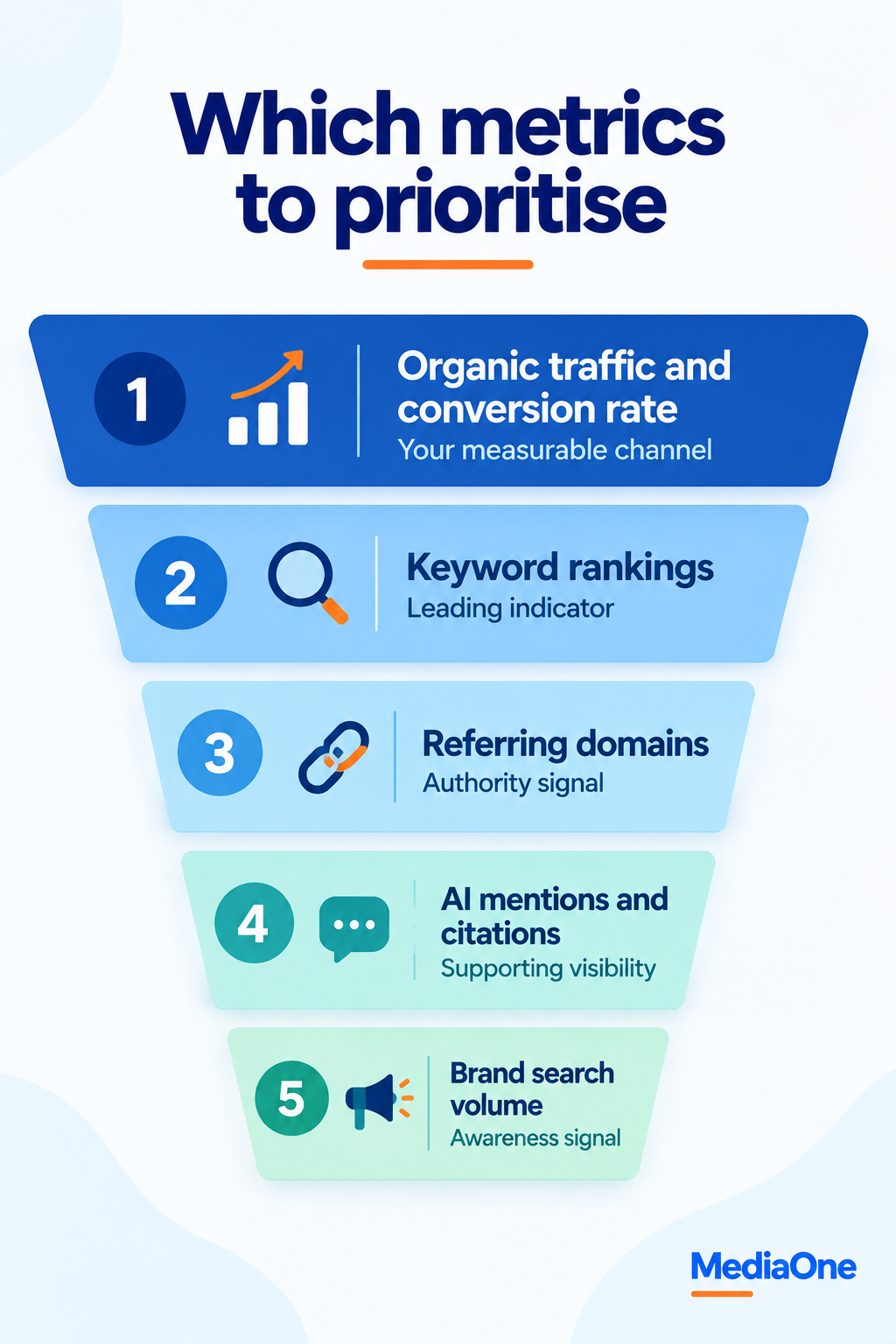
Prioritise metrics in this order:
- Organic search traffic and conversion rate (Google is your measurable channel)
- Keyword rankings for target terms (leading indicator of future traffic)
- Backlink growth and referring domains (signals of domain authority)
- AI system mentions and citations (supporting visibility metric)
- Brand search volume (awareness metric)
A strategy that improves the first three metrics is working. Improvements in the fourth and fifth metrics are validation that your authority is spreading to AI systems.
Common Mistakes Companies Make
Mistake 1: Rewriting Content Specifically for ChatGPT
Some companies rewrite articles to include more citations, external links, and synthesis language in hopes of appealing to ChatGPT. This often backfires. Adding 40 per cent external citations may dilute your on-page keyword focus and reduce Google ranking. You’ve optimised for a system that may or may not cite you while eroding the visibility that makes ChatGPT citation likely in the first place.
Fix: Write for Google’s topical authority requirements first. Ensure your article includes original insights, clear structure, and proper attribution. This serves both systems without compromise.
Mistake 2: Ignoring Backlinks Because “AI Doesn’t Care About Links”
Some companies abandon backlink-building efforts under the assumption that ChatGPT doesn’t use links, so links don’t matter anymore. This is strategically backwards. Backlinks remain Google’s primary trust signal and correlate strongly with whether your content appears in high-quality training data.
Fix: Continue building backlinks as a core activity. These signals drive Google ranking, which in turn makes your content more likely to be cited by AI systems.
Mistake 3: Treating ChatGPT Mentions as Equivalent to Conversions
Some companies celebrate when their brand appears in ChatGPT responses but don’t track whether that mention drives traffic or conversion. ChatGPT mentions are brand awareness; they are not conversion events. A brand mention in ChatGPT that doesn’t lead to a website visit has no measurable business value.
Fix: Distinguish between brand mentions (awareness) and website traffic (business value). Prioritise strategies that drive measurable traffic and conversion.
Mistake 4: Over-indexing on Structured Data Without Building Authority
Structured data (schema markup) helps both systems understand your content, but it does not substitute for authority. A page with perfect schema markup but zero backlinks and low topical authority will rank poorly in Google and may not be cited by AI systems.
Fix: Use schema markup as a supporting tactic, not a substitute for content quality and backlink authority. Build authority first, then add schema markup to amplify it.
Mistake 5: Assuming All AI Systems Are the Same
ChatGPT, Perplexity, Claude and DuckDuckGo operate under different mechanics. ChatGPT doesn’t provide referral data. Perplexity does. Claude is focused on enterprise. DuckDuckGo has marginal market share. Treating them as interchangeable wastes effort on low-opportunity systems.
Fix: Prioritise AI systems by user adoption and measurable traffic potential. Google AI Overviews (through Google Search) are the primary opportunity. Perplexity is secondary. ChatGPT browsing is a nice-to-have. Others should be monitored, not optimised for yet.
Why Google-First Strategy Wins
Search behaviour has changed, but the hierarchy hasn’t reversed. Google still owns most of enterprise search traffic. Companies that rank well in Google are the same companies cited by AI systems. Backlinks, topical authority, and domain trust are cumulative competitive advantages that AI systems cannot assess, replicate, or undo.
A Google-first strategy with AI accommodation is not about ignoring emerging platforms. It’s about understanding where business value actually flows and optimising for that channel first. You build Google authority, which creates the foundation for AI visibility. You structure your content for clarity, use schema markup, and publish original research. This serves both systems simultaneously without compromise.
The companies winning in 2025 are not choosing between ChatGPT and Google. They’re building in Google, optimising for clarity, and letting AI systems discover and cite them as a natural consequence of doing the first two things well.
Frequently Asked Questions
Should we create separate content for ChatGPT?
No. Separate content divides your authority across multiple URLs, making it harder to rank in either system. Write one authoritative article that serves both: original insights and depth (Google’s topical authority), clear citations and structure (ChatGPT’s training value). One strong article beats two mediocre ones.
Can we rank in ChatGPT without ranking in Google first?
Unlikely. AI systems treat Google-ranked, well-linked content as more credible because it has already passed multiple credibility gates. A company with zero Google visibility has no signal of authority for AI systems to recognise. Build Google visibility first.
How long until ChatGPT search becomes a major traffic driver?
ChatGPT has 200 million weekly users but does not return search result pages or track referral traffic. Even if adoption doubles, the business value remains indirect (brand mentions, not conversions). Google will remain the primary traffic channel for most companies through 2026 and beyond.
Is schema markup necessary to rank in Google or appear in ChatGPT?
No, but it helps. Schema markup improves your chances of being understood correctly by both systems and increases the odds of being featured in Google AI Overviews. It’s a supporting tactic, not a requirement. Content quality and authority matter more.
What’s the ROI of appearing in ChatGPT if it doesn’t send traffic?
Brand awareness and credibility. If ChatGPT mentions your brand or cites your research, users may remember you and search for you later (generating direct Google traffic). This is a secondary benefit, not a primary one. Measure it indirectly through brand search volume and awareness surveys, not through ChatGPT referral data (none exists).
Should we update our content more frequently to appear in future AI training sets?
Update content for Google’s freshness signals and to keep facts current, not for ChatGPT. Most AI systems train on historical data with long cutoff dates. Updating in 2025 doesn’t guarantee inclusion in ChatGPT’s next training window. Update for your audience and Google’s ranking factors, which have measurable business impact.
Does AI search mean the end of SEO?
No. AI search has made SEO more important, not less. Google now ranks content based on traditional signals (backlinks, topical authority) and AI-readiness signals (structure, clarity, citations). Companies that master both will dominate search visibility. Those that ignore either will lose ground.
How do we know if our content is being cited by AI systems?
For Google AI Overviews, check Google Search Console for featured snippets and AI Overview eligibility. For Perplexity, monitor referral traffic in your analytics. For ChatGPT, manually search your brand name and key topics within the tool and note mentions. Tools like Ahrefs and SEMrush are also adding AI citation tracking features.
Can a company rank well in Google but not appear in AI systems?
Yes, if the company ranks well but their content is poorly structured, lacks clear citations, or was published after AI training cutoffs. However, this is rare. Google’s ranking factors correlate strongly with quality signals that AI systems value. If you rank well for a competitive keyword, your content almost certainly has features that make it AI-citeable.
What happens to our ranking if ChatGPT starts sending referral traffic but stops suddenly?
Your Google ranking is unaffected. Google doesn’t track ChatGPT referrals. Your ranking depends on Google’s own signals: backlinks, topical authority, user behaviour on your site. ChatGPT traffic, if it ever appears, is a bonus visibility layer, not a ranking factor. Losing it doesn’t hurt your Google position.
Should we adjust our keyword strategy for AI search?
Not significantly. AI systems value the same topics and intent as Google search, just with emphasis on synthesising multiple sources rather than winning a single ranking position. Write for user intent and comprehensiveness (which serves Google topical authority). AI systems will naturally discover and cite you. Keyword strategy should remain Google-focused.