
Google Ads and SEO solve different problems. Paid search can create immediate visibility and fast feedback. SEO can reduce dependence on paid traffic over time. The better investment depends on your margins, search demand, competition, conversion rate, cash-flow needs and measurement discipline.

Key Takeaways
- Google Ads is faster. Campaigns can generate impressions and clicks as soon as they are approved, but profitable conversions still depend on targeting, offer quality and landing pages.
- SEO is slower and less predictable. Meaningful organic growth often takes months, and competitive queries can take considerably longer.
- SEO is not free. Content, technical work, digital PR, link earning, analytics and ongoing maintenance all have real costs.
- Paid search is not automatically expensive. A high CPC can still be profitable when lead quality, conversion rate and customer value are strong.
- There is no universal crossover month. SEO may become more economical than paid search for some businesses; for others, Google Ads remains the stronger acquisition channel.
- Many businesses benefit from both. Paid search can reveal which queries convert, while SEO can build durable visibility around proven demand.
The ROI Question Singapore Business Owners Should Actually Ask
The useful question is not “Is SEO better than Google Ads?” It is: Which channel produces acceptable customer acquisition economics for this business, within the time available?
A business that needs revenue this quarter may value speed more than long-term efficiency. Another business with stable cash flow and a long sales cycle may be willing to invest for twelve months before expecting SEO to materially contribute. A third may discover that its best search terms are so commercially valuable that both paid and organic visibility are worth pursuing.
Start with unit economics, not channel ideology
Before comparing channels, define four numbers:
- Gross profit per new customer, not just revenue.
- Lead-to-customer conversion rate.
- Maximum acceptable CAC after fulfilment and operating costs.
- Payback period your cash flow can tolerate.
If a customer produces SGD 4,000 in gross profit and you are comfortable spending up to SGD 1,000 to acquire that customer, a SGD 40 click can be perfectly viable if the conversion path is strong. Conversely, a SGD 5 click is expensive if it produces low-quality traffic that never converts.
How Google Ads Works — and Where Its ROI Comes From
Google Ads lets businesses bid for visibility on search queries and other Google inventory. Search campaigns are especially valuable when the query itself signals commercial intent, such as “corporate lawyer Singapore”, “same day flower delivery” or “accounting software demo”.
The main advantage: speed and controllability
A new campaign can begin collecting search-term, click and conversion data quickly. That makes paid search useful when a business needs to test demand, validate an offer, launch into a new market or generate leads before organic rankings exist.
Google Ads also gives advertisers control over location targeting, schedules, devices, budgets, keyword themes, negative keywords and landing-page destinations. That control makes it easier to run structured experiments than with SEO, where ranking changes depend on search engines and competitors as well as your own work.
The real cost is more than CPC
The correct cost base includes:
- media spend;
- campaign setup and ongoing optimisation;
- landing-page design and conversion-rate optimisation;
- analytics and conversion tracking;
- creative and copy testing where relevant;
- sales-team time spent processing leads.
A paid-search campaign can look efficient at platform level while producing weak economics after management fees, low-quality leads or poor close rates are included.
When Google Ads tends to be attractive
- Immediate demand capture. People are already searching for the service and the business needs leads now.
- Time-sensitive campaigns. Product launches, events, seasonal promotions and short sales windows benefit from instant visibility.
- New-market testing. Paid search can test whether a query converts before months are invested in ranking organically.
- High customer value. Expensive clicks can be justified when customer lifetime value and margins support them.
- Weak current organic visibility. Ads can bridge the gap while SEO work matures.
Where Google Ads can disappoint
Paid search performs poorly when conversion tracking is unreliable, keyword targeting is too broad, landing pages do not match search intent, the sales team does not follow up quickly, or the economics cannot support prevailing auction prices. It also stops producing paid visibility when spend stops.

However, it is too simplistic to say paid search always becomes more expensive over time. CPCs can rise or fall with competition, Quality Score, match types, seasonality, bidding strategy and market demand. Well-managed accounts can also become more efficient as negative keywords, conversion data and landing pages improve.
How SEO Works — and Why the Timeline Matters
SEO improves a site’s ability to earn unpaid visibility in search results. That usually involves technical SEO, content, internal linking, structured data, authority building, digital PR, local optimisation and continuous improvement based on performance data.
The main advantage: durable discoverability
Unlike paid search, organic clicks are not charged individually. A page that ranks well can continue attracting visitors after the initial work that helped it rank. This creates the possibility of declining acquisition cost over time, particularly when one piece of content ranks for many related queries.
But organic visibility is not permanent. Competitors improve, search intent changes, content becomes outdated and Google systems evolve. Rankings therefore require maintenance, and some queries will remain difficult regardless of effort.
What a realistic SEO timeline looks like
There is no universal “three to six month” rule. A useful way to think about the timeline is by stage:
| Stage | What often happens | What to measure |
|---|---|---|
| Months 1–3 | Technical fixes, research, page improvements and new content. Some pages may be indexed quickly; commercial rankings may show little movement. | Indexation, crawl health, impressions, query coverage, page quality and conversions from existing organic traffic. |
| Months 3–6 | Long-tail queries and lower-competition pages may begin gaining visibility. Existing authoritative domains can move faster than new or weak sites. | Impression growth, non-brand clicks, rankings for priority clusters, assisted conversions. |
| Months 6–12+ | Strong programs may begin producing meaningful traffic and leads across larger topic clusters. Competitive commercial terms may still need more time. | Organic revenue, qualified leads, CAC, conversion rate, share of search visibility and contribution margin. |
New sites can take longer because they lack established signals, but there is no need to invoke an unproven “Google sandbox” as a fixed mechanism. The practical issue is that newer sites usually have less content, fewer references, less behavioural history and lower brand demand.
The real cost of SEO
SEO expenditure commonly includes:
- technical audits and implementation;
- content planning, writing, editing and subject-matter review;
- digital PR, link earning and partnership outreach;
- design, development and page-experience work;
- analytics, rank tracking and reporting;
- refreshing and consolidating ageing content.
The correct question is not whether SEO is “free”. It is whether the total cost of building and maintaining organic visibility produces an acceptable return over the period being measured.
When SEO tends to be attractive
- Customers research before buying. Informational and comparison searches create opportunities to influence a decision before the final transaction.
- Search demand is recurring. Evergreen queries can justify content and authority investment.
- The business has patience and runway. SEO is easier to fund when short-term revenue does not depend on immediate organic results.
- Paid CPCs are high relative to margins. Organic visibility may reduce dependence on expensive auctions.
- The site can build differentiated expertise. Original data, specialist knowledge, useful tools and credible authorship are harder for competitors to copy than generic content.
Google Ads vs SEO: Direct ROI Comparison
| Factor | Google Ads | SEO |
|---|---|---|
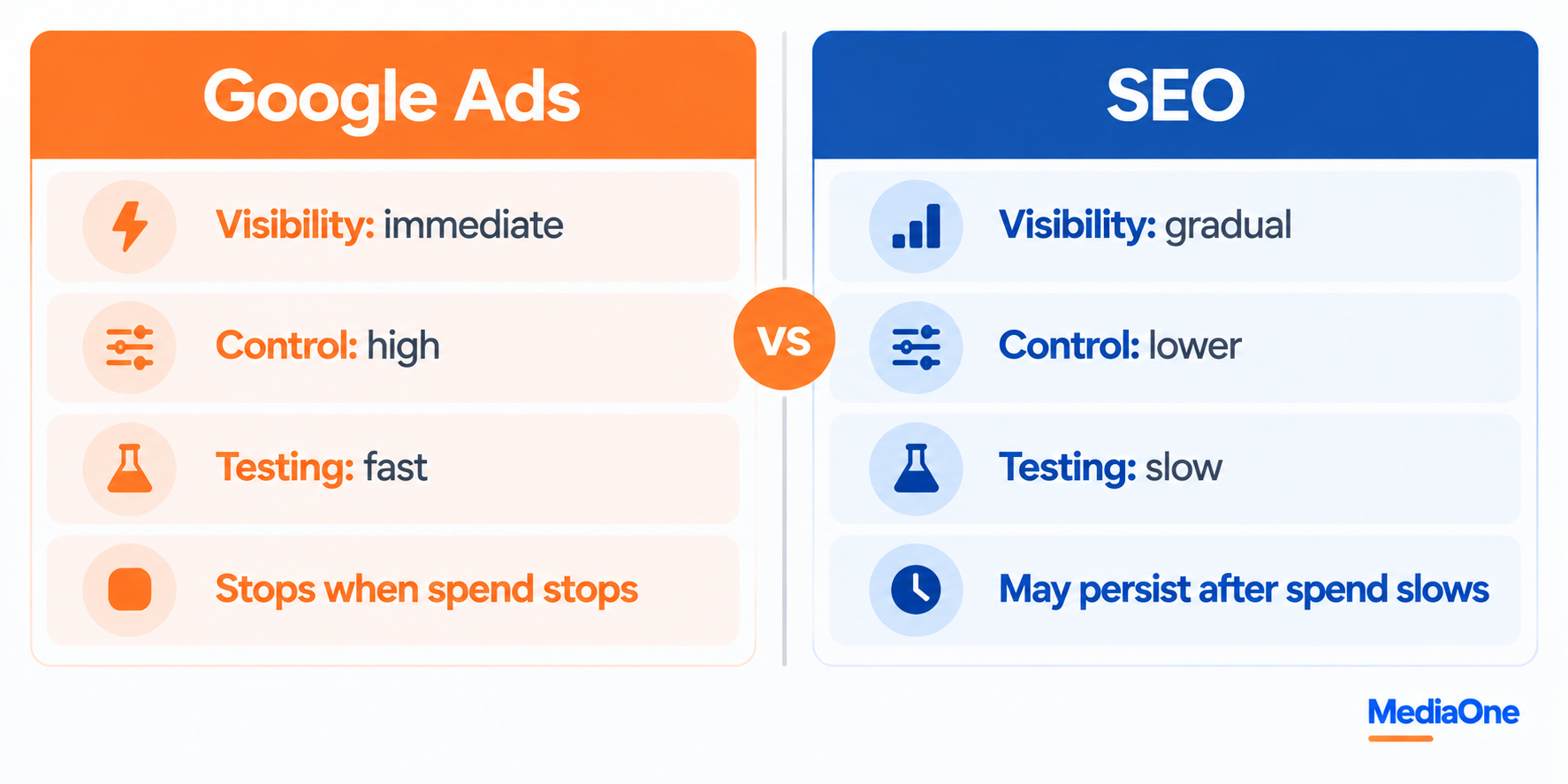
| Time to visibility | Potentially immediate after campaign approval | Usually gradual; meaningful growth often takes months |
| Traffic cost structure | Pay for clicks or outcomes according to campaign type | No per-click fee, but ongoing labour and production costs |
| Control | High control over budget, targeting and landing pages | Lower control over rankings; search engines determine results |
| Testing speed | Fast | Slow |
| Durability after spend is reduced | Paid visibility falls quickly | Strong pages may continue generating traffic, but rankings can decline |
| Scalability | Often scales with additional spend until marginal returns weaken | Can scale non-linearly when content ranks for many related queries |
| Best use | Immediate demand, testing, commercial queries, launches | Evergreen demand, research journeys, category authority, long-term discoverability |
There is no universal SEO “crossover point”
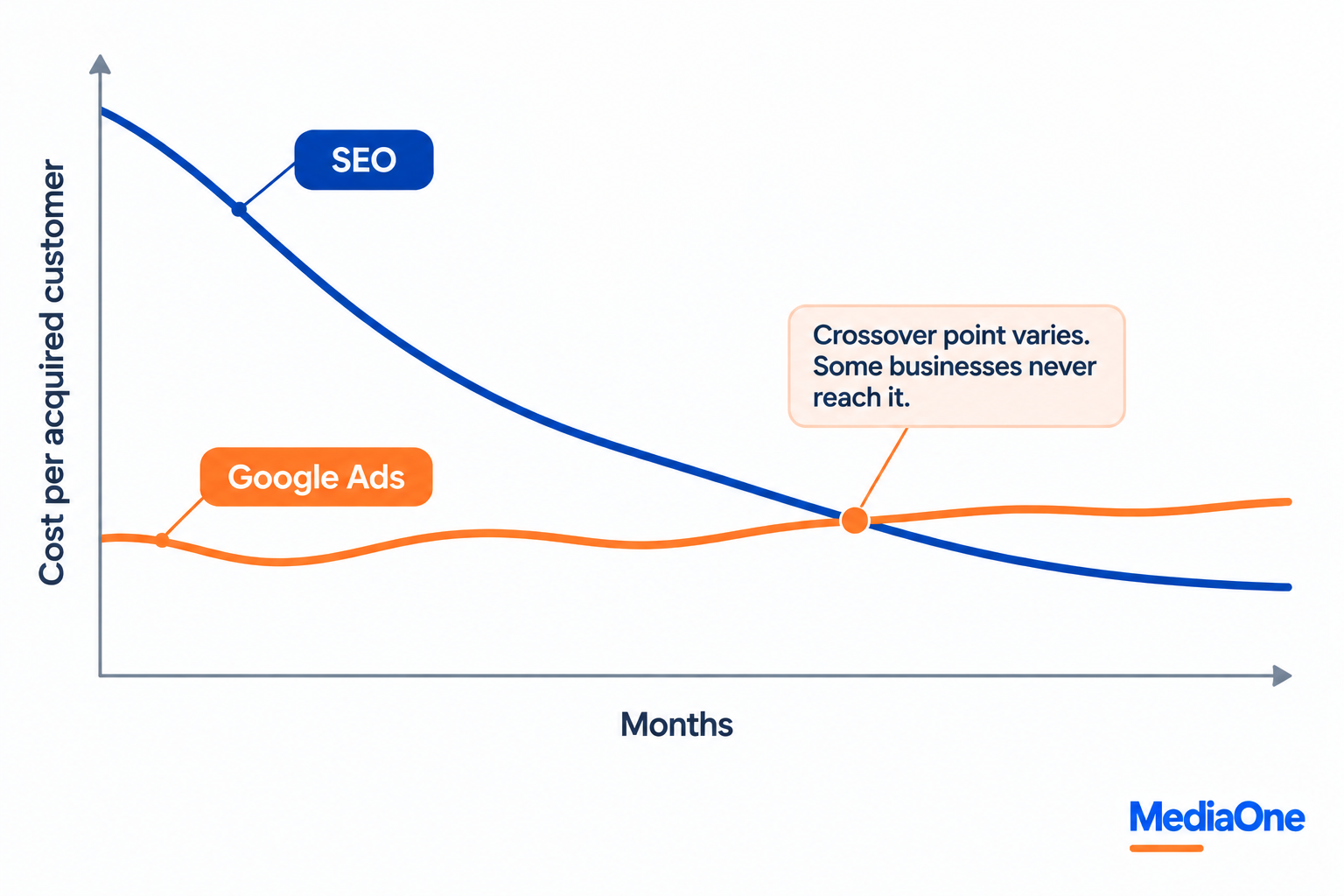
Some businesses see SEO become cheaper per acquisition after a year or more. Others never do. The crossover depends on organic conversion rate, SEO investment, paid CPC, sales close rate, margins, brand strength and the number of queries a business can realistically rank for.
An illustrative comparison
Consider a hypothetical professional-services company. These figures are not market benchmarks; they simply demonstrate the calculation.
| Metric | Google Ads scenario | SEO scenario after maturity |
|---|---|---|
| Monthly channel cost | SGD 5,000 | SGD 6,000 |
| Qualified leads | 25 | 40 |
| Lead-to-customer rate | 20% | 20% |
| Customers | 5 | 8 |
| CAC | SGD 1,000 | SGD 750 |
In this scenario, SEO has lower CAC. Change the assumptions and the conclusion can reverse. If paid traffic converts at 35% while organic traffic converts at 10%, or if SEO requires substantially more investment, Google Ads may produce the stronger return.
What Is Different About the Singapore Market?
Singapore is geographically compact, digitally mature and highly competitive in many commercial categories. These conditions influence both channels.
1. Search volume can be concentrated
A relatively small population means some niche terms have limited monthly volume. That can make a number-one ranking less commercially valuable than expected. Before investing heavily in SEO, estimate the total addressable search demand across the entire topic, not just one headline keyword.
2. Local intent can be extremely important
For clinics, home services, tuition, beauty, F&B and other location-sensitive categories, local SEO can generate customers. That is why Google Business Profile optimisation, reviews, local landing pages and map visibility can matter as much as traditional blue-link rankings.
3. CPC varies dramatically by vertical
Legal, finance, B2B software, insurance and other high-value categories can attract expensive auctions, while niche terms may be much cheaper. Current CPC should always be checked directly rather than assumed from generic benchmark articles.
4. Multilingual and multicultural search behaviour can create missed demand
Depending on the audience, English-only keyword research may not capture all relevant searches. Businesses should investigate how customers actually describe the service, including local terminology, neighbourhood names and language variations.
5. Mobile conversion experience matters
A large share of local and urgent searches are mobile. Slow pages, difficult forms, hidden phone numbers or poor WhatsApp/contact flows can undermine both SEO and Google Ads simultaneously.
When a Hybrid Strategy Makes Sense
For many businesses, Google Ads and SEO should not be treated as opposing bets. They can perform different jobs in the same acquisition system.
Use paid search to learn faster
Search-term and conversion data can identify which commercial queries actually produce revenue. Those insights can inform SEO priorities, landing-page content, FAQs and comparison pages.
Use SEO to broaden and deepen demand capture
SEO can target informational, comparison and long-tail searches that are uneconomical to buy individually through ads. It can also create branded demand by repeatedly exposing prospects to useful content before they are ready to purchase.
Do not use a fixed 70/30 split by default
A budget split should reflect economics. A business with an urgent revenue target may rationally allocate most search budget to Google Ads. A mature company with profitable paid campaigns and strong cash flow may invest aggressively in SEO without reducing ads. Another may pause paid growth because landing pages and tracking need repair first.
Where hybrid search often works well
- E-commerce: ads for products and promotions; SEO for categories, buying guides and evergreen demand.
- Professional services: ads for urgent high-intent queries; SEO for expertise, comparisons and research-heavy journeys.
- SaaS: paid acquisition for demos or trials; SEO for use cases, integrations, alternatives and educational demand.
- Local services: paid visibility for urgent searches; local SEO for maps, reviews, service-area pages and long-term discoverability.
How to Measure ROI Correctly
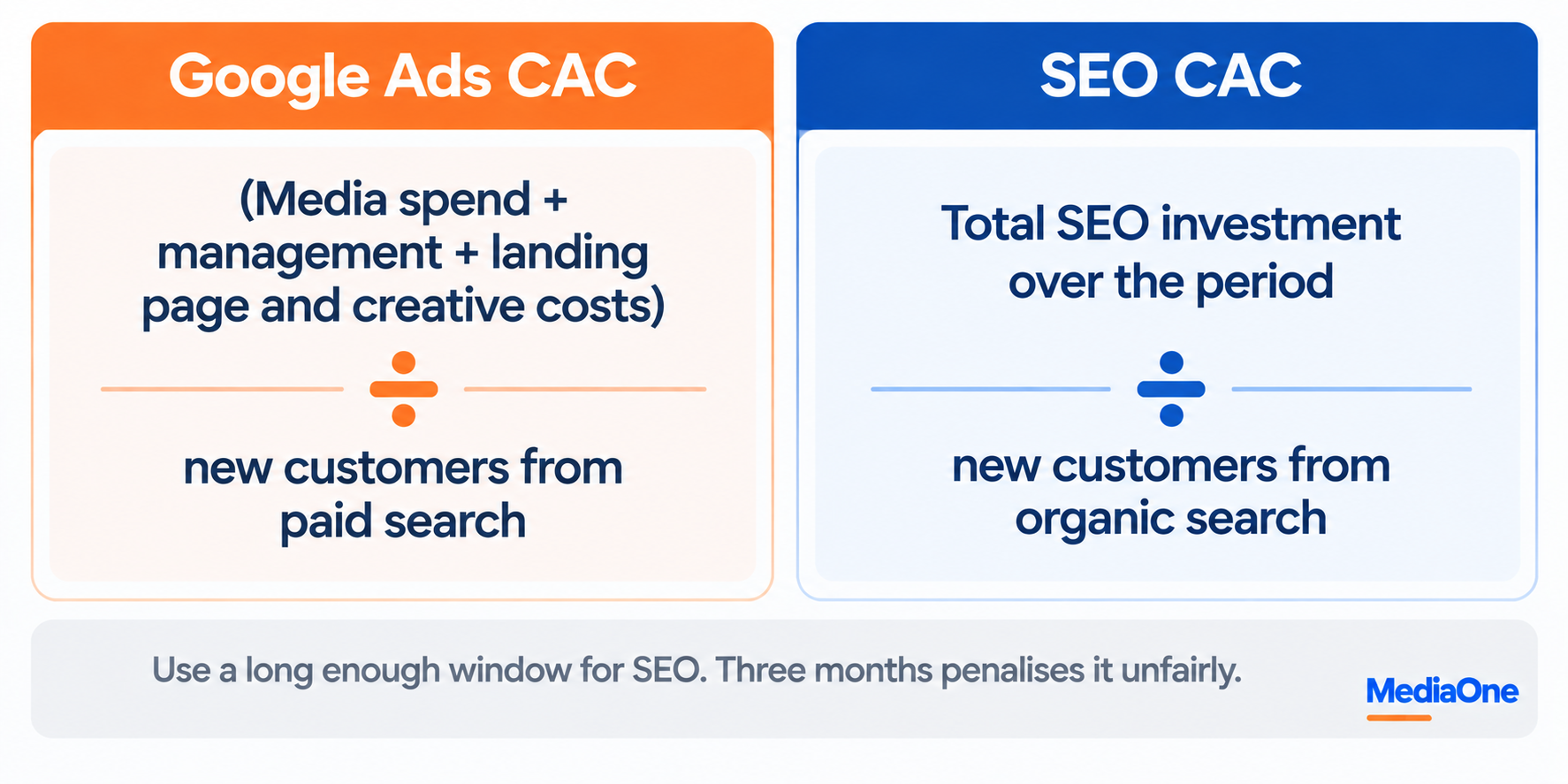
1. Calculate channel CAC on a comparable basis
Google Ads CAC = (Media spend + management + landing-page/creative costs) ÷ new customers attributed to paid search
SEO CAC = total SEO investment over the measurement period ÷ new customers attributed to organic search
For SEO, use a sufficiently long window. Measuring the first three months alone often penalises SEO because much of the investment occurs before traffic compounds.
2. Track contribution margin, not only ROAS
ROAS uses revenue, which can flatter low-margin campaigns. A better view includes gross margin, refunds, fulfilment costs and sales costs. A 5:1 ROAS campaign can still be unattractive if the product has very low margins.

3. Account for multi-touch journeys
A customer might discover a company organically, return through a branded ad and convert after reading a review. Last-click attribution can give all credit to the final ad and none to the earlier organic touchpoint.
Use Google Analytics 4, CRM data, UTM tagging and call tracking where appropriate. Compare multiple attribution views rather than treating one platform’s reported conversions as the complete truth.
4. Separate branded from non-branded search
Brand campaigns and branded organic searches often convert exceptionally well because demand already exists. For a fair acquisition comparison, analyse non-brand performance separately.
5. Measure lead quality
Not every form submission is equal. Track qualified leads, sales opportunities, closed customers, average order value and lifetime value. A channel with fewer leads can be more profitable if those leads close at a higher rate.
Decision Framework: Which Channel Should You Fund First?
| Question | If “yes” | If “no” |
|---|---|---|
| Do you need measurable demand within the next 30–60 days? | Google Ads deserves serious consideration. | You have more room to prioritise SEO. |
| Is there meaningful recurring search demand around your category? | SEO may build a durable acquisition asset. | Do not force an SEO strategy where search demand is weak. |
| Can your margins support current paid CPC and CAC? | Paid search can scale while it remains profitable. | Improve conversion economics or explore lower-cost channels. |
| Do customers research extensively before buying? | SEO content can influence the journey before purchase. | High-intent paid search may capture more of the opportunity. |
| Is your conversion tracking reliable? | You can optimise either channel with confidence. | Fix measurement before increasing spend. |
| Do you have resources to maintain content and technical quality for 6–12+ months? | SEO becomes more feasible. | SEO may underperform simply because execution is underfunded. |
A simple allocation method
- Set the maximum acceptable CAC.
- Run or review paid-search data to understand query-level economics.
- Estimate organic opportunity by topic cluster, not one keyword.
- Model a 12–24 month cash-flow view for SEO.
- Fund the channel with the best expected marginal return, while preserving enough budget to keep learning from the other where appropriate.
Monthly ROI Tracking Template
Update this at least monthly. Replace vanity metrics with revenue-linked measures wherever possible.
| Metric | Google Ads | SEO | Blended |
|---|---|---|---|
| Monthly investment | SGD ___ | SGD ___ | SGD ___ |
| Qualified leads | ___ | ___ | ___ |
| New customers | ___ | ___ | ___ |
| Revenue | SGD ___ | SGD ___ | SGD ___ |
| Gross profit | SGD ___ | SGD ___ | SGD ___ |
| CAC | SGD ___ | SGD ___ | SGD ___ |
| Lead-to-customer rate | ___% | ___% | ___% |
| Payback period | ___ months | ___ months | ___ months |
| Contribution margin after acquisition | SGD ___ | SGD ___ | SGD ___ |
What to watch for
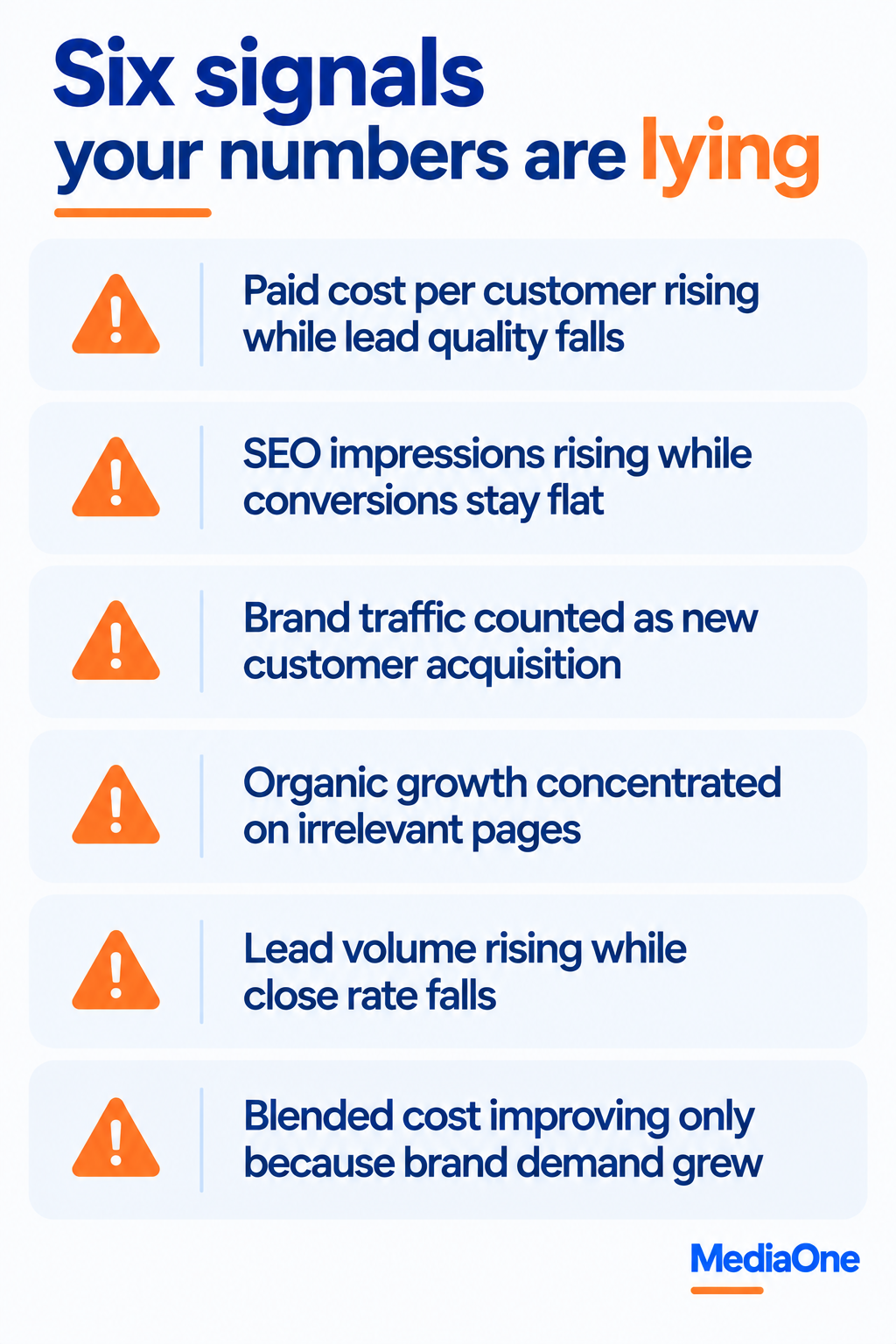
- Paid CAC rising while lead quality falls.
- SEO impressions rising but conversions staying flat, which can indicate poor intent alignment.
- Brand traffic being mistaken for new customer acquisition.
- Organic traffic growth concentrated on irrelevant informational pages.
- Lead volume rising while the sales close rate falls.
- A blended CAC that improves only because existing branded demand is increasing.
Final Assessment
Google Ads and SEO should be judged by the same commercial standard: how much profitable business does each channel create after all costs are included?
Google Ads is generally the more controllable choice when a business needs immediate visibility, fast testing or time-sensitive demand. SEO is generally the more strategic choice when valuable search demand is recurring, and the business can invest long enough to build defensible visibility.
Neither deserves a fixed percentage of budget, and neither should be funded because of a generic benchmark. Build the decision from your allowable CAC, margins, conversion rate, search demand and time horizon. Then measure both channels with the same revenue-linked framework and move budget toward the stronger marginal return.
Frequently Asked Questions
How much should a Singapore SME spend on Google Ads and SEO?
There is no reliable budget based solely on company revenue. Start from your target number of new customers, acceptable CAC, expected conversion rate and available cash flow. A smaller business may profitably spend more than a larger business if its margins and conversion rate are stronger. If the total budget is too thin to execute two channels properly, concentrate investment rather than splitting it mechanically.
Is SEO free once a page ranks?
No. You no longer pay for each organic click, but maintaining performance can require content updates, technical work, internal linking, digital PR, authority building and ongoing measurement. Some rankings remain stable with little intervention; others are highly competitive and need continual investment.
How quickly should Google Ads produce useful data?
Traffic data appears quickly, but the time needed for a reliable profitability judgment depends on conversion volume. A campaign producing one sale a month needs a longer evaluation period than one producing 100. Use statistical and commercial significance rather than an arbitrary four- or six-week deadline.
How long does SEO take in Singapore?
It varies. Existing authoritative sites may see results within weeks for low-competition opportunities, while new sites targeting competitive commercial searches may need many months or longer. Technical fixes can produce faster gains when a site already has demand and authority but is being held back by crawl, indexing, or page-quality problems.
What is a realistic Google Ads cost per lead in Singapore?
There is no single useful benchmark across industries. A qualified legal or B2B lead can reasonably cost far more than an e-commerce signup. The correct benchmark is your own maximum profitable CPL: acceptable CAC multiplied by your lead-to-customer conversion rate.
Can a business succeed using only Google Ads?
Yes. If paid search remains profitable, demand is sufficiently large and the business values speed and control, there is no rule requiring SEO. The trade-off is continued dependence on paid acquisition and auction conditions.
Can a business succeed using only SEO?
Yes, particularly where search demand is evergreen and the business can build strong organic visibility. But an SEO-only strategy may miss opportunities when the business needs immediate visibility, launches new offers or competes for queries where paid placements dominate.
Should Google Ads be managed in-house or outsourced?
The decision should be based on expertise, complexity and opportunity cost rather than spend thresholds alone. A small but technically complex account can justify specialist help. A large but simple branded campaign may be manageable in-house. Compare the expected efficiency gain from expert management with the management fee and internal time saved.
How do I know SEO is progressing before revenue grows?
Look for leading indicators such as improved crawl/indexation, growth in relevant non-brand impressions, movement across priority topic clusters, stronger click-through rates, increasing qualified organic visits and assisted conversions. Rankings alone are not enough.


What is the most common Google Ads mistake?
Optimising for platform metrics rather than business outcomes. High CTR, low CPC and many conversions are not necessarily good if those conversions are low quality. Import qualified-lead or closed-sale data where possible so bidding and reporting reflect real commercial value.
What happens to SEO rankings if investment stops?
Nothing necessarily happens immediately. Some pages may remain stable for a long time, while others decline as competitors improve or the content becomes less useful. The risk depends on query volatility, freshness requirements, technical stability, brand strength and competitive activity. SEO should be treated as an asset that may need maintenance, not as a guaranteed permanent ranking.
Which channel has better ROI: Google Ads or SEO?
The answer can only be determined from your economics. Google Ads often wins on speed and measurability. SEO can win on long-term acquisition cost when a site develops durable organic visibility. Many businesses obtain the strongest overall result by using both selectively and reallocating budget according to marginal return.