The right partner ships a product that earns its keep. The wrong one costs twice, once for the build and again to fix or rebuild it.

Headline prices and ranking lists predict success poorly. Stronger signals are verifiable delivery history in your app category, clearly defined scope, and post-launch commitments. This guide shows how to shortlist vendors, read a quote and vet each firm.
Delivery process and contract terms predict success more reliably than rankings or portfolios. A low quote without defined deliverables often costs more over the app’s life than a higher, well-scoped bid.
This guide shows businesses how to shortlist mobile app development companies in Singapore using a weighted scorecard, covering design, iOS and Android builds, realistic pricing for a custom enterprise product, and how to test claims before signing.
Key Takeaways
- Choose a vendor with proven delivery in your app category, not headline cost or ranking.
- Scope the project first. Build costs range from about US$15,000 to over US$200,000 (LinkedIn).
- Score shortlisted firms on delivery history, scope clarity, support, team continuity and pricing transparency.
- Budget for post-launch maintenance from the start.
- Confirm IP, source code and app store account ownership in writing before signing.
- Verify government funding claims directly with the funding body and vendor.
How to Read Rankings of Mobile App Development Companies
Published rankings disagree because each weights reviews, revenue, awards and paid placement differently. Treat any single list as a starting point, not a verdict. Massive Infinity was founded in 2012, according to Yahoo Finance Singapore’s roundup of enterprise app developers. A founding date shows staying power, not whether a firm has shipped your type of app.
Global firms with Singapore reach also appear on these lists. WillowTree — a Charlottesville, Virginia studio that is part of TELUS — is rated 4.9 from 25 reviews with an indicative rate of $150–$199/hr, per Blackthorn Vision’s market review. The same review shows Mercury Development at 5.0 from 33 reviews. Weight ratings by volume, because a small sample flatters. Check whether a firm’s mobile and software development work matches your platform and budget before relying on its position, and whether its solutions suit your business.
Shortlist Snapshot: Singapore App Developers Compared
|
Company |
Founded |
Rating and reviews |
Indicative rate band (USD/hr) |
Delivery locations |
|
WillowTree |
Not verified |
4.9 / 25 reviews |
$150–$199 |
Charlottesville, VA (part of TELUS); other locations: confirm on Clutch profile |
|
Vention |
20+ years in the software market |
4.9 / 100+ |
$50–$99 |
|
|
Mercury Development |
1999 |
5.0 / 33 |
$50–$99 |
Miami, FL (verified); other locations: confirm on Clutch profile |
|
Fueled |
2007 |
38 reviews |
$150–$199 |
New York, NY; confirm on Clutch profile |
Ratings and rates change, so recheck every figure on the live Clutch profile before shortlisting. Treat any unshown founding year or rate as unknown until verified. Firms offering mobile applications and custom software should be assessed on the same terms, because app quality shows up in the delivery experience as much as in the price. Compare each firm’s design and development services against the same criteria, so a business can judge the best fit for its own needs. Development companies that cannot show verified figures should be ranked below those that can.
Verification Checklist for Each Figure
Confirm each figure against its exact source:
- Founding year: the “About” page, plus a registry such as ACRA BizFile.
- Rating and review count: the live Clutch profile, with the date checked.
- Rate band: the rate the vendor quotes in writing, not a directory listing.
- Delivery locations: vendor office addresses and the Clutch location field.
- Government funding: the Enterprise Singapore funding scheme pages. Confirm eligibility with the funding body before budgeting around any subsidy.
What Drives the Cost of an App in Singapore
Published estimates put mobile app development costs from roughly US$15,000 to over US at the current exchange rate, and confirm whether each quote includes GST.
Five factors shift a quote most: iOS, Android or cross-platform builds, backend integration, third-party APIs, data and security standards, and whether AI features are in scope.
Cross-platform frameworks cut build effort but not backend work. Ask vendors to price the backend separately, because a single bundled line hides the real effort in software development.
A low hourly rate can still produce a higher total. Teams that cannot define scope tend to add late change requests, each billed separately. Clear scope matters just as much for application development and any mobile application project, especially when working with a company in Singapore that serves customer engagement goals.

How Long a Typical Project Takes
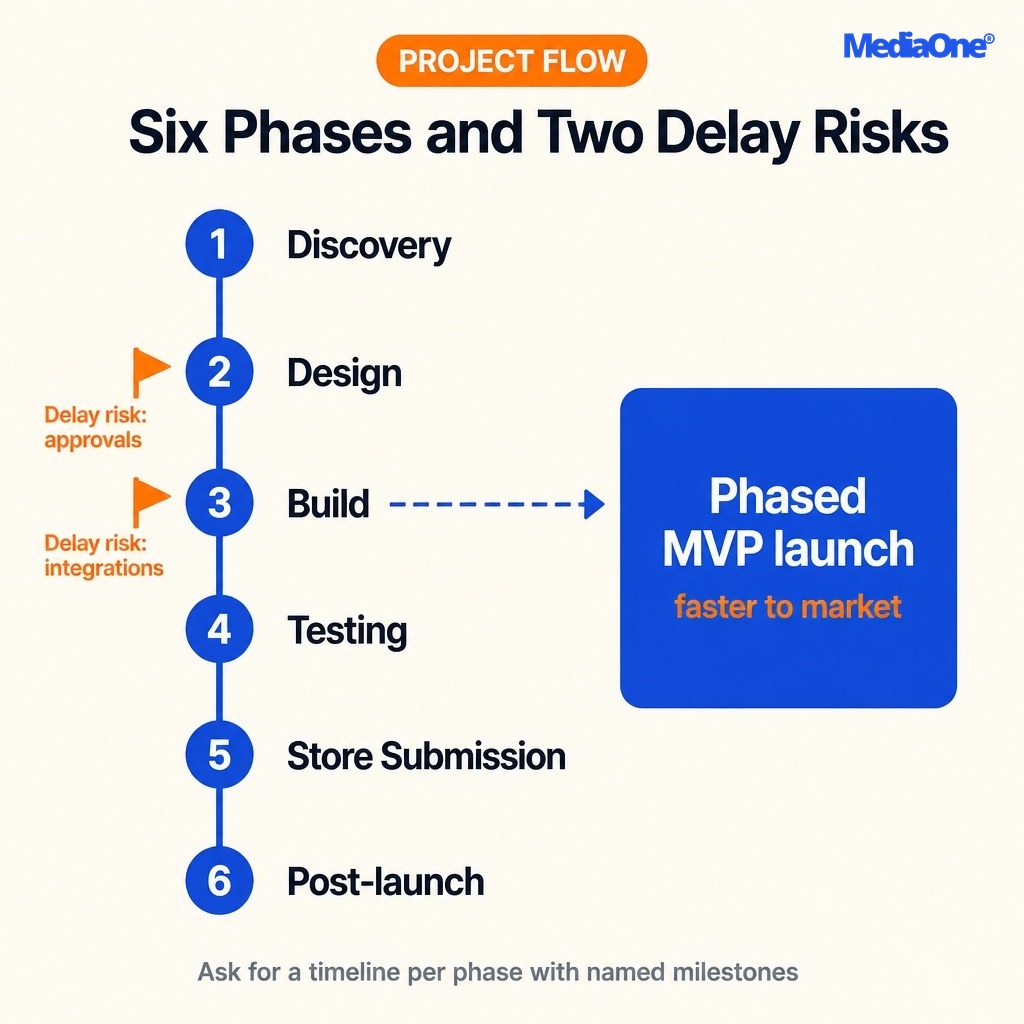
A typical project runs through discovery, design, build, testing, store submission and post-launch support. Integrations and client approvals often cause the most delay. A phased MVP usually reaches market sooner than a full launch. Ask vendors for a timeline per phase with named milestones.
How to Score and Shortlist Vendors
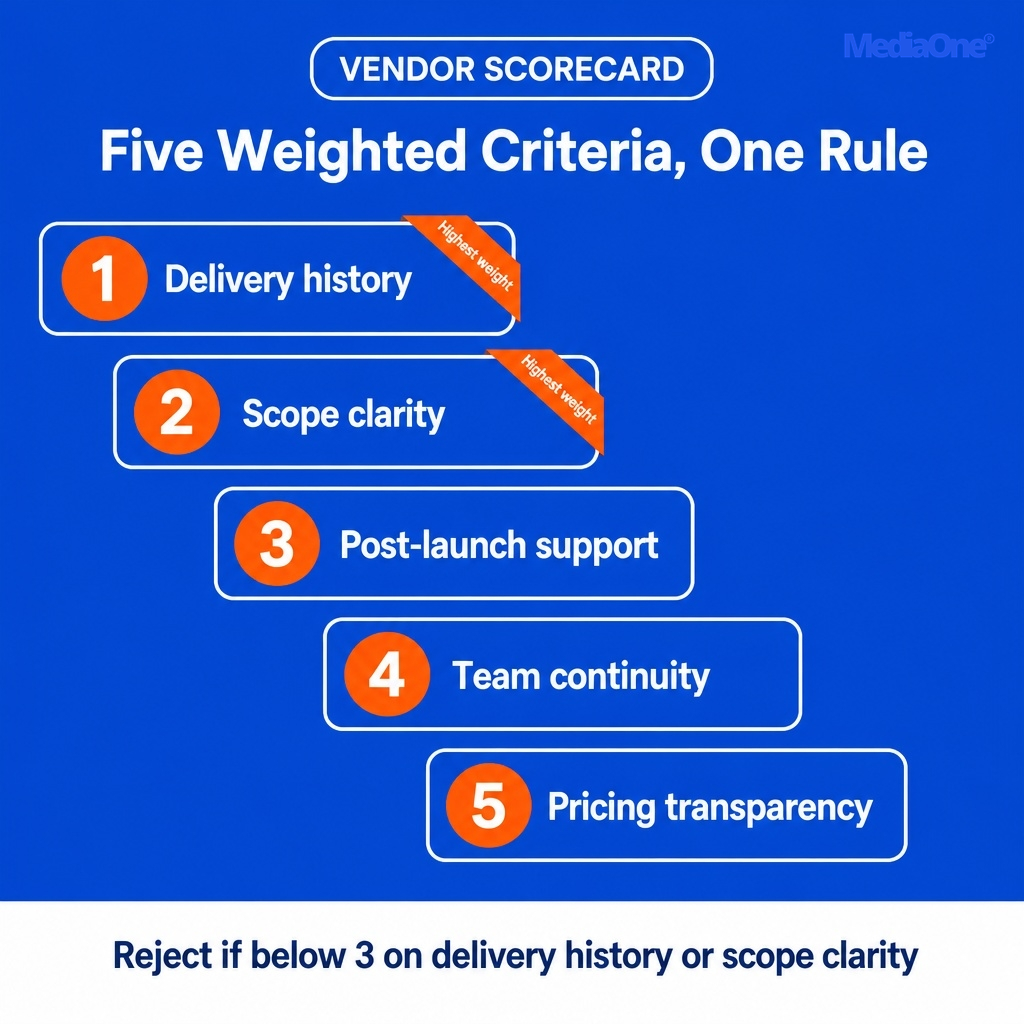
Score each shortlisted firm from 1 to 5 on five criteria, weighting the total toward the first two:
- Verifiable delivery history in your app category (highest weight)
- Scope clarity: fixed deliverables and a written change-request process (highest weight)
- Post-launch support and maintenance commitment
- Team continuity: who you will actually work with
- Transparency on pricing drivers
Reject any firm scoring below 3 on criteria 1 or 2. A low quote not tied to defined scope usually costs more over the app’s life.
Work through this checklist with each vendor:
- Ask for two client references with similar apps, and review the firm’s portfolio of mobile apps and mobile app development work.
- Confirm which app store listings the firm built and still maintains.
- Request a named project lead and developers.
- Check who holds source code, IP and developer accounts after handover.
- Ask what post-launch support and hosting cost per year, and how the firm measures customer engagement and user experience after launch.
Red Flags When Hiring Developers
|
Symptom |
Likely cause |
Question to ask next |
|
Fixed quote with no discovery phase |
Scope is guessed, so overruns are likely |
“Can we fund a paid discovery sprint first?” |
|
Vague IP clause |
Ownership is unclear after handover |
“Who holds the source code and app store accounts on day one?” |
|
No named team members |
Staff may be swapped mid-project |
“Who will lead and build this, and can I meet them?” |
|
Pressure to sign quickly |
The vendor wants payment before scrutiny |
“What happens if we pause after the first milestone?” |
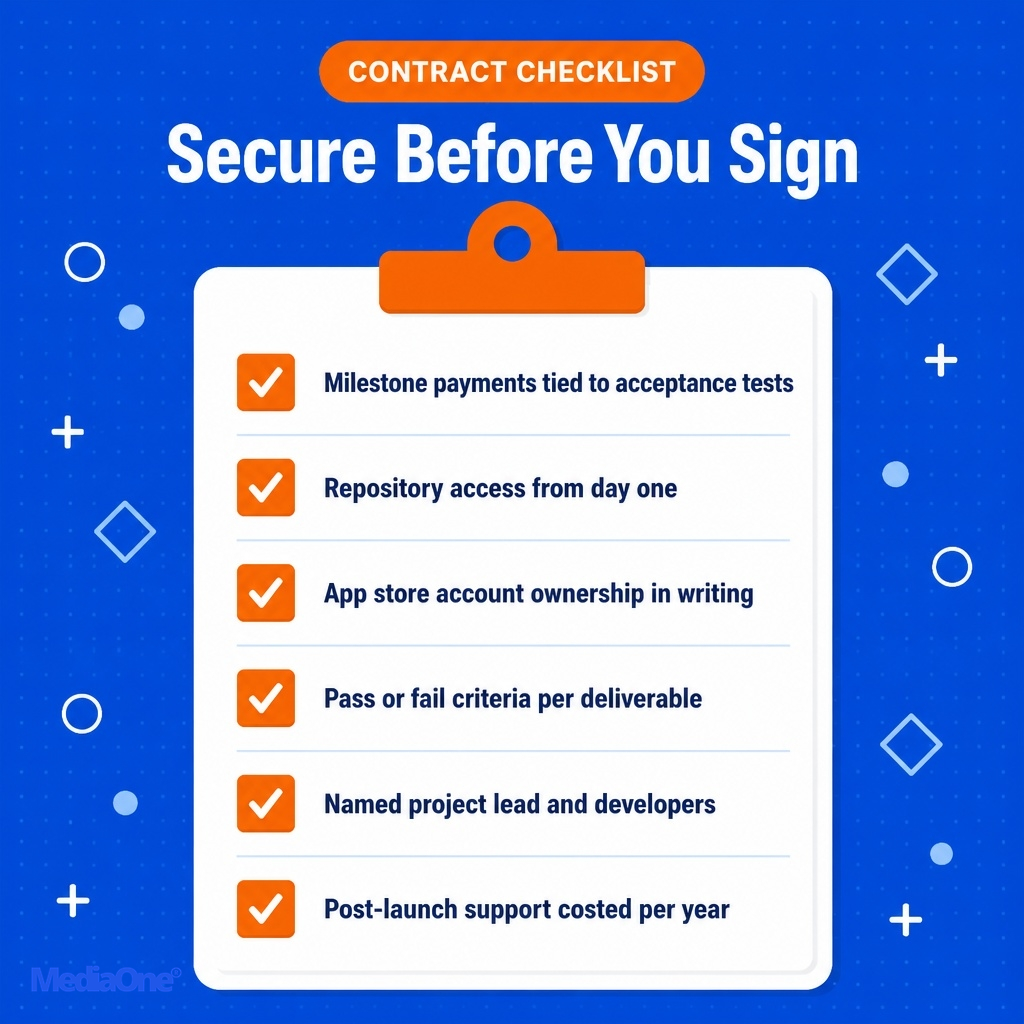
In the contract, pay in milestones tied to acceptance tests, secure repository access from day one, and agree a written pass/fail test for each deliverable. Firms that propose a paid discovery sprint for any custom mobile app development project, including a top mobile app or enterprise app build, usually produce a more accurate scope than those that accept a fixed quote.
Ask for a portfolio of past work and check whether the vendor’s app development services cover the full product lifecycle, from design through to digital transformation of the business.
Benefits of Hiring a Mobile App Development Company in Singapore
A specialist firm gives you designers, iOS and Android engineers, QA and project management under one contract. Building that team in-house means recruiting several scarce roles, and one departure can stall the project. Outsourcing shifts that risk to the vendor, provided the contract makes the companies accountable for delivery, and the best development companies will commit to that in writing.
Check working-hour overlap, the governing law and dispute resolution in writing.
Types of App Briefs and 2026 Trends
Briefs usually fall into three groups: e-commerce apps (payments, catalogues, order tracking; widest cost range), productivity and internal tools (must integrate with existing systems), and innovative product apps (most uncertainty, so start with paid discovery). Many businesses now commission mobile applications built on AI, chatbot and IoT capabilities, so ask any app development companies for a delivered example, not a service list. Choosing the right mobile app development partner and custom software scope starts with that evidence.
Published programme listings show AI and software solutions offered with up to 50% funding, as listed in OTG Lab’s 2026 guide. Treat these as vendor claims to confirm, not guaranteed subsidies. Digital transformation funding schemes may also apply, but eligibility varies.
Choose on Evidence, Then Partner for the Growth
Choosing a mobile app development company in Singapore comes down to evidence over promises. Verify delivery history in your app category, pin the scope in writing, protect IP and app store ownership from day one, and pay in milestones tied to acceptance tests. A weighted scorecard keeps the decision honest, and a paid discovery sprint is the cheapest way to test a vendor before you commit the full budget.
The build, however, is only half the product’s life. An app that nobody finds and nobody measures earns nothing back — which is where MediaOne comes in. As a Singapore paid media and Google Ads agency, MediaOne covers the growth side of your launch: app install and display campaigns, remarketing to re-engage lapsed users, and conversion tracking that shows which channels actually earn their keep.
Ask about EDGE Grant-eligible support for your digital marketing, and talk to MediaOne before launch day — the strongest apps are marketed from day one, not after they ship.
Frequently Asked Questions
How much does a mobile app cost in Singapore?
Costs depend on complexity. According to LinkedIn’s roundup of Singapore providers, projects range from about US$15,000 to over US at the current rate and check whether quotes include GST. Ask for support and hosting costs separately.

How long does it take to build a mobile app?

A focused MVP often takes a few months, while a full-featured launch with integrations takes longer. Approval cycles and third-party API dependencies cause the biggest delays, so ask for a phased timeline with named milestones.
How do I choose between a local and an offshore app development company?
Judge the firm on delivery evidence, scope clarity and team continuity, not location alone. Check time-zone overlap and who holds the source code. A short paid discovery phase lets you test either option.
What should a mobile app development contract include?
Include fixed deliverables, a written change-request process, milestone payments and acceptance criteria. Confirm who owns the source code, IP and app store developer accounts after handover.
Are government funding schemes available for app development?
Some providers advertise up to 50% funding across mobile app, AI and web services, as listed in OTG Lab’s guide. Check the scheme on the Enterprise Singapore website and get written confirmation from the vendor before budgeting around any subsidy.
What red flags should I watch for when hiring a developer?
Watch for fixed quotes with no discovery phase, vague IP clauses, no named team members and pressure to sign quickly. Each signals a scope or ownership risk that will likely cost more later.