
The guest post as a link-building tactic has quietly split in half. On one side, thin guest posts on low-quality networks now trigger the same manual actions that Google reserved for paid link schemes five years ago. On the other side, well-executed guest posts on genuinely relevant publications have become one of the most defensible tactics available for both traditional SEO and the new AI citation surfaces that decide which brands get recommended by ChatGPT, Perplexity, and Google AI Overviews.

Guest Post Backlinks That Actually Move SEO Rankings in 2026
Most guides published before 2024 treat the guest post as a single tactic with a single rulebook. That framing no longer matches how the outcome is produced or measured. According to the Airops 2026 State of AI Search report, 85% of brand mentions influencing AI-generated answers originate from third-party pages rather than the brand’s own website. This means the guest post is no longer just a backlink tactic. It is also one of the most direct inputs into whether AI agents recommend a business at all.
This guide covers what a guest post actually does in 2026, how the risk profile has changed, which formats now produce meaningful outcomes, and how to build a programme that survives contact with Google’s current enforcement posture. The reality most marketers are quietly wrestling with is that guest posts still work for SEO in 2026 only under conditions that look very different from the ones agencies pitched three years ago. Deciding how many guest post backlinks a business actually needs now depends more on placement quality than placement count, and the guest post strategies that trigger a penalty rather than a ranking lift are increasingly the ones that used to be recommended as best practice.
Key Takeaways
- Guest posts now serve two overlapping goals: traditional link authority and AI citation share
- Google’s spam policies explicitly prohibit large-scale guest posting purely for link acquisition
- The sponsored and nofollow attributes are now standard on any paid or exchanged guest post
- Quality is measured through audience overlap, editorial rigour, and topical fit rather than domain authority alone
- Volume-led guest posting produces flat or negative results in 2026 audit data
- A properly built programme prioritises 6 to 12 placements per year on genuinely relevant publications
The 2026 Reality Check
The guest post as a tactic has been abused so thoroughly over the last decade that Google treats bulk guest posting the same way it treats private blog networks.
According to Google Search Central’s spam policies documentation, link schemes include “using automated programs or services to create links to your site” and “large-scale article marketing or guest posting campaigns with keyword-rich anchor text links”. The threshold for what counts as “large-scale” has tightened progressively since 2022, and the enforcement now catches many programmes that operated safely three years ago.
Most agencies still selling guest posting packages of 20, 40, or 60 links per month are selling their clients a manual action. The activity looks productive in the reporting dashboard. It stops looking productive when Search Console starts showing the manual action notification. The distinction between the tactics that still work and those that trigger enforcement is covered in more depth in our analysis of white hat link building strategies, which draws findings from 847 site audits across Singapore and regional markets.
The activity looks productive in the reporting dashboard. It stops looking productive when Search Console starts showing the manual action notification.
The good news for businesses running genuinely relevant guest posts on genuinely relevant publications: the enforcement is aimed at scale, exchange, and irrelevance. It is not aimed at the practice itself.
What A Guest Post Actually Does In 2026
The guest post now produces four distinct outcomes, and different guest posts optimise for different outcomes. Confusing the four is the reason most guest posting programmes fail.
| Outcome | What It Delivers | What It Requires |
| Traditional ranking authority | Passes link equity to the linked page | Genuinely followed link on a topically relevant, indexed page |
| AI citation influence | Increases likelihood of brand mention in AI-generated answers | Brand mention in third-party content AI models index |
| Referral traffic | Direct clicks from readers of the host publication | High-audience-overlap placement with contextually placed link |
| Brand credibility | Reputation reinforcement through association with the host | Placement on a publication your audience already trusts |
The mistake most SEO teams make is measuring guest posts against only the first outcome and ignoring the other three. A guest post on a niche industry publication with 3,000 monthly readers may produce more commercial value than a guest post on a domain with 10 times the traffic, if the audience overlap is stronger and the AI training data is more relevant.
Teams still asking how to get a backlink from a high domain authority website are optimising for a metric that AI models do not use and that Google increasingly discounts. The teams gaining ground are asking how to get their brand named in a context an AI model will index and eventually cite, because that context is where 2026 commercial visibility now lives.
The MediaOne Guest Post Value Stack
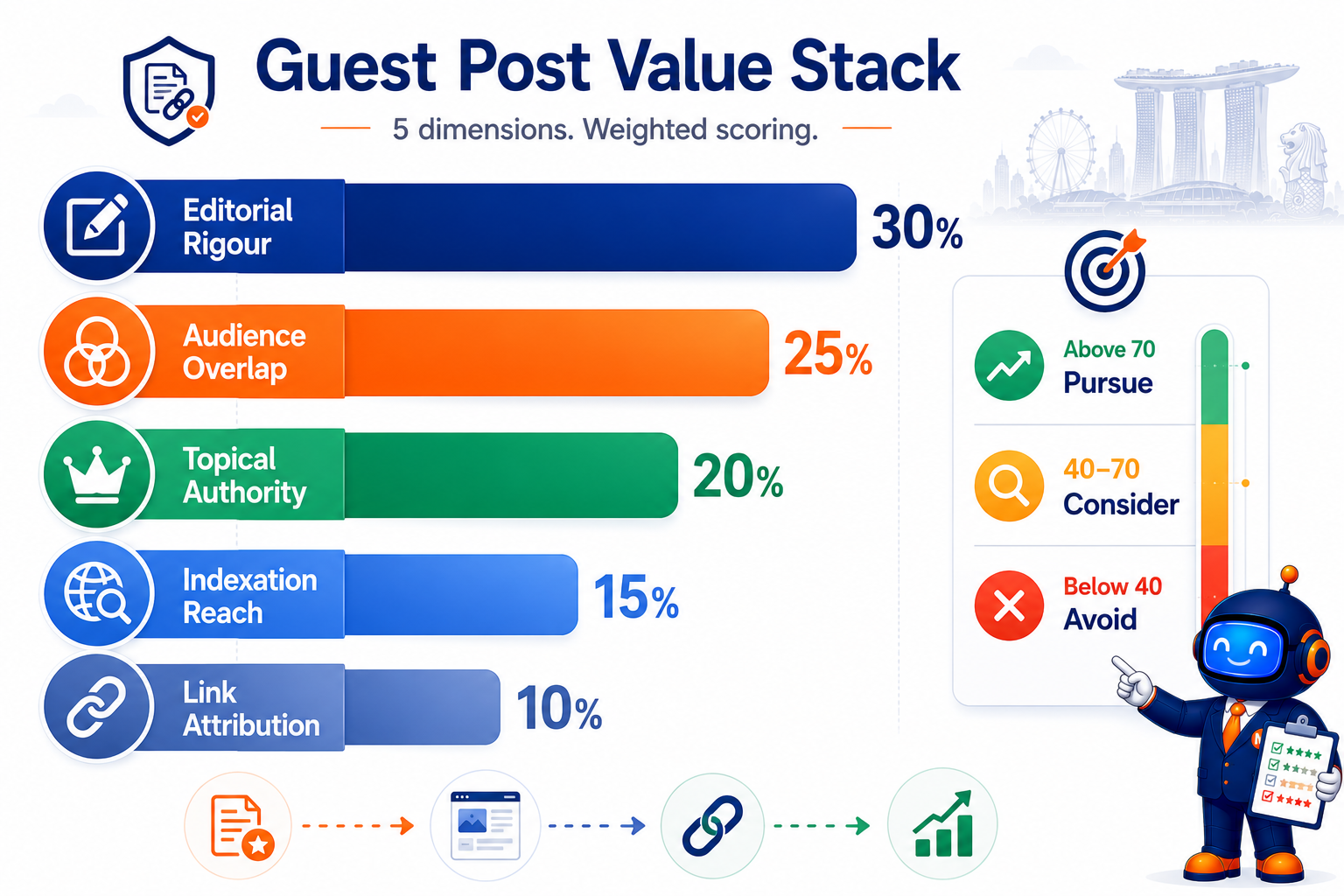 We use a proprietary evaluation framework to score every guest post opportunity before pitching, writing, or accepting a placement. We call it the Guest Post Value Stack, and it scores each opportunity across five dimensions that determine actual commercial outcome.
| Dimension | Weight | What It Measures |
| Editorial Rigour | 30% | Does the publication actually edit, or does it publish anything with a payment attached |
| Audience Overlap | 25% | What percentage of the publication’s audience matches your ICP |
| Topical Authority | 20% | Is the publication considered authoritative in the specific subject area |
| Indexation Reach | 15% | Is the publication indexed in Google, Bing, and referenced by AI training datasets |
| Link Attribution | 10% | Does the site use dofollow, sponsored, or nofollow, and does that match your goal |
A score above 70 indicates a high-value placement worth pursuing seriously. A score between 40 and 70 indicates an opportunistic placement to consider only if the effort cost is low. Below 40 indicates a placement that will produce measurable effort with negligible outcome, or worse, contribute to a spam signal profile.
The most consistent finding across the placements we score: publications with high editorial rigour but modest domain authority almost always outperform publications with high domain authority but no editorial standards. Effort-adjusted, the smaller and stricter publications produce 2.5 to 4 times the commercial return per placement. The over-reliance on domain authority as a placement filter deserves its own conversation, particularly because the methods for checking domain authority return numbers that look precise but represent third-party estimates rather than actual ranking signals Google uses.
Where Volume-Led Guest Posting Now Fails
The old model was simple. Buy or produce 20 guest posts per month across a range of general-topic publications, watch the domain authority creep up, watch the rankings move.
That model does not survive contact with 2026 conditions. Here is why.
1. Google’s link evaluation has become semantic, not just structural
The algorithm now weighs whether the topic of the linking page relates to the topic of the linked page. A guest post about “10 productivity tips for remote workers” linking to a Singapore corporate law firm passes almost no equity, because the semantic distance between the linking context and the linked page is too wide. Local placements on genuinely relevant Singapore publications behave differently, which is why local link building for Singapore businesses remains one of the higher-return activities available to SMEs targeting Singapore-specific search intent.

2. Domain-level trust signals now dilute across placement volume
A publication accepting 40 guest posts per month appears to Google as a syndication platform rather than an editorial publication. Links from these sites carry sharply reduced weight, and Google’s algorithms increasingly discount entire domains that show this pattern.
3. AI models weight source consistency and editorial independence
When ChatGPT or Perplexity decides whether to cite a publication as a source, editorial reputation matters more than domain metrics. Publications that publish anything for a fee do not appear in AI-cited content at meaningful rates.
4. The manual review threshold has lowered
Google’s manual actions team now investigates link patterns at a smaller scale than before. Businesses producing 15 to 20 low-quality guest posts per month sit inside the review threshold, whereas the same volume three years ago sat comfortably outside it.
The businesses still spending five-figure monthly budgets on volume-led guest posting are, in most cases, quietly accumulating a link profile that will need to be disavowed within the next 12 to 18 months. This is one of the more painful conversations we have when auditing new clients.
The Anatomy Of A Guest Post That Actually Works
A guest post that produces both ranking authority and AI citation influence in 2026 shares several structural characteristics.
The Publication Meets Three Editorial Tests
Before accepting or pitching a placement, verify:
- The publication has a named editorial team, not an anonymous submission form
- The publication has rejected submissions in the recent past, evidenced by contributor guidelines that specify criteria
- The publication publishes fewer than 15 to 20 posts per month, indicating actual editorial capacity rather than syndication volume
The Content Meets The Original Reporting Bar
- The piece contains original data, framework, opinion, or case study that could not have been written by anyone else. This is where most guest post drafts fail before they are ever pitched. The techniques for producing content that clears this bar overlap significantly with the wider discipline of SEO content writing that earns citations, including the specific structural choices that make content indexable by AI models and quotable by human editors.
- Word count typically sits between 1,500 and 2,500 words for informational content, or 800 to 1,200 for opinion pieces
- The piece contains at least one specific, verifiable claim with numbers or citations
- The tone matches the host publication’s editorial voice rather than defaulting to generic thought-leadership language
The Link Placement Meets Three Contextual Tests
- The link sits inside a sentence that provides value to the reader independent of the link itself
- The anchor text describes what the linked page contains rather than being keyword-stuffed
- The linked page continues the reader’s thought, providing depth on a point the guest post raised
The Attribution Is Honest
- If the placement is paid or exchanged, the link carries the sponsored or nofollow attribute
- If the placement is genuinely earned, the link can safely be dofollow
- The relationship between the guest author and the publication is disclosed where relevant
The Google Search Central guidance on qualifying outbound links is explicit on this: any link created as part of an advertisement, sponsorship, or compensation agreement should use sponsored, and any link the publication cannot vouch for should use nofollow. The sponsored attribute does not eliminate all SEO value from the placement, but it does eliminate the risk of the placement being classified as a link scheme.
The Four Guest Post Formats That Produce Results
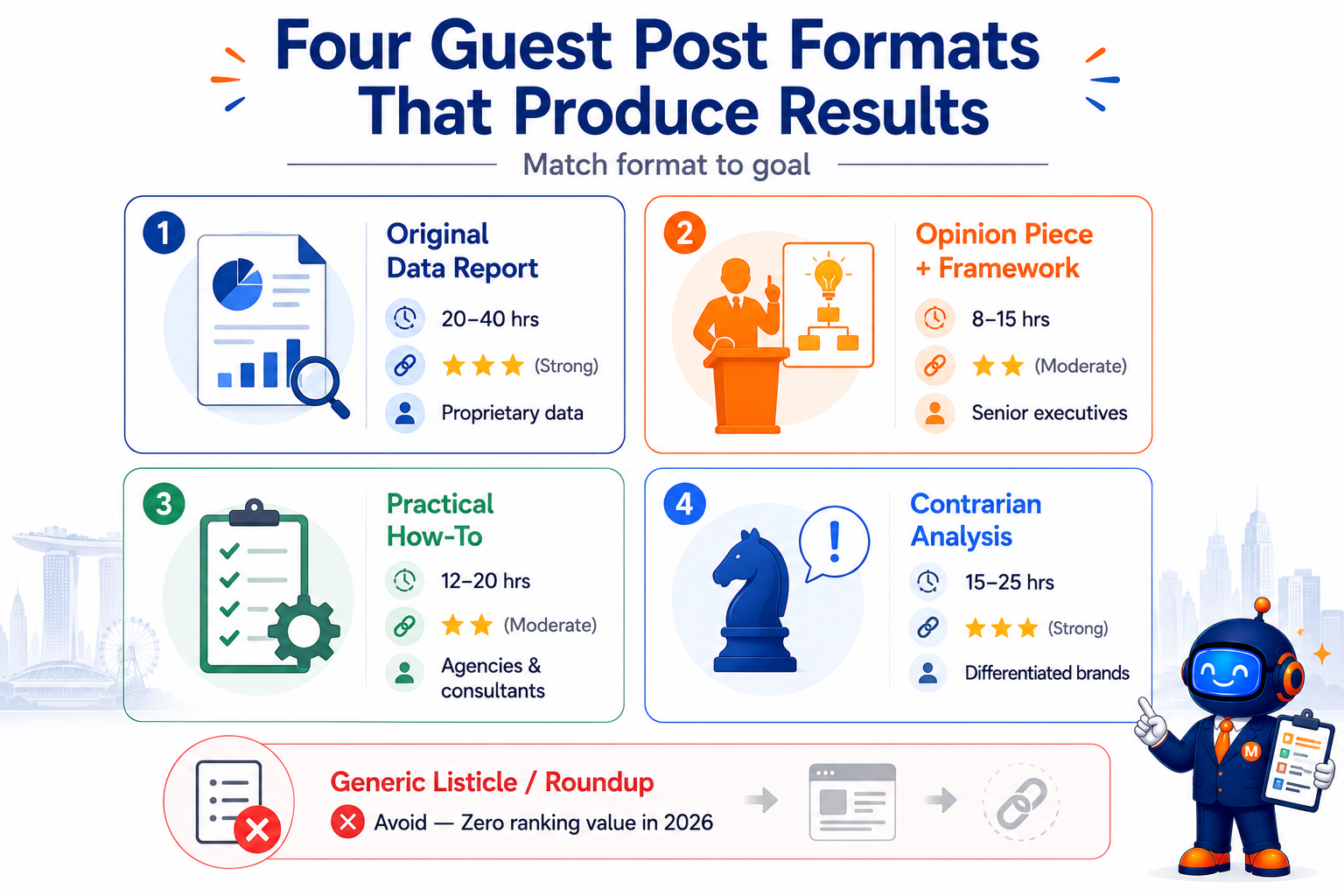

Most articles about guest posting treat the format as interchangeable. Different formats produce different outcomes, and matching the format to the goal determines success.
Format One: The Original Data Report
The guest author publishes original research, data, or a proprietary study on the host publication. The linked page hosts the full methodology or supporting content on the author’s own site.
| Best for: | Brands with proprietary data, industry surveys, or unique client insights worth publishing |
| Time investment per placement: | 20 to 40 hours |
| Expected outcomes: | Strong link equity, high AI citation likelihood, long-lived referral traffic |
Format Two: The Opinion Piece With A Specific Framework
The guest author publishes a strongly-argued opinion piece on a subject in their expertise area. The linked page provides supporting depth on the framework or methodology referenced.
| Best for: | Senior executives, agency principals, and specialists with a differentiated view |
| Time investment per placement: | 8 to 15 hours |
| Expected outcomes: | Brand credibility, moderate link equity, high shareability |
Format Three: The Practical How-To With Real Examples
The guest author publishes a practical guide with specific, executable steps. The linked page provides a template, checklist, or extended methodology.
| Best for: | Agencies, consultants, and service providers demonstrating capability through instruction |
| Time investment per placement: | 12 to 20 hours |
| Expected outcomes: | Strong referral traffic, moderate link equity, sustained AI citation |
Format Four: The Contrarian Analysis
The guest author challenges a widely held industry assumption with evidence. The linked page provides the fuller analysis or supporting data.
| Best for: | Brands with genuinely differentiated positioning and enough authority to argue back if challenged |
| Time investment per placement: | 15 to 25 hours |
| Expected outcomes: | High engagement, strong social amplification, moderate to strong link equity |
The format most abused by low-quality guest posting programmes is a fifth type: the generic listicle or roundup with a single link buried inside. This format has effectively zero ranking value in 2026 and should be avoided entirely.
How Many Guest Posts Do You Actually Need
The honest answer to how many guest post backlinks do I need to rank is fewer than most agencies suggest, and the ones you need have to be genuinely earned.
Across our client accounts, the businesses producing consistent ranking growth through guest posting typically publish 6 to 12 high-quality placements per year, not per month. Each placement takes 15 to 40 hours to research, write, negotiate, and finalise. The math simply does not support monthly volume when the quality bar is maintained.
The businesses producing consistent ranking regression through guest posting typically publish 15 to 40 placements per month across low-quality networks. Every one of these accounts we have audited shows the same pattern: ranking growth for the first 6 to 12 months, then a plateau, then a decline as Google’s algorithms catch up with the pattern.
The trade-off is uncomfortable for teams whose reporting is built around link count as the primary KPI. Reducing volume while increasing quality produces reporting that looks worse in the short term and results that look better in the long term. The pressure to keep volume high often overrides the evidence, which is why the pattern repeats.
Building A Guest Post Programme That Actually Works
For businesses ready to run guest posting as a genuine channel rather than a link-buying exercise, here is the working sequence we use.
Phase One: Target Publication Identification (Weeks 1 To 3)
Build a target list of 20 to 30 publications scored against the Guest Post Value Stack. The list should include:
- 5 to 8 top-priority publications where a placement would be a career-relevant credit
- 10 to 15 secondary publications with strong audience overlap
- 5 to 8 opportunistic publications where placements can be produced quickly if a strong angle emerges
The list is a working document, updated quarterly as publications change editorial standards, editors move roles, and new options emerge.
Phase Two: Relationship Development (Weeks 4 To 8)
Before pitching, engage with target editors through the channels they publish in. Comment thoughtfully on their content. Share their work with commentary. Attend the industry events they speak at. The cold pitch to a publication where you have never interacted with the editor has roughly a 3 to 5% acceptance rate. The warm pitch to an editor who recognises your name has a 25 to 40% acceptance rate.
A practical observation from years of running this work: most SEO agencies skip this phase entirely because it produces no measurable output in the first 8 weeks. The businesses that invest in the relationship phase produce guest posting outcomes that compound over years. The businesses that skip it produce placements that stop the moment the outreach team is defunded.
Phase Three: Pitch And Placement (Weeks 9 To 16)
Pitch each target publication with an angle designed specifically for their audience. The pitch email should be short, specific, and demonstrate awareness of the publication’s recent content. The best pitches offer three angles the editor can choose from, rather than a single fixed proposal.
Phase Four: Content Production And Publication (Weeks 17 To 24)
Produce content that meets the standards defined in the earlier “anatomy of a guest post” section. Do not compromise on originality or depth to hit a publication deadline. A missed deadline can be renegotiated. A weak piece produced under time pressure damages the relationship with the editor for future placements.
Phase Five: Measurement And Iteration (Weeks 25 Onwards)
Measure each placement across four metrics:
| Metric | What It Tells You |
| Referral traffic during weeks 1 to 8 | Immediate audience response |
| Ranking movement on linked pages | Link equity impact |
| AI citation share change over 3 to 6 months | AI search influence |
| Follow-on placement invitations | Editor relationship strength |
The businesses committed to guest posting as a discipline treat this measurement layer as seriously as the placement itself. Working with an SEO agency that runs the measurement rigorously prevents the common failure where a guest post programme continues producing placements after they have stopped producing outcomes.
The Common Failures Worth Naming Explicitly

Not all failures in guest posting are subtle. Some are simply worth calling by name so teams can avoid them.
1. Buying Guest Posts On Marketplaces
Marketplace-sold guest posts on publications you have never read, from editors you have never spoken with, on subjects that have no relationship to your business. These are the placements Google’s algorithms flag most reliably. The offer email in your inbox promising 20 DA50+ placements for a fixed monthly fee is describing a link scheme, whether or not the vendor uses that language.
2. Reciprocal Guest Posting Rings
Two or more sites systematically publishing guest posts pointing at each other. Google identifies these patterns algorithmically, and the sites involved lose equity across the entire linked profile. This tactic looked clever in 2016 and looks like a manual action risk in 2026.
3. Keyword-Stuffed Anchor Text
Guest posts where the same commercial anchor text appears repeatedly across placements. Google’s algorithm treats this as a strong link scheme signal. Anchor text should vary naturally across placements, favouring descriptive phrases over exact-match commercial keywords.
4. Ignoring Attribution Rules
Placements that should carry sponsored or nofollow attributes but do not. These placements are indistinguishable from paid links from Google’s perspective, regardless of what the two parties agree between themselves. When in doubt, use sponsored. The reduced link equity is a small cost compared to the risk of a manual action.

5. Publishing And Forgetting
Producing a guest post, celebrating the placement, and never revisiting it. High-value placements deserve follow-up: promotion on the author’s channels, engagement with comments, follow-on pitches to the same editor, and periodic content refresh conversations 12 months later. The businesses that treat each placement as the start of a relationship rather than a transaction extract 3 to 5 times more commercial value from the same placement volume.
Why Guest Posts Now Feed AI Search Visibility
This is the section most articles about guest posting have not caught up to yet, and it is the most important shift in the tactic since Google introduced the nofollow attribute in 2005.
AI models like ChatGPT, Perplexity, Gemini, and the various Copilot implementations do not treat websites uniformly. They weight sources based on editorial reputation, topical consistency, and independent authority. When an AI model decides which brands to recommend for a query like “best HRMS platforms for mid-market Singapore SMEs”, it draws its recommendation set from third-party sources that mention the brands in relevant editorial contexts.
According to the Airops 2026 State of AI Search research, 91% of AI-generated answers cite third-party sources rather than the brand’s own website. This means a brand’s presence in AI-recommended shortlists depends more on being mentioned in credible third-party content than on the quality of its own site.
Guest posts on high-editorial-quality publications now serve as one of the most direct inputs into AI citation likelihood. A well-placed guest post on a genuinely authoritative publication in your category creates a training data signal that AI models will reference for months or years. This is the reason our approach to guest posting has shifted from pure link-building to what we now think of as citation architecture.
Traditional guest posting optimises for domain authority signals that Google evaluates. Citation-focused guest posting optimises for editorial reputation signals that AI models evaluate. The two overlap but are not identical, and businesses committed to being visible in the AI search era need to weight the second one more heavily than they did two years ago.
What are Singapore-Specific Considerations?
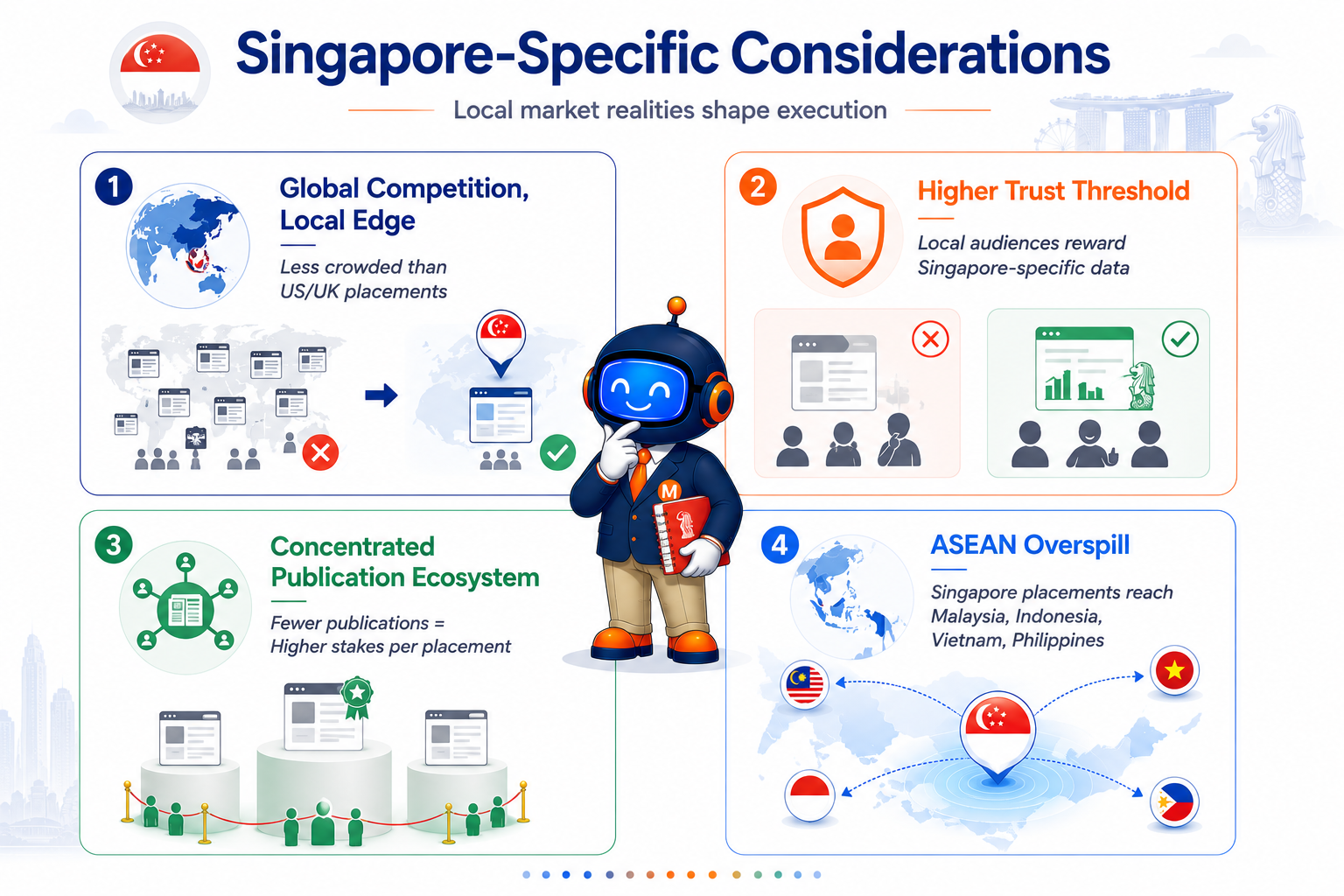
Singapore businesses face several specific conditions that shape how guest posting should be executed locally.
-
English-language market with global competition
Singapore businesses compete directly with global publications for citation share. Guest placements on Singapore publications are less crowded than equivalent placements in the US or UK, and Singapore-specific content receives citation preference for Singapore-context queries.
-
Higher trust threshold from local audiences
Singapore B2B and considered-purchase audiences are generally more sceptical of thought-leadership content than equivalent Western markets. Guest posts that lean on generic frameworks or borrowed statistics underperform locally compared to placements grounded in Singapore-specific data, regulations, and cases.
-
Concentrated publication ecosystem
Singapore’s business publication ecosystem is smaller and more concentrated than most Western markets. This means individual placements carry disproportionate weight when successful, but competition for those placements is intense. Building relationships with local editors is the highest-leverage investment for Singapore businesses running guest posting as a channel.
-
Regional readership overspill
Guest placements on Singapore publications frequently receive readership from Malaysia, Indonesia, Vietnam, and the Philippines. Businesses with ASEAN expansion plans should factor this into their target publication list.
A Simple Way To Audit Your Current Programme
Before commissioning another guest post, pick five placements produced in the last 12 months and ask a straightforward question about each one.
Would the editor of that publication accept your piece if you removed the paid arrangement, the exchanged link, or the outreach agency mediating the relationship?
If the answer is yes, the placement is doing genuine work. If the answer is no, the placement is a link scheme wearing an editorial disguise, and Google’s algorithms are getting progressively better at telling the two apart.
The test is worth applying honestly rather than defensively. Placements that fail it are not evidence of bad decision-making at the time they were commissioned. They are evidence of how sharply the tactic has changed since Google’s 2024 spam updates, and pretending otherwise costs more than acknowledging it.
Well-scoped SEO packages in Singapore now build this audit into the first 30 days of engagement, because the placements already weakening a link profile carry higher priority than the ones a business has not yet built. Working with an SEO agency that runs the audit against real editorial criteria rather than domain authority metrics produces materially different results, particularly for businesses whose existing link profiles were built during the volume-led years.
Request a quote to run the Editor Test across your current guest post programme and identify which placements are compounding, which are neutral, and which are quietly working against you.
Frequently Asked Questions
Do guest post backlinks still work for SEO in 2026?
Yes, but only when the placement meets genuine editorial standards. Guest posts on publications with actual editorial teams, topical relevance to the linked page, and audience overlap with the linking brand’s ICP continue to produce measurable ranking impact. Guest posts on marketplace publications, low-editorial-quality networks, or topically unrelated sites now produce flat or negative results. The tactic has not died. The bar has moved.
How many guest posts should a business produce per year?
For most businesses running guest posting as a serious channel, 6 to 12 high-quality placements per year produce stronger outcomes than 40 to 60 low-quality placements per month. Each high-quality placement takes 15 to 40 hours to research, write, and finalise. Volume-led programmes almost universally underperform quality-led programmes on an effort-adjusted basis.
What is the difference between a guest post and a sponsored post?
A guest post is content contributed to a publication in exchange for editorial exposure and, typically, a contextual link. A sponsored post is content published in exchange for payment. Google requires sponsored placements to use the sponsored link attribute, and treats undisclosed sponsored placements as link scheme violations. The two formats are increasingly used interchangeably in commercial conversation but should be treated distinctly from a compliance perspective.
Can guest posts trigger a Google penalty?
Yes. Large-scale guest posting campaigns with keyword-rich anchor text links are explicitly listed as link scheme violations in Google’s official spam policies. Businesses producing 15 to 40 guest posts per month across generic publications sit inside the enforcement threshold and are increasingly receiving manual actions. The risk profile is significantly higher in 2026 than it was in 2020.
How do you measure the success of a guest post?
Measure across four dimensions: referral traffic in the 8 weeks after publication, ranking movement on the linked pages, AI citation share change over 3 to 6 months, and follow-on placement invitations from the same editor. Measuring only referral traffic or only backlinks misses most of the commercial value the placement produces.
Do guest posts help with AI search visibility?
Yes. Independent research from Airops shows that 91% of AI-generated answers cite third-party sources rather than the brand’s own website. Guest posts on high-editorial-quality publications create the kind of third-party mention signal that AI models weight when deciding which brands to recommend. This is now one of the strongest reasons to invest in genuine editorial guest posting rather than volume-led link building.
What anchor text should a guest post use?
Descriptive anchor text that accurately reflects what the linked page contains. Avoid exact-match commercial keywords repeated across placements. Google’s algorithm treats repetitive commercial anchor text as a strong link scheme signal, and the safest and most effective approach is varied, natural anchor text that describes the linked content rather than sales-optimised keywords.