Should your business spend more on inbound or outbound marketing? For most Singapore businesses, inbound is the stronger default because it builds long-term demand, compounds over time and usually produces more efficient acquisition once the system is working. Outbound still has an important role, especially for time-sensitive launches, high-value B2B deals, named-account selling and categories where buyers are not actively searching yet. The real question is not which side is universally better. It is which mix fits your goals, sales cycle, budget, market maturity and urgency.
This guide explains the difference between inbound and outbound marketing, compares how each performs in practice, shows where each approach works best and gives you a framework to decide your budget split. It is written for business owners, marketing managers and growth teams that want a practical answer rather than a theoretical debate.
Key Takeaways
- Inbound is usually the stronger default. It builds durable marketing assets such as search rankings, content libraries, email lists and organic demand.
- Outbound is best when speed and precision matter. It works well for launches, event pushes, account-based marketing and high-ticket offers.
- The best answer is often a split, not a choice. Many businesses need inbound to create steady demand and outbound to accelerate the pipeline.
- Cheap leads are not always better leads. Track lead-to-opportunity, opportunity-to-sale and customer acquisition cost by channel.
- Singapore execution matters. If you use outbound calls or texts, review local compliance obligations such as Do Not Call rules and consent requirements.
Four Questions to Decide Your Budget Split
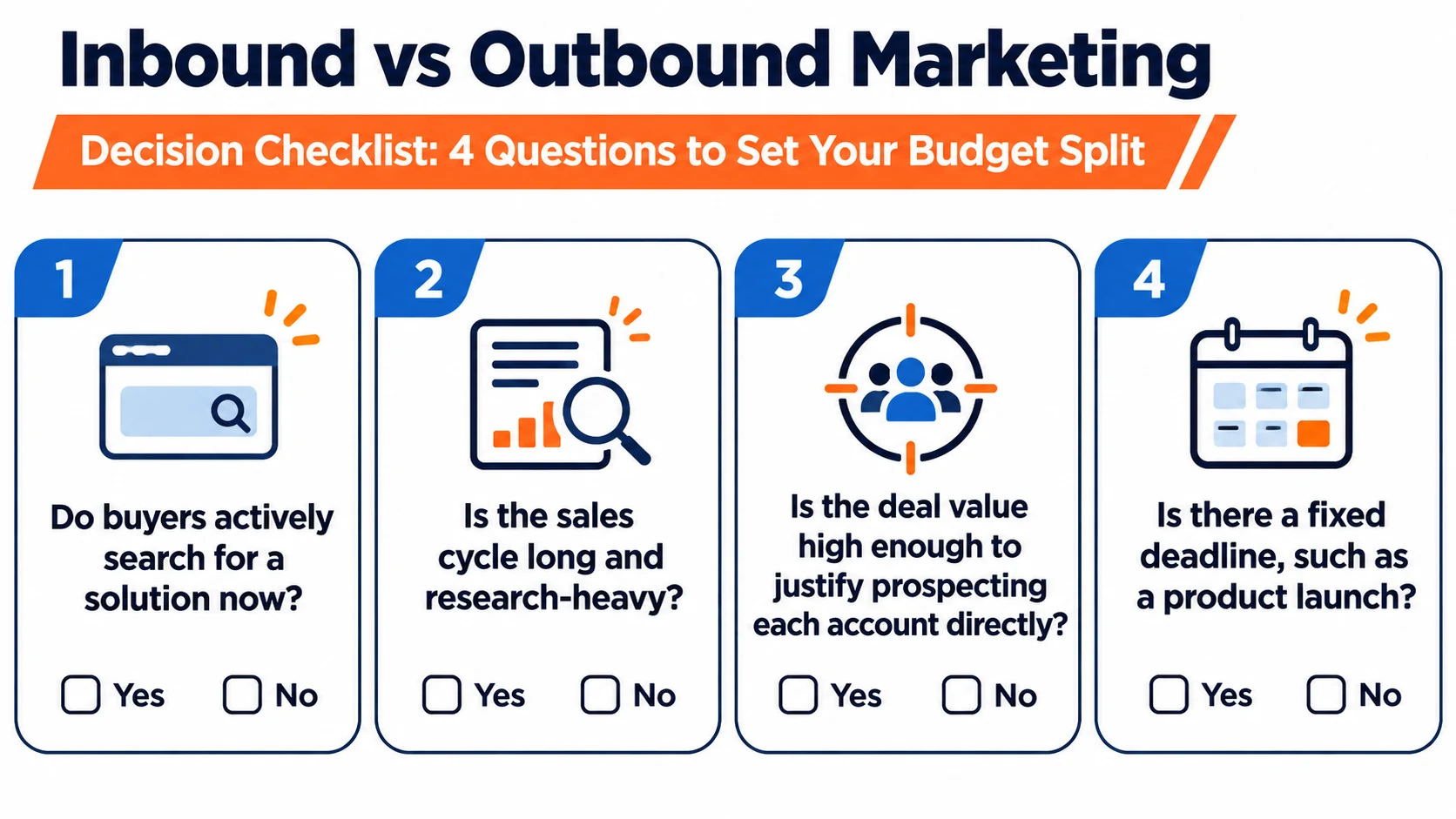
If you need a quick working answer, start here. Ask four questions before you decide your channel mix.
- Do buyers already search for what you sell? If yes, inbound deserves a larger share, because demand already exists and search, content and SEO can capture it.
- Can your buyers educate themselves before speaking to sales? If yes, inbound content can do a large part of the selling before the first conversation.
- Do you need pipeline quickly because of a launch, event or sales target? If yes, outbound becomes more important because it creates immediate reach.
- Are your deal values high enough to justify manual outreach? If yes, outbound is more viable because the economics support higher-touch prospecting.
Score one point for each “yes”. If the first two are yes and the last two are no, lean heavily inbound, often around 70% inbound / 30% outbound. If the last two are yes and the first two are no, lean more outbound, often around 30% inbound / 70% outbound. Mixed answers usually point to a balanced starting split such as 50/50. These are not permanent rules. They are starting hypotheses to refine with actual conversion data.
Inbound vs Outbound Marketing: Definitions and Core Differences
What Is Outbound Marketing?
Outbound marketing is when the business initiates contact with a prospect. The company pushes its message outward rather than waiting to be found. Traditional examples include cold calling, direct mail, event booths, display advertising and unsolicited outreach. In digital channels, outbound can include cold email, sponsored outreach, paid social prospecting and account-based campaigns aimed at a selected list of companies.
Outbound’s strength is speed and control. You decide who to target, when to launch and what message to send. The weakness is that response rates can be low, trust is lower at the start, and costs do not compound in the same way. Once you stop spending or stop contacting people, the flow usually stops too.
For Singapore businesses, outbound also carries a compliance dimension. Any business planning calls or text messages to local numbers should ensure its process is aligned with local rules on consent and the Do Not Call Registry. Design compliance into the campaign, not add it later.
What Is Inbound Marketing?
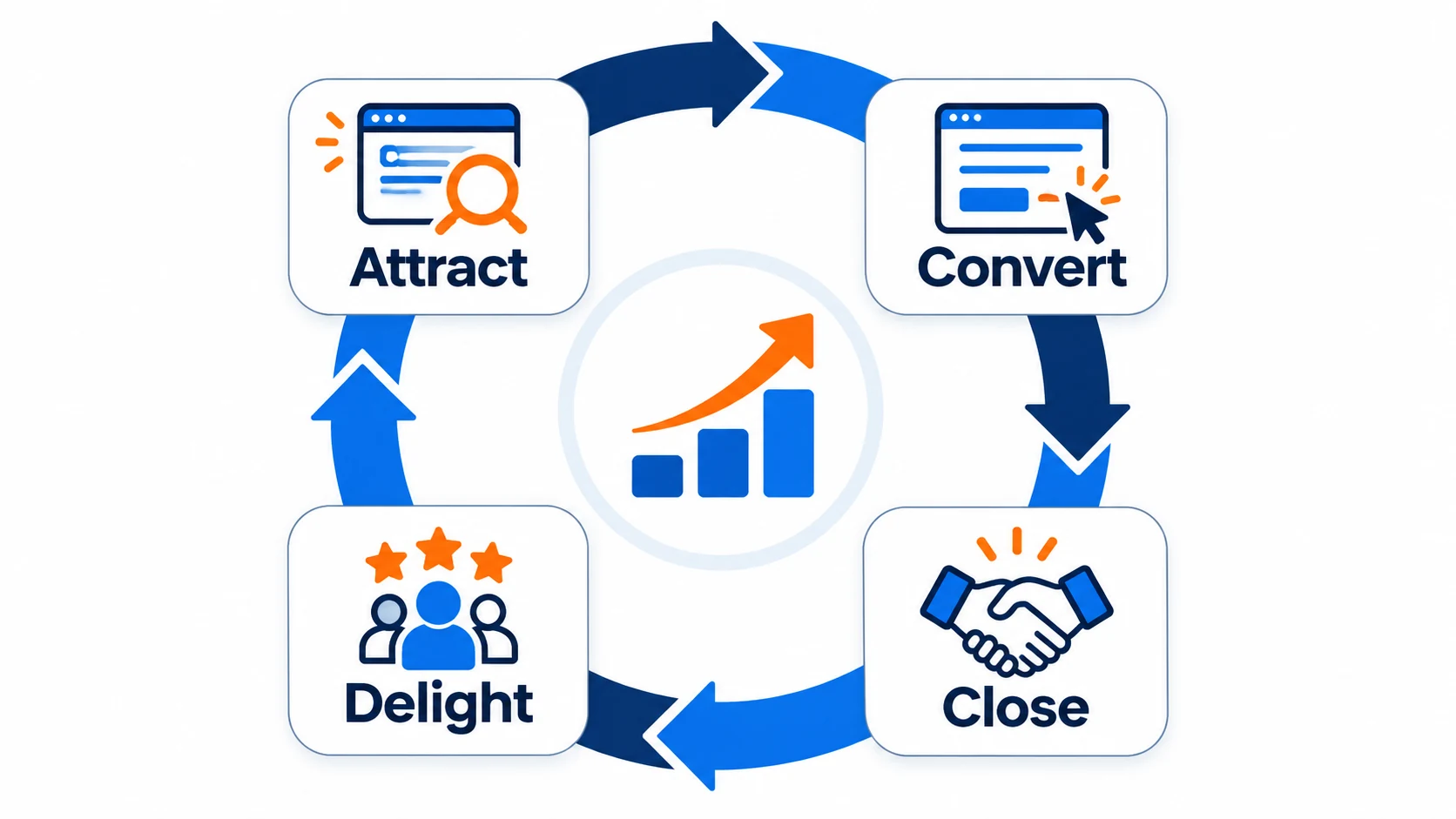
Inbound marketing earns attention rather than interrupts for it. The business publishes useful content, creates helpful tools, improves its visibility on search engines, educates its market and makes itself discoverable when prospects are actively researching. Typical inbound channels include SEO, blog content, organic social media, resource pages, email nurturing, webinars, downloadable guides and lead magnets.
The strength of inbound is efficiency over time. A well-ranked page, a strong guide or a useful tool can continue generating traffic and leads long after publication. The weakness is that inbound usually takes longer to build. It rewards consistency, depth and patience.
Inbound vs Outbound Marketing: Key Differences at a Glance
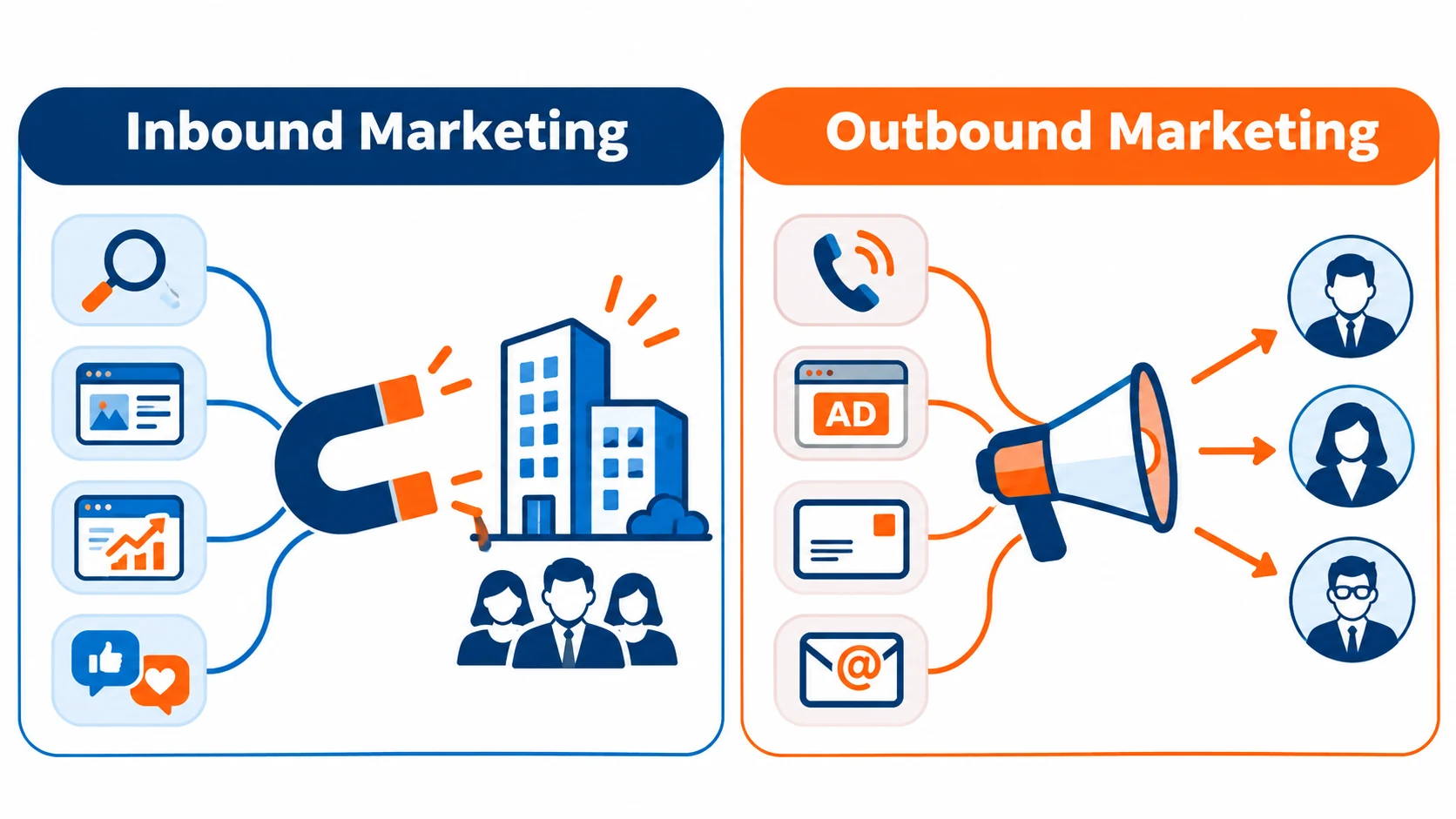
| Factor | Outbound | Inbound |
|---|---|---|
| Who starts contact | The business | The prospect discovers or responds to the business |
| Main channels | Cold email, calls, direct mail, outbound ads, events | SEO, content, social media, email nurture, webinars, guides |
| Speed | Fast to launch, fast to test | Slower to build, stronger over time |
| Compounding effect | Low | High if content and search visibility improve steadily |
| Trust at first touch | Usually lower | Usually higher because the prospect initiated interest |
| Best use cases | Named accounts, launches, high-value B2B, urgency | Evergreen demand capture, education-heavy sales, brand building |
How the Two Approaches Compare in Practice
Inbound and outbound often look similar on a slide but operate very differently. Outbound relies on targeting accuracy and message quality. Inbound relies on discoverability and usefulness. Outbound typically asks, “Who should we reach?” Inbound asks, “What questions are buyers already asking, and how do we become the best answer?”
Outbound performs best when you already know the right audience and can define them clearly. If you can name the accounts, industries, titles and trigger events, outbound can be very efficient. Inbound performs best when search demand is broad and buyers prefer self-education before sales contact.
Cost differences matter, but so does lead quality. Many articles claim inbound leads cost less than outbound leads, including Shopify’s comparison. That can be directionally helpful, but channel economics depend on execution quality, sales follow-up speed and conversion rate after lead capture. A cheap lead that never becomes revenue is still an expensive mistake.
Examples and Benefits: Inbound and Outbound in Action
Examples of Inbound Marketing
A payroll software company publishes a guide called “How to Choose Payroll Software for a 20-Person Business in Singapore.” The guide ranks in search, brings in readers already comparing options and captures demo requests. That is inbound.
A professional services firm runs a webinar answering a common compliance question, records it, turns it into an article, builds an email nurture sequence around it and invites attendees to request a consultation. That is also inbound.
An e-commerce brand invests in SEO category pages, educational blog content and short product explainer videos that answer buyer questions. Visitors arrive through search and convert across several touches. Again, inbound.
Examples of Outbound Marketing
A B2B agency creates a list of 100 named accounts in healthcare, identifies decision-makers and runs a coordinated sequence of personalised email, LinkedIn outreach and follow-up calls. That is outbound.
A new product launch with a short promotion window uses paid ads, event sponsorship and direct sales outreach to create immediate awareness and meetings. That is outbound.
A software company identifies businesses hiring for a role that signals a likely need for its product, then reaches out with a highly relevant message tied to that trigger. That is outbound at its best: specific, relevant and timely.
Pros of Inbound Marketing and Cons of Outbound Marketing
Inbound’s biggest advantage is that it produces assets. An article, a guide, a search-optimised service page, or a webinar can keep generating awareness and leads long after it’s created. Over time, this can lower acquisition cost and improve brand trust. Inbound also usually fits modern buyer behaviour, as many prospects prefer to research first and talk to sales later.
Outbound’s biggest limitation is that it usually does not compound. When the campaign ends, the effect often fades quickly. It can also create brand resistance if the outreach is too generic, too frequent or too poorly targeted. Poor outbound feels like interruption. Good outbound feels like relevance.
That said, businesses often make the opposite mistake and dismiss outbound entirely. This is costly when the company sells a high-ticket service with a long sales cycle, especially if only a defined set of companies are worth pursuing. In those cases, waiting passively for demand can be slower and more expensive than a well-run outbound program.
Choosing Between Inbound and Outbound Marketing, or Using Both
The right choice depends less on marketing fashion and more on five business realities:
- Search demand. If people search for your solution, inbound becomes very attractive.
- Deal size. If one sale is worth a lot, outbound becomes easier to justify.
- Sales cycle complexity. The more education buyers need, the more valuable inbound content becomes.
- Urgency. The faster you need pipeline, the more important outbound becomes.
- Audience precision. If you can define exactly who should buy, outbound improves.
Many businesses should not frame this as a winner-takes-all decision. A better question is: what should create baseline demand, and what should accelerate demand? In most cases, inbound should be the base and outbound the accelerator.
Using Inbound and Outbound Marketing Together
The two approaches work best when they support each other.
- Inbound can improve outbound. If your sales team sends prospects to strong case studies, guides and comparison pages, outbound conversion improves because the follow-up assets are better.
- Outbound can improve inbound. Questions heard in sales calls can become blog topics, landing pages, webinar themes and FAQ content.
- Retargeting connects the middle. Someone who found you through search but did not enquire can later be re-engaged with paid ads or email nurture.
- Shared measurement creates better decisions. If both teams track the same funnel stages, budget allocation becomes more rational.
A practical example: a digital marketing agency publishes SEO and lead-generation content to capture existing demand, while its business development team runs targeted outreach to specific brands or industries. The content warms the market broadly. The outreach speeds up selected opportunities. Each one makes the other stronger.
Practical Budget Models for Different Business Types
B2B service firm with long sales cycles
Recommended starting mix: 60% inbound / 40% outbound. Use inbound to build authority and trust through service pages, guides, LinkedIn thought leadership and SEO. Use outbound to target named accounts and decision-makers.
High-value enterprise solution provider
Recommended starting mix: 40% inbound / 60% outbound. Use inbound to support credibility, but allocate more to account-based outreach because the target universe is smaller and each deal value is higher.
SME consumer or e-commerce brand
Recommended starting mix: 70% inbound / 30% outbound. Search demand, social discovery and evergreen content typically matter more here than manual outreach. Outbound can still support launches, promotions and retargeting.
New product launch or event-driven campaign
Recommended starting mix: 30% inbound / 70% outbound in the short term. Use outbound for immediate visibility, but build inbound assets in parallel so the business does not become dependent on paid or manual push forever.
What to Measure in Each Approach
A channel is only as good as the business result it produces. Do not stop at traffic, impressions or raw lead volume.
Inbound metrics
- Organic traffic and non-branded traffic growth
- Keyword visibility for commercial-intent terms
- Lead conversion rate from blog, landing pages and resource pages
- Email subscriber growth and nurture performance
- Marketing-qualified leads and sales-qualified leads from inbound sources
- Customer acquisition cost and payback period
Outbound metrics
- Reply rate, meeting-booked rate and connection rate
- Cost per meeting and cost per opportunity
- Opportunity creation rate by segment or account list
- Close rate by campaign
- Pipeline value generated
- Time from outreach start to first qualified conversation
The metrics that matter most
The most important comparison is not “Which channel got more leads?” but “Which channel produced more profitable customers at an acceptable acquisition cost?” If outbound creates fewer leads but much larger deals, it can still be the better investment. If inbound creates more leads that convert steadily and cheaply, it deserves more scale.
| Question | Why it matters | Best metric |
|---|---|---|
| Is the channel creating demand efficiently? | Shows economic health | CAC, cost per opportunity, payback period |
| Is the channel producing sales-ready leads? | Prevents vanity reporting | MQL to SQL rate, meeting rate, opportunity rate |
| Is the channel compounding over time? | Helps set long-term budget | Organic growth, assisted conversions, repeat traffic |
Common Mistakes and How to Avoid Them
1. Choosing based on trend rather than business fit
Some companies pick inbound because it sounds modern or outbound because it feels more direct. Both mistakes ignore context. Choose based on demand, urgency, economics and audience behaviour.
2. Expecting inbound to work instantly
Inbound usually takes months, not weeks. A content or SEO program judged too early often gets cut just before it starts to compound. Set realistic expectations and track interim progress such as content production, rankings, traffic quality and conversion rate.
3. Running outbound without sufficient relevance
Generic outbound is expensive. The closer your message is to the prospect’s real situation, the better the results. Good targeting and relevance matter more than volume.
4. Measuring only top-of-funnel numbers
Traffic, impressions and clicks matter, but revenue matters more. If your reporting stops too early in the funnel, budget decisions will be distorted.
5. Failing to connect sales and marketing
Inbound and outbound both break down when marketing and sales work from different definitions of lead quality. Agree on funnel stages, follow-up standards and feedback loops.
Conclusion: Matching the Strategy to Your Business Stage
Inbound is usually the stronger default for Singapore businesses because it builds trust, compounds over time and often lowers acquisition cost once it gains traction. Outbound remains highly valuable when you need speed, when you sell to a defined list of high-value accounts or when buyers are not yet actively searching for your offer.
The most practical answer is usually this: build inbound as the engine and use outbound as the accelerator. Let inbound create steady demand, trust and discoverability. Let outbound create urgency, open target accounts and support launches. Then use your own data to shift the mix over time.
If your business isn’t sure where to start, begin with the four-question framework in this guide, choose an initial split, run both with proper tracking, and review the results after one quarter. Budget decisions improve when they are tied to conversion quality, sales outcomes and customer acquisition cost, not just lead volume.
Practical next step: audit your current marketing mix by channel, assign each lead source to inbound or outbound, and compare cost, speed, conversion quality and revenue contribution. If you want a clearer plan, work with a digital marketing agency that can evaluate your SEO, content, paid media and outbound workflow together rather than in isolation.
Frequently Asked Questions
Is inbound marketing better than outbound marketing?
Not universally. Inbound is the stronger default for many businesses because it builds compounding assets and aligns with modern buyer behaviour. Outbound is often better for high-value target accounts, launches and situations where you need faster pipeline creation.
Which is cheaper, inbound or outbound marketing?
Inbound is often cheaper over time because content, SEO and email nurture can keep working after the initial investment. Outbound can be more expensive per lead, but it may still be the better investment if it generates larger deals or faster revenue. Always compare customer acquisition cost and revenue, not lead cost alone.
Can a small business in Singapore use both inbound and outbound marketing?
Yes. In fact, many small businesses should. Build a strong inbound base through search-focused content, clear service pages and social proof. Then add selective outbound activity for priority accounts, partnerships, launches or local prospecting.
How long does inbound marketing take to show results?
That depends on competition, content quality, site authority and execution consistency, but most businesses should evaluate inbound over several months rather than several weeks. Quick wins are possible, but the main value of inbound is the compounding effect over time.
What is the Attract, Convert, Close, Delight framework?
It is a common inbound framework. Attract brings the right visitors in. Convert them into leads. Close turns qualified leads into customers. Delight turns customers into repeat buyers, advocates or referrers. It helps by reminding marketers that acquisition doesn’t end with the first enquiry.
Sources cited in the original draft, such as Shopify and HubSpot, were retained conceptually where helpful, but the article has been expanded primarily as a practical decision guide for business use.