Quick Answer:


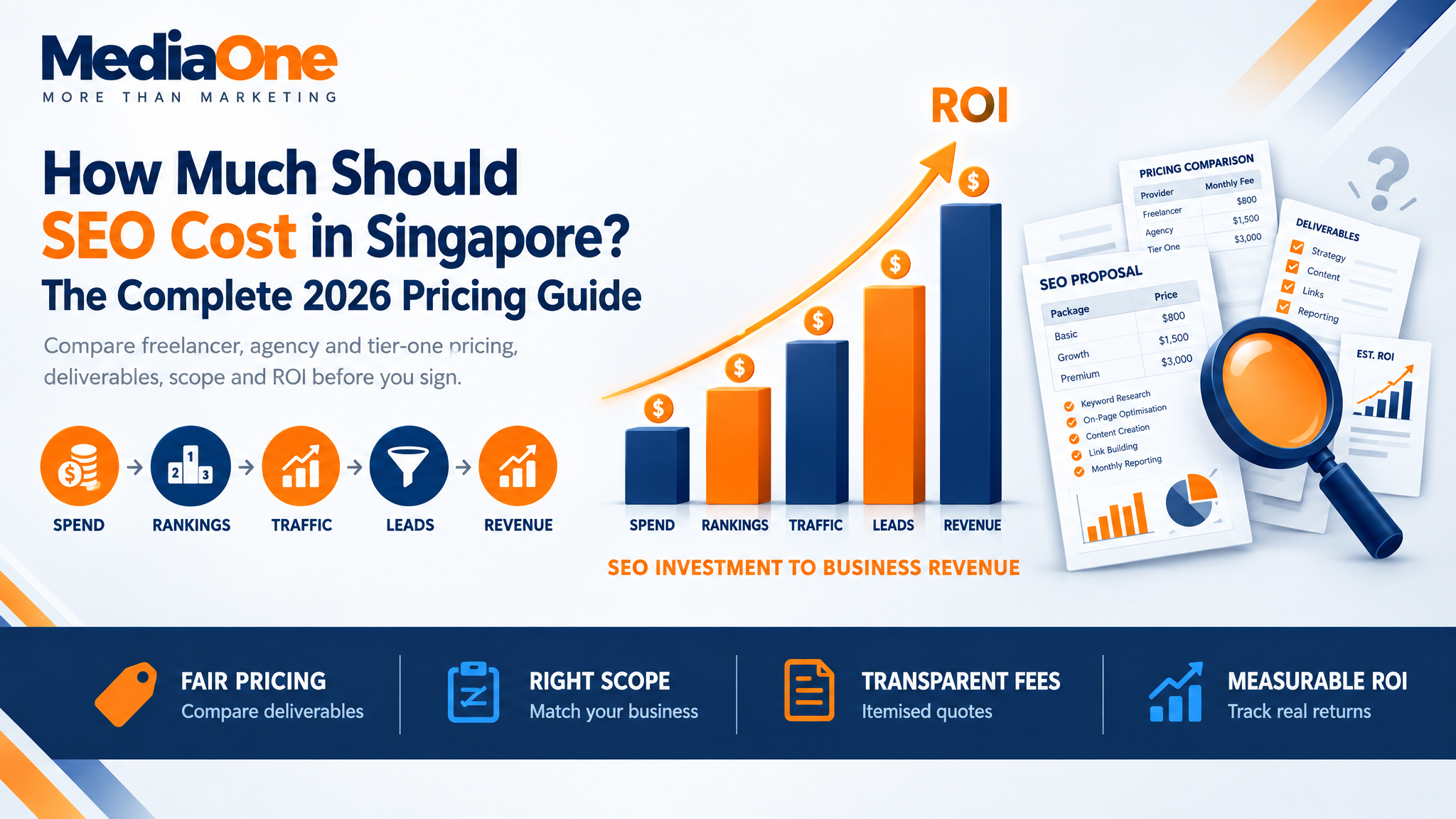
SEO in Singapore typically costs SGD 2,000 to 6,000 a month for freelancers, SGD 3,000 to 10,000 for small-to-mid agencies, and SGD 10,000 to 50,000 or more for tier-one firms, with project-based work running SGD 5,000 to 30,000. The right budget depends on your industry’s competitiveness, your website’s technical condition, and how much content and link building your strategy requires, so comparing deliverables matters more than comparing headline prices.
SEO pricing in Singapore ranges from SGD 2,000 to over SGD 50,000 per month, but the real question isn’t what agencies charge; it’s what you should expect to pay for genuine results. This variation stems not from guesswork but from real differences in scope, team size, and competitive pressure in your industry.
If you’re evaluating SEO proposals right now, you’ve probably noticed quotes vary wildly. One agency quotes SGD 3,500 for “full SEO”, another SGD 8,000 for what sounds like identical work. Neither number is wrong, but one might be a poor fit for your business.
This guide cuts through the confusion by showing you what fair pricing looks like, what each price tier actually delivers, and how to spot proposals that are too cheap to be legitimate or too vague to be trustworthy.
Key Takeaways
- Market range for Singapore SEO: freelancers SGD 2,000–6,000/month; mid-tier agencies SGD 3,000–10,000/month; tier-one firms SGD 10,000–50,000+/month. Project-based work: SGD 5,000–30,000 one-time.
- Fair pricing depends on scope, not just hours. Identical monthly costs may deliver vastly different work. Compare deliverables before deciding.
- Most competitive keywords require 4–8 months and higher budgets. Long-tail opportunities show results in 2–4 months at lower cost.
- Guarantees are a red flag. No legitimate agency can guarantee rankings. Watch for “first page in 30 days” claims.
- ROI calculation is specific to your business model. E-commerce needs 13+ extra orders/month to justify SGD 5,000/month spend. Service businesses need 1–2 qualified leads/year.
Why SEO Pricing Varies So Widely in Singapore
You ask three agencies for an SEO quote. One says SGD 3,500/month. Another quotes SGD 8,200/month. A third offers SGD 1,200/month but mentions it’s an add-on to web design. All three claim to do “SEO”. So why the chasm?
The answer isn’t mystery or greed. The word “SEO” has become so broad it’s almost meaningless. One agency is selling a full strategy and delivery engine. Another is selling hourly consulting time. A third is selling labour arbitrage from offshore staff. They’re not quoting the same service at different markups. They’re quoting entirely different things.
Understanding why pricing scatters this wide is your first step to knowing whether a quote is fair, and whether you’re actually buying what you think you are.
The Scope Problem: Same Word, Different Services
Ask an agency to quote “SEO” without defining scope, and you’ll get proposals for wildly different work.
One agency’s SGD 2,000/month retainer might include only on-page optimisation: keyword research, title tag and meta description updates, content brief writing, and internal link recommendations. They touch your site monthly, advise your in-house team, and assume your team implements the changes. This is a light-touch model, useful if you have a marketer on staff or you’re testing the waters.
Another agency’s SGD 2,000/month quote might be earmarked exclusively for technical SEO: crawl error fixes, site speed optimisation, schema markup, and Core Web Vitals monitoring. This is specialist, deep work, but it doesn’t touch your content strategy or link profile. You’d need a second vendor for content and authority building.
A third agency might call their SGD 2,000/month entry point “SEO consulting”, meaning they charge you hourly (often billed as a retainer of roughly 15 hours/month at SGD 130/hour), and you direct the work. They don’t execute; they advise.
Now ask the same three for a “full SEO retainer”, and they quote SGD 5,000, SGD 8,500, and SGD 6,200 respectively. One includes content production (four blog posts per month). One bakes in basic link outreach (5–8 pitches per month; you approve targets). One covers account management and monthly strategy calls. Each is genuinely fuller, but they’re still three different service bundles under one label.
This scope ambiguity is the single biggest driver of pricing confusion. Two agencies can honestly quote the same client SGD 3,000 apart, and both be correct for their defined scope. The fault lies not in the quotes but in the question asked.
What this means for you: Before comparing prices, compare deliverables. Build a checklist of what you actually need:
- Pages optimised per month
- New blog content or pillar pages created
- Technical audit frequency (monthly, quarterly, annually)
- Link building work (outreach, guest posts, sponsorships, or none)
- Competitor tracking and reporting depth
- Strategy calls (none, monthly, quarterly)
- Tool access (rank tracking, content calendar, analytics dashboard)
Two agencies at SGD 5,000/month may deliver vastly different mixes. Normalising by deliverable (SGD 500 per optimised page, SGD 1,200 per blog post) often reveals that one is genuinely more expensive, or that both are fair for their respective scopes.
Agency Size and Overhead Differences
Cost also swings with who you’re hiring: freelancer, boutique firm, or regional consultancy.
A solo SEO consultant in Singapore can quote SGD 80–180/hour because their overhead is minimal. No office lease, no HR, no stack of tool licences split across a team. They trade off availability and depth for affordability. A freelancer is ideal for audit work, fractional consulting, or light ongoing guidance if you have in-house implementation capacity.
A small boutique agency (2–5 people) operates from a shared office or light coworking space. They employ account managers and specialists, so they have backup if someone leaves. Their overhead is real: salaries, benefits, software subscriptions, training. They charge SGD 3,500–8,000/month because each of those dollars accounts for salary (biggest line item), tools, rent, and margin. But they move faster than a freelancer and can take on more complex projects.
A tier-one regional agency (10+ staff, multiple offices or a Singapore HQ with overseas capacity) carries enterprise overhead: an office lease in a prime location, licensed software at scale, account managers, strategists, content producers, link builders, and designers as permanent staff. They quote SGD 10,000–50,000+/month. Much of this reflects salary payroll; some reflects their brand premium and client calibre (they work with ASX-listed companies and VC-backed startups, not SMEs).
Where you hire also matters. A freelancer based in Singapore quotes differently from one in Manila offering “SEO services for Singapore.” Both might be skilled, but geographic arbitrage is built into pricing. London-based agencies servicing Singapore remotely may quote in GBP and price for UK overheads (higher salaries, higher rent), making them 30–50% pricier than a Singapore-based team. Not always a bad choice, UK firms often bring deeper e-commerce or regulated-sector experience, but the premium is real.
What this means for you: You’re not paying for skill alone. You’re also paying for infrastructure, talent retention, and risk. A freelancer might be as skilled as an agency’s senior strategist, but the freelancer can disappear if they get a full-time offer. An agency commits to continuity and backup. That security has a cost. Decide which you need: low-cost, high-skill individual work, or slightly higher cost paired with stability and team depth.
Outcome Guarantees vs. Effort-Based Models
How an agency frames and prices its work shapes cost structure and risk allocation.
- Effort-based pricing is most common and honest. You pay for labour, deliverables, or retainer hours. An agency charges SGD 4,000/month for four optimised pages, quarterly audits, and reporting. They don’t promise rankings or revenue; they promise to do the work. If rankings don’t improve, it may be that your site’s authority is weak, your competition is strong, or your niche is oversaturated- factors beyond SEO alone.
- Performance-based pricing ties cost to outcomes: you pay if rankings improve, traffic increases, or leads are generated. Sounds fair; you only pay if it works. In practice, it’s risky for both sides. Legitimate agencies avoid it because Google’s algorithm changes and competitor moves are unpredictable. An agency could do flawless work and still see no ranking lift if a competitor secures 20 high-authority backlinks in month two. Rather than risk non-payment on good work, most will pair performance-based fees with very high retainers (SGD 15,000+/month base, then outcome bonuses), which protects them but prices out most SMEs.
- Hybrid models are rising: base retainer (effort-based, SGD 4,000–6,000/month) plus performance bonus if they hit agreed KPIs. This spreads risk more fairly. Legitimate agencies will propose this voluntarily if they’re confident.
- Guaranteed rankings or “first page in 30 days” is a red flag. Google’s algorithm is not public. No one can guarantee page-one rankings for competitive keywords on a timeline. If an agency promises rankings, they’re either misrepresenting their control, relying on black-hat tactics (which Google penalises), or betting on your niche being so low-competition that rankings are easy (in which case, why pay them?). Singapore does not regulate SEO promise enforcement, so buyer beware applies.
Most legitimate Singapore SEO agencies use effort-based retainers or hybrid models. They’ll set ranked outcomes and reporting like “we aim for a 30% boost in organic traffic over 12 months, measured monthly,” but frame it as a shared goal, not a guarantee. This shifts focus where it belongs: execution, learning, and continuous improvement, not hoping for a lucky algorithm shift.
What this means for you: Expect effort-based pricing as normal. If an agency insists on guaranteeing rankings, ask exactly how and at what margin of safety. Do they guarantee top three? Top ten? For how long? Ask for examples. Request references from past clients who did not see promised results and ask how that was handled. Legitimate agencies have lost bets before and will own it. Predatory ones deflect or have no examples.
Current SEO Pricing Benchmarks for Singapore (2026)
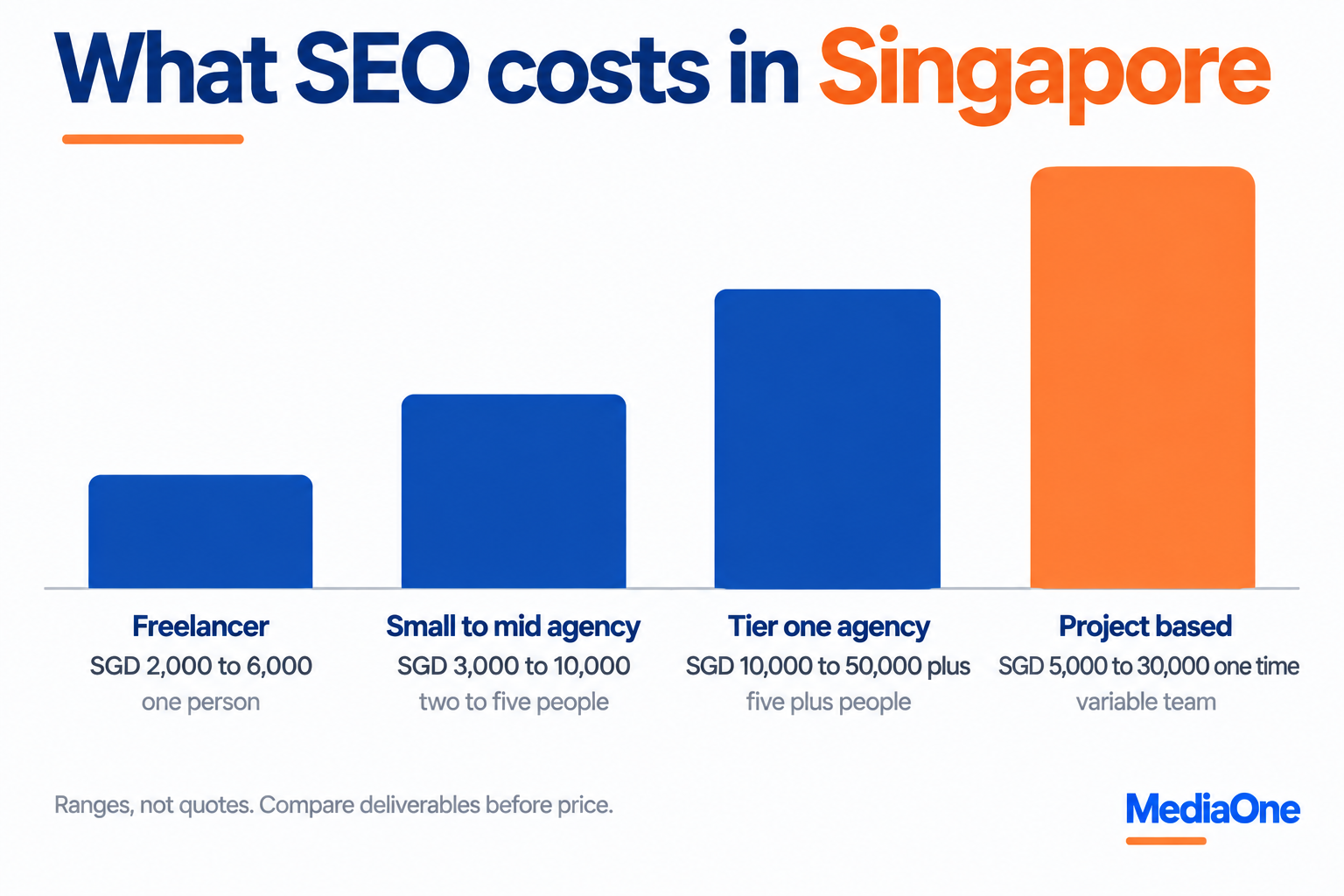
Singapore’s SEO market has matured significantly, and pricing now reflects clear tiers based on agency size, scope, and specialisation. The ranges below are grounded in current market data from local agencies, freelancer networks, and client feedback across 2026.
Freelancer and Solo Consultant Rates
Independent SEO professionals in Singapore typically charge SGD 80–250 per hour or SGD 2,000–6,000 per month for retainer support.
What’s included: On-page optimisation, technical SEO fixes, keyword research, light competitive analysis, and basic monthly reporting. Freelancers typically do not include link building or content creation unless those are added as separate line items.
Best fit: Small businesses with one to two target keywords, local service providers (plumbers, accountants, lawyers), or companies that already have marketing staff and need external expertise to guide strategy rather than execute it fully.
Trade-offs: Lower cost is the main draw. The downside is inconsistent availability (freelancers often work across multiple clients and may not respond instantly), narrower skill sets (most specialise in on-page work rather than enterprise technical SEO or link strategy), and less formal accountability. If the freelancer becomes unavailable, you have no backup support.
Singapore has a growing pool of Google Search Central certified independents, worth verifying credentials via their Google profile or LinkedIn before engaging. Many come from larger agencies and bring solid experience at lower overhead.
Small-to-Mid Agency Retainers
The typical entry point for SMEs is SGD 3,000–10,000 per month.
What’s included at this tier: A quarterly technical SEO audit, optimisation of three to six pages per month, monthly competitor tracking, rank monitoring via dashboard, monthly or bi-weekly reporting, and two strategy calls per year. Most small-to-mid agencies deploy teams of two to five people across multiple clients.
Best fit: SMEs targeting one to three keyword clusters (for example, a plumbing company ranking for “blocked drain Singapore”, “pipe repair Geylang”, and “water heater maintenance”). These agencies move faster than freelancers and can handle light content and basic link outreach.
Timeline expectations: Ranking improvements for less competitive keywords (long-tail, local intent) appear within 4–8 weeks. Competitive terms take 3–6 months. You should see early signals (improved impressions, rising click-through rate) within the first month if optimisation is done correctly.
What costs more: Adding monthly blog posts, guest post outreach, or paid search management typically pushes the retainer up to SGD 5,000–8,000. Clarity on these add-ons prevents scope creep.
Tier-One and Specialised Agencies
Established and specialist agencies charge SGD 10,000–50,000+ per month.
What’s included: Full-service strategy development, content production (blog posts, pillar pages, asset creation), link building campaigns, technical SEO at scale, monthly strategy sessions with senior strategists, competitive intelligence, and integration with paid advertising efforts. Teams are typically 5+ people with dedicated account managers.
Best fit: E-commerce businesses with multiple product categories, enterprises in competitive sectors (finance, real estate, legal services, healthcare), or companies expanding across multiple regional markets. These agencies often insist on 12–24 month contracts because the strategy and compound results take time.
Typical client profile: Annual revenue SGD 2M+, organic search viewed as a core growth channel (not a side project), and capacity to implement recommendations or work with internal teams.
What you’re paying for: Deep industry expertise, proprietary research, relationships with high-authority publishers for link building, and senior-level strategy. A financial services SEO specialist, for example, understands regulatory nuance and competitive dynamics that a generalist does not.
Project-Based SEO Work
One-off, scoped projects cost SGD 5,000–30,000 depending on complexity.
Typical deliverables:
- Full technical SEO audit with remediation roadmap (SGD 5,000–8,000)
- Content strategy document and keyword mapping (SGD 4,000–7,000)
- Website rebuild or migration with SEO optimisation (SGD 15,000–30,000+)
- Competitive analysis and strategic recommendations (SGD 3,000–5,000)
- On-page optimisation for a defined set of pages, e.g., 20–50 pages (SGD 6,000–12,000)
Best fit: Companies that want to test an agency before committing to a retainer, teams with internal resources ready to implement recommendations, or those needing a one-time fix (for example, fixing crawl errors after a site migration).
Advantage: No long-term commitment. You own the output (audit reports, content briefs, technical documentation) and can implement yourself or pass it to another vendor. Several businesses use a project audit as a hiring test: if the recommendations are solid and actionable, the agency moves to a retainer conversation.
Pricing Comparison at a Glance
| Engagement Type | Monthly Cost (SGD) | Team Size | Best For | Timeline to Results |
|---|---|---|---|---|
| Freelancer | 2,000–6,000 | 1 | Small local business, guidance-focused | 6–8 weeks (long-tail) |
| Small-to-Mid Agency | 3,000–10,000 | 2–5 | SME with 1–3 keywords | 4–8 weeks |
| Tier-One Agency | 10,000–50,000+ | 5+ | E-commerce, enterprise, competitive sectors | 3–6 months (competitive terms) |
| Project-based (one-off) | 5,000–30,000 (total) | Variable | Audits, testing, one-time optimisation | N/A (project-bound) |
What Factors Justify Higher SEO Investment?
The raw cost of SEO matters less than what you’re actually buying. A SGD 8,000/month retainer for a niche B2B consultancy might deliver excellent ROI; the same budget for a hyper-competitive e-commerce site could be underfunded. Understanding what drives costs up (and whether those costs are justified) separates smart spending from waste.
Industry Competitiveness and SERP Difficulty
Some sectors demand higher SEO budgets simply because the search landscape is saturated and the stakes are high.
Personal injury law, property real estate, financial services, healthcare, and e-commerce all have one thing in common: fierce competition for every ranking position. Page-one results for “personal injury lawyer Singapore” or “property agent Bukit Timah” represent millions of dollars in potential revenue. Agencies bidding for those keywords compete against well-funded competitors who have been optimising for years.
Ranking for these terms requires more aggressive link-building campaigns, deeper content libraries, and longer timelines. You’re not competing on topic relevance alone; you’re competing on domain authority, backlink profile, and brand signals that take months or years to accumulate.
By contrast, niche B2B services, specialised manufacturing, or professional coaching may face only three to five real competitors on page one. SEO work here costs 40–60% less because the barrier to entry is lower and timelines compress.
Your sector determines your baseline budget. Before evaluating a proposal, search your top 10 target keywords. Count how many competing sites rank above you. If most are major brands, well-funded agencies, or established local names, budget accordingly: SGD 8,000–15,000/month minimum. If most are smaller competitors without obvious SEO investment, SGD 3,500–6,000/month is defensible.
Technical Complexity and Existing Site State
Not all websites start from the same place.
A newly built WordPress site on modern hosting: relatively straightforward. An enterprise site with 50,000+ pages, legacy navigation, crawl errors, canonicalisation chaos, and fragmented tracking across five acquisitions: exponentially harder.
Technical remediation work is the hidden cost driver. Migration from an old CMS platform to Shopify or a modern static site generator requires re-architecting URLs, setting up 301 redirects at scale, fixing internal linking, and managing ranking volatility during the transition. A site with severe technical debt, broken crawl paths, slow server response times, mixed HTTP/HTTPS content, or misconfigured hreflang tags needs weeks of diagnostic work before optimisation can even begin.
Brownfield projects (fixing broken sites) typically run 40–60% more expensive than greenfield work (optimising a clean slate) because the first three months focus purely on remediation, not ranking improvement.
Ask prospective agencies how much of the initial work will be technical repair versus optimisation. If they gloss over technical audits or skip the diagnostic phase, they’re either underbidding or underestimating scope. A transparent quote breaks this down: “Weeks 1–4: technical audit and fixes (SGD 2,500). Weeks 5+: ongoing optimisation (SGD 5,000/month).”
Content Production and Refresh Scope
SEO without content is like fishing without bait.
A retainer that includes strategy and optimisation of existing pages costs less than one that requires writing, editing, designing, and publishing new content. The difference is substantial.
A SGD 4,000/month retainer might cover on-page optimisation, technical fixes, and monthly reporting. Add content creation (four new blog posts or two pillar pages per month), and the budget expands to SGD 7,000–10,000/month. The labour cost of writing at professional standard (not AI-generated filler, but research-backed, fact-checked copy) is significant. A 2,000-word case study or pillar page costs SGD 800–2,000 when written by a professional copywriter familiar with your industry.
Outsourced content agencies that manage the full workflow (research, writing, editing, design integration) cost more than freelance writers. Conversion-focused copywriting (designed to move prospects toward a sale) costs more than informational blog content. Video scripts, testimonial documentation, and technical explainers all carry premium rates.
Clarify what “content” means in any proposal. Does the agency create the content, or do they optimise content you provide? Are they using templates and AI-assisted writing, or custom research and original reporting? Does the SGD 5,000/month include two blog posts, or is content budgeted separately? A typical breakdown: agency fee (strategy, optimisation, reporting) plus content budget (variable, dialled up or down based on your priorities). This separation gives you control and prevents surprise scope creep.
Link Building and Authority Development
Backlinks remain a core ranking factor. Quality links from authoritative Singapore or regional sources cost real money.
Legitimate link building relies on outreach, relationship building, guest posting on established publications, resource page placements, and occasionally sponsorships or partnership announcements. None of these happens passively or cheaply. An agency running a proper outreach campaign allocates 15–25 hours per month to research, personalised outreach, and negotiation. At typical Singapore SEO labour rates, that’s SGD 2,000–4,000/month in cost alone.
Links from high-authority local sites (Singapore Business Review, PropertyGuru, LinkedIn Pulse, regional industry publications) carry more weight than links from generic directories or low-authority blogs. Those sources command a premium because the payoff (ranking lift, traffic, brand mention) is higher.
Suspect any agency claiming “fast links” or “guaranteed 20 links per month” at a fraction of this cost. Black-hat tactics (automated link networks, footer link exchanges, private blog networks) still exist. They work briefly, then Google catches them, and you face manual action penalties. Legitimate link building is slow, manual, and relationship-driven. If it sounds faster or cheaper than market rate, it’s not legitimate.
Allocate a separate budget line for link building if it’s critical to your strategy. Many agencies quote a base retainer (optimisation, content, reporting) and offer link building as an add-on: SGD 2,500–6,000/month depending on competition and target market. This gives you visibility into where money goes and lets you dial the intensity up or down based on results.
International or Multi-Location Expansion
Targeting multiple cities, countries, or languages multiplies complexity geometrically.
A Singapore-only local SEO campaign focuses on one market, one currency, one set of search behaviours, and typically one language. Expand to Malaysia, Vietnam, Hong Kong, and Australia, and you’re managing separate keyword research, localised content, regional link building, and different competitive landscapes for each market.
Technical implementation costs compound. Hreflang tags for language and region targeting require careful architecture. URL structure (subdirectories, subdomains, or separate domains) affects crawl efficiency and link flow. Localisation goes beyond translation: currency handling, local payment methods, regional compliance language (PDPA for Singapore, GDPR considerations for EU expansion), and cultural messaging all require investment.
Regional expansion typically starts at SGD 15,000–25,000/month and scales with market count. A three-market campaign (Singapore, Malaysia, Thailand) may cost 2.5x a single-market retainer, not 3x, because some overhead is shared. But the line items multiply: separate keyword research, competitive analysis per market, localised content production, and region-specific link building.
If you’re planning expansion, scope it separately from your core market campaign. Many agencies will offer bundled pricing (for example, “Singapore core market plus Malaysia expansion equals SGD 12,000/month”), but only after a proper discovery conversation. The saving versus managing two separate retainers is real but modest (10–15% bundle discount is typical).
What You’re Actually Paying For: The Cost Breakdown
When you receive a quote from an SEO agency in Singapore, you’re not just paying for someone to tinker with your website. Understanding where that money goes makes it far easier to spot fair pricing from inflated fees.
Labour and Expertise Costs
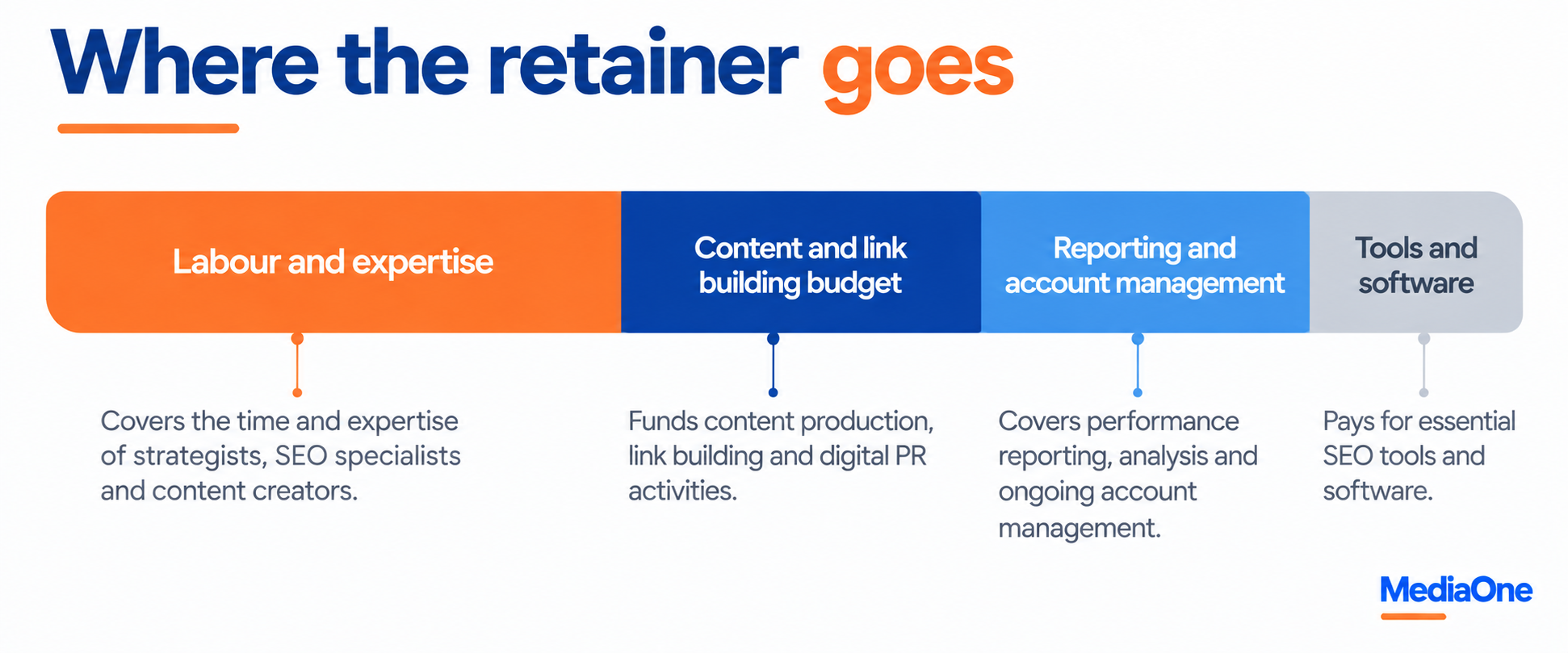
Labour is the single largest expense in any legitimate SEO retainer. This is where your money actually goes.
A mid-level SEO specialist in Singapore typically costs an agency SGD 5,000 to SGD 8,000 per month in salary. A senior strategist commands SGD 10,000 to SGD 15,000 or more. Account managers, content writers, and technical specialists add more layers to the payroll.
This math reveals why certain price points don’t make sense. A SGD 3,000 monthly retainer might support one part-time specialist (sustainable). A SGD 800 retainer cannot, which signals either reselling (an agency buying cheap work elsewhere and marking it up) or such light-touch service that meaningful work simply doesn’t happen.
Freelancers undercut agency rates precisely because they operate solo. No office overhead, no account manager, no HR burden. They also have tighter availability and narrower skill sets. You’re paying for their labour only, not institutional depth.

The key question: is the agency staffing your account with someone whose hourly cost aligns with the monthly fee you’re paying? SGD 4,000 per month ÷ 40 billable hours equals SGD 100 per hour, a fair mid-market rate. SGD 800 per month ÷ 40 hours equals SGD 20 per hour. That person doesn’t exist in Singapore’s SEO market at that cost.
Tools and Technology Stack
Every SEO agency pays for software. These costs are real and compound quickly.
SEMrush and Ahrefs (competitor research, rank tracking) cost SGD 150 to SGD 400 per month each, depending on tier. Screaming Frog (technical audits) runs SGD 99 per month. Rank-tracking tools add SGD 100 to SGD 300 monthly. Analytics platforms, CMS licences, email outreach tools, and reporting software add further. Across a team of three to five people using multiple tools, the monthly total easily reaches SGD 800 to SGD 1,500.
Legitimate agencies either pass these costs through transparently or bundle them into the retainer. Some show a line item: “Tools: SGD 250/month”. Others roll it into the flat fee without itemising.
The risk: agencies that quote SGD 2,500 all-in and never mention tools. Either they’re absorbing substantial costs (unsustainable) or they’re cutting corners (using free or pirated alternatives, reducing audit quality). Ask directly: “What rank-tracking tool do you use? Can I access the dashboard?” A clear, confident answer signals a properly resourced operation.
Reporting, Communication, and Account Management
Monthly calls, custom reports, email support, and Slack responsiveness require time. This is overhead many clients don’t see but definitely feel.
Expect to budget 5 to 10 hours per month at SGD 100 to SGD 300 per hour for mid-tier agency support (strategy calls, reporting, communication). That’s SGD 500 to SGD 3,000 monthly just for communication and reporting, depending on how involved the account manager is.
Agencies transparent about this component itemise it: “Strategy calls and reporting: SGD 1,200/month” alongside technical work. Agencies hiding it lump everything into one number, often undersizing this component to make the headline price look better.
The difference shows up fast. An agency that calls twice a month, produces a five-page custom report, and answers emails the same day costs more than one sending a generic dashboard link once quarterly. Neither is inherently wrong, but mismatch between what you expect and what’s included creates friction.
Traffic Acquisition and Link Building Budget
This is where retainer structure becomes clearer and where you gain real control.
Many agencies separate two distinct components: the core “agency fee” and a variable “link building budget” or “content production budget”. Example structure: SGD 4,000 agency fee (strategy, on-page optimisation, audits, reporting) plus SGD 2,000 link building budget (guest posts, resource page placements, outreach campaigns). You can often dial the second number up or down without affecting the first.
This transparency prevents scope creep and miscommunication. You see exactly what’s included in core services versus what costs extra to accelerate growth. A client on a tight budget keeps the core fee and drops link building for the month, resuming when budget allows. Another client might double the link-building spend to rank faster in a competitive sector.
Agencies that bury link-building costs inside a flat retainer often underdeliver on this component because it’s expensive and hard to control. “We include some link outreach” is vague and usually means minimal effort. “SGD 2,000 monthly link budget” is measurable: you should see 4 to 8 acquired links per month at this spend level.
Practical example:
An e-commerce client receives a quote: “SGD 6,500/month full SEO retainer.” Dig deeper. Is that SGD 4,500 service fee plus SGD 2,000 content budget? Or SGD 6,000 with “nominal link building included”? The first is clear and manageable. The second likely means you get whatever links the account manager can acquire in leftover hours, probably two to three per month instead of eight.
Ask the agency to itemise it. A good one will do so without friction. One that resists signals that the breakdown doesn’t hold up under scrutiny.
Red Flags: When a Quote Is Too Cheap (or Too Vague)
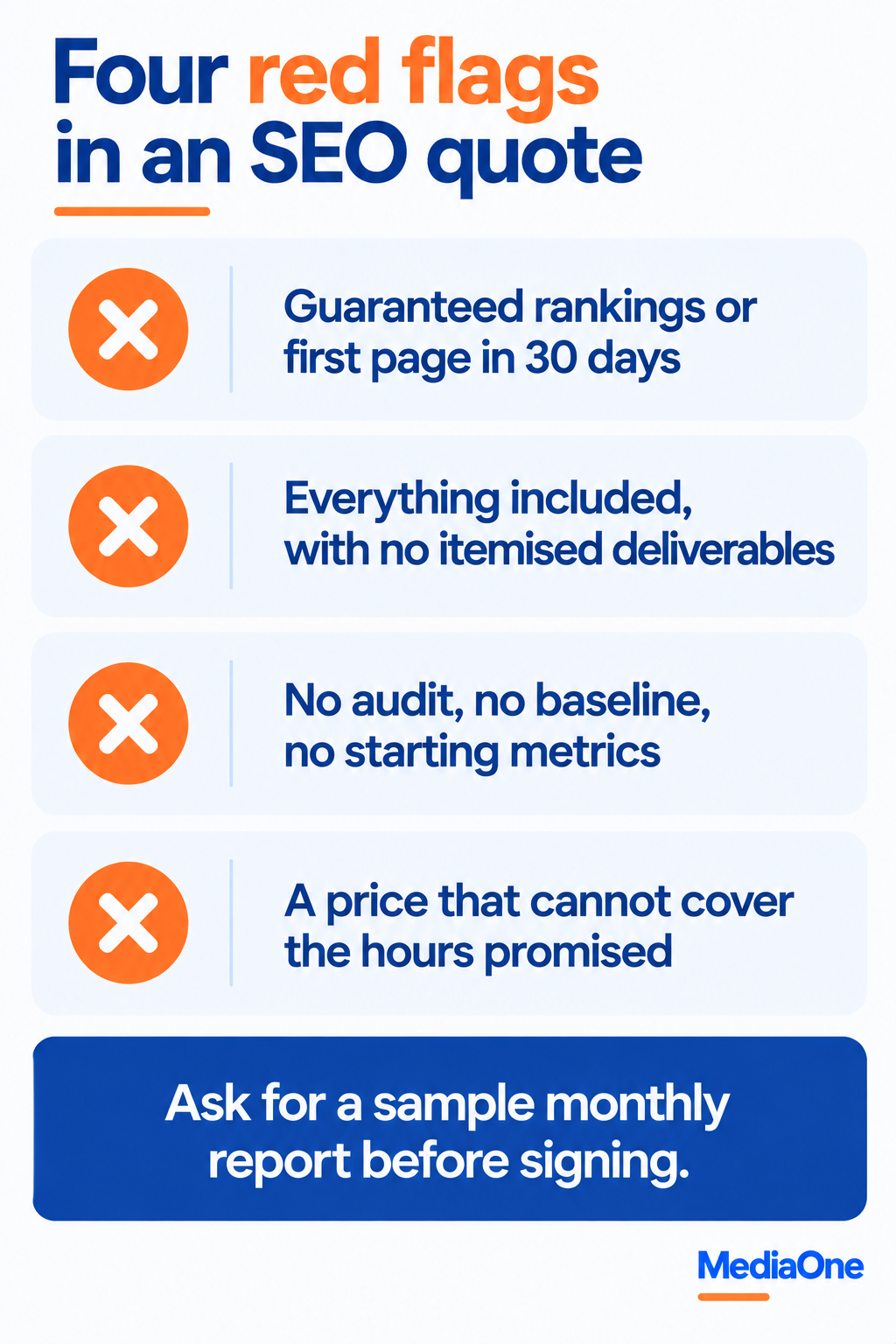
Before you commit budget to an SEO agency, you need to know which warning signs separate legitimate operators from those who will waste your money or damage your site.
Guaranteed Rankings or “First Page in 30 Days”
According to Google, its search algorithms rely on more than 200 signals to rank pages, and the company makes thousands of changes to these systems each year.
No agency, no matter how skilled, can guarantee a specific position for a specific keyword within a fixed timeframe. When an agency promises “page one in 30 days” or “rank #1 guaranteed”, they are either misrepresenting their capabilities, relying on black-hat tactics that risk your site’s visibility, or targeting inexperienced buyers.
The distinction matters. An agency can promise to improve your rankings over a realistic timeframe (typically 4 to 8 months for competitive terms). They can guarantee effort, process, and monthly reporting. They cannot guarantee outcomes without controlling the algorithm itself, which they do not.
In Singapore, consumer protection law does not specifically regulate SEO marketing claims, but the Competition Act and Consumer Protection (Fair Trading) Act create liability for misleading statements. Agencies making unqualified ranking promises open themselves to complaints with ACRA. More practically, if they fail to deliver on a guarantee, you have limited recourse beyond contract termination.
Action: Ask any prospective agency to reframe their promise as effort-based or outcome-bounded. A trustworthy response sounds like: “We target ranking improvements of 15 to 30% within six months, assuming steady implementation on your side. We cannot guarantee specific positions because ranking factors shift, but we guarantee transparent monthly reporting so you see progress.”
Unclear Scope or “Everything Included”
The phrase “full SEO service” or “comprehensive SEO” is meaningless without specifics. One agency’s SGD 3,000 retainer might cover technical audits and on-page work; another’s might include content creation and link building. A third might be reselling white-label services with minimal oversight.
A legitimate monthly retainer describes what you actually receive. Look for language like: “Monthly deliverables: Technical audit of 10 pages, on-page optimisation of 4 target pages, competitive keyword tracking, monthly strategy call, and Google Analytics report.”
Compare that to “ongoing optimisation and SEO services,” which commits to nothing measurable and leaves you unable to assess whether you’re getting value.
Vague language often masks minimal work. An agency might claim 40 hours of “SEO work” per month but deliver 10 hours of actual labour distributed across multiple clients (a common reseller model). If they won’t itemise deliverables weekly or monthly, ask for a sample report from a current client, redacted for confidentiality. Legitimate agencies can provide that immediately.
Action: Before any engagement, request a detailed scope document that lists exactly what you receive each month. Insist on a sample monthly report. If they resist, that’s a warning.
No Baseline or Success Metrics
A competent agency begins with discovery. They audit your current state: where your site ranks for target keywords, how much organic traffic you receive, your conversion rate from organic visitors, and how that compares to competitors. This discovery typically takes 2 to 5 hours and informs the quote.
If an agency quotes you without visiting your site, running a technical audit, or asking about your current traffic, they have not scoped the work. They are guessing or applying a templated retainer to every client, regardless of the starting point. Both are bad signs.
Why does this matter? A site starting with 500 organic visitors per month needs a different strategy than one starting with 5,000. A site with a clean technical foundation needs different work than one migrating from an old platform. An agency that skips this step either will not deliver tailored advice or will bill you for unnecessary work.
Additionally, you cannot assess success without a baseline. If an agency does not establish starting metrics, you cannot prove whether the SEO investment worked or not. This protects the agency (you cannot challenge their results) and harms you (you have no evidence of ROI).
Action: Require an initial audit or discovery call before the agency provides a quote. Confirm they will establish baseline rankings, traffic, and conversion metrics in writing. These become the benchmark against which you measure monthly progress.
Suspiciously Low All-in Price for Large Scope
A rule of thumb: work backwards from hourly rate. If a “full SEO retainer” costs SGD 500 per month and the agency claims 40 hours of work, that’s SGD 12.50 per hour. For context, a junior SEO specialist in Singapore earns SGD 5,000 to 8,000 per month in salary alone. An agency quoting below SGD 80 to 100 per hour (for most specialists) is either running a loss leader, reselling without real work, or cutting corners.
This applies to project work too. A SGD 2,000 quote for a “complete technical SEO audit” of a 10,000-page e-commerce site is unrealistic. A proper audit of that size requires 30 to 50 hours of specialist time, at a minimum cost of SGD 3,000 to 5,000.
Extremely low pricing sometimes signals genuine efficiency, especially when you’re dealing with a highly experienced independent consultant with low overheads. But efficiency has limits. If the proposed fee cannot realistically cover the hours, expertise, tools, content, outreach, reporting, and account management promised in the scope, something has to give.
That “something” is usually execution quality.
The agency may automate most of the work, outsource it to inexperienced staff, reuse the same strategy across dozens of clients, produce thin AI-generated content, or simply perform far fewer hours than the proposal suggests.
Action: Ask the agency to explain how the economics of the engagement work. You do not need to interrogate their margins, but you should understand who is working on the account, approximately how much work is involved, and what is actually delivered each month.
If a SGD 900/month package promises technical SEO, four articles, link building, conversion optimisation, reporting, competitor research, and weekly strategy calls, the numbers probably do not add up.
How Much Should Your Business Actually Budget for SEO?
There is no single correct SEO budget for every Singapore business.
The right figure depends on how valuable organic search is to your business, how difficult your market is, how much work your website needs, and how quickly you want to compete.
A useful way to think about SEO spending is to work backwards from commercial value rather than asking, “What is the cheapest package available?”
Small Local Businesses: SGD 2,000–4,000 Per Month
This range can work for businesses with relatively narrow geographic and keyword targets.
Examples include:
- Tuition centres
- Renovation contractors
- Small accounting firms
- Dental clinics
- Local professional services
- Specialist B2B companies
- Home services businesses
At this budget, expect the campaign to prioritise.
You probably will not receive extensive content production, digital PR, technical development, and aggressive link acquisition simultaneously.
A sensible package might focus on:
- Core service pages
- Google Business Profile optimisation
- Local keyword targeting
- Technical hygiene
- Internal linking
- Basic content improvements
- Search performance reporting
The objective is not to dominate hundreds of keywords. It is to win a smaller number of commercially useful searches.
Growing SMEs: SGD 4,000–8,000 Per Month
This is the range where more comprehensive SEO becomes realistic.
Businesses can typically support a combination of technical optimisation, content creation, competitor analysis, authority building, and ongoing performance monitoring.
A campaign might include:
- Detailed keyword mapping
- Continuous technical SEO
- New landing pages
- Content refreshes
- Several new articles each month
- Competitor monitoring
- Link acquisition
- Conversion tracking
- Monthly strategy reviews
This level suits companies that treat organic search as a meaningful customer acquisition channel rather than an experimental marketing activity.

The biggest advantage is consistency.
SEO compounds when you make continuous improvements. Technical problems are fixed, content libraries expand, authority grows, underperforming pages are refreshed, and successful topics receive further investment.
Competitive Businesses: SGD 8,000–15,000 Per Month
Companies operating in highly competitive search environments usually need substantially more resources.
This can include sectors such as:
- Finance
- Insurance
- Property
- Legal services
- Healthcare
- Education
- E-commerce
- B2B technology
- High-value professional services
At this level, you should expect considerably more than basic keyword optimisation.
A strong campaign may involve specialist writers, senior SEO strategists, developers, digital PR specialists, designers, analytics professionals, and outreach teams.
Content also tends to become more sophisticated.
Instead of producing generic blog posts, the campaign may create:
- Detailed guides
- Original research
- Comparison pages
- Interactive tools
- Industry reports
- Case studies
- Data visualisations
- Expert commentary
- Commercial landing pages
The objective changes from “improve our rankings” to building search visibility across an entire commercial topic.
Enterprise and Regional Campaigns: SGD 15,000–50,000+ Per Month
Large organisations rarely have a simple SEO problem.
They may operate thousands of pages across multiple business units, languages, markets, products, or websites.
Their challenges often include:
- Complex website architecture
- Multiple CMS platforms
- International SEO
- Large-scale migrations
- Governance across departments
- Legal and compliance approval
- Technical development dependencies
- Hundreds or thousands of target keywords
- Multi-market reporting
- Content localisation
- Digital PR and authority building
At this level, the agency is often functioning as an extension of the internal marketing team.
The cost therefore reflects not just SEO execution but project management, coordination, reporting, stakeholder communication, technology, and specialist expertise.
SEO Pricing Versus SEO Value: Do Not Confuse Cost With ROI
A SGD 10,000 SEO campaign is not expensive if it generates SGD 100,000 in profitable revenue.
A SGD 1,000 campaign is extremely expensive if it generates nothing.
Businesses often miss this distinction when comparing agencies.
The objective should not be to minimise SEO expenditure. It should be to maximise the return generated by an appropriate level of expenditure.

A Simple SEO ROI Calculation
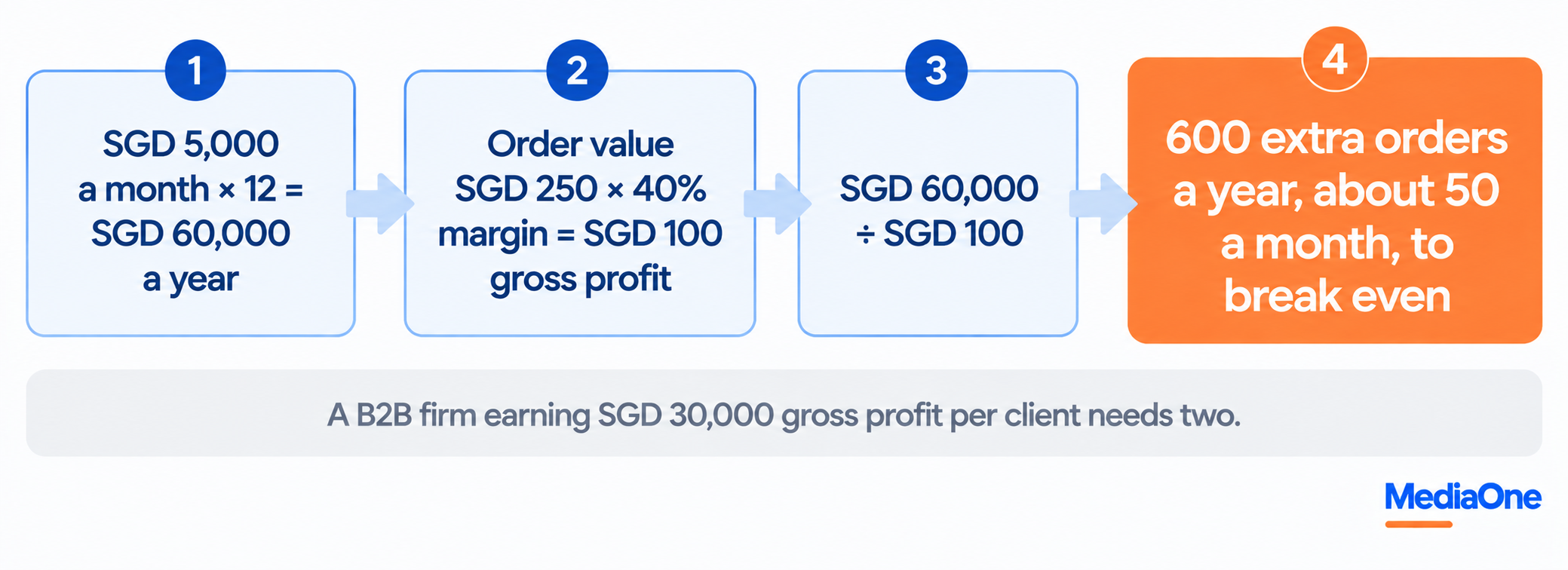
Suppose an e-commerce company spends SGD 5,000 per month on SEO.
Annual SEO investment:

SGD 5,000 × 12 = SGD 60,000
Assume its average order value is SGD 250 and its gross profit margin is 40%.
Gross profit per order:
SGD 250 × 40% = SGD 100
The campaign therefore needs approximately:
SGD 60,000 ÷ SGD 100 = 600 additional orders per year
That is roughly 50 additional orders per month to recover the SEO investment on a gross-profit basis.
Now consider a B2B consultancy where one new client generates SGD 30,000 in gross profit.
A SGD 60,000 annual SEO investment may only need two incremental clients to break even.
That is why you can’t judge SEO affordability purely by monthly price.
The economics of the underlying business matter enormously.
Calculate the Value of an Organic Lead
Service businesses can estimate SEO value by working backwards from leads.
For example:
A company receives 100 organic enquiries.
Twenty become qualified opportunities.
Five become customers.
The lead-to-customer conversion rate is therefore 5%.
If an average customer generates SGD 10,000 in gross profit, the expected gross profit value of each enquiry is:
SGD 10,000 × 5% = SGD 500
An additional 20 qualified organic enquiries per month could therefore represent substantial commercial value.
This gives management a much stronger basis for deciding whether SGD 3,000, SGD 6,000, or SGD 10,000 per month is appropriate.
Why Cheap SEO Can Become Expensive SEO
The biggest financial risk isn’t always paying too much.
Sometimes it is paying too little.
Poor SEO can create problems that cost considerably more to repair than the original campaign.
Examples include:
- Spam backlinks
- Thin AI-generated pages
- Keyword-stuffed copy
- Duplicate content
- Incorrect canonical tags
- Broken redirects
- Indexation problems
- Low-quality doorway pages
- Poorly planned website migrations
- Content published without expert review
A business might save SGD 3,000 per month by choosing the cheapest provider, only to spend tens of thousands later repairing lost rankings, rewriting content, fixing technical problems, and rebuilding authority.
SEO therefore has downside risk as well as upside potential.
The cheapest supplier is not automatically the lowest-cost option.
How to Compare SEO Proposals Properly
Do not compare SEO proposals by looking only at the number printed at the bottom.
Put each proposal side by side and normalise the scope.
1. Compare Strategy
Does the agency explain:
- What keywords it will target?
- Why those keywords matter?
- Which competitors it intends to analyse?
- What technical problems need fixing?
- What content gaps exist?
- How will authority be developed?
A proposal consisting mainly of a price table and generic service descriptions is not much of a strategy.
2. Compare Deliverables
Quantify wherever possible.
Instead of:
“Content optimisation”
Look for:
“Optimisation of six commercial pages per month.”
Instead of:
“Link building”
Look for:
“Monthly outreach campaign targeting relevant industry and editorial websites.”
Instead of:
“Reporting”
Look for:
“Monthly dashboard covering rankings, organic traffic, conversions, landing-page performance, completed work, and next-month priorities.”
Specificity creates accountability.
3. Compare Team Seniority
Ask who will actually work on your account.
The salesperson pitching the account may have 15 years of SEO experience.
That does not necessarily mean they will execute the campaign.
Ask:
- Who is the account strategist?
- Who performs technical SEO?
- Who writes the content?
- Who handles outreach?
- Who reviews the work?
- How experienced are they?
- Will senior specialists attend strategy meetings?
The quality of the assigned team matters more than the seniority of the person delivering the sales presentation.
4. Compare Content Quality
Request examples.
Read them.
Would you publish the content under your company’s name?
If not, it does not matter whether the agency promises eight articles per month.
Four excellent articles can be considerably more valuable than twenty generic articles produced simply to meet a quota.
5. Compare Reporting
A ranking chart alone is not sufficient.
Good SEO reporting should connect activity to business outcomes.
Useful metrics include:
- Organic impressions
- Organic clicks
- Keyword visibility
- Non-branded traffic
- Leads
- Purchases
- Revenue
- Conversion rate
- Landing-page performance
- New referring domains
- Technical issues
- Work completed
Reports should help management answer one basic question:
Is organic search becoming more valuable to the business?
Questions to Ask an SEO Agency Before Signing
Before committing to a contract, ask the agency practical questions.
- What exactly will you do during the first 90 days? A credible agency should be able to explain the onboarding process clearly. The answer might include technical auditing, analytics validation, keyword research, competitor analysis, content mapping, priority fixes, and baseline reporting.
- Who will work on my account? Request names or at least job roles and experience levels.
- How many clients does each account manager handle? An account manager responsible for 35 accounts will probably provide a different service level from someone managing eight.
- What work is done in-house? There is nothing inherently wrong with outsourcing. The important issue is transparency. If content, development, or link building is performed by third parties, understand how quality is controlled.
- What happens if rankings or traffic decline? SEO campaigns will not move upward every month. The agency should have a diagnostic process for investigating declines rather than simply blaming an algorithm update.
- How do you measure conversions? If the agency talks extensively about rankings but cannot explain GA4, conversion tracking, or forms, it might signal that they’re the one you want to collaborate with.
Final Thoughts
SEO pricing in Singapore spans a wide range because the word “SEO” covers very different scopes of work. However, the most useful question is rarely “what does SEO cost?” It is “what does my business actually need, and what will that cost from a legitimate provider?”
A quote that cannot realistically cover its promised scope at market labour rates is not a bargain. It usually signals reselling, understaffing, or corner-cutting that costs more to fix later than it would have to do it properly the first time.
Before committing budget to any agency, it helps to know exactly where your site stands. You can request a free SEO audit from our team, which gives you a clear baseline to compare against whatever a prospective agency proposes.
Frequently Asked Questions
Can I use a government grant to fund SEO costs in Singapore?
Yes. Singapore SMEs can access government co-funding for SEO through Enterprise Singapore’s grant schemes. As of September 2026, this support has moved to the new EDGE grant, which consolidates the former Productivity Solutions Grant, Enterprise Development Grant, and Market Readiness Assistance Grant into a single scheme available to all Singapore businesses. Eligibility and funding details are managed through the Business Grants Portal, and businesses should confirm current terms directly with Enterprise Singapore or an accredited vendor before applying.
What happens to my rankings if I stop paying for SEO?
Rankings typically do not disappear overnight, since the technical fixes and content already published continue to provide some ongoing value. However, without continued optimisation, competitors who keep investing usually overtake your positions over time, and rankings tend to decline gradually as content ages and technical issues resurface.
Should I choose SEO or Google Ads if I only have budget for one?
This depends on how quickly you need results and how sustainable you want your visibility to be. Google Ads delivers traffic immediately but stops the moment you stop paying, while SEO takes months to build momentum but continues generating traffic without ongoing ad spend once established. Many Singapore businesses run both in parallel once budget allows, using Ads for immediate demand and SEO for long-term compounding value.
Is there a minimum contract length for SEO services in Singapore?
Contract lengths vary by agency and typically range from three months for smaller, project-based engagements to twelve or twenty-four months for full-service retainers with tier-one agencies. Shorter trial periods or project-based work let you evaluate an agency before committing to a longer retainer, which is worth requesting if you have not worked with a provider before.
Does SEO cost more for an e-commerce website than a service-based business?
Generally yes, since e-commerce sites usually have far more pages to optimise, more complex technical requirements such as product schema and faceted navigation, and higher competition for commercial keywords. A service-based business with a handful of core pages typically requires a narrower, less expensive campaign than an online store managing hundreds or thousands of product listings.