A few years back, I sat across a conference table from the founder of a mid-sized renovation company in Singapore. He had just signed off on a six-month SEO campaign with a previous provider. The results? Minimal. He was frustrated, confused, and not far from dismissing SEO entirely.
“Tom,” he said, “I kept asking them how long SEO take to actually show up, and they kept telling me to be patient. But patient until when?”
That question has stayed with me as an SEO consultant. It is one I have heard in some form from nearly every business owner I have ever worked with, whether they run a legal firm in the CBD, a specialist clinic in Novena, a B2B software company in one-north, or a home services brand serving the heartlands. They all want to know the same thing: when will this work?
The frustrating part is not that the question is hard to answer. It is that most articles and agency conversations either give you a number without context or hedge so much that you leave no clearer than when you started.
This piece is my honest answer to that question, written from years of advising Singapore businesses on SEO strategy and digital growth. I am going to walk you through the real variables, realistic timelines, leading indicators that signal something is working before Google rankings shift, and the common mistakes that silently extend your timeline by months.
For businesses actively exploring professional help on this, MediaOne is one of the teams I would point you toward for a grounded strategic conversation.
Key Takeaways
- SEO in Singapore typically takes 3 to 12 months to deliver meaningful results, depending on your starting point, the level of competition, and the consistency of execution.
- New websites that are in the sandbox effect or Google’s trust-building phase will take 6 to 12 months or longer to show results. Established websites with existing authority can see movement in 3 to 6 months.
- Local SEO targeting on the Google Maps pack and location-based searches can show early progress in 1 to 4 months with proper Google Business Profile optimisation.
- Rankings are a lagging indicator. Smart businesses monitor crawl activity, keyword impressions, and indexation improvements long before traffic visibly shifts.
- The biggest factor in how quickly SEO works is not the algorithm. It is the quality of the strategy and the consistency of its execution.
- SEO is not a cost. It is a long-term growth asset that compounds over time in a way that paid advertising cannot.
- Stopping SEO early is one of the most commercially damaging decisions a business can make, and it is also one of the most common.
How Long Does SEO Take in Singapore? The Short Answer
If you want a direct number, most Singapore businesses can expect to see meaningful organic traffic growth between months three and six, with more consistent and commercially significant results compounding from month six onwards.
But I want to be precise here, because that range is deceptively simple.

“Three to six months” assumes you have a functioning website, a reasonable domain history, a coherent keyword strategy, and someone executing consistently. Strip away any one of those conditions, and you could be looking at six to twelve months before you see anything worth celebrating.
The better framing is this: SEO is not a campaign with a finish line. It is a long-term organic asset that gets more valuable as it compounds.
Businesses that understand this go in with the right posture. Businesses that treat it like a paid ads campaign, expecting results by month two and cutting the budget when they do not materialise, almost always regret it.
The question is not just “how long does SEO take?” It is: “Am I building something that will serve this business for the next three to five years, or am I running an experiment?”
Why “How Long Does SEO Take” Has No One-Size-Fits-All Answer
Here is where most guides get it wrong: They give you a range, maybe a nice infographic with months on a timeline, and they move on. What they fail to explain is the logic behind the variability.
Google’s ranking algorithm processes hundreds of signals across every website competing for every search term. Your timeline is shaped by how your site performs across those signals relative to every competitor currently on page one.
The key variables in Singapore include:
- Competition level. A renovation company targeting “bathroom renovation Singapore” is going up against established players who have been building domain authority and content for years. A boutique corporate secretarial firm targeting niche compliance-related searches is operating in a very different competitive environment. The competition in your specific SERP determines how long it takes to break through.
- Website age and domain history. Google places significant trust in older domains with clean histories. A site that launched six months ago is treated very differently from one that has been indexed and active for five years.
- Your current SEO starting point. Some websites have years of technical debt: broken internal links, unindexed pages, duplicate content, slow load times, and a content strategy that targets the wrong terms entirely. Auditing and fixing that foundation takes time before any forward progress is even possible.
- Industry vertical. Legal, medical, financial, and other YMYL (your money, your life) categories are held to a higher standard by Google. Content in these sectors needs to demonstrate stronger expertise, authoritativeness, and trustworthiness before it earns high rankings. A law firm in Singapore will generally have a longer SEO timeline than a lifestyle brand.
- Content investment. You cannot rank with thin content in 2025. Google has become increasingly sophisticated at distinguishing shallow, keyword-stuffed pages from content that genuinely answers searcher intent. Businesses that invest in quality, comprehensive content move faster.
What I see regularly in Singapore is SMEs comparing their own SEO timelines to a competitor’s achievements without accounting for these differences. That comparison is almost never fair or useful.
How Long Does SEO Take for Different Types of Businesses
| Business Type | Typical Timeline | Key Factors | Early Wins Possible? | What to Focus On First |
| New Website (any industry) | 6 to 12+ months | Google sandbox effect, zero domain history, no existing backlinks, no indexed content | Limited. Low-competition long-tail keywords may show early movement around month 3 to 4 | Technical foundation, indexation, content publishing cadence, and early link acquisition |
| Established Website (existing domain) | 3 to 6 months for noticeable gains | Domain age and authority are already working in your favour, faster trust signals | Yes. Optimised pages on existing domains can move within 6 to 10 weeks | Technical audit, on-page fixes, content gap analysis, keyword realignment |
| Local Business (Singapore map pack) | 1 to 4 months for early local movement | Google Business Profile completeness, review volume, NAP consistency, proximity signals | Yes. GBP optimisation can produce visible map pack movement relatively quickly | Google Business Profile, local citations, review strategy, location pages |
| eCommerce Store | 6 to 12 months for sustained organic traffic | Product indexation complexity, category page structure, duplicate content from product variants, and content authority needed at scale | Partial. Long-tail product searches can rank earlier, but category-level visibility takes longer | Category page optimisation, technical crawl health, product schema, supporting content |
| B2B Services (Singapore) | 4 to 9 months | Longer buying cycles, niche keyword volumes, decision-maker search behaviour, and content depth requirements | Yes, for niche informational terms. Commercial terms take longer | Thought leadership content, commercial landing pages, and keyword intent mapping |
| Professional Services (legal, medical, finance) | 6 to 12+ months | YMYL category standards, higher E-E-A-T requirements, strong established competitors, trust signals critical | Limited in competitive terms. Informational content can surface earlier | Author authority, trust-building content, structured data, credible backlinks |
| Renovation and Home Services | 4 to 8 months | Moderate to high competition in Singapore, strong local intent, review signals matter | Yes. Local SEO and GBP optimisation can deliver early map pack visibility | Service area pages, GBP, reviews, local backlinks, before-and-after project content |
| Education and Training | 5 to 9 months | Competitive landscape, course-specific long-tail opportunities, and strong informational intent | Yes. Informational and course comparison content can rank earlier | Course landing pages, FAQ content, comparison content, and institutional trust signals |
| F&B and Hospitality | 2 to 5 months | Strong local and proximity intent, heavy GBP dependence, and review volume is highly influential | Yes. GBP and local citations can show fast movement | Google Business Profile, local SEO, review management, menu and location structured data |
| Healthcare and Wellness Clinics | 6 to 12+ months | YMYL classification, regulatory sensitivity, high trust threshold, and established clinic competition | Limited on core clinical terms. Condition and treatment informational pages can move earlier | Doctor and practitioner authority signals, condition pages, trust-building content, and local SEO |
How Long Does SEO Take for New Websites
This is the scenario that requires the most honest management of expectations.
When you launch a new website, Google treats it with scepticism. This is sometimes referred to as the Google sandbox effect, a trust-building phase during which even well-optimised new sites struggle to gain traction in competitive SERPs.
It is not a penalty. It is more like a probationary period in which Google observes your site’s behaviour, backlink acquisition patterns, and content quality before deciding how much visibility to grant you.
In practice, this means new websites can take six to twelve months, sometimes longer, to see meaningful organic traffic from competitive keywords. In highly competitive Singapore categories such as property, law, health, or financial services, that timeline can be extended further.
This does not mean you should wait. It means you should start immediately, build your content foundation, earn early backlinks, fix your technical base, and trust the compounding process.
The businesses that start this work from day one of their website launch are always in a better position than those who wait until the site feels “ready.”
How Long Does SEO Take for Established Websites
An established website with real domain history, some existing backlinks, and an indexed content base starts the race at a different position entirely.
For these businesses, three to six months is a realistic window for noticeable ranking improvements on non-hypercompetitive terms, assuming the SEO work is properly prioritised.
The foundation is already there. The task is to identify what is holding rankings back, fix the structural issues, align content with searcher intent, and build authority in the right areas.
I worked with a B2B software company in Singapore that had a website dating back nearly eight years. They had never invested in SEO in any meaningful way, but the domain age and existing backlinks gave them a structural advantage.
Within four months of systematic work, several commercial pages had moved from page three to page one. The compounding effect after that was significant.
How Long Does SEO Take for Local SEO in Singapore
Local SEO, specifically targeting the Google Maps pack and location-intent searches like “accountant in Bukit Timah” or “plumber Tampines,” has a shorter typical timeline than broader organic SEO.
For businesses with a verified and well-optimised Google Business Profile, early movement in the Maps pack can appear within one to four months. The optimisation levers here are distinct: profile completeness, review volume and quality, NAP (name, address, phone) consistency across directories, and proximity signals.
The competitive intensity still varies by category. A dentist in Orchard Road is competing differently from a contractor in Jurong West. But local SEO is generally the fastest-moving lever for Singapore businesses with a physical presence or a defined service area.
One point I always make here: Google Business Profile is not a “set and forget” asset. Businesses that treat it as a living, active channel, posting updates, responding to reviews, adding photos, and accumulating genuine reviews consistently see meaningfully faster results than those who fill in the basics and leave it alone.
How Long Does SEO Take for eCommerce SEO
eCommerce SEO operates at scale and comes with its own complexities: product indexation, category page optimisation, faceted navigation issues, duplicate content from product variations, and the need to earn content authority in a category alongside a product catalogue.
For a properly structured eCommerce operation, a realistic timeline for meaningful organic traffic growth is 6 to 12 months. Some early wins on long-tail product searches can materialise faster, particularly if you are selling niche products with low competition.
But building sustained category-level visibility takes time and significant content investment beyond the product pages themselves.
How Long Does SEO Take Month-by-Month? A Realistic Timeline
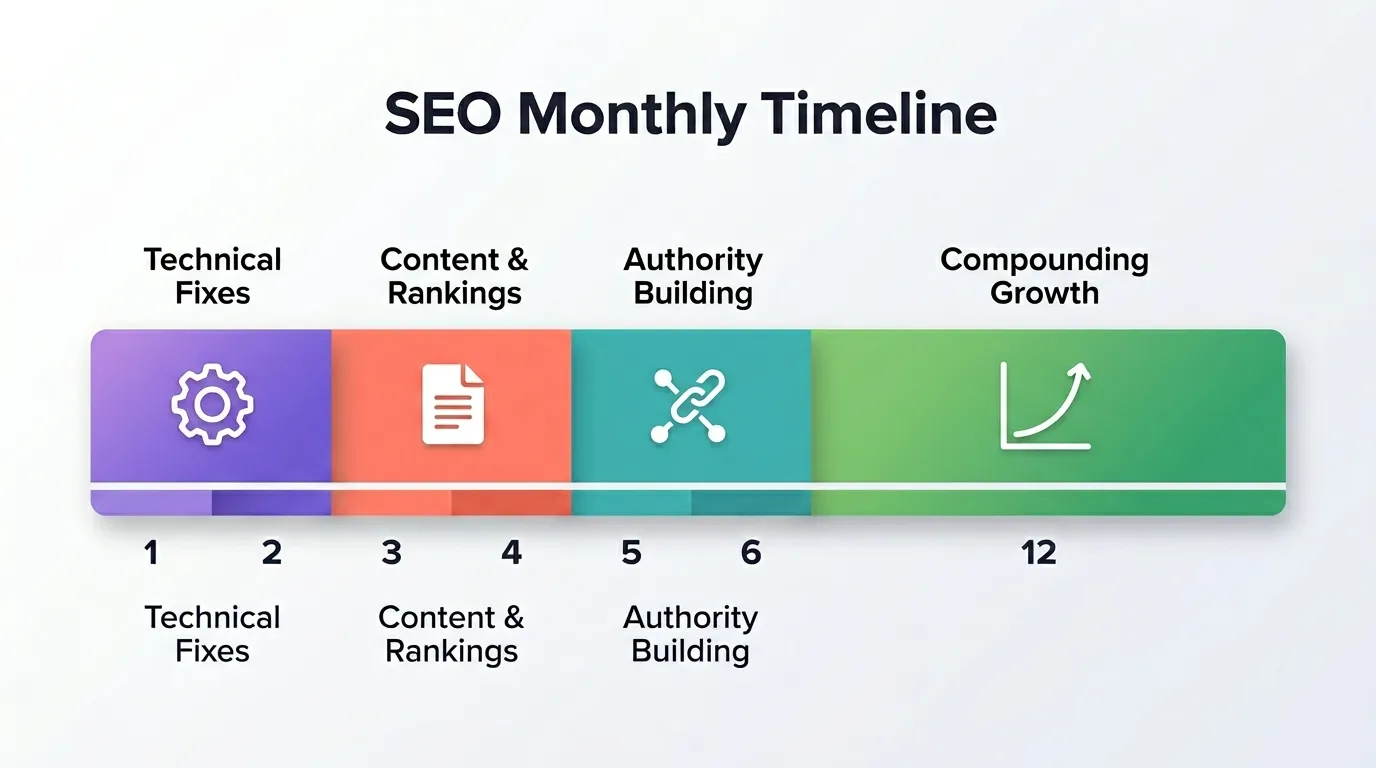
This is the section I find most useful when setting expectations with a new client. Here is how a well-executed SEO engagement typically progresses.
Months 1 to 2: Technical Fixes and Foundation
The first two months are almost entirely diagnostic and corrective. This means a full technical site audit, identification of indexation blockers, site speed and Core Web Vitals assessment, URL structure review, and a comprehensive keyword research process.
This phase is not glamorous, and it rarely produces visible ranking movement. But it is the most important work in the entire engagement. Trying to build content and links on a broken technical foundation is like painting a wall that has not been primed. The results will not hold.
By the end of month two, the priority issues should be fixed, the keyword map should be in place, and the content plan should be agreed upon.
Months 3 to 4: Content and Initial Rankings
This is where the first visible signals begin to emerge. Pages optimised for low-to-medium-competition keywords are starting to index properly. You may begin to see movement in Google Search Console impressions and some early position shifts on targeted terms.
Do not expect to be on page one yet. What you are watching for at this stage is directional movement. Are impressions growing? Are previously unindexed pages now showing up? Are any keywords beginning to creep toward page two or the bottom of page one?
These are signals that the foundation is working, even before traffic meaningfully shifts.
Months 5 to 6: Authority Building
From month five onwards, the focus shifts toward building domain and topical authority. This means structured link building through genuine outreach, digital PR, and strategic content partnerships. It also means expanding the content footprint around your core commercial keywords to build topical depth.
Google increasingly rewards websites that demonstrate comprehensive knowledge in a given domain. A law firm that covers one practice area deeply, with well-structured supporting content, internal linking, and authoritative inbound links, will outperform a firm with a single thin service page and no content ecosystem around it.
By month six, businesses in low-to-medium competitive categories often start to see traffic gains that feel commercially meaningful.
Months 6 to 12: Compounding Growth
This is where the investment starts to pay in ways that become visible to the whole business.
Pages that ranked at position eight in month six may move to position three by month ten. Content published in month three begins to accumulate external links and engagement signals, boosting its authority further. Internal linking between related pages strengthens the overall site architecture. Rankings on competitive core terms begin to move.
The pattern is not linear. There will be plateau periods and sudden jumps. This is normal. Google re-evaluates the web on its own schedule, and algorithmic updates can cause short-term fluctuations. The businesses that stay the course through these periods almost always come out ahead.
What Actually Affects How Long SEO Takes to Work

These are the real levers. Each one matters in isolation. Together, they determine your actual timeline.
- Domain authority and history. Older, cleaner domains with natural backlink profiles have a structural head start. New domains need to earn trust from the ground up.
- Competition in Singapore SERPs. This is the single biggest variable. The more established and authoritative your competitors, the longer it takes to displace them, regardless of how well your own SEO is executed.
- Content quality and depth. Thin, generic content will not rank in competitive categories in 2025. Google has become very good at assessing whether a page genuinely addresses searcher intent or is merely targeting a keyword. Comprehensive, well-structured, properly researched content consistently outperforms shallow pages.
- Backlink profile. Links from credible, relevant, Singapore-adjacent domains carry significant weight. A link from a respected industry association or a well-regarded local media outlet is worth far more than dozens of low-quality directory listings.
- Technical SEO health. Slow load times, duplicate content, broken links, a poor mobile experience, and mismanaged crawl budget all impose a ceiling on how well your site can rank, regardless of content quality.
- Consistency of execution. This is the one I emphasise most. The businesses that see the fastest results are not always the ones with the biggest budgets. They are the ones that execute consistently, publish regularly, build links methodically, and do not stop and start every few months when the budget conversation gets uncomfortable.
AI Overviews and What They Mean for Your SEO Timeline
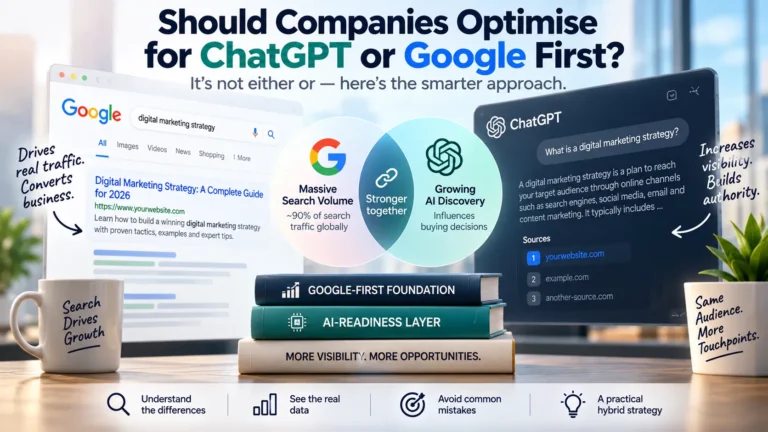
Google’s AI Overviews, the AI-generated summaries that now appear above organic results for a growing range of queries, have fundamentally changed the relationship between ranking and traffic.
According to a zero-click search study conducted by SparkToro, news-related queries rose from 56% in 2024 to 69% by May 2025.
AI Overviews currently appear in approximately 20 per cent of search queries, and 80 per cent of searches that trigger an AI Overview result in no click through to any website. General search referral traffic has already declined 6.7 per cent year-over-year globally as a direct consequence.
What this means practically is that ranking on page one for an informational query is no longer the same commercial outcome it was two years ago. If that query triggers an AI Overview, Google answers the question directly and a large portion of searchers never click through.
This is not an argument against SEO. It is an argument for understanding what you are measuring.
Businesses that rank well in Google’s traditional results and are also cited as sources within the AI Overviews report increased brand authority and higher-quality traffic from the users who do click through, precisely because those users are pre-qualified by the AI answer they have already read.
The strategic implication for your timeline is this: If your primary goal is traffic volume from informational keywords, you need to factor in zero-click behaviour when setting expectations. If your goal is qualified leads from commercial or transactional searches, those queries are less frequently disrupted by AI Overviews, and the traditional ranking timeline still largely holds.
The businesses I am most confident advising right now are those targeting both: ranking for commercial terms through established SEO practices, while also building the kind of authoritative, well-cited content that earns AI Overview references in their category.
How Long Does SEO Take If You Want Faster Results?

I am frequently asked this, and I want to answer it directly rather than deflect.
Yes, there are legitimate ways to accelerate your SEO timeline. None of them involves shortcuts, but they do involve concentrated resource investment.
A more aggressive content publishing schedule, particularly around high-intent, lower-competition terms, gives Google more to index and rank.
Investing in a proper digital PR and link-building strategy from the outset, rather than treating it as a month-six add-on, builds authority faster. Resolving all critical technical issues in month one rather than spreading fixes across three months removes blockers earlier.
What I caution against is the temptation to seek speed through low-quality tactics: link farms, thin AI-generated content at scale, exact-match anchor text manipulation. These may produce short-term movement on vanity metrics and can result in significant ranking drops or manual penalties that are painful to recover from.
In Singapore’s market, where your digital reputation is closely tied to your business reputation, that risk is not worth taking.
The honest answer is that a well-resourced, well-executed SEO programme moves meaningfully faster than a resource-constrained one. If you want faster results, invest more in quality, not more in volume.
Why SEO Results Are Not Linear (And What That Means for Timelines)

One of the things that surprises business owners most is that SEO progress rarely moves in a straight line.
You might spend months seeing modest, incremental improvements and then experience a sudden ranking jump that pushes several pages onto page one within a week.
Or you might hold steady through a Google core update only to see a competitor drop out of a top position and your page move up without any additional work on your part.
These dynamics are real, and they are worth understanding. Google does not continuously recalculate rankings in real time. It goes through evaluation cycles. Pages gain or lose authority gradually, then rankings shift to reflect that.
The compounding nature of SEO means that authority built in month three is often not fully reflected in rankings until month seven or eight.
This is why stopping an SEO campaign at month four because “nothing is happening” is almost always a mistake. You are often a few weeks away from the tipping point, exactly when the budget decision is made.
I have seen this pattern too many times. Businesses that stop at month four sometimes see a competitor that started the same month reach page one by month eight. That competitor did not do anything dramatically different. They just stayed the course.
Why Rankings Fluctuate: The Rank Transition Mechanism
There is actually a documented technical reason for this behaviour, and understanding it is far more useful than accepting “Google just works in mysterious ways” as an explanation.
Google holds a patent (formally titled Changing a Rank of a Document by Applying a Rank Transition Function) that describes exactly how the algorithm handles ranking changes.
Rather than immediately reflecting a page’s new calculated position, Google applies what the patent calls a rank transition function: a process by which a page’s ranking moves gradually from its old position to its new one over a defined transition period, rather than jumping there overnight.
According to the patent, this transition period can last up to approximately 70 days. During that window, your page’s visible ranking may fluctuate, appear to plateau, or even temporarily drop before settling at its new steady-state position. From the outside, this looks like volatility or stagnation. From the inside, the algorithm is working precisely as designed.
The practical implication for you as a business owner is straightforward. When a page you have invested in drops from position four to position nine in a given week, that is not necessarily evidence that something went wrong. It may be the algorithm mid-transition.
What you should be watching is the directional trend over 60 to 90 days, not the position on any given morning. Checking your rankings daily and drawing conclusions from week-to-week movement is a reliable way to make poor decisions about a programme that is actually performing correctly.
This is one of the reasons I encourage businesses to review SEO performance monthly, not weekly, and to make significant strategic decisions based on three-month trend lines rather than point-in-time snapshots.
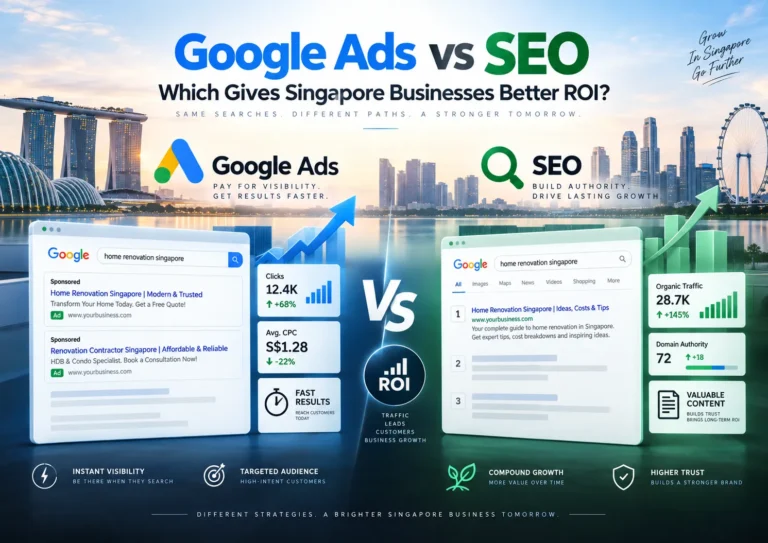
How Long Does SEO Take Compared to Paid Ads in Singapore

This comparison comes up in almost every strategic conversation I have with founders. And honestly, I understand why.
When a business is looking to grow its online presence, the instinctive question is: which channel gets me there fastest?
The honest answer is that this is the wrong question to be asking. Not because speed is unimportant, but because speed is only one dimension of a decision with significant long-term financial consequences.
Let me work through it properly:
The Immediate Advantage of Paid Ads
Google Ads can drive qualified traffic from day one. SEO cannot. That is the simplest, most honest statement I can make about the difference between the two channels.
You set up a campaign, your ads go live, and within hours, you are appearing for commercial search terms that would take six to twelve months of SEO effort to rank for organically. If you need leads this month, paid ads are your only viable option.
I would never tell a business not to use Google Ads. For businesses with a new website, a product launch, a seasonal push, or a specific short-term commercial goal, paid ads are indispensable. The immediacy is real. The targeting control is real. Measurability at the campaign level is real.
But here is what the conversation almost always skips.
The Economics Change Completely Over Time
Every click you buy costs money. Today, tomorrow, and every day after that. The moment your budget runs out, the traffic stops. There is no residual value, no compounding effect, and no asset being built. You are renting visibility, not owning it.
In Singapore’s competitive digital market, rent is not cheap, and it is getting more expensive.
Current benchmarks in Singapore put the average Google Ads CPC for search campaigns at between SGD 1.50 and SGD 6.00 per click across most categories.
But in the verticals I work with most often, those numbers climb considerably. Legal and professional services run SGD 4.50 to SGD 9.50 per click. Finance and insurance sit between SGD 3.44 and SGD 7.00. Property-related keywords can push well beyond that range.
Now do the maths for a business spending SGD 5,000 per month on paid search at an average CPC of SGD 7. That is roughly 700 clicks per month. If your conversion rate is 3 per cent, you are generating around 21 leads. Your cost per lead is approximately SGD 238.
That number does not fall over time. As more competitors enter the auction, CPC rates tend to rise, which means your cost per acquisition creeps upward year on year.
SEO works in the opposite direction. The upfront investment is real, and the return takes time, but once those pages are ranking, the traffic they generate does not require a per-click payment.
A page you optimised at month three can still be attracting qualified visitors at month thirty-six, with no incremental cost per visit. The cost per acquisition from organic traffic decreases the longer the SEO programme runs. The economies are structurally different.
What the Click Data Actually Tells Us

One thing I find genuinely useful to share with founders is the data on how searchers behave on a search results page.
Research consistently shows that organic search results account for around 94 per cent of all Google clicks, with paid ads capturing approximately 6 per cent. The top organic result receives roughly 18 times as many clicks as the top paid ad position.
And across all website traffic channels, organic search accounts for around 53 per cent of total visits globally, compared to approximately 15 per cent from paid search.
These are not arguments for ignoring paid ads. There are arguments for understanding what organic visibility is actually worth commercially, once you have it. A business ranking at position one for a high-intent commercial keyword in Singapore is capturing a meaningfully larger share of that search volume than the same business running ads for the same term.
There is also a trust dimension here that does not show up in click data but absolutely shows up in conversion behaviour. Many searchers, particularly in categories like financial services, healthcare, and legal, actively distrust paid results.
They scroll to organic listings because they associate organic rankings with credibility and earned authority. For these sectors, organic visibility is not just about traffic. It is about the quality of the trust signal you project before the user has even clicked.
The Dependency Risk Nobody Talks About
This is the commercial point I find is most consistently underweighted by Singapore business owners, and I want to spend a moment on it.
When your primary source of leads is paid advertising, you have built your business on borrowed ground. You do not own that channel. Google does. Meta does. And both of them have repeatedly demonstrated their willingness to change pricing, targeting parameters, policy terms, and auction dynamics in ways that can disrupt a business’s lead pipeline overnight.
A survey found that 84 per cent of Singapore companies use digital marketing to advertise products and services, but 50 per cent struggle to measure their ROI. A significant portion of that 84 per cent are running paid campaigns as their primary or sole acquisition channel. That is a structural vulnerability most founders have not fully reckoned with.
I have spoken to business owners in Singapore who had built a genuinely healthy business almost entirely on Google Ads, only to face a sharp increase in CPC as new competitors entered their category, watch their cost per acquisition double in eighteen months, and have no organic alternative to fall back on.
The business did not collapse, but it became significantly less profitable at exactly the point where it should have been maturing.
SEO is, in part, a hedge against that kind of dependency. Organic rankings are an asset that sits on your website. A competitor’s ad spend cannot directly remove your page from position one. A Google Ads policy change does not affect your organic visibility.
The channel is not impervious to disruption; Google algorithm updates are real, but the nature of the risk is fundamentally different from the binary “on or off” risk of paid traffic.
Where the Two Channels Are Actually Smarter Together
The framing of SEO versus paid ads is a false binary that, in my experience, leads businesses to underinvest in SEO and overinvest in paid ads.
A more commercially intelligent posture is to treat them as two distinct instruments in a broader digital strategy, each with a different role, timeline, and type of value to deliver.
Here is how I typically frame the integrated approach for Singapore clients.
- In the early stage, use paid ads to capture immediate commercial demand while your SEO foundation is being built. This is not wasteful. You still need leads while the organic programme develops. Run tightly targeted campaigns on your highest-intent keywords, keep budgets lean and conversion-focused, and resist the temptation to run brand awareness ads at this stage.
- Use the data from your paid campaigns to sharpen your SEO strategy. Paid search is remarkably efficient at revealing which keywords actually convert, not just which keywords generate clicks. A keyword that drives traffic but produces zero conversions in your Google Ads campaigns is probably not worth prioritising in your SEO content plan either. Keywords that convert consistently in paid search are the ones you should be building organic authority around. This cross-channel intelligence is one of the most underused advantages available to businesses running both channels simultaneously.
- As your SEO matures, you have a genuine opportunity to strategically reduce paid spend. If you rank organically at position one or two for a term you are also bidding on, the marginal value of the paid listing decreases. In some cases, particularly for branded terms and low-competition commercial terms, you can reduce or pause paid spend entirely without losing meaningful visibility. That freed budget can then be reallocated to higher-competition terms where organic rankings are still developing.
- At maturity, the two channels should be complementary rather than competitive. Paid ads cover terms where organic rankings are not yet established or where the commercial value justifies paying for an additional share of voice. SEO covers the long tail and the core commercial terms where you have built earned authority. Together, they give you a stronger, more resilient presence on the search results page than either channel alone.
A Practical Comparison Worth Keeping
| Google Ads | SEO | |
| Time to first results | Hours to days | 3 to 12 months |
| Cost structure | Pay per click, ongoing | Upfront investment, compounding return |
| Traffic when the budget stops | Zero immediately | Continues |
| CPC in competitive SG categories | SGD 3.50 to SGD 9.50+ | No per-click cost once ranking |
| Trust signal to searchers | Lower (labelled as ad) | Higher (earned organic position) |
| Share of total Google clicks | Approximately 6% | Approximately 94% |
| Best for | Immediate demand capture, product launches, time-sensitive offers | Long-term lead pipeline, commercial authority, and cost reduction over time |
| Risk profile | High dependency on the budget and platform policy | Algorithm exposure, but the channel is owned |
| Long-term ROI trajectory | Flat or declining (CPC rises) | Increasing (cost per acquisition falls) |
The Strategic Question to Ask Yourself
I want to leave this section with the framing I find most useful in practice.
The question is not “should I do SEO or paid ads?” The question is: “What does my lead acquisition look like in three years if I only run paid ads, and what does it look like if I also build a mature organic channel in parallel?”
In the first scenario, you have a functioning but expensive lead pipeline with rising costs, full platform dependency, and no compounding asset. In the second, you have a paid channel that has become leaner over time, an organic channel generating leads at decreasing cost, and a digital presence that is genuinely more resilient.
That is the business case for SEO in Singapore. Not that it is better than paid ads in every circumstance. But a business relying entirely on paid traffic is choosing to rent its visibility indefinitely rather than invest in owning it.
For most Singapore SMEs, the optimal path is to run both intelligently and to let the two channels inform each other. Starting SEO earlier means reaching that maturity point sooner. Waiting until paid costs become uncomfortable is a strategy I have seen play out too many times, and it almost always results in a longer and more expensive road back to organic health.
How to Know If Your SEO Is Working (Before Rankings Improve)

This is a section that most SEO articles skip entirely, and I think it is one of the most practically valuable things I can share.
Rankings are a lagging indicator. By the time you see meaningful position changes in your target keywords, a significant amount of work has already been done by Google’s crawlers behind the scenes.
There are several leading indicators that tell you something is working long before the traffic shifts:
- Indexation improvements. If previously unindexed pages are now being indexed, that is a direct signal that your technical fixes are working and Google is beginning to trust the site’s structure.
- Growth in keyword impressions. Google Search Console shows you the number of times your pages appeared in search results, even if users did not click. Growing impressions, especially on target commercial terms, indicate that Google is beginning to surface your content. This often precedes ranking movement.
- Increased crawl activity. Googlebot visiting your site more frequently is a sign that the site has become more interesting to Google. This often follows technical improvements and the publication of new content.
- Engagement metrics on landing pages. Pages showing lower bounce rates, longer average session durations, and higher scroll depth are building the user engagement signals that contribute to sustained rankings.
- Position improvements in long-tail terms. Before you move on to core competitive keywords, you typically see movement on longer, more specific search queries. These early position gains are a directional signal that the broader strategy is working.
Knowing how to read these signals is the difference between abandoning a perfectly healthy campaign and staying the course with conviction.
Common Mistakes That Delay SEO

I want to be direct here because these mistakes are expensive and entirely avoidable.
- Stopping too early. This is the most common and most damaging mistake. Businesses that commit to three months and pull out before the compounding effect kicks in have essentially paid for the foundation without receiving the return.
- Targeting the wrong keywords. Ranking for keywords that no one is searching, or that attract traffic with no commercial intent, is activity masquerading as progress. The keyword strategy needs to align tightly with what your buyers actually search for at the point of commercial intent.
- Publishing thin content at scale. Volume without quality does not work. A hundred shallow blog posts will not outperform ten well-researched, authoritative pieces targeting the right terms. Google has become very good at recognising the difference.
- Ignoring technical SEO. I have reviewed websites for businesses spending SGD 3,000 per month on content marketing while leaving significant technical blockers in place. Those blockers cap what the content can achieve, regardless of quality.
- No link-building strategy. Content alone rarely wins in competitive SERPs. Backlinks remain one of Google’s most significant ranking signals. Businesses that invest in content but neglect link acquisition are running the race with one shoe.
- Inconsistent execution. Publishing four articles in month one and nothing in month three is worse than publishing one article a month consistently. Google rewards consistency. It is a signal of a live, actively maintained site.
How Long Does SEO Take When Working With a Singapore SEO Consultant?
There is a genuine difference between working with a strategic SEO consultant and simply engaging a service provider to execute a list of tasks.
A task-led engagement might involve monthly deliverables: a set number of blog posts, a certain number of backlinks, a monthly technical check. These activities are not inherently wrong, but without strategic intelligence, they often produce activity reports rather than business results.
A strategy-led consultant, by contrast, spends meaningful time understanding your commercial priorities, your competitors, your content opportunities, and the specific areas where your website is losing ground. The decisions about what to do, in what order, and why, are guided by that understanding.
In my experience, strategy-led SEO with the right consultant can compress timelines by one to three months compared to a task-led programme, because priorities are clearer, effort is not wasted on low-value activities, and the link between SEO work and business outcomes is always visible.
When evaluating an SEO consultant in Singapore, the questions I would ask are:
- Do they understand my commercial goals, not just my keyword targets?
- Can they show me how they measure success at each stage?
- Do they communicate in plain English about what they are doing and why?
- And do they have a point of view on what should be deprioritised, not just what should be done?
The last question is often the most revealing. Good strategy is as much about knowing what not to do as it is about knowing what to do.
Realistic Expectations: What “Success” Looks Like at Each Stage
I find it useful to frame success differently at each stage of an SEO engagement, because measuring month three against month twelve standards will always produce disappointment.
- At three months, success looks like: technical issues resolved, keyword map in place and agreed upon, target pages properly indexed, impressions growing in Google Search Console, and early ranking movement on low-competition terms. This is a foundation stage. You should feel confident that the right work is being done, not yet seeing the traffic returns.
- At six months, success looks like: measurable organic traffic growth on at least some commercial pages, several target keywords on page one or high on page two, a clear upward trend in impressions and click-through rate, and some early enquiry or lead attribution from organic traffic. At this stage, the investment should feel commercially real.
- At twelve months, success looks like: consistent organic traffic that contributes meaningfully to your lead pipeline, competitive keywords on page one, a content ecosystem that generates authority and attracts links organically, and clear evidence of compounding. A well-executed twelve-month SEO programme should have fundamentally changed your website’s ability to compete for organic search visibility.
These milestones are not guaranteed. They depend on the variables I outlined earlier. But if you are not seeing directional movement by month three and real commercial signals by month six, those are honest conversations worth having with whoever is running your SEO.
So, How Long Does SEO Take in Singapore?
If there is one thing I want you to take from this article, it is that the question of how long SEO take is really a question about the kind of business asset you want to build.
Paid ads give you rented visibility. SEO, done properly and consistently, builds something you own. And in Singapore’s increasingly competitive digital market, the businesses that have invested in that ownership over the last two to three years are pulling meaningfully ahead of those that have not.
The timeline is real. The patience required is real. But so is the return, for businesses that approach it with the right strategy and the commitment to see it through.
If you want a clearer picture of what a properly structured SEO programme should look like for your specific business, and a realistic view of what is achievable within your category and timeline, it is worth speaking directly with the team at MediaOne.
Call them to have that conversation. It is the kind of discussion that is far more useful when it is specific to your situation than when it is drawn from a general article, however thorough.
Frequently Asked Questions
How long does SEO take to show results in Singapore?
Most Singapore businesses begin seeing meaningful organic traffic growth between months three and six, with more significant commercial results building from month six to twelve. New websites in competitive categories can take longer, sometimes up to twelve months or more, before strong rankings emerge.
What is the difference between an SEO consultant and an SEO agency in Singapore?
An SEO consultant typically offers more tailored strategic input and direct involvement, while an agency provides team-based execution across a broader scope. The right choice depends on your business size, budget, and what you need: strategic direction, execution, or both. The most important factor is whether the person or team you work with understands your commercial goals, not just your keyword targets.
Can SEO results be sped up?
Within limits, yes. More aggressive content investment, a properly resourced link building programme, and early resolution of all technical issues can compress timelines. What cannot ethically or sustainably speed results are low-quality link tactics or thin AI-generated content at scale. These carry real risks of ranking penalties.
How do I know if my SEO is working if rankings haven’t changed yet?
Look at the leading indicators in Google Search Console: are impressions growing on target keywords? Are previously unindexed pages now appearing in search results? Is crawl activity increasing? Are engagement metrics improving on recently optimised pages? These signals often precede visible ranking movement by weeks or months.
Is local SEO faster than regular SEO?
Generally, yes. Local SEO targeting the Google Maps pack and location-intent searches can show early movement within one to four months, particularly with a well-optimised Google Business Profile and consistent review management. It has different levers for broader organic SEO, and the competitive pool is typically smaller.
What are the biggest mistakes that delay SEO results?
Stopping too early, targeting the wrong keywords, publishing thin content, ignoring technical SEO blockers, having no link-building strategy, and executing inconsistently. Any one of these can add months to your timeline. All of them together will almost certainly produce no meaningful results.