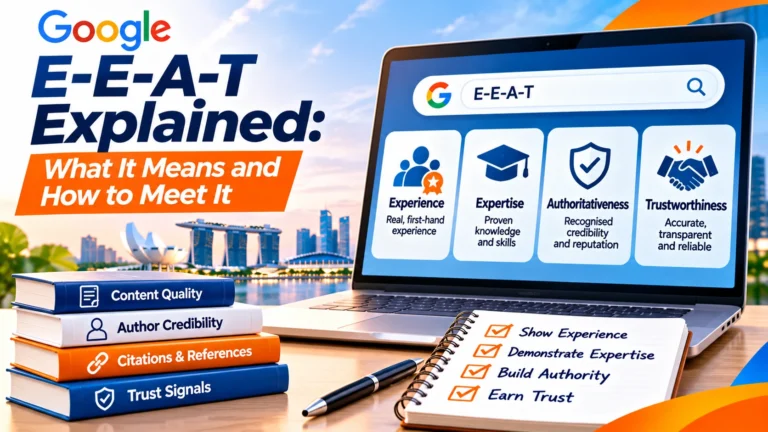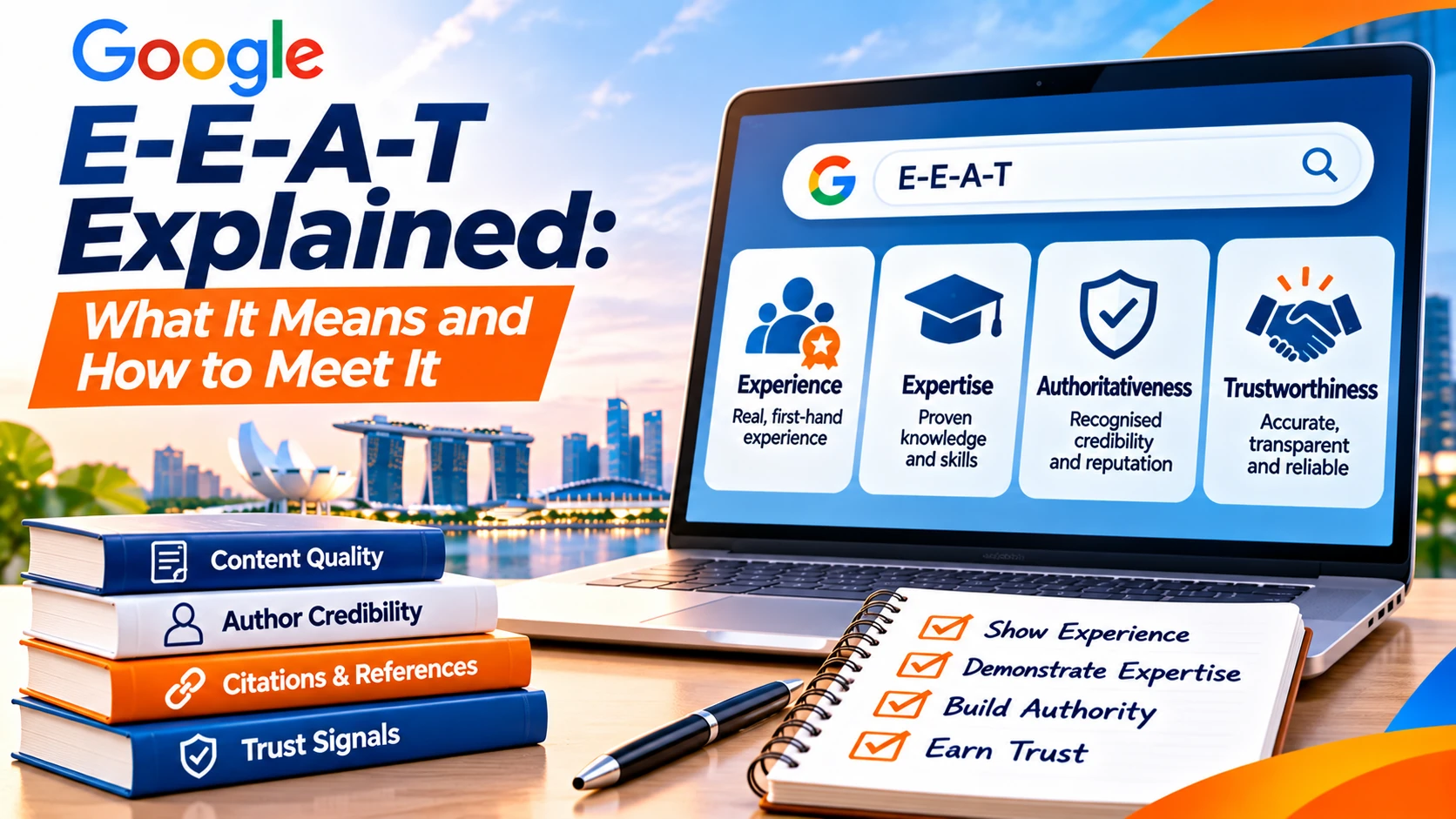
Google E-E-A-T is a quality framework with four pillars: Experience, Expertise, Authoritativeness and Trustworthiness. Google’s human raters use it to judge whether a page deserves to rank well in search results. It is not a switch a website can flip, and it is often misunderstood as a fuller author bio or a credentials badge.
Raters look for evidence that a page is worth trusting. Websites that earn lasting visibility show, on the page, that real people with real experience stand behind the content and that its information holds up under scrutiny. Users are more likely to rely on a site whose reputation is visible and verifiable. This article traces how the term evolved from E-A-T, explains each pillar, and sets out a practical way to audit your pages. The short answer: show first-hand experience, name the people behind the content, cite primary sources, and make contact details and corrections easy to find. Google’s own guidance on the framework is the primary reference: Google Search Quality Rater Guidelines.
The Evidence Audit is more useful than the pillar definitions. Definitions explain the framework; a scored audit shows which page to fix first and is important for prioritising effort. Scoring a real set of pages also shows where a site’s gaps cluster, which is information the definitions alone cannot give.
Key Takeaways
- E-E-A-T is a rater framework, not a ranking switch. Sites cannot optimise for it directly.
- Google first launched E-A-T as part of its Google Rater Guidelines in 2016 and added the second E for Experience in December 2022.
- The topic gained wider attention after the 2018 Medic Update.
- Experience means first-hand evidence, such as original photos, tested results and documented processes.
- Use the Evidence Audit. Score each page on Experience, Expertise, Authoritativeness and Trustworthiness (0 to 2 each). Below 5 out of 8 means rewrite or consolidate.
- Audit YMYL pages first. Health, finance and safety content faces the highest bar.
What Google E-E-A-T Means: The Four Pillars
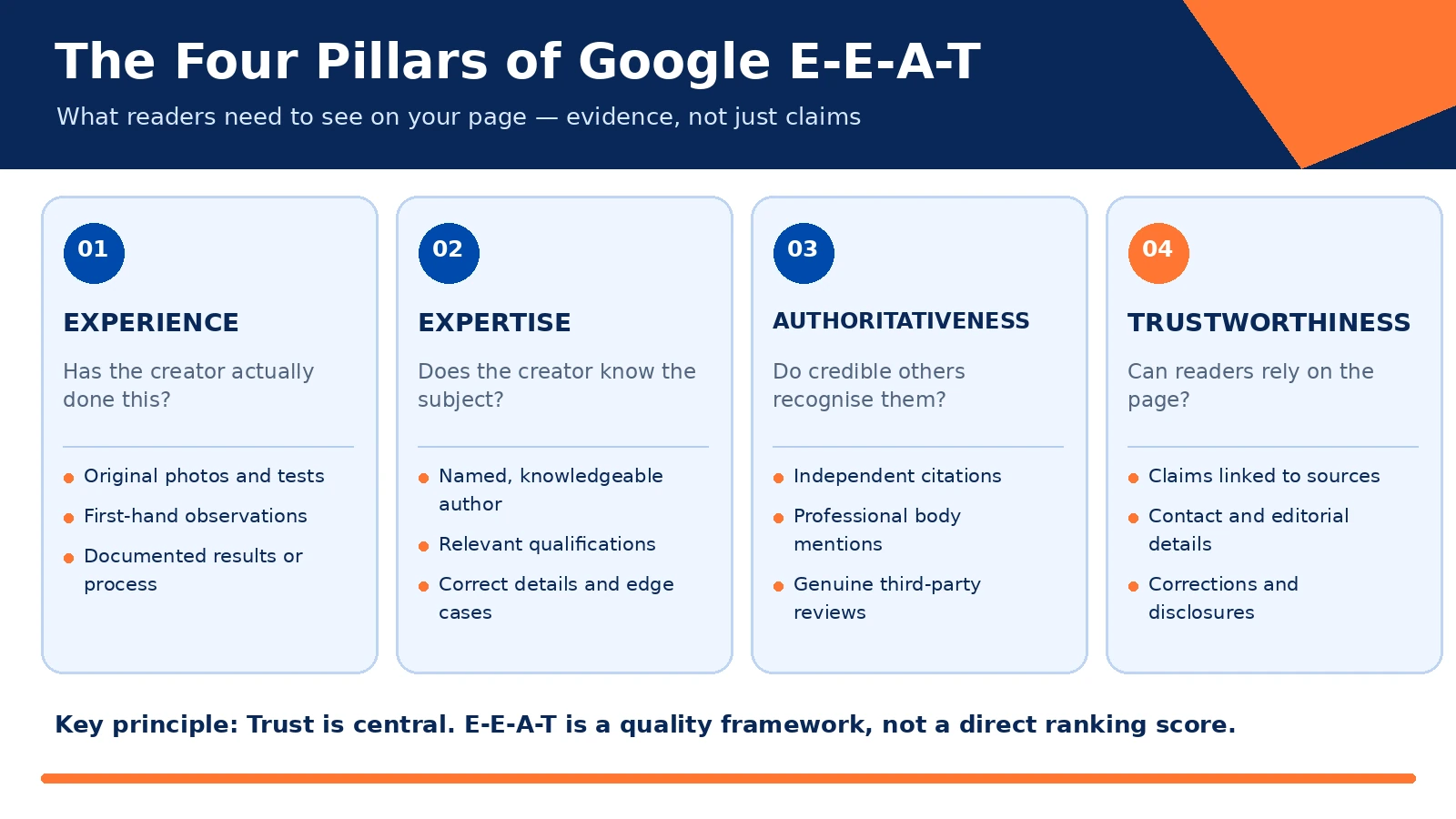
E-E-A-T is the quality framework Google describes in its Search Quality Rater Guidelines. The four letters stand for Experience, Expertise, Authoritativeness and Trustworthiness. Human raters use these questions to judge whether a page deserves to rank well for a query. It is a yardstick for people judging content, not a setting you can switch on.
Experience: first-hand, lived involvement with the topic
Experience asks whether the creator has actually used the product, visited the place or lived the situation described. A summary built from other people’s reviews can be accurate, but it cannot show what happened when the writer tried the thing. The proof depends on the topic.
Expertise: demonstrable knowledge and skill
Expertise is the depth of knowledge a page shows, backed by relevant training where it applies. Precise terminology and correct handling of edge cases signal it, as much as credentials do.
Authoritativeness: recognition of the creator or site by others
Authoritativeness is recognition from outside, such as citations by respected publications, mentions by professional bodies and named reviews on established platforms. Self-description does not count. Recognition of a creator or the websites they publish on can build that authority over time.
Trustworthiness: the most important pillar
Trustworthiness is the pillar that the other three depend on. Trust comes from sourced claims, visible contact details, a clear site purpose, transparent corrections and a clean separation between editorial content and paid promotion. When these are present, readers can rely on the information a page provides. A site’s reputation with its users rests on the same signals. Google’s E-E-A-T guidance treats this trust as the foundation of the whole framework.
The table below gives the question each pillar asks and sample evidence.
| Pillar | The question it answers | Example evidence |
|---|---|---|
| Experience | Has the creator actually used or done this? | Original photos with metadata, dated test results, documented process |
| Expertise | Does the creator know this subject in depth? | Relevant qualifications, precise terminology, correct handling of exceptions |
| Authoritativeness | Do others recognise this creator or website as a source? | Citations by respected publications, mentions by professional bodies, named reviews |
| Trustworthiness | Can a reader rely on this page and this website? | Sourced claims, visible contact details, editorial policy, transparent corrections |
How E-E-A-T Evolved from E-A-T
Google first launched E-A-T as part of its Google Rater Guidelines in 2016, and the term stayed inside SEO circles for years. Google first publicly released its Search Quality Rater Guidelines in November 2015, with a partial public version in 2013.
Public attention arrived with the Medic Update, fully rolled out on 1 Aug 2018. Many websites that lost visibility were in health and finance, and explanations leaned heavily on E-A-T.
In December 2022, Google added the first “E” for Experience to E-A-T, making it E-E-A-T. According to a published analysis of the change, this responded to demand for authenticity and personal relevance in online content, as seen from users’ perspective.
Google also updated its Quality Rater Guidelines in July 2022, refining how raters assess YMYL topics such as health, finance, legal and safety. Google’s own announcements are the authority on these changes, and the framework is a guide to how quality raters work, not a published ranking formula that reputation signals can be reverse-engineered from. Experts in search have long debated how much of this framework applies directly to ranking and how much credible, trustworthy information a page must show to earn that trust.
Core updates have followed since. The August 2024 core update began on August 15 and finished by September 3.
How a site should respond after a core update
When a core update lands and rankings shift, resist the urge to make sweeping changes. Start by comparing the pages that fell with the pages that rose for the same queries. The gap is usually visible: first-hand testing, named authors, cited sources or clear contact details. Fix the weakest pages first, then measure again after the next update cycle.
Why E-E-A-T Matters for SEO and Rankings
E-E-A-T affects rankings only indirectly. Google’s Search Central guidance (August 1, 2019) says that assessing your content in terms of E-A-T criteria “may help align it conceptually” with the signals its automated systems use. Human quality raters apply the framework to sample pages, and their ratings help Google refine those systems. Chasing a score rarely works. The framework rewards better, well-sourced information from credible experts, and it builds the authority and reputation that keep users returning.
First-hand experience is one of the clearest ways to improve that signal. The proof has to show on the page itself, because a search engine can only recognise what it can read. Experience, the first “E” in E-E-A-T, stands for first-hand involvement with the topic.
Core updates are broad changes, not penalties. Core updates change how the search engine’s systems weigh content overall. They are not aimed at specific pages.
Trust carries more weight than the other three pillars. Readers can verify a website that shows its sources, so they trust it.
AI-written text struggles most with the Experience criterion. It has not used the product, visited the clinic or run the campaign. For that reason, a page can read well and still score low on Experience.
Reader sentiment on AI content is strong. In an informal Twitter poll run by Lily Ray, Founder of Algorythmic and senior director at Amsive Digital, most respondents said they would trust AI-generated content less on YMYL websites, as reported by Lumar. Read it as reader sentiment rather than proof of a ranking effect.
YMYL pages face the highest bar. YMYL stands for “your money or your life” and covers topics that affect health, finances, legal position, or safety. Google’s raters hold these topics to a higher standard. Audit YMYL pages first, giving them stronger credentials, citations to primary sources and clear accountability.
How the rater guidelines fit in
The rater guidelines describe how human raters judge quality. They are guidance for raters, not a ranking algorithm, so treat them as a description of what good pages look like rather than a checklist that guarantees results.
Practical Steps to Demonstrate E-E-A-T on Your Site
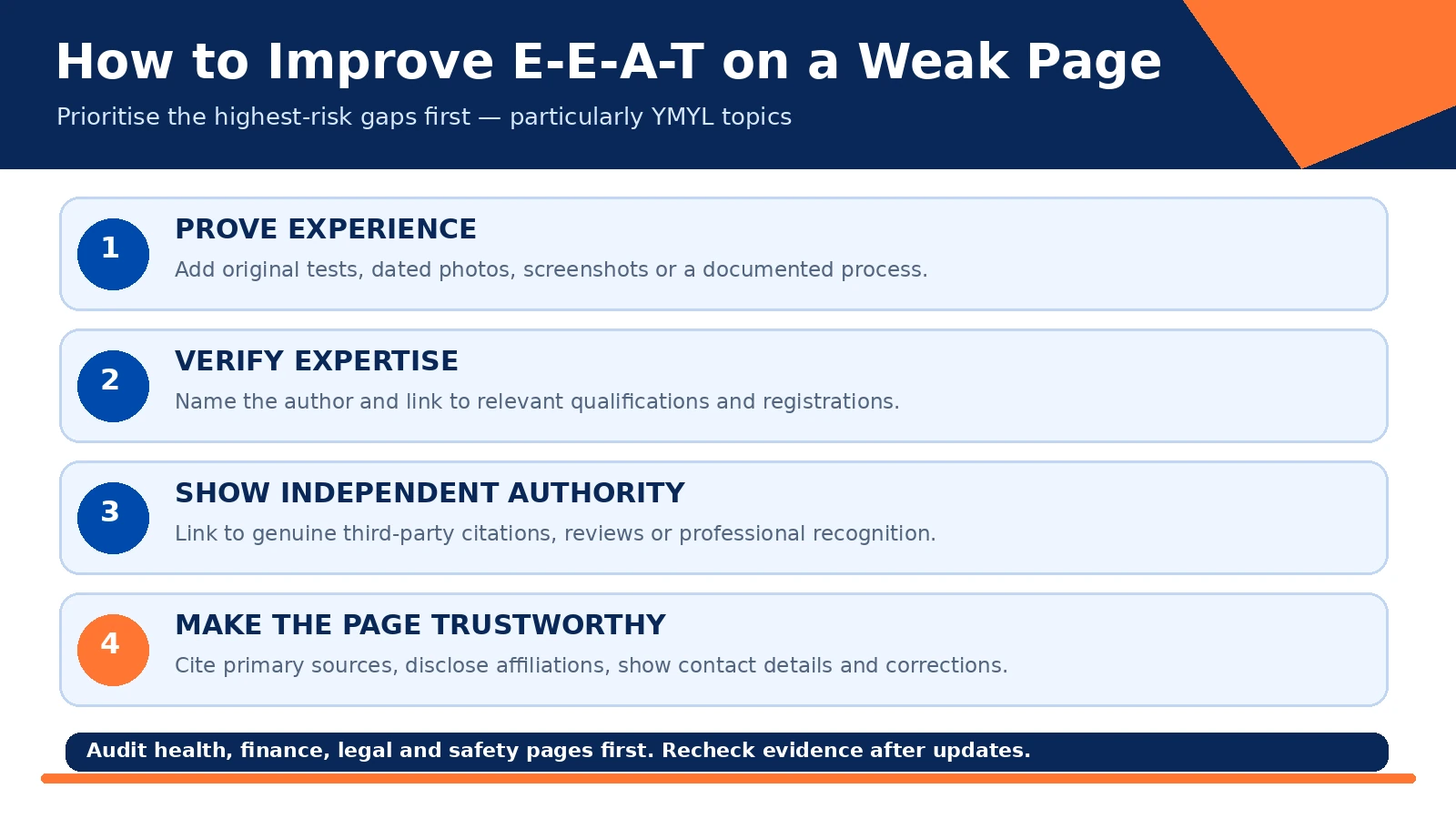
E-E-A-T is not a setting you can switch on. Google’s Search Central guidance describes assessing your content against these criteria as a way to check your own work and says this “may help align it conceptually” with the signals its systems use. The practical job is to make real experience, expertise, and trust visible on the page. A byline and a credentials badge on a generic article change how the page looks, not what it offers. Users and experts both notice the difference, and so does the information they rely on. Experience is the one criterion a template cannot fake, so make it the foundation of every page on your website, and let that first-hand record build your reputation over time.
Show first-hand experience, not just claim it
Experience is the one criterion a template cannot fake. The evidence depends on the content type:
- Product reviews: original photos taken during use, your own measurements, and notes on what broke or disappointed.
- How-to or service guides: a documented process, dated screenshots, and the mistakes you made along the way.
- Professional advice: outcomes described without identifying clients and what you would do differently next time.
Where you have no direct experience, say so. Point readers to people who do.
Author expertise and credentials
Give each author a dedicated page stating their role, qualifications, years in the field and any professional registrations. Keep the byline identical across articles. For regulated professions, link to the public directory where the registration is listed.
Content integrity checklist
- Source every factual claim. Link to the primary source, such as the regulator, study or official publication.
- Disclose affiliations. If you earn commission or work with a brand, state it near the top of the page.
- Update dated facts. Show when each page was last reviewed, and correct figures that have moved on.
- Cite Google directly. Where Google has made a statement, quote it and link to its Search Central documentation.
Trust signals checklist
Confirm each of these is present and easy to find on your website:
- Contact details: a physical address, working phone number, email and registered business name.
- Editorial policy: who writes and reviews content, and how sponsored material is handled.
- Transparent corrections: a visible note when a page changes materially, stating what changed and when.
For a small business, a verified Google Business Profile with genuine named reviews does much of this work at no cost. Our digital marketing services team can help you set up these signals.
Decision framework: symptom to fix
| Symptom | Likely cause | Fix | Priority |
|---|---|---|---|
| Health or finance articles show no author | Missing attribution on YMYL pages | Add a credentialed author and reviewer | High |
| Reviews read like spec sheets | No first-hand testing | Add original photos, measurements and tested outcomes | High |
| Claims have no links | Unsourced statistics | Link each claim to its primary source | High |
| Old figures still displayed | Content never reviewed | Add a review date and update or remove stale facts | Medium |
| Author pages are thin or missing | No credential pages | Build one verifiable page per author | Medium |
Work through the high-priority rows first, especially where a wrong answer could cause harm.
How the rater guidelines fit in
Google’s Search Quality Rater Guidelines train human raters, who evaluate sample results against them. They are not a score a page is ranked by. Treat them as a description of what a careful reviewer looks for, and build the page that would satisfy that reviewer on its merits. Important: these guidelines reward important qualities such as genuine expertise, so apply them to every important page on your website.
Scoring a page yourself
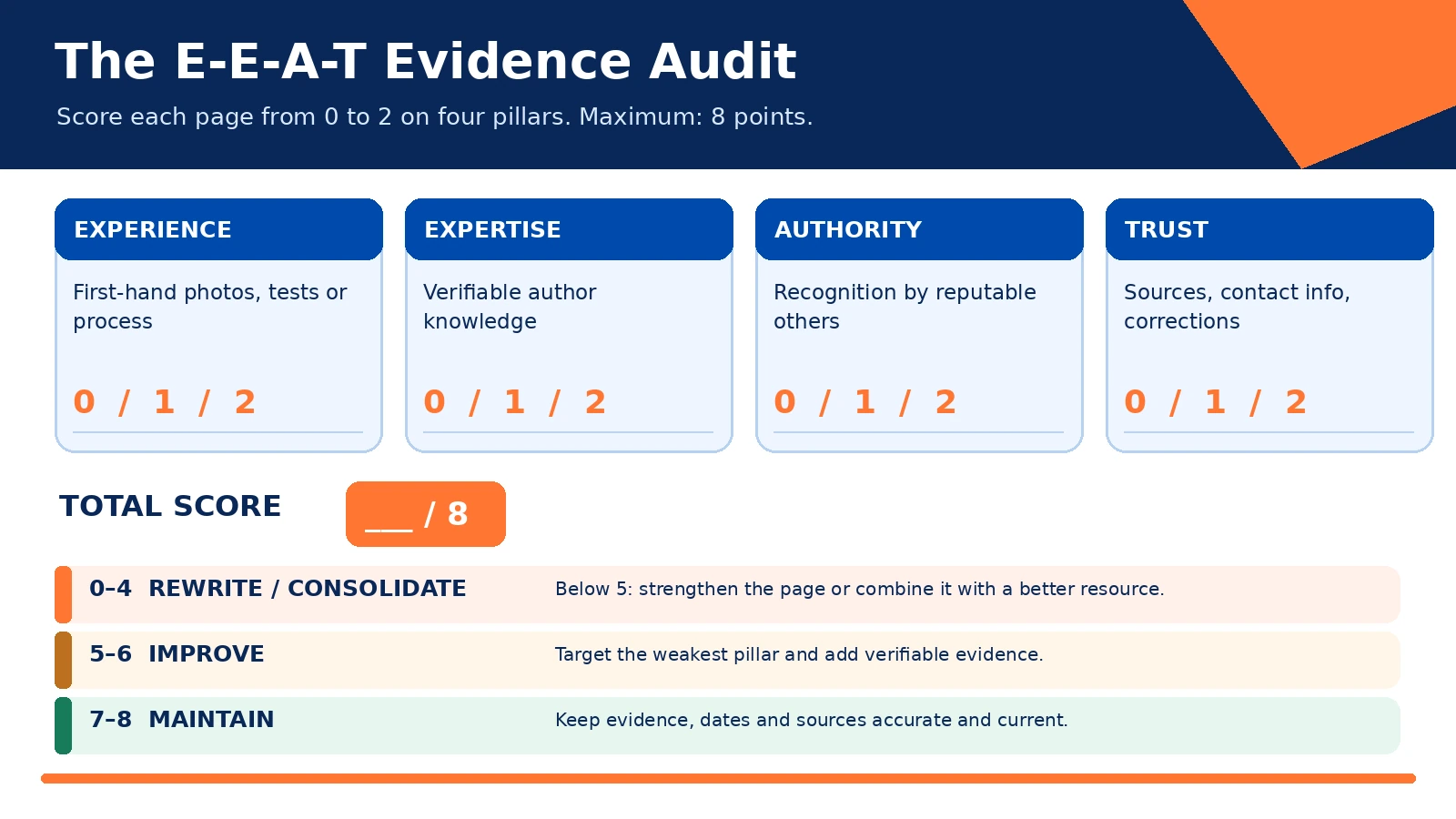
Score each pillar from 0 to 2 using the table below. Add the four scores for a total out of 8. Under 5, rewrite or consolidate the page.
| Pillar | 0 | 1 | 2 |
|---|---|---|---|
| Experience | No first-hand involvement shown | Some involvement, but only described | Original testing, photos or documented process |
| Expertise | Author’s knowledge is not evident | Relevant knowledge, no credentials shown | Qualified author with verifiable credentials |
| Authoritativeness | No recognition from others | Some mentions or reviews | Recognised by peers, customers or reputable sources |
| Trustworthiness | No contact details or sources | Some sources and contact details | Sourced claims, clear contact details and public corrections |
Conclusion
E-E-A-T rests on four pillars: Experience, Expertise, Authoritativeness and Trustworthiness. Each asks a different question of a page: has someone done this, do they know the subject, do others recognise them, and can readers rely on the information? Google first launched E-A-T as part of its Google Rater Guidelines in 2016 and added the second E for Experience in December 2022.
E-E-A-T is evidence, not a switch. Tested results, named authors with verifiable backgrounds and public corrections build trust over time. A byline alone changes only the appearance.
To see where your website stands, score one important page against the four questions in the Evidence Audit, starting with any health, money or safety advice page. To discuss an audit, contact the Mediaonemarketing.com.sg team.
Frequently Asked Questions
Is E-E-A-T a direct Google ranking factor?
No. E-E-A-T is a quality framework that human raters use to assess search results. Google has said that assessing content against E-A-T criteria “may help align it conceptually” with its automated ranking signals (Google Search Central, August 2019). You cannot optimise a score for E-E-A-T. You can only make your experience, expertise and trust visible on the page.
What is the difference between E-A-T and E-E-A-T?
E-A-T stands for expertise, authoritativeness and trustworthiness. Google first launched it as part of its Google Rater Guidelines in 2016. Google added the extra “E” for experience in December 2022. Trustworthiness sits at the centre of the four pillars.
Why was Experience added to E-E-A-T?
Google expanded the framework to reward authenticity and personal relevance. A summary written by someone who has never used a product can be accurate yet less useful than a review based on real testing.
Which pages does E-E-A-T matter most for?
It matters most for YMYL (your money or your life) pages covering health, finance, legal matters and safety, where a poor answer can harm the reader. If you run a clinic, financial advisory or renovation firm in Singapore, audit your YMYL pages first.
How does AI-generated content affect E-E-A-T?
AI-written content struggles to meet the experience criterion because it cannot report first-hand use, testing or observation. In a Twitter poll by Lily Ray, most respondents said they would trust AI-generated content less on YMYL sites. This is a poll, not a controlled study, so treat it as a signal of reader attitude rather than proof of ranking impact.
How can a small site demonstrate E-E-A-T?
Start with substance, not badges. Publish content based on work you have done, name the author with verifiable credentials, cite primary sources, and keep contact details and a corrections policy visible. Verifiable local signals include an ACRA-registered business name, publicly listed professional registrations, and named reviews on your Google Business Profile.