An enterprise SEO agency has to work inside a large company’s CMS, engineering queue, analytics stack and approval chain. Many buyers shortlist based on case studies, then find operating friction only after signing. Operating fit, not headline results, decides whether organic growth lasts past year one.
This guide sets out a decision framework for choosing an enterprise SEO agency. It explains which criteria to test before signing, how to score a shortlist, and which tasks your team should keep in-house. Use it to judge how each agency will work with your marketing, search and engineering teams.
Key Takeaways
- Operating fit matters more than headline results. CMS, analytics and engineering integration decide whether growth lasts.
- Choose on integration capacity first. Case study results matter less than whether the agency can work inside your release process.
- Score every shortlisted agency on six weighted dimensions. Use the Fit Matrix below and set a minimum threshold.
- Test claims before signing. Request a sample audit of a site the agency hasn’t worked on, and the name of the analyst who signs it off.
- Keep the right tasks in-house. Write content approval, engineering tickets and data access into scope from the start.
- Govern multi-agency setups deliberately. Name who owns the canonical rankings dashboard and who resolves conflicting recommendations.
Selection Criteria and the Fit Matrix
To shortlist an enterprise SEO agency, score each candidate on integration capacity first, then test the claims behind its results. Case study decks and traffic headlines show what an agency achieved for other clients. The tests below show whether it will work inside your organization, since a strong agency that cannot fit your workflow will underdeliver. Working professionals in marketing and growth roles should weight this fit heavily, because a strategy that stalls in handoffs delivers little organic growth.
The Enterprise SEO Agency Fit Matrix
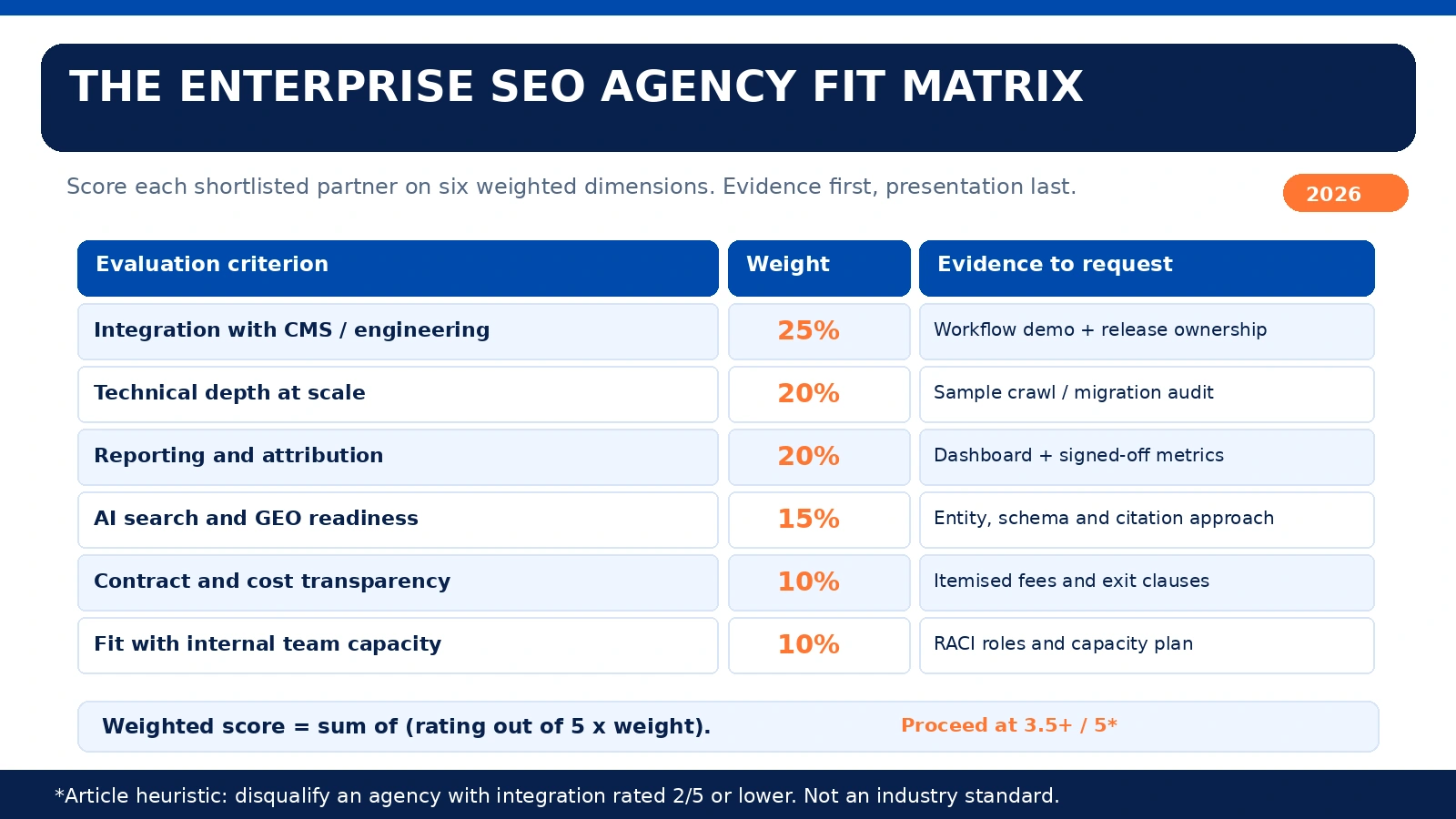
Score each shortlisted agency from 1 to 5 on six dimensions. Multiply each score by its weight, then add the results.
- Technical depth at scale. Crawling, rendering and migrations for a large search engine footprint.
- Integration with your CMS, analytics and engineering workflow.
- Reporting and attribution clarity.
- AI search and GEO readiness.
- Contract and cost transparency.
- Fit with your internal capacity.
- Weight integration more heavily if your team has little in-house engineering.
- Weight it less if your engineers can ship SEO changes without help.
- Back every score with evidence, such as a sample audit or a reference call.
Worked example. Assume the weights are 25% for integration, 20% for technical depth, 20% for reporting, 15% for AI search readiness, 10% for cost transparency and 10% for internal capacity fit. Agency A scores 4, 5, 3, 3, 4 and 4. Agency B scores 5, 3, 4, 4, 3 and 3. Weighted, Agency A totals 3.95 and Agency B totals 3.85. Agency A leads, but only just. A total of 3.5 or more is the minimum threshold to proceed, and any agency scoring 2 or lower on integration is removed regardless of total.
Questions to Ask Before Signing
Use these questions in a buyer meeting. Write down the answers.
- Who does the work? Find out whether the analyst auditing your site is salaried or a freelancer you will never meet. Reboot Online’s review of enterprise SEO agencies notes that Croud combines a core in-house team with a global network of on-demand specialists it calls “Croudies”.
- Can the agency run a sample audit on a site it hasn’t worked on? Check crawl depth and rendering issues, and confirm that each recommendation names an owner and an effort level.
- Does the reporting template link traffic to business outcomes? Ask for the template and the name of the analyst who signs it off. A traffic chart with no revenue attribution signals weak accountability.
- What must your team provide? Content approval, engineering tickets and analytics access are usually the real constraints, not the agency’s skill. Write these into scope so each deliverable has a named owner.
- Which CMS, tag manager and analytics tools has the team run in production? Ask which crawlers, log analyzers and rank trackers it uses and whether it has run migrations on your platform.
Red Flags That Should End a Pitch
Several of these warning signs surface during the questions above. Treat any one of them as grounds to pause.
- Guaranteed rankings or traffic percentages with no discussion of your site’s constraints.
- Reluctance to share the sample audit or reporting template before signing.
- Senior staff on the pitch and junior staff on delivery, with no contractual protection.
- No questions about your engineering capacity or content workflow.
- Case studies that omit baselines or time periods.
Enterprise SEO Services and What to Verify
A full-scope enterprise SEO agency covers engineering queues, content workflows, and the AI answer engines that sit between a buyer and search results. Check that each strategy is tied to measurable outcomes before committing to a best enterprise SEO partner or a formal SEO strategy. Weigh each agency’s expertise in your own sector before signing, and confirm the agency’s content strategy is built around your business goals rather than generic templates.
Technical Audits and Site Architecture at Scale
At enterprise size, a technical SEO audit covers how hundreds of thousands of URLs are crawled, rendered and linked. It also predicts how a planned migration will affect rankings before launch. Ask for the audit approach, not just the findings. A serious provider explains how it samples templates, validates fixes in staging and ranks issues by revenue impact. If it cannot, the audit is a spreadsheet, not a plan.
Content Operations and Programmatic Optimization
Enterprise content is an operations problem. Thousands of product, location or category pages need templates, data feeds and editorial rules that your team can sustain without the agency. The agency’s value lies in designing that system and handing it over. Pair this with a broader content marketing plan so every templated page serves a defined purpose.
Templated pages that differ only by a city name drift into thin content. A credible agency sets minimum unique-content thresholds and knows when to stop a page type altogether.
Enterprise SEO for AI Search and Generative Engine Optimization (GEO)
Search behavior is shifting. Research cited by Reboot Online shows 37% of consumers already start searches with AI instead of Google. Visibility now depends on whether AI engines recognize the brand, find structured data describing its products and pull clear answers from its pages. This is generative engine optimization (GEO), and it sits alongside digital marketing rather than replacing it.
Treat GEO as a checklist. Keep entity data consistent across your site and third-party profiles, add accurate schema markup to key pages, and write short, self-contained answer passages. Ask how the agency measures citations in AI answers. AI-visibility measurement is still unproven, so treat citation numbers as a starting point, not a settled result.
Business Verticals and Industries Served
Vertical experience matters because constraints differ. B2B SaaS needs demo-led conversion paths. A retailer needs category pages and inventory feeds. A regulated business needs tracking; its compliance team can sign off on. Platform matters too: a Shopify store, an Adobe Experience Manager site and a headless build each need different fixes. Claims to serve “every industry” usually signal limited depth in any one of them. Ask for named examples in your sector.
Software and Platform Experience
Confirm hands-on experience with your CMS, tag manager and analytics stack. A migration on a 50,000-page commerce site is a different job from a brochure site, so ask for a migration on a platform like yours.
Customer Proof: Testimonials, Retention and Case Studies
Treat retention figures as claims to verify. Linkflow’s 2025 guide reports one listed agency with a 94% client retention rate and a 9.3 client satisfaction score. These figures are self-reported and not independently verified. Ask for two referees with comparable site scale and call them.
Check case studies for scope. Ask what the baseline was, what changed on the site and which results the agency could not control. MediaOne, for instance, describes an enterprise migration and APAC expansion for a Fortune 500 technology company managing 50,000+ product pages on its enterprise SEO services page. This is MediaOne’s own example, and its outcome is not independently verified. Request the underlying before-and-after data, including the link-building methods used.
Comparing Leading Enterprise SEO Providers
Comparison Criteria Table
Decide what you are comparing on before comparing agencies by name. Many firms list the same services in different wording. The table below sets out the criteria that separate one enterprise SEO agency from another, and the same six rows are applied to each firm profiled in the next subsection. A thoughtful evaluation starts with these criteria rather than brand recognition.
| Criterion | What to look for | Red flag |
|---|---|---|
| Technical depth at scale | Named experience with crawl budget, JavaScript rendering and migrations across tens of thousands of URLs | Only small-site case studies |
| Delivery model | Clear split between core team and on-demand specialists, with named analysts | Vague “our experts” language |
| Integration | Work inside your CMS, analytics and engineering sprint process | Deliverables are PDFs only |
| Reporting | Shared dashboard, stated attribution method, sample reports available | Reports built on vanity rankings |
| AI search readiness | Entity work, structured data and citable content, with a way to measure visibility | Generic “AI optimization” promises |
| Contract and cost | Itemized scope, exit terms and fees stated in writing | Retainers with unspecified deliverables |
Score each agency against these six rows before you look at its award wall. Weight the rows according to your in-house capacity and the business goals your marketing services program serves.
Profiles of Established Enterprise SEO Firms
The firms below appear most often on published enterprise SEO shortlists. The notes apply the comparison criteria above. The details come from third-party publications and have not been verified, so check them against each firm’s current materials.
Croud
- Model: a core in-house team plus on-demand specialists, founded in 2011, according to Reboot Online’s review.
- Verify: ask how specialist access is billed and how those specialists are briefed.
SALT.agency
- Model: a technical SEO specialist founded in 2014, per Reboot Online.
- Verify: confirm how much content and paid media work sits outside its scope.
Credo
- Model: a marketplace that says it has helped 6,500+ companies find a digital marketing firm, per Credo’s enterprise SEO page. This is Credo’s own claim.
- Verify: each firm it introduces still needs a full evaluation against the criteria table.
Linkflow
- Model: reports a range of $10,000 to $50,000+ per month for enterprise SEO in 2026, according to its 2025 enterprise SEO agency roundup. This is a third-party estimate.
- Verify: request a written quote for your own site.
Delivery model and integration tell you more about fit than founding dates or office counts. For a B2B SaaS business, test each agency’s proposed strategy against your own pipeline targets. Judge the firm’s real expertise by how it handles your specific site architecture, not by its general claims. Ask whether the firm plans its content marketing work alongside its technical fixes so that new pages rank and convert.
MediaOne as a Benchmark Example
We include MediaOne as a worked benchmark because we publish this guide. Treat its figures as MediaOne’s own claims and test them as you would any other firm.
MediaOne states that it has served more than 3,000 clients since 2009, with an 83.7% success rate, and that its work has produced 230 million organic visits and 800,000+ ranking improvements, per its enterprise SEO services page. The page describes an enterprise migration for a Fortune 500 technology company managing more than 50,000 product pages. This is an illustrative example, not a guaranteed outcome, and you should confirm the client’s approval for publication.
Apply the comparison criteria to MediaOne as you would to any candidate. Ask for a sample audit on a non-client site, request its reporting template, and confirm which analyst would sign off your work. Ask too how the agency will align its content strategy with your wider marketing activity, including what its social media channels contribute, and whether its reporting shows how organic visibility feeds your wider marketing efforts, including how a search engine ranking connects to revenue.
Budgeting and Pricing for Enterprise SEO
The monthly retainer is only part of the real cost. Before comparing quotes, understand what the retainer covers, how long the investment takes to pay back, and whether public funding can reduce the net spend. Enterprise SEO is an ongoing operating cost, not a one-off purchase, so review the strategy against business goals at each stage. Build your budget with content marketing included as a line item from the start, not added later.
What Drives Enterprise SEO Pricing
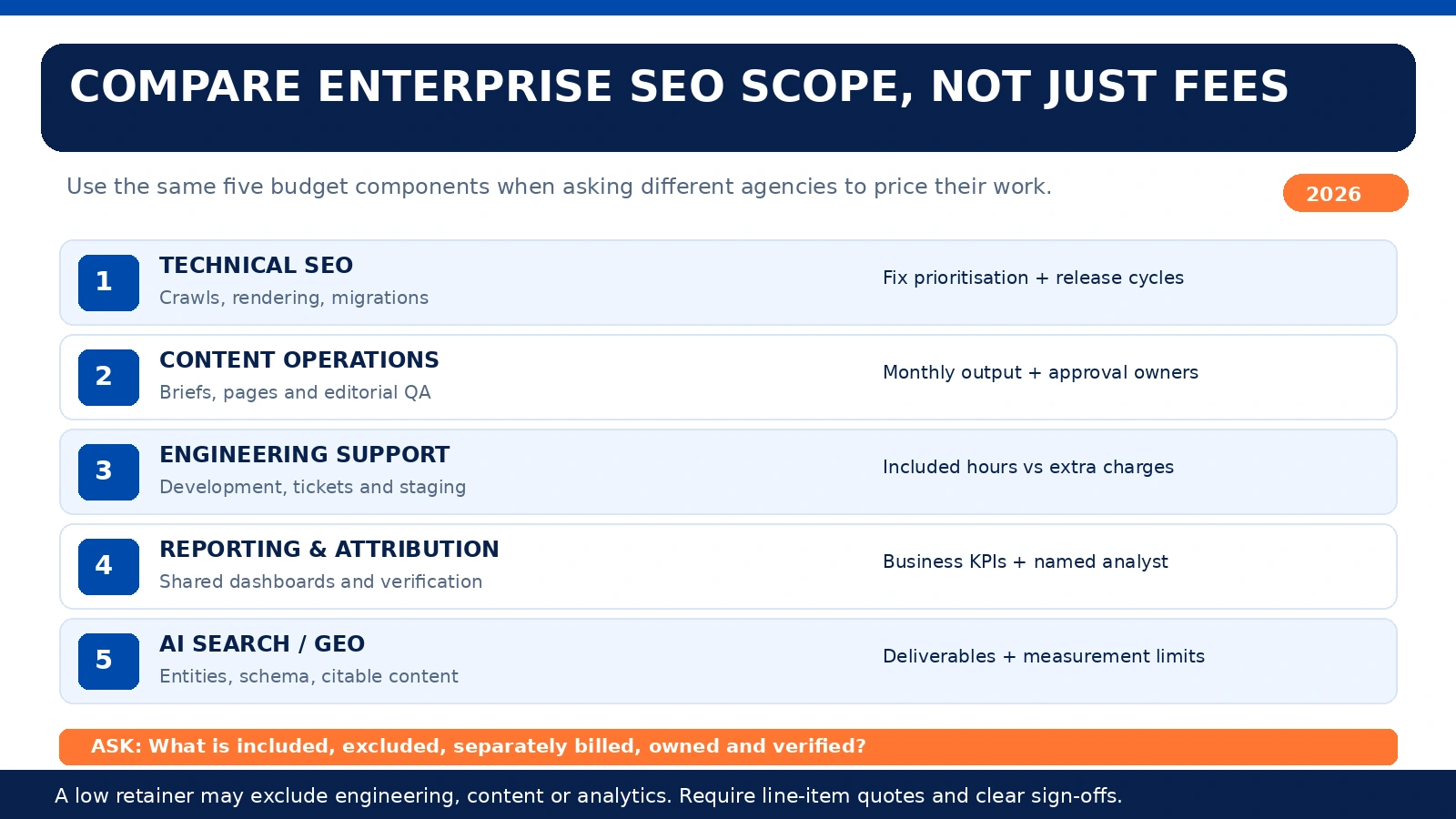
Pricing varies widely with site size and scope. Linkflow’s 2025 review puts enterprise SEO costs at $10,000 to $50,000+ per month in 2026, but this is one publication’s estimate, not a market standard. The number of URLs and templates, the depth of engineering support, and whether content production is included are the main drivers of quotes. Technical SEO work on large template sets is often the largest single cost driver, and a B2B SaaS site with many product and integration pages will usually cost more.
A monthly retainer suits ongoing work such as audits, releases and content. A fixed project fee suits a defined task, such as a single migration. Ask every agency to break its fee into the same components:
| Component | What to confirm |
|---|---|
| Technical audit and remediation | Crawl and rendering coverage, release cycles included |
| Content operations | Briefs, writing or editing volume, approval workflow |
| Engineering support | Ticket hours, and whether developers are included or billed separately |
| Reporting and analytics | Dashboard build, attribution method, named analyst |
| AI search visibility | Entity work, structured data, citable content |
If an agency cannot separate these lines, the retainer is hiding scope. A low headline fee often means engineering or content production is billed elsewhere. Compare scope first and price second. Ask each agency to state its approach to content strategy and how that work is priced, since content is one of the costs most often left out of a headline retainer.
Expected Timelines and Returns
Enterprise SEO moves more slowly than paid media. Technical fixes come first, and returns build later. MediaOne projects first significant traffic increases of 20 to 40% in months 4 to 6, and growth of 40 to 80% in months 7 to 9, as set out on its enterprise SEO service page. These are the agency’s own projections and depend on your starting baseline, so measure them against your own data before relying on them.
A fair early checkpoint is the end of the first technical phase. By month three, crawl errors should be fixed, priority templates should index faster, and a content roadmap should be signed off. If none of these exists, the timeline is slipping. Growth in organic search usage is also worth tracking on social media channels, where brand mentions can signal awareness building before rankings move.
The same page gives a worked example of an SGD 120,000 annual investment returning SGD 288M in Month 12 organic revenue against a SGD 150M baseline. This is MediaOne’s own modelled projection, not a measured result, and such figures depend heavily on conversion economics. Use it to frame questions, not to set your own forecast. Judge the agency on demonstrated expertise with comparable sites, not on the example alone. Weigh the quality of the experience each candidate brings with sites of similar scale.
Co-Funding and Government Support Options
Some buyers can offset part of the cost through public schemes. MediaOne is an EDGE Pre-Approved Vendor, and its example shows an SGD 5,000 monthly investment becoming an effective cost of SGD 2,500 with EDGE funding, per its service page. This is MediaOne’s own example. Eligibility and caps change, so confirm current terms with the scheme administrator.
For US buyers, the equivalent question is internal: whether procurement allows multi-year contracts and whether the spend is classed as operating cost or project spend. Those choices shape the retainer negotiation more than any headline discount. Large companies often find that clear brand guidelines reduce revisions and therefore reduce the retainer needed.
Working with an Enterprise SEO Agency Alongside Other Vendors
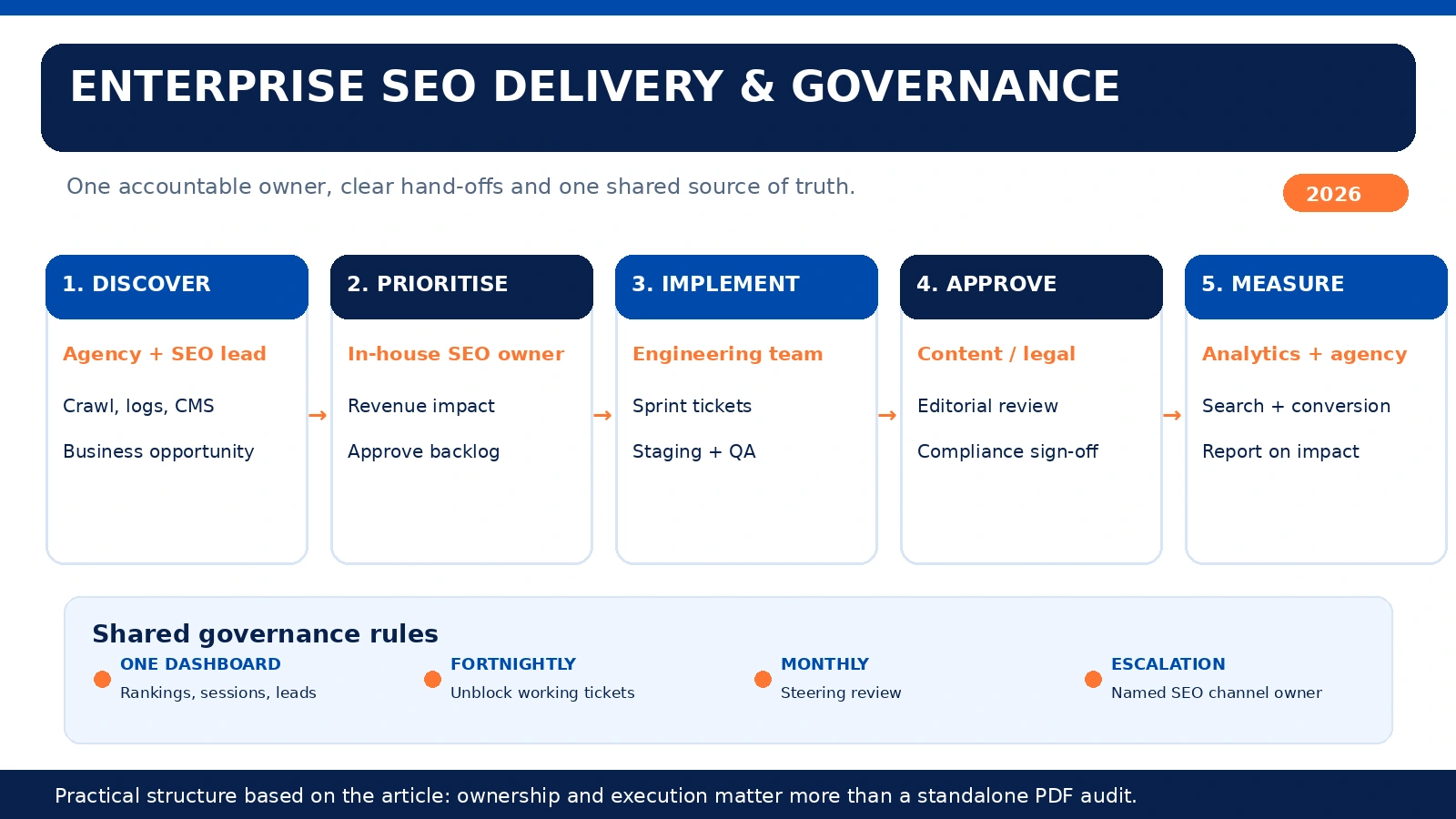
Enterprises rarely buy SEO in isolation. The agency sits beside an in-house content team, a web development partner, a paid media vendor and perhaps a link-building firm. Each can undo the others’ work. A migration built by one vendor can strip the structured data another has been developing, and a poorly coordinated campaign can dilute the brand’s voice across channels, weakening the marketing that companies rely on to reach their clients.
Name one owner for the organic search channel. That owner decides which recommendation wins when two vendors conflict and approves the strategy every partner works toward. The owner should maintain a documented SEO strategy that every vendor follows, and each partner’s strategies should be checked against it. Vendors that consult on a best enterprise SEO approach should also be held to that same document.
Then map the handoffs. For each recurring task, record who produces, reviews, implements and measures the work. Engineering tickets are the most common bottleneck, so any fix needing a developer should state its expected turnaround and sprint.
Coordinating Multiple SEO and Development Partners
When several partners touch the site, use one shared task log visible to every vendor. Each item records the affected URL or template, the proposed change, the owner, and the release that will carry it.
Decide in advance which tasks stay in-house, such as content approval, final engineering sign-off, Search Console and analytics access, and production CMS changes.
Ask each agency how its approach works with your stack, including whether it needs a staging environment. Agencies that draw on outside specialists, such as Croud with its on-demand “Croudies”, should explain how they brief and check those specialists so the expertise they bring stays consistent with your standards. A marketing agency working with a B2B SaaS business should also confirm how its approach fits the product and sales cycle.
Enterprise Tool Stacks: Crawlers, Log Analyzers and Rank Trackers
A site crawler finds broken links, redirect chains and indexing problems, which is the core of any technical SEO review. A log analyser shows which URLs search engine bots request, which helps when crawl budget is limited. A rank tracker measures keyword positions over time. Ask which tools the agency uses, who holds the licenses, and whether you receive raw exports.
Governance, Reporting and Accountability Structures
Governance is where most multi-vendor programs quietly fail. A workable minimum has four elements:
- One canonical dashboard for rankings, organic sessions and conversions, with vendor views beneath the headline numbers.
- A fortnightly working review where vendors and internal owners clear blocked tasks.
- A monthly steering review where senior stakeholders check progress against targets.
- A written escalation path setting how disagreements move to the channel owner and how long a decision may take.
Insist that every vendor uses the same definitions. If one partner counts organic conversions from Google Analytics and another from server logs, the numbers will never reconcile. A named senior analyst who answers for the numbers is a stronger signal than a polished template. Ask each partner to show how its optimization work is measured against the same targets so that no vendor’s results are reported in isolation.
Conclusion: Choosing an Enterprise SEO Agency with Confidence
The strongest signal in an agency pitch is whether it can work inside your organization: your CMS, analytics, engineering queue and approval process. Score each shortlisted enterprise SEO agency on the six dimensions of the Fit Matrix, weighted by your in-house engineering capacity. Choose the highest weighted score, not the most impressive results.
Before you sign, request a sample audit of a site the agency has not worked on, its reporting template and the name of the analyst who will sign off on it. An agency that cannot produce all three within a few weeks will probably perform the same way once the contract starts.
Frequently Asked Questions
How much does an enterprise SEO agency cost per month?
Linkflow reports that enterprise SEO costs $10,000 to $50,000 or more per month in 2026. Treat this as a third-party estimate, not a quote. Ask each agency to price its audit, migration and content phases separately.
How long does enterprise SEO take to show results?
Expect a phased curve. Technical fixes come first, then content and link work, and returns build over time. MediaOne projects a 20 to 40 percent traffic increase by months 4 to 6 and 40 to 80 percent growth by months 7 to 9, as set out on its enterprise SEO services page. These are the agency’s own projections, not independent data or guarantees.
What is the difference between enterprise SEO and regular SEO?
Enterprise SEO covers tens of thousands of URLs, multiple markets and release cycles involving engineering, product and legal teams. At that scale, the hard problems are migrations, rendering, crawl budget and getting changes shipped through development.
Should an enterprise run SEO in-house or through an agency?
Most large organizations do both. An in-house team owns decisions and data access, while an agency adds specialist depth and surge capacity. Decide which tasks must stay internal before you scope the agency.
Can an enterprise SEO agency help with AI search visibility?
Yes. Research cited by Reboot Online indicates 37 percent of consumers already start searches with AI instead of Google (Reboot Online). Ask how the agency audits brand entity signals and structured data, and how it validates its method, since measuring AI visibility is still unproven.
How many enterprise SEO agencies should a company work with at once?
Most enterprises work with one primary agency, adding specialists only for defined gaps such as international expansion or link acquisition. Running several agencies on the same site raises the risk of conflicting recommendations, so name one owner of the rankings dashboard.