If you work in Singapore and are weighing up a digital marketing certificate, you need to answer three questions. What does it prove? What will you pay after subsidies? Will it change your career? Many listings quote fees before subsidies and leave renewal and verification unanswered.

For most working professionals here, a short, subsidised, skills-focused course gives a better return than a multi-year academic credential. Employers reward current, demonstrable skills. This guide explains what a digital marketing certificate, a marketing certification and a degree-level programme each prove. It then matches each option to your career stage and budget.
Key Takeaways
- A digital marketing certificate builds skills through training. A certification validates competence through an exam that usually needs renewing. Know which one you are buying before you pay.
- Compare courses on net cost after subsidy, not list price. A WSQ-certified two-day course at S$1,088 before subsidy can cost less once SkillsFuture or corporate funding applies.
- Use the Credential Fit Matrix below. Score each option on time to complete, net cost, what it proves to an employer and whether it needs renewal.
- Check the guide’s update date and any funding deadline, such as the 30 Nov 2026 completion date, before enrolling.
- Treat a credential as a signal, not a guarantee. Pair it with a portfolio of real campaigns to win interviews.
Comparing the main options at a glance
The table below compares named Singapore options from the guide updated on 17 July 2026. Fees are before subsidy. Confirm the current subsidy, list fee and renewal terms with each provider before you enrol.
| Option | Duration | List fee (before subsidy) | Subsidy status | Renewal terms |
|---|---|---|---|---|
| OOm Institute digital marketing course | 2 days | S$1,088 | WSQ-certified, so it may be eligible for SkillsFuture or corporate subsidies | Not stated in the guide; confirm with the provider |
| National University of Singapore Digital Marketing Course | 3.5 days | S$3,242.75 | Not stated in the guide; confirm with the provider | Not stated in the guide; confirm with the provider |
| Singapore Management University Professional Certificate in Digital Marketing | Completion of 6 modules within a maximum of 3 years | S$10,464 | Confirm with the provider | Not stated in the guide; confirm with the provider |
Singapore programmes range from short 2-day workshops to longer-term diplomas, so the right choice depends on how much time and money you can commit now. Some options also cover content strategy and social media management. Check each syllabus against the skills your role needs, and compare each marketing certification against the marketing certifications your employer already recognises.
Certificate or certification: which one you are buying
In most cases, a digital marketing certificate is awarded when you finish a structured course. The provider sets the curriculum and issues the document. It shows that you completed the training, not that you can carry out the work on your own.
In most cases, a certification checks your competence through an exam and requires renewal. The University of San Diego’s continuing education guide draws the same line: a certificate is “a specialised credential focused on education and training,” while a certification “validates competence through an exam and typically requires periodic renewal.” Renewal and expiry rules differ by issuing body, so check each one before you rely on it.
Certificates show what you learned. Certifications show you can still do the job to the expected standard. Many professionals take marketing certifications alongside marketing courses to cover both learning and validated skills. Many of these courses run online, so you can fit them around your existing work.
Each option signals something different to an employer. A short, practical course shows recent, hands-on exposure. A renewable certification shows validated competence at a point in time. A multi-year academic programme shows depth, but takes longer to pay off and may not show current tool fluency.
Choosing the best digital marketing credential depends on whether you need to prove social media campaign experience or broader strategic knowledge. Pick the option that helps you reach your career goal fastest.
Core modules every programme should include
A credible digital marketing certification covers five modules: search engine optimisation (SEO), paid search, social media, analytics and email marketing. If a programme skips one, question that gap before you pay. Look for marketing certifications that name every module in their published outline.
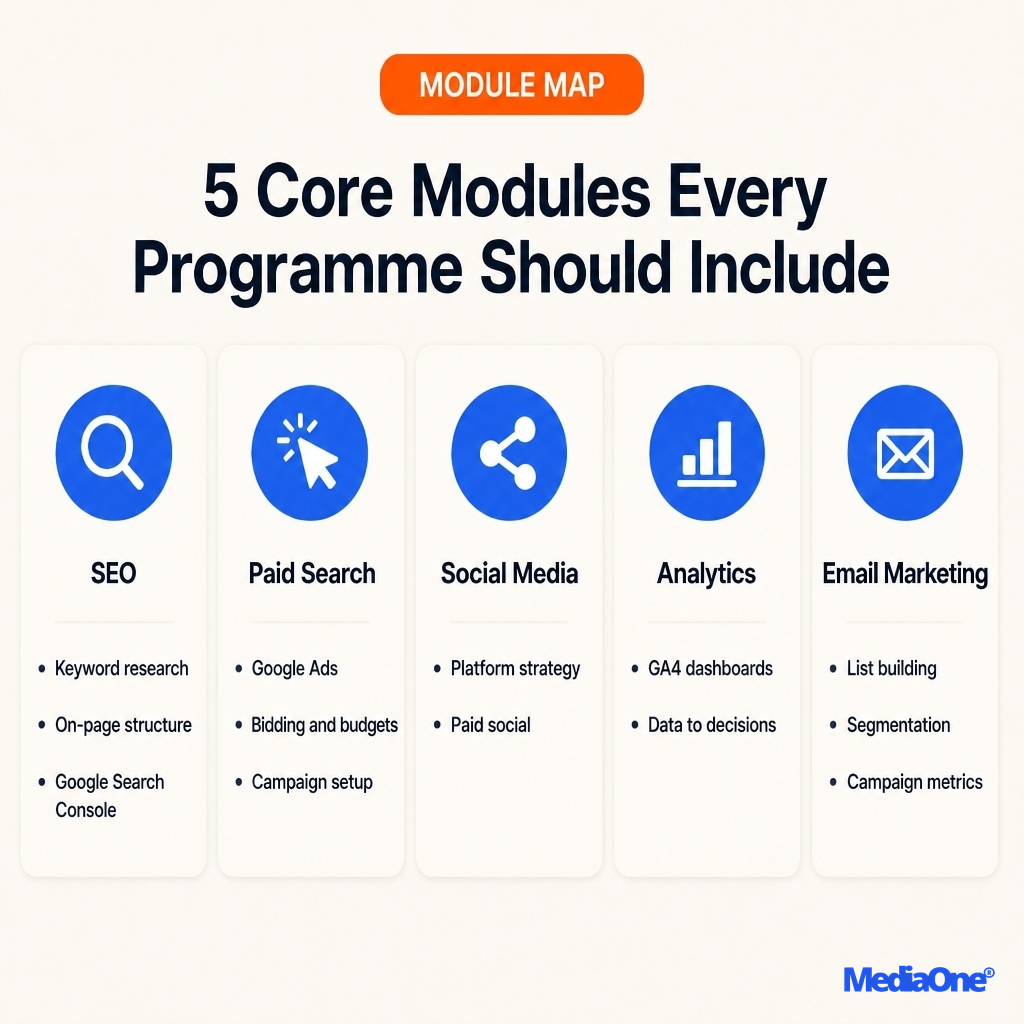
- SEO covers keyword research, on-page structure, technical basics and search traffic measurement for business content. A Singapore Management University guide to digital marketing careers cites HubSpot: 77% of web traffic analysts ranked targeting high-volume keywords as the most effective SEO strategy.
- Paid search covers campaign setup, bidding and budget control, with Google Ads and Google Analytics taught hands-on.
- Social media covers platform strategy and paid social, not just posting. The same guide reports that 89% of Singapore consumers engaged with social media ads in the past year.
- Analytics covers reading performance data and turning it into decisions, a skill digital professionals rely on daily.
- Email marketing covers list building, segmentation and campaign measurement.
Diagnostic check: if a course cannot name the tools it teaches for each module, its outline is too vague to compare. Look for a marketing institute that publishes its full syllabus.


Practical skills employers now expect, including data and AI tools
Employers hire for output. Choose a digital marketing certificate that teaches skills you can show in a portfolio or interview. These include dashboard reporting, campaign briefs, A/B testing, and AI tools for drafting and audience research. Teach AI as a productivity tool with human review, not a replacement for strategy.
Ask providers for a sample assignment. Live campaign plans or dashboard reviews build job-ready skills. Multiple-choice quizzes mainly prepare you for tests.
Using the curriculum as a checklist when comparing courses
Use one checklist for both curriculum and funding. Score each course one point per core module taught with practice, plus one point for each of these:
- Named tools (for example, Google Ads or Google Analytics) with hands-on exercises.
- A graded practical assignment, not only a quiz.
- Data and AI tool training with a stated learning outcome.
- A current outline, checked against the guide’s update date.
- WSQ (Workforce Skills Qualifications) certification. WSQ courses may be eligible for SkillsFuture funding. Check the eligibility criteria on the official SkillsFuture website, and confirm with the funding body at enrolment, because rules change.
Why 7 of 9? Scoring the nine points gives a simple test. A course that reaches 7 covers most of the practical ground that professionals and business owners ask about, so its cost is worth comparing. Test the method on one course: score the OOm two-day course against the nine points using its published outline, then repeat with a second provider as part of your broader digital marketing strategy.
Courses scoring 7 or more out of 9 merit a closer look against cost. Below 5, a course is usually an awareness workshop: suitable for beginners, not job-ready training.
Credential Fit Matrix: worked scores for two named courses
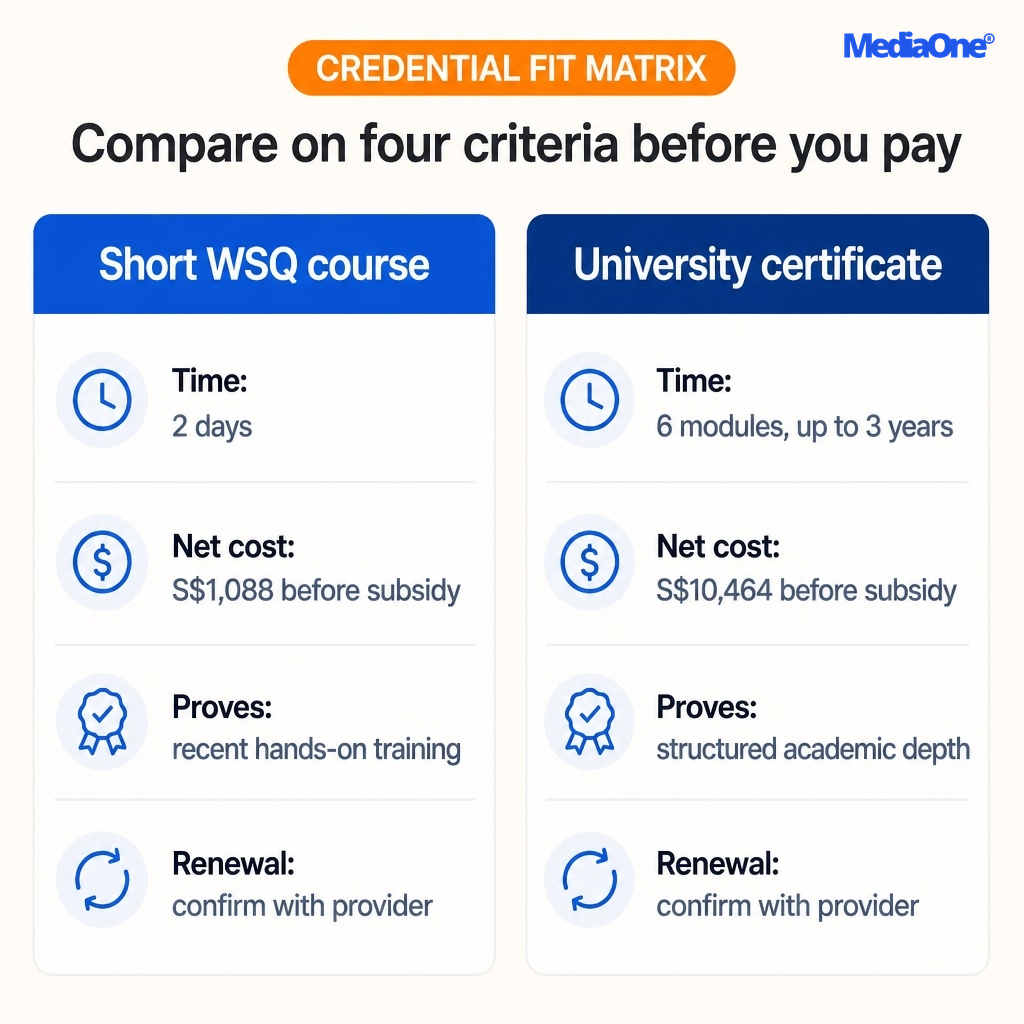
Use this matrix to compare options on the four criteria that matter to working professionals. Costs are before subsidy, as the sources give them. Subsidy eligibility depends on SSG and SkillsFuture rules at the time you enrol. The subsidy amount is not published in the guide. To calculate net cost, take the list fee and subtract the subsidy your eligibility group qualifies for, confirmed with the provider.
| Criterion | OOm Institute digital marketing course | Singapore Management University Professional Certificate in Digital Marketing |
|---|---|---|
| Time to complete | 2 days | Completion of all 6 modules within a maximum of 3 years |
| Net cost | S$1,088 before subsidy; subsidy amount not published, so net cost depends on your eligibility | S$10,464 before subsidy; net cost depends on subsidy confirmed with the provider |
| What it proves | Recent, hands-on training in a short course | Structured, academic-level training across six modules |
| Renewal | Confirm with the provider; no renewal term is given in the guide | Confirm with the provider; no renewal term is given in the guide |
Worked scoring: the OOm course scores higher on time and net cost, so it suits a fast skills refresh. The SMU certificate scores higher on depth and structure, so it suits a longer career move. Score each row for your own situation, then subtract any subsidy you qualify for from the list fee.
A sharper view: for many working professionals, a SkillsFuture-funded course is a poor buy if it teaches a single tool, has no graded assignment and carries no renewal path. Subsidy lowers the price but does not raise the value. Judge the outline first, since a well-designed course in marketing content and advertising strategy will serve a business better than a cheaper course that covers only one platform.
Benefits and limits: when a credential helps your career
Career advancement and job prospects in digital marketing
A credential helps most when it closes a specific gap. A marketer may need a reporting dashboard, and a career switcher may need a portfolio. Ask which skill a digital marketing certificate lets you show in an interview: an analytics setup, a measured campaign or a content calendar you have run.
A marketing certification is most useful when it proves a skill a business can see. Industry bodies such as the Marketing Institute and advertising associations often set the practical skills employers expect. Many of the best digital marketing courses are built around these same skills.
Be realistic about outcomes. The Singapore Institute of Management’s postgraduate team reports that digital marketing has driven a 30% to 100% increase in digital revenue for some industries. That describes the industry, not an individual’s pay.
Digital marketing job demand in Singapore
Demand is the strongest argument for skills training. The same postgraduate team cites a 2021 LinkedIn report that named digital marketing specialist among the jobs on the rise in Southeast Asia. That report is dated, so check current Singapore job listings before you decide.
Consumer behaviour points the same way. The source also cites an Integral Ad Science report finding that 89% of Singapore consumers engaged with social media ads in the past year. Employers hire for the channels their customers already use. That favours practical, platform-specific skills, including content marketing for professional audiences.
Where a certificate will not replace experience
A certificate shows you were trained. It does not show you delivered results under pressure. Hiring managers weigh a live campaign and a measured outcome more heavily than a course title.
Three situations expose the limit. Senior roles that require managing budgets and teams rarely accept a short course in place of a track record. A course that is not WSQ-certified may carry less weight with an employer who checks. A course completed years ago with no recent practice may signal skills that have aged.
Pair the credential with evidence: run a small campaign, publish a case study or document an analytics project. The certificate gets you past the screen. The evidence wins the role.
Choosing the right digital marketing course for your experience level

The right course depends less on the course itself and more on where you stand. Beginners, career switchers and practitioners need different credentials. The most common mistake is choosing by brand name or by the longest syllabus. Start with your experience level, then test the shortlist on time, net cost, what the credential proves and whether it needs renewal.
Eligibility by experience level: beginner, switcher and practitioner
Beginners have no working marketing vocabulary yet. A short foundational course covering SEO, paid search, social media, analytics and email gives you the map. A two-day hands-on workshop usually beats a long programme you are not ready to use. Many beginners start with a course from a recognised body such as the Marketing Institute, which publishes structured learning paths for newcomers. Foundational courses give you the vocabulary before you commit to a longer programme.
Career switchers need proof that they can do the work. A WSQ-certified course with practical assignments, such as building a campaign or auditing a website, gives you something concrete to show a hiring manager. Look for a course that includes content marketing and online advertising tasks. Employers in Singapore often ask for both, so check that the syllabus covers them.
Practitioners already run campaigns, so the value lies in closing gaps: a new analytics tool, AI-assisted content workflows or paid social. A targeted short course that adds one capability usually beats a full programme. Where a formal credential helps, recognised marketing certifications can validate a specific skill without repeating what you already know.
A step-by-step selection checklist
- Name your goal. Write one sentence: “I need to switch into a marketing role”, “I need a promotion” or “I need to refresh my skills.”
- Set a time budget. Decide how many weeks of evening or weekend learning you can sustain.
- Check subsidy status first. Confirm the course is WSQ-certified and check the curriculum for core modules and the data and AI tools employers ask about. Then calculate the net cost after subsidy, not the list price. Subsidy eligibility is set by SSG and SkillsFuture rules at the point of enrolment, so confirm it again before paying.
- Verify currency. Check the provider’s updated date and any funding deadline, such as the 30 Nov 2026 completion date in the OOm Institute guide, against the provider’s current terms.
- Decide what you need to prove. A certificate shows you trained. If an employer must see validated competence, add an exam-based marketing certification that requires renewal.
- Shortlist two options and place each on the matrix. Pick the one with the best time-to-value for your goal. A score of 7 out of 9 is the threshold used here: below it, the course is unlikely to justify its cost for your goal.
Red flags to avoid when evaluating providers
- Fees quoted with no subsidy figure. Ask for the net amount after subsidy.
- No WSQ status stated. WSQ (Workforce Skills Qualifications) is Singapore’s national skills framework. Unclear status may mean no SkillsFuture funding.
- Guaranteed job outcomes. No course can guarantee a role.
- Outdated content. Syllabi that omit current analytics platforms or AI tools teach yesterday’s workflow.
- Vague duration. If a provider cannot state hours or days, you cannot plan around it.
- Pressure to enrol today. Legitimate providers allow time to compare options.
Is a digital marketing certificate worth it in 2026?
For most working professionals in Singapore, a short, subsidised, skills-focused course is often a better fit than a multi-year academic credential. Employers tend to hire on current skills they can see, and a two-day programme can teach a specific skill set faster than a three-year diploma.
Use the Credential Fit Matrix to test this against your situation. Score each option on time to complete, net cost after subsidy, what it shows an employer and whether it needs renewal. The OOm Institute digital marketing course runs 2 days, costs S$1,088 before subsidy and is WSQ-certified. The Singapore Management University Professional Certificate in Digital Marketing requires completion of all 6 modules within a maximum duration of 3 years. Both can be valid, but they answer different needs.
Before you enrol, confirm the course’s WSQ status and subsidy eligibility on the provider’s site, and check the guide’s update date and funding deadlines, including the 30 November 2026 completion date. Verify course details before you pay, since listings change.
Frequently asked questions
Is a digital marketing certificate the same as a certification?
In most cases, no. A digital marketing certificate is an education credential that shows you completed a course. A certification validates competence through an exam and usually needs periodic renewal. Check which one the job posting asks for before you enrol.
How long does a digital marketing certificate take to complete?
Duration ranges from a few weeks to several months. In Singapore, short workshops can run as briefly as two days. The Singapore Management University Professional Certificate in Digital Marketing requires completion of all 6 modules within a maximum duration of 3 years. Match the length to the outcome you need.
Can I get SkillsFuture funding for a digital marketing course?
Possibly, but only for certain courses. Eligibility depends on WSQ status and SSG and SkillsFuture rules at the point of enrolment. SkillsFuture is the government’s skills programme, and WSQ (Workforce Skills Qualifications) is the framework that certifies courses for it. Confirm the course’s status and the 30 November 2026 completion date with the provider before paying, because funding rules change.
Does a digital marketing certificate help with a job switch?
It can help, mainly by showing current, practical skills on your CV, but it rarely works alone. Employers usually look for a portfolio, measurable campaign work or analytics experience. Use the certificate to fill specific gaps, then back it with a project you can explain in an interview.
Do I need marketing experience before enrolling?
Usually not for introductory courses. Intermediate and advanced certificates often expect some working knowledge of marketing or analytics. If you can follow the module topics without guessing at the terms, you are ready.
How often do digital marketing certifications need renewing?
It depends on the issuing body. Certifications typically require periodic renewal, often through continuing education credits or re-assessment. A certificate normally does not expire, though its skills can age quickly. Check the renewal terms on the certification’s own site before you commit.