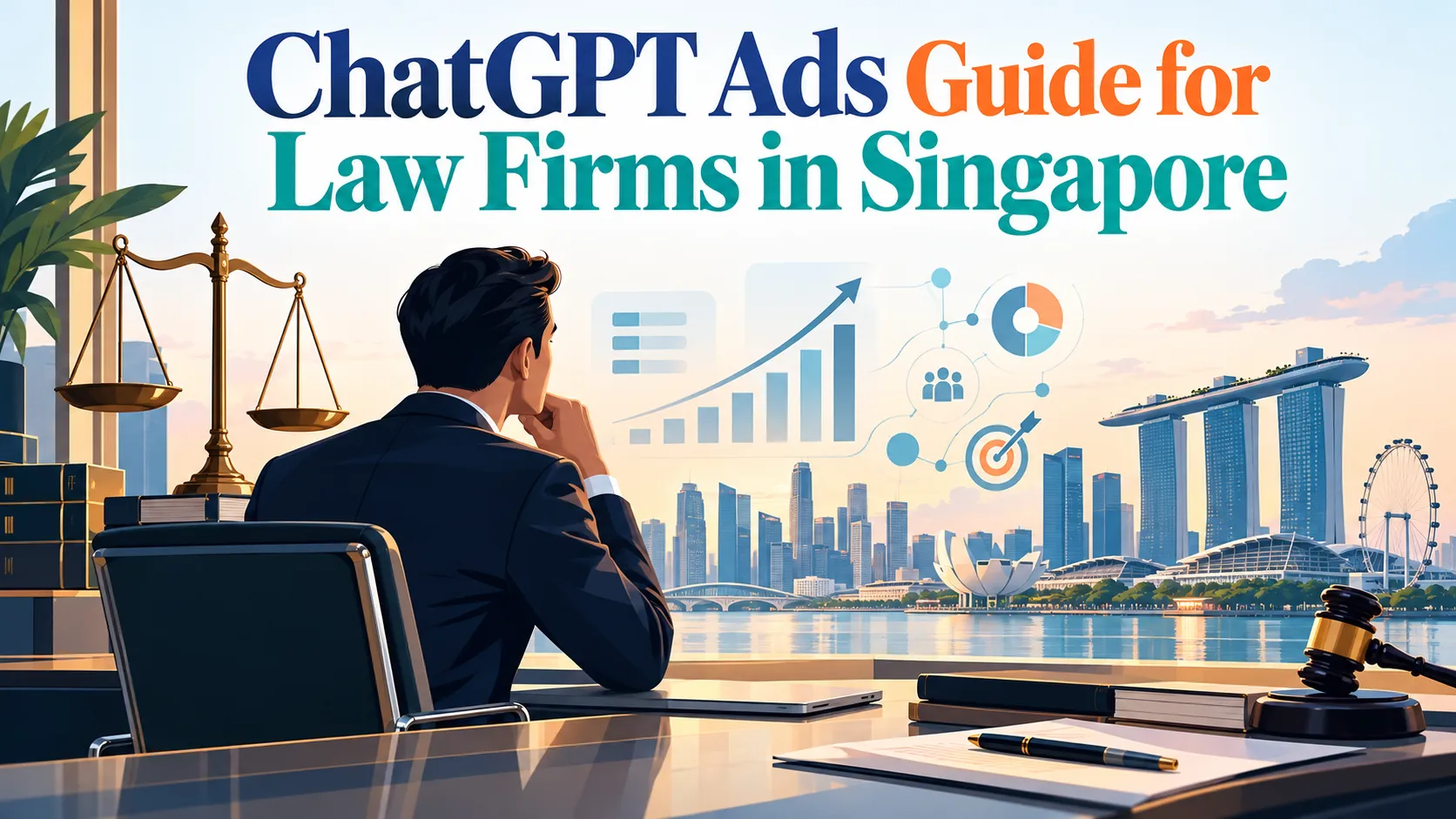
Should Singapore law firms run ChatGPT Ads now? For most firms, the answer is a small, scoped test, not a budget shift. Conversational ads are new, the evidence is thin, and professional advertising rules are stricter than those facing a retail brand. This guide sets out a cautious view and a clear decision rule: which buyer scenarios to test, what Singapore’s rules require, how the three service tiers compare, and what a 30-day test should look like.
Key Takeaways
- Start with a narrow test. For most firms, the sensible first step is a small test alongside existing Google and Meta spend.
- Define buyer scenarios before committing budget. A specific question, such as a tenant asking whether a landlord can end a lease, works better than a broad “lawyer near me” keyword.
- Score each scenario on four criteria. Specificity, practice fit, compliant creative and measurability decide which scenarios to test first.
- Check the regulatory position before writing creative. Avoid outcome promises, comparative claims and unverified testimonials, and confirm that enquiry data flows meet PDPA obligations.
- Verify tracking in week one. If the pixel and Conversions API do not record enquiries correctly, you cannot tell whether ChatGPT Ads produce consultations.
- Judge the channel on cost per qualified consultation over at least 90 days. Early click volume and cheap leads are misleading signals.
A Decision Rule and a 30-Day Test Plan
Test only if at least one buyer scenario scores 10 or more out of 12 on the framework below, and your tracking records a consultation booking. If neither condition holds, fix the gap first.
A workable 30-day test has four stages:
- Days 1 to 5: verify tracking. Confirm that a test enquiry registers as a consultation event.
- Days 6 to 10: launch one or two scenarios. Keep the budget small and fixed for the test period.
- Days 11 to 25: read the early signal. Track consultation bookings, not clicks.
- Days 26 to 30: decide. Continue only if the cost per qualified consultation is within the threshold you set before launch.
Set your budget and threshold in advance:
- Test budget: a fixed sum agreed before the campaign starts, sized to what the firm can afford to lose while learning.
- Cost ceiling per qualified consultation: a maximum figure agreed in advance, so every result is judged against a known benchmark.
- Exit criterion: pause the campaign if spend reaches the agreed limit without a qualified consultation being booked.
Worked example (hypothetical): divide the test budget by the cost ceiling per qualified consultation to get the number of consultations the test must produce. Suppose the budget is set at a fixed amount and the ceiling is set at a fixed amount per qualified consultation. The firm should book enough qualified consultations to cover that budget at the ceiling, so the test stays within its limits. A firm that spends the full budget and books none has a clear reason to pause, regardless of how many clicks it received.
Is ChatGPT Advertising Suitable for Your Practice Area?
Not every practice area suits chat-based ads. Score each candidate scenario on four criteria, each out of three, for a maximum of 12:
| Criterion | 0 | 3 |
|---|---|---|
| Specificity | Broad question | Concrete, situation-specific question |
| Practice fit | Outside core experience | Core, repeatable matter |
| Compliant creative | Needs outcome claims | Can be stated accurately within rules |
| Measurability | No consultation tracking | Consultation event tracked end to end |
Score a scenario 10 or higher to test it first. Score it below 7 to drop it.
Practice areas with high-intent, consultation-led enquiries
Areas where a prospect typically needs to speak to a lawyer before acting, such as family matters, tenancy disputes and employment questions, tend to produce specific, situation-led questions. These suit a consultation offer well.
Practice areas where chat-based ads are likely a poor fit
Matters where the outcome depends heavily on confidential facts, or where advertising rules limit what can be said about results, usually score low on compliant creative. Firms in those areas should exclude them from the test entirely and focus on scenarios that score higher.
What ChatGPT Ads Are and Why Law Firms Should Pay Attention
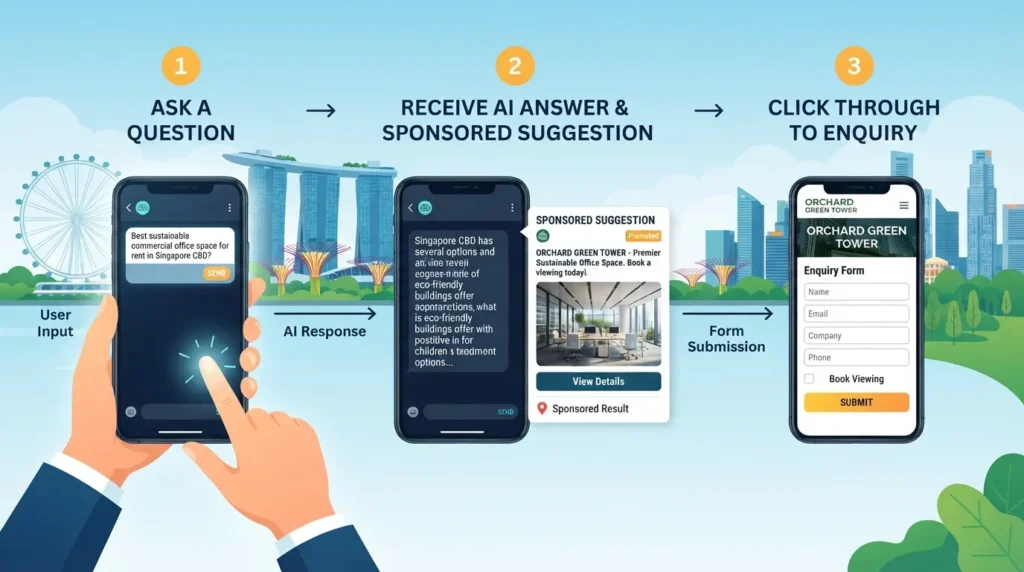
ChatGPT Ads place a sponsored message inside a conversation with an AI assistant. A prospect asks a question, and the answer may include a clearly labelled sponsored suggestion. The person often describes a real problem in their own words, not browsing a list of results. That gives an advertiser a different kind of signal.
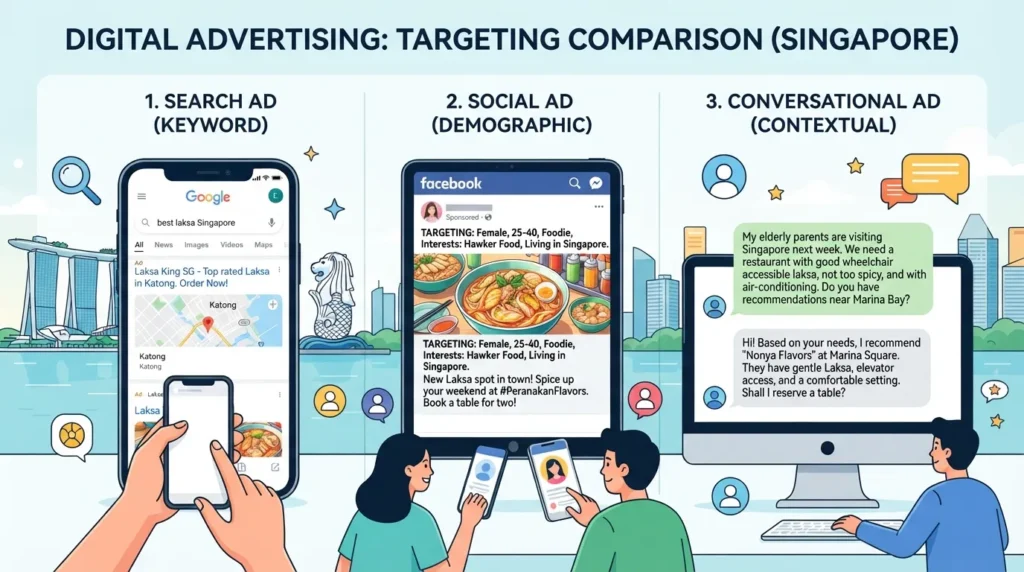
A search ad responds to a short string of keywords. A social ad responds to a profile and an interest, usually without any stated need. A conversational ad responds to a full question, often several sentences long, with context about the person’s situation.
| Feature | Search ads | Social ads | Conversational ads |
|---|---|---|---|
| Signal used | Keywords | Profile and interests | Full question |
| User mindset | Comparing options | Scrolling | Describing a problem |
| Creative format | Text headlines | Image or video | Text in an answer |
Keyword intent asks, “Which firm handles this?” A buyer scenario asks, “What does this person need to know before they decide to act?” Take a prospect who types a full question about a shareholder deadlock. Search would match “shareholder dispute lawyer”. The chat question carries the stage, the stakes and the uncertainty, which shows whether to offer a consultation or a process explanation.
Why buyer intent in a chat interface matters for legal services
Legal enquiries are rarely casual. A person asking whether a landlord can end a lease, or whether a non-compete clause is enforceable, usually faces a decision involving money, property or livelihood. Intent is high, but so is caution. Prospects want specifics and want to know whether a lawyer can help before they commit.
A chat context can reach people while they are still weighing their options, which is valuable. The same context makes overpromising easy. A creative line implying a guaranteed outcome would not survive a professional advertising review, and it would damage trust with the prospects a firm wants.
The strongest opportunity for a law firm is therefore not volume. It is narrow, specific scenarios where the firm has real experience and can give a measured, accurate response.
What is still unproven about ChatGPT Ads for professional services
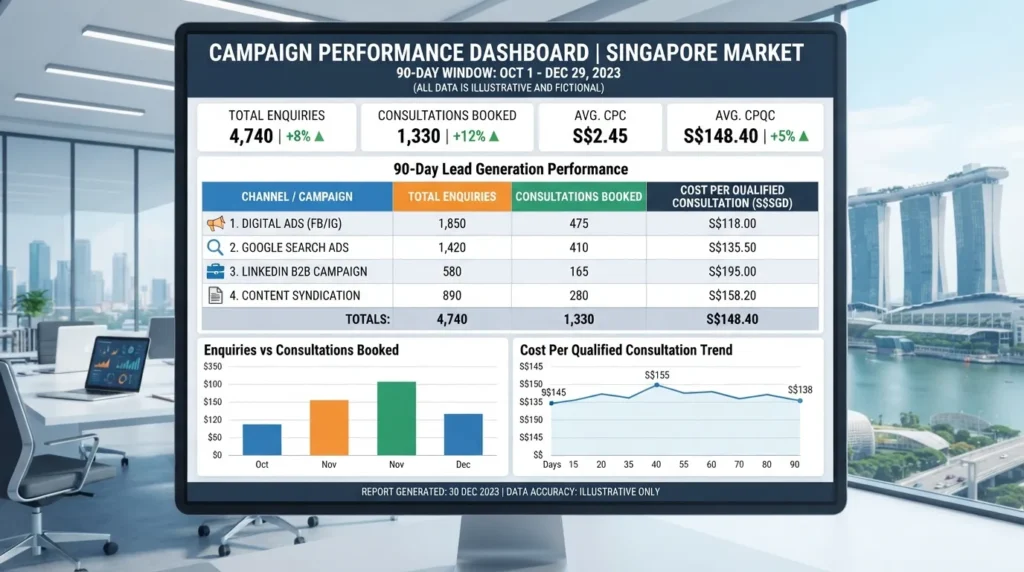
There is no independent, long-run body of evidence showing what conversational ads cost per qualified consultation for law firms, or how they compare with Google or Meta over a full year. Results from any one account will vary by practice area, market and creative quality, and should not be treated as a benchmark.
Several questions remain open:
- Measurement: How reliably can an enquiry that begins in a chat be linked back to the ad that prompted it, and how much of that link survives privacy controls?
- Volume: How many Singapore prospects in a given practice area ask questions a firm can answer under its advertising rules?
- Lead quality: Do conversational enquiries convert to paying clients at a rate comparable to search enquiries?
- Policy: How will platform rules on sensitive categories, including legal services, develop over time?
A firm that cannot yet answer these questions should test on a small, measured scale rather than commit a large budget.
Is ChatGPT Advertising Suitable for Your Practice Area?
Not every practice area should spend money on ChatGPT Ads for law firms. Some firms will get enquiries that turn into paying matters. Others will pay for clicks that never reach a consultation. The difference usually comes down to how the client decides to seek help, and how much they need to talk to a lawyer before they act.
Practice areas with high-intent, consultation-led enquiries
The best candidates are practice areas where a prospect has a specific, urgent problem and needs a lawyer’s view before deciding what to do next. Enquiry patterns for legal accounts typically show these areas:
- Employment disputes, such as wrongful dismissal after a retrenchment exercise or unpaid salary claims.
- Tenancy and landlord matters, such as lease termination, deposit disputes or breach of a commercial lease.
- Shareholder and company disputes, such as deadlock between founders or disagreements over share transfers.
- Family matters, such as divorce or custody questions, where the client wants to know their options before committing.
These prospects often phrase their questions in full sentences, which suits a conversational interface. A founder who types “my co-founder wants to exit and I think the shareholder agreement is unclear” is far more ready to book a consultation than someone who searches a single keyword. Chat-style ad placements are a newer format, so firms should test the channel before assuming it works for their practice.
Practice areas where chat-based ads are likely a poor fit
Some practices are harder to justify on this channel. Where the buyer journey depends on price comparison, a lengthy research phase, or a brand decision made over many months, conversational ads generate interest without enough qualified enquiries. Routine, high-volume work such as simple wills or standard conveyancing is often bought on price and speed, which the chat format may not reward. Exclude these from the first test so the budget goes where a consultation is most likely.
Be cautious with matters where the client may not yet know they have a legal problem. A prospect who has not framed the issue as legal is unlikely to ask an assistant for a lawyer. Test these areas only if your existing data already shows strong conversion from the same type of prospect.
A scoring framework to decide whether to test
Before committing budget, score each candidate buyer scenario on four criteria. A buyer scenario is a specific question a prospect might ask an AI assistant. Give each criterion a score from 1 (weak) to 3 (strong):
| Criterion | Question to ask | Score 1 | Score 3 |
|---|---|---|---|
| Specificity | Is the question clear? | Vague concern | Detailed question |
| Practice fit | Does the firm handle this well? | Occasional matters | Core practice |
| Compliant creative | Can we advertise it factually? | Needs guarantees | Process-led copy |
| Measurability | Can enquiries be tracked? | No clear event | Trackable consultation |
A total of 10 or more out of 12 suggests the scenario is worth testing. Scores of 7 to 9 mean the scenario needs work on one or two criteria, usually creative or tracking, before spend. Below 7, leave it alone for now.
The same logic maps onto the Buyer Scenario Readiness Matrix used in our ChatGPT ads agency service, where scenarios that score well on all four criteria go first. Our Starter Plan (From S$850/month) covers up to 2 buyer scenario sets, which suits a firm testing one or two strong scenarios. The Growth Plan (From S$1,245/month) allows up to 5 sets, and the Enterprise Plan (From S$3,550/month) has no set limit.
A low measurability score does not always mean a scenario is weak. Some firms have older intake systems that make tracking hard. In that case, fixing tracking may be the first project, and the scenario may be worth testing once it is in place.
Understanding the Three Service Tiers and What Each Includes
Our Starter Plan (From S$850/month) suits a firm testing ChatGPT Ads for the first time with a focused buyer scenario. It covers OpenAI Ads account setup and verification, up to 2 buyer scenario sets, conversational ad creative in 2 variations, Pixel and Conversions API setup, and monthly performance reporting.
The Growth Plan (From S$1,245/month) suits SMEs ready to scale across more scenarios. It includes everything in Starter, plus up to 5 buyer scenario sets, conversational creative in 5 variations, bid strategy optimisation (CPM, oCPC or oCPM), Event Quality Score monitoring and a dedicated account manager.
The Enterprise Plan (From S$3,550/month) suits larger firms aiming for a dominant position in a competitive category. It includes everything in Growth, plus unlimited buyer scenario sets, a full conversational creative library, cross-channel integration with SEO, GEO, Google Ads and Meta Ads, AI-powered campaign management and quarterly strategy sessions.
Bid strategy options and the Conversions API should be checked against OpenAI’s own ads documentation before purchase, because feature availability can change. A firm should confirm which options are generally available in its account, not just those described in a plan summary.
Singapore Regulatory Constraints on Legal Advertising
Law firm advertising in Singapore is governed by the Legal Profession Act and Law Society guidance. The Law Society’s rules restrict misleading statements, unverifiable claims and comparisons with other lawyers. A firm should review the current text before any launch, because the rules apply to every channel, including conversational ads.
In practice, three areas need attention:
- Accuracy: A claim about a result, timeline or fee must be verifiable. Avoid phrases that imply a guaranteed outcome.
- Comparative claims: Do not compare your firm with named or unnamed competitors on quality or price unless the rules permit it.
- Testimonials: Only use client testimonials where the firm can confirm they are genuine and the rules allow them.
Lead capture also engages the Personal Data Protection Act. A prospect who types a legal problem into a form is sharing sensitive information. Confirm the consent wording, retention period and access controls before the form goes live, and check that tracking pixels do not collect more data than the enquiry needs.
As a worked example of compliant copy, a firm might write: “Wondering whether your lease allows early termination? Book a consultation to review your terms with a lawyer.” This describes a service and a next step without promising any outcome. The non-compliant version, “Get your lease terminated for free, guaranteed,” makes an outcome promise and should never run.
Building Buyer Scenarios for a Law Firm
Defining the buyer scenario and why it replaces traditional keyword lists
A buyer scenario is a specific question a prospect might type into an AI assistant, written the way the prospect would phrase it. It replaces a keyword list because the question carries context that a short keyword cannot. A scenario should name the situation, the stakes and the next decision the person faces.
Mapping scenarios to practice areas and client stages
For each practice area you shortlist, write three to five scenarios at different stages: an early question about rights, a question about a specific step, and a question about whether to hire a lawyer. Early-stage scenarios often generate the most volume, but later-stage scenarios usually convert to consultations more readily. Test a mix, then weight your budget toward the stage that produces qualified bookings.
Worked example: a three-partner family law practice
A three-partner family law practice might write three scenarios: “What happens to the family home if we divorce but still share a mortgage?”, “How do Singapore courts consider custody when parents live apart?” and “Do I need a lawyer before filing for divorce?” Each scores on the four criteria. The first scores well on specificity and practice fit, so it goes into the first test. The third scores lower on specificity because it is broad, so the firm holds it back until the first scenario has produced data.
Creating Conversational Ad Creative That Complies and Converts
Avoiding guarantees, outcome promises and misleading claims
Good conversational creative explains the process and offers a consultation. It should not promise a result, claim a success rate the firm cannot verify, or imply that a prospect will win. Read each line as a regulator would: could a reasonable prospect take it as a promise?
Testing creative variations without breaching confidentiality
Test two or three variations that change the framing, such as a question-led opening against a process-led one. Do not use real client details, case outcomes or confidential facts to make a variation more persuasive. Measure which variation books more consultations, and retire the rest.
Conclusion and Next Steps
ChatGPT Ads are worth a small, measured test for firms with a specific practice area, a scenario that scores well and working tracking. They are not yet a reliable replacement for existing channels. Start with one or two scenarios, a fixed budget and a clear cost-per-consultation threshold, and decide at day 30 and again at day 90.
Summary of when to test and when to wait
Test when a scenario scores 10 or more out of 12 and tracking records consultations. Wait when creative needs guarantees, when tracking is broken, or when the practice area depends on price comparison.
A pre-launch checklist for your firm
- Confirm the scenario score and the test budget in writing.
- Check the Law Society guidance and your firm’s own rules on each line of creative.
- Confirm the consent wording, retention period and tracking setup under the PDPA.
- Verify that a test enquiry registers as a consultation event.
- Set the cost-per-consultation threshold and exit criterion before launch.
Singapore Regulatory Constraints on Legal Advertising
Singapore law firms should check the rules on what they may say about themselves before they set up any conversational ad. Most compliance problems come from creative written as if the firm were a consumer brand. A legal practice is regulated differently. The risks sit in three areas: how the firm may advertise, what it can claim, and how it handles the personal data of people who respond.
Law Society of Singapore rules on legal advertising
Advertising by advocates and solicitors in Singapore is governed by the Legal Profession Act and the professional conduct rules set by the Law Society of Singapore. The broad principle is that advertising must be dignified, must not be misleading, and must not amount to touting for work. Read the current Law Society guidance directly before approving any creative, because the rules are updated and summaries go out of date. This guide was checked against these sources in October 2026. Recheck them before launch.
Conversational ad formats do not change these core duties. A chat-based ad is still a communication by the firm to the public. What changes is the context. The prospect may be asking an AI assistant about a dispute, and the ad appears inside that conversation. That makes it easy to slip into language that sounds like advice. Creative should describe the firm and its services. It should never answer the prospect’s legal question inside the ad.
Ads must not solicit matters, promise outcomes, or target people in a way that could be seen as touting. Confirm the specific restriction on direct solicitation in the current Law Society rules before launch. A compliant chat ad for a chatgpt ads for law firm campaign follows the same rule: it describes the firm and never reads like an answer.
A compliant example. “Our family law team advises on divorce, child arrangements and matrimonial property. Book a consultation to discuss your situation with a named lawyer.” This describes the firm and its services, makes no outcome promise, and does not answer a legal question.
Accuracy, comparative claims and client testimonials
Three types of claim cause the most trouble:
| Claim type | Risk | Check before approval |
|---|---|---|
| Outcome promises | Misleading, impossible to guarantee | Describe the process instead |
| Comparative claims | Unsubstantiated superlatives | Use verifiable facts about the firm |
| Client testimonials | Confidentiality and consent | Confirm written consent |
Accuracy also applies to the firm’s own details. Practice areas, fee arrangements, languages spoken and office locations should match what the firm offers today. Creative has gone live advertising a practice area the firm had stopped handling. That is a fixable error, but it should never reach a live audience.
Testimonials need the most care. Even with consent, a testimonial about a family matter can identify a client to people who know them. Avoid testimonials about contentious or sensitive matters entirely, and use general statements about client experience instead.
Personal Data Protection Act considerations for lead capture and tracking pixels
When a prospect submits an enquiry, the firm collects personal data. The Personal Data Protection Commission oversees the Personal Data Protection Act 2012 (PDPA), which sets obligations on notice, consent and purpose limitation. Enquiry data flows must meet these obligations, so confirm the approach with your data protection officer.
Tracking adds a second layer. A pixel or the Conversions API passes event data back to the ad platform, so the firm must be clear about what is sent and why. Three steps reduce the exposure:
- Tell the prospect at the point of enquiry what information is collected and how it will be used, in a short privacy notice linked from the form.
- Keep the data sent to the ad platform to the minimum needed to measure conversions, such as an event name and a timestamp. Do not send the content of a legal enquiry.
- Make sure the privacy policy describes the use of tracking technologies, and review it when the tracking setup changes.
Treat the enquiry form as a sensitive intake point, not a marketing data field. Sending a prospect’s description of their dispute to an ad platform is a mistake that should never happen.
Understanding the Three Service Tiers and What Each Includes
Most law firms start by asking which tier they need. A better starting point is what the channel can do for the firm. The right tier depends on how many buyer scenarios the firm can test, how much creative it can write without overpromising, and how much management time its partners can spare. This section sets out what each tier includes and where the limits sit.
Starter: scope, buyer scenario limits and reporting
The Starter Plan starts from S$850 per month. It suits a firm testing ChatGPT Ads for the first time with one focused practice area. It covers OpenAI Ads account setup and verification, up to two buyer scenario sets, two conversational ad creative variations, pixel and Conversions API setup, and monthly performance reporting.
The Conversions API is a server-side connection that sends conversion events from the firm’s own systems to the ad platform. It works alongside the pixel, which is a browser-based tracking code.
The two-scenario ceiling is the main limit. Two scenario sets is enough to test one practice area properly, for example one employee-side question and one employer-side question within employment law. It is not enough to compare several practice areas at once. Running four or five unrelated scenarios on Starter blurs the results, and the firm cannot tell which buyer question is producing enquiries.
Monthly reporting on Starter shows enquiry volume and cost per enquiry for each scenario set. In the first two months, read it as a direction indicator, not a verdict.
Growth: bid strategy options and account management
The Growth Plan starts from S$1,245 per month. It suits a small or medium firm ready to test several buyer scenarios and creative sets. It includes everything in Starter, plus up to five buyer scenario sets, five conversational creative variations, bid strategy optimisation, Event Quality Score monitoring, and a dedicated account manager.
Bid strategy is how the platform decides which people to show the ad to and how much to pay for them. The options the firm can use depend on what OpenAI currently makes generally available. Check the OpenAI ads documentation for the bid options on offer, and confirm with the provider before planning any option into a test.
Event Quality Score is a measure of how well the conversion signals sent from the firm’s systems match real prospects. A cheap enquiry is only useful if it is a real prospect. Watching this score shows when optimisation is rewarding volume over quality.
The dedicated account manager is the practical difference. A partner can ask a question and get an answer from someone who knows the account history, rather than waiting for a ticket to be triaged.
Enterprise: cross-channel integration and strategic reviews
The Enterprise Plan starts from S$3,550 per month. It suits multinational companies and firms in highly competitive practice areas that want a strong presence in their category. It includes everything in Growth, plus unlimited buyer scenario sets, a full conversational creative library, cross-channel integration with SEO/GEO and Google and Meta Ads, AI-powered campaign management through Digimetrics, and quarterly strategy sessions.
Cross-channel integration matters when ChatGPT Ads is one part of a wider acquisition plan. If the same practice area is also bought through Google Ads and organic search, the firm needs one view of which buyer question converts through which channel. Without that view, enquiries get double-counted and budget gets cut in the wrong place.
Quarterly strategy sessions give a managing partner a regular checkpoint to decide whether to expand, hold or stop. Enterprise is worth its cost only when the firm already has measurable demand across several scenarios.
Matching a tier to your firm’s size and budget in S$
The table below compares the three plans on the points that usually decide the choice. Prices are the starting monthly fees as stated. Confirm current pricing with the provider before budgeting.
| Factor | Starter (From S$850/month) | Growth (From S$1,245/month) | Enterprise (From S$3,550/month) |
|---|---|---|---|
| Buyer scenario sets | Up to 2 | Up to 5 | Unlimited |
| Creative variations | 2 | 5 | Full library |
| Bid strategy optimisation | Not included | Included | Included |
| Event Quality Score monitoring | Not included | Included | Included |
| Dedicated account manager | Not included | Included | Included |
| Cross-channel integration | Not included | Not included | Included |
| Quarterly strategy sessions | Not included | Not included | Included |
Start on Starter if the firm has one practice area and one or two clear buyer questions. Choose Growth if it has two or three practice areas or a proven scenario to scale. Choose Enterprise only when ChatGPT Ads will sit alongside substantial Google, Meta or SEO investment and the firm needs one reporting view across them.
Two cautions apply. The monthly fee is not the media budget. Ad spend is separate, so model the total cost of a 90-day test, not just the plan price. The cheapest plan per month is also not always the cheapest per qualified consultation. A Starter test that runs too narrow can produce a weak signal, and the firm then pays for a second test. Choose the plan that lets the firm answer its question in one cycle.
For the first 90 days, the monthly report guides the decision. Expect it to show enquiry volume, cost per enquiry and early Event Quality Score trends. Do not judge a scenario on one month of data. Review two or three consecutive reports before deciding to expand. If you are still deciding between channels, our guide to ChatGPT ads vs Google ads sets out where each one tends to fit, and a ChatGPT ads agency can walk through which tier suits your practice mix.
Building Buyer Scenarios for a Law Firm
Defining the buyer scenario and why it replaces traditional keyword lists
In search advertising, a keyword list tells the platform which words to match. In a conversational interface, a person describes a problem in full sentences. They often add context such as their role, their deadline and what they have already tried. A keyword like “employment lawyer” captures only a fragment of that. A buyer scenario captures the situation itself.
We define a buyer scenario as a specific question a prospect would put to an AI assistant, together with the stage of intent behind it. For example: “I was retrenched last month and my employer offered a payout if I sign a release. Is that fair?” That one question tells you the practice area, the urgency, the emotional state and the likely next step, which is a consultation. A keyword list would need dozens of variants to approximate it, and it would still miss the context.
The difference shows up in how a firm reads its results. A keyword such as “chatgpt ads for law firm” tells you a platform is matching a phrase. A buyer scenario tells you which real situation produced an enquiry, so the firm can judge whether the enquiry is worth a consultation.
For a law firm, the scenario approach has two practical advantages. First, it forces the firm to name the exact problems it solves well. This is the same discipline a good consultation intake already demands. Second, it makes compliance easier to check. Creative written around a concrete, factual situation is easier to keep accurate than creative built on broad promises such as “winning cases” or “maximum compensation”.
A useful test: if you cannot write the scenario as one question a real client could type, it is not yet a buyer scenario. It is a topic.
Mapping scenarios to practice areas and client stages
Once you have candidate scenarios, sort them on two axes: the practice area they belong to, and the stage the client has reached. Singapore practices tend to cluster around a few recurring matters. Employment disputes, tenancy and lease questions, family matters, and company or shareholder disputes are common examples. Each generates a different kind of first question.
Client stage matters because the same practice area produces very different intent at different points. Broadly, a prospect moves through three stages:
| Stage | What the prospect is asking | Typical scenario shape |
|---|---|---|
| Problem recognition | “Do I have a claim or a risk?” | Describes events, asks if they are legal issues |
| Option evaluation | “What can I do, and what would it cost?” | Compares routes such as mediation or litigation |
| Provider selection | “Who should I instruct?” | Asks about suitability, experience or process |
Scenarios at the problem recognition stage are usually broad and produce lower-intent clicks. Scenarios at the option evaluation and provider selection stages are more specific and tend to convert to consultations more reliably. For a first test, we generally prioritise scenarios in the option evaluation stage. They combine a concrete question with a clear reason to book a conversation.
Mapping the two axes into a short grid gives you a shortlist. Keep the list to a handful of entries. Each scenario you add creates creative and measurement work, so the number you can test properly is limited.
Worked example: a three-partner family law practice
Consider a three-partner family law practice in Singapore. The partners want to test ChatGPT Ads but are cautious about both budget and how the firm’s advertising will look to the Law Society. The example below shows how they narrowed the field.
Step 1: List candidate scenarios. The team drafts five possible questions a prospect might ask an AI assistant:
- “My husband wants a divorce and I’m worried about losing the house. What are my options?”
- “How is custody decided for children in Singapore?”
- “I want to apply for a divorce but I don’t know if I qualify. Where do I start?”
- “What is a good family lawyer in Singapore?”
- “Can I get maintenance from my spouse if we separate?”
Avoiding guarantees, outcome promises and misleading claims
Law firm advertising in Singapore is governed by professional conduct expectations. Creative must not promise a result, imply a guaranteed outcome or make a claim the firm cannot back up. Words such as “guaranteed”, “win your case”, “maximum compensation” or “no risk” should be removed from every draft. Comparative claims such as “the best employment firm in Singapore” are also a problem unless the firm can evidence them on request.
Ads must not solicit matters, promise outcomes or target people in a way that could be seen as touting. The Law Society restricts direct solicitation, so the ad should invite a prospect to learn more rather than pressure them to instruct the firm. Confirm the current wording of the rules directly with the Law Society of Singapore before launch.
Before any creative goes live, check three things:
- Does the copy promise or imply a result the firm cannot control?
- Could a reader reasonably take a claim as a guarantee of fees, timelines or outcomes?
- Can the firm evidence every factual statement on request?
Client testimonials need particular care. Do not use a testimonial that discusses the outcome of a specific matter unless the firm has checked it against current Law Society of Singapore advertising guidance. When in doubt, remove the testimonial and describe the process instead.
Testing creative variations without breaching confidentiality
Testing creative is valuable, but it must never expose client information. Do not use real matter details, client names or case facts as the basis for an ad or a test variation. Build every buyer scenario from general, publicly understood situations, and write the example facts as hypotheticals.
Keep the process clean. Use the same review checklist for each variation, store approved versions in one place, and do not reuse wording drawn from an actual file. If a variation is inspired by a real matter, anonymise it heavily and have a partner sign off before it runs. Measure aggregate results, such as the number of enquiries and their qualification rate, rather than any individual’s story.
Testing also has to respect personal data rules. Enquiry data passed through a pixel or the Conversions API must meet the consent and purpose-limitation obligations of the Personal Data Protection Act (PDPA). Confirm the approach with the firm’s data protection officer before the test starts, and avoid placing sensitive personal details in tracked fields.
Conclusion and Next Steps
Some Singapore law firms may find ChatGPT Ads worth testing in 2026. They do not replace Google or Meta search spend, and they do not suit every practice. Most firms should run a small test, scoped to two or three buyer scenarios, and judge it on cost per qualified consultation rather than cost per click.
Summary of when to test and when to wait
Test now if your practice handles matters where a prospect describes a specific problem to an AI assistant, such as a founder asking about a shareholder dispute or a tenant asking about lease termination. Test now if you already log every enquiry, can follow up within a working day, and have someone who can write creative that stays within the Law Society’s advertising rules.
Wait if your practice relies on broad, reputation-led work that is hard to reduce to one question. Wait also if your intake process cannot yet tell you which enquiries came from which channel, or if your budget cannot absorb several months of learning. Early results on a small account are noisy, and a firm that stops after three weeks will learn very little.
| Situation | Recommendation |
|---|---|
| Two or three clear buyer scenarios, enquiries logged and followed up quickly | Test with a focused set |
| Broad reputation work with no single clear question | Wait and strengthen search and GEO work first |
| Intake cannot attribute enquiries to a channel | Fix tracking and enquiry handling first |
| Budget covers a fair test period | Proceed with a 30-day first phase, then review |
| Budget covers only a few weeks | Wait until the budget allows a fair test |
A firm should start with one scenario it understands rather than five it cannot measure. Writing the scenario down is often the most useful output of the whole exercise.
A pre-launch checklist for your firm
Work through these points before any ad goes live. If you cannot tick an item, pause and fix it first.
- Buyer scenarios: Write down two or three specific questions a prospect would ask an AI assistant, each tied to one practice area.
- Scenario scoring: Score each scenario on specificity, fit with your practice and capacity, ability to write compliant creative, and measurability. Start with the ones that score well on all four.
- Compliance review: Check the draft creative against current Law Society of Singapore guidance on advertising and solicitation. Remove guarantees, outcome promises and comparative claims you cannot substantiate.
- Confidentiality: Confirm that no client details appear in any creative or testing material.
- Landing page: Send traffic to a page written for that specific scenario, not your generic homepage.
- Consultation route: Define exactly what counts as a qualified enquiry, and who receives it.
- Pixel and Conversions API: Confirm that the enquiry event fires correctly on a test submission. Review the data flow against your Personal Data Protection Act (PDPA) obligations, and confirm the approach with your data protection officer.
- Enquiry handling: Set a response standard, such as contact within one working day, and assign a named person to it.
- Budget and target: Set a monthly budget and a cost-per-consultation figure in S$ that would make the channel worth continuing.
- Reporting: Agree in advance which numbers the managing partner will review, and when. Treat early click and impression figures as signals, not verdicts.
- Plan fit: Match the number of scenario sets to your plan. The Starter Plan (From S$850/month) covers up to 2 buyer scenario sets, the Growth Plan (From S$1,245/month) covers up to 5, and the Enterprise Plan (From S$3,550/month) covers unlimited sets.
- Review date: Put a 30-day review in the diary now, with a clear decision to continue, pause or expand.
If you want a second opinion on your scenarios or compliance review before launch, our ChatGPT ads agency team can walk through the checklist with you. Before you sign with any provider, the questions to ask a ChatGPT ads agency guide is a useful starting point.
Can law firms in Singapore legally run ChatGPT Ads?
Yes, a law firm can advertise in Singapore, but the content must meet the professional advertising rules that govern lawyers. Before launching any conversational creative, check the current guidance from the Law Society of Singapore on advertising and solicitation. Ads must not solicit matters, promise outcomes or target people in a way that could be seen as touting. The main risks are usually the wording: promises of outcomes, unverified comparisons and testimonials that could mislead a prospect. We recommend having the creative reviewed against those rules before it goes live.
What is the minimum budget needed to test ChatGPT Ads?
The entry point is the Starter Plan, from S$850 per month. That fee covers account setup and verification, up to two buyer scenario sets, two creative variations, pixel and Conversions API setup, and monthly performance reporting. Ad spend is separate from the management fee, so the total budget depends on how much you allocate to media.
A simple way to set the number is a worked calculation. Take the management fee of S$850, add the media budget for the test period, and divide the total by the number of qualified consultations you expect. Then set a cost ceiling per qualified consultation that the firm is willing to pay, and treat any result above that ceiling as a reason to pause. Keep the scope narrow for a first test: two scenarios, two creatives and one reporting cycle, so the result is readable without a large spend.
How long before ChatGPT Ads show usable results?
Expect the first two to three weeks to produce early signals only, mostly on impressions, clicks and whether enquiries are recorded correctly. A reliable read on cost per qualified consultation needs a longer run of data, and the length depends on enquiry volume. Acting on a few enquiries in week one is a common mistake. Set your decision date in advance and judge the test against the criteria you wrote before launch.
Do I need a separate tracking setup from my Google Ads account?
Yes. ChatGPT Ads needs its own pixel and Conversions API configuration, and its enquiry events should be defined separately from your Google Ads conversions. Sharing a tag or reusing a Google conversion label blurs which channel produced the lead. Make sure enquiry events fire on the correct confirmation step, and test them before launch. Setup is included in the Starter Plan.
Is a managed service necessary, or can an in-house team run the account?
An in-house team can run the account, provided someone has the time to build buyer scenarios, write compliant creative and review event quality each month. Many firms underestimate that workload. A managed service makes sense when the firm lacks that capacity or wants compliance checks built into the process. The Growth Plan, from S$1,245 per month, adds a dedicated account manager and bid strategy optimisation, which is useful once several scenario sets run at the same time.
How should a firm handle leads generated by an ad before a consultation?
Respond quickly and log every enquiry against its source, because a slow reply is one of the most common reasons paid leads are lost. Record the practice area, the stage of the matter and whether the prospect booked a consultation. Keep personal data handling consistent with the PDPA, limiting what you collect to what the enquiry needs and telling the prospect how their details will be used. Review the log weekly to see which scenarios produce qualified consultations rather than just volume.