Parents now start school searches inside AI assistants as often as they start them on Google. The question for education advertisers is whether ChatGPT ads for education are a place to buy cheap impressions, or a place to reach families when they are weighing up a school. We think it is the second. This guide explains how conversational ads differ from search and social ads, how to plan buyer scenarios and creative before you spend, how to set up tracking, and how to choose among the three managed plan tiers. It is written for marketing managers, admissions leads and education founders who need a decision they can act on.
Key Takeaways
- Treat ChatGPT ads for education as a discovery channel for enquiries. Judge the channel on qualified enquiries per dollar, not on impressions.
- Define your buyer scenarios before you buy. Each distinct reason a family or student searches is one scenario. Count them first, because your plan tier depends on that count.
- Match the plan to your scenario and creative count. Starter from S$850/month covers up to 2 buyer scenario sets with 2 creative variations. Growth from S$1,245/month covers up to 5 sets with 5 variations. Enterprise from S$3,550/month offers unlimited scenario sets and a full creative library. Prices are indicative and subject to change.
- Get your enquiry pipeline ready before launch. Pixel and Conversions API setup only measures what your admissions team can record. Define enquiries, campus tour bookings and applications as conversion events first.
- Plan around registration peaks. Parent enquiry demand tends to rise around school registration periods. Plan creative and budget ahead of those peaks.
- Set a review rhythm and ask the right questions of any provider. Agree on reporting, quality monitoring and account management scope before signing, and judge results against admissions outcomes.
Table of Contents
- What ChatGPT Ads Are and How They Differ From Search and Social Ads
- Why Singapore’s International Schools and Education Providers Should Test ChatGPT Ads
- Mapping Buyer Scenarios for Schools, Tuition Centres and Training Providers
- Ad Creative for Conversational Formats in an Education Context
- Setting Up Your ChatGPT Ads Account, Pixel and Conversions Tracking
- Conclusion and Next Steps
- Frequently Asked Questions
What ChatGPT Ads Are and How They Differ From Search and Social Ads
A ChatGPT ad does not behave like the ads most marketing teams already run. Many schools and training providers treat a conversational placement as a search ad with a different logo. It is a different kind of channel, and the difference shapes creative, budget and measurement.
Defining conversational ad placements in ChatGPT
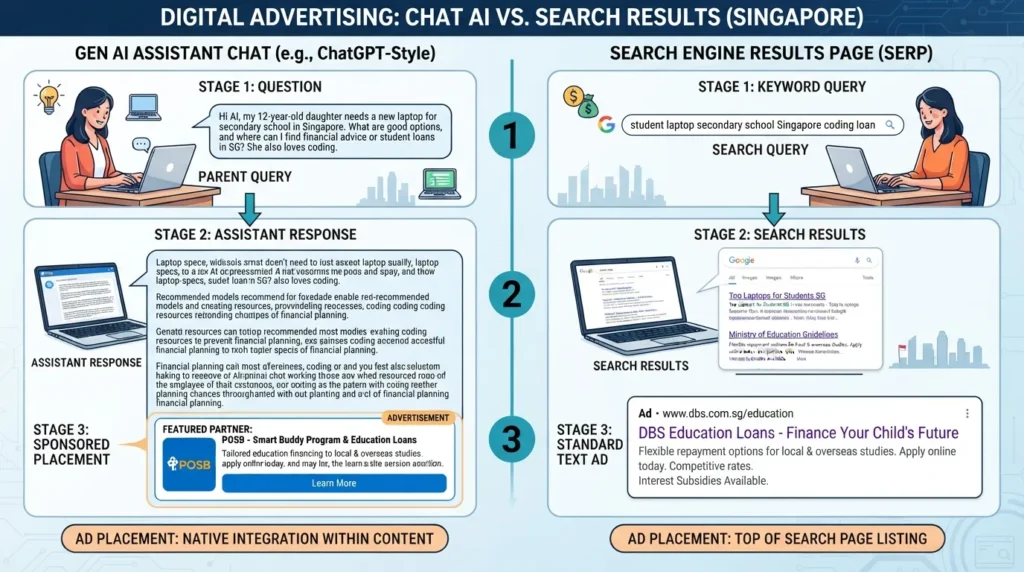
A conversational ad appears inside an AI assistant’s answer, not in a list of links. The user asks a question in plain language, the assistant responds, and a sponsored placement can appear as part of that exchange. The ad is read in the context of a dialogue the person has chosen to have. A search ad competes for a keyword. A conversational placement competes for a line of reasoning.
This matters for education. Parents rarely ask a search engine one clean question about a school. They describe a situation: a child who needs a flexible timetable, a family moving in six months, a student weighing a diploma against a degree. Conversational formats suit that kind of open, multi-part question. The creative has to fit inside the answer rather than shout over it.
How ad delivery in a conversation changes buyer intent
Intent in a conversation is usually less immediate than intent in a search box. A search such as “international school Singapore fees” signals someone close to a decision who is comparing prices. A question such as “my son is nine, we move from London next year, what should I look for in a school” signals someone still framing the decision. Both are valuable, but they call for different offers.
We have found it useful to split the two. Conversational placements tend to reach people earlier in the admissions journey, when they are still defining what they need. The enquiry prompt therefore matters more than a hard call to action. A parent who is not ready to book a campus tour may still accept a useful next step, such as a shortlist checklist or a fee guide. Schools that push for a booking too early often see low conversion and wasted spend.
Judge conversational campaigns on the quality of the enquiries that follow, not on the volume of impressions. Measurement is covered in detail later in this guide.
Where ChatGPT Ads sit alongside Google Ads and Meta Ads
Each channel answers a different question for the buyer. Google Ads captures people who already know the category and type a query. Meta Ads reaches people in feeds, often before they have clear intent, and relies on audiences and visual creative. Conversational ads sit between them. They reach people actively seeking advice, but the advice is generated rather than listed.
For a school, the three channels work best as a sequence. Meta can build awareness among parents in a target area or expatriate community. Google captures the explicit search for a named programme. Conversational placements reach the parent asking an assistant how to choose. We think most education providers should not move budget out of Google or Meta to fund conversational ads. A better approach is to test conversational placements against a fixed share of spend and compare the enquiry quality each channel produces. For example, a school might hold 80 per cent of its budget on Google and Meta and allocate the remainder to a conversational test, then compare cost per qualified enquiry across the two.
For a deeper comparison, see chatgpt ads vs google ads and chatgpt ads vs Facebook ads, which set out how the mechanics differ.
Counterpoint worth stating: conversational formats are new, delivery volumes are uncertain, and published performance benchmarks for education are limited. Do not assume early results will match mature search channels. Treat the first cycle as a controlled test with a fixed budget and a set review date.
Why Singapore’s International Schools and Education Providers Should Test ChatGPT Ads
Many education marketers still treat AI assistants as a curiosity. We believe that is a mistake. More parents and students now ask an assistant to compare schools, shortlist courses and explain entry requirements before they visit a search results page. For a school, that conversation is the enquiry stage, and it is worth paying to be part of. Surveys on AI-assistant use among Singapore parents are still limited, so this is our working view rather than a measured trend.
Parents and students researching schools inside AI assistants
Research often starts with a broad question. A relocating parent might ask which international schools in Singapore offer the IB Diploma. A 16-year-old might ask which polytechnic or private course suits a specific career. The assistant answers, narrows the field and asks follow-up questions. By the time the user clicks anything, they have formed a shortlist.
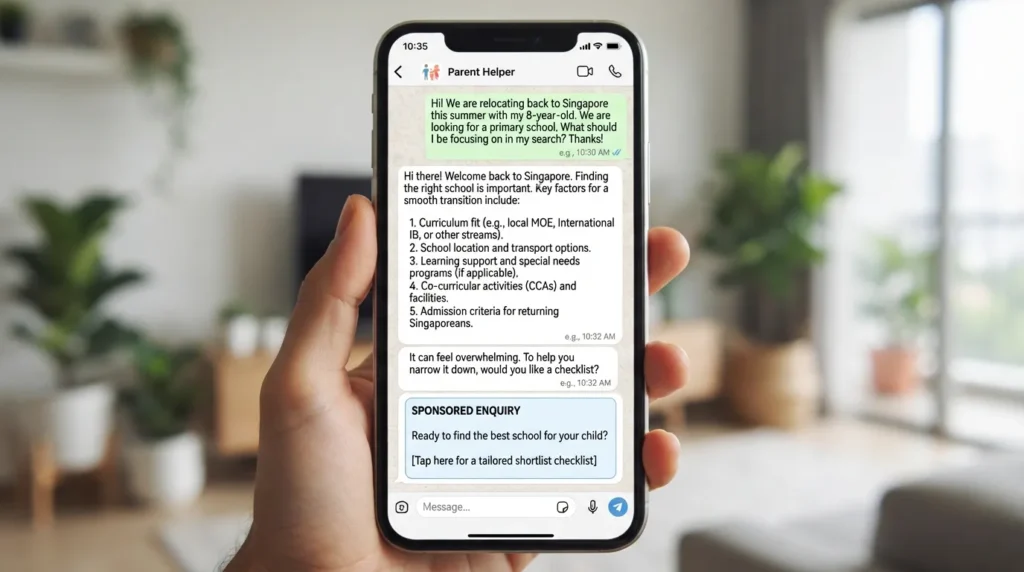
The advertiser’s task changes as a result. The person reading a conversational ad has described their situation in their own words. That context is richer than a single search keyword, so a well-matched ad can reach someone close to a decision. A school that waits for organic visibility inside these answers may find competitors already named.
The competitive pressure in Singapore’s international school market
Singapore’s international school market serves three groups: local families seeking an alternative to the national system, expatriate families relocating for work, and students pursuing a specific curriculum or pathway. Each group researches differently and decides on different timelines. Secondary school enquiries tend to rise around registration periods, so demand is concentrated rather than spread evenly across the year.
When many providers compete for that concentrated demand, being absent from the research moment becomes costly. A school that appears in a parent’s assistant conversation during a planning window has a presence that a competitor absent from it does not. That is the pressure we see in the market today.
Our thesis: conversational intent is the new enquiry stage for schools
ChatGPT ads for education should be judged on the quality of qualified enquiries, not on cheap impressions. A conversational placement is valuable because it meets a person mid-decision. Measuring it by cost per thousand impressions misses that purpose entirely.
Our sharper view is that conversational ads should outperform search once a family is still shortlisting, not yet comparing fees or booking a tour. Search tends to win when the parent already knows the school name and wants a price or a date. Conversational placements tend to win earlier, when the parent is asking what to look for.
The test is measurable. Track the share of conversational enquiries whose notes show the parent was still defining criteria, and the cost per qualified enquiry for that group against search. As a working rule, if at least 40 per cent of conversational enquiries are early-stage and their cost per qualified enquiry is within 25 per cent of search, the channel earns more budget. If early-stage enquiries are below 40 per cent, or cost per qualified enquiry runs more than 25 per cent above search, keep the weight on search. These thresholds are our suggested starting points, not benchmarks, and should be adjusted to your own admissions data.
For most Singapore education marketers, the right first step is to treat this channel as an enquiry tool, define the buyer scenarios it should serve, and track which scenarios produce admissions conversations. The counterpoint is fair: a new channel with limited history carries measurement risk, and a school with a small admissions team may not be able to follow up every enquiry quickly. Those constraints should shape the test, not stop it.
Mapping Buyer Scenarios for Schools, Tuition Centres and Training Providers
A buyer scenario is a specific situation that leads someone to look for an education provider. It describes who the person is, what they need and what would make them enquire. “Parents looking for a school” is not a scenario. “A relocating expatriate family with a Year 7 child who needs an IB Middle Years Programme place within three months” is one.
Scenarios matter because conversational ads depend on context. A parent who asks an AI assistant a detailed question about school options has already shared their situation. An ad that answers that situation directly tends to do better than a generic message. A generic message is what you get when a scenario is too broad.
Broad scenarios waste spend in two ways. First, one creative has to serve several intents, so it fits none of them well. Second, enquiries arrive from people who are not your admissions target, and your team spends time screening them out. When we review education accounts, the most common fault is a single scenario set covering every enquiry type a school offers.
Each scenario also needs its own creative and its own tracked conversion path. The number of scenarios you define therefore sets how much work and spend the campaign requires.
Example scenarios: international school admissions, enrichment, and professional upskilling
Education providers in Singapore usually serve three distinct groups, and each needs separate scenarios.
International school admissions. Scenarios here are shaped by curriculum, entry year and residency status. Examples include a local Singaporean family comparing IB and British curricula for a child entering secondary school, and an expatriate family relocating for a corporate posting who needs a place before the term starts. These two parents ask different questions. The local family cares most about fees and transport. The relocating family cares about availability and onboarding support. They also decide on different timelines.
Enrichment and tuition. A tuition centre or enrichment provider can define scenarios around a student’s academic goal and the parent’s timeline. A parent preparing a Primary 6 child for national examinations feels a different urgency from a parent seeking weekend coding classes for a younger child. Mapping these separately lets each scenario carry a message that matches its stage of decision.
Professional upskilling. Training providers face adult learners who research courses on their own behalf, often on their employer’s budget. A mid-career professional looking for a recognised data analytics certificate and a finance manager looking for a leadership programme are separate buyers, even when both arrive through the same channel.
For each scenario, write down four things: the person, their trigger, the question they ask first, and the action that counts as a qualified enquiry. If you cannot fill all four, the scenario is not yet specific enough to advertise.
Building a scenario map that matches your admissions funnel
Define scenarios before you spend anything. A scenario map is a table that links each buyer scenario to a stage in your admissions process. It keeps the plan tied to what happens after the click, not to impressions alone.
Build it in five steps:
- List your admissions routes. Write down every way a family or learner becomes an enrolled student, such as an open-house enquiry, a campus tour booking, an application or a course registration.
- Group routes by buyer. Assign each route to the person most likely to take it. Routes that share the same buyer and the same message can share a scenario.
- Define the trigger and first question. For each group, record what prompted the search and the first thing the person needs answered.
- Set the qualified conversion. Choose the event you will track, such as a completed enquiry form or a booked tour, and confirm your CRM can record it against the scenario.
- Count the variations. Estimate how many distinct creative angles each scenario needs. This count helps you judge how much creative work the campaign requires.
Here is an example map for a hypothetical Singapore international school:
| Scenario | Buyer | Trigger | Qualified conversion | Creative variations needed |
|---|---|---|---|---|
| IB Diploma enquiries | Local family, Year 10 student | Planning post-secondary pathway | Booked campus tour | 3 |
| Expatriate relocation | Relocating parent | Corporate posting confirmed | Completed enquiry form | 3 |
Two scenarios with three variations each need six creative variations in total. Check that figure against the allowance in the plan you are considering. Our Growth plan includes up to 5 buyer scenario sets and 5 conversational creative variations, and the Starter plan includes up to 2 scenario sets and 2 variations. Confirm current allowances with the vendor’s documentation before you commit.
Singapore’s parents are already using AI assistants to research schools. Scenarios that mirror how they phrase those questions are a sensible starting point. Test the map against the questions parents actually type, and refine it as enquiry data comes in. Our data on how parents use AI assistants during the registration window is not yet measured, so treat any timing assumption as a hypothesis to test.
Ad Creative for Conversational Formats in an Education Context
Conversational ad creative behaves differently from a search headline or a social image. A parent who asks an AI assistant “which international school in Singapore has a strong IB Diploma programme?” is already in a dialogue. An ad that appears inside that answer has to read as a helpful next step, not an interruption. In our work with education clients, the creative that performs best reads like a considered reply from someone who understands the decision, not a brochure dropped into a chat window.
Writing conversational ad variations that respect parental decision-making
Parents rarely choose a school alone. A mother may research curriculum fit, a father may focus on commute time, and a teenager may care most about subject choice. Good creative names the decision the parent is weighing, then offers a concrete reason to take the next step.
Write each variation around one decision factor. A variation for an expatriate relocating family might lead with transition support and the orientation process. A variation for a local family might lead with the admissions timeline and entry requirements. Avoid pressure language such as “limited seats, enrol today”. A parent who feels rushed tends to leave the conversation and does not return.
Use a plain test before publishing: if the variation still makes sense read aloud to a parent sitting beside their child, it respects the decision-making process. If it only works as a sales hook, rewrite it.
Creative tests to run: messaging angles, enquiry prompts and call-to-action wording
Test creative in a structured way. Change one element at a time rather than several at once. We recommend three testable dimensions for education advertisers.
| Test dimension | Variation A | Variation B | What to measure |
|---|---|---|---|
| Messaging angle | Academic outcomes and curriculum | Pastoral care and settling-in support | Enquiry rate per 100 impressions |
| Enquiry prompt | “Ask about entry requirements” | “Book a campus tour” | Share of clicks that reach the enquiry form |
| Call-to-action wording | “Find out more” | “Request an admissions call” | Completed enquiries per click |
Change one dimension per test cycle, and hold the others constant long enough to see a meaningful difference in enquiry volume. A school’s enquiry volume may be modest compared with a retail advertiser’s, so plan each test around a full admissions window rather than a single week.
Judge a conversational placement on whether the parent who engaged then submits a qualified enquiry, not on the click alone. A search ad is often judged on click-through rate. Measure the downstream action for conversational placements.
Plan your test matrix before you buy, because each plan caps the number of creative variations. A school running three messaging angles across two buyer scenarios needs at least six variations to test properly, so check that figure against the plan’s allowance.
Avoiding claims that breach parental trust
Education is a category where a single overstated claim can damage a school’s reputation for years. Avoid outcome guarantees such as “100% of our students enter a top university” unless the figure is verified, published and dated. Avoid rankings or awards you cannot evidence in writing. Comparative claims about other schools invite challenge and rarely help a parent decide, so leave them out.
Keep claims specific and sourced. Instead of “the best IB programme in Singapore”, write “our IB Diploma results for the most recent cohort, published in our annual report”. Link to the source wherever you can, and make sure the figure is current for the year you advertise.
Treat parental trust as an asset you can measure. An ad that overpromises may bring enquiries in the short term, but families who feel misled on a campus tour will not enrol, and they may say so publicly. A conservative, accurate approach usually produces fewer but better-qualified enquiries, which is what an admissions team needs.
Setting Up Your ChatGPT Ads Account, Pixel and Conversions Tracking
Most education providers lose the first month of a chatgpt ads for education campaign to avoidable setup problems. The account is not verified, the pixel fires on the wrong page, or the enquiry form sends nothing back to the platform. This section walks through setup in the order we run it for clients. That way, the campaign can measure real admissions activity from day one.
Account setup and verification steps
Work through these steps before you build any ad:
- Confirm the business entity. Use the legal name registered with ACRA for your school or training provider. Ad accounts tied to a sole proprietor name or a personal login make later handover difficult.
- Create the advertiser account and add admin users. Give at least two people admin rights, such as the admissions lead and a marketing manager, so access does not depend on one person.
- Complete business verification. Submit the documents the platform requests. Ads cannot run until verification clears, so allow time for review.
- Set the billing currency to S$. Confirm the currency before the first top-up. Changing it later can complicate invoicing and budget reporting.
- Map your buyer scenarios to the account structure. Decide how many scenario sets you will run. This drives plan selection (see the tier comparison below), because the scenario count affects both cost and creative workload.
Keep one document with the account ID, admin list and verification status. Your admissions team will need it if a campaign is paused or handed over.
Installing the pixel and Conversions API for enquiry tracking
A pixel is a small piece of code on your website that reports visitor actions back to the ad platform. The Conversions API (CAPI) sends the same events from your server. It captures enquiries that browser-side code misses, such as form submissions blocked by ad blockers or enquiries completed by phone after a web visit.
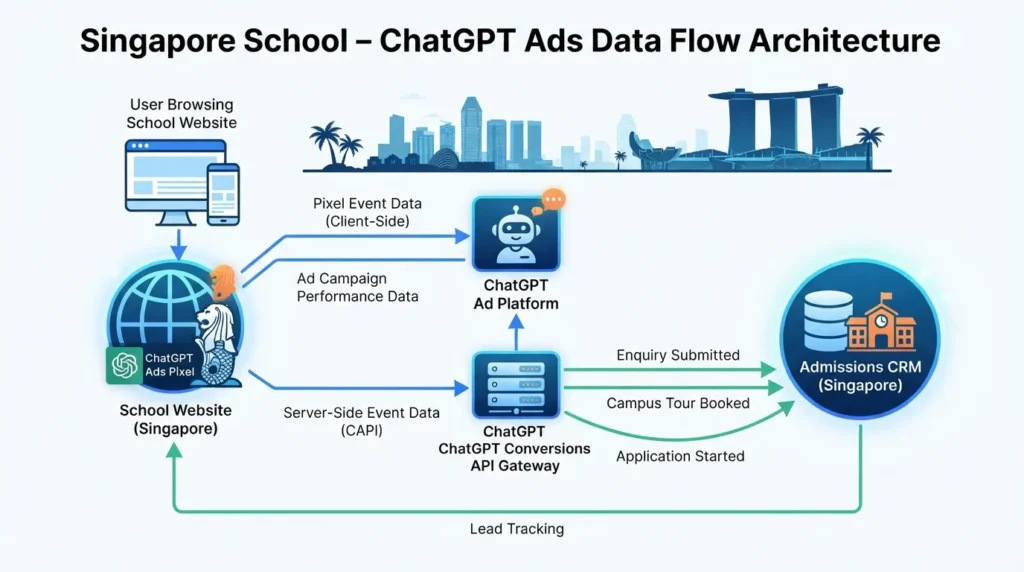
Use both where possible, and set them up in this sequence:
- Install the base pixel on every page of the website, through your tag manager or the website builder’s integration field.
- Test the base pixel with the platform’s event testing tool. Load the homepage, a programme page and the enquiry form, then confirm each shows as a recorded event.
- Connect the Conversions API through your web host, CRM or a middleware tool. Confirm that server and browser events are deduplicated, so one enquiry is not counted twice.
- Pass the event parameters the platform needs to attribute the conversion, such as the click identifier, and hash any personal data before sending it.
- Check the thank-you page. Many schools fire the conversion on the form page, which records clicks rather than completed enquiries. Fire it on the confirmation page instead.
Deduplication works through a shared event ID. Each enquiry gets one unique ID, the pixel sends it with the browser event, and the server sends the same ID with the CAPI event. The platform then counts the two as one conversion. Check that your middleware generates the ID once per submission and passes it to both channels.
Your admissions CRM must accept and store the click identifier from the enquiry form. Without it, you cannot connect a lead that becomes an enrolled student back to the ad that produced it. Ask your CRM vendor whether the identifier can be captured as a hidden form field before you start.
Defining conversion events: enquiries, campus tour bookings and applications
Not every action deserves the same weight. Define a tiered set of conversion events, so the platform optimises toward the outcomes you care about rather than the cheapest form fill.
| Event | Typical signal | Priority for optimisation |
|---|---|---|
| Enquiry submitted | Form completed with name and contact details | Primary, for most providers |
| Campus tour or trial booked | Booking confirmed through a scheduler | Secondary, high intent |
| Application started | Application portal opened with a student record | Tertiary, closer to enrolment |
| Application submitted | Completed application received | Highest value, lower volume |
Start with the enquiry as the primary event. Application volume is low in the early weeks, and a campaign optimised for applications alone often learns too slowly. Add tour bookings and applications as secondary events once you have enough data to read them clearly.
Set a value for each event where you can. For example, you might assign a notional value to a tour booking based on your average conversion rate to enrolment. This lets you compare campaigns by expected revenue rather than raw counts.
Agree on one definition with your admissions team. A qualified enquiry for an IB Diploma programme may differ from one for an expatriate relocation enquiry, so write down the criteria for each scenario before launch.
Choosing a Service Tier: Starter, Growth and Enterprise Compared
Before committing budget, most education marketers ask which plan they actually need. In our experience working with schools and training providers, the answer rarely depends on how much you want to spend. It depends on how many distinct buyer scenarios you serve and how many creative variations each one needs. Count those two numbers first, and the tier choice becomes straightforward.
Comparison table of inclusions across the three plans
Our plan prices are shown as starting figures. They are indicative, exclude GST where applicable, and may change. Features and availability may also change, so check the official plan page for the current position.
| Inclusion | Starter | Growth | Enterprise |
|---|---|---|---|
| Starting price (per month) | From S$850 | From S$1,245 | From S$3,550 |
| OpenAI Ads account setup and verification | Yes | Yes | Yes |
| Pixel and Conversions API setup | Yes | Yes | Yes |
| Buyer scenario sets | Up to 2 | Up to 5 | Unlimited |
| Conversational ad creative | 2 variations | 5 variations | Full creative library |
| Monthly performance reporting | Yes | Yes | Yes |
| Bid strategy optimisation (CPM, oCPC, oCPM) | No | Yes | Yes |
| Event Quality Score monitoring | No | Yes | Yes |
| Dedicated account manager | No | Yes | Yes |
| Cross-channel integration with SEO/GEO and Google/Meta Ads | No | No | Yes |
| AI-powered campaign management (Digimetrics) | No | No | Yes |
| Quarterly strategy sessions | No | No | Yes |
Every plan includes account setup, pixel and Conversions API configuration, and monthly reporting. The real differences sit in scenario coverage, creative volume and the level of hands-on optimisation.
Choosing between an in-house setup and a managed service
Decide first whether to run the account in-house or hand it to an outside team, rather than matching a tier to your budget. The steps below work for either route:
- List every buyer scenario you serve. A scenario is one distinct reason a person would search for you. For a school, that might be an IB Diploma enquiry, an expatriate family relocating, or a Secondary 3 student seeking a specific subject pathway.
- Count the creative variations each scenario needs. Conversational formats respond to message angle, so plan at least two or three variations per scenario.
- Check who will do the work. An in-house setup suits a team that can maintain pixel tests, reporting and creative refreshes each month. A managed setup suits a team that wants those tasks handled and has the budget to pay for them.
- Note the trigger for change. If your scenario count, creative volume or reporting needs outgrow your current setup, revisit the choice.
A single-campus provider with one or two audiences can often run an in-house test. A multi-campus group juggling several admissions streams usually needs more hands on the account. A large education group with many programmes and channels tends to benefit from a managed setup, particularly once its SEO, Google Ads and Meta Ads already work as one admissions system.
Whichever route you take, start small and widen the scope once tracking is reliable. Our view is that a first test with a narrow scenario set is a sensible step for any provider new to the channel. If you are weighing the channel against other paid platforms first, our comparisons of ChatGPT ads vs Google Ads and ChatGPT ads vs LinkedIn ads set out where each channel tends to earn its place.
Decision threshold: when to widen the setup
Widen the setup once two conditions hold for at least one full month. First, your scenario or creative count has reached the limit of your current approach. Second, your enquiry volume is steady enough to support optimisation work. Track cost per qualified enquiry alongside cost per impression. If cost per qualified enquiry is rising while impressions grow, the campaign is reaching people who do not convert, so tighten the scenario set before adding more. If enquiries are still sparse, keep the test narrow and fix tracking first.
Worked example: a hypothetical international school
Consider a hypothetical international school with two buyer scenarios: IB Diploma enquiries and expatriate relocation enquiries. It plans three creative variations for each scenario, so six in total across two scenario sets.
- A narrow setup with two creative variations would be too few for three per scenario, so the school would have to cut its creative testing in half.
- A setup covering five scenario sets and five variations handles two scenarios comfortably if the school spreads variations across them, and leaves room to add a third scenario later without changing the approach.
The school would therefore start on Growth, from S$1,245 per month. Adding a third scenario keeps it within the five-scenario allowance, so no upgrade is needed until the count passes five.
Monthly pricing in S$ and what each tier leaves out
Starter, from S$850 per month, suits a provider testing the channel with a focused scenario set. Growth, from S$1,245 per month, adds bid strategy optimisation, Event Quality Score monitoring and a dedicated account manager. Enterprise, from S$3,550 per month, adds unlimited scenario sets, the full creative library, cross-channel integration and AI-powered campaign management. Each step up excludes nothing from the tier below it, but Starter leaves out hands-on bid tuning and a named account contact, and Growth leaves out cross-channel work and quarterly strategy sessions. Ad spend is not included in any plan price, so budget for media separately.
Summary of when ChatGPT Ads suit education providers
ChatGPT Ads suit an education provider when three conditions hold. The provider has clearly defined buyer scenarios, meaning distinct reasons a family searches, such as an IB Diploma enquiry from a local family or a relocation enquiry from an expatriate household. The admissions team can track which enquiries came from the campaign and what happened to them. The team will judge the channel on qualified enquiries rather than cheap impressions.
When one condition is missing, the channel is harder to justify. A school without enquiry tracking cannot tell whether a campaign worked. A provider with one broad audience may do better with search or social advertising, which offer larger reach and mature reporting. Conversational discovery is a useful addition for education providers, but it is an addition, not a replacement.
The tier choice follows the same logic. A provider with two scenarios and two creative variations per scenario can start on the Starter Plan from S$850 per month. A provider running several scenarios with multiple creative sets will usually need the Growth Plan from S$1,245 per month. The Enterprise Plan from S$3,550 per month suits groups that need unlimited scenario sets, a full creative library and cross-channel integration with their existing Google and Meta Ads work.
Recommended first step for a Singapore school or provider
Start by writing down your buyer scenarios before you speak to a provider or open an account. For each scenario, name the audience, the question they are likely to ask and the enquiry you want them to send. Then count the scenarios and creative variations you need.
This count does two jobs. It shows which plan fits, and it shows whether your admissions CRM can receive and tag the enquiries each scenario produces. If you cannot tag an enquiry by scenario, fix that first, because Pixel and Conversions API setup depends on it.
Before you sign, ask how monthly reporting is produced, who your day-to-day contact will be, and what happens when you add a scenario mid-campaign. Those answers will tell you more about fit than the headline price.
Frequently Asked Questions
What is the minimum monthly budget to start testing ChatGPT Ads in Singapore?
The lowest plan price we publish is the Starter Plan from S$850 per month. Media spend is separate from the management fee, so budget both. Set spend by the number of enquiries you need each month, since a test too small to produce enquiries teaches you little. Confirm with the provider whether prices include GST and whether they have changed.
Do I need a dedicated account manager to run ChatGPT Ads?
Not always. A school running one focused buyer scenario can often manage the account in-house once setup is complete. A dedicated account manager is included from the Growth Plan (from S$1,245 per month), which suits schools running several scenarios and creative sets. Ask any provider how often your account is reviewed and who responds when enquiry volumes drop.
How many buyer scenarios should a school start with?
Start with two. This fits the Starter allowance and lets you compare results cleanly. Add a third only when the first two produce qualified enquiries and you have creative ready for it.
How is conversion tracking set up for ChatGPT Ads?
Tracking has three parts: the Pixel or Conversions API on your enquiry and booking pages, the conversion events defined in the account (enquiries, campus tour bookings and applications), and a feed of those events into your admissions CRM. Without the CRM link you can count clicks but not enrolled students. Confirm that each event fires once per real action, and test with a sample enquiry before launch.
Can ChatGPT Ads be combined with SEO and Google Ads?
Yes, and the channels work better when coordinated. Use the same buyer scenarios across search and conversational placements so parents see consistent messages, and avoid bidding on the same audience twice, which raises cost without adding enquiries. Our Enterprise Plan includes cross-channel integration with SEO, GEO, Google Ads and Meta Ads, which is designed for schools that want one view of admissions performance. For smaller budgets, keep one channel as the lead and use the others to test.
What compliance issues should education advertisers consider in Singapore?
Check three areas before launch: how enquiry data is collected and stored, what claims the ads make about school outcomes, and how children’s information is handled, since many enquiries come from parents on behalf of minors. Keep claims factual, avoid implying guaranteed admission, and make clear what information you collect and why. Review these points with your legal or compliance adviser before the first campaign goes live.